
The Direction Field in Routing MetricConstraint Objects Used

The Direction Field in Routing Metric/Constraint Objects Used in RPL draft-goyal-roll-metrics-direction-00 Mukul Goyal University of Wisconsin Milwaukee
Introduction • Asymmetric links are a common observation in LLNs. • Many link-level routing metrics have a directional aspect. • Not always desirable to calculate a link-level metric in bidirectional manner. For example, – if a DAG is built for low latency communication to the DAG root, the link latency must be measured in Up direction – if a temporary DAG is being constructed to discover a point -to-point route towards a destination, the routing metric must be measured in Down direction. • Useful to specify the directional aspect within the routing metric/constraint.

The Direction Field • This document defines a Direction field inside the Routing Metric/Constraint object header in two previously reserved bits. • The modified Routing Metric/Constraint object header is backward compatible with its definition in [I-D. ietf-roll-routing-metrics].
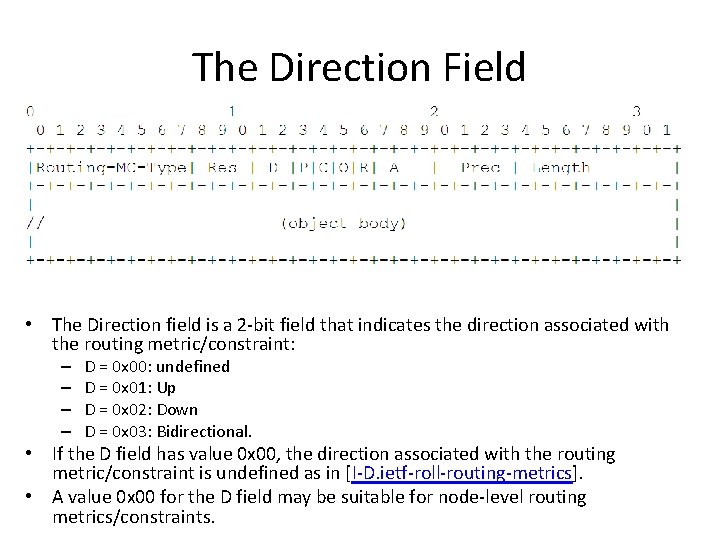
The Direction Field • The Direction field is a 2 -bit field that indicates the direction associated with the routing metric/constraint: – – D = 0 x 00: undefined D = 0 x 01: Up D = 0 x 02: Down D = 0 x 03: Bidirectional. • If the D field has value 0 x 00, the direction associated with the routing metric/constraint is undefined as in [I-D. ietf-roll-routing-metrics]. • A value 0 x 00 for the D field may be suitable for node-level routing metrics/constraints.
Rules associated with D field • A routing metric/constraint object MUST be measured/evaluated in accordance with its D field value if defined. • In case, an RPL node can not measure/evaluate the routing metric/constraint object in the specified direction, the following rules MUST be applied: – If the object is a recorded metric, i. e. , has C=0 and R=1 fields, the RPL node MUST set the P flag inside the object, thereby indicating the partial nature of the recorded metric. – If the object is an aggregated metric, i. e. , has C=0 and R=0 fields, the RPL node MUST drop the DIO containing the object. – If the object is a mandatory constraint, i. e. , has C=1 and O=0 fields, the RPL node MUST drop the DIO containing the object. – If the object is an optional constraint, i. e. , has C=1 and O=1 fields, the RPL node MAY drop the DIO containing the object or it MAY continue processing rest of the DIO ignoring this object.
- Slides: 5