
The DIRC projects of the PANDA experiment at
![Time-of-Propagation particle angle ? ? ? time resolution [e. V] = QE*wavele disc with(out)](https://slidetodoc.com/presentation_image/fc6efe612ed1f5a066e611210382ead0/image-18.jpg "Time-of-Propagation particle angle ? ? ? time resolution [e. V] = QE*wavele disc with(out)")




- Slides: 81
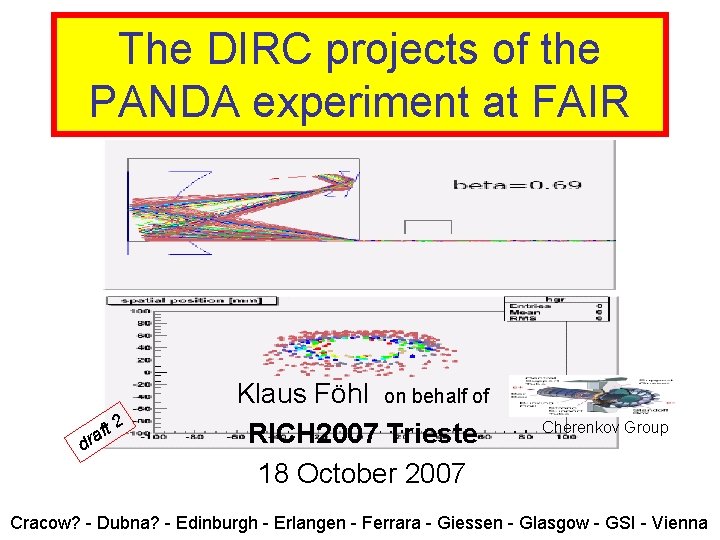
The DIRC projects of the PANDA experiment at FAIR ft a r d 2 Klaus Föhl on behalf of RICH 2007 Trieste 18 October 2007 Cherenkov Group Cracow? - Dubna? - Edinburgh - Erlangen - Ferrara - Giessen - Glasgow - GSI - Vienna
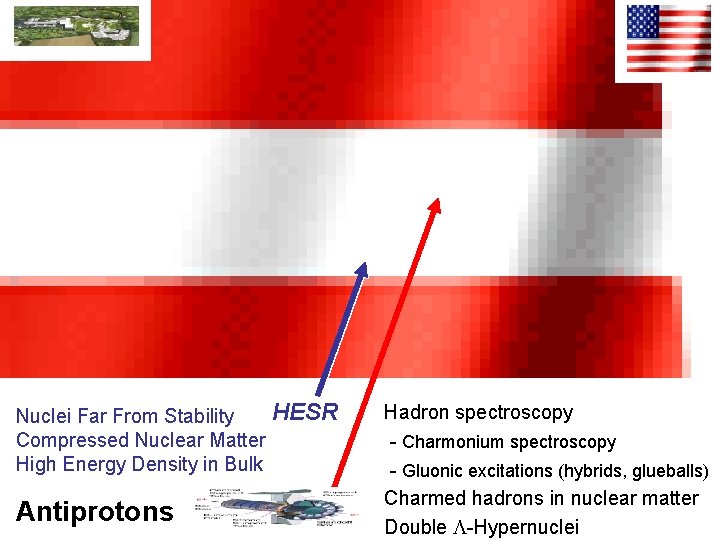
Nuclei Far From Stability Compressed Nuclear Matter High Energy Density in Bulk Antiprotons HESR Hadron spectroscopy - Charmonium spectroscopy - Gluonic excitations (hybrids, glueballs) Charmed hadrons in nuclear matter Double -Hypernuclei
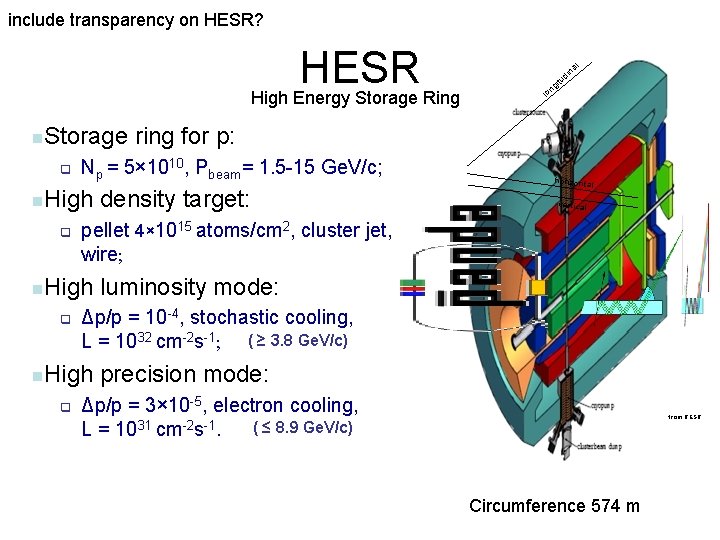
include transparency on HESR? HESR High Energy Storage Ring n. Storage q q density target: horizonta l vertical luminosity mode: Δp/p = 10 -4, stochastic cooling, L = 1032 cm-2 s-1; ( ≥ 3. 8 Ge. V/c) n. High q lo pellet 4× 10¹⁵ atoms/cm 2, cluster jet, wire; n. High q it l na ring for p: Np = 5× 10¹⁰, Pbeam= 1. 5 -15 Ge. V/c; n. High ng i ud precision mode: Δp/p = 3× 10 -5, electron cooling, ( ≤ 8. 9 Ge. V/c) L = 1031 cm-2 s-1. from RESR Circumference 574 m
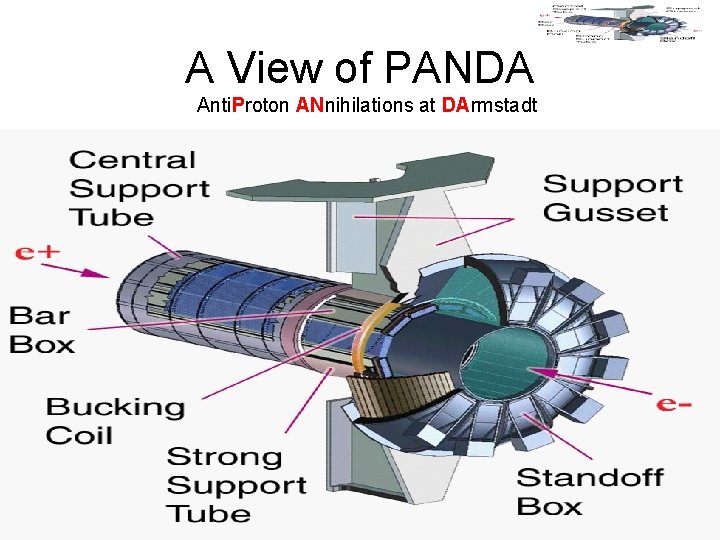
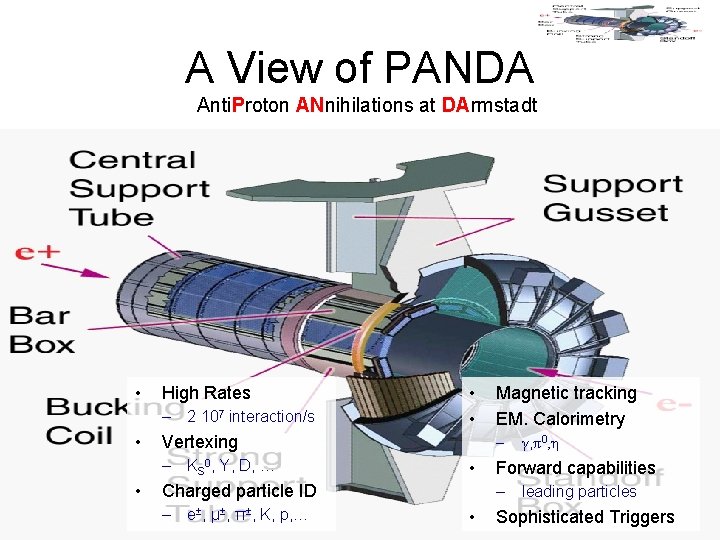
A View of PANDA Anti. Proton ANnihilations at DArmstadt
A View of PANDA Anti. Proton ANnihilations at DArmstadt • High Rates – 2 107 interaction/s • Vertexing – KS 0, Y, D, … • • • – • Charged particle ID – e±, μ±, π±, K, p, … Magnetic tracking EM. Calorimetry γ, π0, η Forward capabilities – leading particles • Sophisticated Triggers
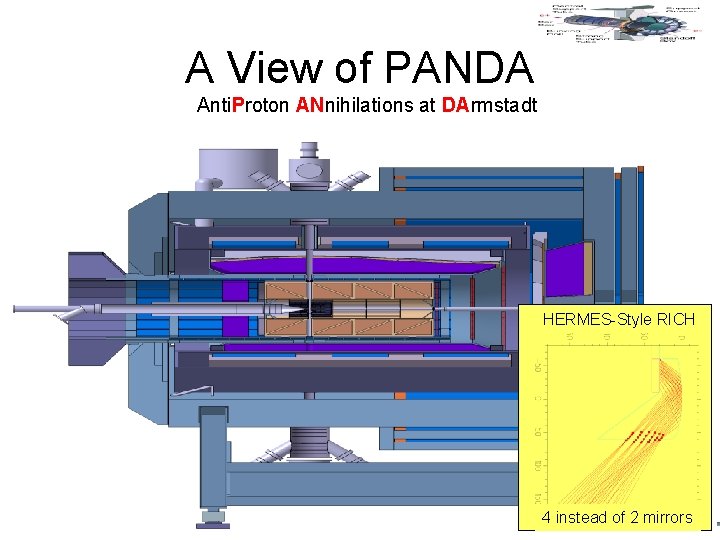
A View of PANDA Anti. Proton ANnihilations at DArmstadt HERMES-Style RICH 4 instead of 2 mirrors
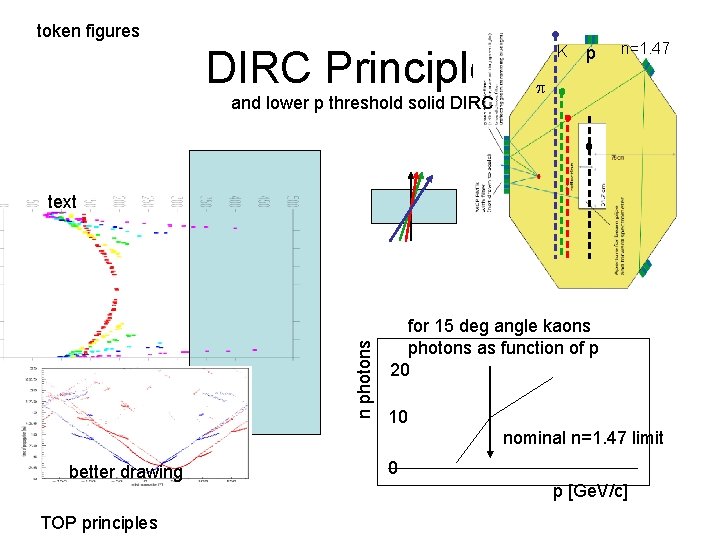
token figures DIRC Principles and lower p threshold solid DIRC K p n=1. 47 n photons text for 15 deg angle kaons photons as function of p 20 10 nominal n=1. 47 limit better drawing TOP principles 0 p [Ge. V/c]
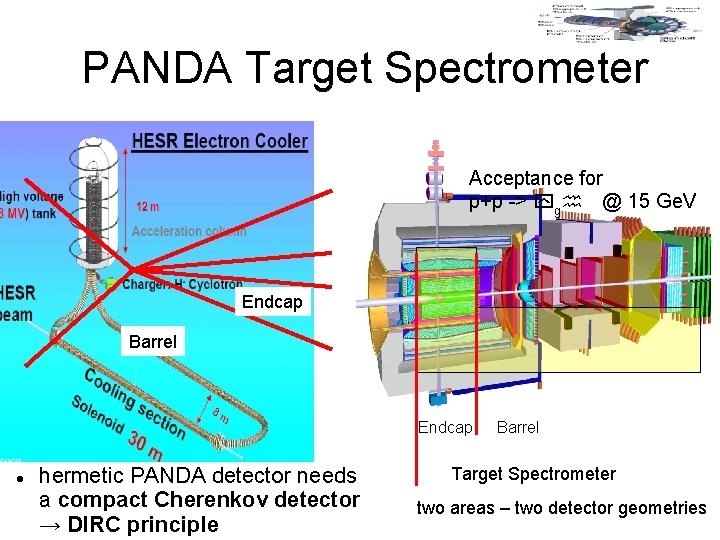
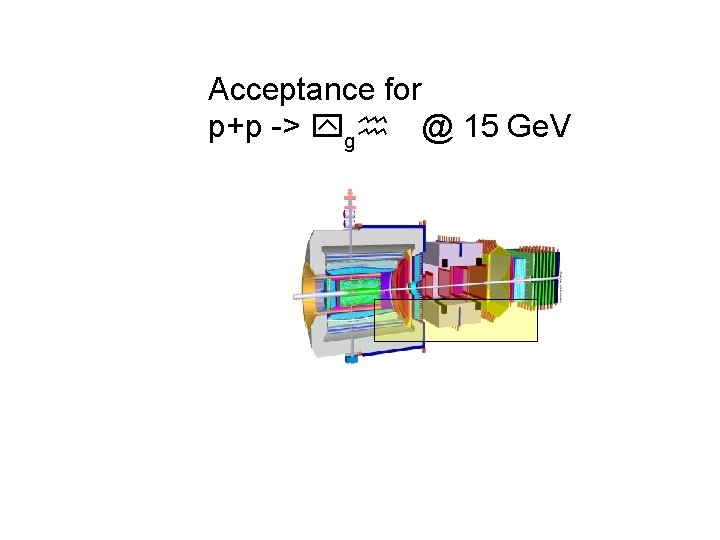
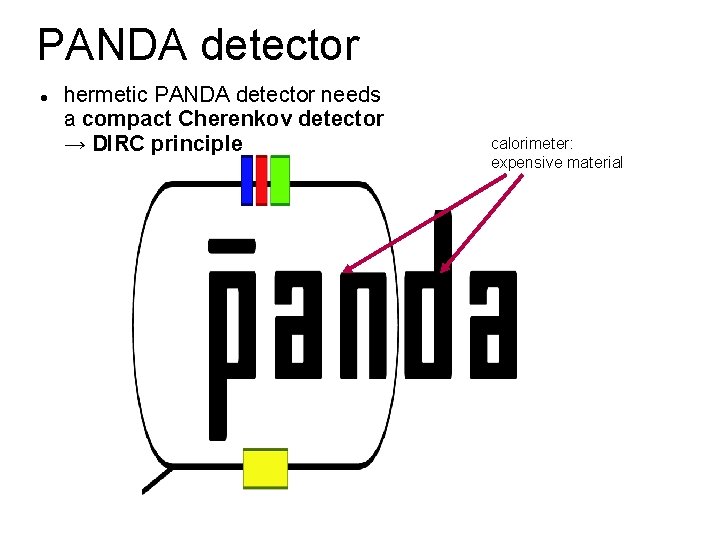
PANDA Target Spectrometer Acceptance for p+p -> ygh @ 15 Ge. V Endcap Barrel Endcap hermetic PANDA detector needs a compact Cherenkov detector → DIRC principle Barrel Target Spectrometer two areas – two detector geometries
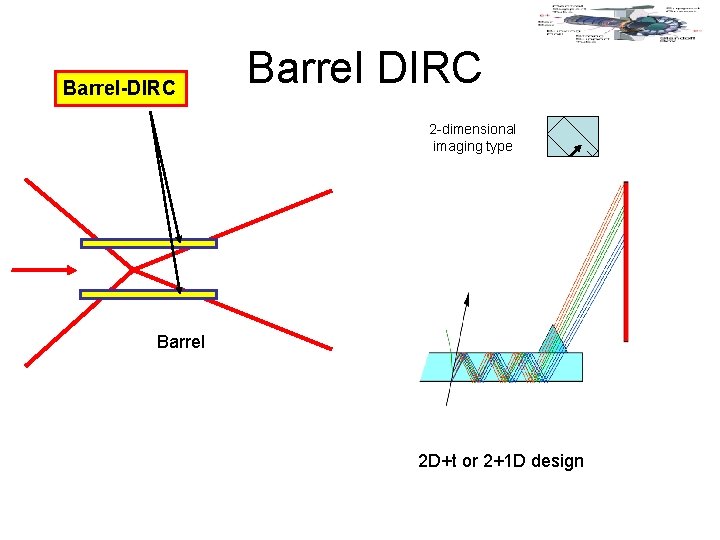
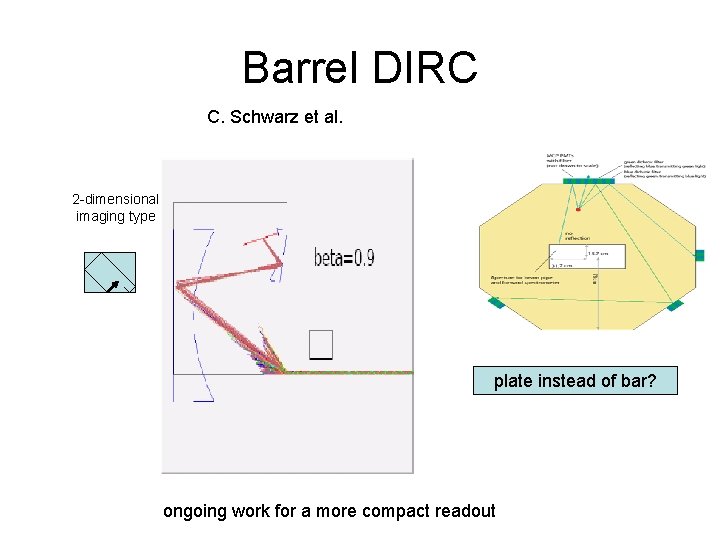
Barrel-DIRC Barrel DIRC 2 -dimensional imaging type Barrel 2 D+t or 2+1 D design
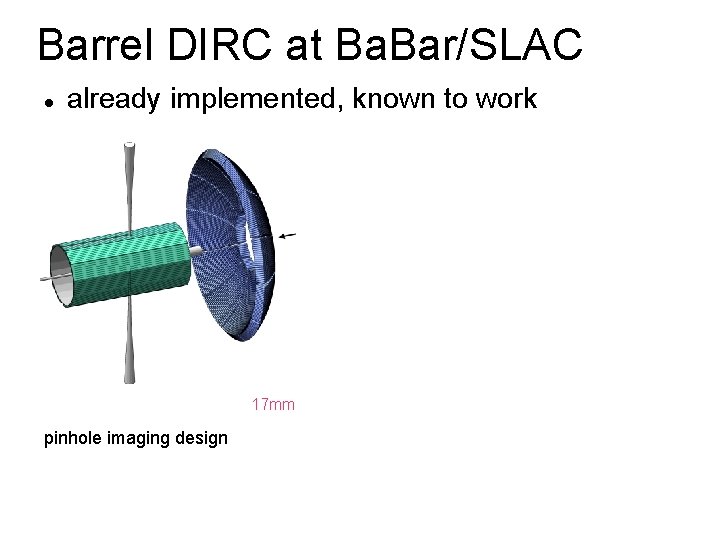
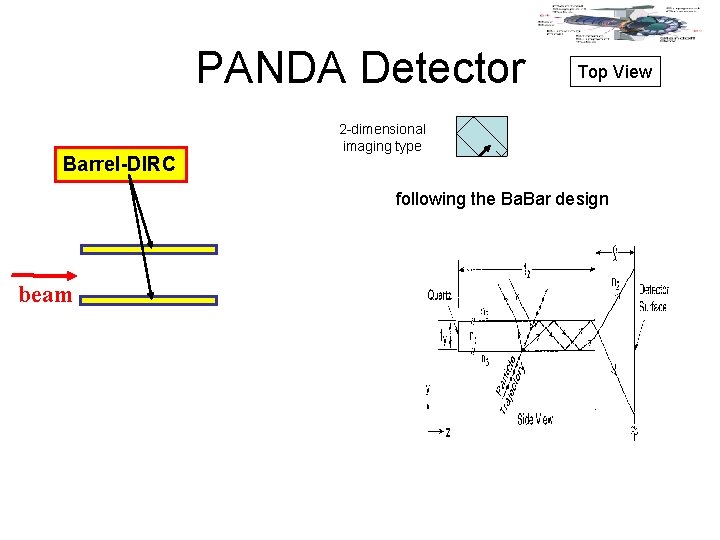
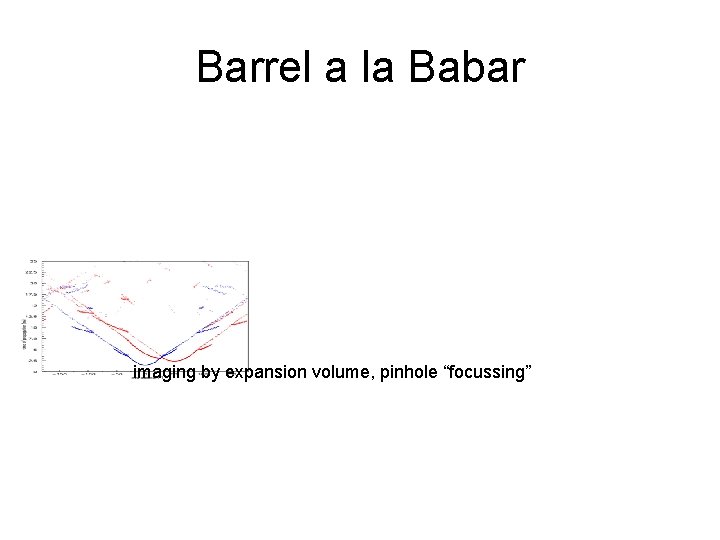
Barrel DIRC at Ba. Bar/SLAC already implemented, known to work 17 mm pinhole imaging design
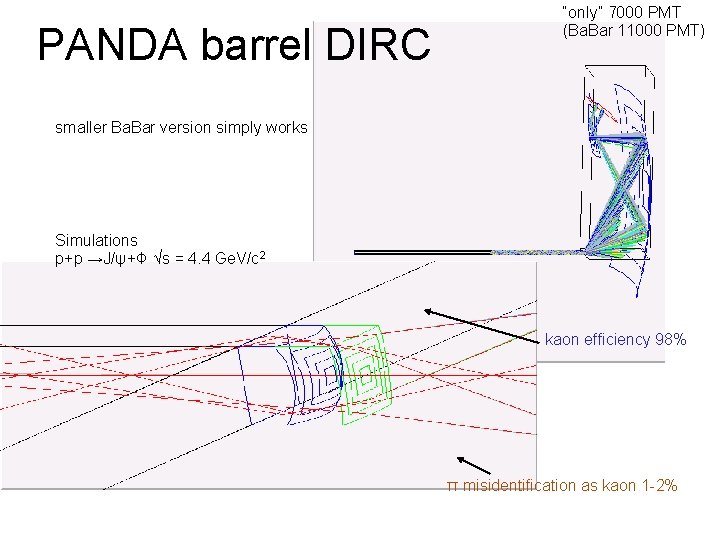
PANDA barrel DIRC “only” 7000 PMT (Ba. Bar 11000 PMT) smaller Ba. Bar version simply works Simulations p+p →J/ψ+Φ √s = 4. 4 Ge. V/c 2 kaon efficiency 98% π misidentification as kaon 1 -2%
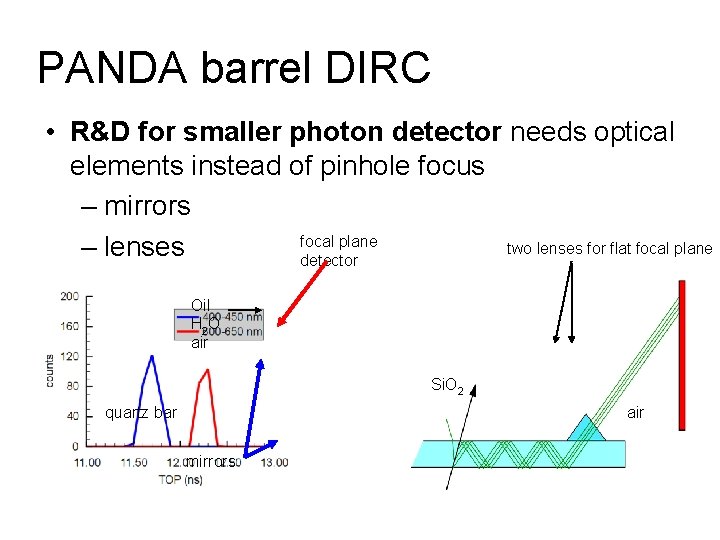
PANDA barrel DIRC • R&D for smaller photon detector needs optical elements instead of pinhole focus – mirrors focal plane two lenses for flat focal plane – lenses detector Oil H 2 O air Si. O 2 quartz bar air mirrors
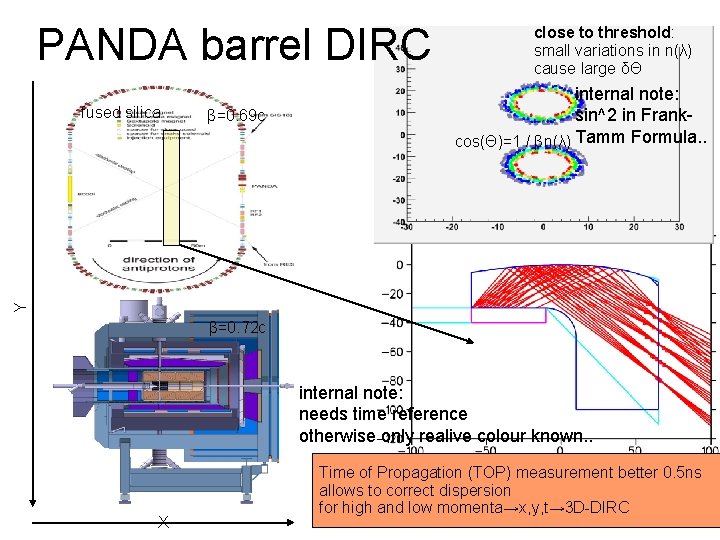
PANDA barrel DIRC β=0. 69 c internal note: sin^2 in Frankcos(Θ)=1 / βn(λ) Tamm Formula. . Y fused silica close to threshold: small variations in n(λ) cause large δΘ β=0. 72 c internal note: needs time reference otherwise only realive colour known. . X Time of Propagation (TOP) measurement better 0. 5 ns allows to correct dispersion for high and low momenta→x, y, t→ 3 D-DIRC
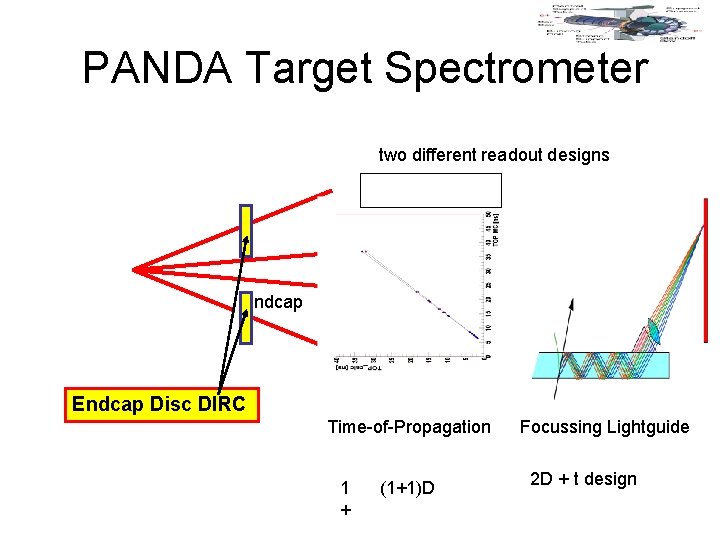
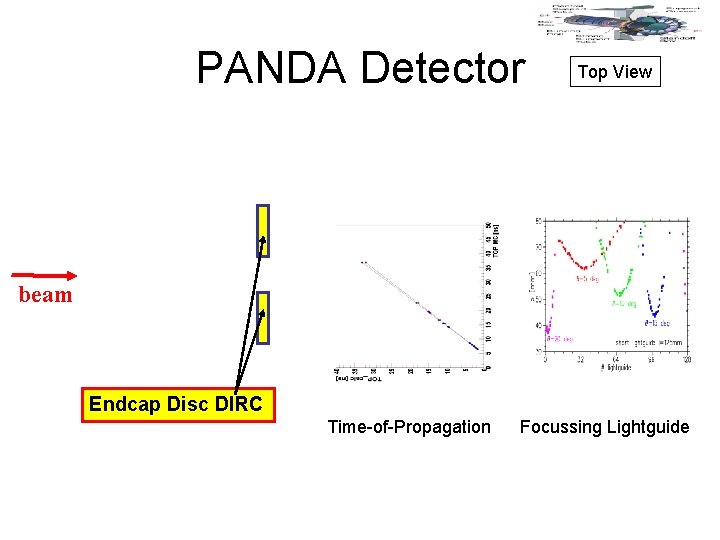
PANDA Target Spectrometer two different readout designs Endcap Disc DIRC Time-of-Propagation 1 + (1+1)D Focussing Lightguide 2 D + t design
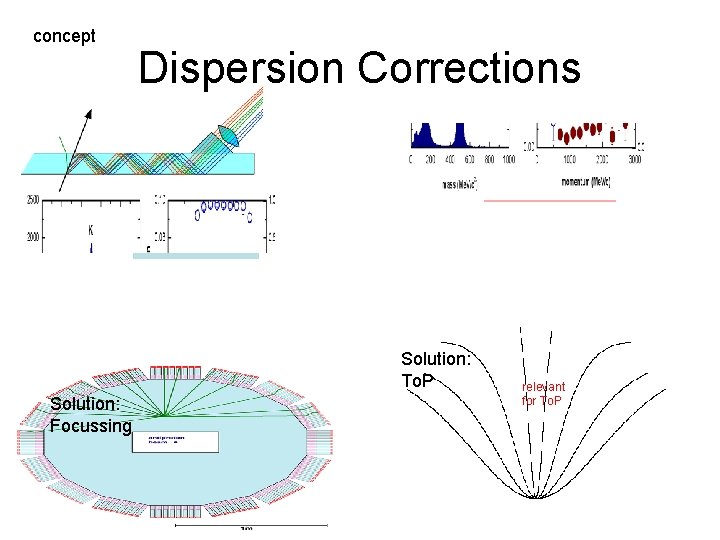
concept Dispersion Corrections Solution: To. P Solution: Focussing relevant for To. P
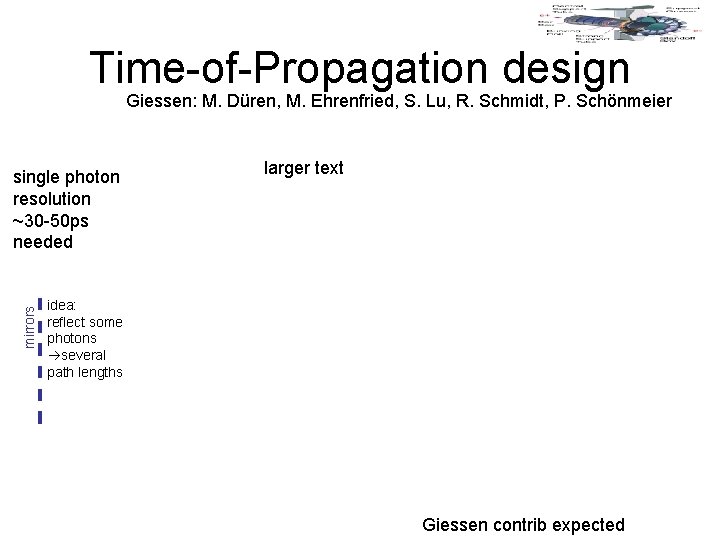
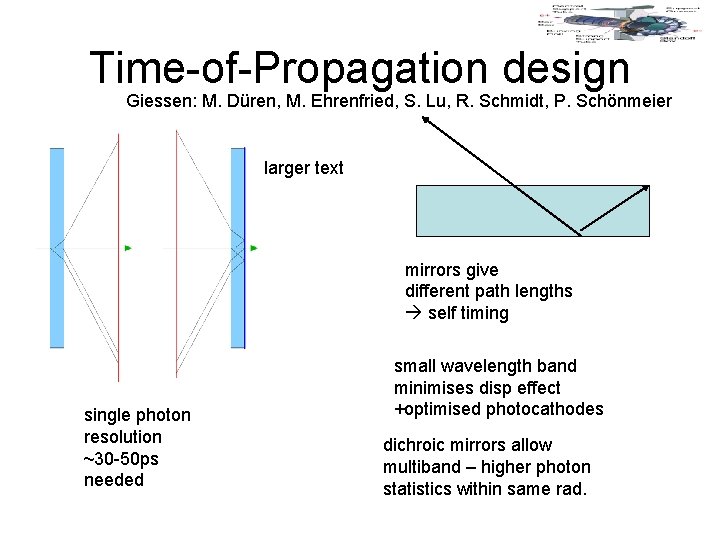
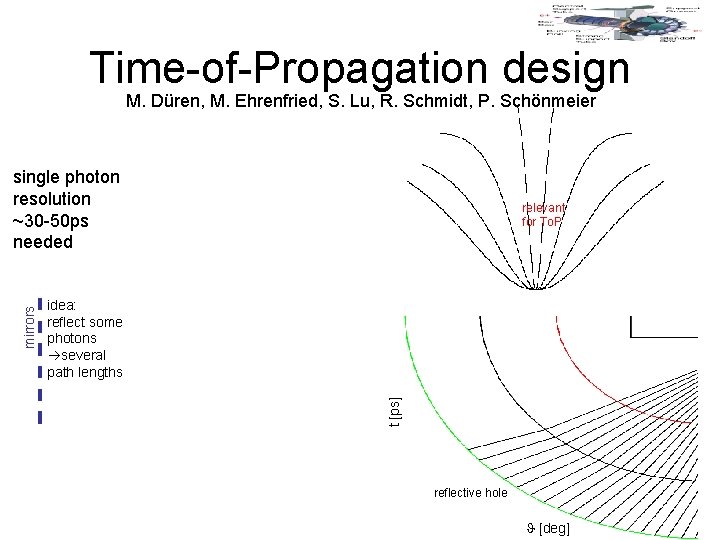
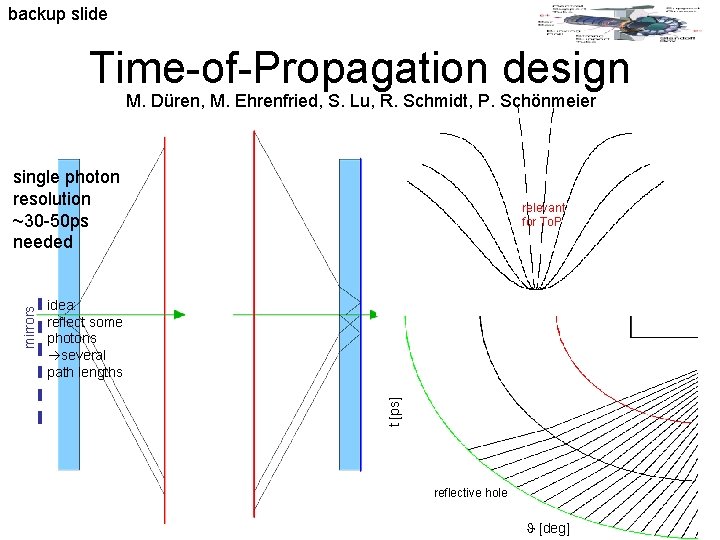
Time-of-Propagation design Giessen: M. Düren, M. Ehrenfried, S. Lu, R. Schmidt, P. Schönmeier mirrors single photon resolution ~30 -50 ps needed larger text idea: reflect some photons several path lengths Giessen contrib expected
Time-of-Propagation design Giessen: M. Düren, M. Ehrenfried, S. Lu, R. Schmidt, P. Schönmeier larger text mirrors give different path lengths self timing single photon resolution ~30 -50 ps needed small wavelength band minimises disp effect +optimised photocathodes dichroic mirrors allow multiband – higher photon statistics within same rad.
Time-of-Propagation particle angle ? ? ? time resolution [e. V] = QE*wavele disc with(out) (blac separation def
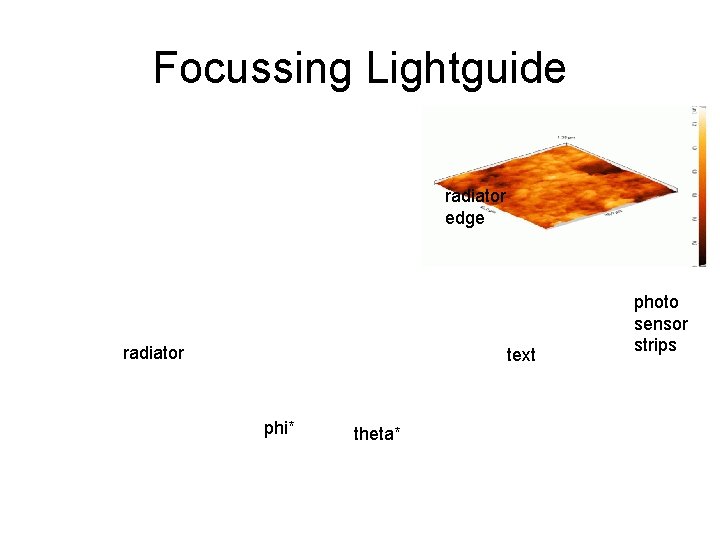
Focussing Lightguide radiator edge radiator text phi* theta* photo sensor strips
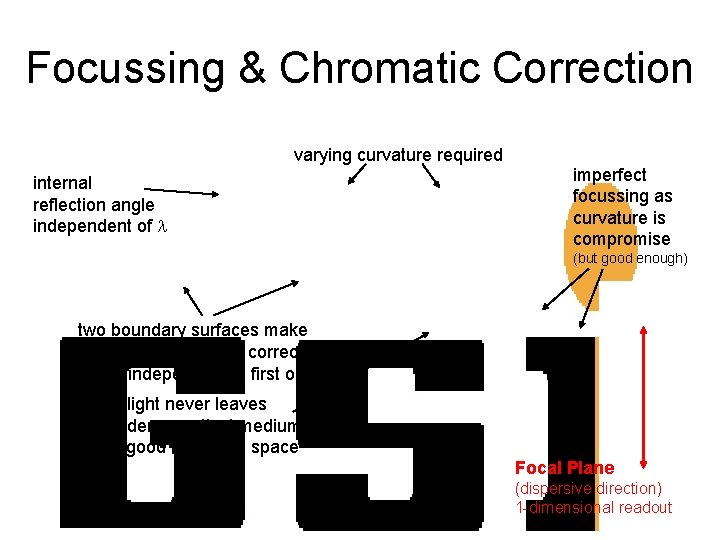
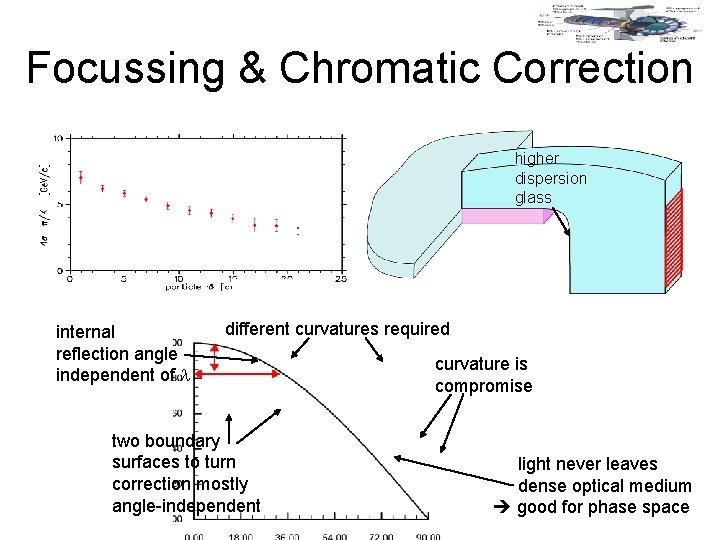
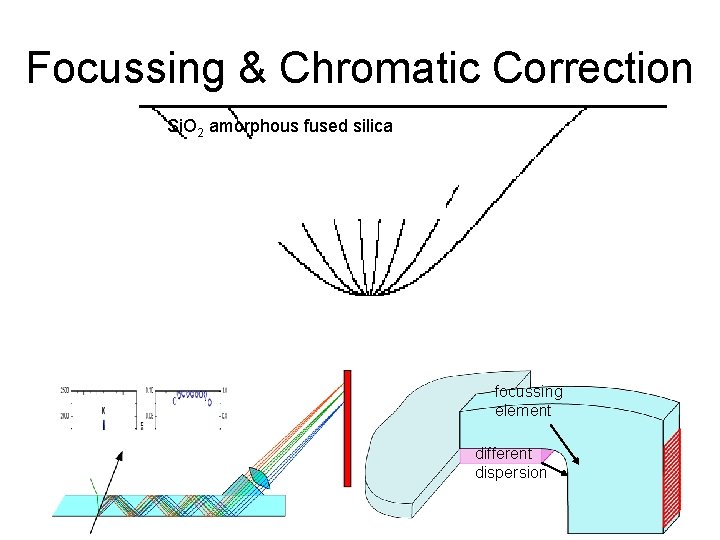
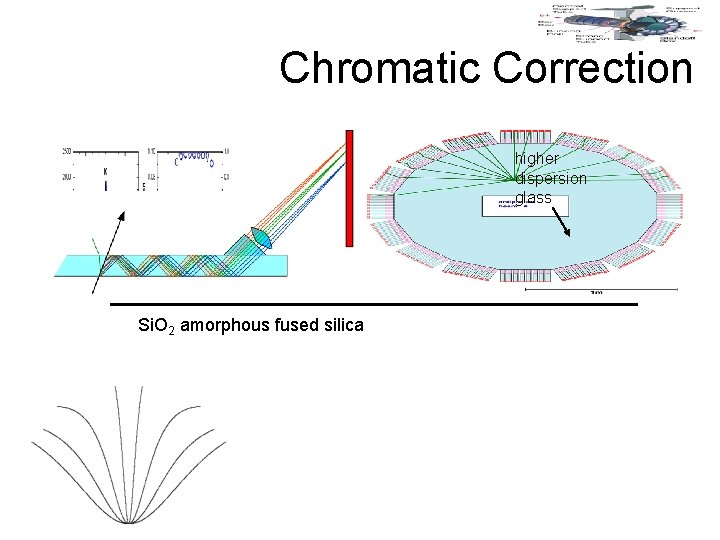
Focussing & Chromatic Correction varying curvature required internal reflection angle independent of imperfect focussing as curvature is compromise (but good enough) two boundary surfaces make chromatic dispersion correction angle-independent in first order light never leaves dense optical medium good for phase space Focal Plane (dispersive direction) 1 -dimensional readout
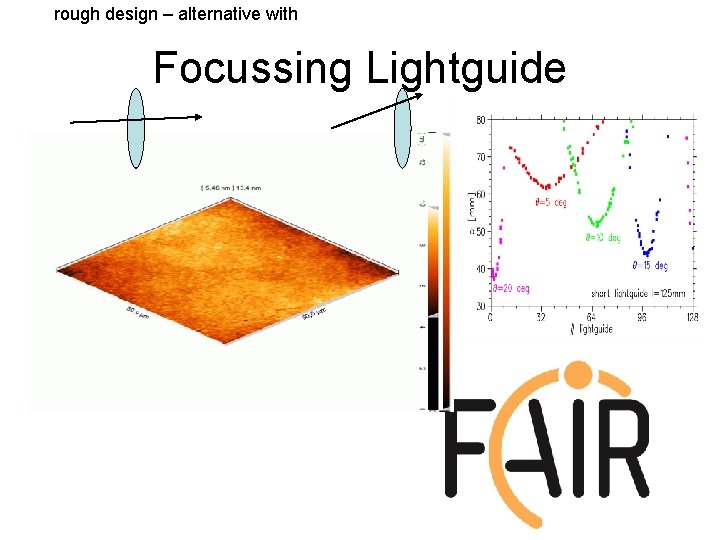
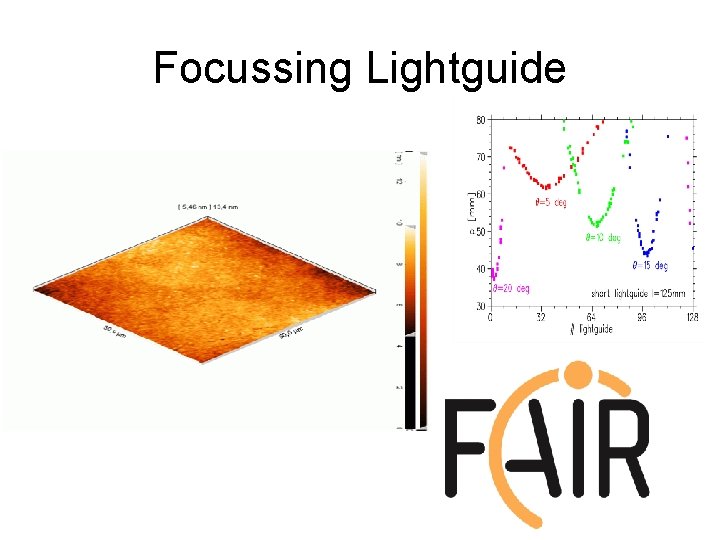
rough design – alternative with Focussing Lightguide simulation example with 2 fit analysis short lightguide 125 mm, focal plane 48 mm p 2 -p 1= 4 x( 1/2 + 2/2)
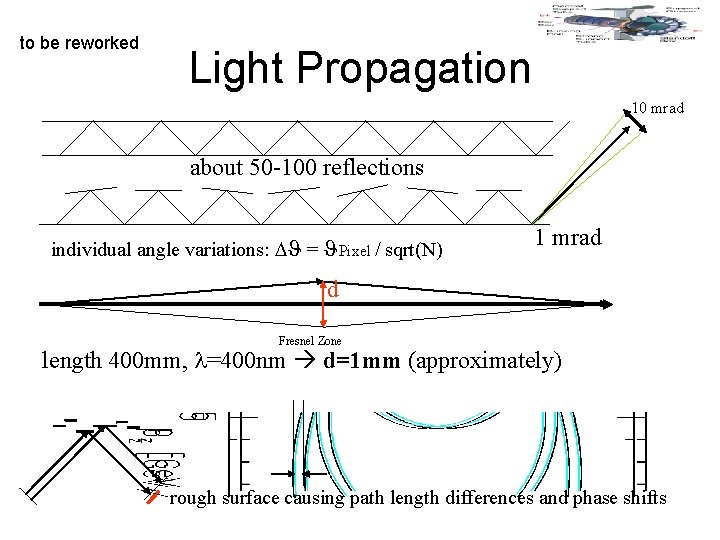
to be reworked Light Propagation 10 mrad about 50 -100 reflections individual angle variations: = Pixel / sqrt(N) 1 mrad d Fresnel Zone length 400 mm, =400 nm d=1 mm (approximately) rough surface causing path length differences and phase shifts
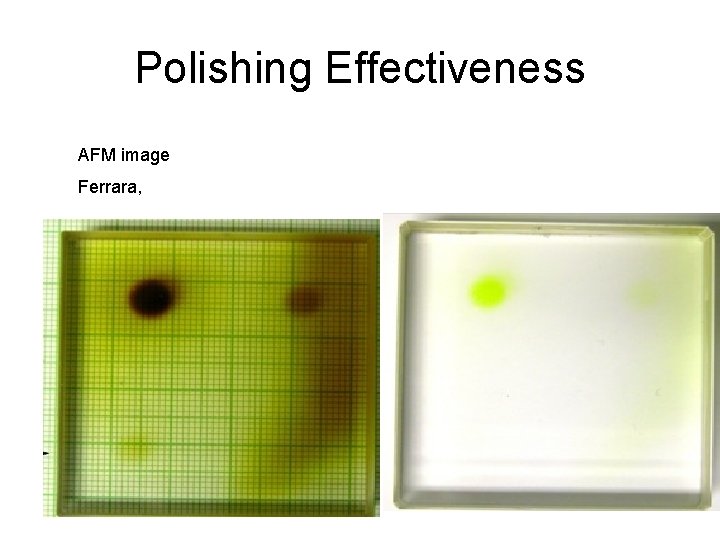
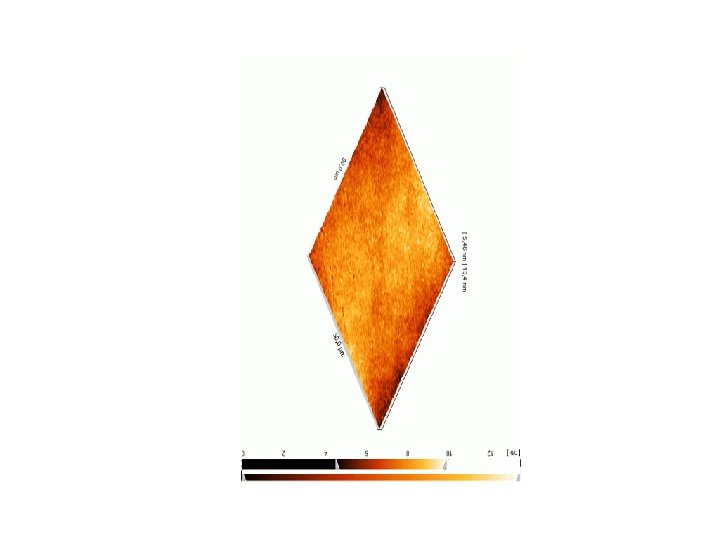
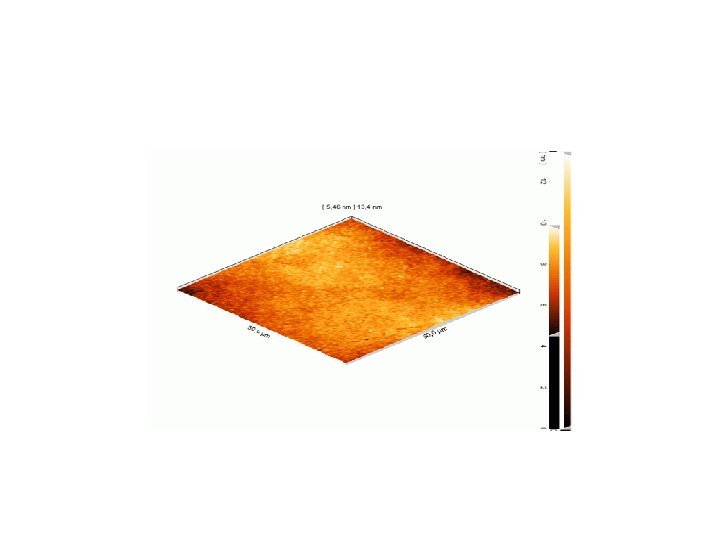
Polishing Effectiveness AFM image Ferrara, surface from GW-Glasgow Testing transmission and total internal reflection of a fused silica sample (G. Schepers and C. Schwarz, GSI)
Radiator Tests AFM image Ferrara, surface from GW-Glasgow Testing transmission and total internal reflection of a fused silica sample (G. Schepers and C. Schwarz, GSI)
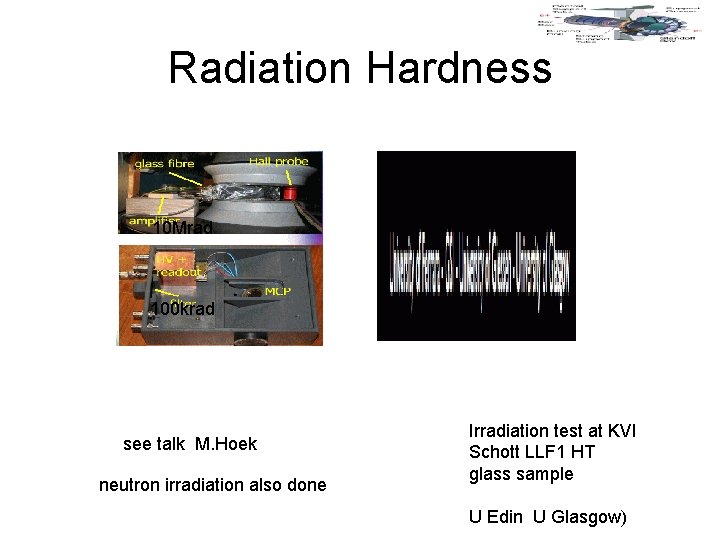
Radiation Hardness 10 Mrad 100 krad see talk M. Hoek neutron irradiation also done Irradiation test at KVI Schott LLF 1 HT glass sample U Edin U Glasgow)
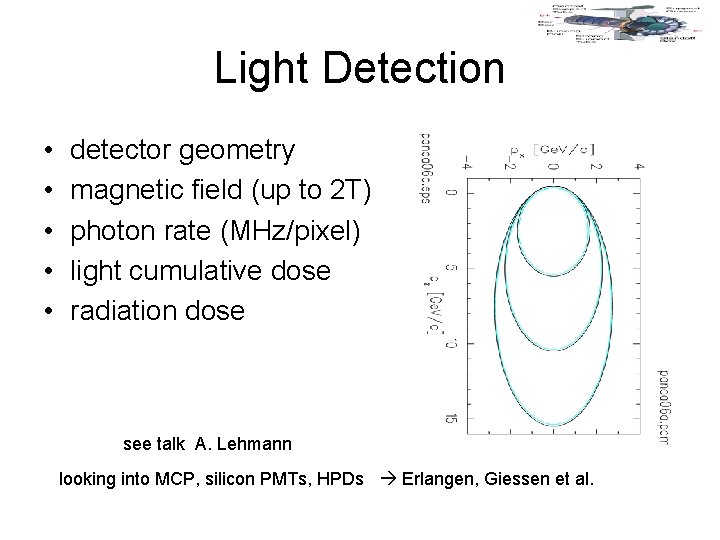
Light Detection • • • detector geometry magnetic field (up to 2 T) photon rate (MHz/pixel) light cumulative dose radiation dose see talk A. Lehmann looking into MCP, silicon PMTs, HPDs Erlangen, Giessen et al.
Summary • Ambitious antiproton physics aims require novel detectors • PANDA needs DIRCs for PID • Several designs with innovative solutions • R&D in progress
Thank you for listening DIRC areas highlighted
alternative slide Thank you for listening
Backup Slides
Panda Participating Institutes more than 300 physicists (48 institutes) from 15 countries U Basel IHEP Beijing U Bochum U Bonn U & INFN Brescia U & INFN Catania U Cracow GSI Darmstadt TU Dresden JINR Dubna (LIT, LPP, VBLHE) U Edinburgh U Erlangen NWU Evanston U & INFN Ferrara U Frankfurt LNF-INFN Frascati U & INFN Genova U Glasgow U Gießen KVI Groningen U Helsinki IKP Jülich I + II U Katowice IMP Lanzhou U Mainz U & Politecnico & INFN Milano U Minsk TU München U Münster BINP Novosibirsk LAL Orsay U Pavia IHEP Protvino PNPI Gatchina U of Silesia U Stockholm KTH Stockholm U & INFN Torino Politechnico di Torino U Oriente, Torino U & INFN Trieste U Tübingen U & TSL Uppsala U Valencia IMEP Vienna SINS Warsaw U Warsaw
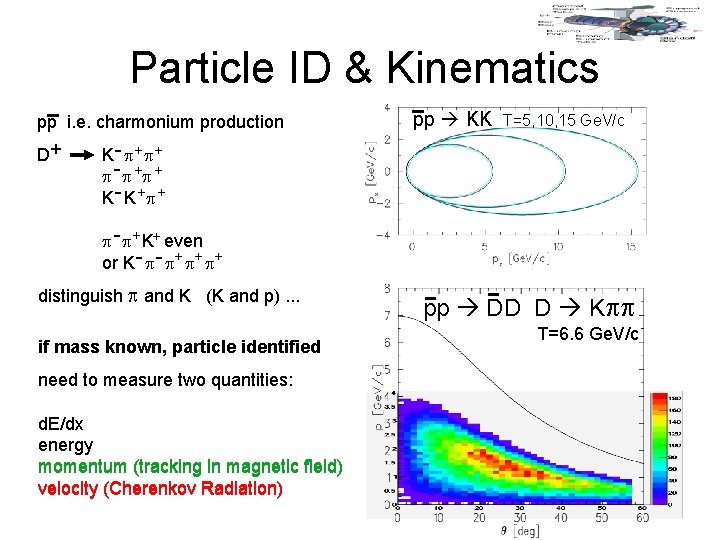
Particle ID & Kinematics pp i. e. charmonium production D+ K - + + - + + K - K + + pp KK T=5, 10, 15 Ge. V/c - + K+ even or K- - + + + distinguish and K (K and p). . . if mass known, particle identified need to measure two quantities: d. E/dx energy momentum (tracking in magnetic field) velocity (Cherenkov Radiation) pp DD D K T=6. 6 Ge. V/c
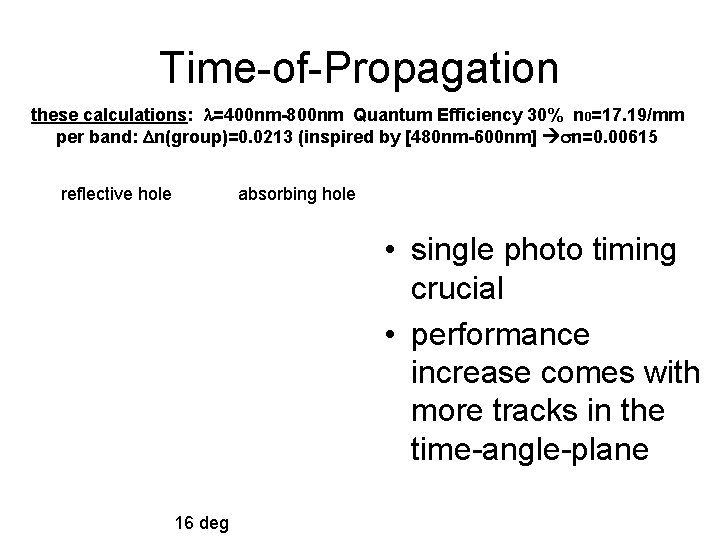
Time-of-Propagation these calculations: =400 nm-800 nm Quantum Efficiency 30% n 0=17. 19/mm per band: n(group)=0. 0213 (inspired by [480 nm-600 nm] n=0. 00615 reflective hole absorbing hole • single photo timing crucial • performance increase comes with more tracks in the time-angle-plane 16 deg
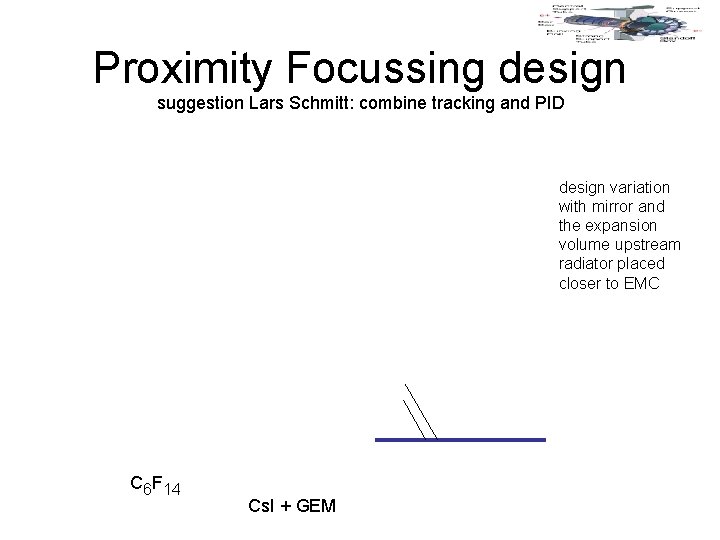
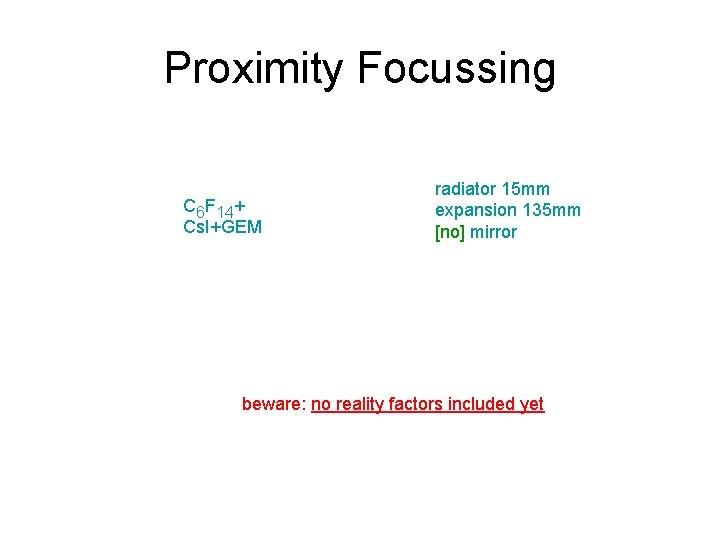
Proximity Focussing design suggestion Lars Schmitt: combine tracking and PID design variation with mirror and the expansion volume upstream radiator placed closer to EMC C 6 F 14 Cs. I + GEM
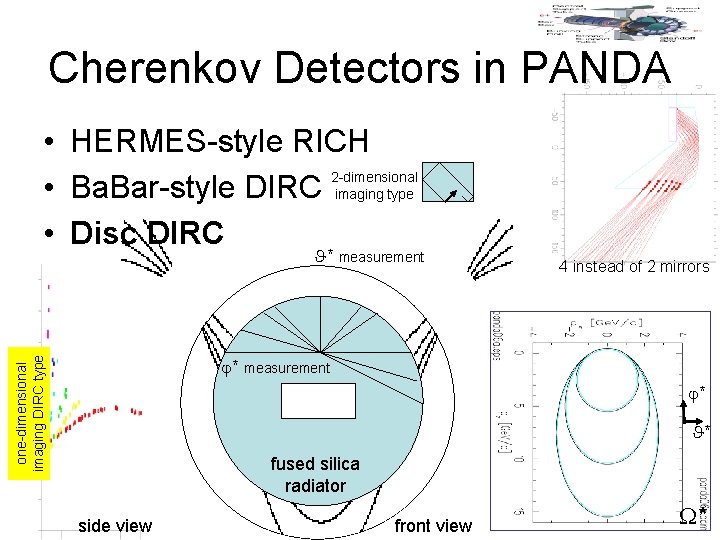
Cherenkov Detectors in PANDA • HERMES-style RICH 2 -dimensional • Ba. Bar-style DIRC imaging type • Disc DIRC * measurement 4 instead of 2 mirrors one-dimensional imaging DIRC type * measurement * * fused silica radiator side view front view *
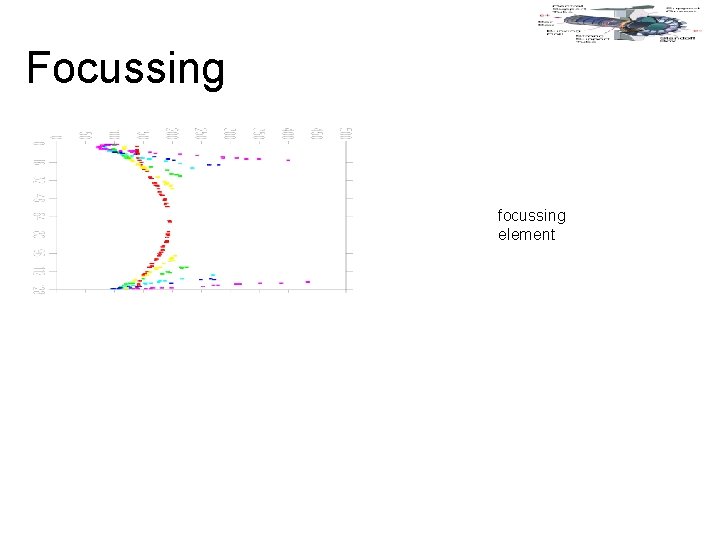
Focussing & Chromatic Correction focussing element
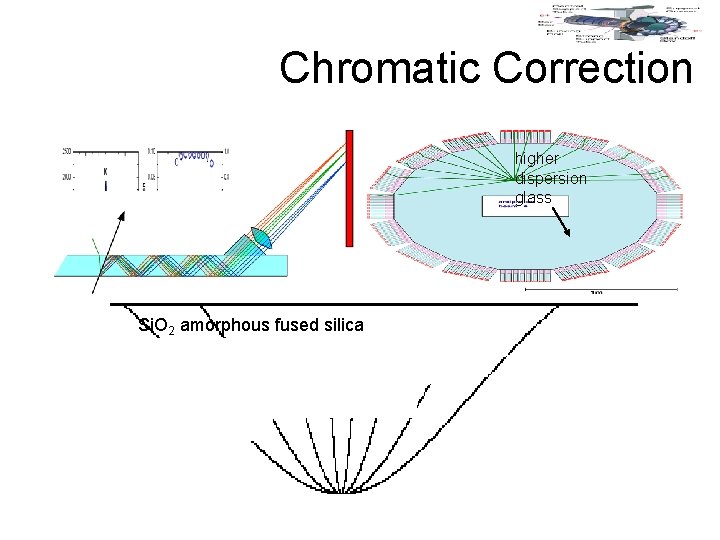
Focussing & Chromatic Correction higher dispersion glass Si. O 2 amorphous fused silica
Focussing & Chromatic Correction higher dispersion glass internal reflection angle independent of different curvatures required two boundary surfaces to turn correction mostly angle-independent curvature is compromise light never leaves dense optical medium good for phase space
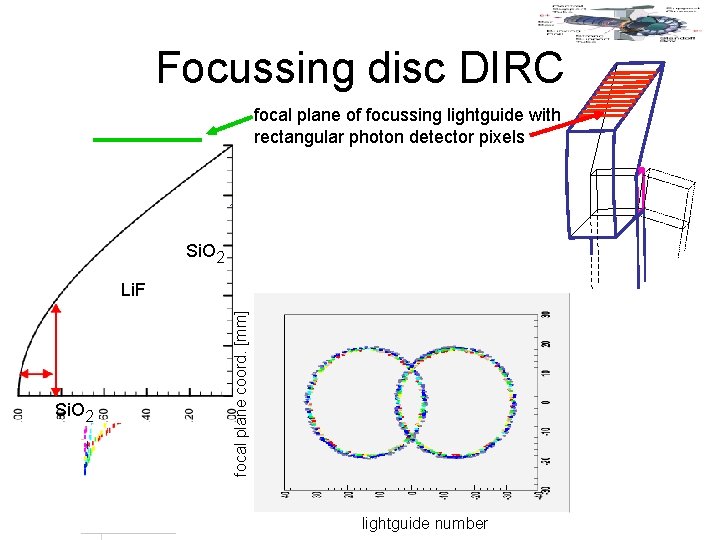
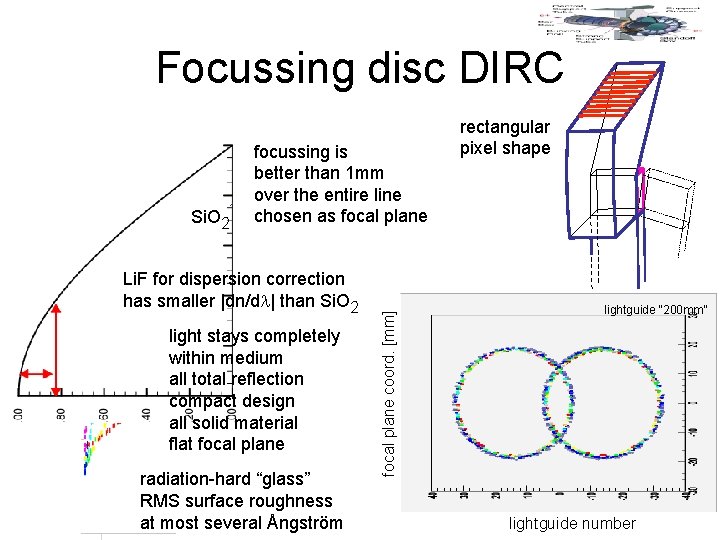
Focussing disc DIRC focal plane of focussing lightguide with rectangular photon detector pixels Si. O 2 focal plane coord. [mm] Li. F lightguide “ 200 mm” lightguide number
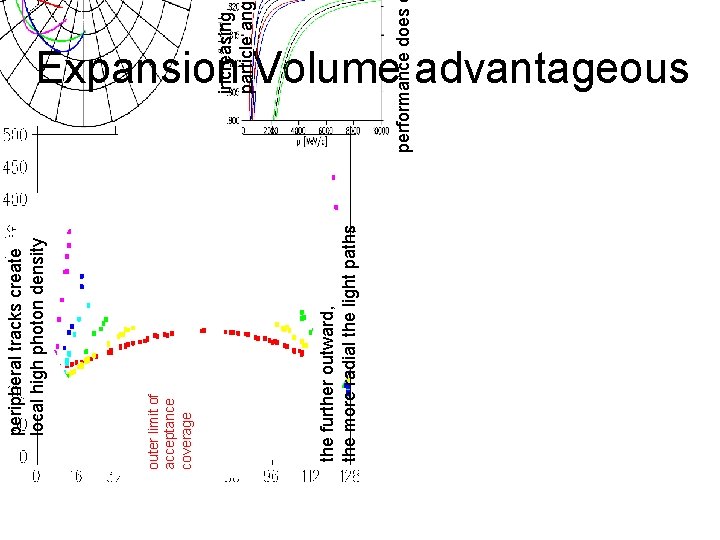
the further outward, the more radial the light paths outer limit of acceptance coverage peripheral tracks create local high photon density performance does increasing particle ang Expansion Volume advantageous
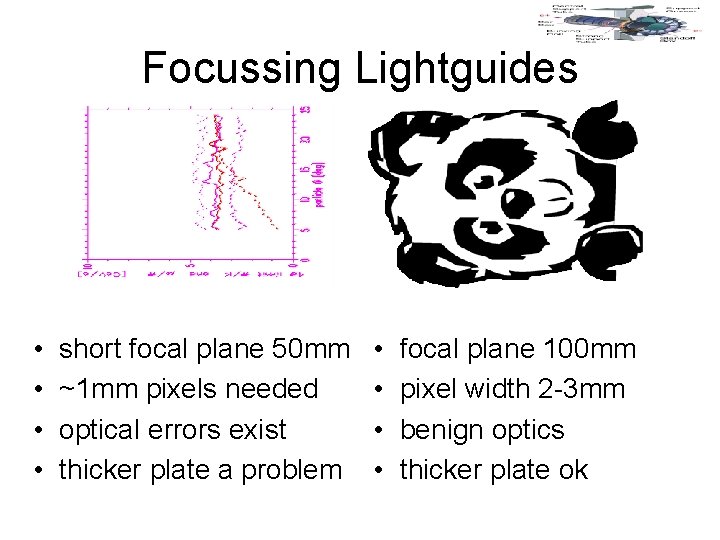
Focussing Lightguides • • short focal plane 50 mm ~1 mm pixels needed optical errors exist thicker plate a problem • • focal plane 100 mm pixel width 2 -3 mm benign optics thicker plate ok
Focussing disc DIRC Li. F for dispersion correction has smaller |dn/d | than Si. O 2 light stays completely within medium all total reflection compact design all solid material flat focal plane radiation-hard “glass” RMS surface roughness at most several Ångström focal plane coord. [mm] Si. O 2 focussing is better than 1 mm over the entire line chosen as focal plane rectangular pixel shape lightguide “ 200 mm” lightguide number
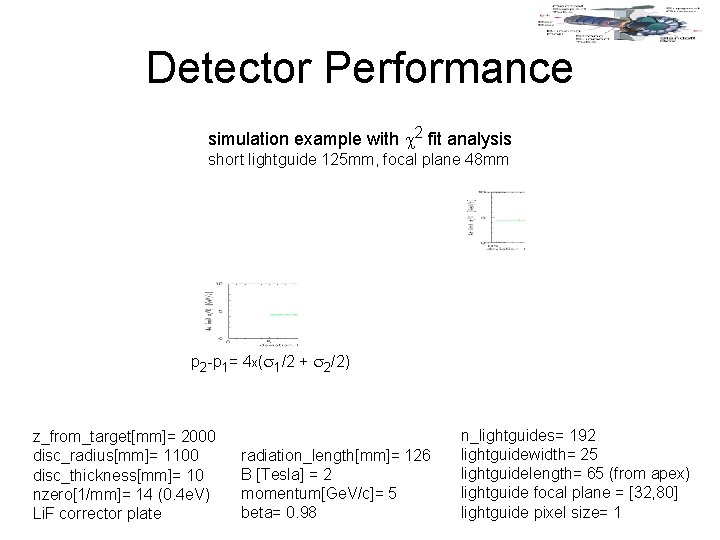
Detector Performance simulation example with 2 fit analysis short lightguide 125 mm, focal plane 48 mm p 2 -p 1= 4 x( 1/2 + 2/2) z_from_target[mm]= 2000 disc_radius[mm]= 1100 disc_thickness[mm]= 10 nzero[1/mm]= 14 (0. 4 e. V) Li. F corrector plate radiation_length[mm]= 126 B [Tesla] = 2 momentum[Ge. V/c]= 5 beta= 0. 98 n_lightguides= 192 lightguidewidth= 25 lightguidelength= 65 (from apex) lightguide focal plane = [32, 80] lightguide pixel size= 1
In brief • fused silica radiator disc, around the rim: – Li. F plates for dispersion correction – internally reflecting focussing lightguides • • • one-dimensional imaging DIRC radiator with very good RMS roughness required perfect edges (as in the Ba. Bar DIRC) not needed number-of-pixels ~ p 4 stringent requirements for photon detectors • two alternative designs, one DIRC, one RICH • two examples of material tests working on Cerenkov detectors for PANDA: Edinburgh, GSI, Erlangen, Gießen, Dubna, Jülich, Vienna, Cracow, Glasgow
Time-of-Propagation design M. Düren, M. Ehrenfried, S. Lu, R. Schmidt, P. Schönmeier relevant for To. P idea: reflect some photons several path lengths t [ps] mirrors single photon resolution ~30 -50 ps needed reflective hole [deg]
no Li. F plate Focussing Lightguides
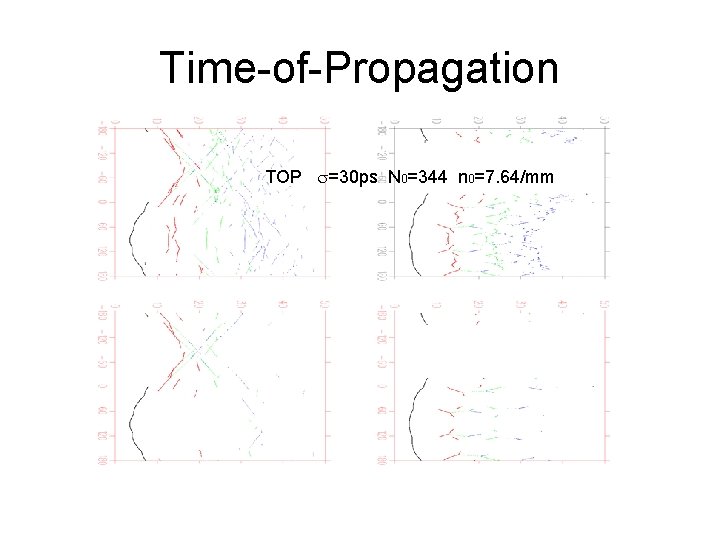
Time-of-Propagation TOP =30 ps N 0=344 n 0=7. 64/mm
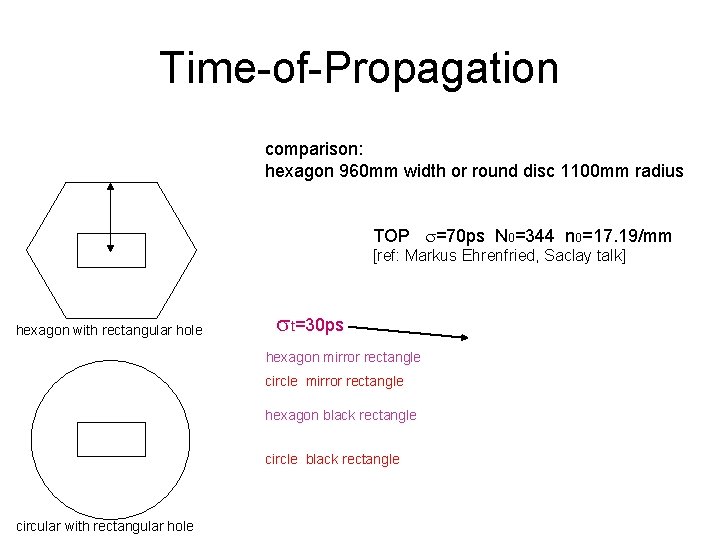
Time-of-Propagation comparison: hexagon 960 mm width or round disc 1100 mm radius TOP =70 ps N 0=344 n 0=17. 19/mm [ref: Markus Ehrenfried, Saclay talk] hexagon with rectangular hole t=30 ps hexagon mirror rectangle circle mirror rectangle hexagon black rectangle circle black rectangle circular with rectangular hole
Proximity Focussing C 6 F 14+ Cs. I+GEM radiator 15 mm expansion 135 mm [no] mirror beware: no reality factors included yet
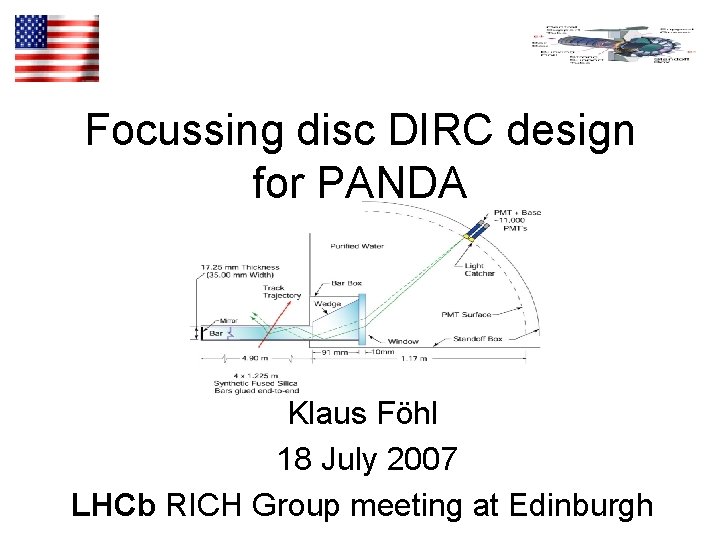
Focussing disc DIRC design for PANDA Klaus Föhl 18 July 2007 LHCb RICH Group meeting at Edinburgh
Core programme of PANDA (1) • Hadron spectroscopy – Charmonium spectroscopy – Gluonic excitations (hybrids, glueballs) • Charmed hadrons in nuclear matter • Double -Hypernuclei
Core programme of PANDA (2)
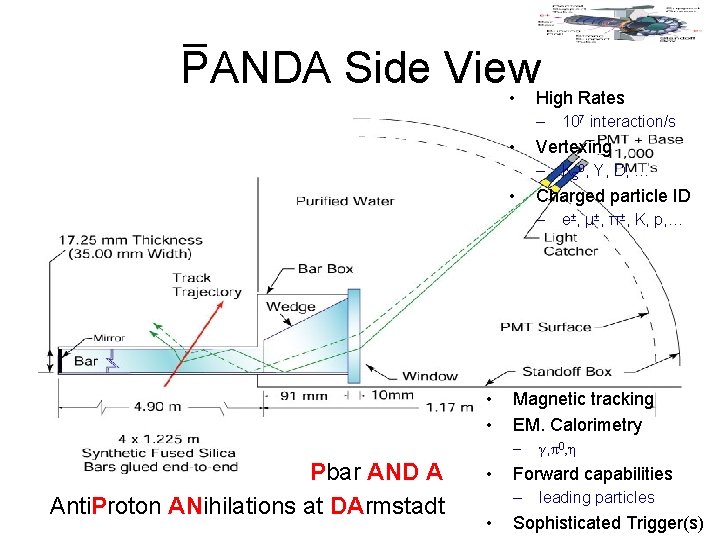
PANDA Side View • High Rates – 107 interaction/s • Vertexing – KS 0, Y, D, … • Charged particle ID – e±, μ±, π±, K, p, … • • Magnetic tracking EM. Calorimetry – Pbar AND A Anti. Proton ANihilations at DArmstadt • γ, π0, η Forward capabilities – leading particles • Sophisticated Trigger(s)
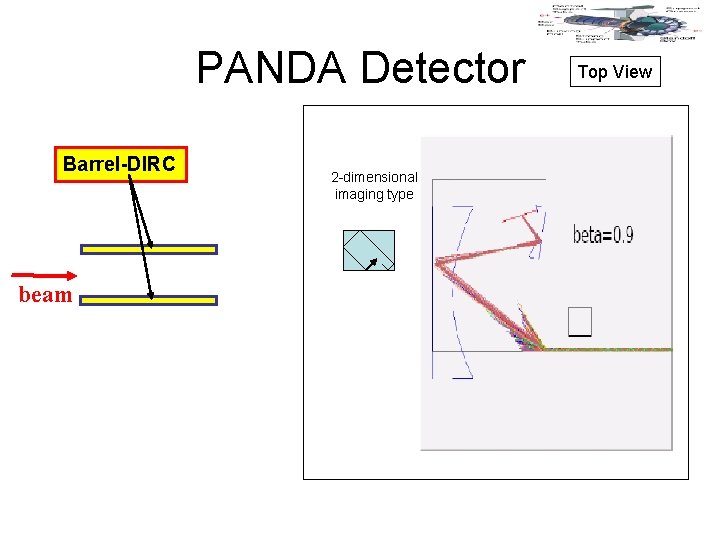
PANDA Detector Barrel-DIRC beam 2 -dimensional imaging type Top View
Gliederung • quick FAIR & PANDA overview • DIRC detectors – Barrel – Disc Focussing – Disc Time-of-Propagation • Challenges • Summary
• Gesellschaft für Schwerionenforschung in Darmstadt, Germany • German National Lab for Heavy Ion Research • Highlights: – Heavy ion physics (i. e. tsuperheavies) – Nuclear physics – Atomic and plasma physics – Cancer research
PANDA Detector beam Top View
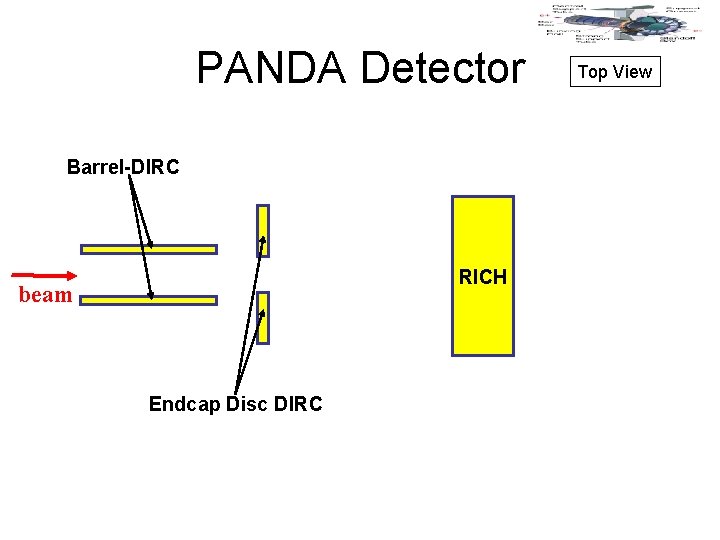
PANDA Detector Barrel-DIRC RICH beam Endcap Disc DIRC Top View
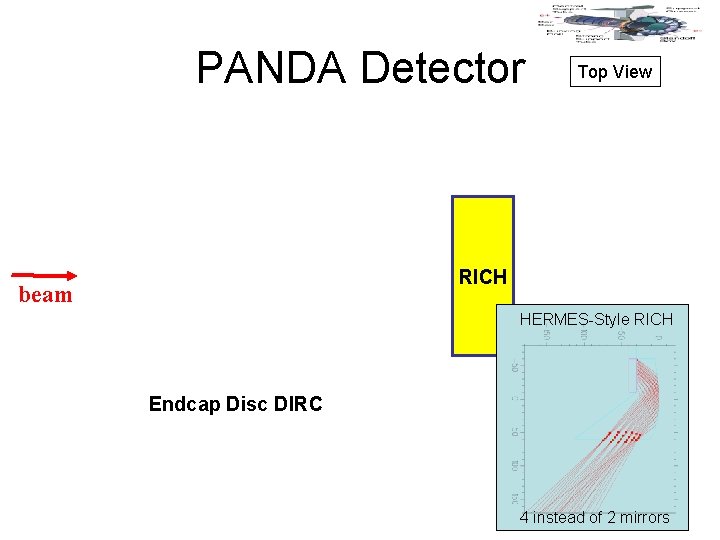
PANDA Detector Top View RICH beam HERMES-Style RICH Endcap Disc DIRC 4 instead of 2 mirrors
Acceptance for p+p -> ygh @ 15 Ge. V
PANDA detector hermetic PANDA detector needs a compact Cherenkov detector → DIRC principle calorimeter: expensive material
Barrel DIRC C. Schwarz et al. 2 -dimensional imaging type plate instead of bar? ongoing work for a more compact readout
PANDA Detector Barrel-DIRC Top View 2 -dimensional imaging type following the Ba. Bar design beam
Barrel a la Babar imaging by expansion volume, pinhole “focussing”
PANDA Detector Top View beam Endcap Disc DIRC Time-of-Propagation Focussing Lightguide
backup slide Time-of-Propagation design M. Düren, M. Ehrenfried, S. Lu, R. Schmidt, P. Schönmeier relevant for To. P idea: reflect some photons several path lengths t [ps] mirrors single photon resolution ~30 -50 ps needed reflective hole [deg]
Focussing & Chromatic Correction Si. O 2 amorphous fused silica focussing element different dispersion
backup slide
Focussing & Chromatic Correction higher dispersion glass Si. O 2 amorphous fused silica
Analysis without external timing
Focussing Lightguide simulation example with 2 fit analysis short lightguide 125 mm, focal plane 48 mm p 2 -p 1= 4 x( 1/2 + 2/2)
backup slide simulation example with 2 fit analysis short lightguide 125 mm, focal plane 48 mm p 2 -p 1= 4 x( 1/2 + 2/2) z_from_target[mm]= 2000 disc_radius[mm]= 1100 disc_thickness[mm]= 10 nzero[1/mm]= 14 (0. 4 e. V) Li. F corrector plate radiation_length[mm]= 126 B [Tesla] = 2 momentum[Ge. V/c]= 5 beta= 0. 98 n_lightguides= 192 lightguidewidth= 25 lightguidelength= 65 (from apex) lightguide focal plane = [32, 80] lightguide pixel size[mm]= 1
Challenges and Compromises • • Radiator bulk and surface properties Radiator thickness Straggling Radiation hardness
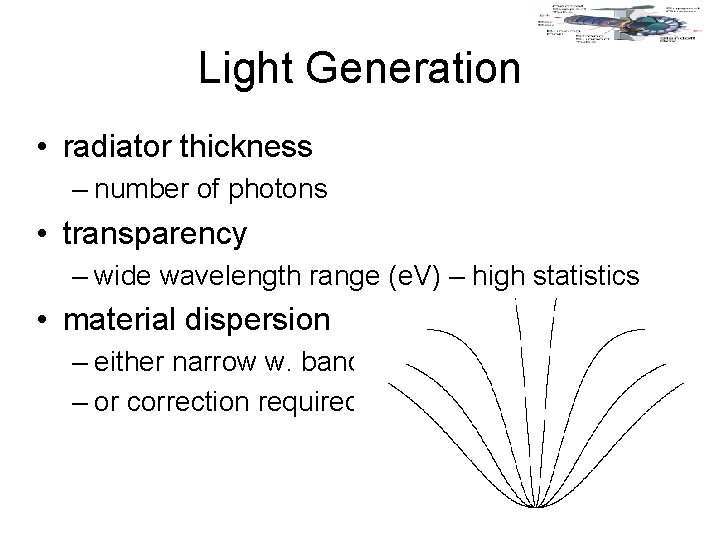
Light Generation • radiator thickness – number of photons • transparency – wide wavelength range (e. V) – high statistics • material dispersion – either narrow w. band – or correction required
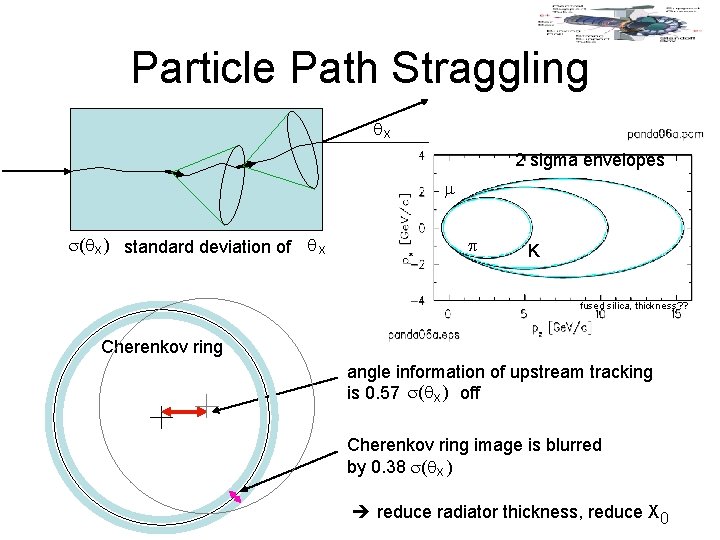
Particle Path Straggling x 2 sigma envelopes ( x ) standard deviation of x K fused silica, thickness? ? Cherenkov ring angle information of upstream tracking is 0. 57 ( x ) off Cherenkov ring image is blurred by 0. 38 ( x ) reduce radiator thickness, reduce X 0
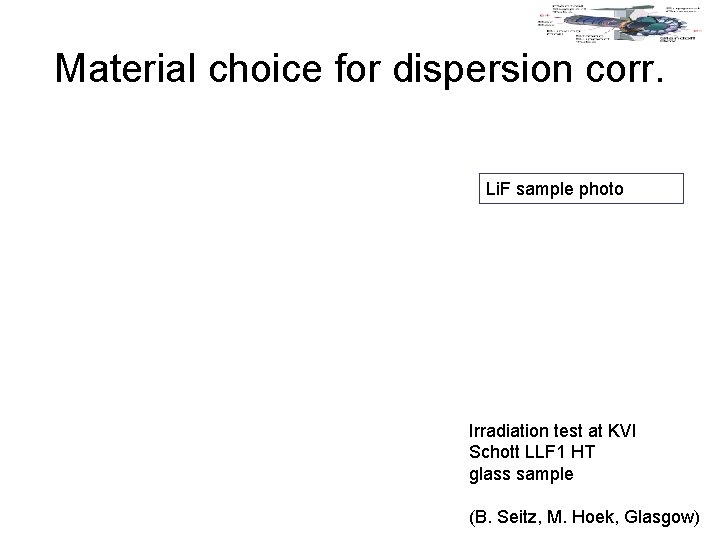
Material choice for dispersion corr. Li. F sample photo Irradiation test at KVI Schott LLF 1 HT glass sample (B. Seitz, M. Hoek, Glasgow)
Advantages • wide dynamic range (0. 6 Ge. V/c-~6 Ge. V/c)
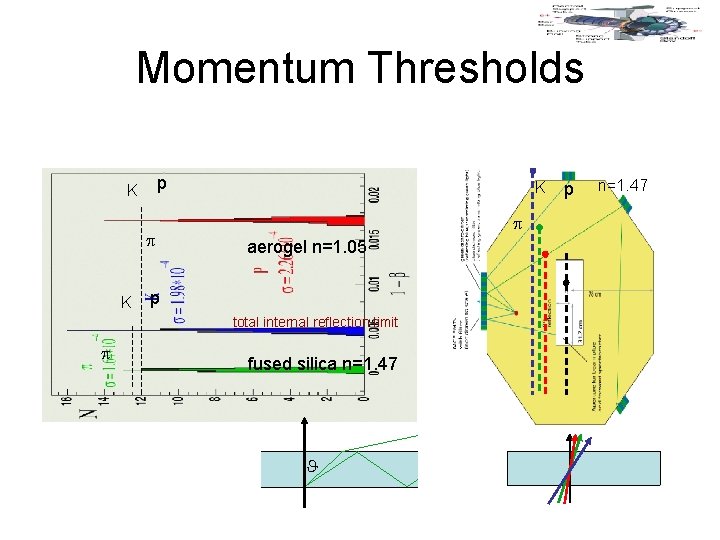
Momentum Thresholds p K K K aerogel n=1. 05 p total internal reflection limit fused silica n=1. 47 p n=1. 47
Thank you for listening