
The DIR Foundation for the Future Strengthening Developmental
- Slides: 66
The DIR® Foundation for the Future Strengthening Developmental Capacities Integrating Individual Difference Using Relationships To Promote Healthy Social Emotional Development and Learning Serena Wieder Ph. D Copyright 1
Presented by Serena Wieder, Ph. D. Founder of ICDL with Dr. Stanley Greenspan Director, DIR® Institute www. icdl. com www. Floortime. org swieder@icdl. com Authors of Engaging Autism Child with Special Needs Serena Wieder Ph. D Copyright 2
The DIR®/Floortime™ Model for healthy emotional-social and intellectual development Serena Wieder Ph. D Copyright 3
DIR® Provides a Developmental Roadmap for understanding and integrating all aspects of development. Serena Wieder Ph. D Copyright 4
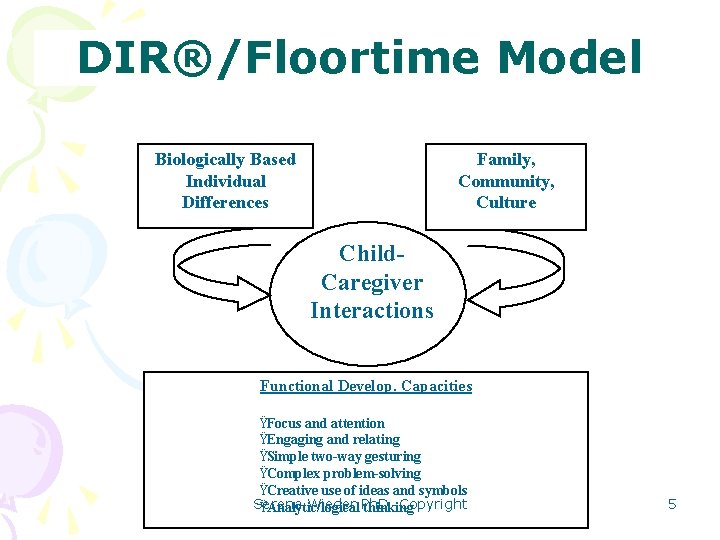
DIR®/Floortime Model Biologically Based Individual Differences Family, Community, Culture Child. Caregiver Interactions Functional Develop. Capacities ŸFocus and attention ŸEngaging and relating ŸSimple two-way gesturing ŸComplex problem-solving ŸCreative use of ideas and symbols Serena Wieder Ph. D Copyright ŸAnalytic/logical thinking 5
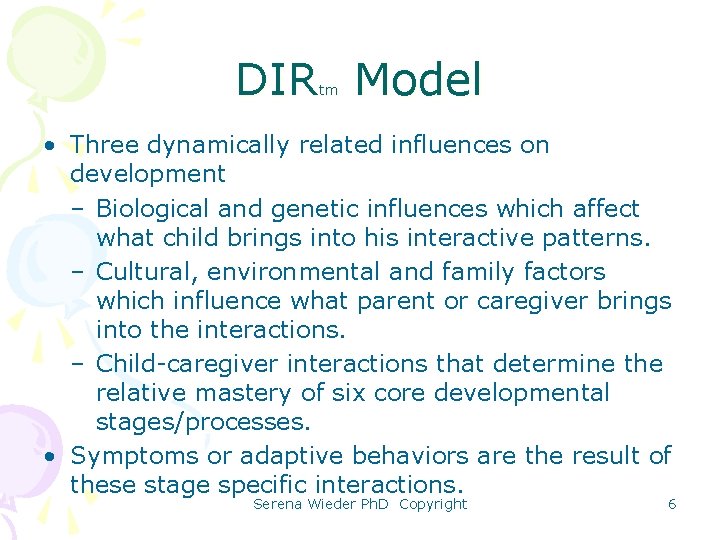
DIR Model tm • Three dynamically related influences on development – Biological and genetic influences which affect what child brings into his interactive patterns. – Cultural, environmental and family factors which influence what parent or caregiver brings into the interactions. – Child-caregiver interactions that determine the relative mastery of six core developmental stages/processes. • Symptoms or adaptive behaviors are the result of these stage specific interactions. Serena Wieder Ph. D Copyright 6
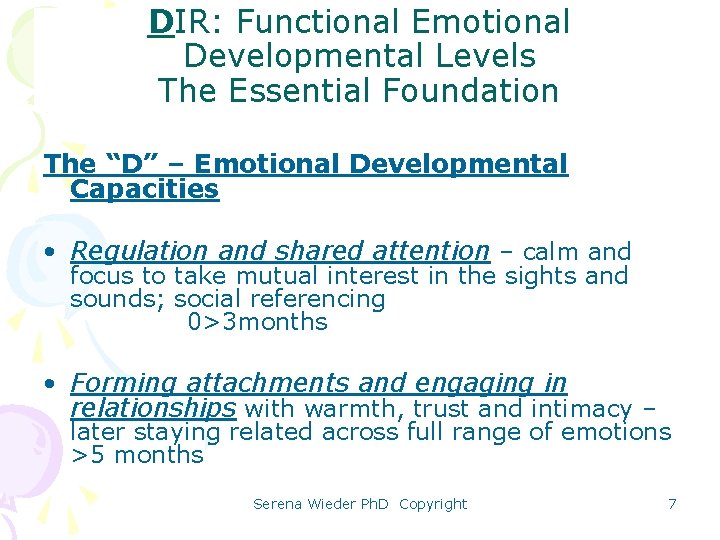
DIR: Functional Emotional Developmental Levels The Essential Foundation The “D” – Emotional Developmental Capacities • Regulation and shared attention – calm and focus to take mutual interest in the sights and sounds; social referencing 0>3 months • Forming attachments and engaging in relationships with warmth, trust and intimacy – later staying related across full range of emotions >5 months Serena Wieder Ph. D Copyright 7
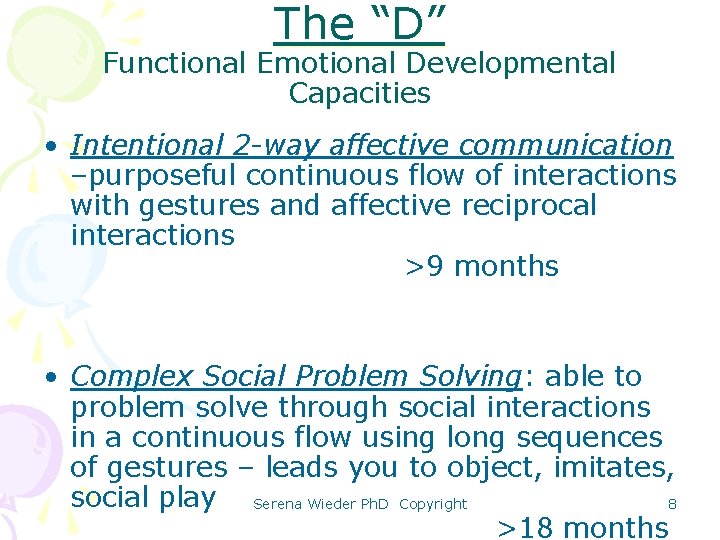
The “D” Functional Emotional Developmental Capacities • Intentional 2 -way affective communication –purposeful continuous flow of interactions with gestures and affective reciprocal interactions >9 months • Complex Social Problem Solving: able to problem solve through social interactions in a continuous flow using long sequences of gestures – leads you to object, imitates, social play Serena Wieder Ph. D Copyright 8 >18 months
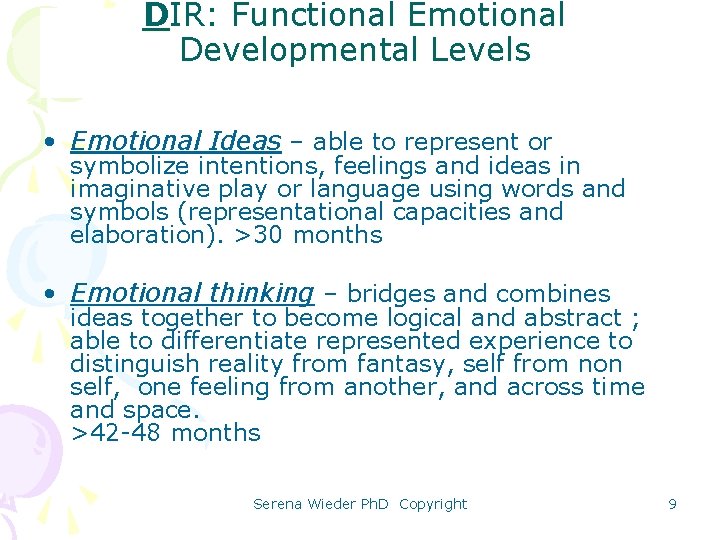
DIR: Functional Emotional Developmental Levels • Emotional Ideas – able to represent or symbolize intentions, feelings and ideas in imaginative play or language using words and symbols (representational capacities and elaboration). >30 months • Emotional thinking – bridges and combines ideas together to become logical and abstract ; able to differentiate represented experience to distinguish reality from fantasy, self from non self, one feeling from another, and across time and space. >42 -48 months Serena Wieder Ph. D Copyright 9
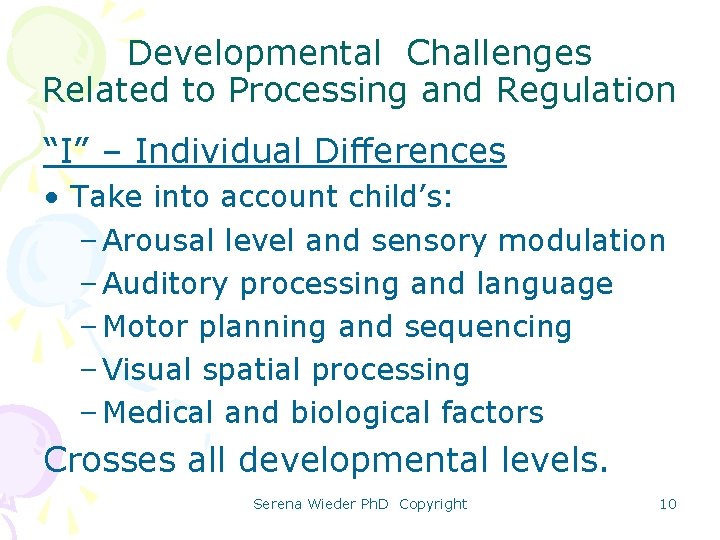
Developmental Challenges Related to Processing and Regulation “I” – Individual Differences • Take into account child’s: – Arousal level and sensory modulation – Auditory processing and language – Motor planning and sequencing – Visual spatial processing – Medical and biological factors Crosses all developmental levels. Serena Wieder Ph. D Copyright 10
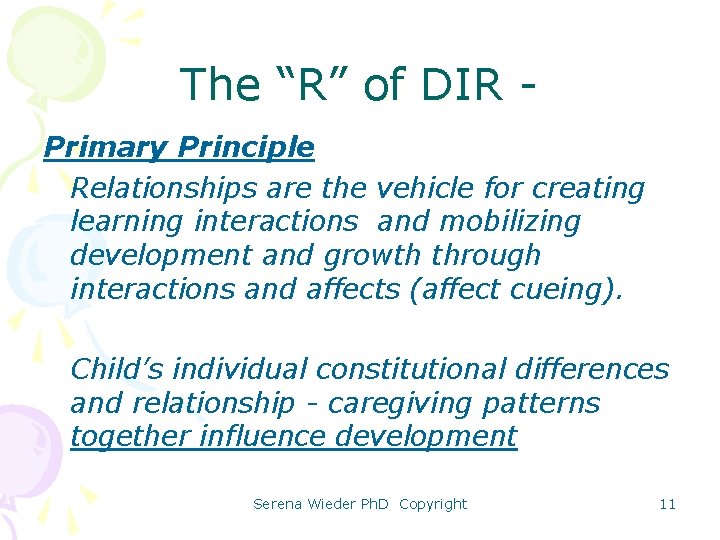
The “R” of DIR Primary Principle • Relationships are the vehicle for creating learning interactions and mobilizing development and growth through interactions and affects (affect cueing). • Child’s individual constitutional differences and relationship - caregiving patterns together influence development Serena Wieder Ph. D Copyright 11
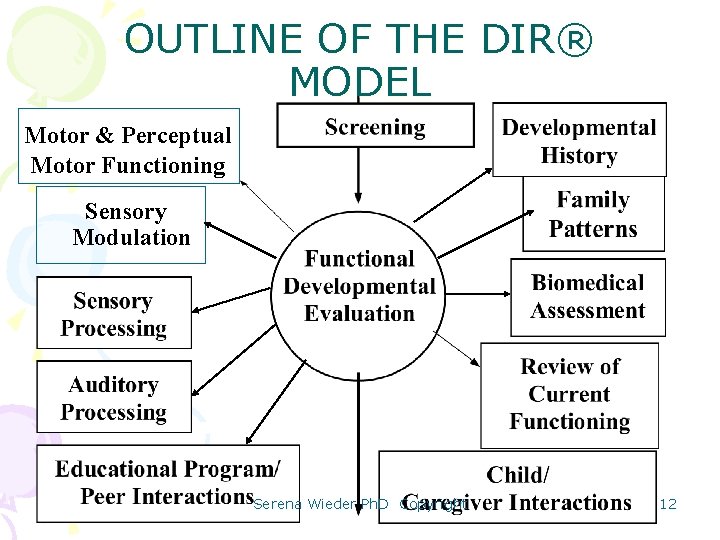
OUTLINE OF THE DIR® MODEL Motor & Perceptual Motor Functioning Sensory Modulation Serena Wieder Ph. D Copyright 12
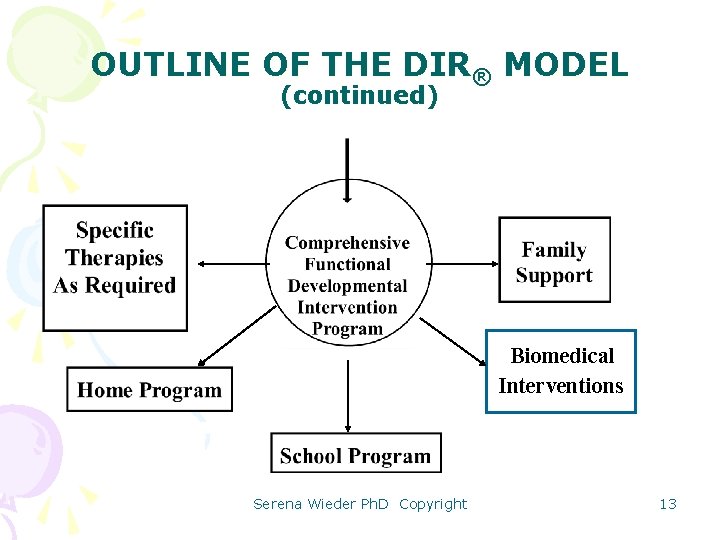
OUTLINE OF THE DIR® MODEL (continued) Biomedical Interventions Serena Wieder Ph. D Copyright 13
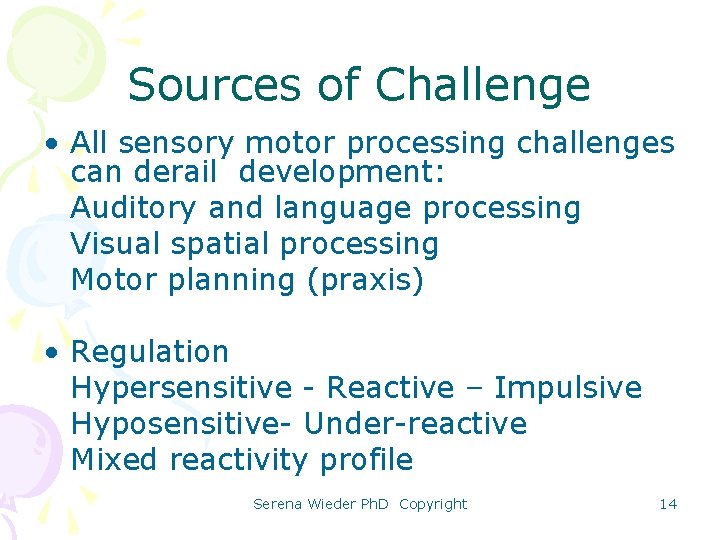
Sources of Challenge • All sensory motor processing challenges can derail development: Auditory and language processing Visual spatial processing Motor planning (praxis) • Regulation Hypersensitive - Reactive – Impulsive Hyposensitive- Under-reactive Mixed reactivity profile Serena Wieder Ph. D Copyright 14
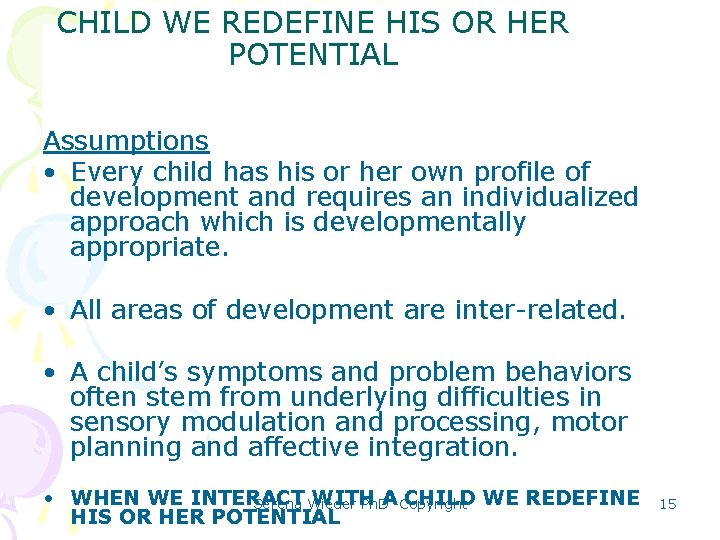
WHEN WE INTERACT WITH A CHILD WE REDEFINE HIS OR HER POTENTIAL Assumptions • Every child has his or her own profile of development and requires an individualized approach which is developmentally appropriate. • All areas of development are inter-related. • A child’s symptoms and problem behaviors often stem from underlying difficulties in sensory modulation and processing, motor planning and affective integration. • WHEN WE INTERACT WITH A Copyright CHILD WE REDEFINE Serena Wieder Ph. D HIS OR HER POTENTIAL 15
DIR®: Affect Based Learning • Affect carves the pathway for learning – provides direction for actions and meanings (of symbols, words) • Interactive strategies are based on child’s intent or affect • uses child’s natural intentions and feelings as personal foundation of learning Serena Wieder Ph. D Copyright 16
DIR Intervention Model • Addresses core deficits directly • Affect and relationship based • Developmentally appropriate approach • Comprehensive and integrated approach • Focuses on family interactions and relationships • Emphasizes symbolic thinking 17 Serena Wieder Ph. D Copyright • Works across the full range of
OUTLINE OF THE DIRtm MODEL COMPREHENSIVE HOME & ED PROGRAM • Floor Time – 6 -8 daily sessions • Talk Time – ongoing reality based problem solving conversations • Semi-Structured Problem Solving Activities – social games, ritualized learning, reading, “work” 3 -4 daily sessions • Family • Sensory Motor and Regulatory Activities 3 -4 daily sessions • Play Dates – accd. to age • Social Groups • School Based Programs • Therapy Activities – OT, SLP, PT, VCT. • Augmentation – visual strategies, auditory training, PECS, VOCAs, Support Typing… Serena Wieder Ph. D Copyright • Nutritional Interventions 18
DIR Approach to Intervention: Goals • Create opportunities to assist child in learning basic developmental capacities – Ability to attend and focus – Ability to engage warmly and trustingly with others across a range of emotions – Ability to communicate intentionally with both simple and complex gestures to negotiate dependency, aggression, approval and rejection Serena Wieder Ph. D Copyright 19
DIR Approach to Intervention: Goals – Ability to problem solve through social interactions in a continuous flow – Ability to represent or symbolize intentions and feelings in imaginative play or language – Ability to differentiate represented experience to distinguish reality from fantasy, self from non self, one feeling from another, and time and space. Serena Wieder Ph. D Copyright 20
Health Development, Individual Difference, Relationship Based • Provide specific types of developmental experiences at each stage of emotional development in order to foster further emotional growth. • Consider infant’s unique individual differences – constitutional and maturational patterns in order to provide these experiences. • Enable parents or caregivers to understand their own characteristics and interaction patterns with their children to foster growth. • Enable parents or caregivers to understand deal with emotional lags, constrictions, deficits, symptoms and foster adaptive development. Serena Wieder Ph. D Copyright 21
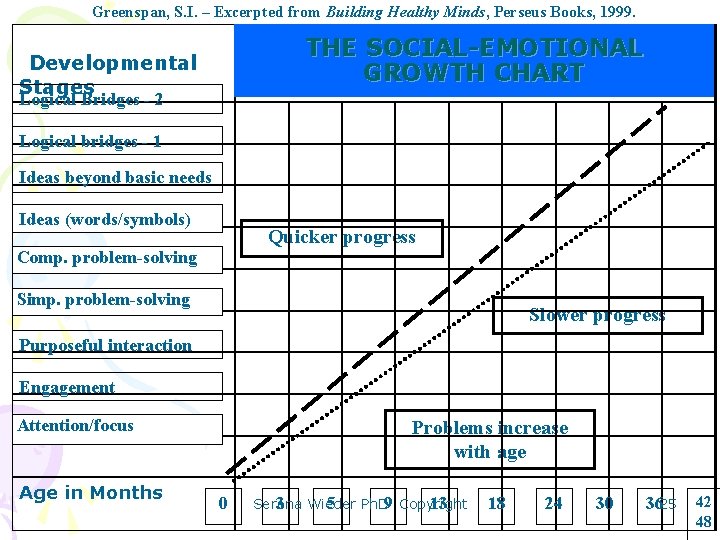
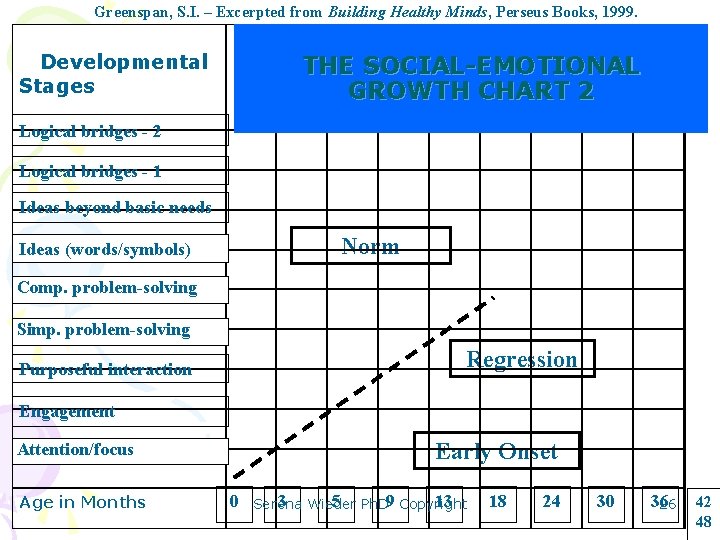
Greenspan – Early Identification Social-Emotional Growth Chart A Screening Questionnaire for Infants and Young Children Psych Corporation Serena Wieder Ph. D Copyright 22
Bayley Scales of Infant Development III Part of the standardization data • Administered to 456 children ages 15 days – 42 months • Children from all over the U. S. representative of the U. S. population based on census of 2003 • Stratified sample: race/ethnicity, region, parent education level, equal numbers of girls and boys • Reliability scores reflected strong internal consistency • Evidence of validity based on test construct Serena Wieder Ph. D Copyright 23
Questionnaire • Divided into 8 age intervals from birth to 42 months • Parent reports on Behavior Frequency from none of the time to all of the time (or can’t tell) for social-emotional behaviors and sensory processing behaviors • Each response is weighted for frequency and added • The total Growth Chart Score converts into an ageappropriate Growth Chart Index Score • These summary Scores indicate possible challenges, emerging mastery, and full mastery including highest score mastered • Can plot the child’s social emotional developmental accomplishments in relation to the age expected giving a view of the child’s patterns Serena Wieder Ph. D Copyright 24
Greenspan, S. I. – Excerpted from Building Healthy Minds, Perseus Books, 1999. THE SOCIAL-EMOTIONAL GROWTH CHART Developmental Stages Logical Bridges - 2 Logical bridges - 1 Ideas beyond basic needs Ideas (words/symbols) Quicker progress Comp. problem-solving Simp. problem-solving Slower progress Purposeful interaction Engagement Attention/focus Age in Months Problems increase with age 0 3 Wieder 5 Ph. D 9 Copyright 13 Serena 18 24 30 3625 42 48
Greenspan, S. I. – Excerpted from Building Healthy Minds, Perseus Books, 1999. Developmental Stages THE SOCIAL-EMOTIONAL GROWTH CHART 2 Logical bridges - 1 Ideas beyond basic needs Norm Ideas (words/symbols) Comp. problem-solving Simp. problem-solving Regression Purposeful interaction Engagement Early Onset Attention/focus Age in Months 0 3 Wieder 5 Ph. D 9 Copyright 13 Serena 18 24 30 36 26 42 48
Caregiver Report and Clinical Application • First step to learning about the child and determining how to assist in the child’s functional emotional growth • Identifies patterns which may require further investigation based on how close or how far to expected patterns • Can be used to measure progress over time Serena Wieder Ph. D Copyright 27
but what is? Emotional Development Not just social skills or “good” behavior Serena Wieder Ph. D Copyright 28
Emotional Development • • • What is emotional development? When does it start? How and when does it unfold? What is the hierarchy of emotions? How does it relate to intellectual development? • How does it relate to social development? • How do we establish the foundation for healthy emotional development? Serena Wieder Ph. D Copyright 29
The DIR®Model Provides a roadmap for emotional development Symbols reflect the hierarchy of emotional development Serena Wieder Ph. D Copyright 30
Emotional Development Parallels Symbolic Development and Intellectual Development Serena Wieder Ph. D Copyright 31
What is a Symbol? • A symbol represents “the real thing” • Symbols have many forms – words, drama (dress up and role play), toys, drawings or pictures, movement… All of which symbolize experiences • Goal is to learn we have to substitute reality through symbols or images • Symbolic play turns images into concepts which reflect the meaning of the image. Serena Wieder Ph. D Copyright 32
Hierarchy of Emotions • Dependency Themes – Feeding, cooking, fixing, doctor, mechanic, builder…. . joy, love… • Transition Themes – Separation, disappointment, loss, sadness, fears … • Assertiveness/Aggressive themes – Control, power, competition, anger, jealousy, justice, morality…. Serena Wieder Ph. D Copyright 33
WHY BUILD A SYMBOLIC WORLD? • Symbolic play and conversation is the safe way to practice, reenact, understand, and master the full range of emotional ideas, experiences and feelings. • Symbolic play leads to abstract thinking and a differentiated sense of self and others. Serena Wieder Ph. D Copyright 34
Floortime BUILD A SYMBOLIC WORLD - GOALS • Goal is to elevate all feelings and impulses to the level of ideas and express them through words and play instead of acting out behavior • Symbolic play provides the distance from real life and immediacy of needs to differentiating self from others (through different roles) and self from the environment (not bound by time and space) Serena Wieder Ph. D Copyright 35
The Foundation for the Future • Support emotional development to support mental health and intellectual development • Aggression and acting out behavior reflects the failure of symbolization and relationships • Need a comprehensive model of development to foster the emotional, social and intellectual foundation for the future Serena Wieder Ph. D Copyright 36
Floortime™, is a vital element of the DIR®/Floortime™model • a treatment method as well as a philosophy for interacting with children, adolescents, (and adultsl). • Floortime™ involves meeting a child at his current developmental level, and building upon his particular set of strengths. • Floortime™ harnesses the power of a child’s motivation; following his lead, wooing him with warm but persistent attempts to engage his attention and tuning in to his interests and desires in interactions. • By entering into a child’s world, we can help him or her learn to relate in meaningful, spontaneous, flexible and warm ways. Serena Wieder Ph. D Copyright 37
What is Floortime™? • Floortime™ is the term used for those experiences in which you follow your child’s lead in areas that give him pleasure, and then build on them in ways that expand his emotional capacities and tolerance for frustration helping him climb the developmental ladder. Serena Wieder Ph. D Copyright 38
What is Floortime™? • It is called “Floortime™” because it reminds parents, child care providers, teachers and therapists that a window into the child’s emotional and intellectual world most easily opens when you enter into his orbit at his eye level and on his terms. • With infants and young children you may actually play on the floor, and this evolves into other forms of interactions as you grow, such as reflective conversations. Serena Wieder Ph. D Copyright 39
Emotional Thinking • Each stage involves the simultaneous mastery of both emotional and cognitive abilities • New Research Serena Wieder Ph. D Copyright 40
Emotions, Symbols and Sensory Motor Processing • What is the intersection between emotional-symbolic development and sensory perception and processing? Serena Wieder Ph. D Copyright 41
What to observe? Motor Planning and Visual Spatial Capacities • Wanders aimlessly without looking at or exploring toys • Only finds toys in certain areas (. e. g. , on the floor or table top or last seen) • Drops objects/toys and does not pick them up automatically • Plows through floor littered with toys which have been dropped or 42 Serena Wieder Ph. D Copyright abandoned
What to observe? Pre-verbal or non-verbal indicators of motor planning and visual spatial challenges • Arranges toys in certain spots but does not use them for play • Lines up figures, animals, or dinosaurs • Lines up figures one at a time to “fight” – battles or contests • Cannot arrange scene using toys to set up a picnic, zoo, battle, ambush, etc. • Sets up scene but won’t move any of 43 Serena Wieder Ph. D Copyright the pieces for “action”
Emotional/Social Behaviors: Anxiety & Visual Spatial Processing • Separation Anxiety • Overly fearful and reactive to body damage, aggression, unpredictable events • Panic reactions when s/he turns around and does not see parent or feels lost • Catastrophic reactions to not finding needed objects or thinking something broke • Helpless or frustrated feelings when task requires using space, tracking, finding parts, fixing things… Serena Wieder Ph. D Copyright 44
Semi-Structured Play & Visual Spatial Perceptual Motor Processing • Does not play matching, visual discrimination, visual strategy - games • Cannot find desired figures in basket of toys • Insists on repeating same puzzles or toys • Selects easy puzzles again and again • Does not use trial and error or other strategies to rotate puzzle pieces, use cues, tries to push pieces in, etc. • Avoids construction, tinker toys, Legos, etc. Serena Wieder Ph. D Copyright 45
Floortime™ Principles • Child must generate the idea – – Encourage through toys and props – May rely on favorite ideas or obsessions – May borrow from books, videos, imitating others – May be a personal concern Child initiates and invests 46 Serena Wieder Ph. D Copyright affectively!
Floortime™ CREATE A SYMBOLIC WORLD • Create an inviting environment for interaction and symbolic play – let your child explore and discover new experiences and ideas. • Represent the world you want your child to symbolize in your Floortime™ room using toys, puppets and dress up: • Reality based experiences (people and video figures, house, school, food, cars, trains, planes, zoo, farm • Discover the Imaginative ( jungle, Jurassic Park, castles, kings and pirates, jails, monsters, superheroes, Star wars…. ) Serena Wieder Ph. D Copyright 47
Level I : Shared Attention and Regulation • Establish joint attention • Get connected and interactive • Challenges: Child gets distracted, looks away, starts fidgeting, throws down or drops objects, or takes flight. Serena Wieder Ph. D Copyright 48
Level I : Shared Attention and Regulation • Co-Regulation: Soothe and woo child who is anxious or overactive; energize child who appears subdued or passive to achieve a calm and focused state. • Regain attention using affect cues in the way you call his name, e. g. , use a broadcasting voice or whisper; imitate musical cues to signal getting ready or something is coming, e. g. , Dum, da, dum, da dum, dum! • Create curiosity by covering the task at hand invite child to uncover. Serena Wieder Ph. D Copyright 49
Level II : Engagement • Engage child pleasurably and woo him into playing and relating • Stay engaged across the full range of emotions – when angry, scared, aggressive…. • Challenges: Child becomes self-absorbed, passive or hyperactive and dis-engages. Child gets angry and rejecting, refusing to work. Serena Wieder Ph. D Copyright 50
Level III : Two Way Communication • Entice child with back and forth gestures, touch, movement , vocalizations, or words. • Allow child to explore the materials and/or play and model. • Get a gestural or verbal dialogue going back and forth, asking questions as child begins to work. Serena Wieder Ph. D Copyright 51
Level III : Two Way Communication • Applaud child when he succeeds, clap and praise until child actually looks up and acknowledges you or anticipates your response. Similarly, use empathic tone to encourage child to try again. • If child begins to get frustrated or anxious, use simple cues or words to acknowledge his feelings, coupled with encouragement and limit setting when necessary, e. g. , Uh oh, that is hard…. again! Serena Wieder Ph. D Copyright 52
Level IV: Problem Solving • Enlist a continuous flow of back and forth with more gestures, dialogue and problem solving. For example: For verbal child – What are you going to do next/? – How did you do that? – What should I do? Where is that? • For pre-verbal use gestures and actions Serena Wieder Ph. D Copyright 53
Level V: Create Ideas • Encourage child to use imagination and create symbolic ideas as he works. This can take the form of images (Oh no, a giant crab is coming!), or roles (construction worker, dancer, artist), or storyteller. • “Okay, go for it! You are a great design copier, architect, etc. Who should we pretend to be? • “ What a great idea! “ 54 Serena Wieder Ph. D Copyright
Level VI – Abstract Thinking • Identifying idea and feelings • Organizing beginning, middle and end • Giving opinions • Having debates • Agreeing and disagreeing • Reflecting on feelings and empathy Serena Wieder Ph. D Copyright 55
Level VI: Identify Feelings – Causal Thinking • Now, how did you feel about that? How did you feel when you were doing this? Why do you think you feel that way? What would make it different? Well, this makes me feel mad! I’m pretty good at this stuff! Yeah, it makes me use my eyes too much. • Empathize and soothe but also provide feedback to help child evaluate the task more objectively. Encourage and challenge to foster cooperation and persistence. Serena Wieder Ph. D Copyright 56
Common Errors • Not finding symbolic intent to keep child more engaged and initiating the goals. • Try to control disruptive behaviors without addressing feelings. Serena Wieder Ph. D Copyright 57
DIR® Model for Infant Mental Health • But what if problem behavior is part of a larger developmental failure? – Has not learned to relate or engage warmly to other people or others have not related to him – Has not learned to empathize with someone else’s perspective – Has not learned to regulate or control aggressive impulses because he lacks capacity to see his behavior has Serena Wieder Ph. D Copyright consequences for others 58
DIR Model for Infant Mental Health • Behavioral approaches or focusing on isolated units of behavior can obscure a larger developmental challenge and miss the larger opportunity to master critical developmental milestones. Serena Wieder Ph. D Copyright 59
DIR Model for Infant Mental Health –Focus on behavioral control rather than engagement or learning relationships can be warm and supportive. –Using very concrete rewards or negative consequences can undermine the first goal of creating a sense of relationship and engagement. Serena Wieder Ph. D Copyright 60
DIR Model for Infant Mental Health – To appreciate the consequences of interaction need to learn that communication is causal and twoway and has impact on others – – therefore child needs to learn to experiment with his own initiative and monitor the feedback he gets from others. Serena Wieder Ph. D Copyright 61
DIR Model for Infant Mental Health – Focus on reinforcers may be a bigger problem than the particular behavior child evidences – may seek any form of attention or feel rewarded by other people’s discomfort rather feel rewarded by relationships and a sense of pride and respect. Serena Wieder Ph. D Copyright 62
Serena Wieder Ph. D Copyright 63
www. icdl. com • Annual International Conferences – – • • • Annual Conference Workshops on DIR® Practice Over 10, 000 Participants from all US States and 82 countries Publications – Books, Videos and Journals DIR® Networks in Atlanta, Boston, Chicago, New York, Rochester, San Francisco, Portland, Miami, Ireland, Australia, Israel, Wales, Argentina, Chile, Bolivia, Peru, Mexico…. DIR® Institutes in the US, Israel, Italy and Amsterdam DIR® Conferences in Europe, Israel, Australia, China, Singapore, South America DIR® Books translated into Italian, Indonesian, Dutch, Chinese, Spanish, Hebrew, Croatian Serena Wieder Ph. D Copyright 64
DIR® Institute Educational Programs 2007 in ASILOMAR, CA July 8 -13 – – – DIRB for Professionals Beginning Practice DIRC Competency Based Certificate Program FTP Floor Time Players DIRA for Administrators DIR® Training of Trainers – Serena Wieder Ph. D Copyright Faculty/Facilitator Program 65
• Publications – Books and Journals – www. icdl. com – – – Clinical Practice Guidelines DMIC Diagnostic Classification Manual for Infants and Young Children FEAS – Functional Emotional Assessment Scale The Child With Special Needs – Spanish Edition Serena Wieder Ph. D Copyright Bipolar Patterns in Children 66