
The Digital Michelangelo Project Marc Levoy Computer Science







- Slides: 56
The Digital Michelangelo Project Marc Levoy Computer Science Department Stanford University
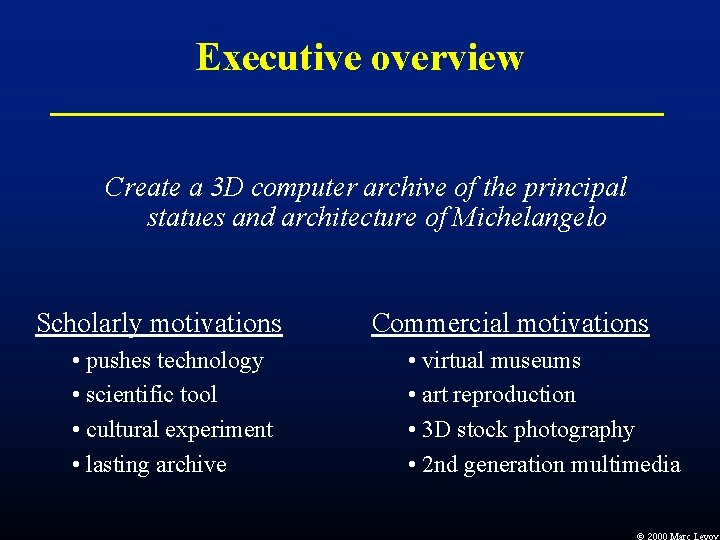
Executive overview Create a 3 D computer archive of the principal statues and architecture of Michelangelo Scholarly motivations • pushes technology • scientific tool • cultural experiment • lasting archive Commercial motivations • virtual museums • art reproduction • 3 D stock photography • 2 nd generation multimedia
Outline of talk • • scanner design processing pipeline scanning the David problems faced and lessons learned acquiring a big light field uses for our models the problem of the Forma Urbis Romae
Scanner design 4 motorized axes laser, range camera, white light, and color camera truss extensions for tall statues
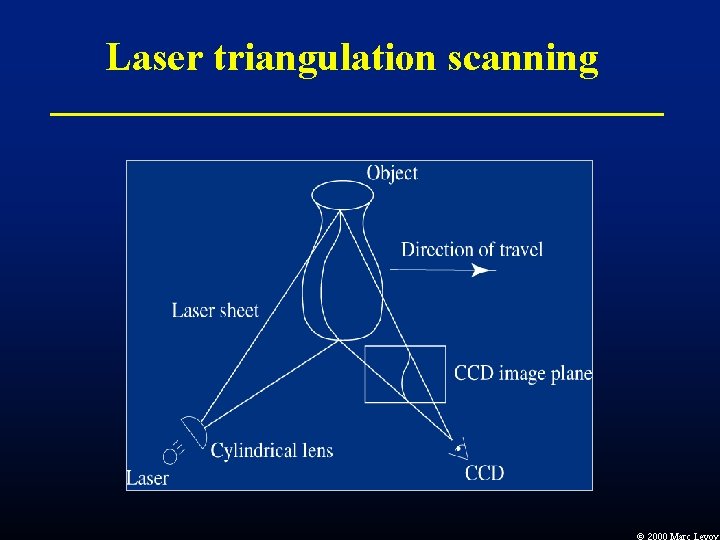
Laser triangulation scanning
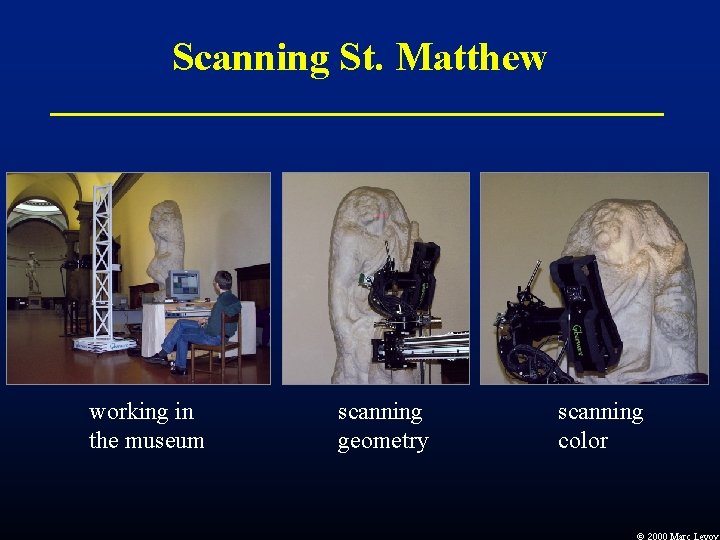
Scanning St. Matthew working in the museum scanning geometry scanning color
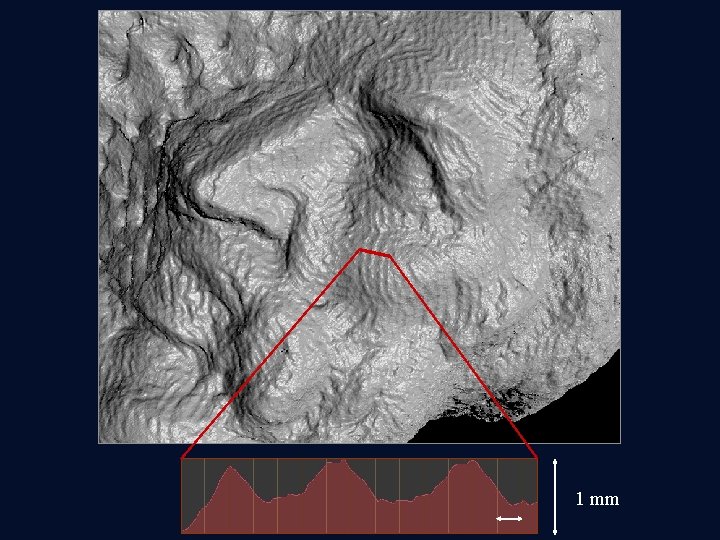
single scan of St. Matthew 1 mm
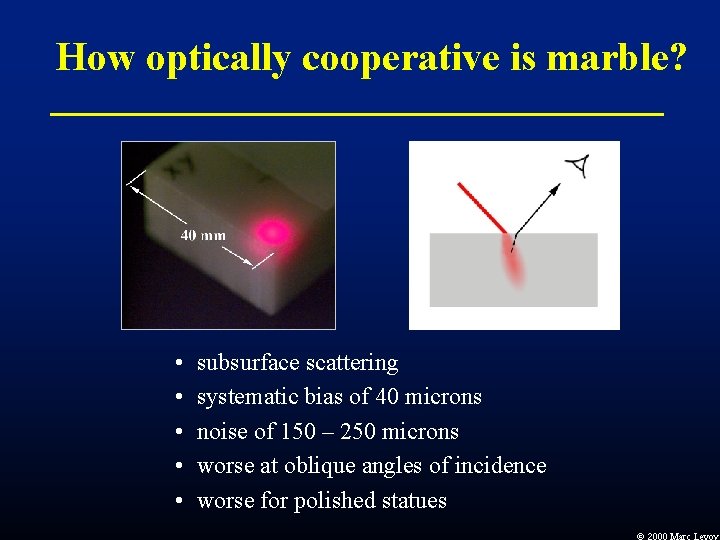
How optically cooperative is marble? • • • subsurface scattering systematic bias of 40 microns noise of 150 – 250 microns worse at oblique angles of incidence worse for polished statues
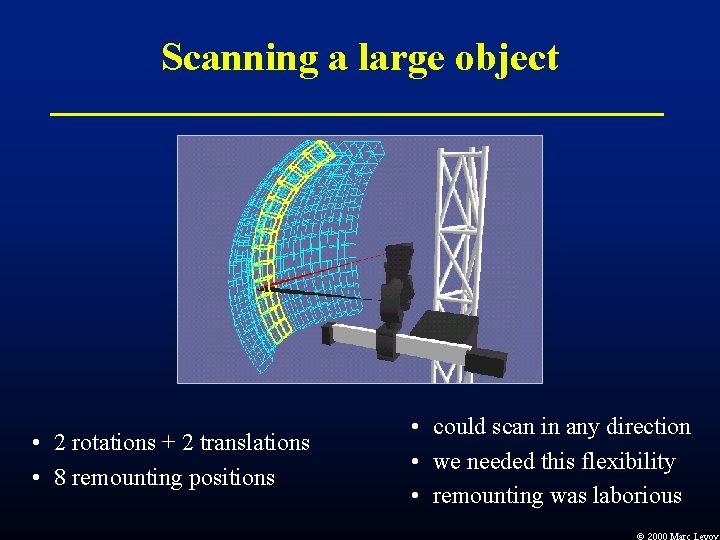
Scanning a large object • 2 rotations + 2 translations • 8 remounting positions • could scan in any direction • we needed this flexibility • remounting was laborious
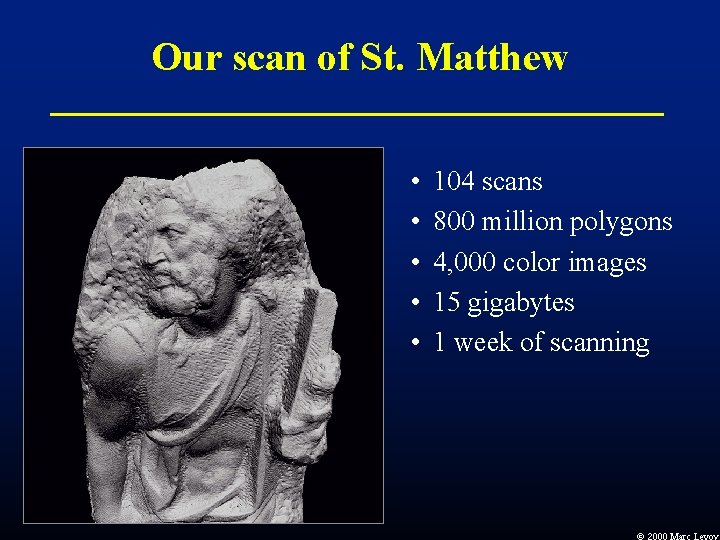
Our scan of St. Matthew • • • 104 scans 800 million polygons 4, 000 color images 15 gigabytes 1 week of scanning
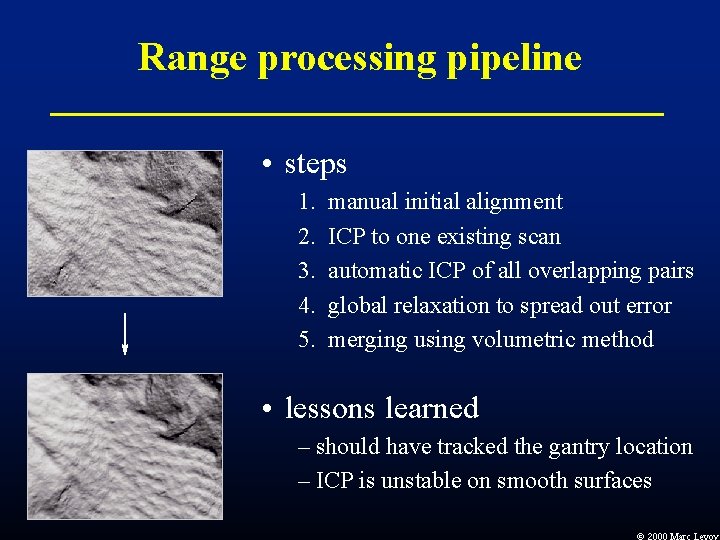
Range processing pipeline • steps 1. 2. 3. 4. 5. manual initial alignment ICP to one existing scan automatic ICP of all overlapping pairs global relaxation to spread out error merging using volumetric method • lessons learned – should have tracked the gantry location – ICP is unstable on smooth surfaces
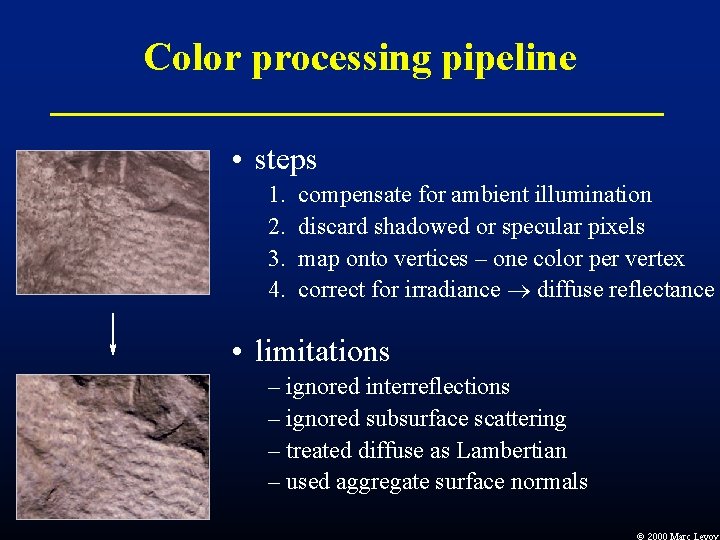
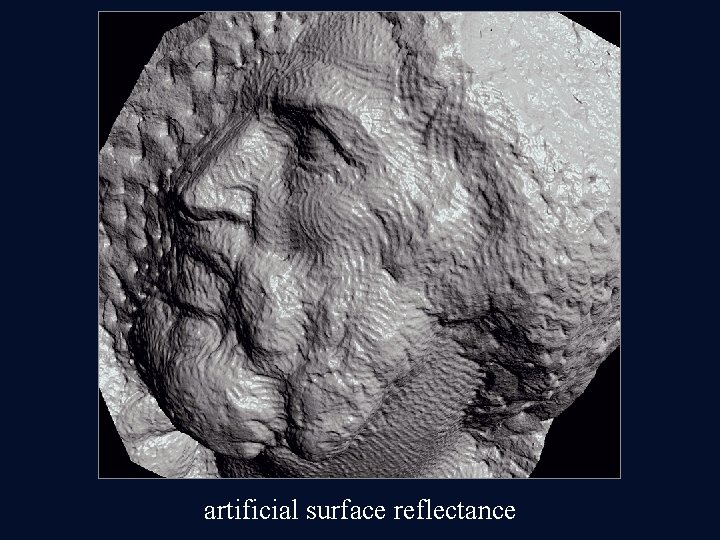
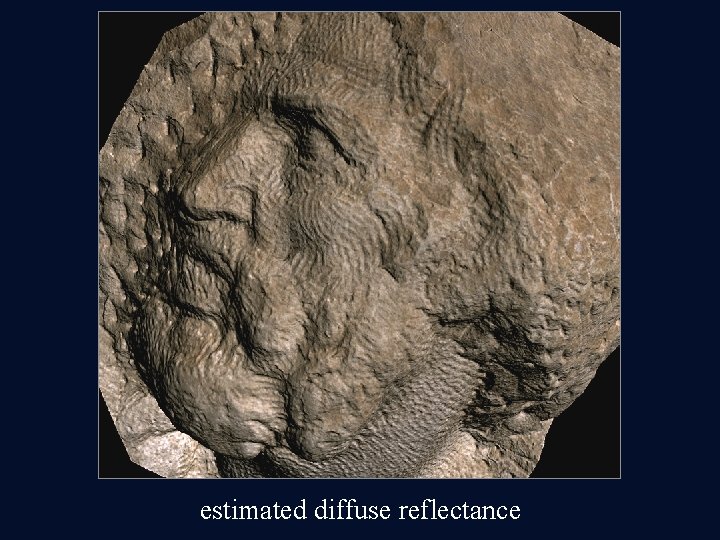
Color processing pipeline • steps 1. 2. 3. 4. compensate for ambient illumination discard shadowed or specular pixels map onto vertices – one color per vertex correct for irradiance diffuse reflectance • limitations – ignored interreflections – ignored subsurface scattering – treated diffuse as Lambertian – used aggregate surface normals
artificial surface reflectance
estimated diffuse reflectance
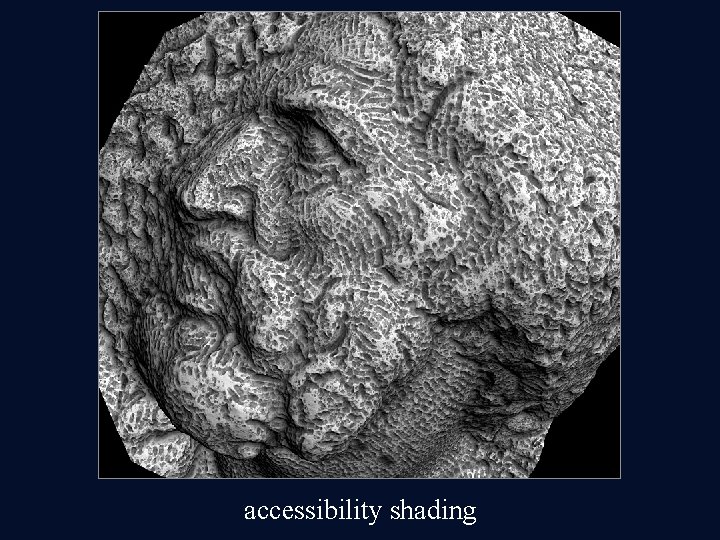
accessibility shading
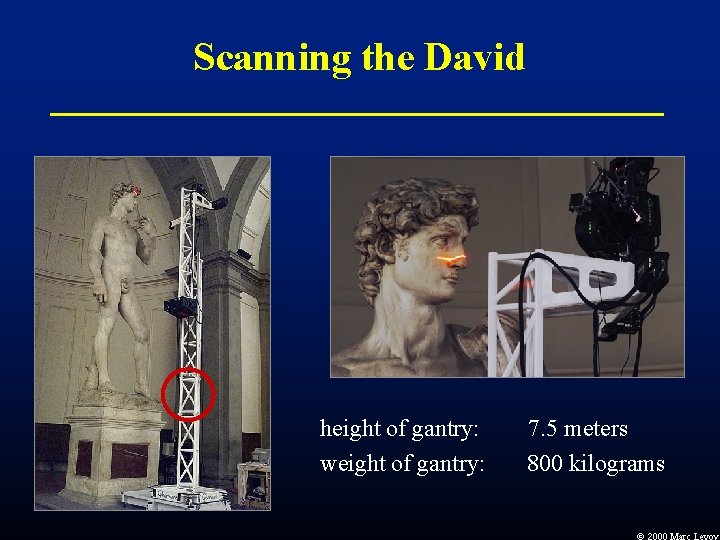
Scanning the David height of gantry: weight of gantry: 7. 5 meters 800 kilograms
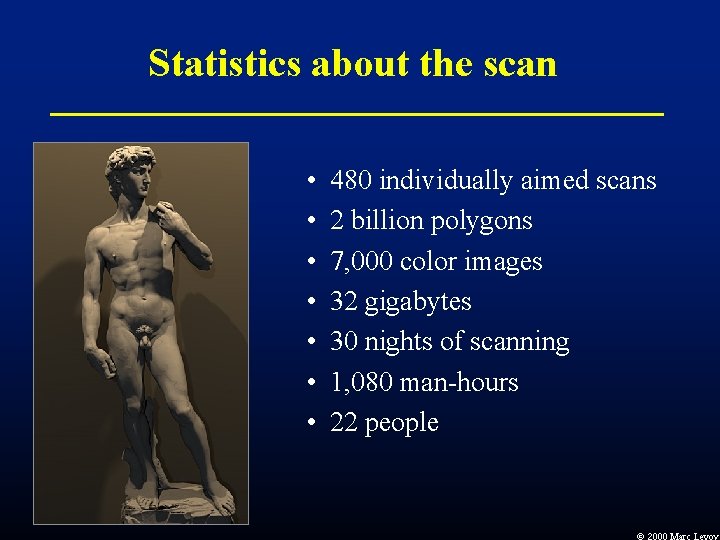
Statistics about the scan • • 480 individually aimed scans 2 billion polygons 7, 000 color images 32 gigabytes 30 nights of scanning 1, 080 man-hours 22 people
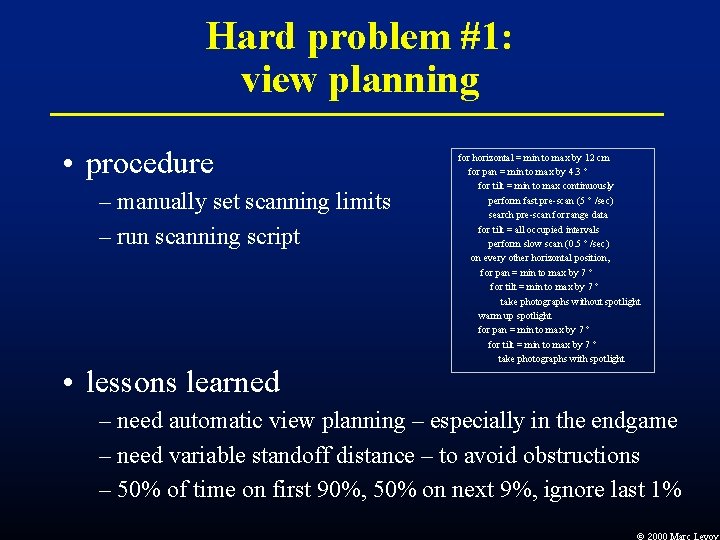
Hard problem #1: view planning • procedure – manually set scanning limits – run scanning script • lessons learned for horizontal = min to max by 12 cm for pan = min to max by 4. 3 ° for tilt = min to max continuously perform fast pre-scan (5 ° /sec) search pre-scan for range data for tilt = all occupied intervals perform slow scan (0. 5 ° /sec) on every other horizontal position, for pan = min to max by 7 ° for tilt = min to max by 7 ° take photographs without spotlight warm up spotlight for pan = min to max by 7 ° for tilt = min to max by 7 ° take photographs with spotlight – need automatic view planning – especially in the endgame – need variable standoff distance – to avoid obstructions – 50% of time on first 90%, 50% on next 9%, ignore last 1%
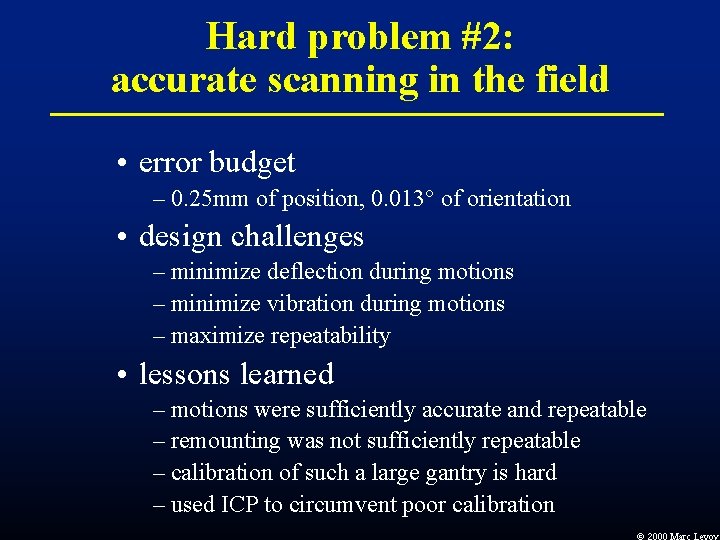
Hard problem #2: accurate scanning in the field • error budget – 0. 25 mm of position, 0. 013° of orientation • design challenges – minimize deflection during motions – minimize vibration during motions – maximize repeatability • lessons learned – motions were sufficiently accurate and repeatable – remounting was not sufficiently repeatable – calibration of such a large gantry is hard – used ICP to circumvent poor calibration
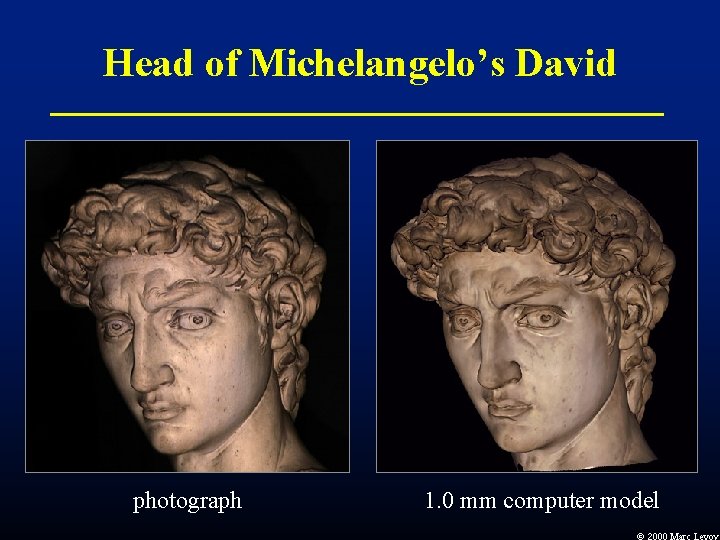
Head of Michelangelo’s David photograph 1. 0 mm computer model
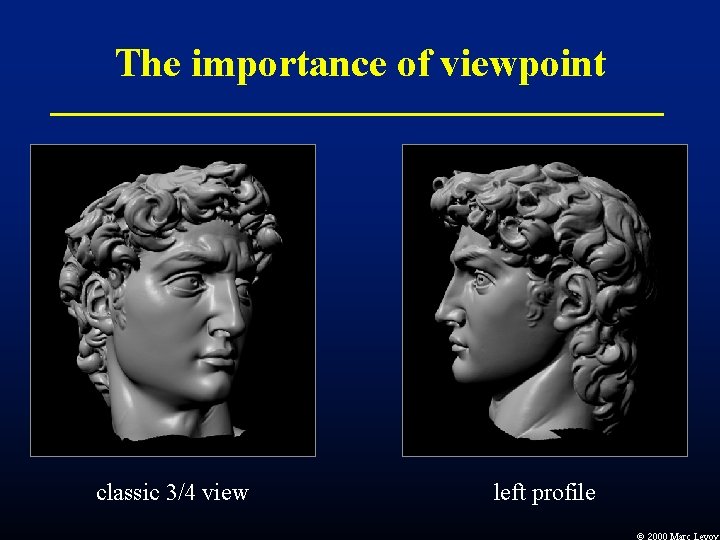
The importance of viewpoint classic 3/4 view left profile
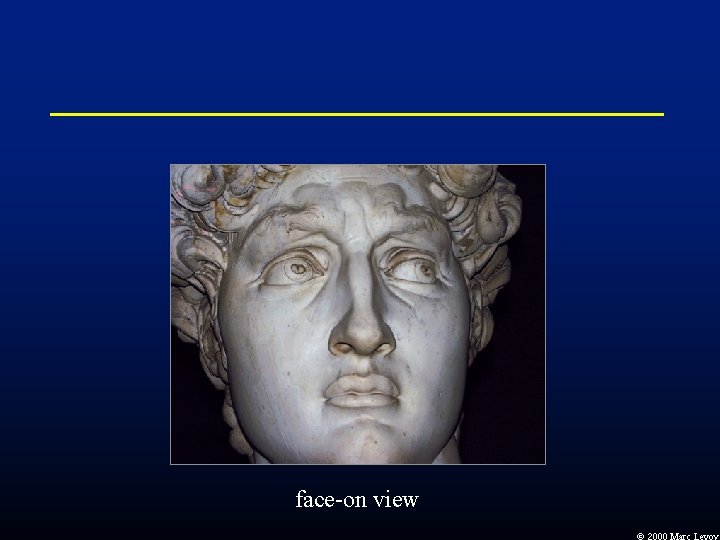
face-on view
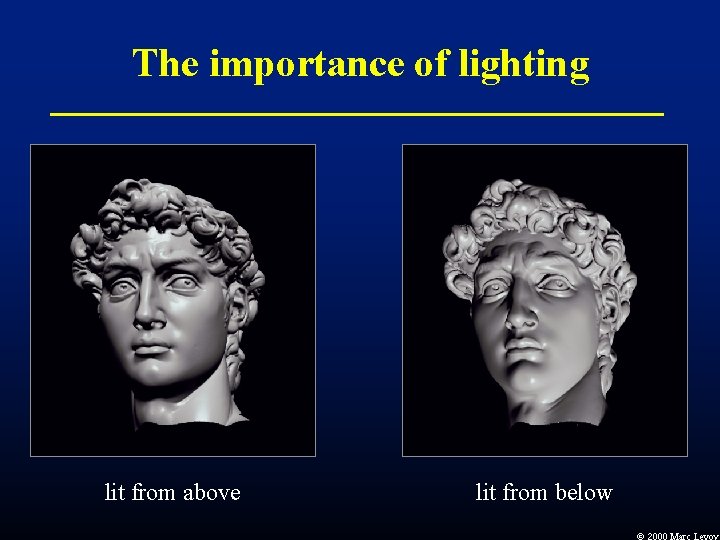
The importance of lighting lit from above lit from below
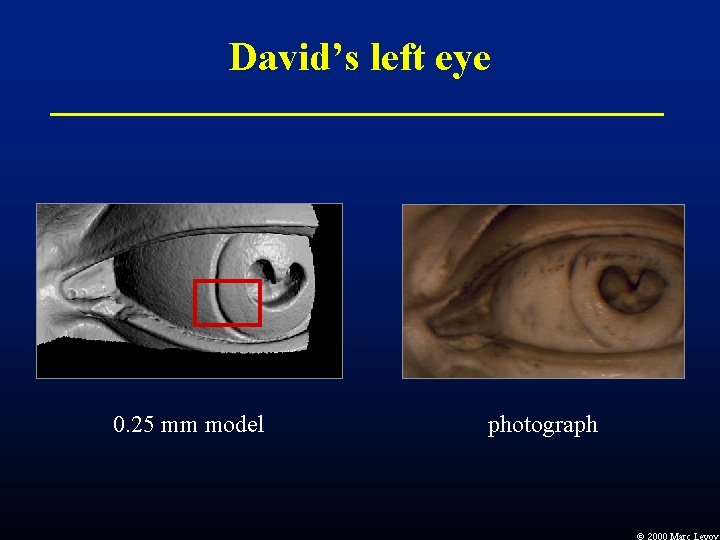
David’s left eye 0. 25 mm model photograph
Single scan of David’s cornea
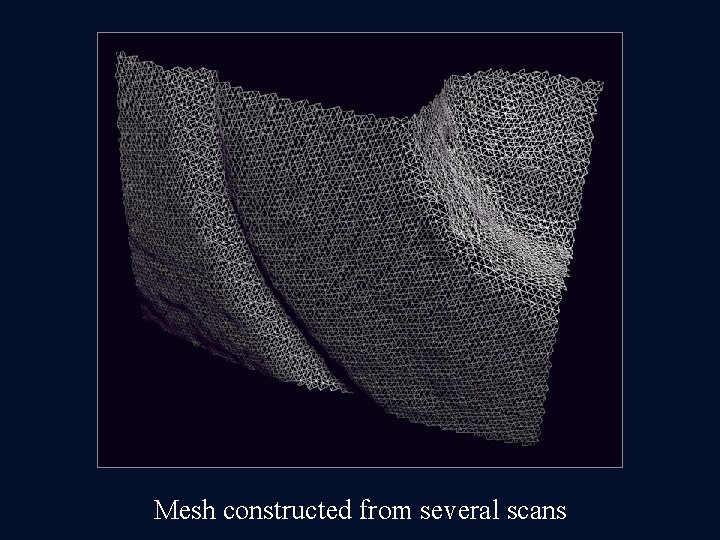
Mesh constructed from several scans
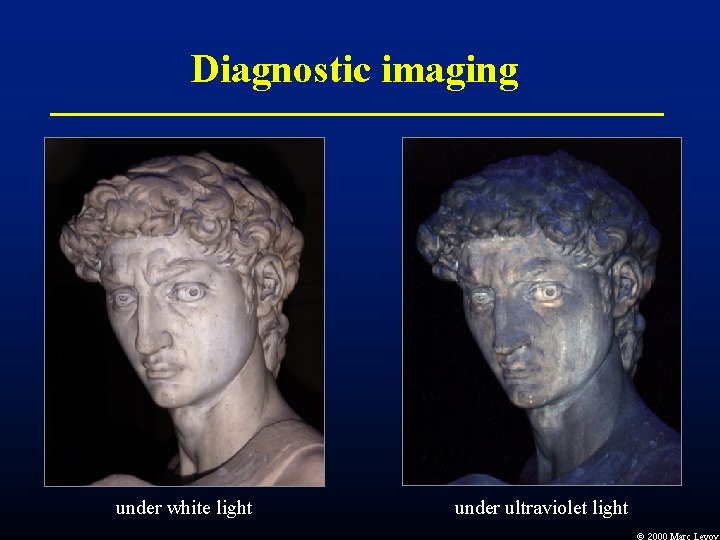
Diagnostic imaging under white light under ultraviolet light
Hard problem #3: insuring safety for the statues • energy deposition – not a problem in our case • avoiding collisions – manual motion controls – automatic cutoff switches – one person serves as spotter – avoid time pressure – get enough sleep • surviving collisions – pad the scan head
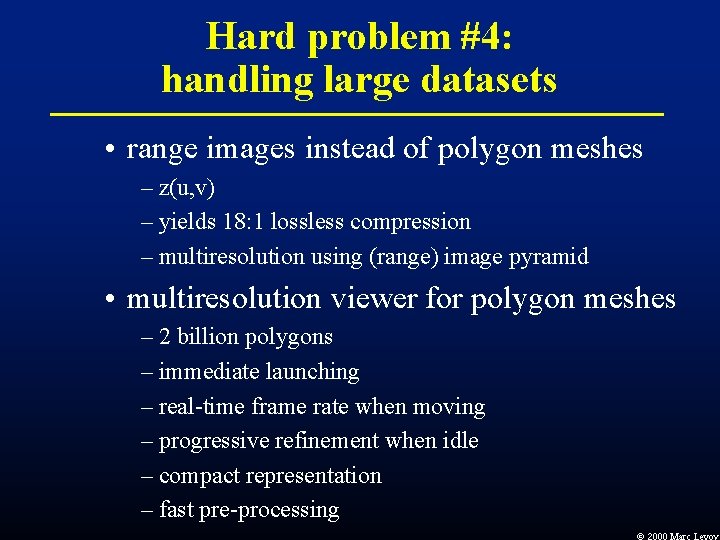
Hard problem #4: handling large datasets • range images instead of polygon meshes – z(u, v) – yields 18: 1 lossless compression – multiresolution using (range) image pyramid • multiresolution viewer for polygon meshes – 2 billion polygons – immediate launching – real-time frame rate when moving – progressive refinement when idle – compact representation – fast pre-processing
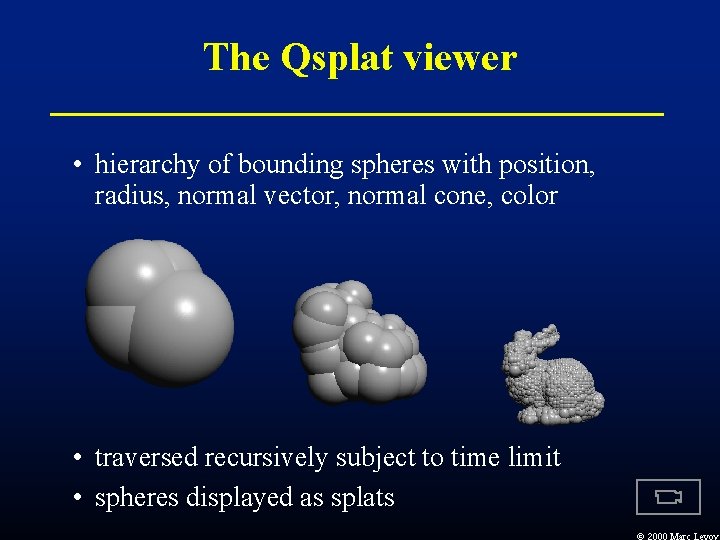
The Qsplat viewer • hierarchy of bounding spheres with position, radius, normal vector, normal cone, color • traversed recursively subject to time limit • spheres displayed as splats
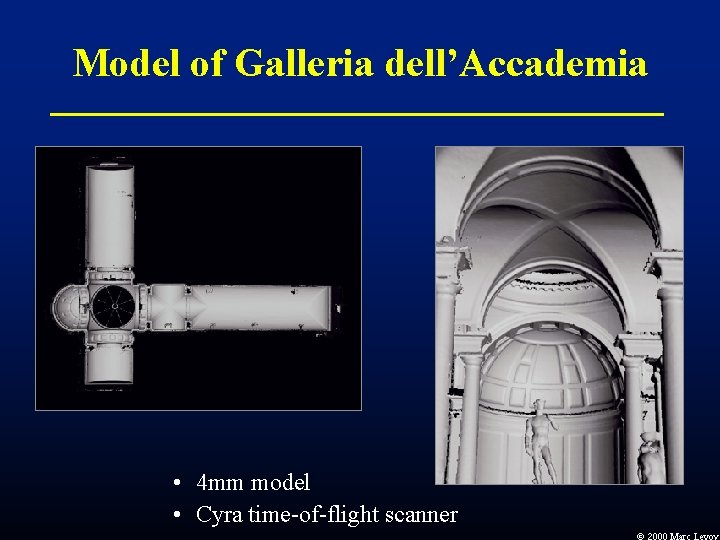
Model of Galleria dell’Accademia • 4 mm model • Cyra time-of-flight scanner
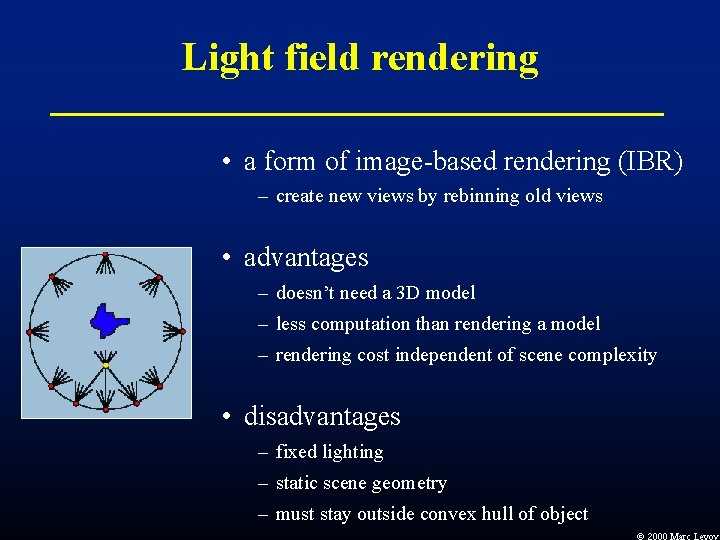
Light field rendering • a form of image-based rendering (IBR) – create new views by rebinning old views • advantages – doesn’t need a 3 D model – less computation than rendering a model – rendering cost independent of scene complexity • disadvantages – fixed lighting – static scene geometry – must stay outside convex hull of object
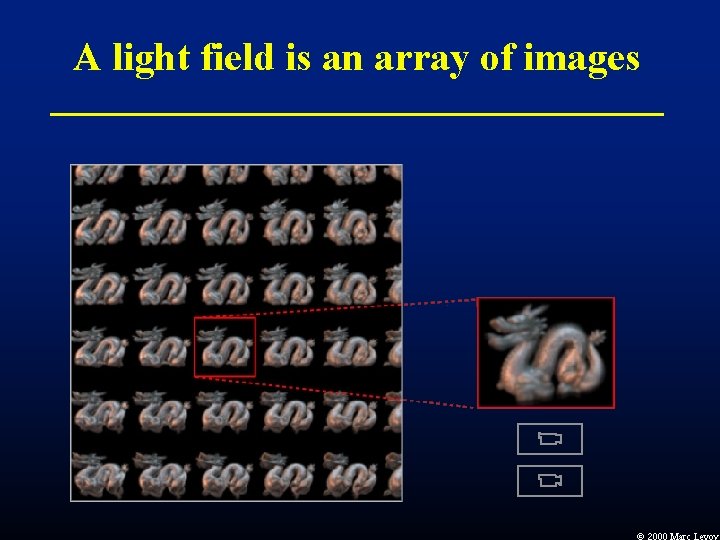
A light field is an array of images
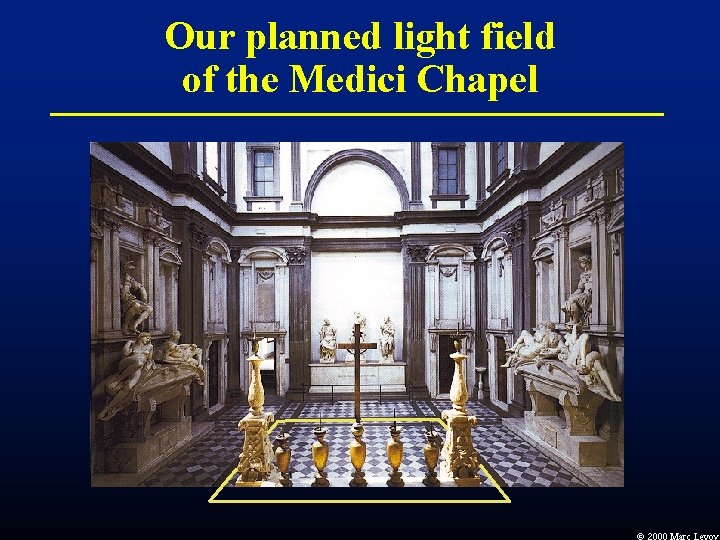
Our planned light field of the Medici Chapel
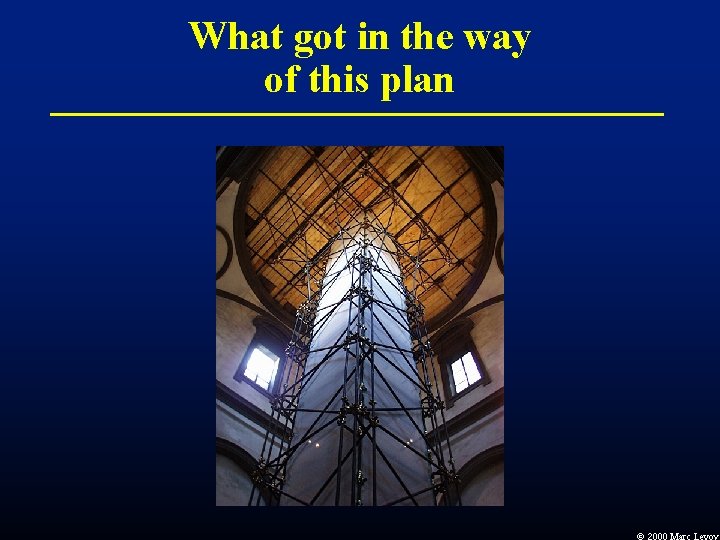
What got in the way of this plan
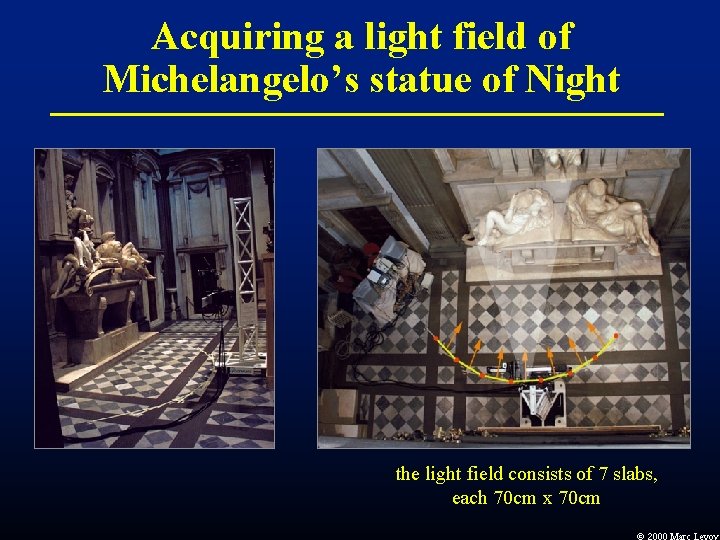
Acquiring a light field of Michelangelo’s statue of Night the light field consists of 7 slabs, each 70 cm x 70 cm
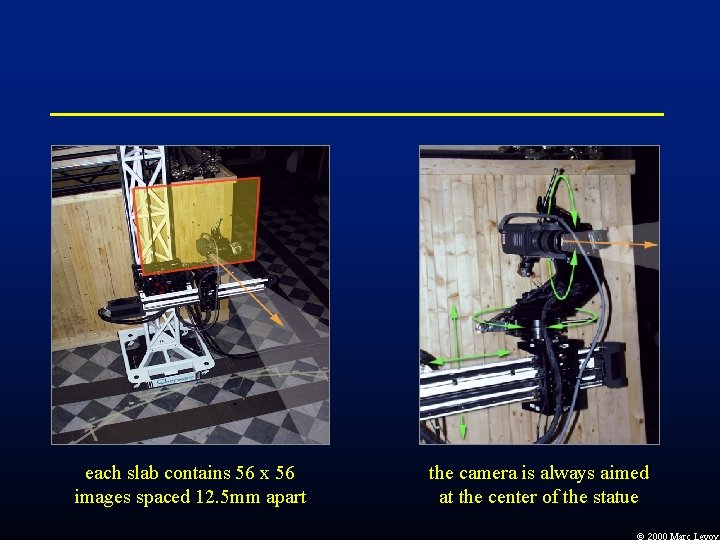
each slab contains 56 x 56 images spaced 12. 5 mm apart the camera is always aimed at the center of the statue
Sample image from center slab
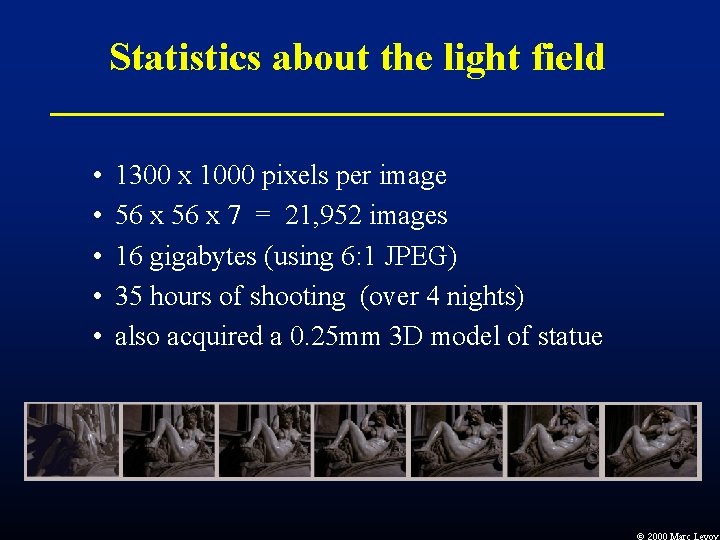
Statistics about the light field • • • 1300 x 1000 pixels per image 56 x 7 = 21, 952 images 16 gigabytes (using 6: 1 JPEG) 35 hours of shooting (over 4 nights) also acquired a 0. 25 mm 3 D model of statue
Some obvious uses for these models • • unique views of the statues virtual museums permanent archive physical replicas
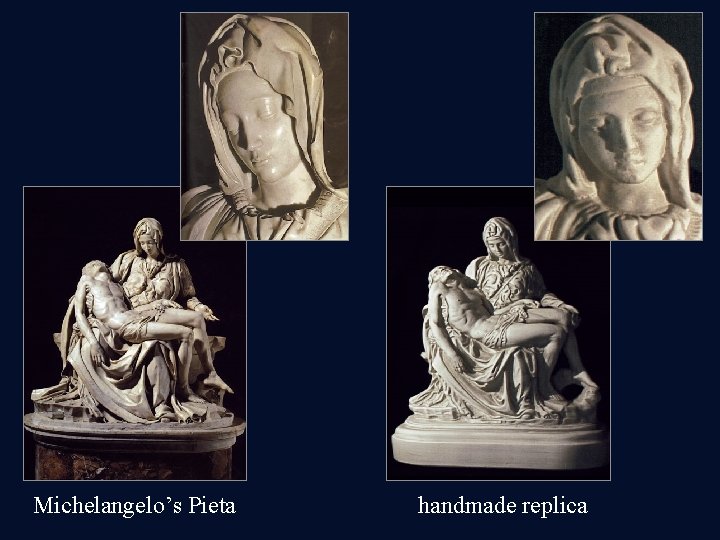
Michelangelo’s Pieta handmade replica
Some not-so-obvious uses • restoration record • geometric calculations • projection of images onto statues
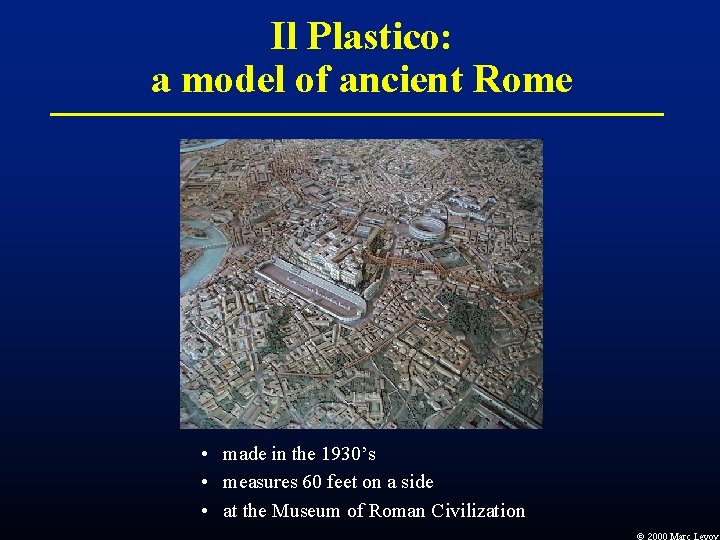
Il Plastico: a model of ancient Rome • made in the 1930’s • measures 60 feet on a side • at the Museum of Roman Civilization
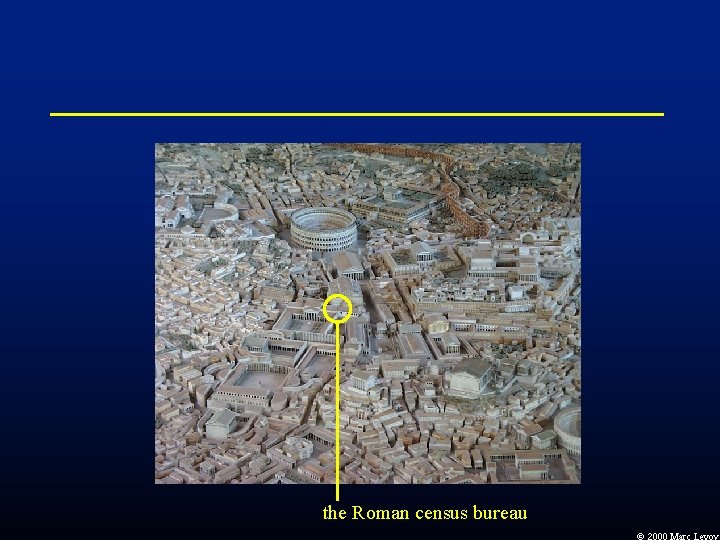
the Roman census bureau
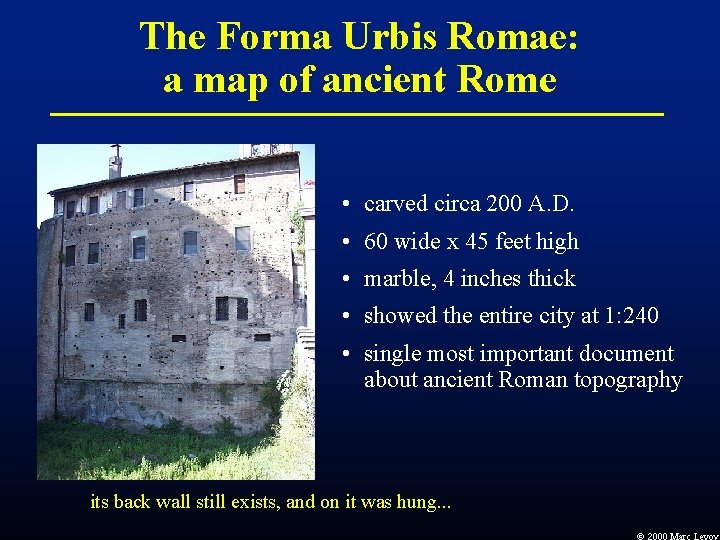
The Forma Urbis Romae: a map of ancient Rome • carved circa 200 A. D. • 60 wide x 45 feet high • marble, 4 inches thick • showed the entire city at 1: 240 • single most important document about ancient Roman topography its back wall still exists, and on it was hung. . .
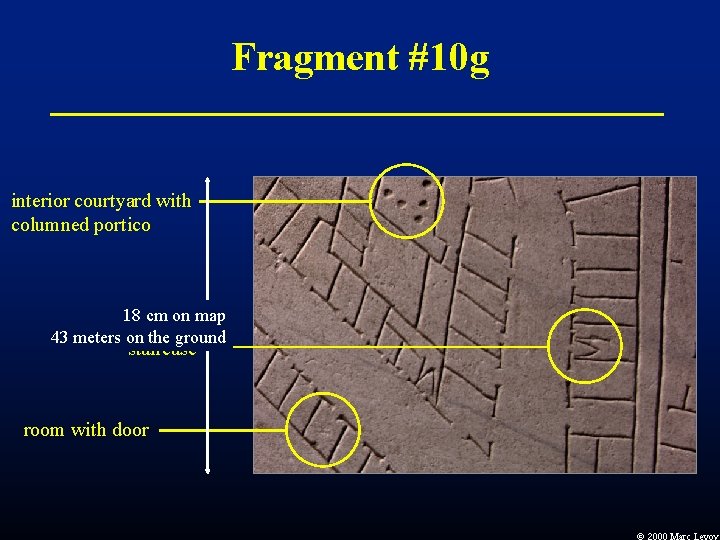
Fragment #10 g
Fragment #10 g interior courtyard with columned portico 18 cm on map 43 meters on the ground staircase room with door
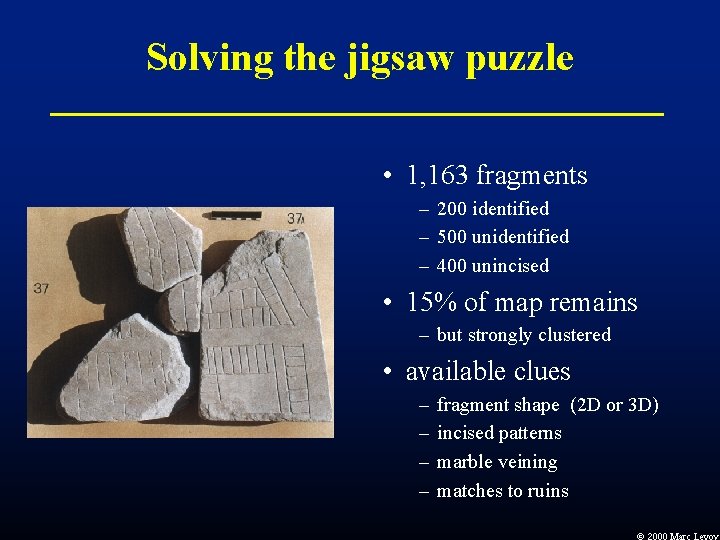
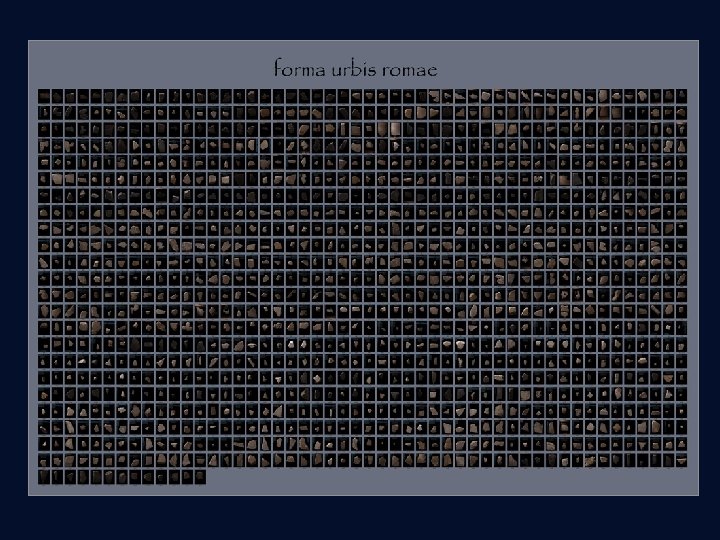
Solving the jigsaw puzzle • 1, 163 fragments – 200 identified – 500 unidentified – 400 unincised • 15% of map remains – but strongly clustered • available clues – – fragment shape (2 D or 3 D) incised patterns marble veining matches to ruins
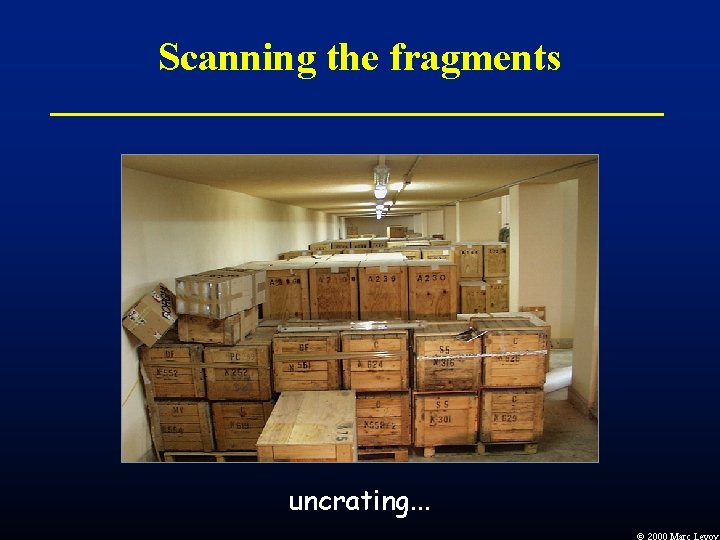
Scanning the fragments uncrating. . .
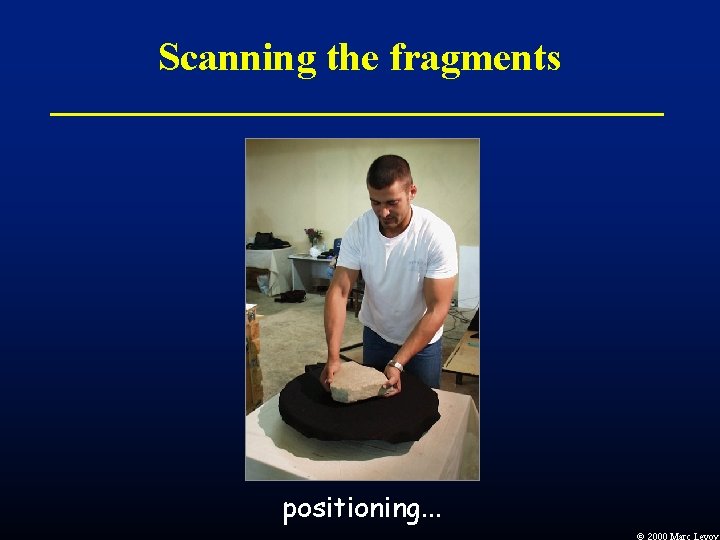
Scanning the fragments positioning. . .
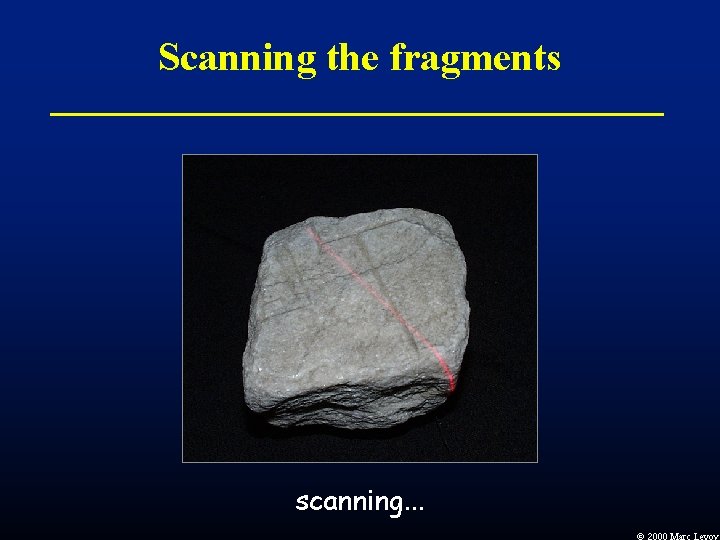
Scanning the fragments scanning. . .
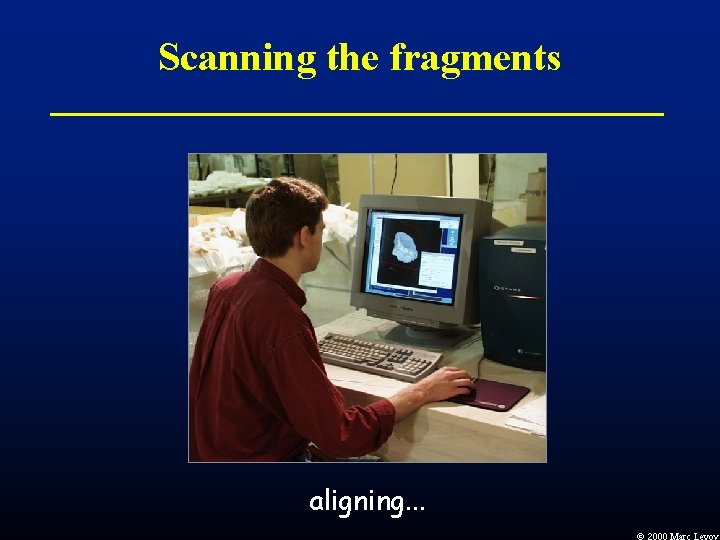
Scanning the fragments aligning. . .
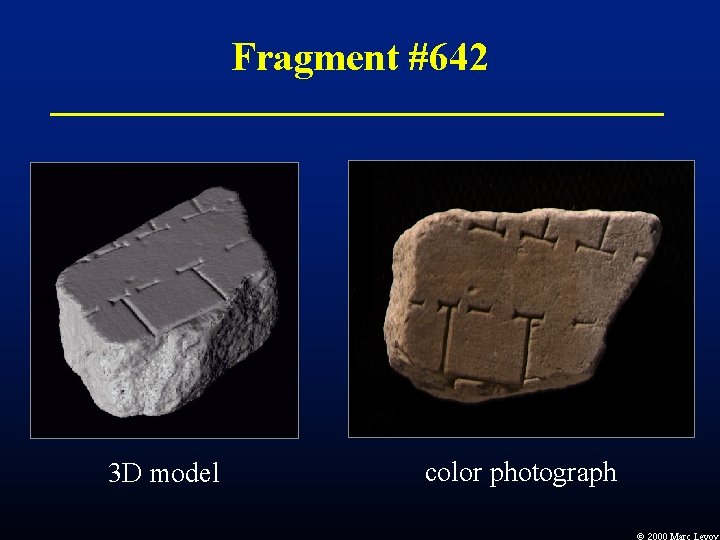
Fragment #642 3 D model color photograph
Acknowledgements Faculty and staff Prof. Brian Curless Jelena Jovanovic Lisa Pacelle Dr. Kari Pulli In Florence John Gerth Prof. Marc Levoy Domi Pitturo In Rome Graduate students Sean Anderson James Davis Lucas Pereira Jonathan Shade Daniel Wood Barbara Caputo Dave Koller Szymon Rusinkiewicz Marco Tarini Prof. Eugenio La Rocca Dott. ssa Anna Somella Dott. ssa Susanna Le Pera Dott. ssa Laura Ferrea In Pisa Roberto Scopigno Sponsors Undergraduates Alana Chan Jeremy Ginsberg Unnur Gretarsdottir Wallace Huang Ephraim Luft Semira Rahemtulla Joshua David Schroeder David Weekly Dott. ssa Cristina Acidini Dott. ssa Franca Falletti Dott. ssa Licia Bertani Alessandra Marino Matti Auvinen Kathryn Chinn Matt Ginzton Rahul Gupta Dana Katter Dan Perkel Alex Roetter Maisie Tsui Interval Research Stanford University Paul G. Allen Foundation for the Arts Equipment donors Cyberware Faro Technologies Silicon Graphics 3 D Scanners Cyra Technologies Intel Sony
http: //graphics. stanford. edu/projects/mich/ levoy@cs. stanford. edu