
The Digital Divide and the Elderly By Tyson
The Digital Divide and the Elderly By: Tyson Pentecost for LIS 600
What is the digital divide? “The term “digital divide” has been coined to describe a gap in understanding, capability, and access to technology in order to exploit the digital revolution in information. ” (Lester, Koehler, pg 357) “The digital divide refers to the gap that exists between individuals and groups who have access to modern information and communication technologies — particularly the Internet — and those who do not. ” (Weiss, pg 25)
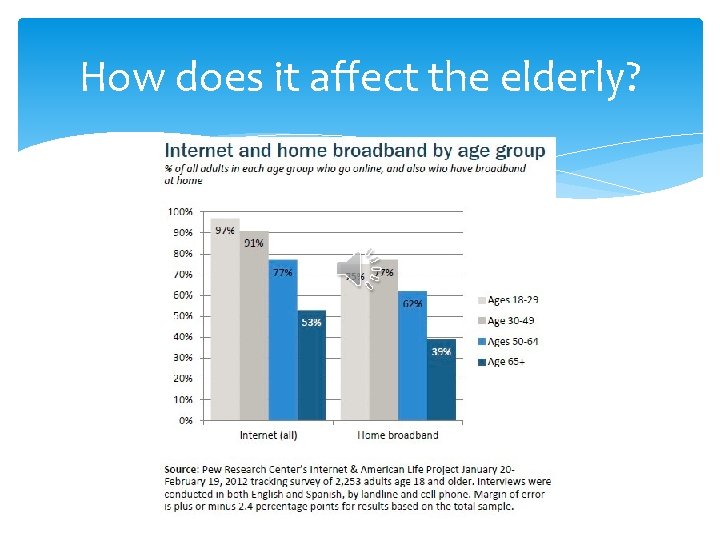
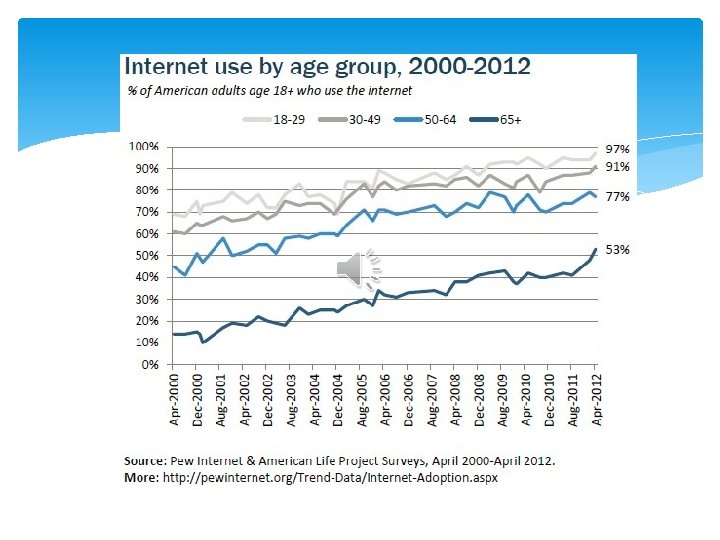
How does it affect the elderly?
Benefits of Digital Literacy for Seniors Access to health care information Access to government resources Communication with others Mental stimulation Entertainment
Barriers to Crossing the Digital Divide Embarrassment at lack of knowledge and skills Devices not designed for the needs of the elderly “Product developers do not care very much about the fact that the elderly cannot use tiny mobile telephones very well or that they are unable to decipher icons. A large number of elderly cannot read text on the screen or use a keyboard due to visual impairments or other physical or psychological handicaps. ” (Paul)
Barriers continued… Cost of internet access and devices Different Learning styles: “The elderly are more used to reasoning, systematic and logical thinking, linear step–by–step processes which are good formal learning but turn out to be an obstacle when dealing with new technologies. ” (Paul)
How should libraries deal with this issue? Provide basic computer classes solely for seniors Provide senior friendly equipment Partner with local senior centers Market and advertise upcoming classes
Conclusion “… more opportunities will be presented to people online well into the future and public libraries, it seems, have already received the “unfunded mandate” to help bridge what has been called the digital divide. ” –Mairn
Bibliography Cresci, M. , & Jarosz, P. (2010). Bridging the digital divide for urban seniors: community partnership. Geriatric Nursing, 31(6), 455 -463. doi: 10. 1016/j. gerinurse. 2010. 006 Juznic, P. , Blazic, M. , Mercun, T. , Plestenjak, B. , & Majcenovic, D. (2006). Who says that old dogs cannot learn new tricks? . New Library World, 107(7/8), 332 -345. doi: 10. 1108/03074800610677308 Kinney, B. (2010). The Internet, Public Libraries, and the Digital Divide. Public Library Quarterly, 29(2), 104 -161. doi: 10. 1080/01616841003779718 Lester, J. , & Koehler, W. C. (2007). Fundamentals of information studies: Understanding information and its environment. New York: Neal-Schuman Publishers. Madden, M. , & Zickuhr, K. (2012). Older Adults and Internet Use. Washington, D. C. : Pew Research Center Mairn, C. (2012). Book Review: Without A Net: Librarians Bridging the Digital Divide. Internet Reference Services Quarterly, 17(2), 113 -116. doi: 10. 1080/10875301. 2012. 692653 Mc. Murtrey, M. E. , Zeltmann, S. M. , Downey, J. P. , & Mc. Gaughey, R. E. (2011). SENIORS AND TECHNOLOGY: RESULTS FROM A FIELD STUDY. Journal Of Computer Information Systems, 51(4), 22 -30. Mordini, E. , Wright, D. , & Wadhwa, K. (2009). Senior Citizens and the Ethics of E-inclusion. Ethics And Information Technology, 11(3), 203 -220. Paul, G. , & Stegbauer, C. (2005). Is the digital divide between young and elderly people increasing? [computer file]. First Monday, 10(10), 1. Voelker, R. (2005). Seniors Seeking Health Information Need Help Crossing “Digital Divide”. JAMA: Journal Of The American Medical Association, 293(11), 1310 -1312. Weiss, R. J. (2012). LIBRARIES AND THE DIGITAL DIVIDE. Journal Of The Library Administration & Management Section, 8(2), 25 -47.
- Slides: 10