
The Digital Divide A Training Module for Teachers

- Slides: 17
The Digital Divide A Training Module for Teachers
What is the Digital Divide? • According to Education World (Steele-Carlin, 2000), it is “ the gap between people who have access to computer technology and people who don't. ” • Let’s look at some factors that may affect it.
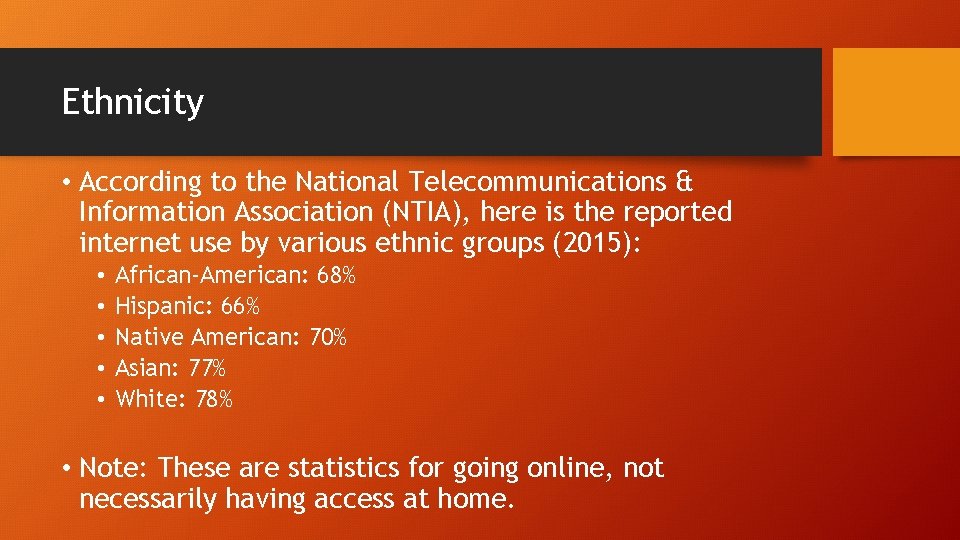
Ethnicity • According to the National Telecommunications & Information Association (NTIA), here is the reported internet use by various ethnic groups (2015): • • • African-American: 68% Hispanic: 66% Native American: 70% Asian: 77% White: 78% • Note: These are statistics for going online, not necessarily having access at home.
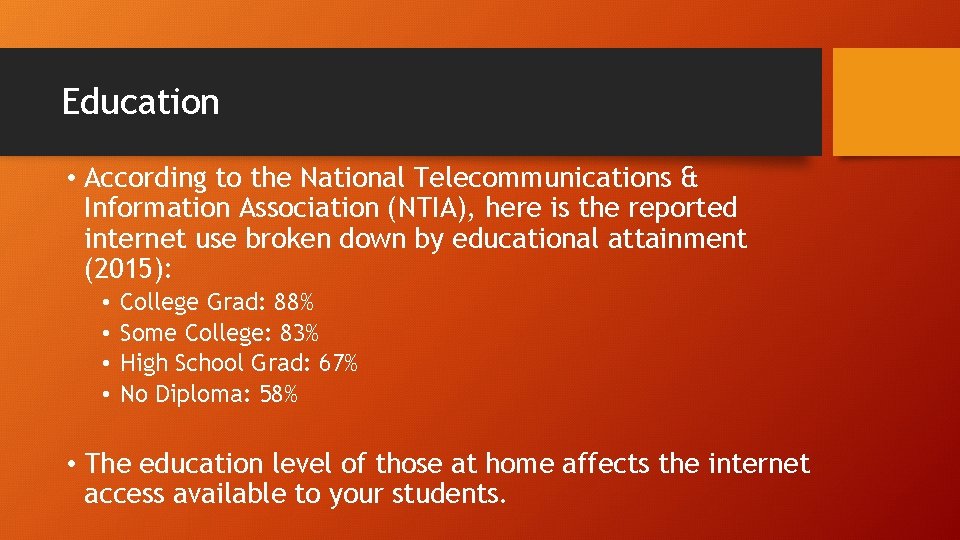
Education • According to the National Telecommunications & Information Association (NTIA), here is the reported internet use broken down by educational attainment (2015): • • College Grad: 88% Some College: 83% High School Grad: 67% No Diploma: 58% • The education level of those at home affects the internet access available to your students.
Geography • The NTIA (2010) reported that urban families are more likely to have internet access than are rural families.
Gender • There are significantly fewer women than men in technical and scientific fields, and in high school fewer girls than boys show interest in technical classes and clubs.
Social • According to the NTIA (2010) and Harvey (2014), another obstacle to internet use in eduction is students’ unwillingness to use devices for school.
Economic • “According to a Tech. Week Live article, "New Efforts Bring Poor And Minority Users Into Tech Revolution”, households with incomes greater than $75, 000 are more than 20 times more likely to have Internet access than households in lower income brackets are. ” (Steele. Carlin, 2000)
Teacher Choice/Use According to Warschauer, Knobel, Stone (2004): • More recent research has investigated how computers are used by different groups of students. Schofield and Davidson’s (2004) qualitative study of Internet use in schools documented how online access is often provided as a privilege or reward to the most advanced students, thus amplifying other forms of inequality in schools. Becker’s (2000) national survey analyzed school use by subject area, showing that low-SES students actually use computers more than high-SES students in math and English courses, where computer-based drills are common, but high-SES students are the main users of technology in science courses, where computers are often used for simulations and research. An emphasis on remedial or vocational uses of new technology by low-SES or Black and Hispanic students and more academic uses of technology by high-SES or White and Asian students was similarly found by Wenglinsky (1998) and Warschauer (2000).
What can we do? • Teachers can structure their class so that internetdependent work (such as researching and downloading sources) is done in class, and the work that students do at home does not require an internet connection.
What can we do? • Teachers can provide whatever is needed for work outside of the classroom that students can load onto the harddrive/flashdrive of their school-issued computers (not in cloud storage).
What can we do? • Students should download their etextbooks onto their computers so that they do not need internet access to use them at home.
What can we do? • Teachers can seek out opportunities to highlight role models for women and minorities in technical fields, and they can encourage participation in technology clubs (like robotics) and enrollment in other technical classes.
What can we do? • Teachers can provide students with a list of free access points in their neighborhoods, such as: • • Public Library Public Parks Mac. Donalds Starbucks
Teachers Need To Know • Poll your students to find out who does not have access to internet at home. • Be aware: self reporting is not totally reliable because many students are embarrassed to say they do not have internt at home. • Check with guidance/administration to verify your findings.
References 1. Steele-Carlin, S. (2000) Caught in the digital divide. Education World. Retrieved from: http: //www. educationworld. com/a_tech/tech 041. shtml 2. Morris, J. B. (2016, March 21). First look: Internet use in 2015. [Web Log]. Retrieved from: https: //www. ntia. doc. gov/blog/2016/first-lookinternet-use-2015 3. National Telecommunications & Information Administration (2010, November 30). Exploring the digital divide. [Web Log]. Retrieved from: https: //www. ntia. doc. gov/blog/2010/exploring-digital-divide 4. Harvey, B. (2014, July 2). Bridging the digital divide in classrooms. Education Week. Retrieved from: http: //www. edweek. org/tm/articles/2014/07/02/ctq-harveydigital. html
References 5. Johnson, D. (February 2015). Power up! / Helping to close the digital divide. Educational Leadership, 72 (5). Retrieved from: http: //www. ascd. org/publications/educationalleadership/feb 15/vol 72/num 05/Helping-to-Close-the-Digital. Divide. aspx 6. Warschauer, M. Knobel, M. Stone, L. (September 2004). Technology and Equity in Schooling: Deconstructing the Digital Divide. Educational Policy, 18 (4). Retrieved from: http: //www. education. uci. edu/person/warschauer_m/docs/tes. pdf