
The Digestive System The ENTERIC GI system Mouth




- Slides: 40
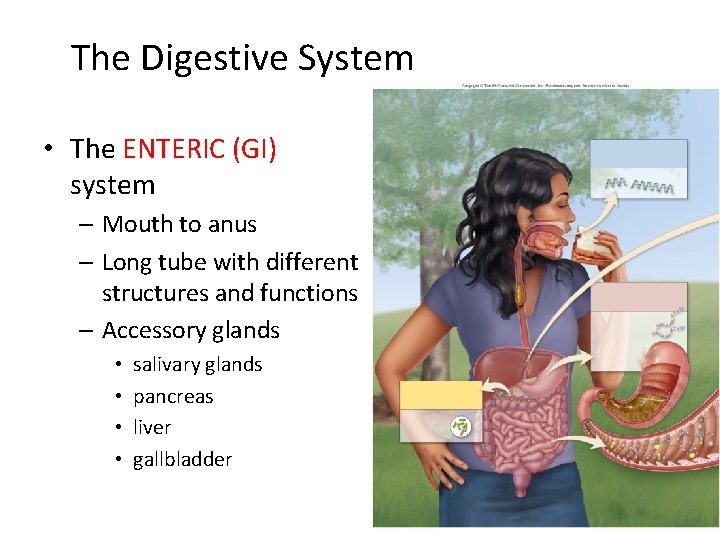
The Digestive System • The ENTERIC (GI) system – Mouth to anus – Long tube with different structures and functions – Accessory glands • • salivary glands pancreas liver gallbladder 1
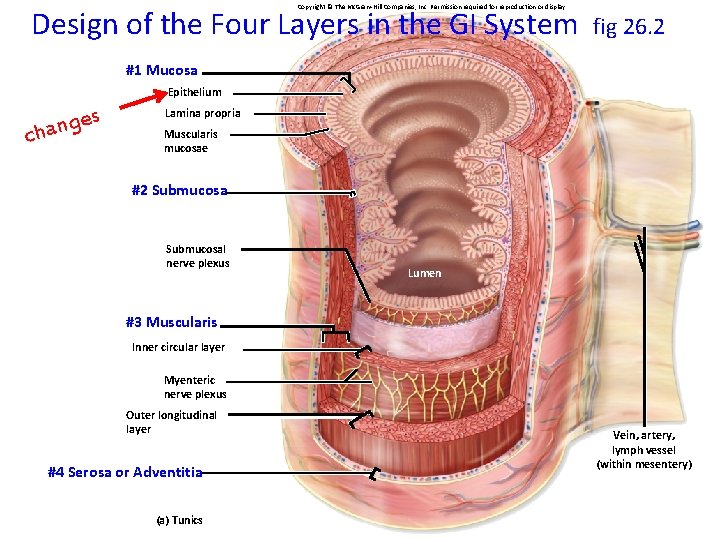
Objectives: Digestive System • Understand the digestive system is a series of tubes with different epithelia and cells = mouth to the anus • Describe the 4 layers in the tubes (mucosa, submucosa, muscularis externa, adventitia or serosa • Describe the structure and functions of each organ: mouth, esophagus, stomach, duodenum, small intestine, and large intestine. • Describe the structure and function of the accessory organs (salivary, pancreas, liver, and gallbladder) • Understand describe the control mechanisms: – nervous system (intrinsic and extrinsic) and – hormonal – paracrine and endocrine mechanisms • Describe the secretory cells in the tubes and accessory glands • Understand why motility (via muscle contraction) of the tubes is important • Explain where and how the processes of digestion, absorption, and excretion occur 2
The Plan • Introduction – – 1. General concepts • Follow food as it moves thru the digestive tract and discuss the anatomy and physiology or each area – 2. Mouth thru esophagus – 3. Stomach – 4. Duodenum and accessory glands – liver, gall bladder and pancreas – 5. Small intestine and large intestine 3
Readings – Digestive 1 • Mc. Kinley, O’Loughlin, and Bidle, Anatomy and Physiology An integrative Approach, p 10151061. • Overview of the Digestive System 1015 -1019 4
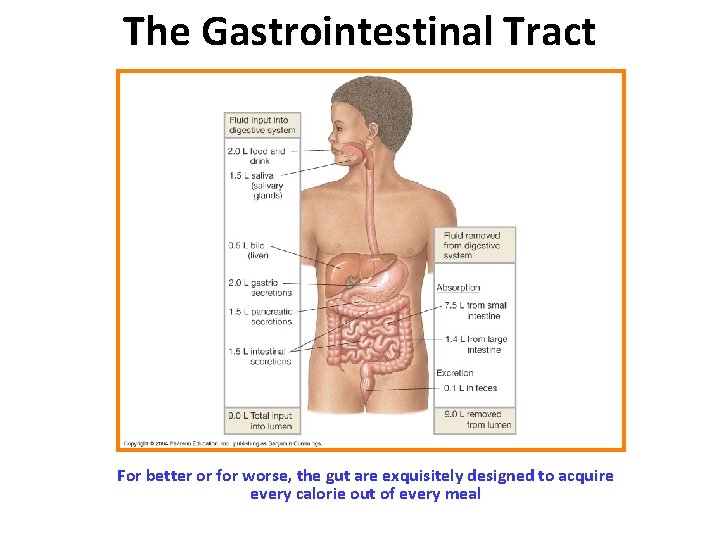
The Gastrointestinal Tract For better or for worse, the gut are exquisitely designed to acquire every calorie out of every meal
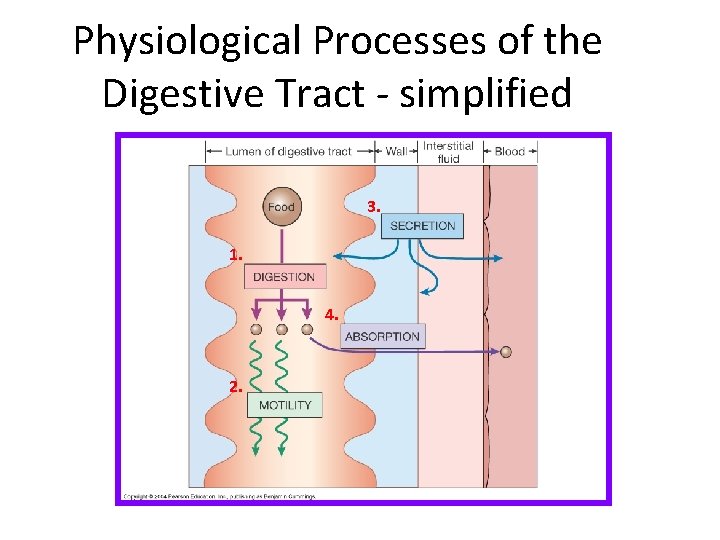
Physiological Processes of the Digestive Tract - simplified 3. 1. 4. 2.
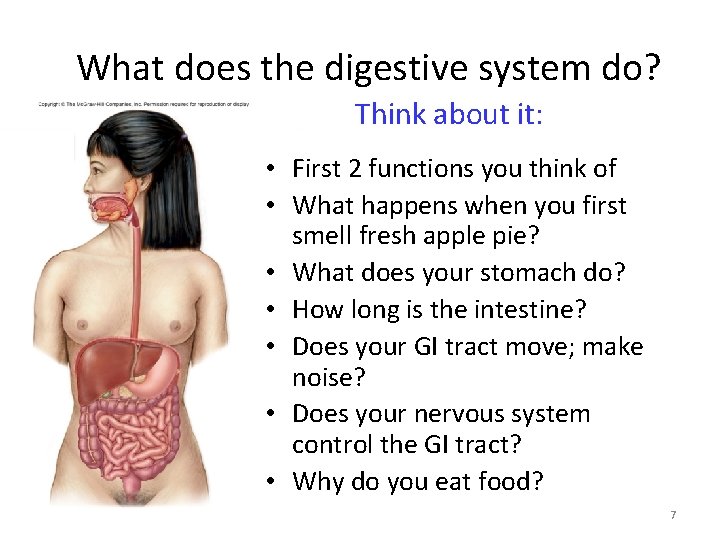
What does the digestive system do? Think about it: • First 2 functions you think of • What happens when you first smell fresh apple pie? • What does your stomach do? • How long is the intestine? • Does your GI tract move; make noise? • Does your nervous system control the GI tract? • Why do you eat food? 7
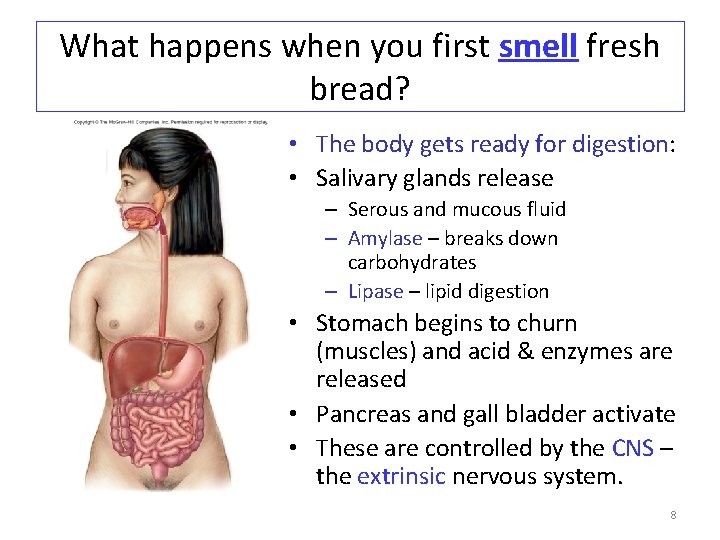
What happens when you first smell fresh bread? • The body gets ready for digestion: • Salivary glands release – Serous and mucous fluid – Amylase – breaks down carbohydrates – Lipase – lipid digestion • Stomach begins to churn (muscles) and acid & enzymes are released • Pancreas and gall bladder activate • These are controlled by the CNS – the extrinsic nervous system. 8
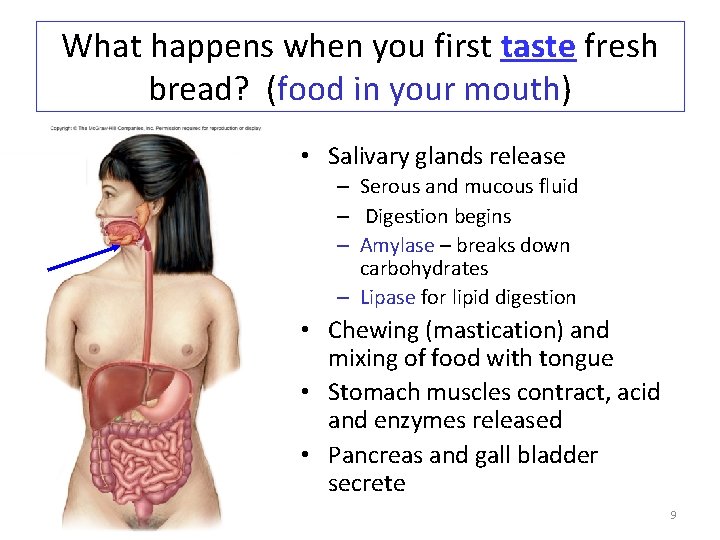
What happens when you first taste fresh bread? (food in your mouth) • Salivary glands release – Serous and mucous fluid – Digestion begins – Amylase – breaks down carbohydrates – Lipase for lipid digestion • Chewing (mastication) and mixing of food with tongue • Stomach muscles contract, acid and enzymes released • Pancreas and gall bladder secrete 9
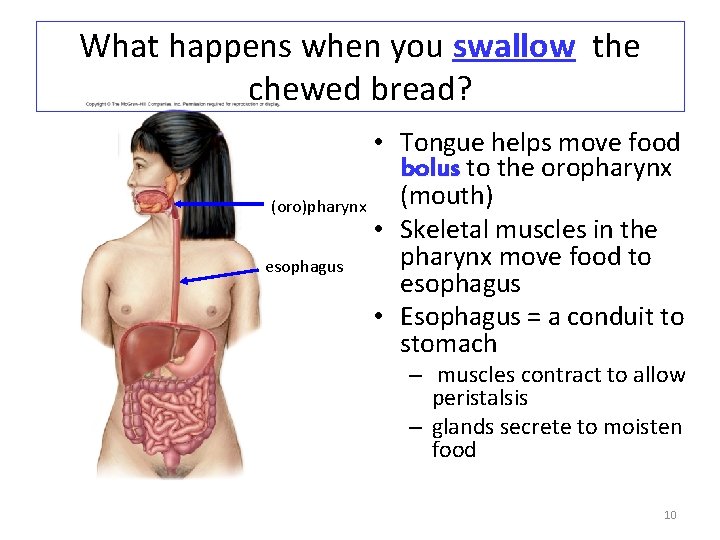
What happens when you swallow the chewed bread? • Tongue helps move food bolus to the oropharynx (mouth) (oro)pharynx • Skeletal muscles in the pharynx move food to esophagus • Esophagus = a conduit to stomach – muscles contract to allow peristalsis – glands secrete to moisten food 10
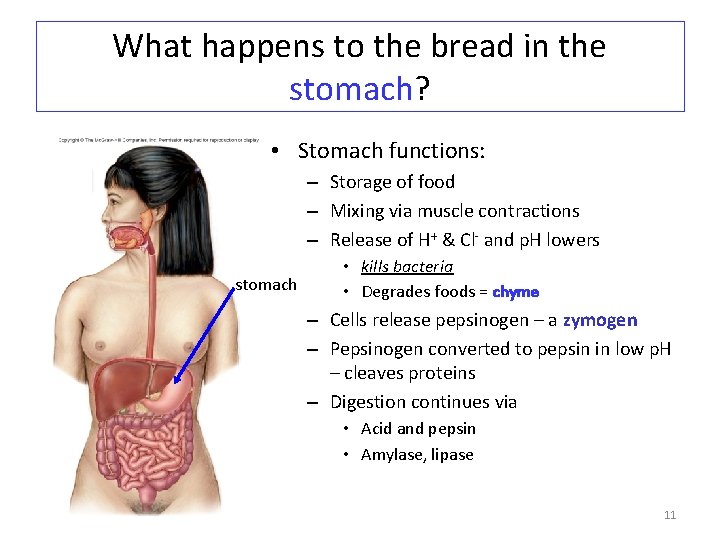
What happens to the bread in the stomach? • Stomach functions: – Storage of food – Mixing via muscle contractions – Release of H+ & Cl- and p. H lowers stomach • kills bacteria • Degrades foods = chyme – Cells release pepsinogen – a zymogen – Pepsinogen converted to pepsin in low p. H – cleaves proteins – Digestion continues via • Acid and pepsin • Amylase, lipase 11
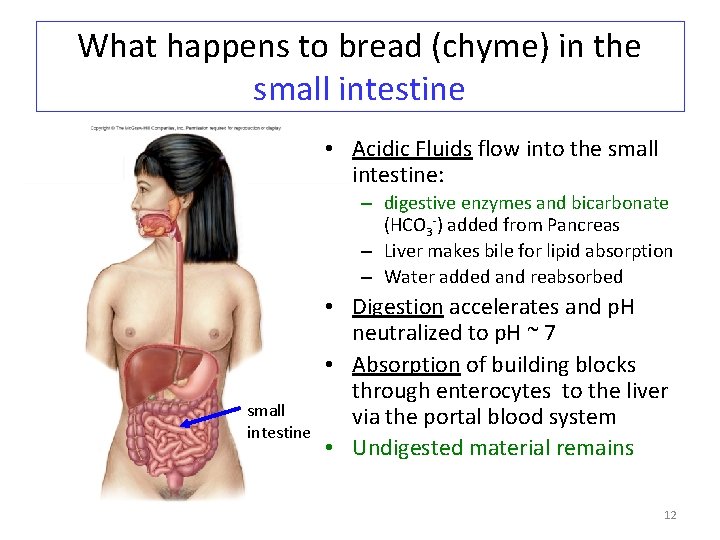
What happens to bread (chyme) in the small intestine • Acidic Fluids flow into the small intestine: – digestive enzymes and bicarbonate (HCO 3 -) added from Pancreas – Liver makes bile for lipid absorption – Water added and reabsorbed small intestine • Digestion accelerates and p. H neutralized to p. H ~ 7 • Absorption of building blocks through enterocytes to the liver via the portal blood system • Undigested material remains 12
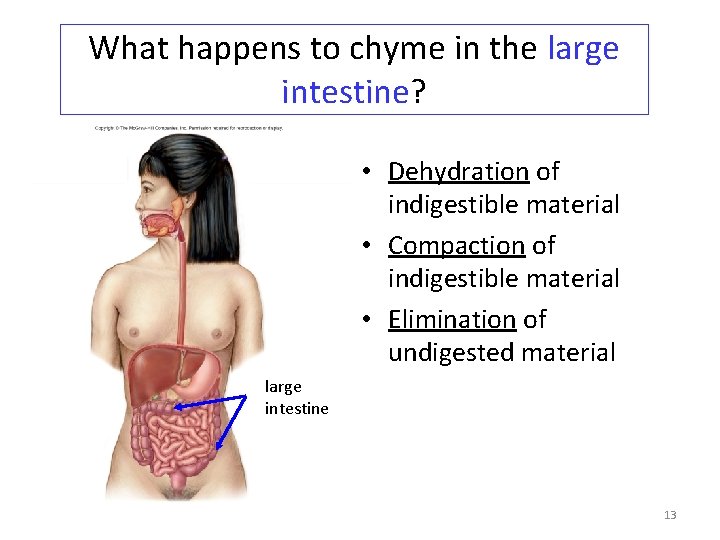
What happens to chyme in the large intestine? • Dehydration of indigestible material • Compaction of indigestible material • Elimination of undigested material large intestine 13
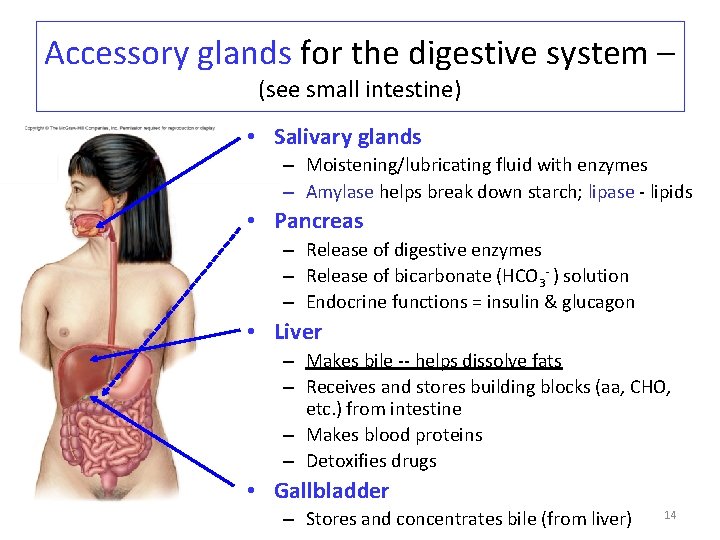
Accessory glands for the digestive system – (see small intestine) • Salivary glands – Moistening/lubricating fluid with enzymes – Amylase helps break down starch; lipase - lipids • Pancreas – Release of digestive enzymes – Release of bicarbonate (HCO 3 - ) solution – Endocrine functions = insulin & glucagon • Liver – Makes bile -- helps dissolve fats – Receives and stores building blocks (aa, CHO, etc. ) from intestine – Makes blood proteins – Detoxifies drugs • Gallbladder – Stores and concentrates bile (from liver) 14
Copyright © The Mc. Graw-Hill Companies, Inc. Permission required for reproduction or display. Digestive ummary S System Accessory Digestive Organs (Figure 26. 1) Teeth Tongue: mechanical processing, moistening, and mixing with salivary secretions Salivary glands: secretion of lubricating fluids with enzymes to breakdown carbohydrates and lipids Gastrointestinal (GI) Tract Oral cavity Pharynx: muscular propulsion of materials into the esophagus Esophagus: conduit to the stomach (15”) Liver: synthesis of bile, storage of nutrients, many other functions Gallbladder: Storage, concentration and secretion of bile Pancreas: exocrine portion secrete buffers and digestive enzymes and endocrine portion secretes hormones Stomach: chemical breakdown of materials by acidic and enzymatic processing and mechanical mixing via muscular contractions ( 12”) Small intestine: enzymatic digestion and absorption of nutrients (20’) Large intestine: dehydration and compaction of materials in preparation for elimination (3’) Anus
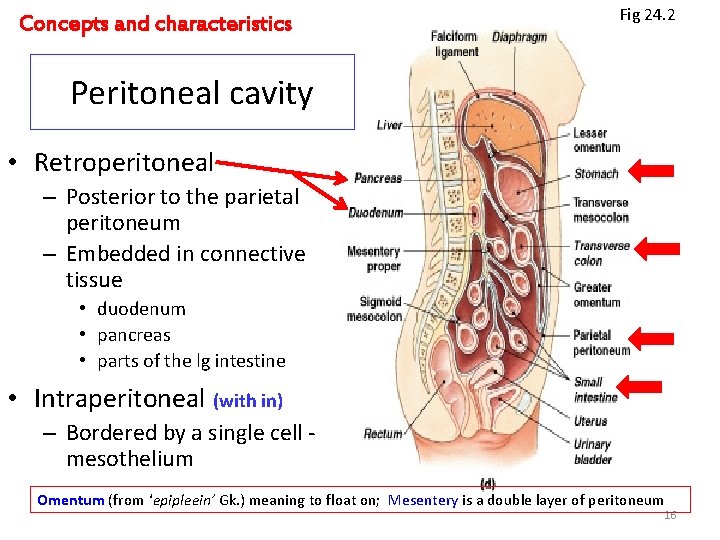
Concepts and characteristics Fig 24. 2 Peritoneal cavity • Retroperitoneal – Posterior to the parietal peritoneum – Embedded in connective tissue • duodenum • pancreas • parts of the lg intestine • Intraperitoneal (with in) – Bordered by a single cell mesothelium Omentum (from ‘epipleein’ Gk. ) meaning to float on; Mesentery is a double layer of peritoneum 16
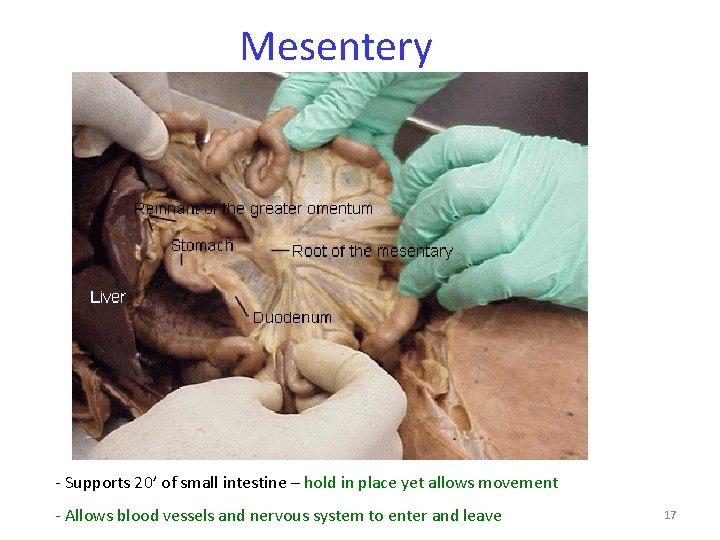
Mesentery - Supports 20’ of small intestine – hold in place yet allows movement - Allows blood vessels and nervous system to enter and leave 17
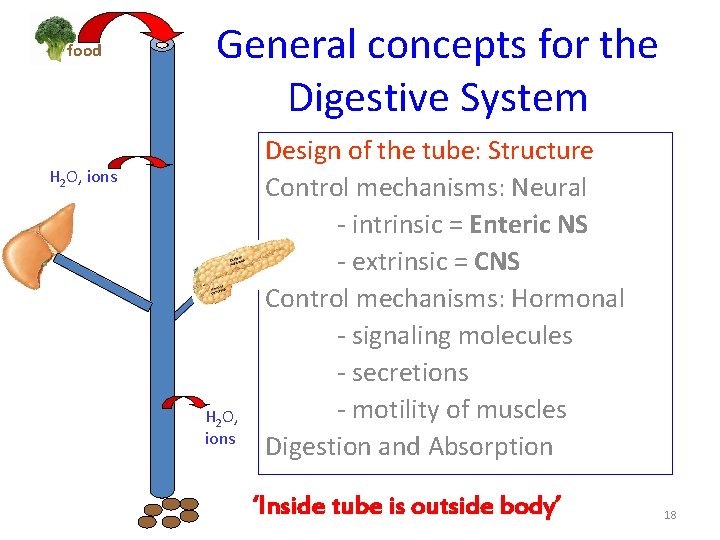
food General concepts for the Digestive System H 2 O, ions Design of the tube: Structure Control mechanisms: Neural - intrinsic = Enteric NS - extrinsic = CNS Control mechanisms: Hormonal - signaling molecules - secretions - motility of muscles Digestion and Absorption ‘Inside tube is outside body’ 18
Copyright © The Mc. Graw-Hill Companies, Inc. Permission required for reproduction or display. Design of the Four Layers in the GI System fig 26. 2 #1 Mucosa Epithelium c s e g n ha Lamina propria Muscularis mucosae #2 Submucosal nerve plexus Lumen #3 Muscularis Inner circular layer Myenteric nerve plexus Outer longitudinal layer #4 Serosa or Adventitia (a) Tunics Vein, artery, lymph vessel (within mesentery)
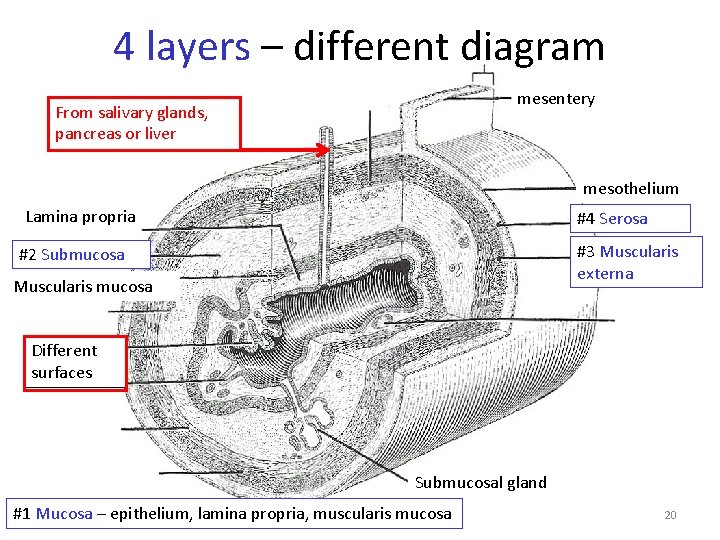
4 layers – different diagram mesentery From salivary glands, pancreas or liver mesothelium Lamina propria #4 Serosa #3 Muscularis externa #2 Submucosa Muscularis mucosa Different surfaces Submucosal gland #1 Mucosa – epithelium, lamina propria, muscularis mucosa 20
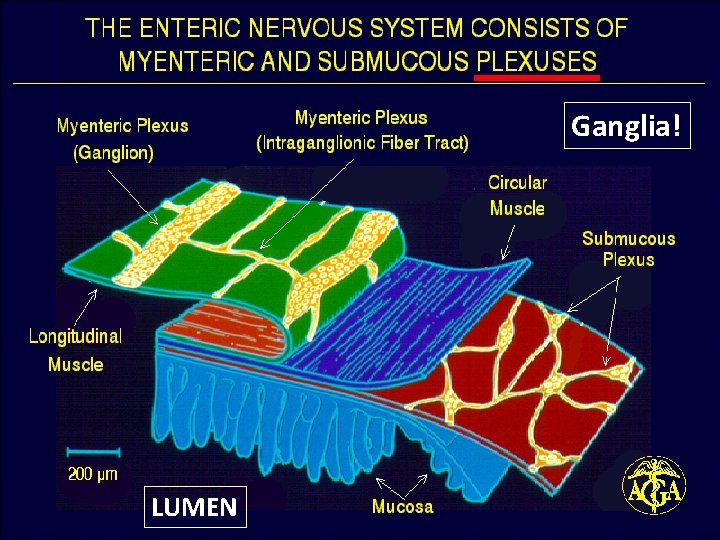
Fig 24. 4 Peristalsis, segmentation, and… • Ganglia! Peristalsis – process that moves chyme forward – in 1 direction • Segmentation – irregular contractions forcing chyme in both directions NO NET PROGRESS – Passes nutrients back and forth to optimize absorption • Interstitial cells of Cajal – motor neurons in the myenteric plexus – Intrinsic control – Slow, constant contractions LUMEN 21
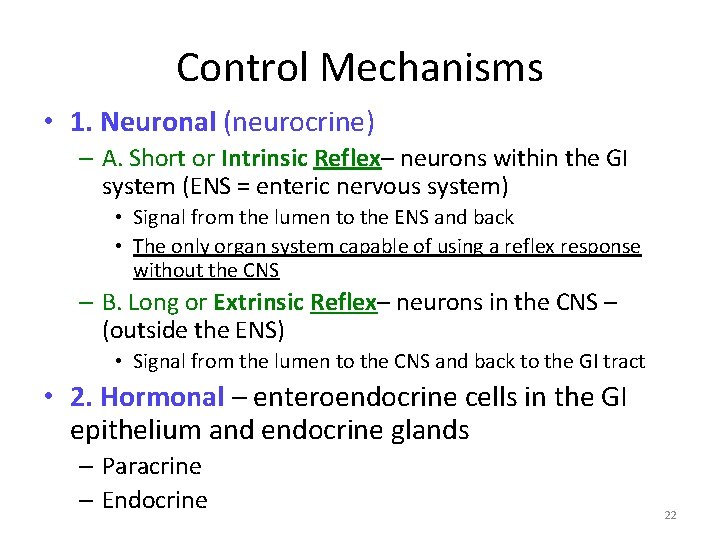
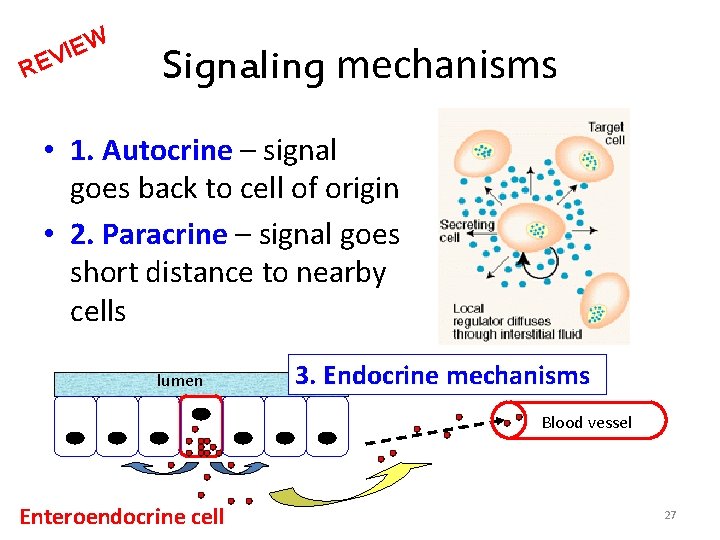
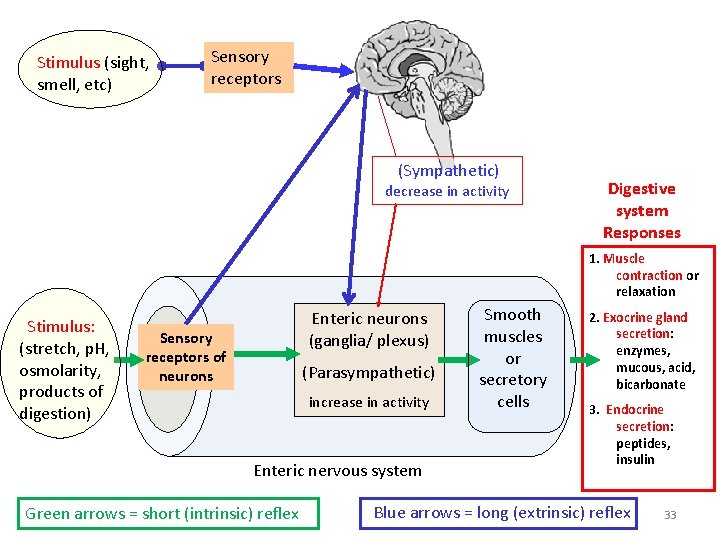
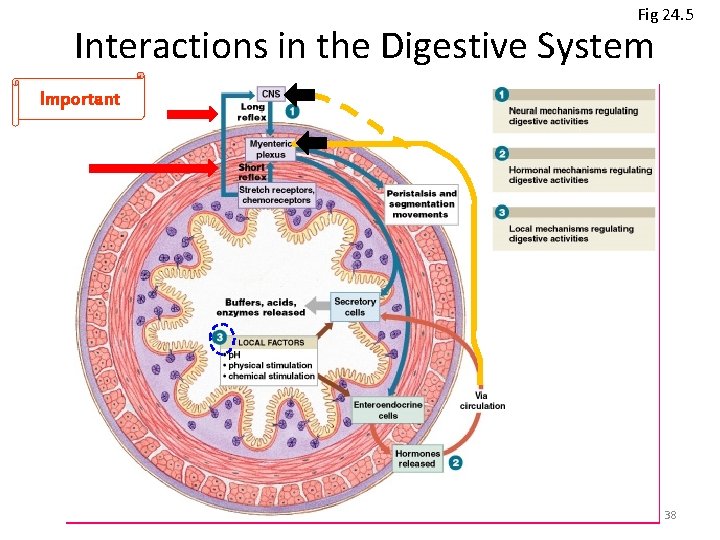
Control Mechanisms • 1. Neuronal (neurocrine) – A. Short or Intrinsic Reflex– neurons within the GI system (ENS = enteric nervous system) • Signal from the lumen to the ENS and back • The only organ system capable of using a reflex response without the CNS – B. Long or Extrinsic Reflex– neurons in the CNS – (outside the ENS) • Signal from the lumen to the CNS and back to the GI tract • 2. Hormonal – enteroendocrine cells in the GI epithelium and endocrine glands – Paracrine – Endocrine 22
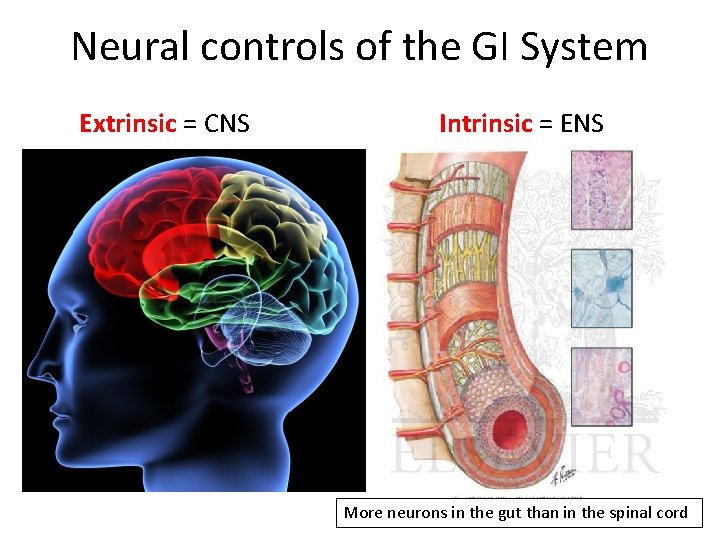
Neural controls of the GI System Extrinsic = CNS Intrinsic = ENS More neurons in the gut than in the spinal cord
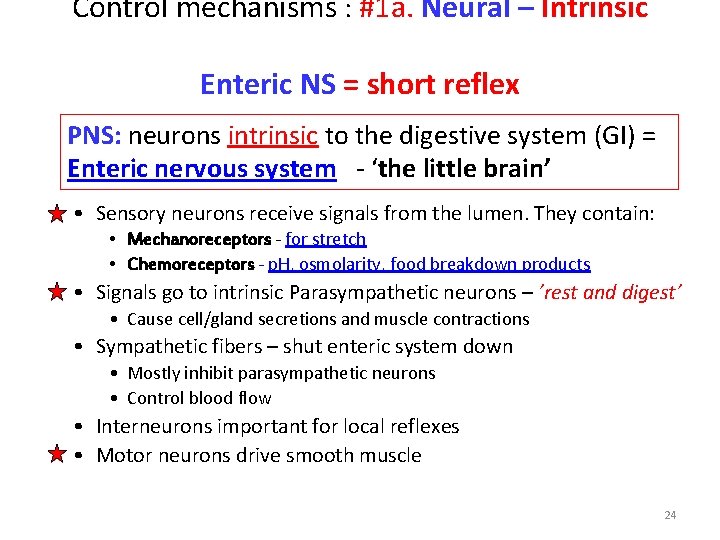
Control mechanisms : #1 a. Neural – Intrinsic Enteric NS = short reflex PNS: neurons intrinsic to the digestive system (GI) = Enteric nervous system - ‘the little brain’ • Sensory neurons receive signals from the lumen. They contain: • Mechanoreceptors - for stretch • Chemoreceptors - p. H, osmolarity, food breakdown products • Signals go to intrinsic Parasympathetic neurons – ’rest and digest’ • Cause cell/gland secretions and muscle contractions • Sympathetic fibers – shut enteric system down • Mostly inhibit parasympathetic neurons • Control blood flow • Interneurons important for local reflexes • Motor neurons drive smooth muscle 24
Control mechanisms : #1 b. Neural – Extrinsic CNS = long reflex • Input from 5 senses in CNS signal GI system • Starts gland cell secretions in mouth and stomach • Starts muscle contractions in stomach • OR Signals in GI are sent to the CNS – Sensory information(from GI) =afferent to CNS and response = efferent back to GI system = REFLEX – CNS sends signals to enteric neurons • controls GI gland cell secretions • controls GI muscle contractions– indirectly through – CNS influences can be modified by autonomic NS • Parasympathetic and sympathetic • Emotions (CNS) effect enteric system • Butterflies when flying 1 st time • Talking in front of a class – mouth is dry • Really scared – urination or diarrhea 25
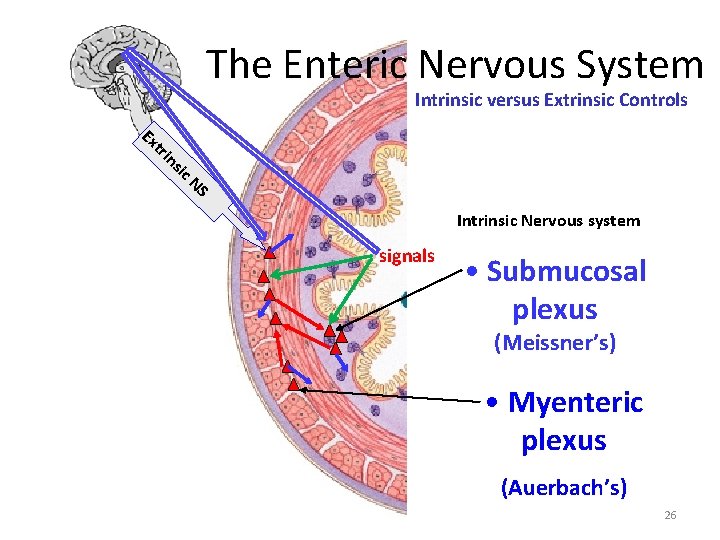
The Enteric Nervous System Intrinsic versus Extrinsic Controls ic ns tri Ex NS Intrinsic Nervous system signals • Submucosal plexus (Meissner’s) • Myenteric plexus (Auerbach’s) 26
W E I V RE Signaling mechanisms • 1. Autocrine – signal goes back to cell of origin • 2. Paracrine – signal goes short distance to nearby cells lumen 3. Endocrine mechanisms Blood vessel Enteroendocrine cell 27
Control mechanisms: #2. Hormonal • Hormonal mechanisms – Enteroendocrine cells ‘ taste’ chemicals in the lumen – Enteroendocrine release peptide hormones • Released into CT and then blood vessels – Function via paracrine & endocrine mechanisms • Controls secretion of gland cells (stomach, pancreas, etc. ) • Controls - enhance or inhibit muscle contraction • Influence intrinsic and extrinsic nervous system inputs – Endocrine hormones, eg. insulin, glucagon, etc 28
w e i v Re Glands - • Exocrine glands – release of products through duct systems • Endocrine glands – release of products into the circulation (blood vessels) to circulate to target cells – enteroendocrine cells secrete peptides – GI is the largest endocrine gland – 29
Secretions: cells & glands • Enteroendocrine cells (stomach, duodenum …) – Respond to events in the lumen (mechanical or chemical) = ‘taste buds’ of the gut – Secrete peptides – paracrine & endocrine (into the circulation) • Example: G cells release gastrin – a peptide • Gastrin – to near cells and enters into blood vessels and controls – Cell secretion – Muscle motility – Some also respond to CNS neural inputs • Exocrine Glands (gland cells secrete into ducts) – – Salivary glands make H 20 and enzymes Liver makes bile Pancreas makes digestive enzymes and bicarbonate (HCO 3 -) Duodenal glands make bicarbonate (HCO 3 -) to neutralize HCl 30
Motility = muscle movement • Skeletal muscle = voluntary control from CNS – Tongue and pharynx – Upper 2/3 esophagus – Anal region sphincter • Smooth muscle = involuntary control – Intrinsic control from enteric parasympathetic neurons on: • Muscularis mucosa: smooth muscle • Muscularis externa: inner circular and outer longitudinal bands – Extrinsic control from the CNS neurons • CNS neurons stimulate ENS parasympathetic neurons • Control muscles in the enteric nervous system • Modified by sympathetic neurons 31
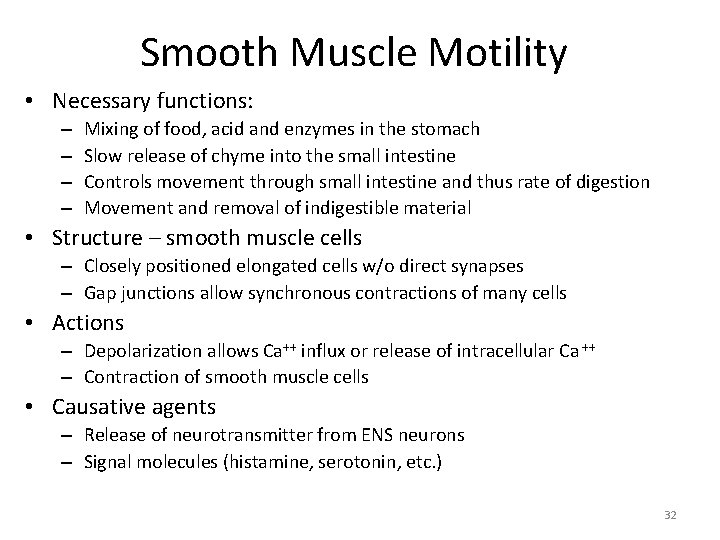
Smooth Muscle Motility • Necessary functions: – – Mixing of food, acid and enzymes in the stomach Slow release of chyme into the small intestine Controls movement through small intestine and thus rate of digestion Movement and removal of indigestible material • Structure – smooth muscle cells – Closely positioned elongated cells w/o direct synapses – Gap junctions allow synchronous contractions of many cells • Actions – Depolarization allows Ca++ influx or release of intracellular Ca ++ – Contraction of smooth muscle cells • Causative agents – Release of neurotransmitter from ENS neurons – Signal molecules (histamine, serotonin, etc. ) 32
Stimulus (sight, smell, etc) Sensory receptors (Sympathetic) decrease in activity Digestive system Responses 1. Muscle contraction or relaxation Stimulus: (stretch, p. H, osmolarity, products of digestion) Enteric neurons (ganglia/ plexus) Sensory receptors of neurons (Parasympathetic) increase in activity Enteric nervous system Green arrows = short (intrinsic) reflex Smooth muscles or secretory cells 2. Exocrine gland secretion: enzymes, mucous, acid, bicarbonate 3. Endocrine secretion: peptides, insulin Blue arrows = long (extrinsic) reflex 33
Digestion, Absorption & Elimination • Digestion – break down of foodstuffs to basic building blocks (aa, sugars, fats, nucleotides) • Absorption – passage of building blocks from intestine via portal system to the liver • Elimination – release of waste products and recovery of fluids 34
Summary: Digestive System • Series of tubes with different epithelia and cells = mouth to the anus • 4 layers to the tubes (mucosa, submucosa, muscularis externa, adventitia or serosa • Accessory organs (salivary, pancreas, liver, and gallbladder) • Controls: – nervous system (extrinsic and intrinsic) and – hormones – paracrine and endocrine mechanisms • Secretory cells in the tubes and accessory glands • Motility (muscle) of the tubes is important • Digestion, absorption, and excretion occur 35
What does the digestive system do? • First 2 functions you think of • What happens when you first smell fresh apple pie? • What does your stomach do? • How long is the intestine? • Does your GI tract move, make noise? • Does your nervous system control the GI tract? • Why do you eat food? 36
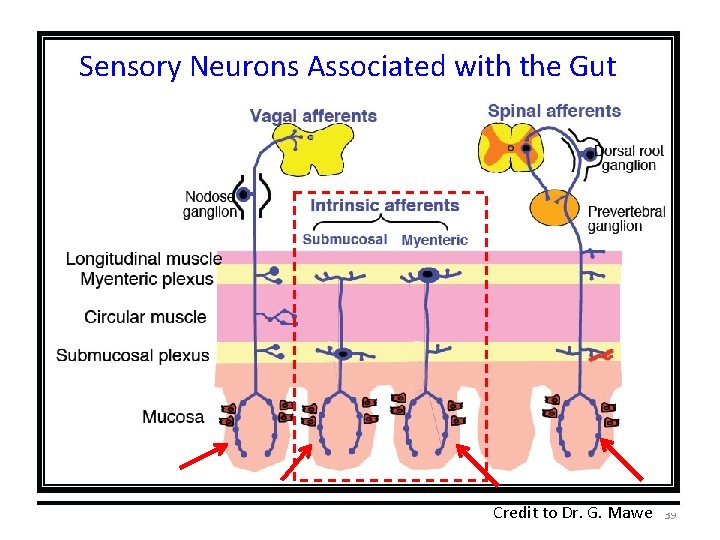
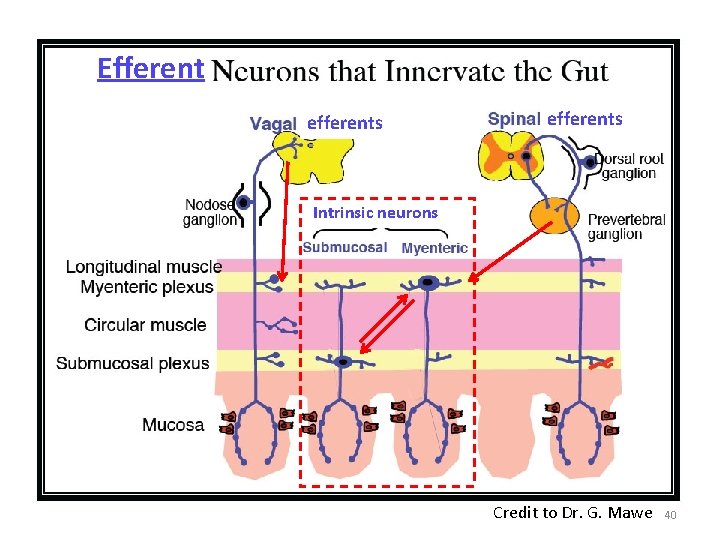
For those who want more. . • The next 3 images are alternative examples to explain the difference between the intrinsic (short) reflex and the extrinsic (long) reflex. • I have put an explanation of each figure in the ‘notes’ feature presented in Power. Point below the images
Fig 24. 5 Interactions in the Digestive System Important 38
Sensory Gut Sensory. Neurons. Associated with the Gut Intrinsic neurons Credit to Dr. G. Mawe 39
Efferent efferents Intrinsic neurons Credit to Dr. G. Mawe 40