
The Digestive System Human Anatomy 3 rd edition
- Slides: 30
The Digestive System Human Anatomy, 3 rd edition Prentice Hall, © 2001
Introduction • Structure of the digestive system – A tube that extends from mouth to anus – Accessory organs are attached • Functions include – – – Ingestion Movement Digestion Absorption Defecation Human Anatomy, 3 rd edition Prentice Hall, © 2001
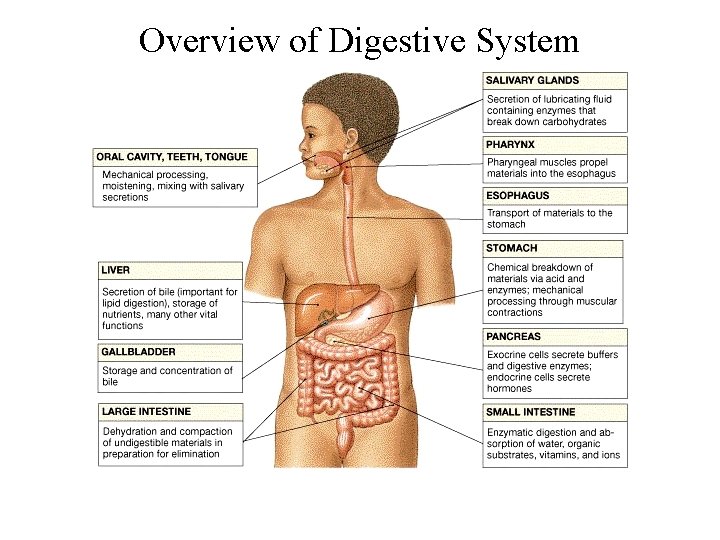
Overview of Digestive System
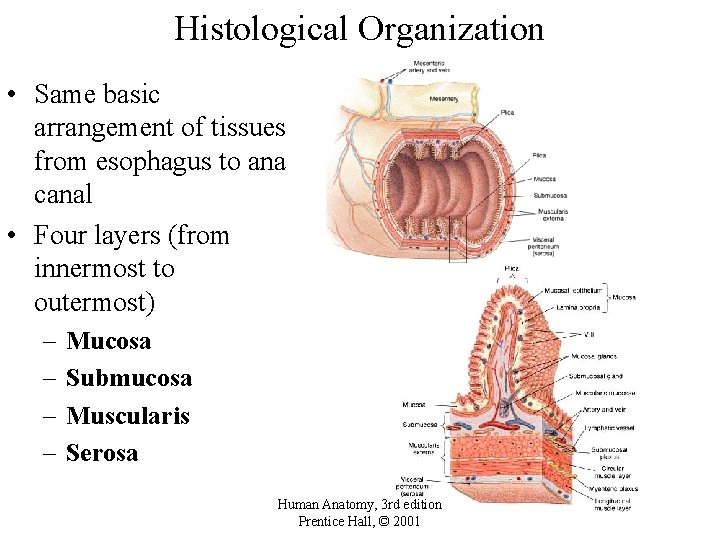
Histological Organization • Same basic arrangement of tissues from esophagus to anal canal • Four layers (from innermost to outermost) – – Mucosa Submucosa Muscularis Serosa Human Anatomy, 3 rd edition Prentice Hall, © 2001
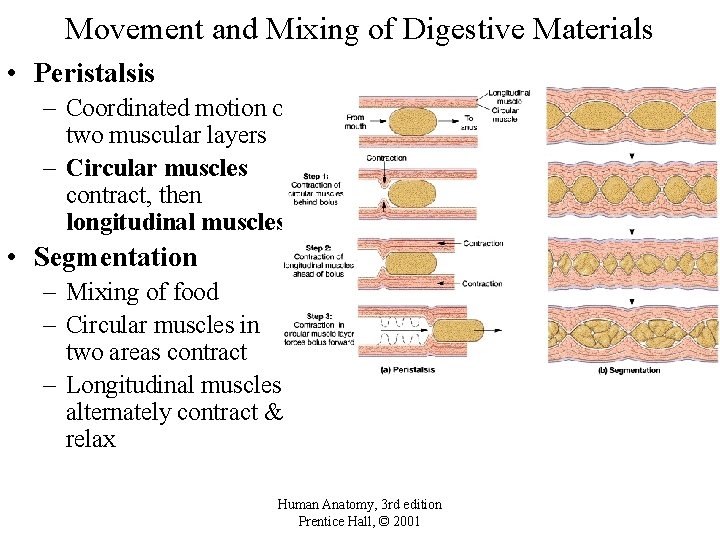
Movement and Mixing of Digestive Materials • Peristalsis – Coordinated motion of two muscular layers – Circular muscles contract, then longitudinal muscles • Segmentation – Mixing of food – Circular muscles in two areas contract – Longitudinal muscles alternately contract & relax Human Anatomy, 3 rd edition Prentice Hall, © 2001
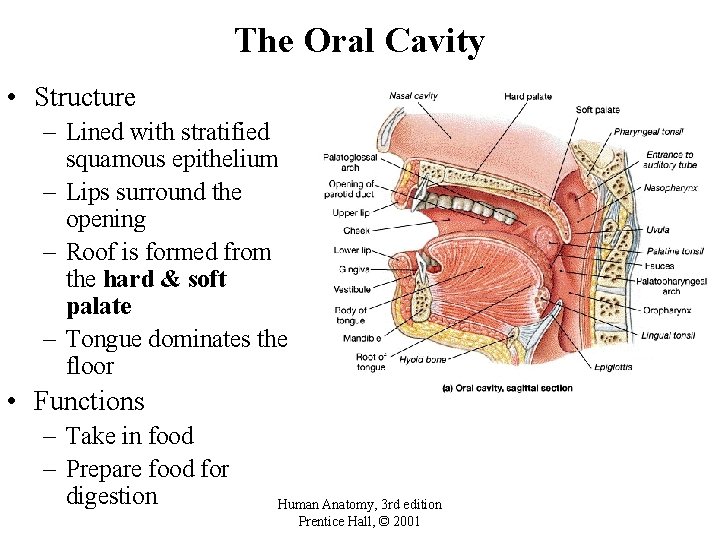
The Oral Cavity • Structure – Lined with stratified squamous epithelium – Lips surround the opening – Roof is formed from the hard & soft palate – Tongue dominates the floor • Functions – Take in food – Prepare food for digestion Human Anatomy, 3 rd edition Prentice Hall, © 2001
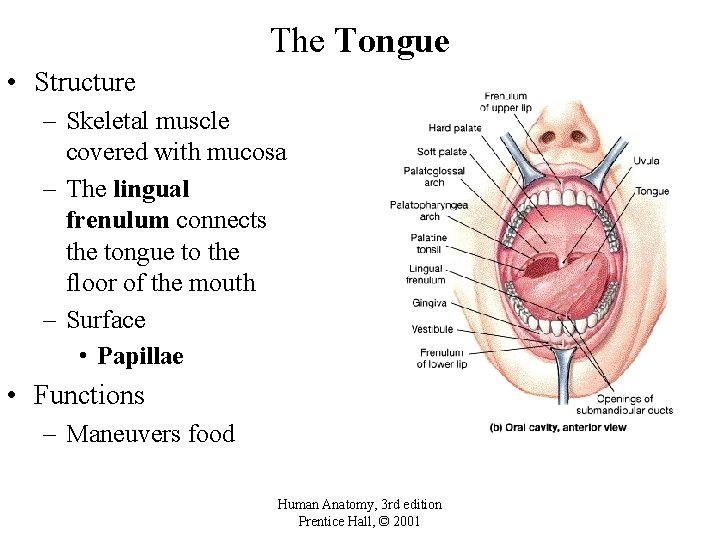
The Tongue • Structure – Skeletal muscle covered with mucosa – The lingual frenulum connects the tongue to the floor of the mouth – Surface • Papillae • Functions – Maneuvers food Human Anatomy, 3 rd edition Prentice Hall, © 2001
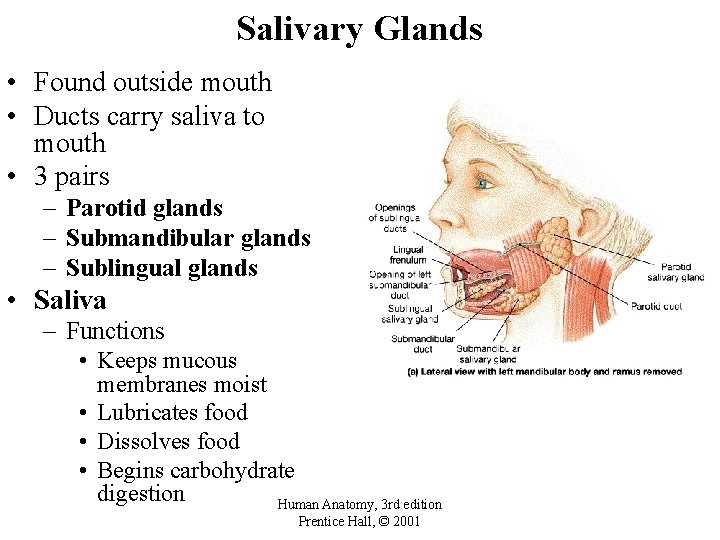
Salivary Glands • Found outside mouth • Ducts carry saliva to mouth • 3 pairs – Parotid glands – Submandibular glands – Sublingual glands • Saliva – Functions • Keeps mucous membranes moist • Lubricates food • Dissolves food • Begins carbohydrate digestion Human Anatomy, 3 rd edition Prentice Hall, © 2001
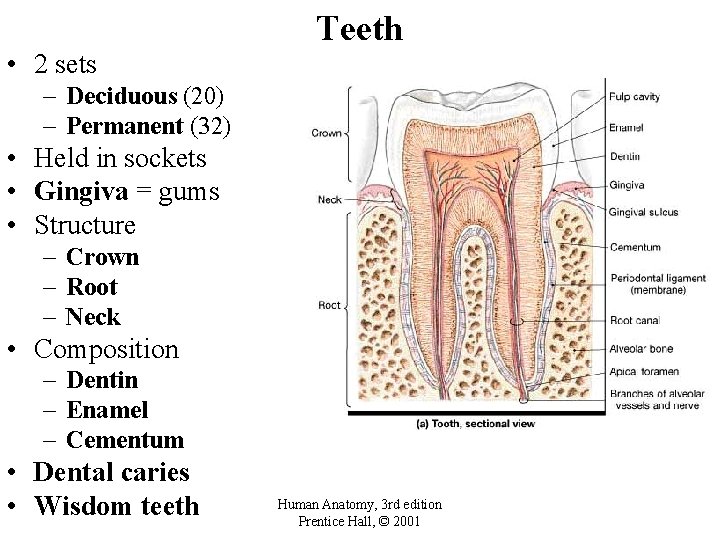
• 2 sets Teeth – Deciduous (20) – Permanent (32) • Held in sockets • Gingiva = gums • Structure – Crown – Root – Neck • Composition – Dentin – Enamel – Cementum • Dental caries • Wisdom teeth Human Anatomy, 3 rd edition Prentice Hall, © 2001
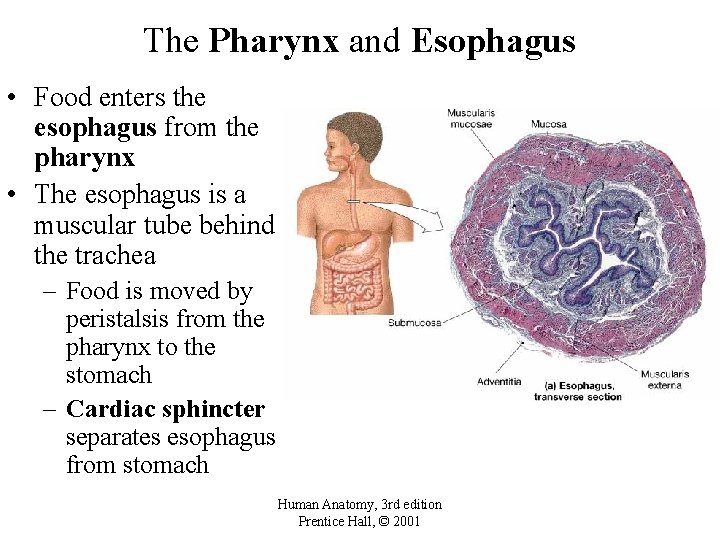
The Pharynx and Esophagus • Food enters the esophagus from the pharynx • The esophagus is a muscular tube behind the trachea – Food is moved by peristalsis from the pharynx to the stomach – Cardiac sphincter separates esophagus from stomach Human Anatomy, 3 rd edition Prentice Hall, © 2001
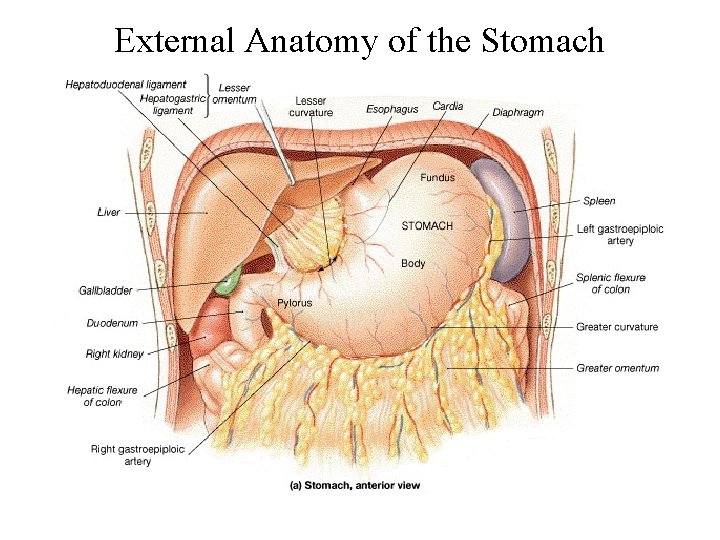
External Anatomy of the Stomach
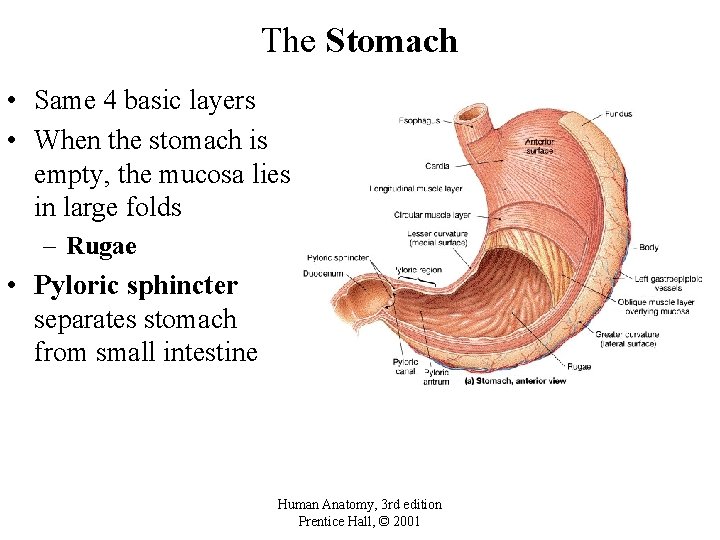
The Stomach • Same 4 basic layers • When the stomach is empty, the mucosa lies in large folds – Rugae • Pyloric sphincter separates stomach from small intestine Human Anatomy, 3 rd edition Prentice Hall, © 2001
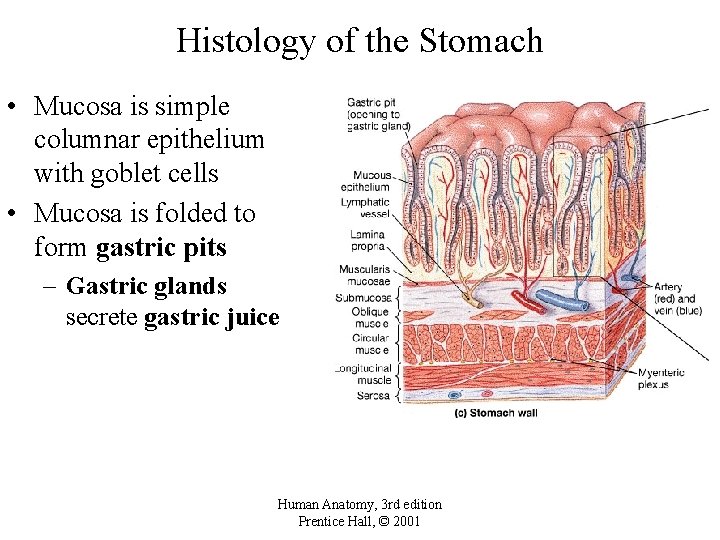
Histology of the Stomach • Mucosa is simple columnar epithelium with goblet cells • Mucosa is folded to form gastric pits – Gastric glands secrete gastric juice Human Anatomy, 3 rd edition Prentice Hall, © 2001
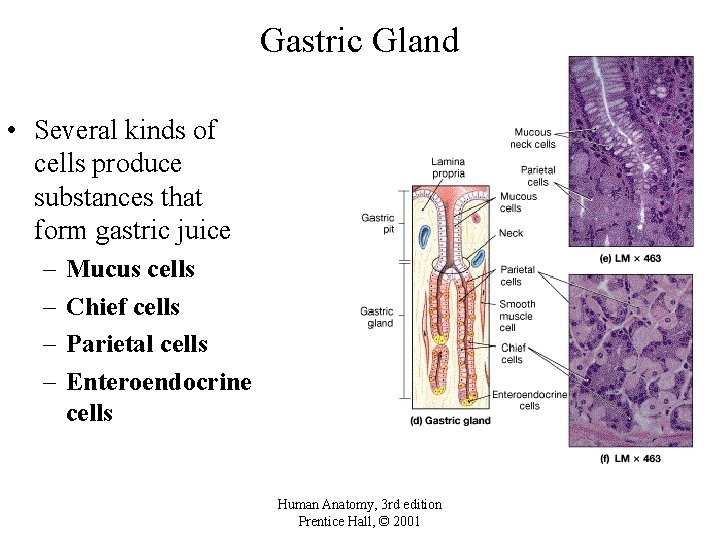
Gastric Gland • Several kinds of cells produce substances that form gastric juice – – Mucus cells Chief cells Parietal cells Enteroendocrine cells Human Anatomy, 3 rd edition Prentice Hall, © 2001
Functions of the Stomach • Mechanical digestion – Food reaches pylorus • Chemical digestion – Digestion of proteins • Absorption – – No food Water, electrolytes Some drugs Alcohol Human Anatomy, 3 rd edition Prentice Hall, © 2001
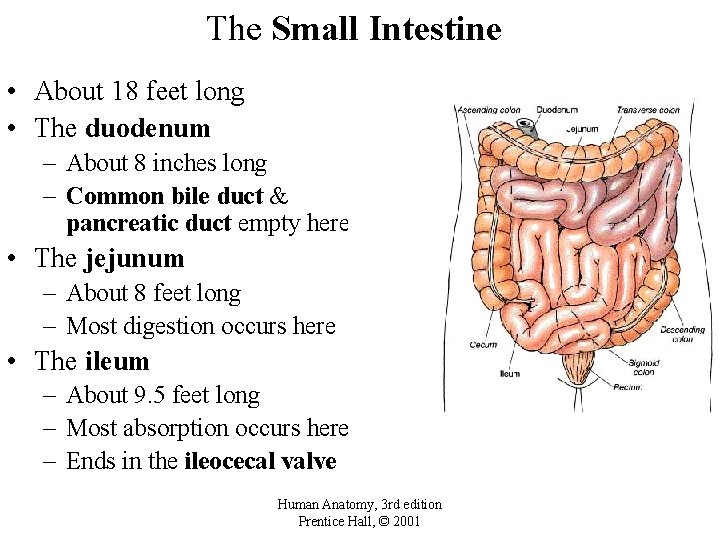
The Small Intestine • About 18 feet long • The duodenum – About 8 inches long – Common bile duct & pancreatic duct empty here • The jejunum – About 8 feet long – Most digestion occurs here • The ileum – About 9. 5 feet long – Most absorption occurs here – Ends in the ileocecal valve Human Anatomy, 3 rd edition Prentice Hall, © 2001
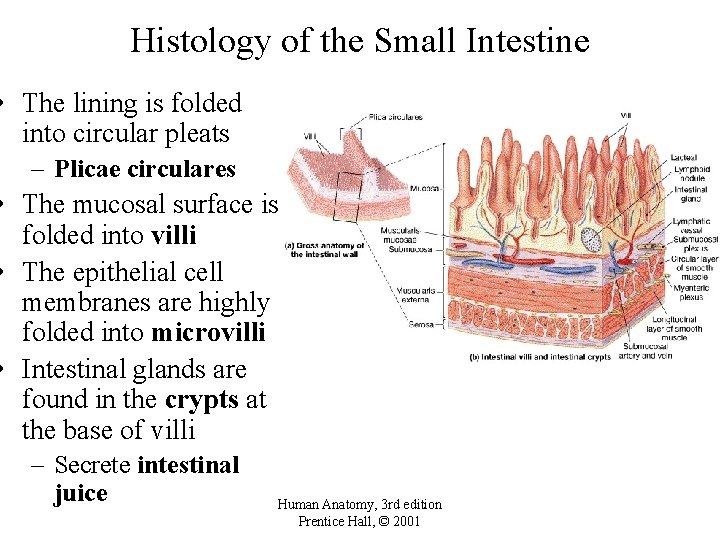
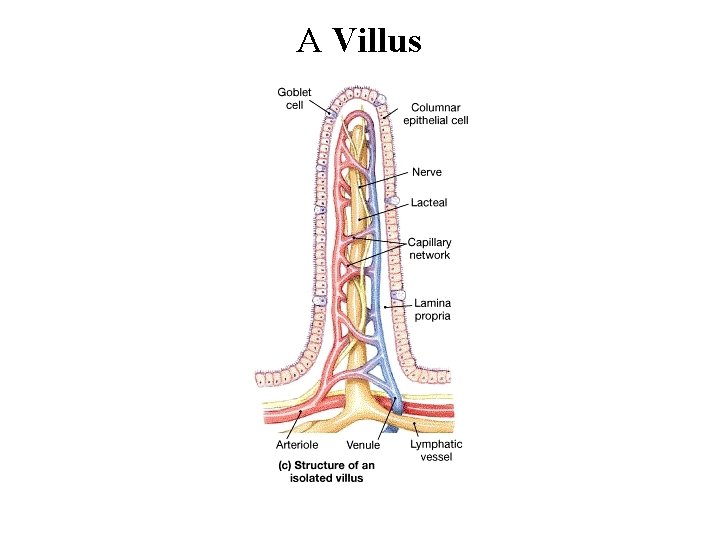
Histology of the Small Intestine • The lining is folded into circular pleats – Plicae circulares • The mucosal surface is folded into villi • The epithelial cell membranes are highly folded into microvilli • Intestinal glands are found in the crypts at the base of villi – Secrete intestinal juice Human Anatomy, 3 rd edition Prentice Hall, © 2001
A Villus
Functions of the Small Intestine • Chyme is further broken down – Proteins – Carbohydrates – Fats • Most absorption is in the small intestine Human Anatomy, 3 rd edition Prentice Hall, © 2001
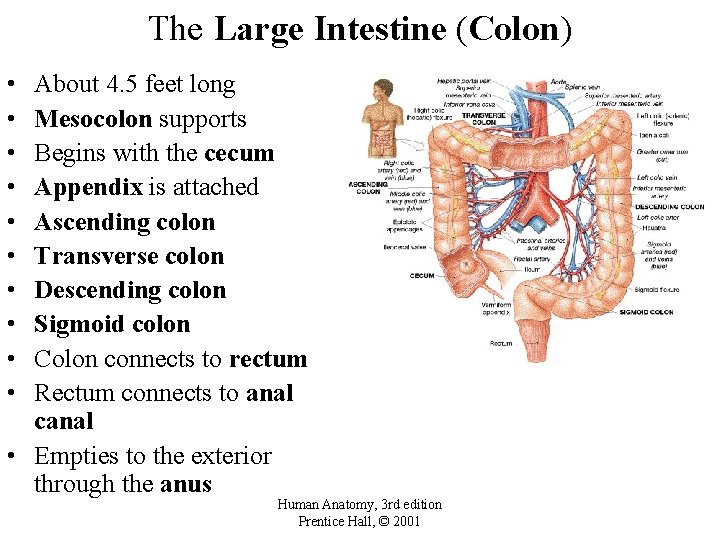
The Large Intestine (Colon) • • • About 4. 5 feet long Mesocolon supports Begins with the cecum Appendix is attached Ascending colon Transverse colon Descending colon Sigmoid colon Colon connects to rectum Rectum connects to anal canal • Empties to the exterior through the anus Human Anatomy, 3 rd edition Prentice Hall, © 2001
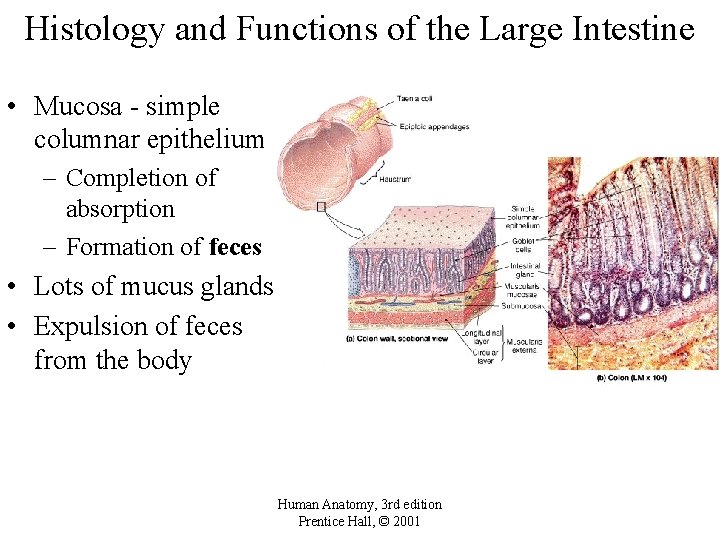
Histology and Functions of the Large Intestine • Mucosa - simple columnar epithelium – Completion of absorption – Formation of feces • Lots of mucus glands • Expulsion of feces from the body Human Anatomy, 3 rd edition Prentice Hall, © 2001
Digestion in the Large Intestine • Mechanical – Regulated by the ileocecal valve – Mixing and peristalsis – Mass peristalsis • Chemical – Mucus secreted – No enzymes – Bacteria – prepare chyme for elimination Human Anatomy, 3 rd edition Prentice Hall, © 2001
Feces Formation & Defecation • Chyme is now solid or semi-solid - feces • Large intestine absorbs any more water and electrolytes from feces • Defecation – Mass peristalsis pushes fecal material into rectum – Rectum stretches • Defecation reflex Human Anatomy, 3 rd edition Prentice Hall, © 2001
Accessory Organs • Liver • Pancreas • Gall bladder Human Anatomy, 3 rd edition Prentice Hall, © 2001
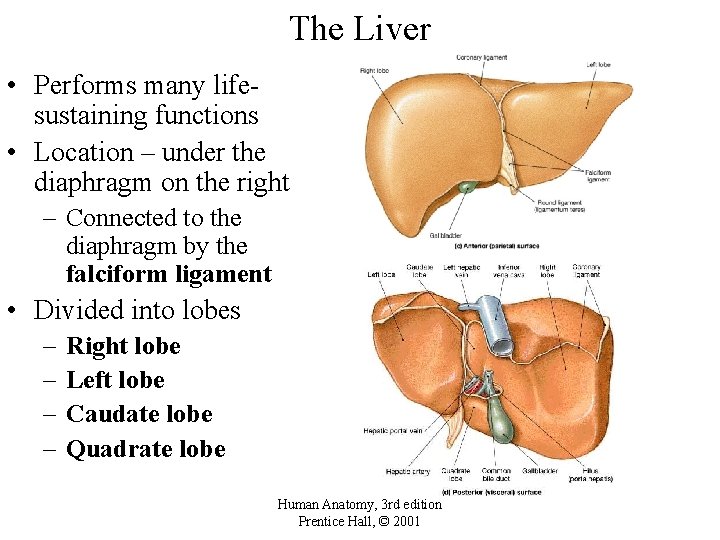
The Liver • Performs many lifesustaining functions • Location – under the diaphragm on the right – Connected to the diaphragm by the falciform ligament • Divided into lobes – – Right lobe Left lobe Caudate lobe Quadrate lobe Human Anatomy, 3 rd edition Prentice Hall, © 2001
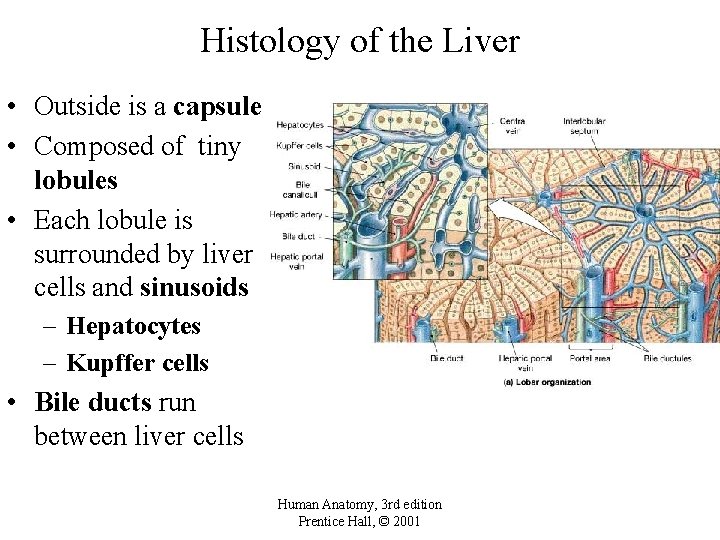
Histology of the Liver • Outside is a capsule • Composed of tiny lobules • Each lobule is surrounded by liver cells and sinusoids – Hepatocytes – Kupffer cells • Bile ducts run between liver cells Human Anatomy, 3 rd edition Prentice Hall, © 2001
Functions of the Liver • Produces bile – the primary digestive function – Composition • • Water Bile salts Cholesterol Pigments – Bilirubin – Digestive function • Emulsification of fats Human Anatomy, 3 rd edition Prentice Hall, © 2001
Other Functions of the Liver • • • Absorbs and stores iron, vitamins A, D, E, B 7, K Detoxifies toxins and hormones Metabolizes proteins, carbohydrates, and lipids Removes bacteria from the blood Produces plasma proteins Removes worn-out and damaged red blood cells Human Anatomy, 3 rd edition Prentice Hall, © 2001
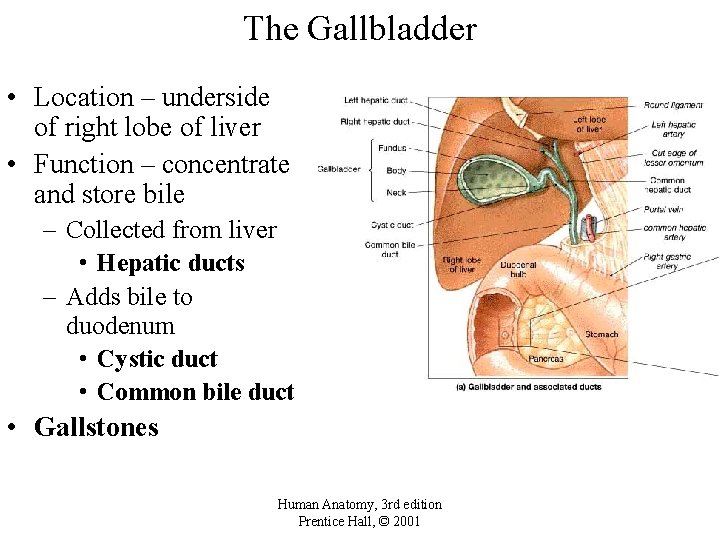
The Gallbladder • Location – underside of right lobe of liver • Function – concentrate and store bile – Collected from liver • Hepatic ducts – Adds bile to duodenum • Cystic duct • Common bile duct • Gallstones Human Anatomy, 3 rd edition Prentice Hall, © 2001
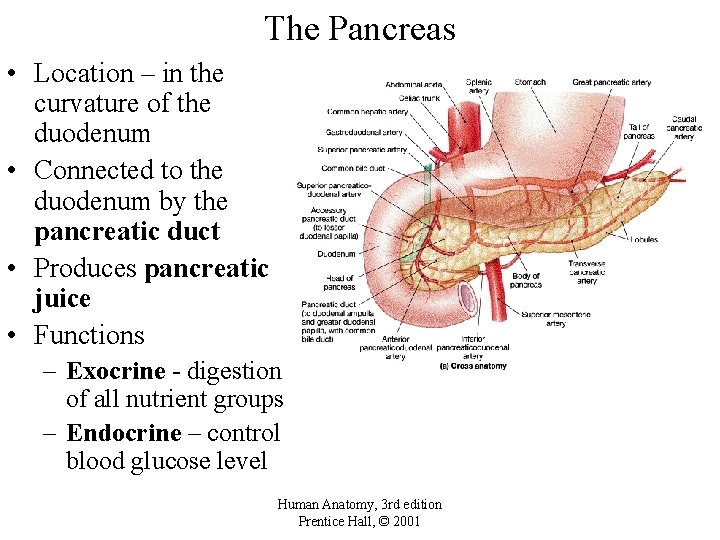
The Pancreas • Location – in the curvature of the duodenum • Connected to the duodenum by the pancreatic duct • Produces pancreatic juice • Functions – Exocrine - digestion of all nutrient groups – Endocrine – control blood glucose level Human Anatomy, 3 rd edition Prentice Hall, © 2001