
The Digestive System Exocrine glandwith duct Constituents of

- Slides: 30
The Digestive System
Exocrine gland---with duct Constituents of multicellular gland: secretory portion: tubular, acinar or tubuloacinar gland duct: passage of secretions Exocrine gland---without duct
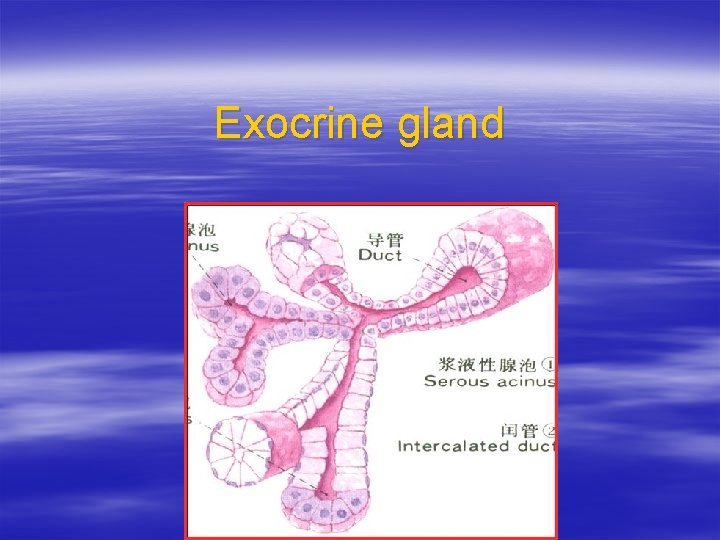
Exocrine gland
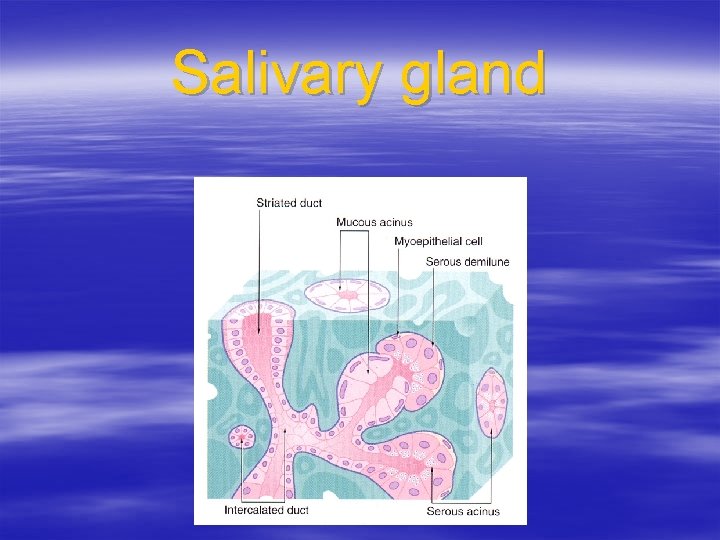
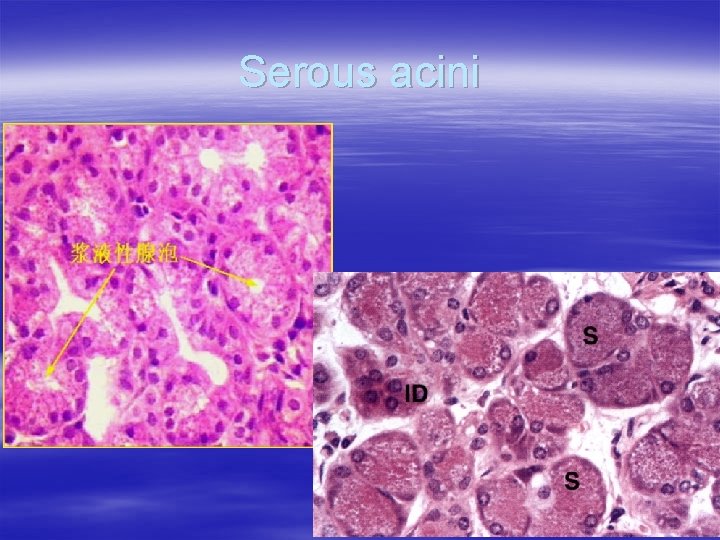
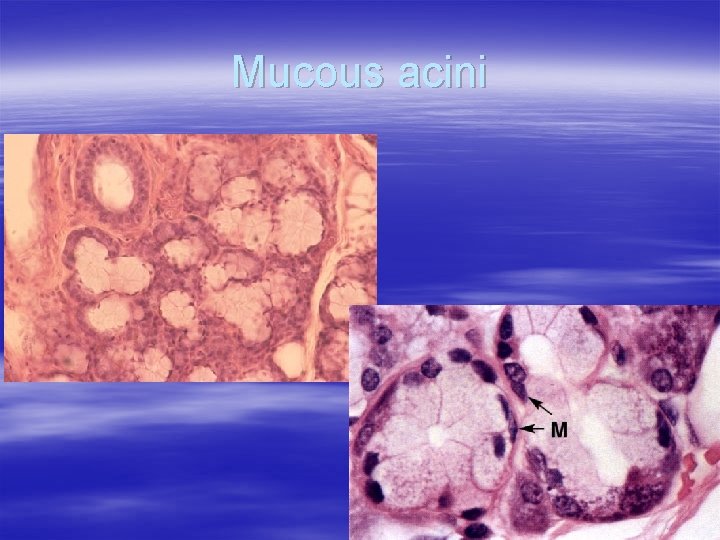
Salivary gland Acinus: mucous acinus, serous acinus , mixed acinus Duct: intercalated duct, striated duct, interlobular duct and common duct Serous acinus Mucous acinus Cell type Serous cell Mucous cell Cytoplasm Deep stained Light-blue stained Nucleus Spherical, near the base spindle, near the base Secretions Protein Mucoprotein (mucus)
Salivary gland
Serous acini
Mucous acini
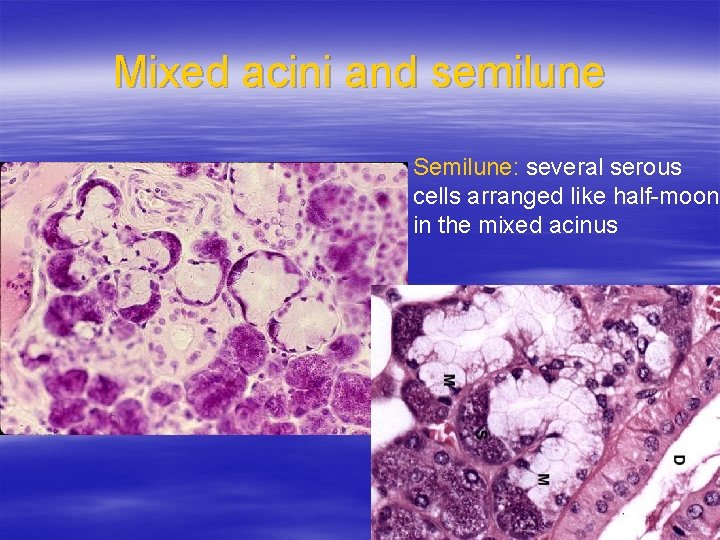
Mixed acini and semilune Semilune: several serous cells arranged like half-moon in the mixed acinus
Salivary glands 1. components: parotid gland, submandibular gland sublingual gland, etc. 2. function: secreting saliva.
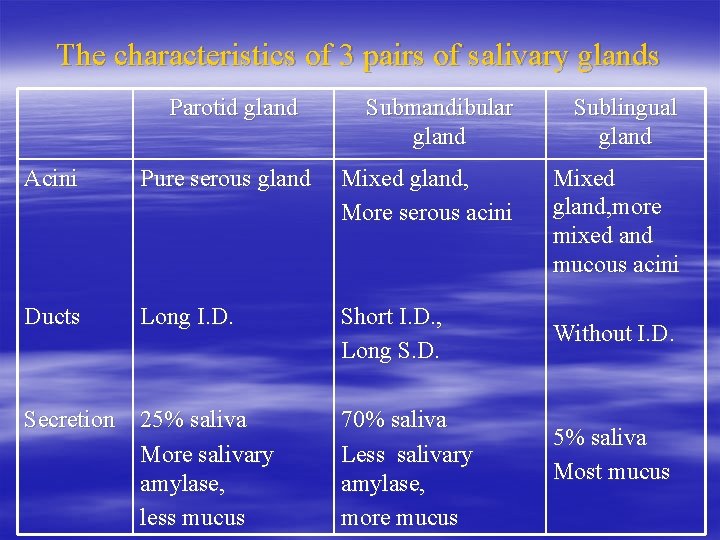
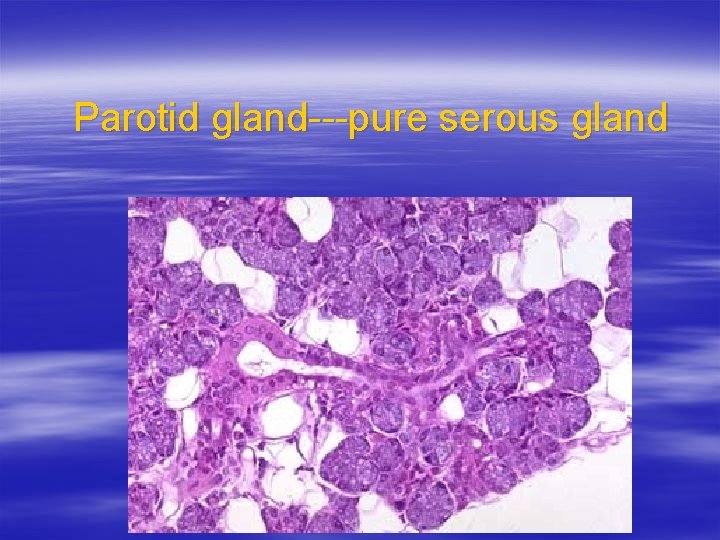
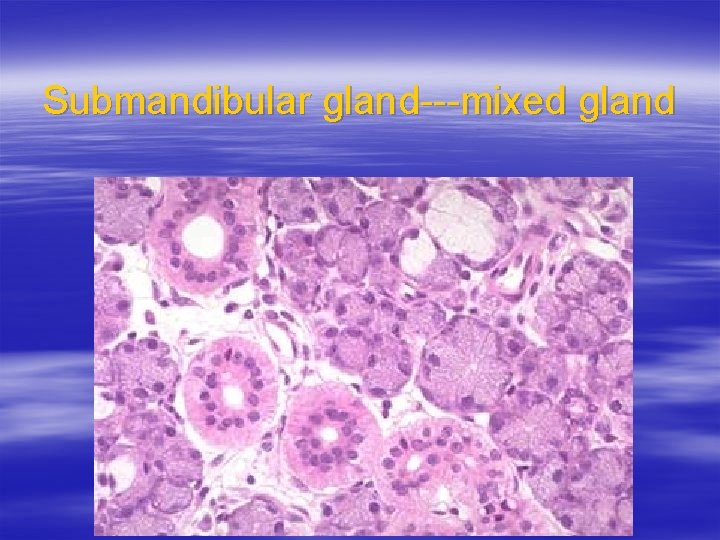
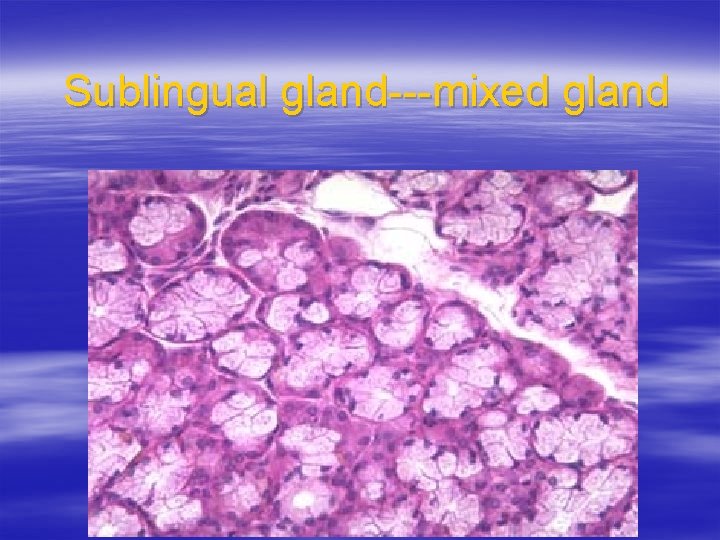
The characteristics of 3 pairs of salivary glands Parotid gland Submandibular gland Sublingual gland Mixed gland, more mixed and mucous acini Acini Pure serous gland Mixed gland, More serous acini Ducts Long I. D. Short I. D. , Long S. D. Secretion 25% saliva More salivary amylase, less mucus 70% saliva Less salivary amylase, more mucus Without I. D. 5% saliva Most mucus
Parotid gland---pure serous gland
Submandibular gland---mixed gland
Sublingual gland---mixed gland
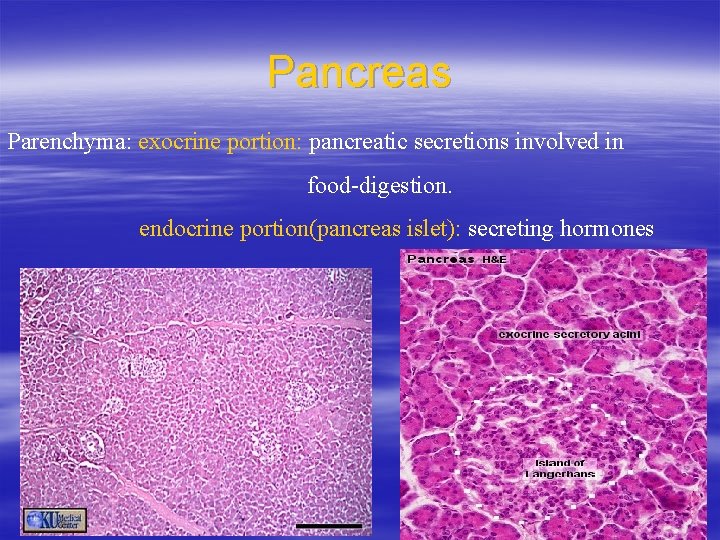
Pancreas Parenchyma: exocrine portion: pancreatic secretions involved in food-digestion. endocrine portion(pancreas islet): secreting hormones
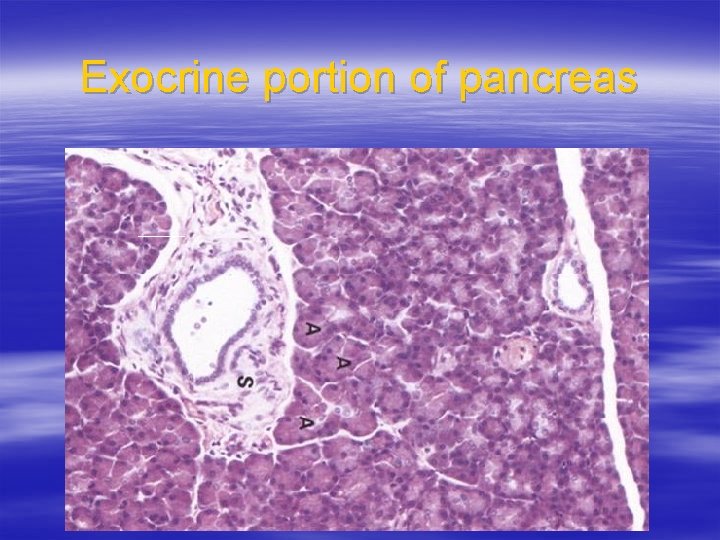
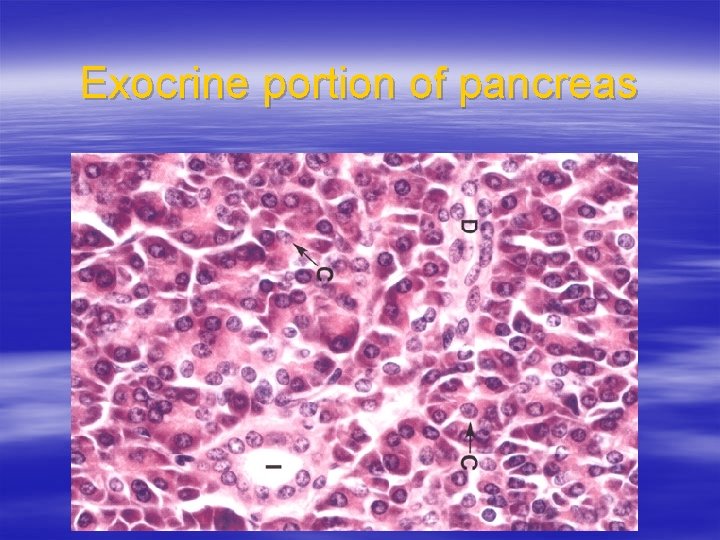
1. Exocrine portion acini ducts Consists of serous cells surrounded by basal lamina, Without myoepithelial cells, With several centro-acinar cells in acinus cavity. Long I. D. , no S. D.
Exocrine portion of pancreas
Exocrine portion of pancreas
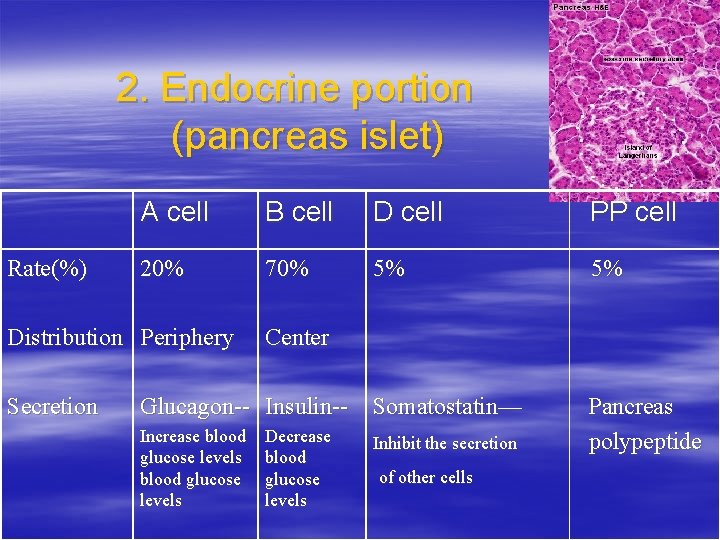
2. Endocrine portion (pancreas islet) Rate(%) A cell B cell D cell PP cell 20% 70% 5% 5% Glucagon-- Insulin-- Somatostatin— Increase blood glucose levels Inhibit the secretion Pancreas polypeptide Distribution Periphery Secretion Center Decrease blood glucose levels of other cells
Diabetes: absence or inadequate amounts of insulin.
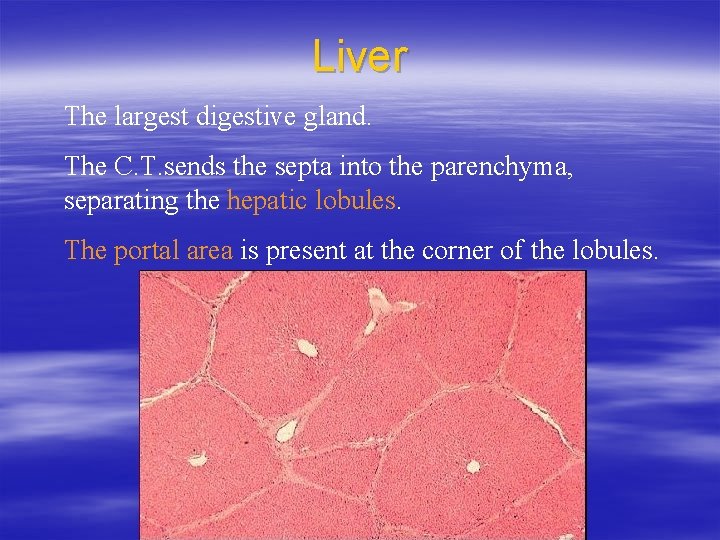
Liver The largest digestive gland. The C. T. sends the septa into the parenchyma, separating the hepatic lobules. The portal area is present at the corner of the lobules.
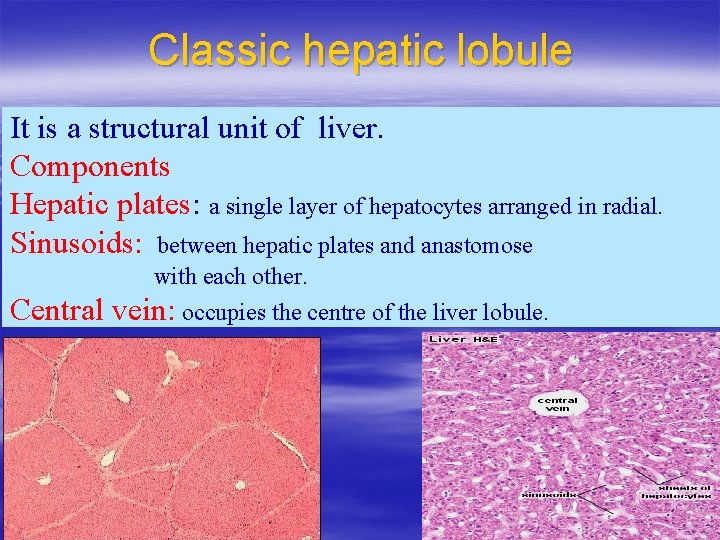
Classic hepatic lobule It is a structural unit of liver. Components Hepatic plates: a single layer of hepatocytes arranged in radial. Sinusoids: between hepatic plates and anastomose with each other. Central vein: occupies the centre of the liver lobule.
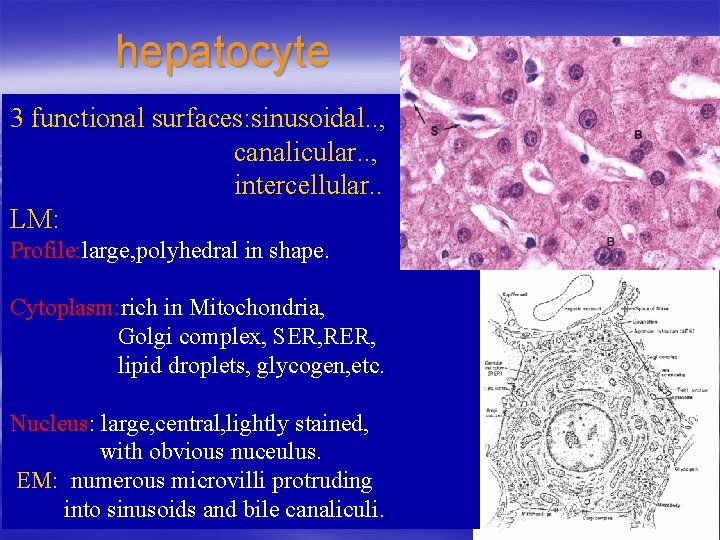
hepatocyte 3 functional surfaces: sinusoidal. . , canalicular. . , intercellular. . LM: Profile: large, polyhedral in shape. Cytoplasm: rich in Mitochondria, Golgi complex, SER, RER, lipid droplets, glycogen, etc. Nucleus: large, central, lightly stained, with obvious nuceulus. EM: numerous microvilli protruding into sinusoids and bile canaliculi.
Function of hepatocyte 1. Bile secretion 2. Synthesis and storage 3. Detoxification and inactivation 4. Defence : related to Kuffer cell 5. Hemopoiesis
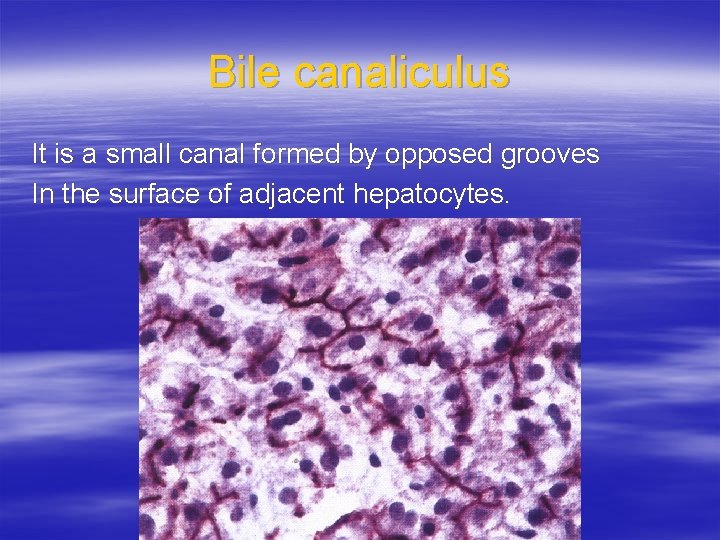
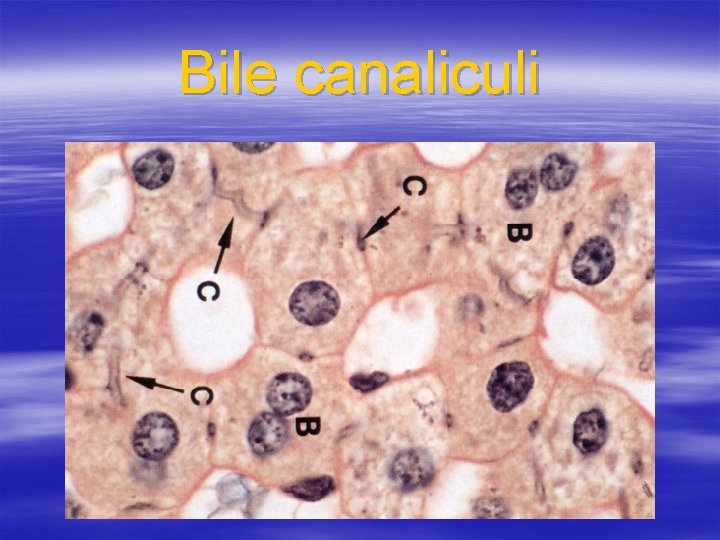
Bile canaliculus It is a small canal formed by opposed grooves In the surface of adjacent hepatocytes.
Bile canaliculi
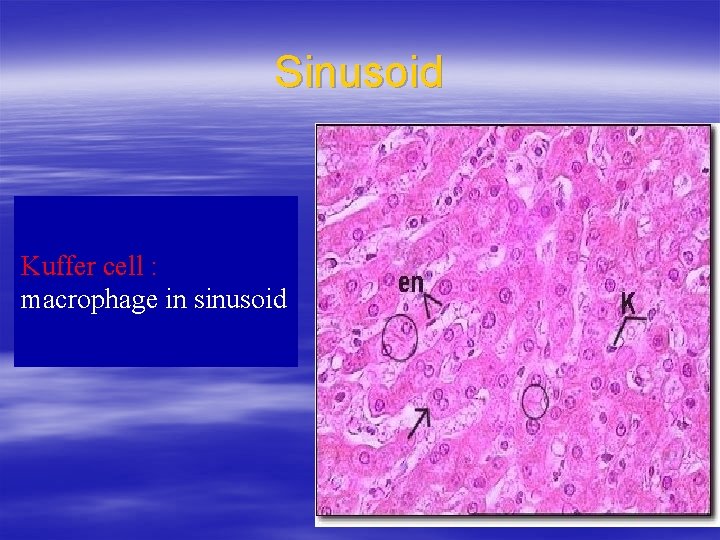
Sinusoid Kuffer cell : macrophage in sinusoid
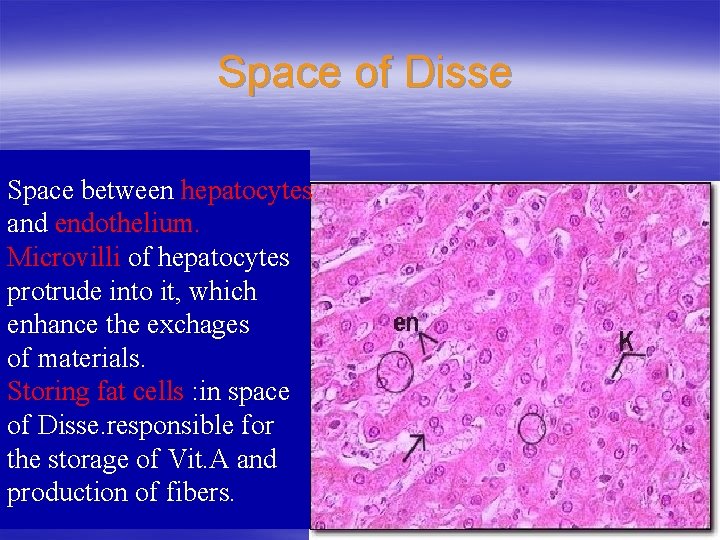
Space of Disse Space between hepatocytes and endothelium. Microvilli of hepatocytes protrude into it, which enhance the exchages of materials. Storing fat cells : in space of Disse. responsible for the storage of Vit. A and production of fibers.
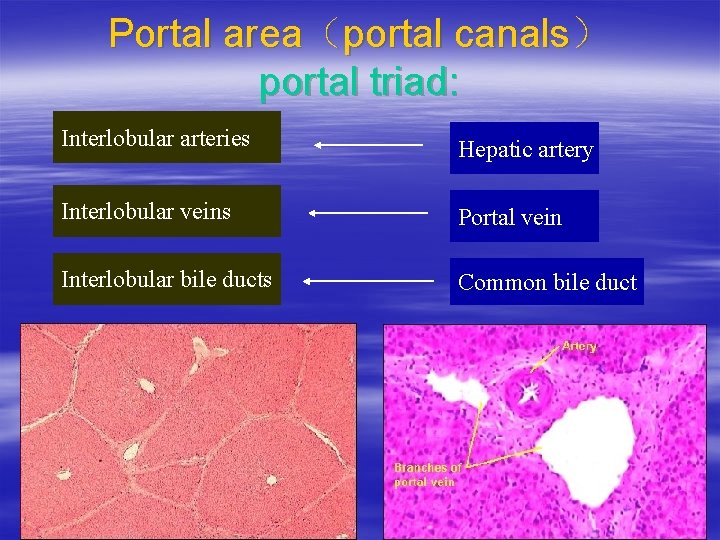
Portal area(portal canals) portal triad: Interlobular arteries Hepatic artery Interlobular veins Portal vein Interlobular bile ducts Common bile duct
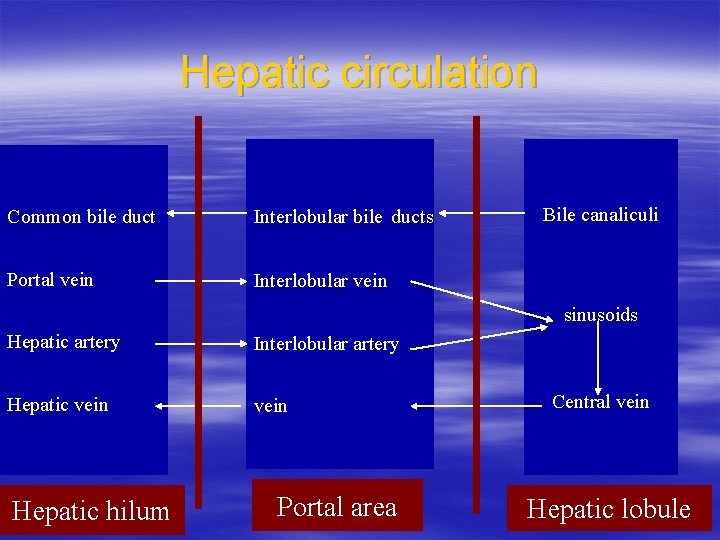
Hepatic circulation Common bile duct Interlobular bile ducts Portal vein Interlobular vein Bile canaliculi sinusoids Hepatic artery Interlobular artery Hepatic vein Hepatic hilum Portal area Central vein Hepatic lobule
Key points 1. The structure and function of pancreas. (exocrine portion and endocrine portion), the cellular components of pancreas islet and their function. 2. The definition of hepatic lobule and portal area. sinusoid , space of Disse, Kuffer cell; 3. The formation of bile canaliculi.