
The differential neutrondeuteron scattering cross section from 100
- Slides: 21
The differential neutron-deuteron scattering cross section from 100 ke. V to 600 ke. V measured using a proportional counter A. J. M. Plompen 1, J. Beyer 2, R. Nolte 3, S. Röttger 3 1 Institute for Reference Materials and Measurements, Geel, Belgium 2 Technical University Braunschweig, Germany 3 Physikalisch-Technische R. Nolte, PTB: ERINDA Workshop, Geneva, 01 -03 Oct. 2013 Bundesanstalt, Braunschweig, Germany 1
Overview • Motivation: Why is n-d scattering still of interest? • Experimental and evaluated data • Detour: Experiment at higher energies at n. ELBE • The recoil proton prop. counter P 2 of PTB • MC modelling of the P 2 reponse • Measurements • Results and future work Þ Remind: Work in progress! R. Nolte, PTB: ERINDA Workshop, Geneva, 01 -03 Oct. 2013
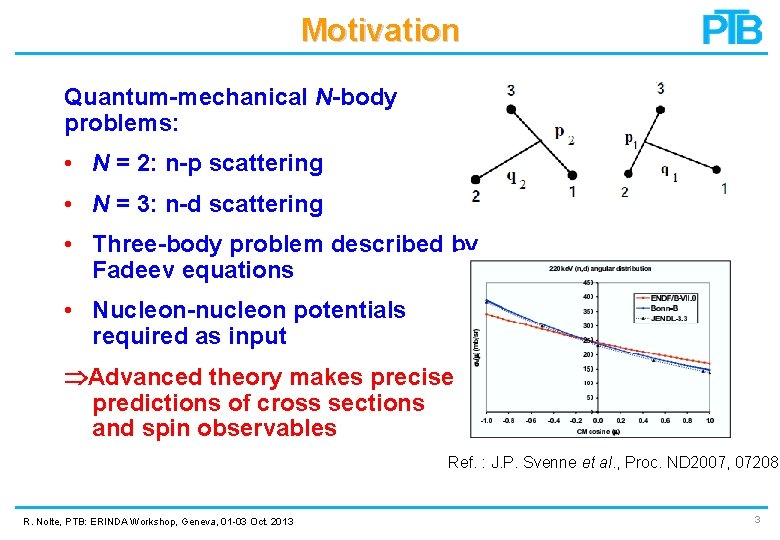
Motivation Quantum-mechanical N-body problems: • N = 2: n-p scattering • N = 3: n-d scattering • Three-body problem described by Fadeev equations • Nucleon-nucleon potentials required as input Advanced theory makes precise predictions of cross sections and spin observables Ref. : J. P. Svenne et al. , Proc. ND 2007, 07208 R. Nolte, PTB: ERINDA Workshop, Geneva, 01 -03 Oct. 2013 3
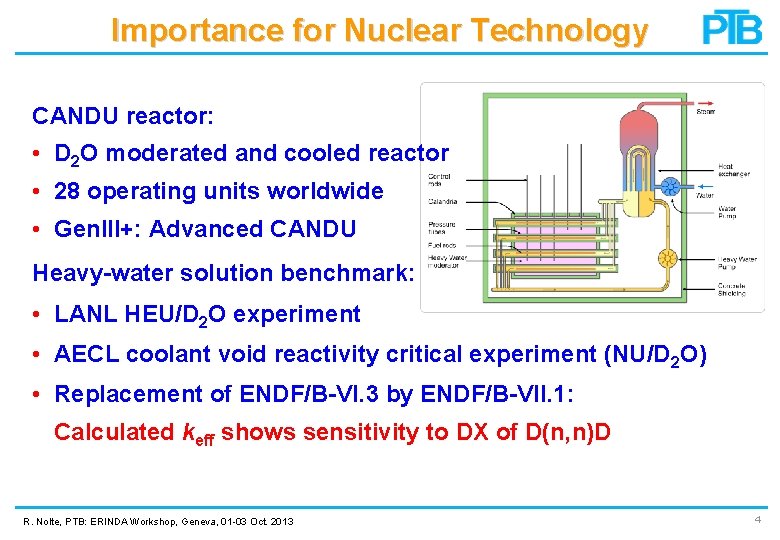
Importance for Nuclear Technology CANDU reactor: • D 2 O moderated and cooled reactor • 28 operating units worldwide • Gen. III+: Advanced CANDU Heavy-water solution benchmark: • LANL HEU/D 2 O experiment • AECL coolant void reactivity critical experiment (NU/D 2 O) • Replacement of ENDF/B-VI. 3 by ENDF/B-VII. 1: Calculated keff shows sensitivity to DX of D(n, n)D R. Nolte, PTB: ERINDA Workshop, Geneva, 01 -03 Oct. 2013 4
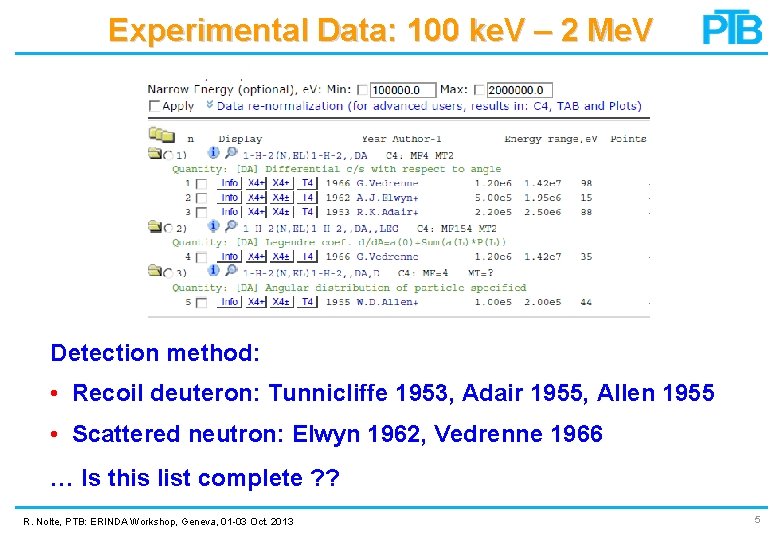
Experimental Data: 100 ke. V – 2 Me. V Detection method: • Recoil deuteron: Tunnicliffe 1953, Adair 1955, Allen 1955 • Scattered neutron: Elwyn 1962, Vedrenne 1966 … Is this list complete ? ? R. Nolte, PTB: ERINDA Workshop, Geneva, 01 -03 Oct. 2013 5
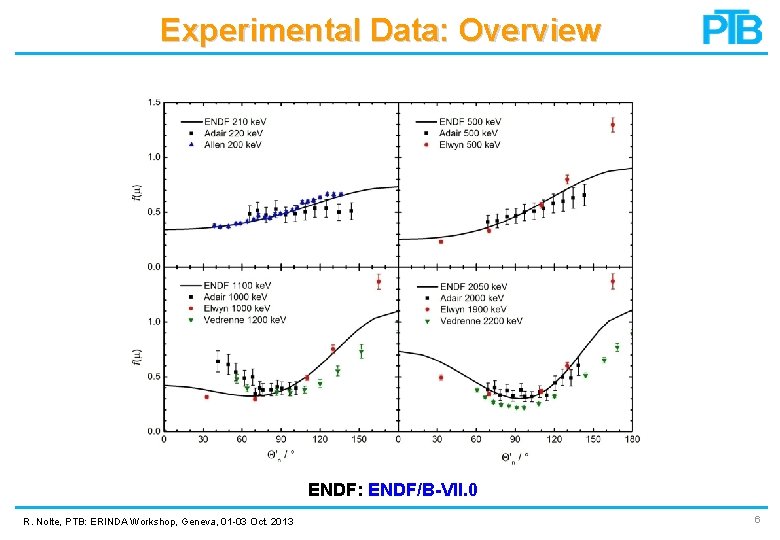
Experimental Data: Overview ENDF: ENDF/B-VII. 0 R. Nolte, PTB: ERINDA Workshop, Geneva, 01 -03 Oct. 2013 6
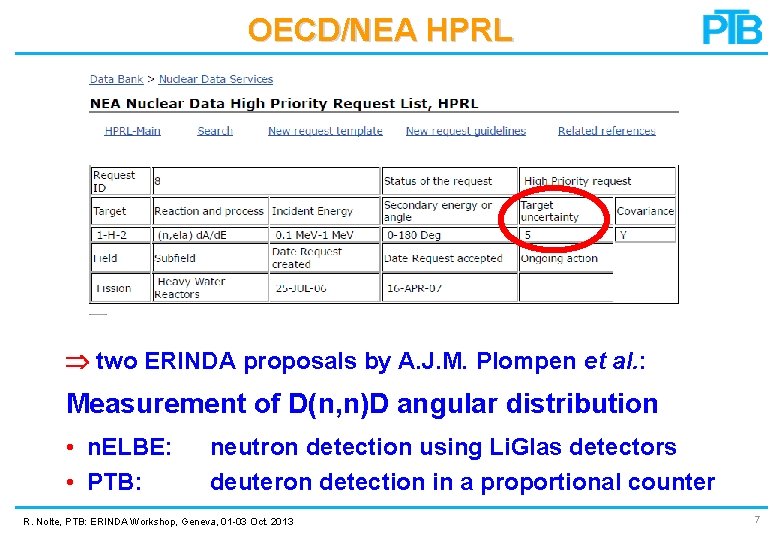
OECD/NEA HPRL two ERINDA proposals by A. J. M. Plompen et al. : Measurement of D(n, n)D angular distribution • n. ELBE: • PTB: neutron detection using Li. Glas detectors deuteron detection in a proportional counter R. Nolte, PTB: ERINDA Workshop, Geneva, 01 -03 Oct. 2013 7
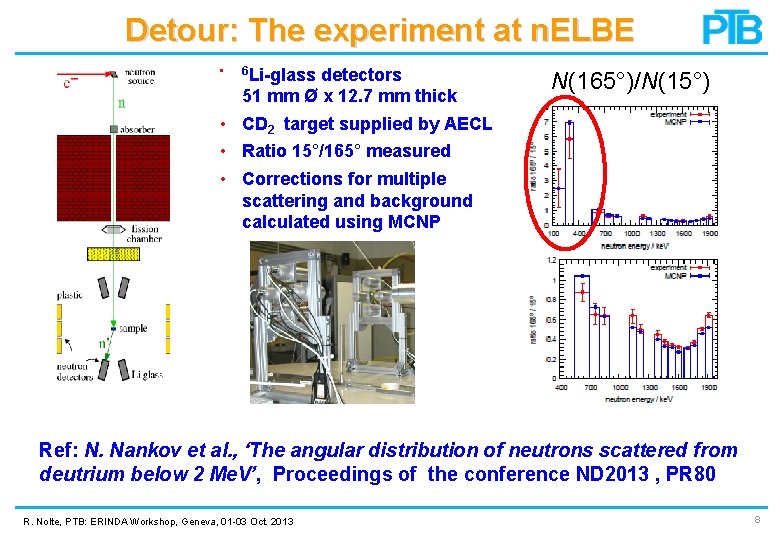
Detour: The experiment at n. ELBE • 6 Li-glass detectors 51 mm Ø x 12. 7 mm thick N(165°)/N(15°) • CD 2 target supplied by AECL • Ratio 15°/165° measured • Corrections for multiple scattering and background calculated using MCNP Ref: N. Nankov et al. , ‘The angular distribution of neutrons scattered from deutrium below 2 Me. V’, Proceedings of the conference ND 2013 , PR 80 R. Nolte, PTB: ERINDA Workshop, Geneva, 01 -03 Oct. 2013 8
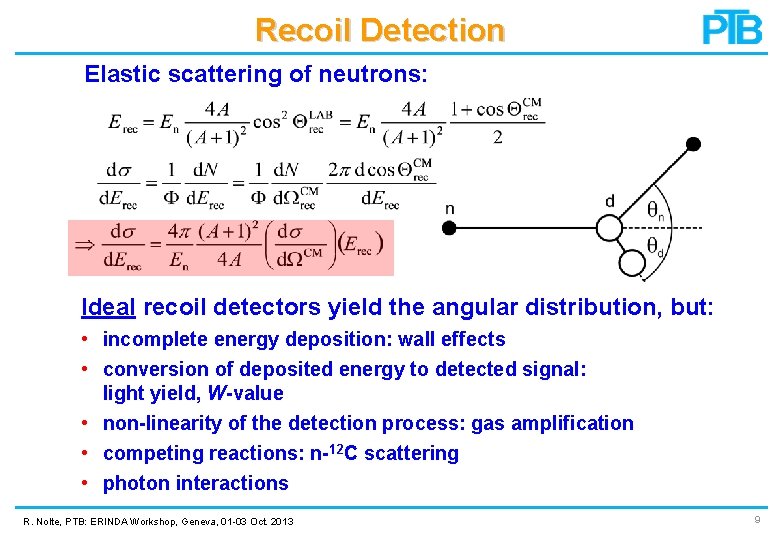
Recoil Detection Elastic scattering of neutrons: Ideal recoil detectors yield the angular distribution, but: • incomplete energy deposition: wall effects • conversion of deposited energy to detected signal: light yield, W-value • non-linearity of the detection process: gas amplification • competing reactions: n-12 C scattering • photon interactions R. Nolte, PTB: ERINDA Workshop, Geneva, 01 -03 Oct. 2013 9
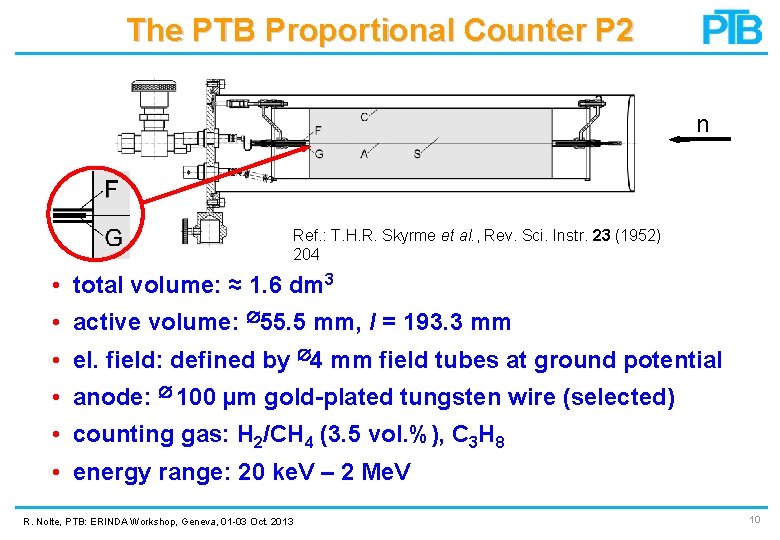
The PTB Proportional Counter P 2 n Ref. : T. H. R. Skyrme et al. , Rev. Sci. Instr. 23 (1952) 204 • total volume: ≈ 1. 6 dm 3 • active volume: 55. 5 mm, l = 193. 3 mm • el. field: defined by 4 mm field tubes at ground potential • anode: 100 µm gold-plated tungsten wire (selected) • counting gas: H 2/CH 4 (3. 5 vol. %), C 3 H 8 • energy range: 20 ke. V – 2 Me. V R. Nolte, PTB: ERINDA Workshop, Geneva, 01 -03 Oct. 2013 10
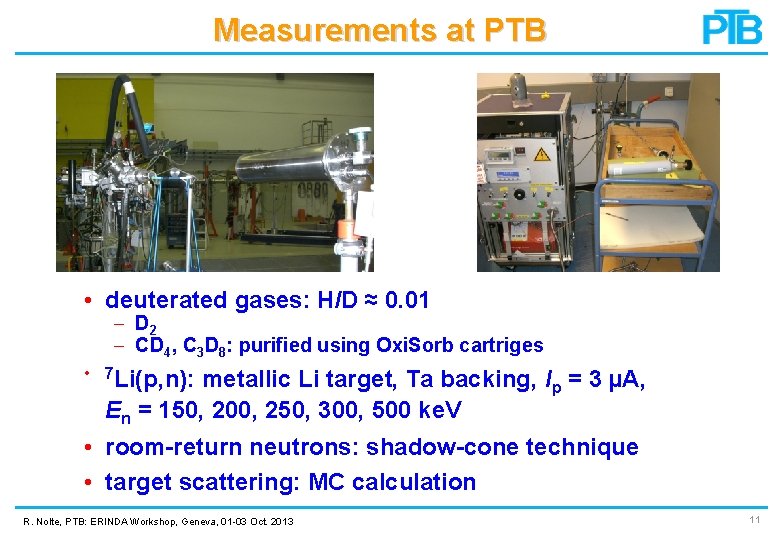
Measurements at PTB • deuterated gases: H/D ≈ 0. 01 - D 2 - CD 4, C 3 D 8: purified using Oxi. Sorb cartriges • 7 Li(p, n): metallic Li target, Ta backing, Ip = 3 µA, En = 150, 200, 250, 300, 500 ke. V • room-return neutrons: shadow-cone technique • target scattering: MC calculation R. Nolte, PTB: ERINDA Workshop, Geneva, 01 -03 Oct. 2013 11
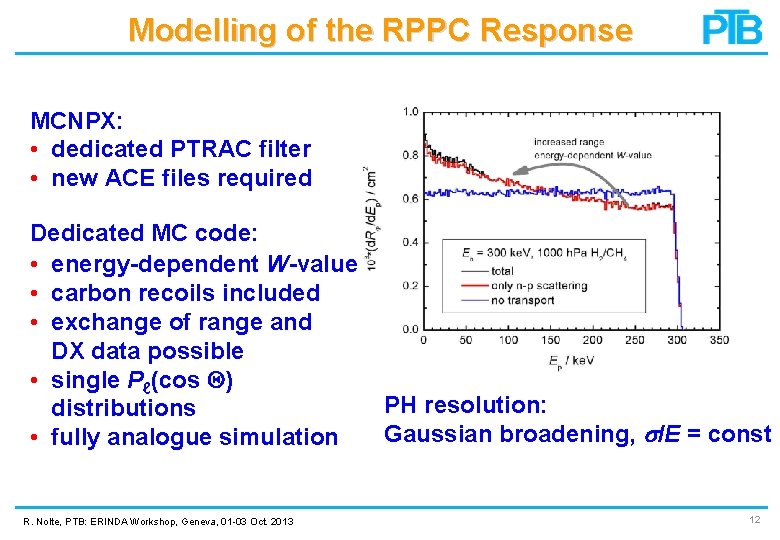
Modelling of the RPPC Response MCNPX: • dedicated PTRAC filter • new ACE files required Dedicated MC code: • energy-dependent W-value • carbon recoils included • exchange of range and DX data possible • single Pℓ(cos Q) distributions • fully analogue simulation R. Nolte, PTB: ERINDA Workshop, Geneva, 01 -03 Oct. 2013 PH resolution: Gaussian broadening, s/E = const 12
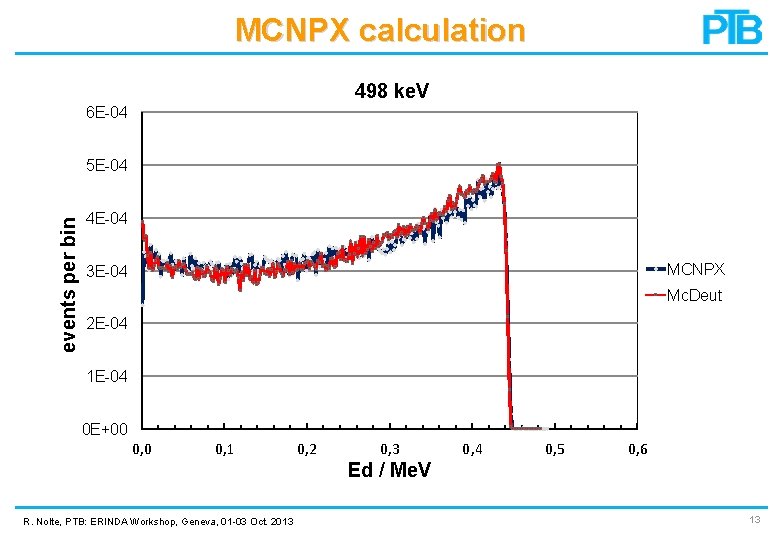
MCNPX calculation 498 ke. V 6 E-04 events per bin 5 E-04 4 E-04 MCNPX 3 E-04 Mc. Deut 2 E-04 1 E-04 0 E+00 0, 1 0, 2 0, 3 0, 4 0, 5 0, 6 Ed / Me. V R. Nolte, PTB: ERINDA Workshop, Geneva, 01 -03 Oct. 2013 13
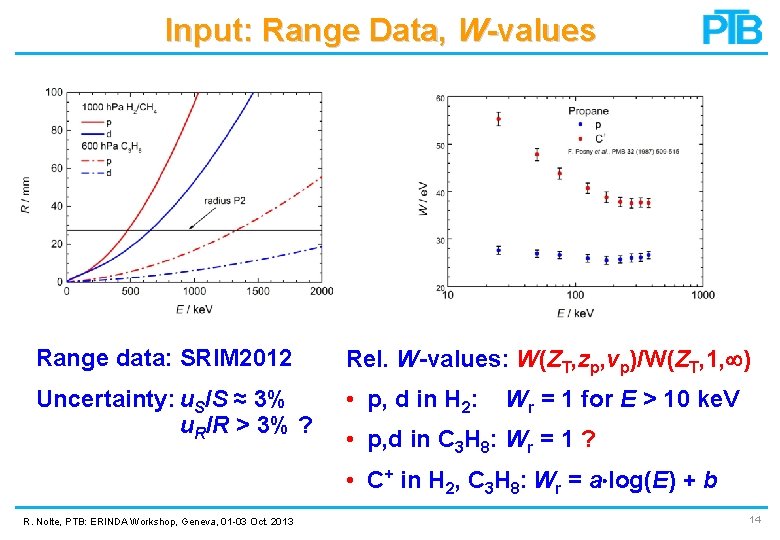
Input: Range Data, W-values Range data: SRIM 2012 Rel. W-values: W(ZT, zp, vp)/W(ZT, 1, ) Uncertainty: u. S/S ≈ 3% u. R/R > 3% ? • p, d in H 2: Wr = 1 for E > 10 ke. V • p, d in C 3 H 8: Wr = 1 ? • C+ in H 2, C 3 H 8: Wr = a log(E) + b R. Nolte, PTB: ERINDA Workshop, Geneva, 01 -03 Oct. 2013 14
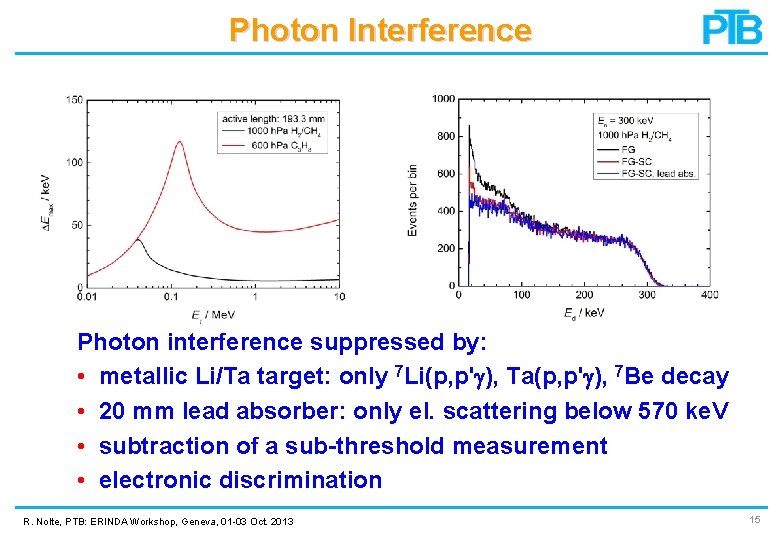
Photon Interference Photon interference suppressed by: • metallic Li/Ta target: only 7 Li(p, p'g), Ta(p, p'g), 7 Be decay • 20 mm lead absorber: only el. scattering below 570 ke. V • subtraction of a sub-threshold measurement • electronic discrimination R. Nolte, PTB: ERINDA Workshop, Geneva, 01 -03 Oct. 2013 15
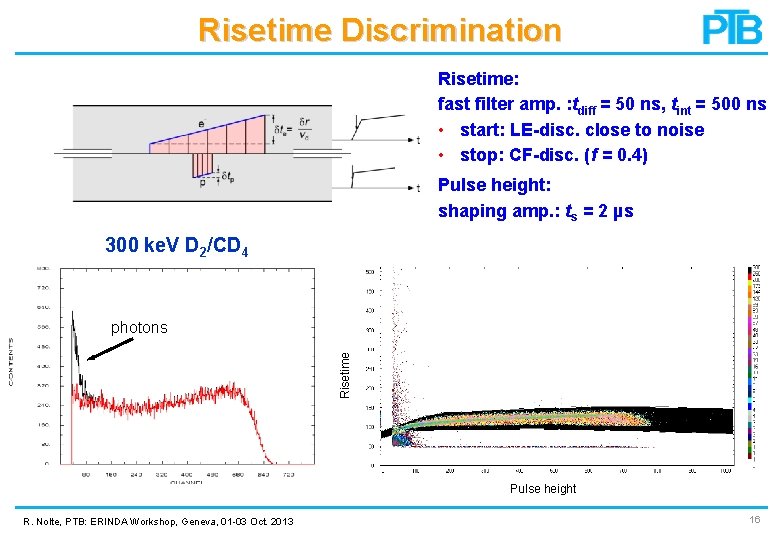
Risetime Discrimination Risetime: fast filter amp. : tdiff = 50 ns, tint = 500 ns • start: LE-disc. close to noise • stop: CF-disc. (f = 0. 4) Pulse height: shaping amp. : ts = 2 µs 300 ke. V D 2/CD 4 Risetime photons Pulse height R. Nolte, PTB: ERINDA Workshop, Geneva, 01 -03 Oct. 2013 16
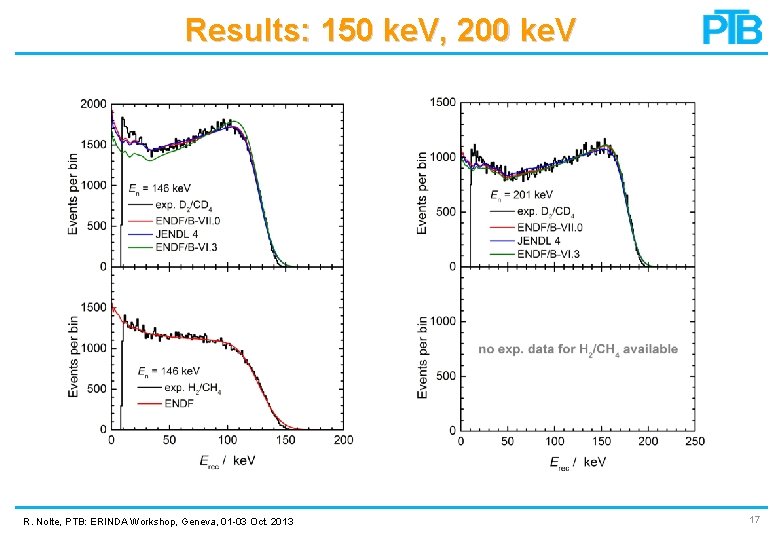
Results: 150 ke. V, 200 ke. V R. Nolte, PTB: ERINDA Workshop, Geneva, 01 -03 Oct. 2013 17
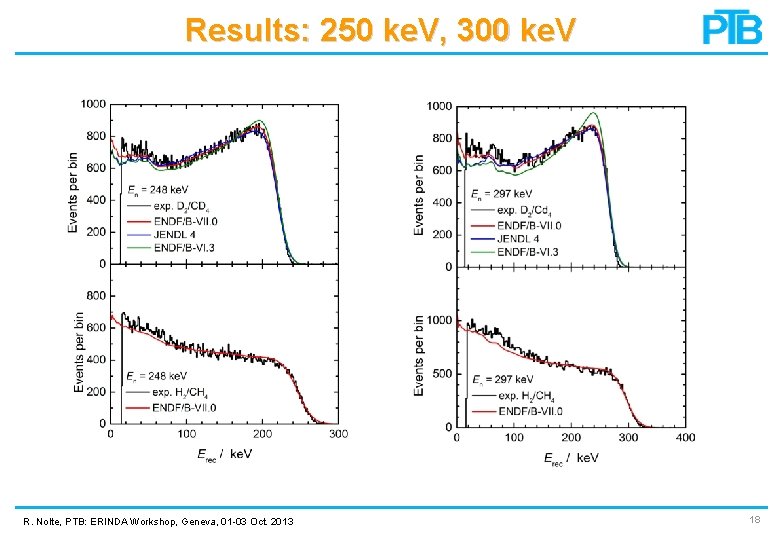
Results: 250 ke. V, 300 ke. V R. Nolte, PTB: ERINDA Workshop, Geneva, 01 -03 Oct. 2013 18
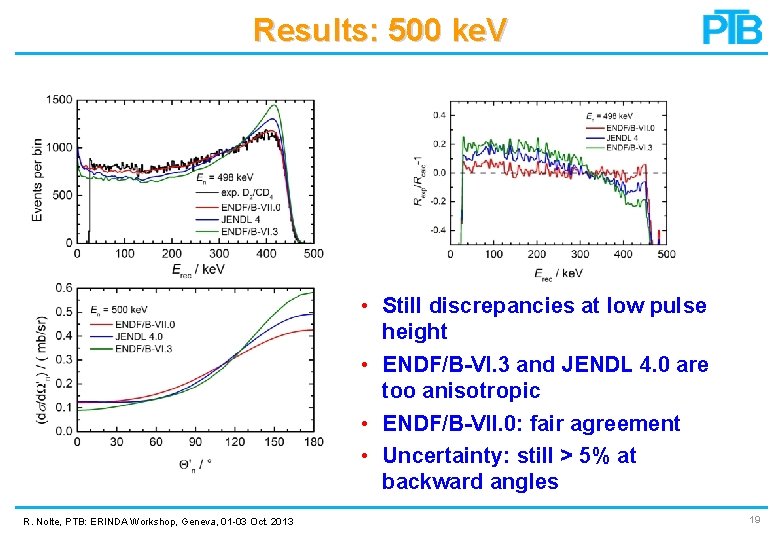
Results: 500 ke. V • Still discrepancies at low pulse height • ENDF/B-VI. 3 and JENDL 4. 0 are too anisotropic • ENDF/B-VII. 0: fair agreement • Uncertainty: still > 5% at backward angles R. Nolte, PTB: ERINDA Workshop, Geneva, 01 -03 Oct. 2013 19
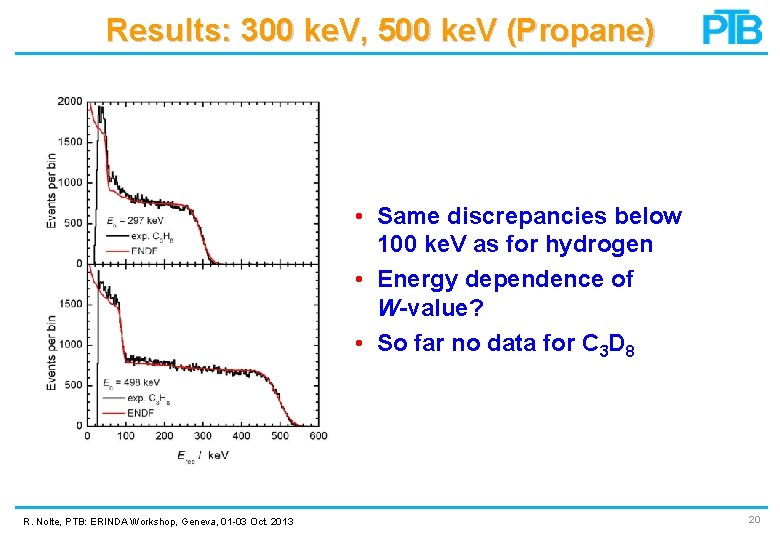
Results: 300 ke. V, 500 ke. V (Propane) • Same discrepancies below 100 ke. V as for hydrogen • Energy dependence of W-value? • So far no data for C 3 D 8 R. Nolte, PTB: ERINDA Workshop, Geneva, 01 -03 Oct. 2013 20
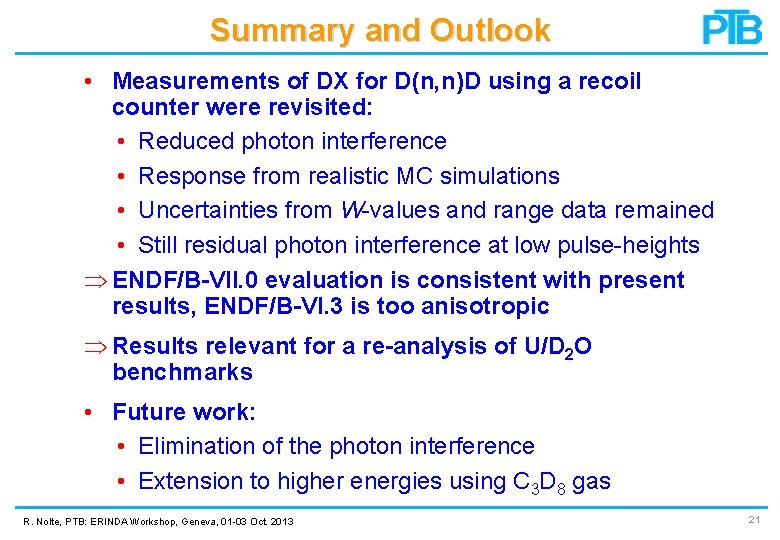
Summary and Outlook • Measurements of DX for D(n, n)D using a recoil counter were revisited: • Reduced photon interference • Response from realistic MC simulations • Uncertainties from W-values and range data remained • Still residual photon interference at low pulse-heights Þ ENDF/B-VII. 0 evaluation is consistent with present results, ENDF/B-VI. 3 is too anisotropic Þ Results relevant for a re-analysis of U/D 2 O benchmarks • Future work: • Elimination of the photon interference • Extension to higher energies using C 3 D 8 gas R. Nolte, PTB: ERINDA Workshop, Geneva, 01 -03 Oct. 2013 21