
The different transitions across the lifecycle Massimiliano Mascherini
- Slides: 16
The different transitions across the lifecycle Massimiliano Mascherini Senior Research Manager Social Policy Unit - EUROFOUND
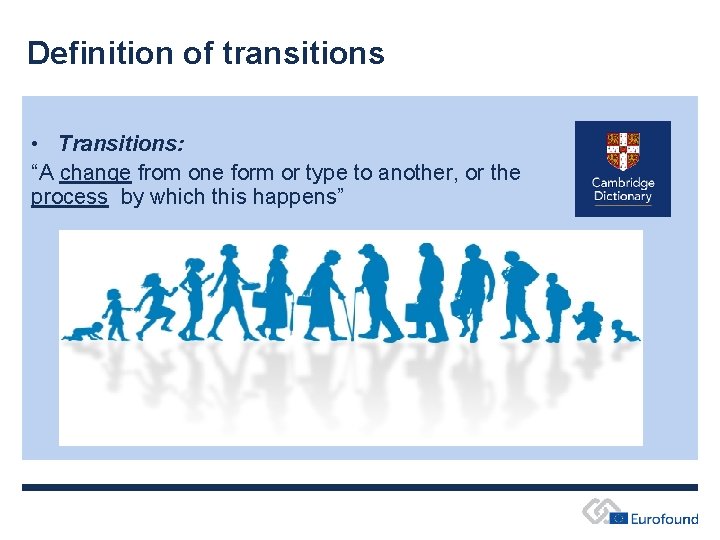
Definition of transitions • Transitions: “A change from one form or type to another, or the process by which this happens”
Transitions… • Transitions are important in our life! • Changing actually is a big thing: it’s something we will remember for years, if not decades. • Transitions may redefine our position in the social topology of the society! • Transitions are inevitable and sometimes unexpected. Often we are happy with the status quo, so change is the last thing we want in our life. However, changes happens and sometimes cannot be stopped. • Transitions bring a lot of stress to cope with, the “relocation bump”
Why studying transitions • Stock variables such as unemployment rate, provides information about the level of the phenomenon at a given point in time. • However, the analysis of static variables fails to answer to the dynamic nature of phenomena/ For example, the entrance of young people into the labour market and their transition from school to work. • The investigation of these dynamic dimensions is fundamental in order to better design policies in support of youth that take into account the full set of challenges and difficulties that youth have to face in order to enter the labour market and in adulthood. • However, there are little data!
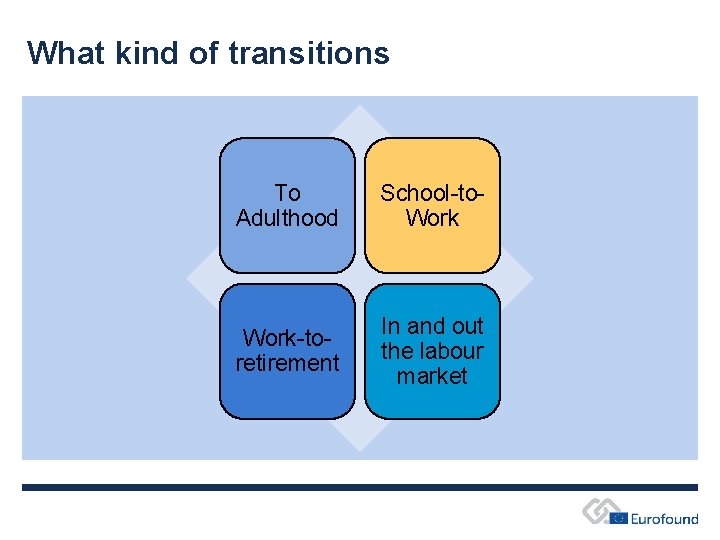
What kind of transitions To Adulthood School-to. Work-toretirement In and out the labour market
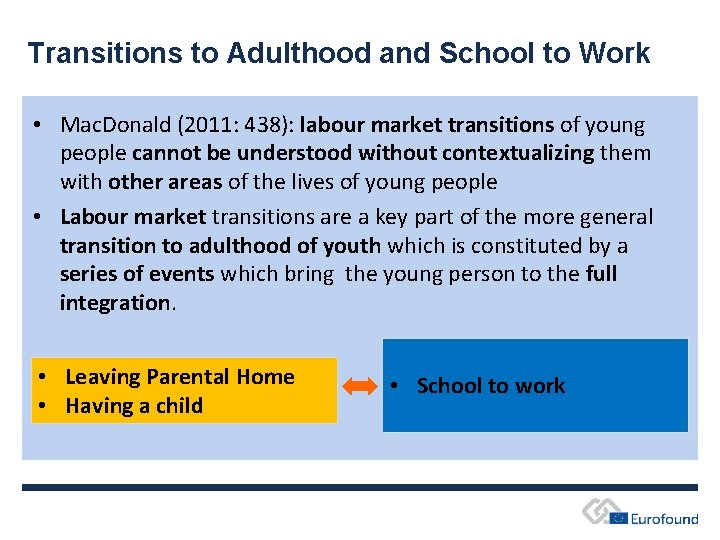
Transitions to Adulthood and School to Work • Mac. Donald (2011: 438): labour market transitions of young people cannot be understood without contextualizing them with other areas of the lives of young people • Labour market transitions are a key part of the more general transition to adulthood of youth which is constituted by a series of events which bring the young person to the full integration. • Leaving Parental Home • Having a child • School to work
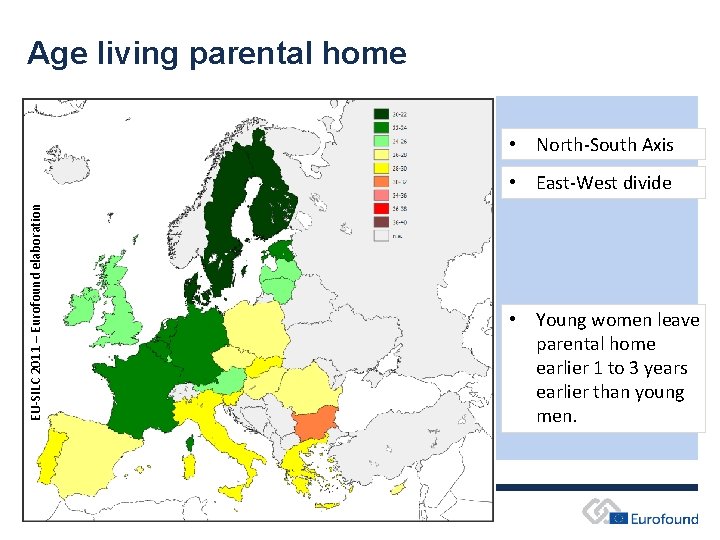
Age living parental home • North-South Axis EU-SILC 2011 – Eurofound elaboration • East-West divide • Young women leave parental home earlier 1 to 3 years earlier than young men.
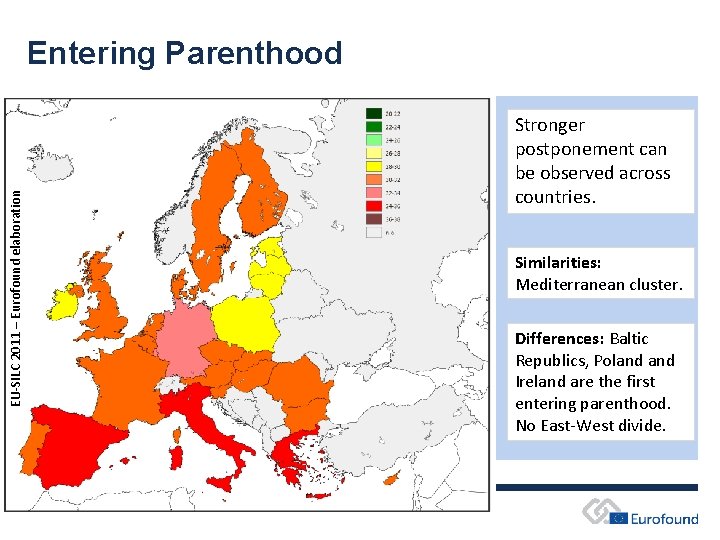
EU-SILC 2011 – Eurofound elaboration Entering Parenthood Stronger postponement can be observed across countries. Similarities: Mediterranean cluster. Differences: Baltic Republics, Poland Ireland are the first entering parenthood. No East-West divide.
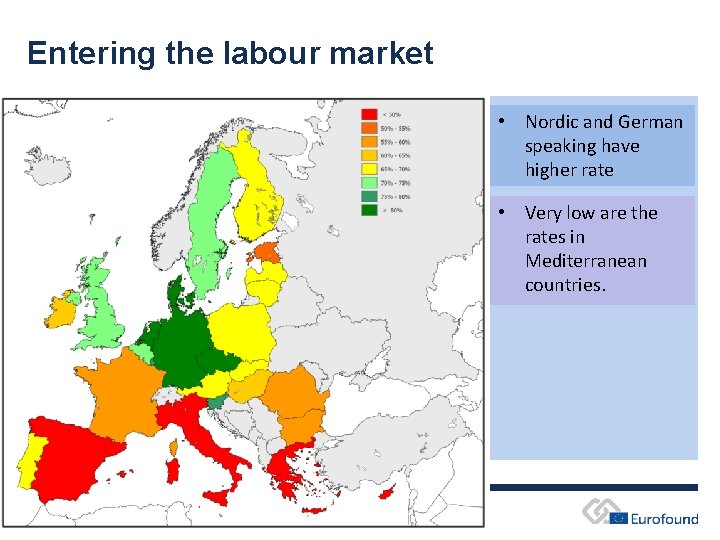
Entering the labour market • Nordic and German speaking have higher rate • Very low are the rates in Mediterranean countries.
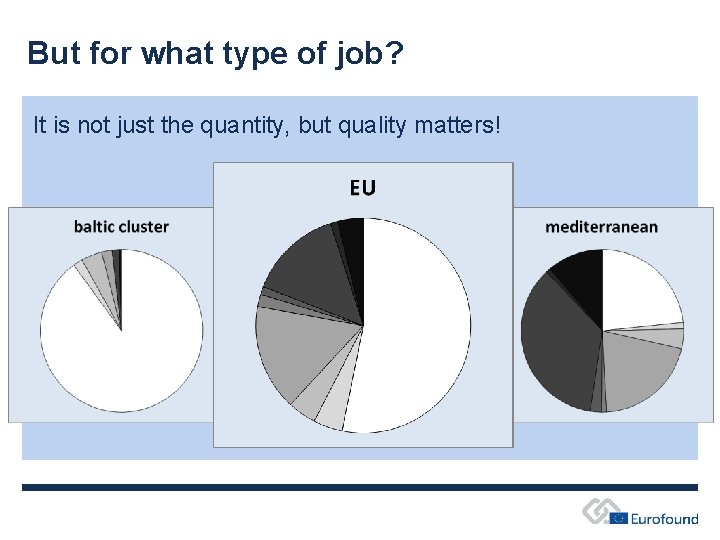
But for what type of job? It is not just the quantity, but quality matters!
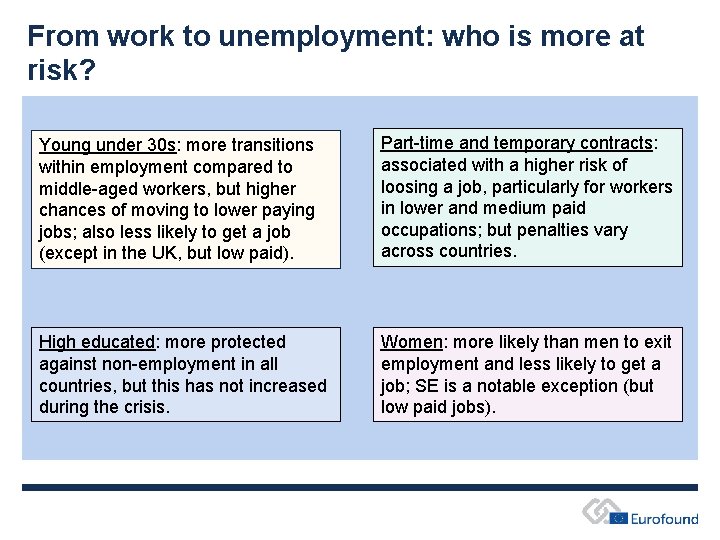
From work to unemployment: who is more at risk? Young under 30 s: more transitions within employment compared to middle-aged workers, but higher chances of moving to lower paying jobs; also less likely to get a job (except in the UK, but low paid). Part-time and temporary contracts: associated with a higher risk of loosing a job, particularly for workers in lower and medium paid occupations; but penalties vary across countries. High educated: more protected against non-employment in all countries, but this has not increased during the crisis. Women: more likely than men to exit employment and less likely to get a job; SE is a notable exception (but low paid jobs).
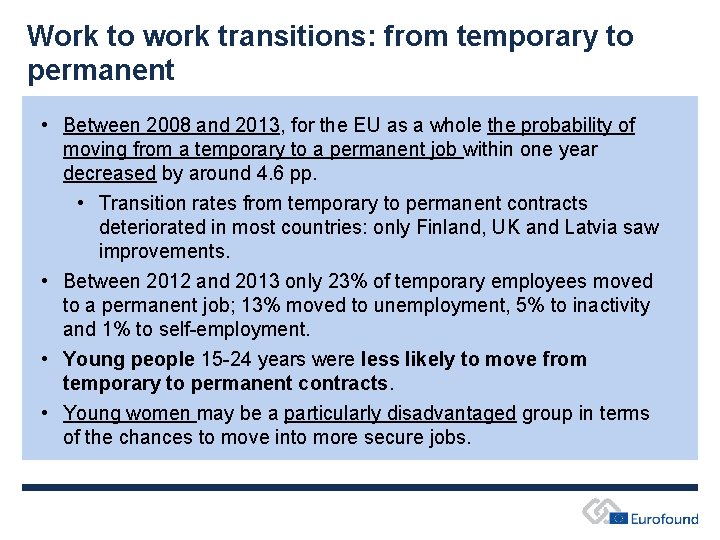
Work to work transitions: from temporary to permanent • Between 2008 and 2013, for the EU as a whole the probability of moving from a temporary to a permanent job within one year decreased by around 4. 6 pp. • Transition rates from temporary to permanent contracts deteriorated in most countries: only Finland, UK and Latvia saw improvements. • Between 2012 and 2013 only 23% of temporary employees moved to a permanent job; 13% moved to unemployment, 5% to inactivity and 1% to self-employment. • Young people 15 -24 years were less likely to move from temporary to permanent contracts. • Young women may be a particularly disadvantaged group in terms of the chances to move into more secure jobs.
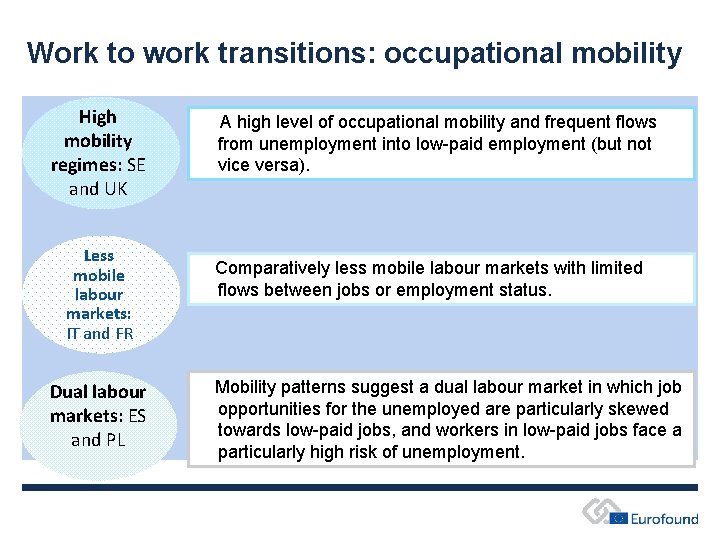
Work to work transitions: occupational mobility High mobility regimes: SE and UK Less Stiff labour mobile labour IT markets: and FR IT and FR Dual labour markets: ES and PL A high level of occupational mobility and frequent flows from unemployment into low-paid employment (but not vice versa). Comparatively less mobile labour markets with limited flows between jobs or employment status. Mobility patterns suggest a dual labour market in which job opportunities for the unemployed are particularly skewed towards low-paid jobs, and workers in low-paid jobs face a particularly high risk of unemployment.
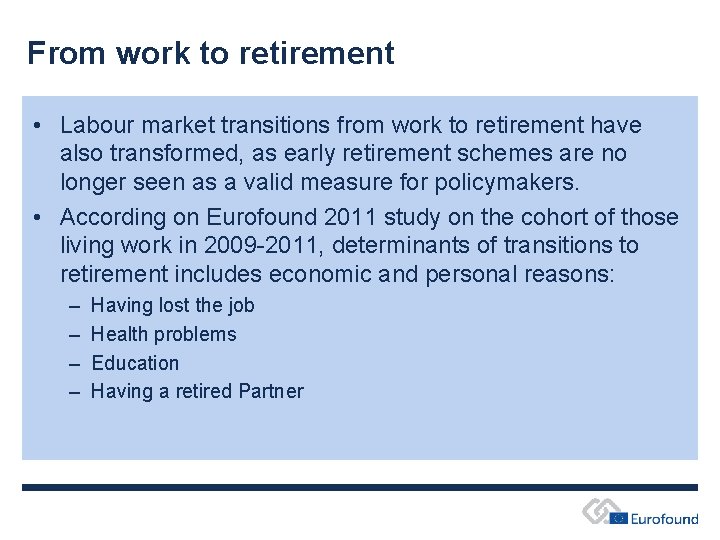
From work to retirement • Labour market transitions from work to retirement have also transformed, as early retirement schemes are no longer seen as a valid measure for policymakers. • According on Eurofound 2011 study on the cohort of those living work in 2009 -2011, determinants of transitions to retirement includes economic and personal reasons: – – Having lost the job Health problems Education Having a retired Partner
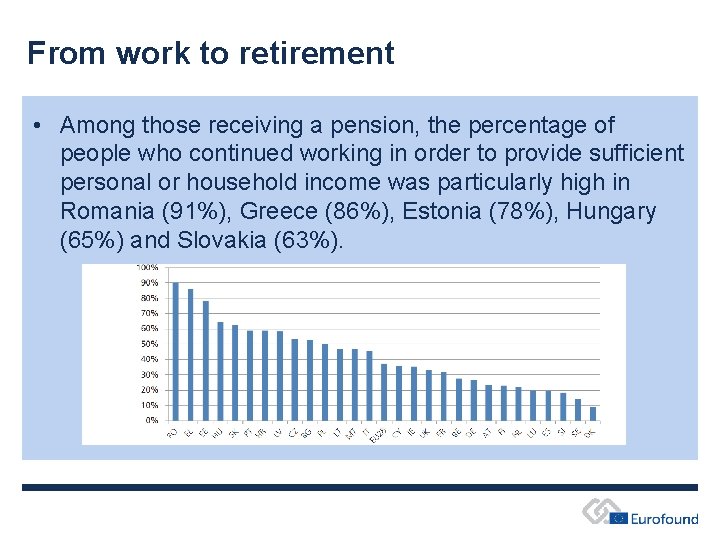
From work to retirement • Among those receiving a pension, the percentage of people who continued working in order to provide sufficient personal or household income was particularly high in Romania (91%), Greece (86%), Estonia (78%), Hungary (65%) and Slovakia (63%).
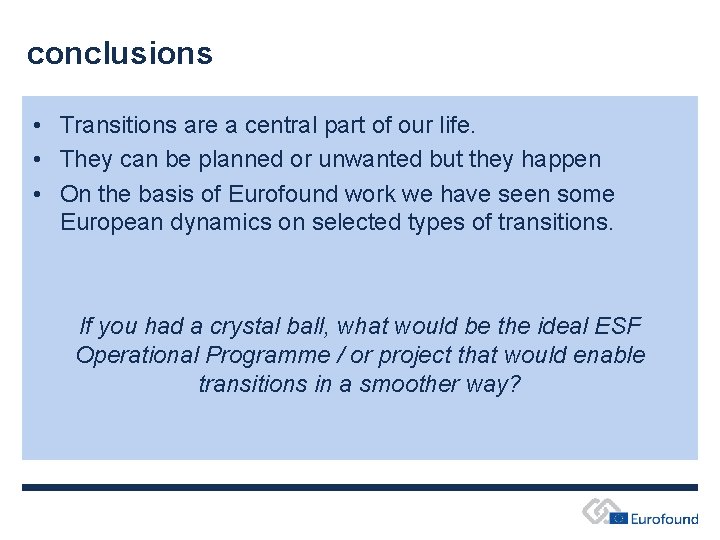
conclusions • Transitions are a central part of our life. • They can be planned or unwanted but they happen • On the basis of Eurofound work we have seen some European dynamics on selected types of transitions. If you had a crystal ball, what would be the ideal ESF Operational Programme / or project that would enable transitions in a smoother way?