
The Diabetic Retinopathy Clinical Research Network EETDRS Visual
The Diabetic Retinopathy Clinical Research Network E-ETDRS Visual Acuity Testing after Autorefraction versus Manual Refraction in Eyes with Diabetic Macular Edema Supported through a cooperative agreement from the National Eye Institute and the National Institute of Diabetes and Digestive and Kidney Diseases, National Institutes of Health, Department of Health and Human Services EY 14231, EY 14229, EY 018817 1
Background Ø Although E-ETDRS visual acuity is used in many studies, the reproducibility had not been substantially evaluated across multiple centers in eyes with diabetic macular edema. Ø ETDRS refraction is difficult and time consuming. Using an autorefractor might be easier and faster, but the reproducibility of this approach had not been evaluated across large numbers of diabetic subjects with diabetic macular edema. 2
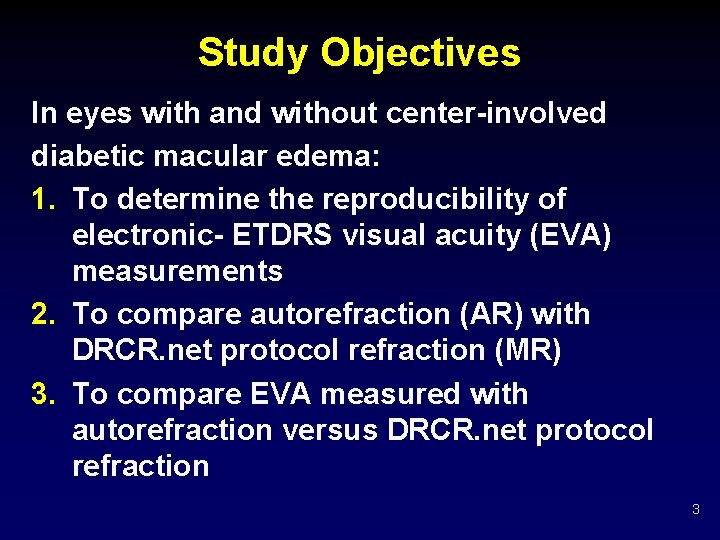
Study Objectives In eyes with and without center-involved diabetic macular edema: 1. To determine the reproducibility of electronic- ETDRS visual acuity (EVA) measurements 2. To compare autorefraction (AR) with DRCR. net protocol refraction (MR) 3. To compare EVA measured with autorefraction versus DRCR. net protocol refraction 3
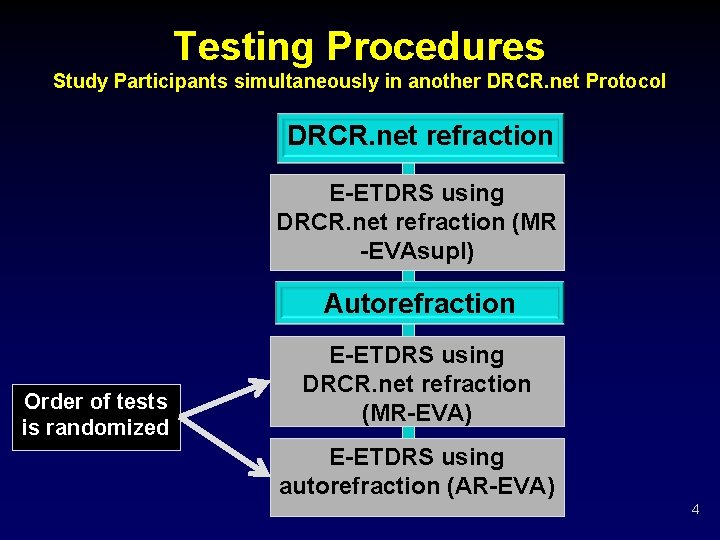
Testing Procedures Study Participants simultaneously in another DRCR. net Protocol DRCR. net refraction E-ETDRS using DRCR. net refraction (MR -EVAsupl) Autorefraction Order of tests is randomized E-ETDRS using DRCR. net refraction (MR-EVA) E-ETDRS using autorefraction (AR-EVA) 4
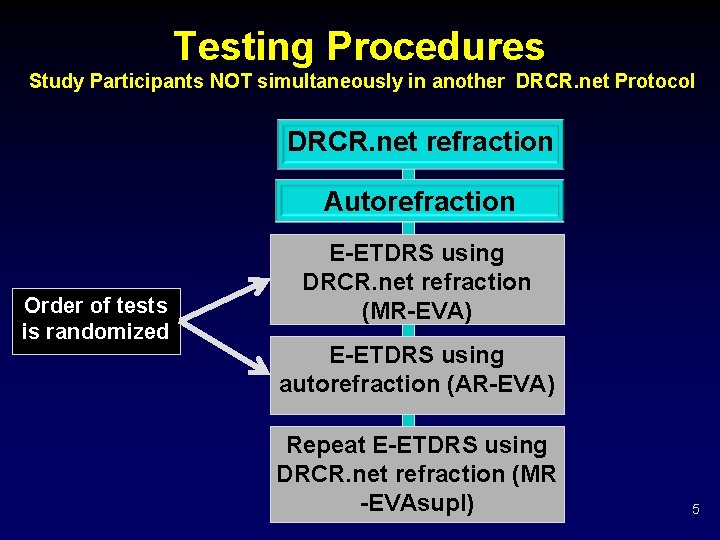
Testing Procedures Study Participants NOT simultaneously in another DRCR. net Protocol DRCR. net refraction Autorefraction Order of tests is randomized E-ETDRS using DRCR. net refraction (MR-EVA) E-ETDRS using autorefraction (AR-EVA) Repeat E-ETDRS using DRCR. net refraction (MR -EVAsupl) 5
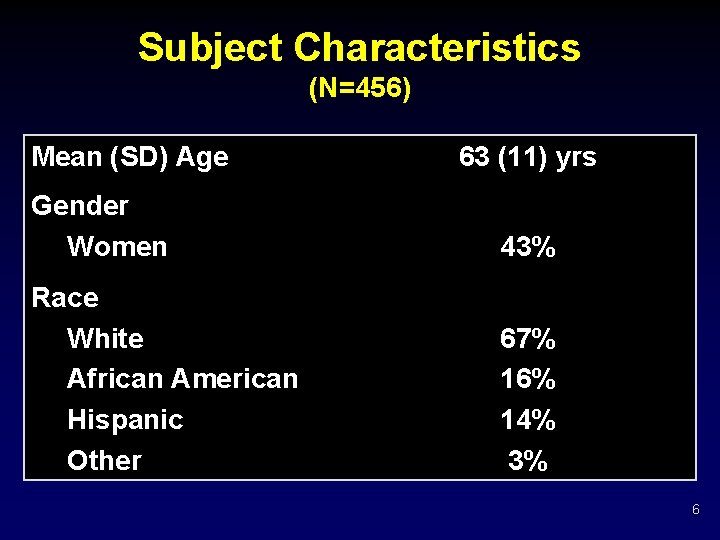
Subject Characteristics (N=456) Mean (SD) Age 63 (11) yrs Gender Women 43% Race White African American Hispanic Other 67% 16% 14% 3% 6
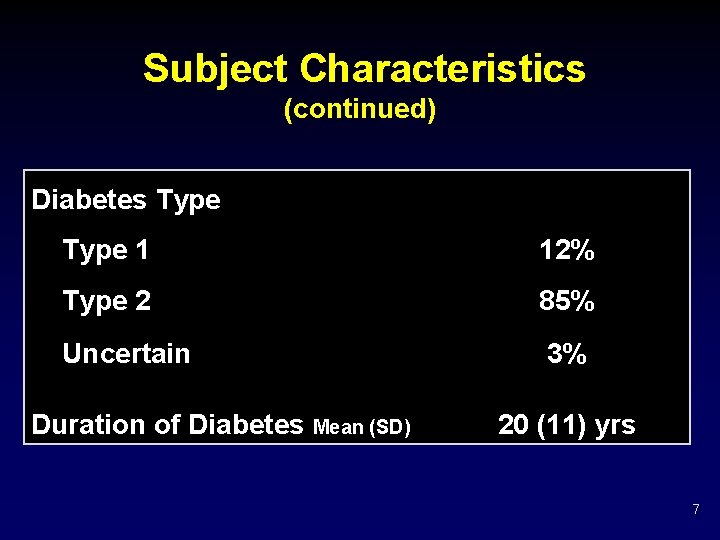
Subject Characteristics (continued) Diabetes Type 1 12% Type 2 85% Uncertain 3% Duration of Diabetes Mean (SD) 20 (11) yrs 7

Ocular Characteristics N= 565* DRCR EVA Letter Score (~ Snellen equivalent) Median 73 (20/40) 25 th, 75 th percentiles (61, 81) (20/63, 20/25) Approximate Snellen Equivalent Visual Acuity ≥ 20/20 19% 20/25 - 20/32 28% 20/40 - 20/80 36% 20/100 – 20/400 18% * Excludes eyes with AR-EVA, MR-EVA or MR-EVAsupl not done (N=27) or with MR-EVA letter score < 19 (N=8) 8

Ocular Characteristics (continued) DME on Clinical Exam None Present, center not involved Present, center involvement uncertain Present, center involved Cannot determine 18% 15% 6% 60% <1% 9
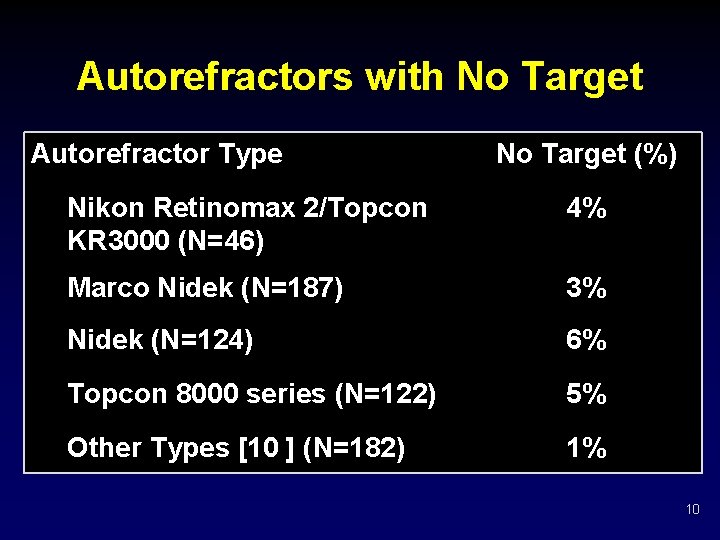
Autorefractors with No Target Autorefractor Type No Target (%) Nikon Retinomax 2/Topcon KR 3000 (N=46) 4% Marco Nidek (N=187) 3% Nidek (N=124) 6% Topcon 8000 series (N=122) 5% Other Types [10 ] (N=182) 1% 10

Comparison of: Manual Refraction Electronic-ETDRS Visual Acuity (MR-EVA) with Autorefraction Electronic-ETDRS Visual Acuity (AR-EVA) and Manual Refraction Electronic-ETDRS Visual Acuity (MR-EVA) with An Identical DRCR. net Manual Refraction (MR-EVAsupl) 11
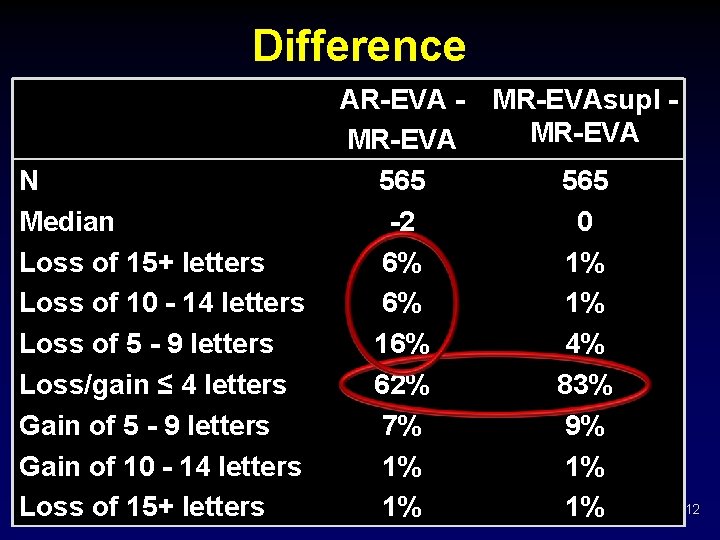
Difference N Median Loss of 15+ letters Loss of 10 - 14 letters Loss of 5 - 9 letters Loss/gain ≤ 4 letters Gain of 5 - 9 letters Gain of 10 - 14 letters Loss of 15+ letters AR-EVA MR-EVA 565 -2 6% 6% 16% 62% 7% 1% 1% MR-EVAsupl MR-EVA 565 0 1% 1% 4% 83% 9% 1% 1% 12
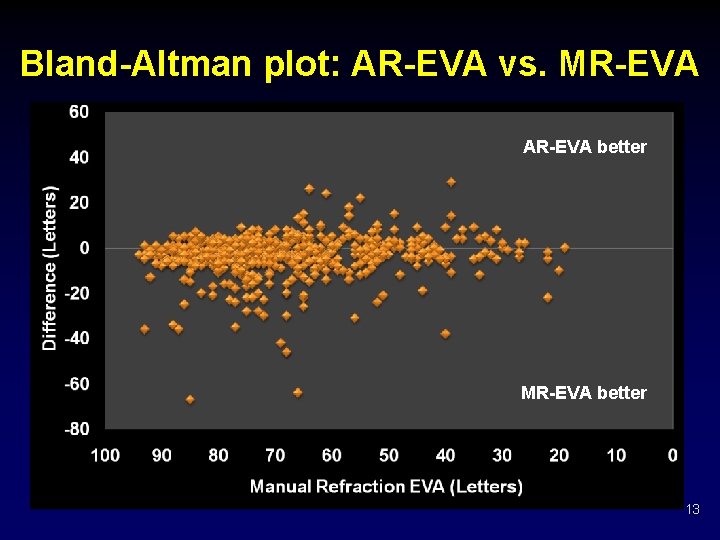
Bland-Altman plot: AR-EVA vs. MR-EVA AR-EVA better MR-EVA better 13
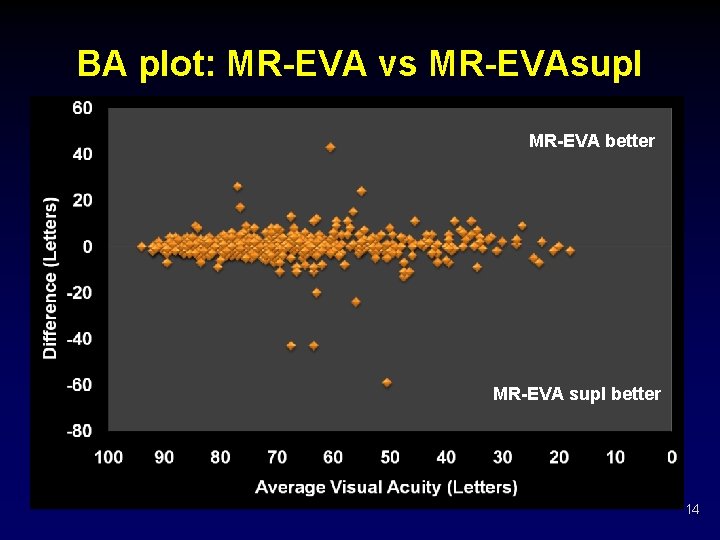
BA plot: MR-EVA vs MR-EVAsupl MR-EVA better MR-EVA supl better 14
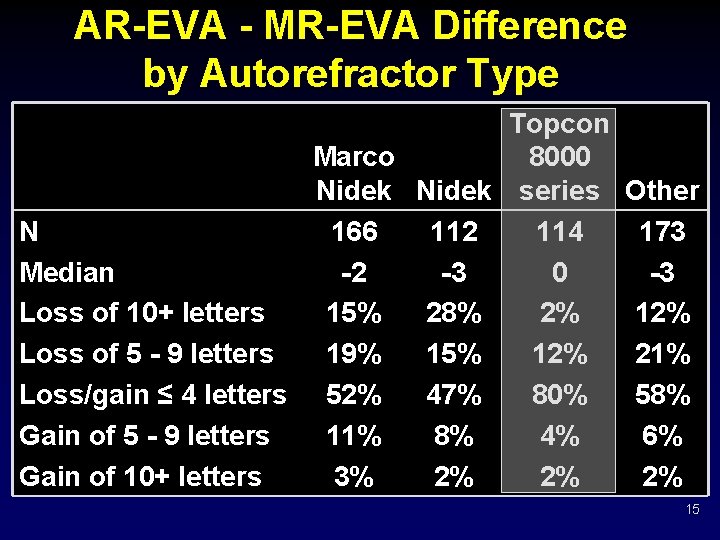
AR-EVA - MR-EVA Difference by Autorefractor Type Marco Nidek N 166 112 Median -2 -3 Loss of 10+ letters 15% 28% Loss of 5 - 9 letters 19% 15% Loss/gain ≤ 4 letters 52% 47% Gain of 5 - 9 letters 11% 8% Gain of 10+ letters 3% 2% Topcon 8000 series 114 0 2% 12% 80% 4% 2% Other 173 -3 12% 21% 58% 6% 2% 15
Comparison of Autorefraction with Manual Refraction 16
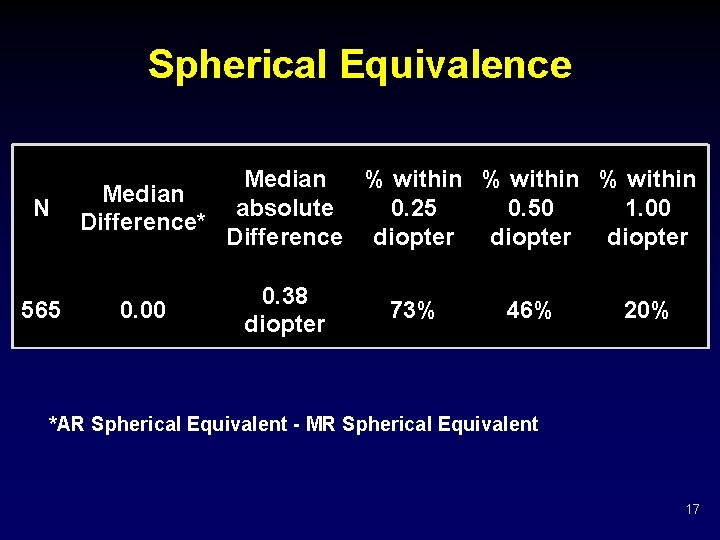
Spherical Equivalence N 565 Median % within Median absolute 0. 25 0. 50 1. 00 Difference* Difference diopter 0. 00 0. 38 diopter 73% 46% 20% *AR Spherical Equivalent - MR Spherical Equivalent 17
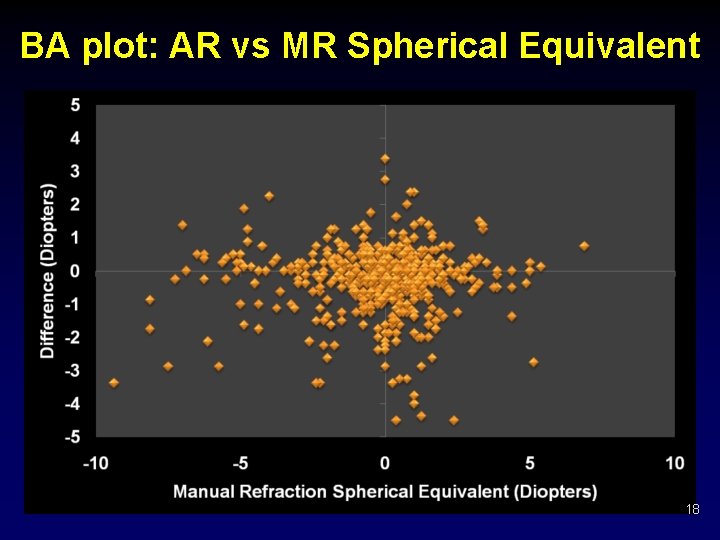
BA plot: AR vs MR Spherical Equivalent 18
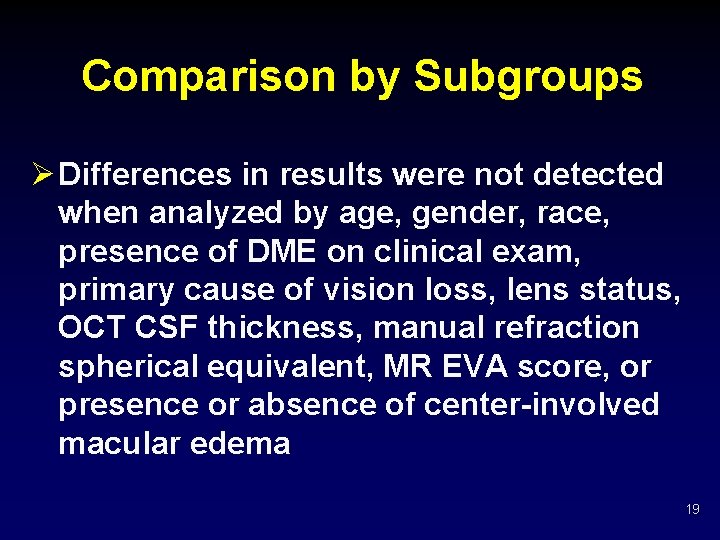
Comparison by Subgroups Ø Differences in results were not detected when analyzed by age, gender, race, presence of DME on clinical exam, primary cause of vision loss, lens status, OCT CSF thickness, manual refraction spherical equivalent, MR EVA score, or presence or absence of center-involved macular edema 19
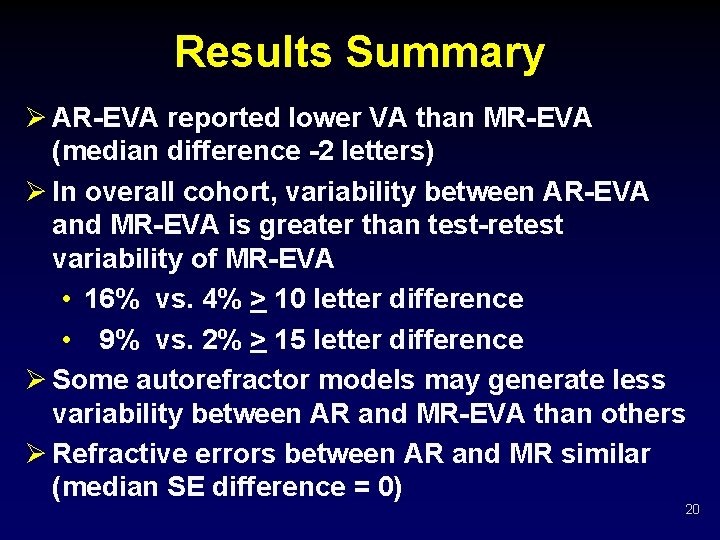
Results Summary Ø AR-EVA reported lower VA than MR-EVA (median difference -2 letters) Ø In overall cohort, variability between AR-EVA and MR-EVA is greater than test-retest variability of MR-EVA • 16% vs. 4% > 10 letter difference • 9% vs. 2% > 15 letter difference Ø Some autorefractor models may generate less variability between AR and MR-EVA than others Ø Refractive errors between AR and MR similar (median SE difference = 0) 20
Conclusions Ø Additional analyses underway to evaluate differences among various autorefractors Ø Discussions underway to determine under what circumstances autorefractors might be able to be used in DRCR Network protocols 21
- Slides: 21