
The Development of the Periodic Table of Elements
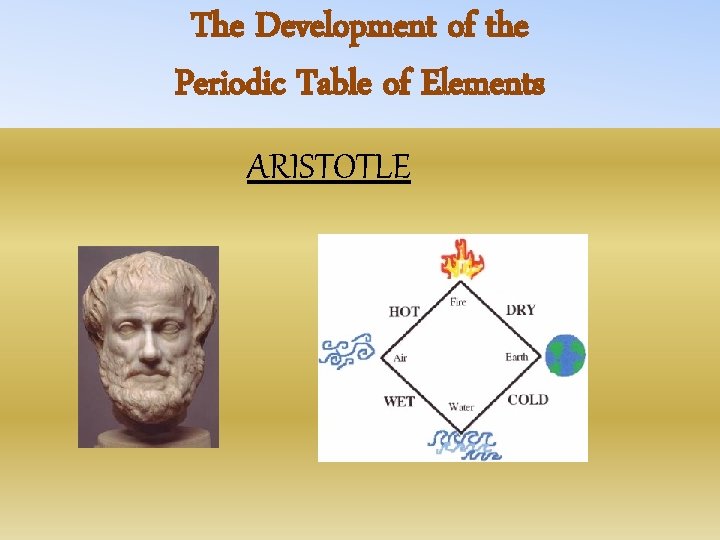
The Development of the Periodic Table of Elements ARISTOTLE
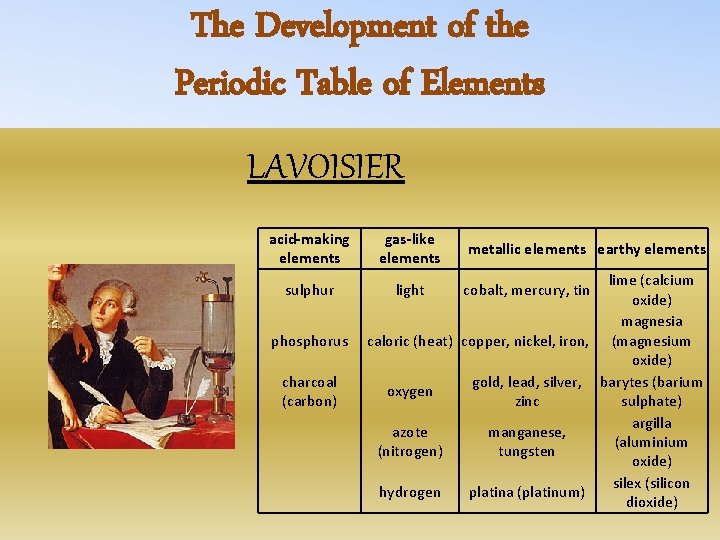
The Development of the Periodic Table of Elements LAVOISIER acid-making elements sulphur phosphorus charcoal (carbon) gas-like elements metallic elements earthy elements lime (calcium oxide) magnesia caloric (heat) copper, nickel, iron, (magnesium oxide) gold, lead, silver, barytes (barium oxygen zinc sulphate) argilla azote manganese, (aluminium (nitrogen) tungsten oxide) silex (silicon hydrogen platina (platinum) dioxide) light cobalt, mercury, tin

The Development of the Periodic Table of Elements Jöns Jakob Berzelius Developed a table of atomic weights 1828. Introduced letters to symbolize elements.
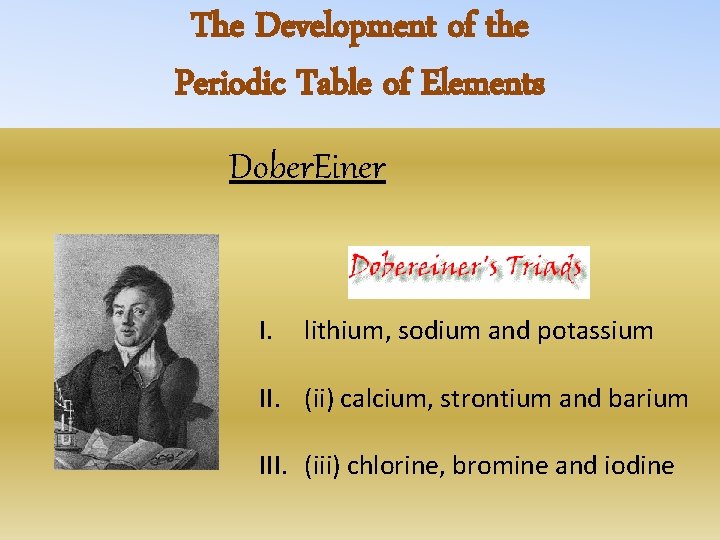
The Development of the Periodic Table of Elements Dober. Einer I. lithium, sodium and potassium II. (ii) calcium, strontium and barium III. (iii) chlorine, bromine and iodine
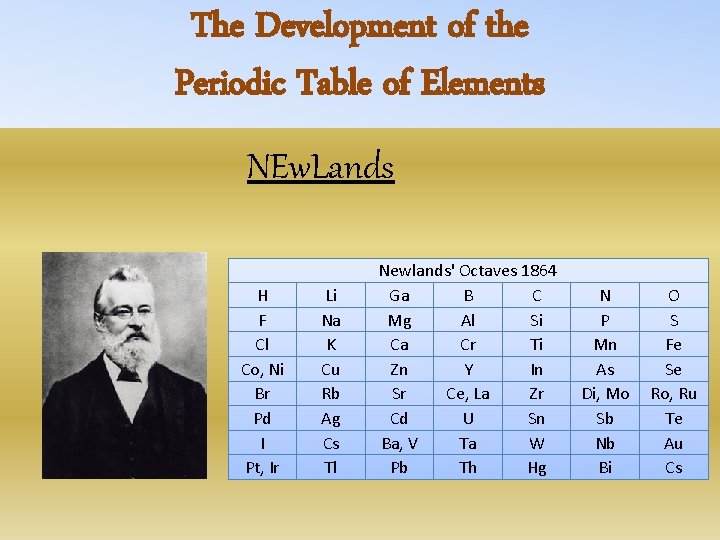
The Development of the Periodic Table of Elements NEw. Lands H F Cl Co, Ni Br Pd I Pt, Ir Li Na K Cu Rb Ag Cs Tl Newlands' Octaves 1864 Ga B C Mg Al Si Ca Cr Ti Zn Y In Sr Ce, La Zr Cd U Sn Ba, V Ta W Pb Th Hg N P Mn As Di, Mo Sb Nb Bi O S Fe Se Ro, Ru Te Au Cs
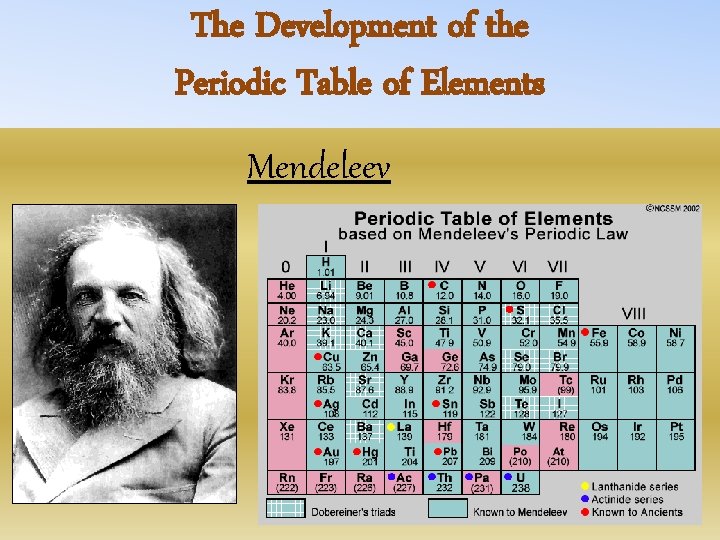
The Development of the Periodic Table of Elements Mendeleev
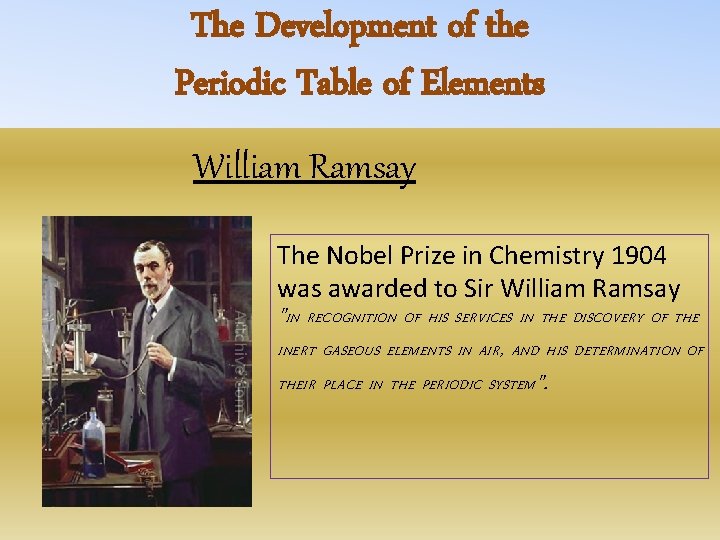
The Development of the Periodic Table of Elements William Ramsay The Nobel Prize in Chemistry 1904 was awarded to Sir William Ramsay "IN RECOGNITION OF HIS SERVICES IN THE DISCOVERY OF THE INERT GASEOUS ELEMENTS IN AIR, AND HIS DETERMINATION OF THEIR PLACE IN THE PERIODIC SYSTEM".
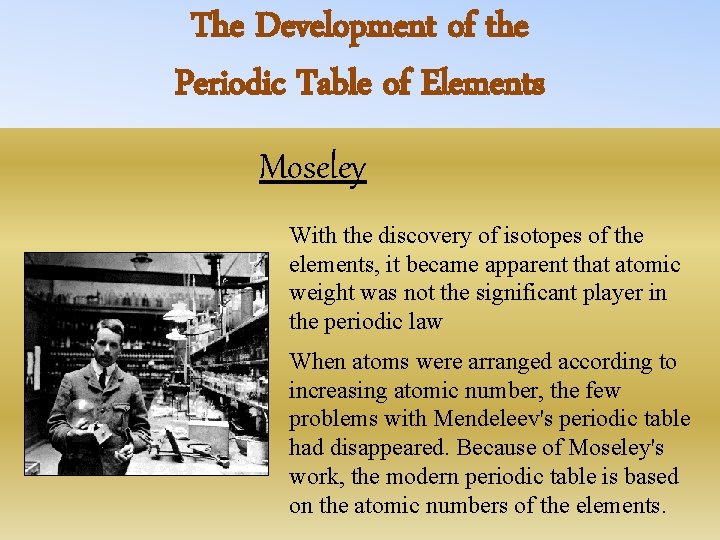
The Development of the Periodic Table of Elements Moseley With the discovery of isotopes of the elements, it became apparent that atomic weight was not the significant player in the periodic law When atoms were arranged according to increasing atomic number, the few problems with Mendeleev's periodic table had disappeared. Because of Moseley's work, the modern periodic table is based on the atomic numbers of the elements.
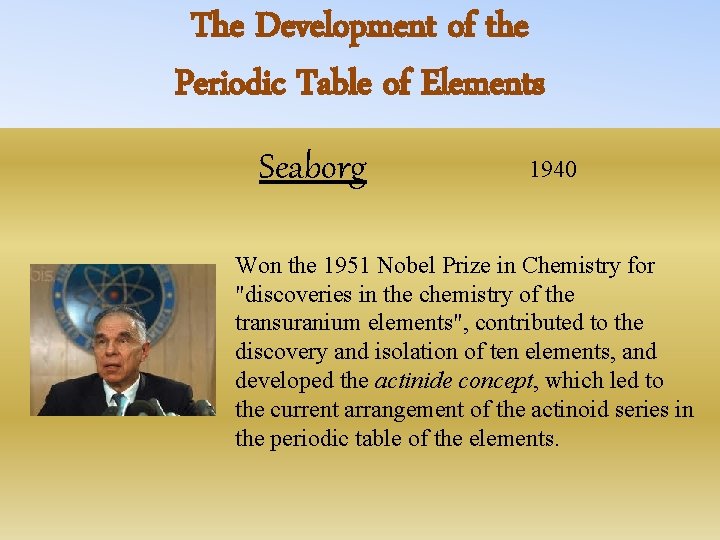
The Development of the Periodic Table of Elements Seaborg 1940 Won the 1951 Nobel Prize in Chemistry for "discoveries in the chemistry of the transuranium elements", contributed to the discovery and isolation of ten elements, and developed the actinide concept, which led to the current arrangement of the actinoid series in the periodic table of the elements.
- Slides: 9