
The Development of the German Economy 1871 1900

- Slides: 14
The Development of the German Economy 1871 -1900 Dan T. and Kieran B.
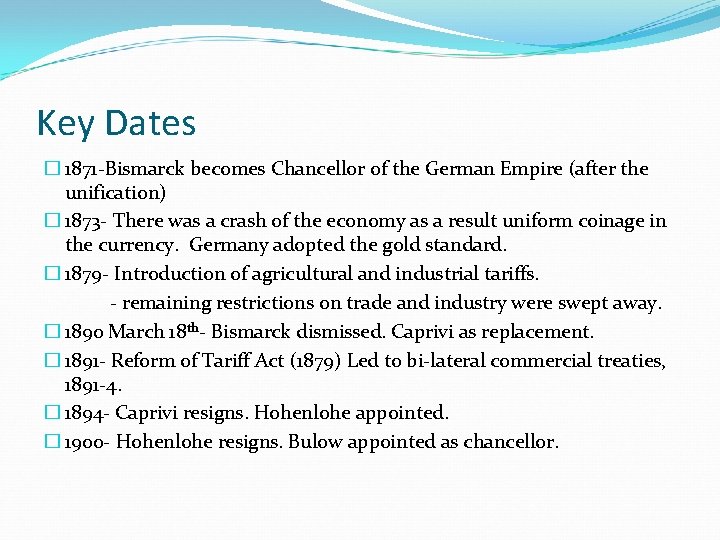
Key Dates � 1871 -Bismarck becomes Chancellor of the German Empire (after the unification) � 1873 - There was a crash of the economy as a result uniform coinage in the currency. Germany adopted the gold standard. � 1879 - Introduction of agricultural and industrial tariffs. - remaining restrictions on trade and industry were swept away. � 1890 March 18 th- Bismarck dismissed. Caprivi as replacement. � 1891 - Reform of Tariff Act (1879) Led to bi-lateral commercial treaties, 1891 -4. � 1894 - Caprivi resigns. Hohenlohe appointed. � 1900 - Hohenlohe resigns. Bulow appointed as chancellor.
Bismarck and the economy � Bismarck took a laissez-faire attitude to the economy, he was prepared to let it sort itself out, this was a liberal idea which firmly aligned him with the middle classes. � 1870’s onwards was a period of economic prosperity in which a middle class was created. � In reality Bismarck dominated the government, the economy was not the only focus of his attention. � laissez-faire- ‘let do’ in French. Means governments shouldn’t intervene with the marketplace.
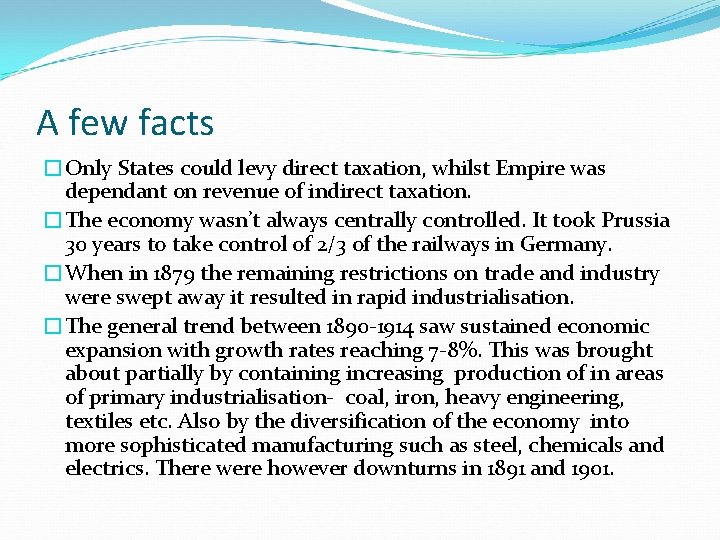
A few facts �Only States could levy direct taxation, whilst Empire was dependant on revenue of indirect taxation. �The economy wasn’t always centrally controlled. It took Prussia 30 years to take control of 2/3 of the railways in Germany. �When in 1879 the remaining restrictions on trade and industry were swept away it resulted in rapid industrialisation. �The general trend between 1890 -1914 saw sustained economic expansion with growth rates reaching 7 -8%. This was brought about partially by containing increasing production of in areas of primary industrialisation- coal, iron, heavy engineering, textiles etc. Also by the diversification of the economy into more sophisticated manufacturing such as steel, chemicals and electrics. There were however downturns in 1891 and 1901.
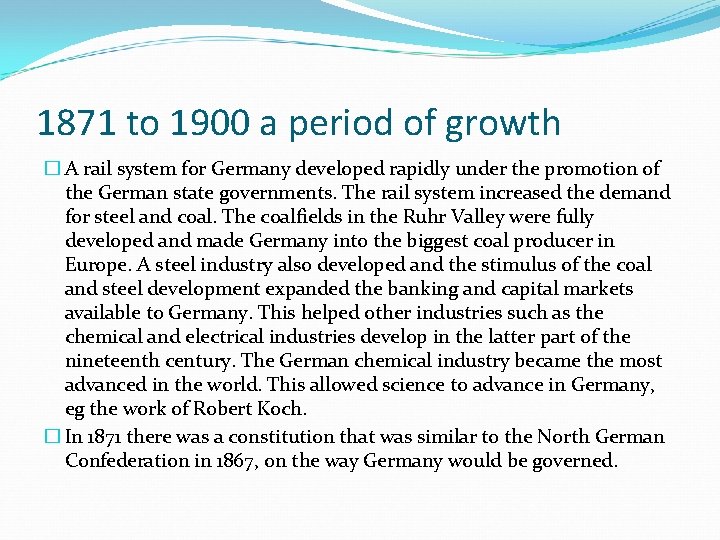
1871 to 1900 a period of growth � A rail system for Germany developed rapidly under the promotion of the German state governments. The rail system increased the demand for steel and coal. The coalfields in the Ruhr Valley were fully developed and made Germany into the biggest coal producer in Europe. A steel industry also developed and the stimulus of the coal and steel development expanded the banking and capital markets available to Germany. This helped other industries such as the chemical and electrical industries develop in the latter part of the nineteenth century. The German chemical industry became the most advanced in the world. This allowed science to advance in Germany, eg the work of Robert Koch. � In 1871 there was a constitution that was similar to the North German Confederation in 1867, on the way Germany would be governed.
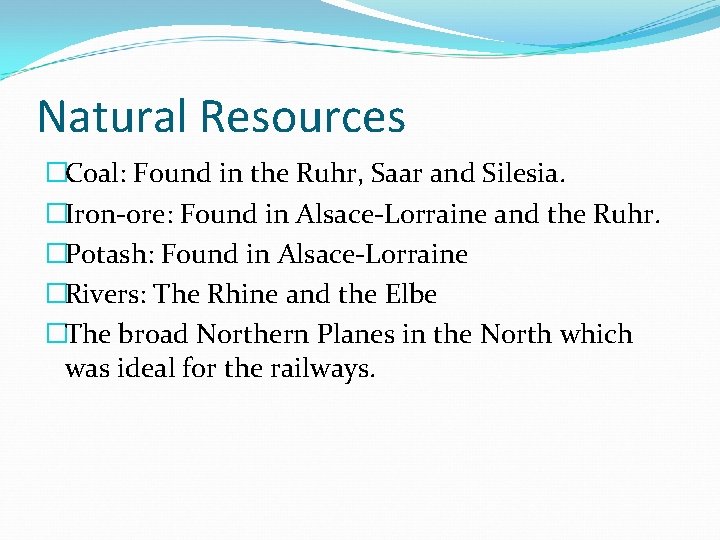
Natural Resources �Coal: Found in the Ruhr, Saar and Silesia. �Iron-ore: Found in Alsace-Lorraine and the Ruhr. �Potash: Found in Alsace-Lorraine �Rivers: The Rhine and the Elbe �The broad Northern Planes in the North which was ideal for the railways.
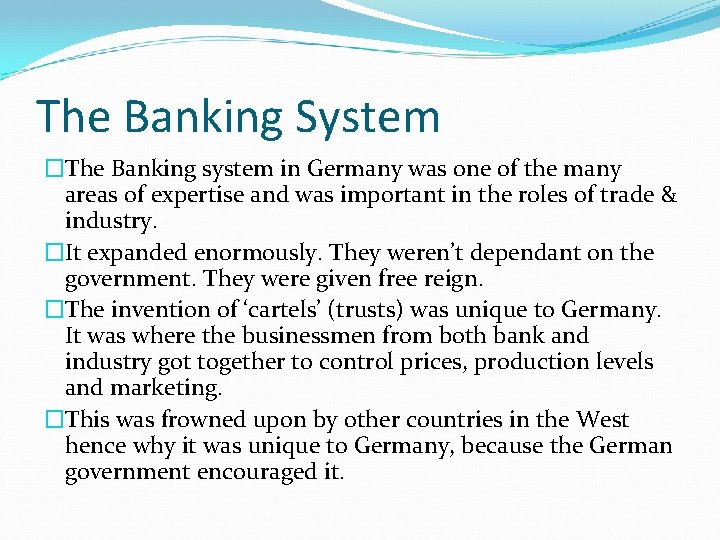
The Banking System �The Banking system in Germany was one of the many areas of expertise and was important in the roles of trade & industry. �It expanded enormously. They weren’t dependant on the government. They were given free reign. �The invention of ‘cartels’ (trusts) was unique to Germany. It was where the businessmen from both bank and industry got together to control prices, production levels and marketing. �This was frowned upon by other countries in the West hence why it was unique to Germany, because the German government encouraged it.
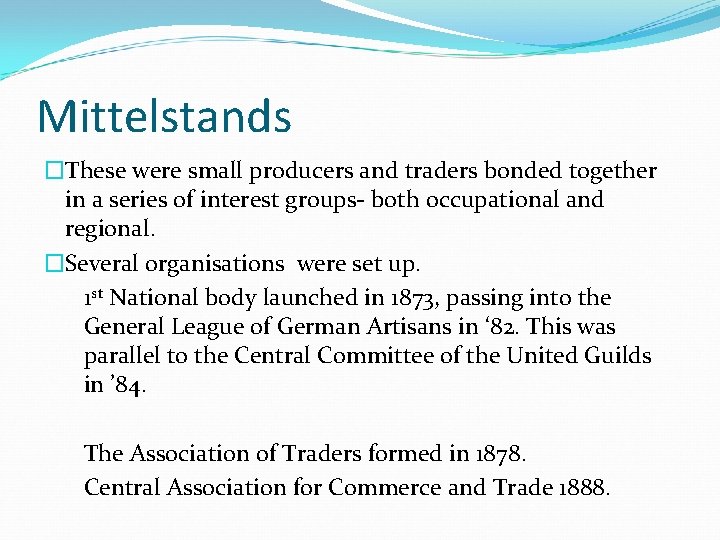
Mittelstands �These were small producers and traders bonded together in a series of interest groups- both occupational and regional. �Several organisations were set up. 1 st National body launched in 1873, passing into the General League of German Artisans in ‘ 82. This was parallel to the Central Committee of the United Guilds in ’ 84. The Association of Traders formed in 1878. Central Association for Commerce and Trade 1888.
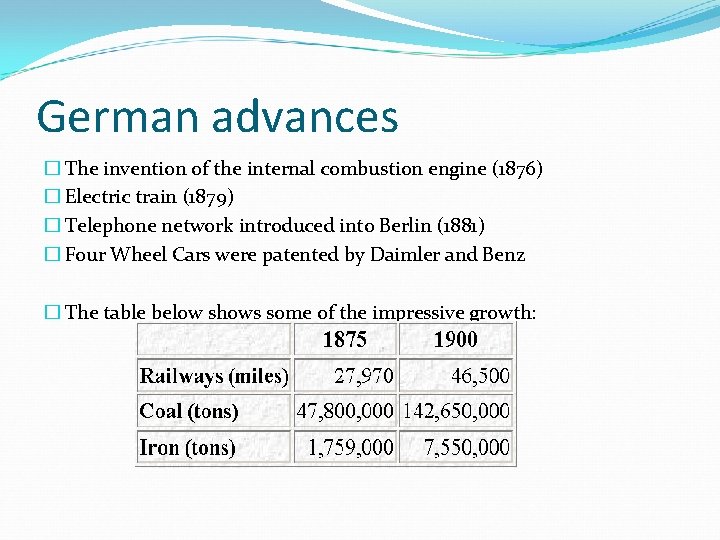
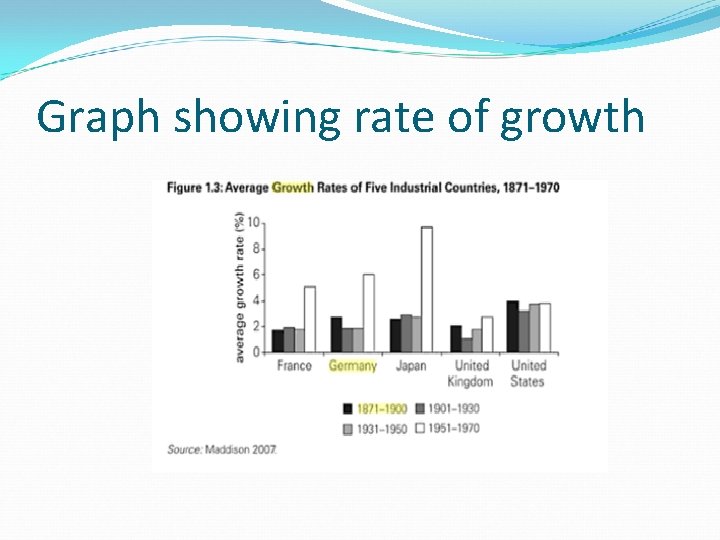
German advances � The invention of the internal combustion engine (1876) � Electric train (1879) � Telephone network introduced into Berlin (1881) � Four Wheel Cars were patented by Daimler and Benz � The table below shows some of the impressive growth:
Graph showing rate of growth
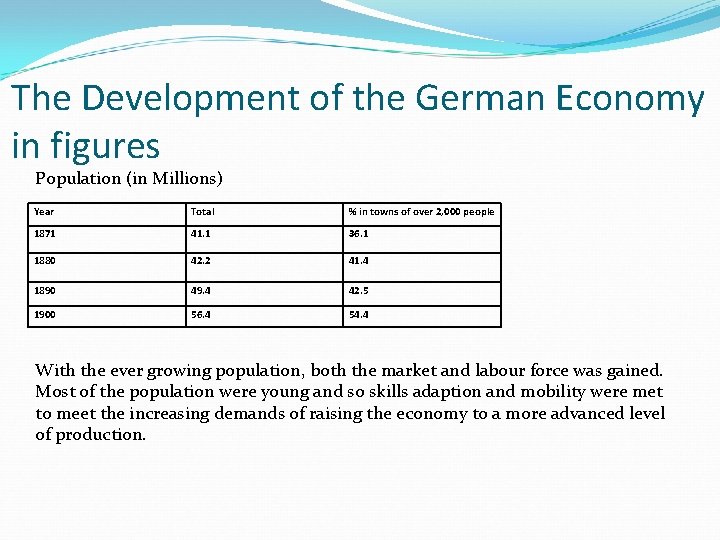
The Development of the German Economy in figures Population (in Millions) Year Total % in towns of over 2, 000 people 1871 41. 1 36. 1 1880 42. 2 41. 4 1890 49. 4 42. 5 1900 56. 4 54. 4 With the ever growing population, both the market and labour force was gained. Most of the population were young and so skills adaption and mobility were met to meet the increasing demands of raising the economy to a more advanced level of production.
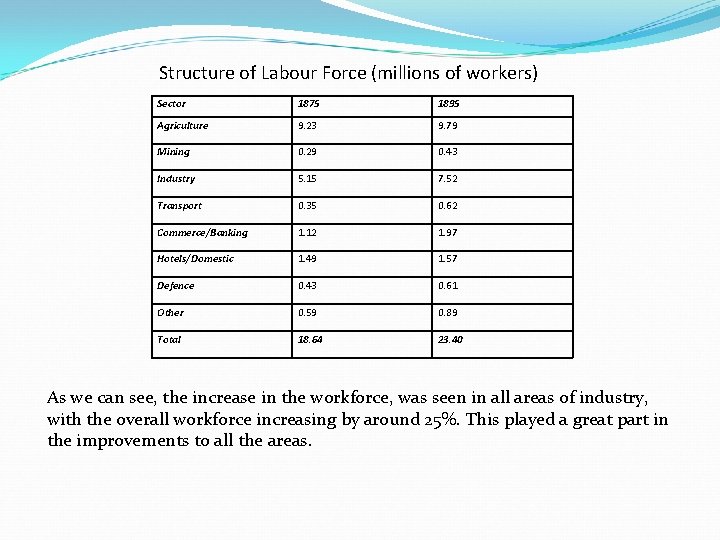
Structure of Labour Force (millions of workers) Sector 1875 1895 Agriculture 9. 23 9. 79 Mining 0. 29 0. 43 Industry 5. 15 7. 52 Transport 0. 35 0. 62 Commerce/Banking 1. 12 1. 97 Hotels/Domestic 1. 49 1. 57 Defence 0. 43 0. 61 Other 0. 59 0. 89 Total 18. 64 23. 40 As we can see, the increase in the workforce, was seen in all areas of industry, with the overall workforce increasing by around 25%. This played a great part in the improvements to all the areas.
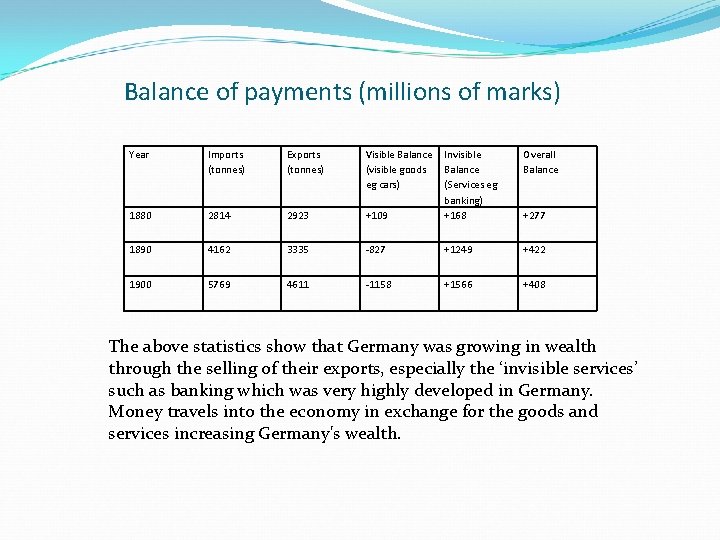
Balance of payments (millions of marks) Year Imports (tonnes) Exports (tonnes) Visible Balance (visible goods eg cars) Overall Balance +109 Invisible Balance (Services eg banking) +168 1880 2814 2923 1890 4162 3335 -827 +1249 +422 1900 5769 4611 -1158 +1566 +408 +277 The above statistics show that Germany was growing in wealth through the selling of their exports, especially the ‘invisible services’ such as banking which was very highly developed in Germany. Money travels into the economy in exchange for the goods and services increasing Germany's wealth.
Sources and Further Reading � ‘From Bismarck to Hitler: Germany 1890 -1933’, Geoff Layton, (Hodder & Stoughton) � ‘Bismarck: The White Revolutionary- Volume 2, 1871 -1898’, Lothar Gall, (Unwin Hyman Ltd) � ‘From Unification To Nazism’, Geoff Eley, Rouledge.