
THE DEVELOPMENT OF SECTOR PRIORITY PAPERS FOR NDPIII


- Slides: 13
THE DEVELOPMENT OF SECTOR PRIORITY PAPERS FOR NDPIII By National Planning Authority Catherine Mayanja, Nassaka 1
Presentation outline 1. Context for programmes 2. Definitions 3. Structure of the Sector Priorities Paper (Priorities and Projects) 2
Context • NPA has proposed 19 national programmes that will provide the framework for implementation and achievement results for NDPIII. • Implementation of interventions defined in NDP II, was premised “on the MDAs and LGs using the national results framework to prepare DPs • However, linkage between the national results framework and the annual plans/budgets (for sectors and MDAs) remains weak - Co. C • A program-based approach to planning, budgeting and implementation will therefore be adopted to strengthen alignment and eliminate the ‘silo’ approach to service delivery and enhance synergies across sectors and other actors 3
Definitions 1. A programme is defined as a set of broad interventions or interrelated projects that need to be implemented within a defined timeframe to achieve a desired impact or outcome. 2. A project, on the other hand, is defined as a set of specified activities that need to be implemented within a defined timeframe in order to generate a desired result or output. 4
STRUCTURE FOR THE DEVELOPMENT OF SECTOR PRIORITY PAPERS 5
Section 1: Introduction 1. Identify the relevant program(s) that sector contributes to. 2. Articulate a service value chain along the identified programme - programme components 3. Describe how the Programme Component (s) {this is sector level} will contribute to the programme 4. Identify the relevant sectors or MDAs to implement the Programme Component (s) along the service delivery value chain 5. Identify the relevant DPs, private sector and CSOs for implementation of the Programme. 6
Section 2: Situational Analysis 1. Will be based on the key elements of the value chain or service delivery mechanism depending on the sector e. g. Development Plan implementation value chain 2. Identify the major stages of the value chain and do the 3. Analysis of performance for each applicable stages of the value chain; 1. Comparison with regional and global trends (where appropriate); 2. Identification of the major successes (backed with statistics) and key constraints along the stages of the value chain; 3. Brief discussion of both budget and off-budget performance pointing out critical areas that were prioritized but not adequately financed; 4. Analysis of human resources capacity 7
Section 2: Situational Analysis… 5. Discuss suitability of existing policy and legal framework, clearly indicating any gaps and proposals on how to strengthen 6. Highlight the key issues affecting implementation of ongoing projects 7. Provide a summary of key successes and problems to be addressed for consideration in the programme 8
Section 3: Programme Component (s) Articulation 1. Identify desired results (Objectives and respective indicator targets for the five year ) considering the overall programme results; 2. Propose interventions that will enable the sector to attain the desired results; 3. Based on the proposed interventions, describe a proposed set of development projects (new project ideas) to realize the desired results; 4. Harmonise existing projects inline with overall programme 5. Identify any other possible Programme Component (s) considering the proposed interventions 9
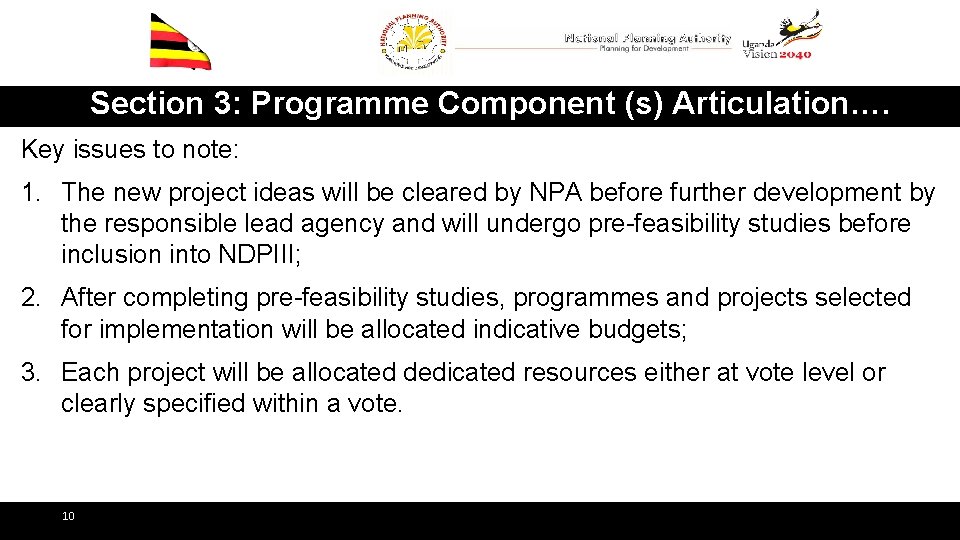
Section 3: Programme Component (s) Articulation…. Key issues to note: 1. The new project ideas will be cleared by NPA before further development by the responsible lead agency and will undergo pre-feasibility studies before inclusion into NDPIII; 2. After completing pre-feasibility studies, programmes and projects selected for implementation will be allocated indicative budgets; 3. Each project will be allocated dedicated resources either at vote level or clearly specified within a vote. 10
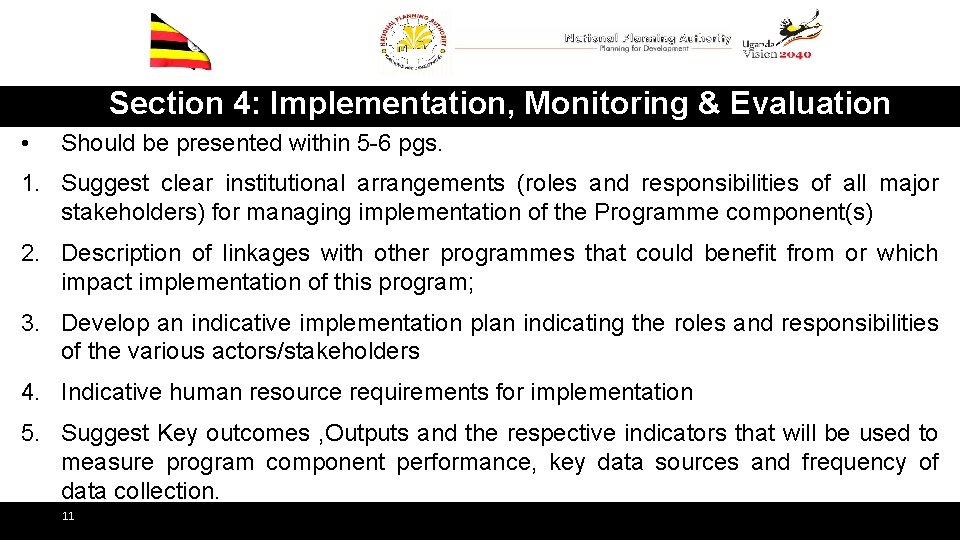
Section 4: Implementation, Monitoring & Evaluation • Should be presented within 5 -6 pgs. 1. Suggest clear institutional arrangements (roles and responsibilities of all major stakeholders) for managing implementation of the Programme component(s) 2. Description of linkages with other programmes that could benefit from or which impact implementation of this program; 3. Develop an indicative implementation plan indicating the roles and responsibilities of the various actors/stakeholders 4. Indicative human resource requirements for implementation 5. Suggest Key outcomes , Outputs and the respective indicators that will be used to measure program component performance, key data sources and frequency of data collection. 11
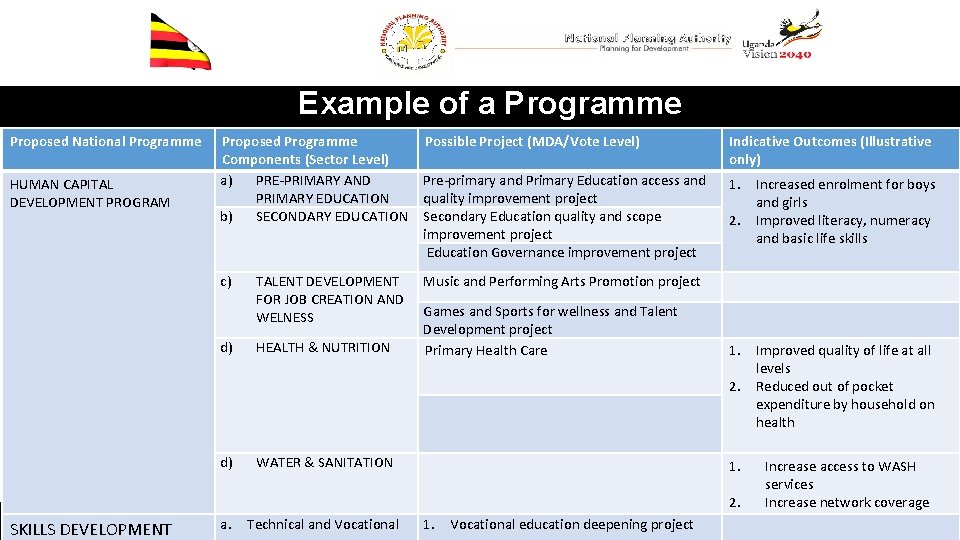
Example of a Programme Proposed National Programme HUMAN CAPITAL DEVELOPMENT PROGRAM Proposed Programme Components (Sector Level) a) PRE-PRIMARY AND PRIMARY EDUCATION b) SECONDARY EDUCATION c) 12 SKILLS DEVELOPMENT TALENT DEVELOPMENT FOR JOB CREATION AND WELNESS d) HEALTH & NUTRITION d) WATER & SANITATION Possible Project (MDA/Vote Level) Indicative Outcomes (Illustrative only) Pre-primary and Primary Education access and quality improvement project Secondary Education quality and scope improvement project Education Governance improvement project 1. Increased enrolment for boys and girls 2. Improved literacy, numeracy and basic life skills Music and Performing Arts Promotion project Games and Sports for wellness and Talent Development project Primary Health Care 1. Improved quality of life at all levels 2. Reduced out of pocket expenditure by household on health 1. 2. a. Technical and Vocational 1. Vocational education deepening project Increase access to WASH services Increase network coverage
THANK YOU!