
The Development of Project Management Past Present and
- Slides: 16
The Development of Project Management: Past, Present and Future Theme Day Goal Directed Project Management in 30 Years 13 May 2014 Prof Ralf Müller BI Norwegian Business School Department of Leadership and Organizational Behaviour
Agenda • • Where do we come from Where are we now Where do we og from here … in research and practice “Life can only be understood backwards; but it must be lived forwards. ” ― Søren Kierkegaard (1813 -1855) BI Norwegian Business School Department of Leadership and Organizational Behaviour
Research: where do we come from Analysis of 15 years of IRNOP papers showed • a significant dominance of project management research which is based on subjectivity, interpretivism, and use of case study methodologies together with qualitative methods. • Contributions to knowledge were mainly in the governance, behavior and optimization school of thought. Biedenbach & Müller 2011
Research: where are we now Analysis of 15 years of IRNOP papers showed • Subjective research paradigms are gradually reduced at the expense of more objective paradigms, albeit at a low level. • About 80 percent of studies are subjective, interpretivistic and use qualitative methods. • Methodologies shift towards multiple case studies • Along with a slight reduction in subjective studies comes an increase in objective and positivist studies, using quantitative methods (slightly less than 20 percent of all studies). • Contributions to knowledge have strongly shifted towards the process school of thought and to a lesser extend the behavior and contingency schools. Biedenbach & Müller 2011
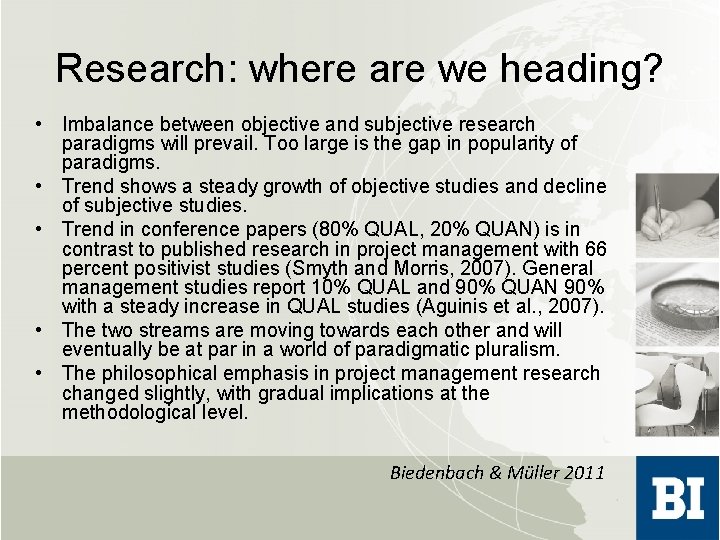
Research: where are we heading? • Imbalance between objective and subjective research paradigms will prevail. Too large is the gap in popularity of paradigms. • Trend shows a steady growth of objective studies and decline of subjective studies. • Trend in conference papers (80% QUAL, 20% QUAN) is in contrast to published research in project management with 66 percent positivist studies (Smyth and Morris, 2007). General management studies report 10% QUAL and 90% QUAN 90% with a steady increase in QUAL studies (Aguinis et al. , 2007). • The two streams are moving towards each other and will eventually be at par in a world of paradigmatic pluralism. • The philosophical emphasis in project management research changed slightly, with gradual implications at the methodological level. Biedenbach & Müller 2011
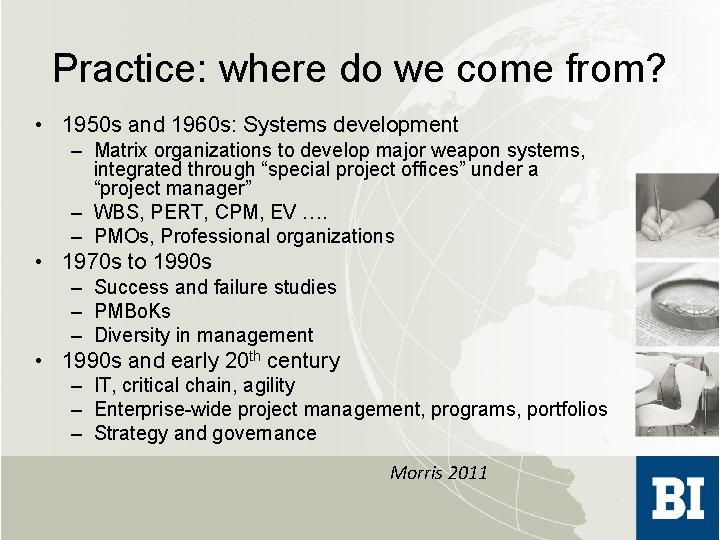
Practice: where do we come from? • 1950 s and 1960 s: Systems development – Matrix organizations to develop major weapon systems, integrated through “special project offices” under a “project manager” – WBS, PERT, CPM, EV …. – PMOs, Professional organizations • 1970 s to 1990 s – Success and failure studies – PMBo. Ks – Diversity in management • 1990 s and early 20 th century – IT, critical chain, agility – Enterprise-wide project management, programs, portfolios – Strategy and governance Morris 2011
Practice: where are we now • Methodological multiplicity • Agile and combinations of traditional & agile approaches • Awareness of soft factors increases • Awareness for governance grows • Enterprise project management on the rise
Practice: where are we now • • Educated project managers Sustainability aware generation Declining tolerance for failure Leadership “In command: out of control” New commercial odels Poly project management Growing profile Taylor 2014
Practice: where are we heading? • Increase in large infrastructure projects – 2004 -2998 China spent more on infrastructure than during the 20 th century, a 20 fold increase – “Biggest investment boom in history” (Economist (2008) • Price levels of USD 50 -100 billion are common for gigaprojects, prices above USD 100 billion not uncommon Flyvbjerg 2014
Practice: where are we heading? DEPEST analysis: • Demographics • Economics • Political-legal factors • Ecological factors • Social-cultural factors • Technology Jugdev, Müller & Hutchison 2009
Practice: where are we heading? • Demographics – Multilingual business – Retiring baby boomers demand more projects for hospitality, travel, entertainment • Economics – Globalization and multi-culturality increases project complexity – Increase in social projects, and importance of values such as ethics, green, CSR etc • Political-legal factors – Political unrest will continue to demand specialization of project managers, e. g. in technology, military, IT, logistics etc. Jugdev, Müller & Hutchison 2009
Practice: where are we heading? • Ecological factors – Net generation at mid career by 2025 – Increase in energy projects, but also freshwater supply and agricultural projects • Social-cultural factors – Social networks impact the development of tools and work practices of project managers – PM a topic at undergraduate and grade school – Work-life balance importance for Generation X and Y (1983 onwards) – Communities driven projects • Technology – Aging population demands more pharmaceutical projects and technology enhancements for health and wellness – Virtual teams and virtual work, e. g. using highly intelligent analysis tools for business intelligence – Advances from interactive computer games will make their way in project management, control and reporting Jugdev, Müller & Hutchison 2009
Practice: Some pragmatic trends • Demand for project managers to meet triple constraints plus expectation will continue. Companies will: – Increase training and education – develop intelligent project selection techniques/tools and project management tools • Diversity of projects will increase, calling on well educated and trained PMs, e. g. in – Nanotechnology or other upcoming technologies, – Social competences for social media, crowdfunding and community-based project management – Collaboration of companies, communities of practice and professional organizations for knowledge sharing and integration Jugdev, Müller & Hutchison 2009
Practice: Some pragmatic trends • Professional organizations to: – Continue their Bo. Ks, but diversify in more industries – Expand certification to industries and upcoming methodologies using more applied rather than rote learning apporaches – Emphasize the role of values and ethics for a long-term orientation of and for projects Jugdev, Müller & Hutchison 2009
Thank you
References Aguinis, H. , Pierce, C. a. , Bosco, F. a. , & Muslin, I. S. (2007). First Decade of Organizational Research Methods: Trends in Design, Measurement, and Data-Analysis Topics. Organizational Research Methods, 12(1), 69– 112. Biedenbach, T. , & Müller, R. (2011). Paradigms in project management research: examples from 15 years of IRNOP conferences. International Journal of Managing Projects in Business, 4(1), 82– 104. The Economist (2008). Building BRIC’s of growth, June 7, p. 80. Flyvbjerg, B. (2014). What You Should Know About Megaprojects and Why An Overview. Project Management Journal, 45(2), 6– 19. doi: 10. 1002/pmj Jugdev, K. , Müller, R. , & Hutchison, M. (2009). Future Trends in Project Management: A Macro. Environmental Analysis. In D. L. Cleland & B. Bidanda (Eds. ), Project Management Circa 2025. Newtown Square, PA, USA: PMI. Morris, P. W. G. (2011). A brief history of project management. In P. W. G. Morris, J. K. Pinto, & J. Söderlund (Eds. ), Oxford Handbook of Project Management (pp. 15– 36). Oxford, UK: Oxford University Press, UK. Smyth, H. , & Morris, P. (2007). An epistemological evaluation of research into projects and their management: Methodological issues. International Journal of Project Management, 25(4), 423– 436. Taylor, T. (2014): Project management trends and fashions. Baltic. PM Days conference, May 8 -9, 2014, Vilnius, Lithuania.