
The Development of Large Area Psec TOF Systems
- Slides: 59
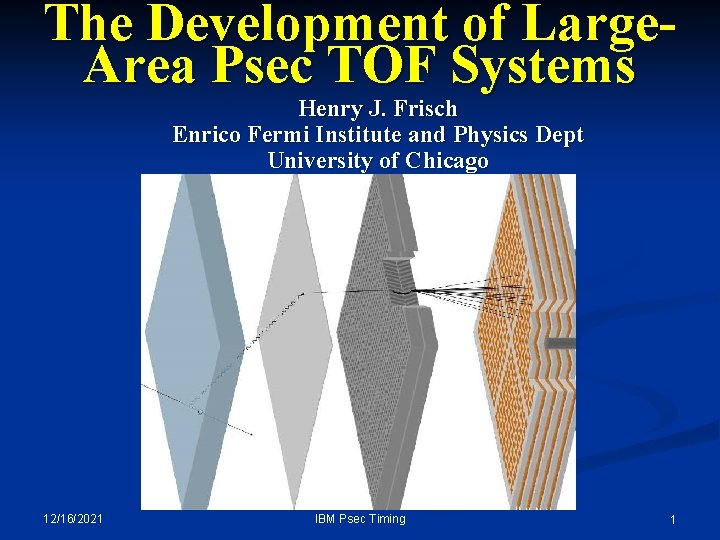
The Development of Large. Area Psec TOF Systems Henry J. Frisch Enrico Fermi Institute and Physics Dept University of Chicago 12/16/2021 IBM Psec Timing 1
Introduction • Resolution on time measurements translates into resolution in space, which in turn impact momentum and energy measurements. • Silicon Strip Detectors and Pixels have reduced position resolutions to ~5 -10 microns or better. • Time resolution hasn’t kept pace- not much changed since the 60’s in large-scale TOF system resolutions and technologies (thick scint. or crystals, PM’s, Lecroy TDC’s) • Improving time measurements is fundamental , and can affect many fields: particle physics, medical imaging, accelerators, astro and nuclear physics, laser ranging, …. • Need to understand what are the limiting underlying physical processes- e. g. source line widths, photon statistics, e/photon path length variations. • What is the ultimate limit for different applications? 12/16/2021 IBM Psec Timing 2
OUTLINE 1. Introduction: why picosec, and why `large 2. 3. 4. 5. 6. 7. area’? HEP needs: particles and quark flow, heavy particles, displaced vertices, photon origin Three key developments since the 60’s: Micro. Channel Plates (MCPs), 200 GHZ electronics, and end-to-end simulation The need for end-to-end simulation Why Positron-Emission Tomography (PET) looks like HEP: data rate, # of channels, S/N, data-acquisition, real-time imaging What determines the ultimate limits for relativistic particles, and also for PET? A wish list for answers to questions. 12/16/2021 IBM Psec Timing 3
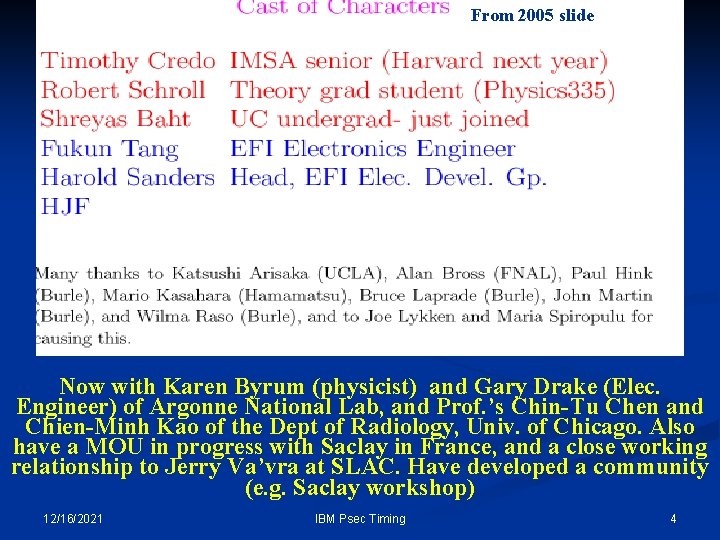
From 2005 slide Now with Karen Byrum (physicist) and Gary Drake (Elec. Engineer) of Argonne National Lab, and Prof. ’s Chin-Tu Chen and Chien-Minh Kao of the Dept of Radiology, Univ. of Chicago. Also have a MOU in progress with Saclay in France, and a close working relationship to Jerry Va’vra at SLAC. Have developed a community (e. g. Saclay workshop) 12/16/2021 IBM Psec Timing 4
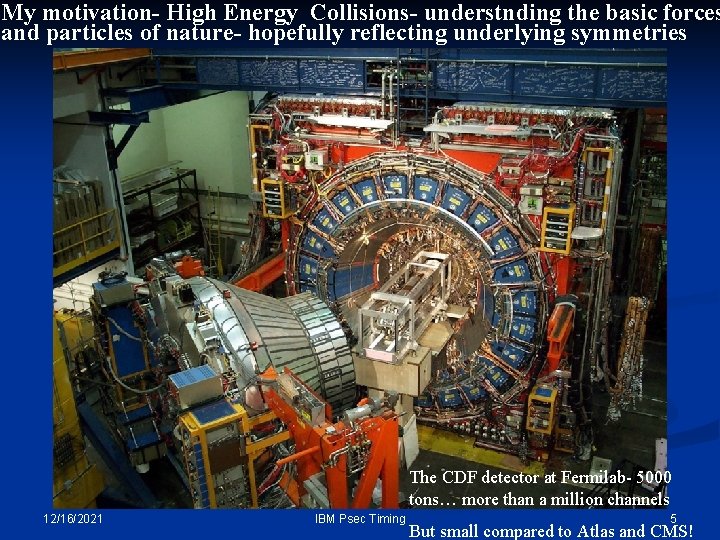
My motivation- High Energy Collisions- understnding the basic forces and particles of nature- hopefully reflecting underlying symmetries The CDF detector at Fermilab- 5000 tons… more than a million channels 12/16/2021 IBM Psec Timing 5 But small compared to Atlas and CMS!
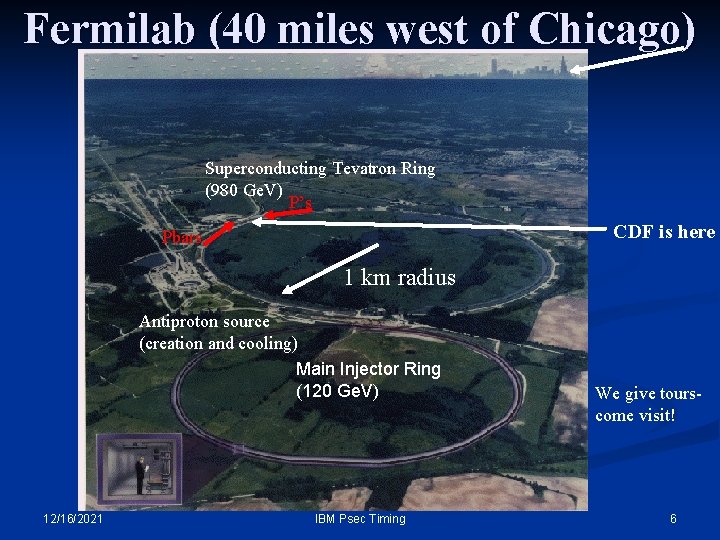
Fermilab (40 miles west of Chicago) Superconducting Tevatron Ring (980 Ge. V) P’s CDF is here Pbars 1 km radius Antiproton source (creation and cooling) Main Injector Ring (120 Ge. V) 12/16/2021 IBM Psec Timing We give tourscome visit! 6
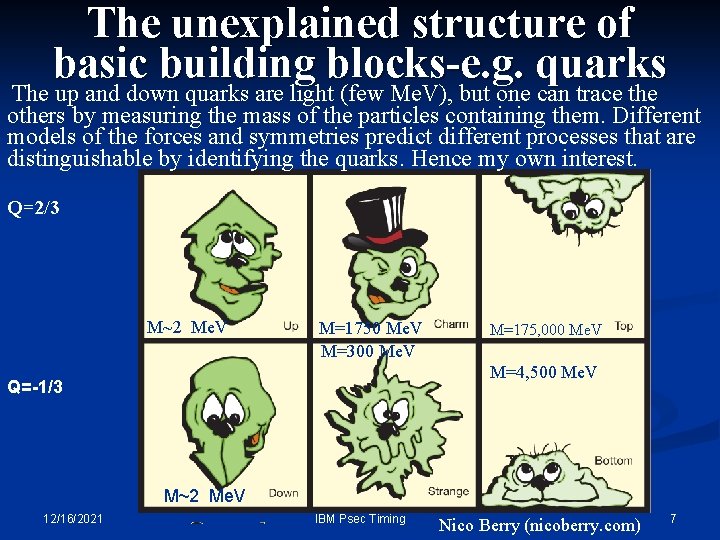
The unexplained structure of basic building blocks-e. g. quarks The up and down quarks are light (few Me. V), but one can trace the others by measuring the mass of the particles containing them. Different models of the forces and symmetries predict different processes that are distinguishable by identifying the quarks. Hence my own interest. Q=2/3 M~2 Me. V M=1750 Me. V M=300 Me. V M=175, 000 Me. V M=4, 500 Me. V Q=-1/3 M~2 Me. V 12/16/2021 IBM Psec Timing Nico Berry (nicoberry. com) 7
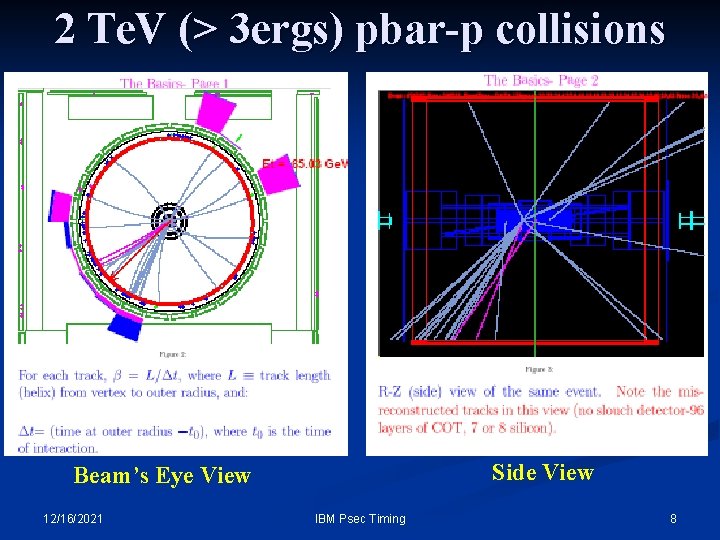
2 Te. V (> 3 ergs) pbar-p collisions Side View Beam’s Eye View 12/16/2021 IBM Psec Timing 8
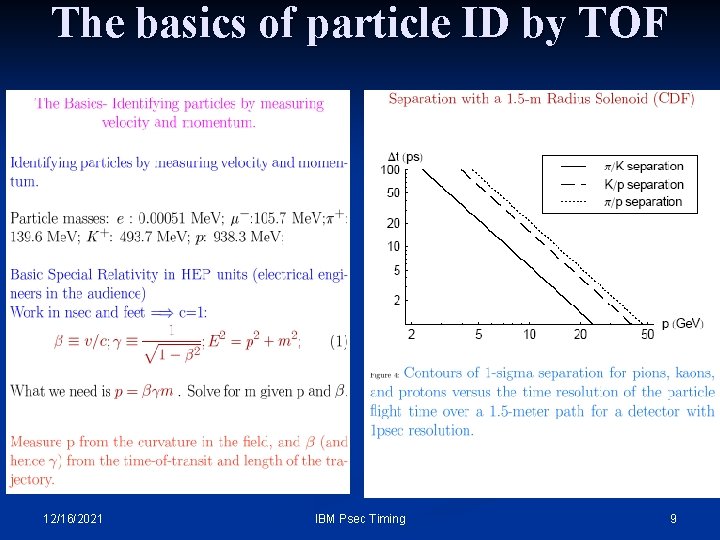
The basics of particle ID by TOF 12/16/2021 IBM Psec Timing 9
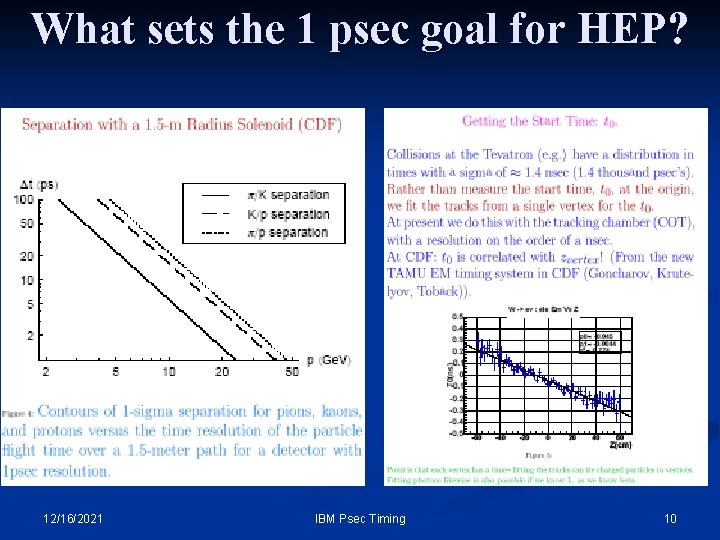
What sets the 1 psec goal for HEP? 12/16/2021 IBM Psec Timing 10
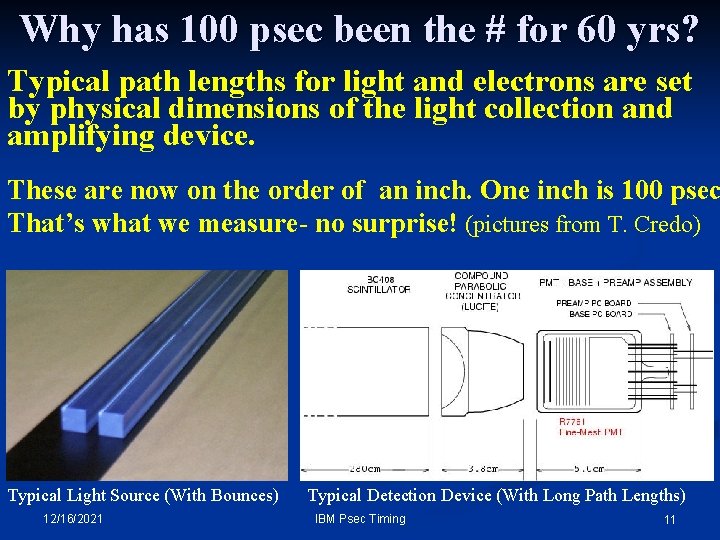
Why has 100 psec been the # for 60 yrs? Typical path lengths for light and electrons are set by physical dimensions of the light collection and amplifying device. These are now on the order of an inch. One inch is 100 psec That’s what we measure- no surprise! (pictures from T. Credo) Typical Light Source (With Bounces) 12/16/2021 Typical Detection Device (With Long Path Lengths) IBM Psec Timing 11
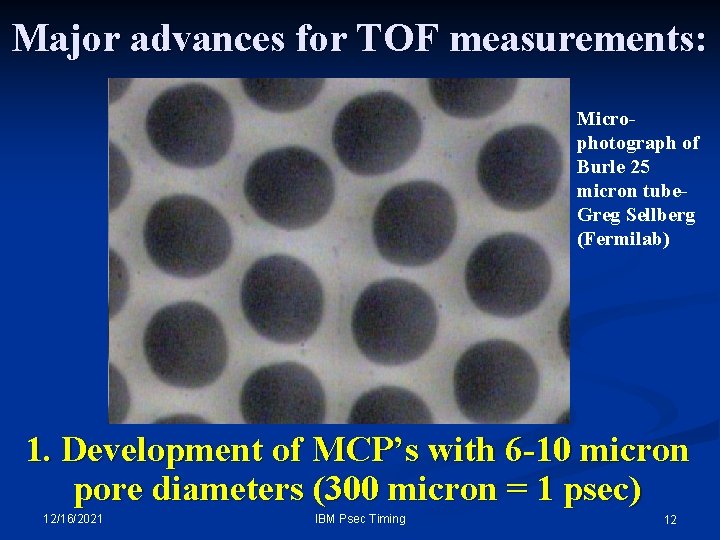
Major advances for TOF measurements: Microphotograph of Burle 25 micron tube. Greg Sellberg (Fermilab) 1. Development of MCP’s with 6 -10 micron pore diameters (300 micron = 1 psec) 12/16/2021 IBM Psec Timing 12
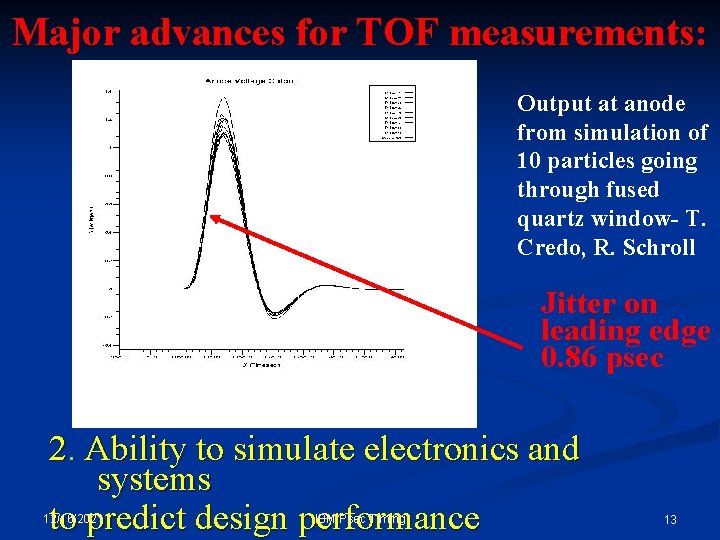
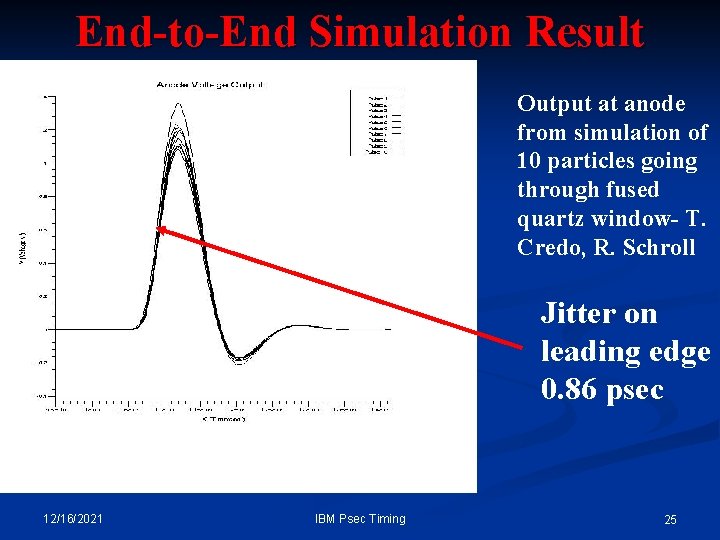
Major advances for TOF measurements: Output at anode from simulation of 10 particles going through fused quartz window- T. Credo, R. Schroll Jitter on leading edge 0. 86 psec 2. Ability to simulate electronics and systems to predict design performance 12/16/2021 IBM Psec Timing 13
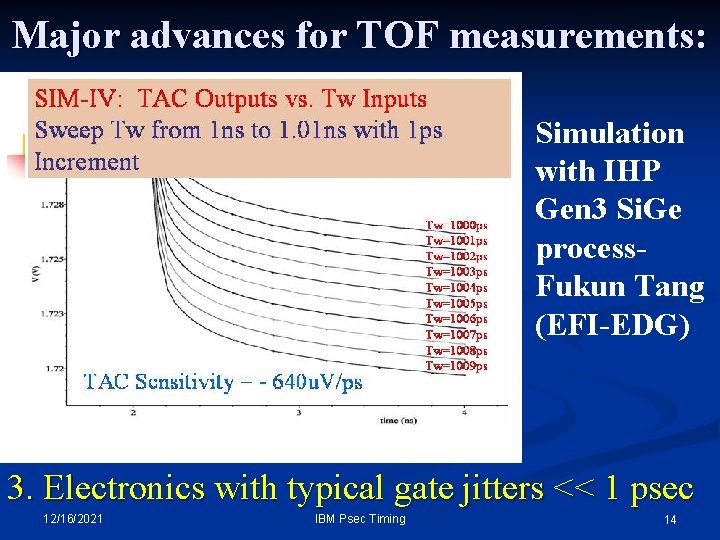
Major advances for TOF measurements: Simulation with IHP Gen 3 Si. Ge process. Fukun Tang (EFI-EDG) 3. Electronics with typical gate jitters << 1 psec 12/16/2021 IBM Psec Timing 14
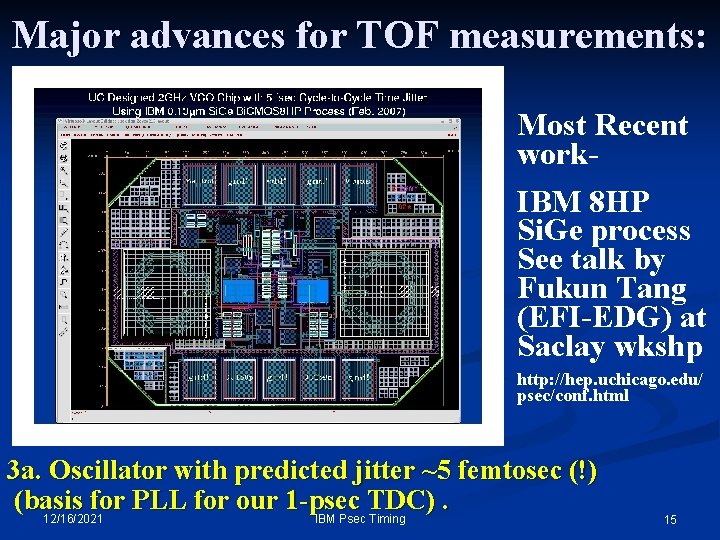
Major advances for TOF measurements: Most Recent work. IBM 8 HP Si. Ge process See talk by Fukun Tang (EFI-EDG) at Saclay wkshp http: //hep. uchicago. edu/ psec/conf. html 3 a. Oscillator with predicted jitter ~5 femtosec (!) (basis for PLL for our 1 -psec TDC). 12/16/2021 IBM Psec Timing 15
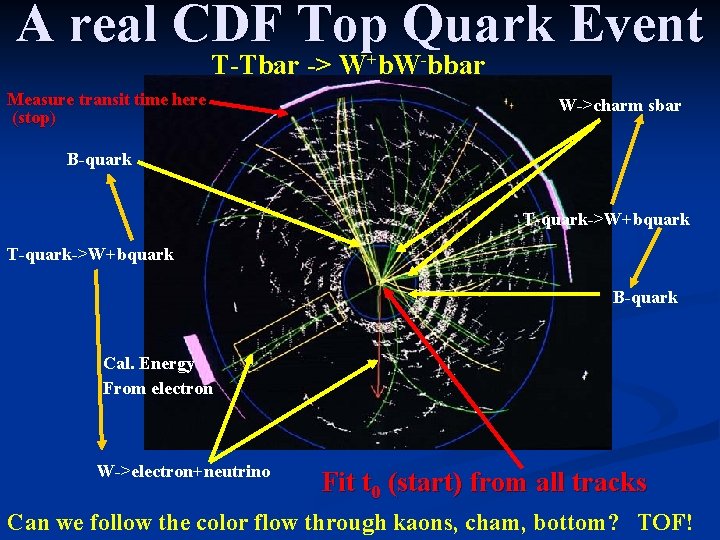
A real CDF Top Quark Event T-Tbar -> W+b. W-bbar Measure transit time here (stop) W->charm sbar B-quark T-quark->W+bquark B-quark Cal. Energy From electron W->electron+neutrino Fit t 0 (start) from all tracks Can we follow the color flow through kaons, cham, bottom? TOF!
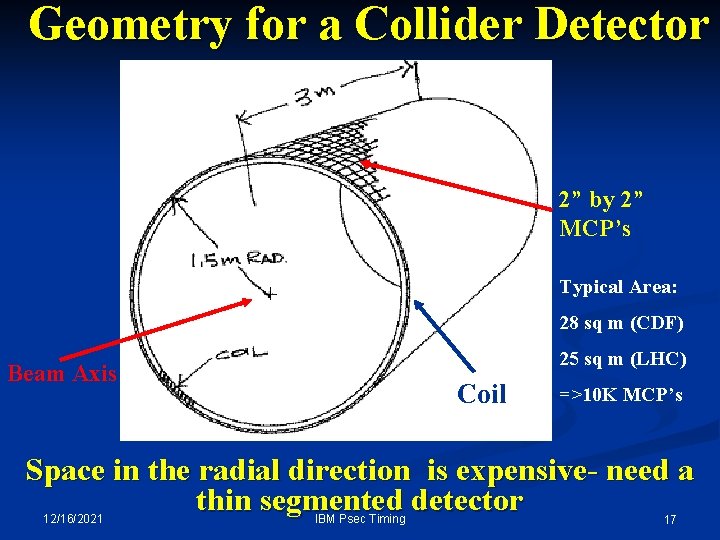
Geometry for a Collider Detector 2” by 2” MCP’s Typical Area: 28 sq m (CDF) 25 sq m (LHC) Beam Axis Coil =>10 K MCP’s Space in the radial direction is expensive- need a thin segmented detector 12/16/2021 IBM Psec Timing 17
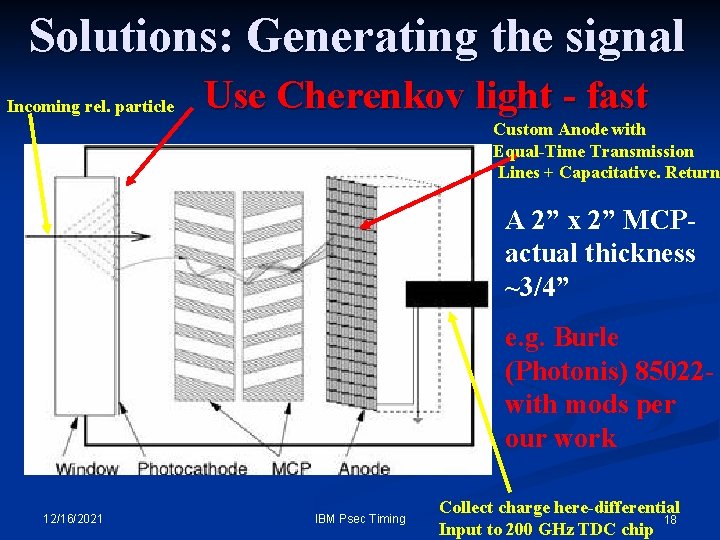
Solutions: Generating the signal Incoming rel. particle Use Cherenkov light - fast Custom Anode with Equal-Time Transmission Lines + Capacitative. Return A 2” x 2” MCPactual thickness ~3/4” e. g. Burle (Photonis) 85022 with mods per our work 12/16/2021 IBM Psec Timing Collect charge here-differential 18 Input to 200 GHz TDC chip
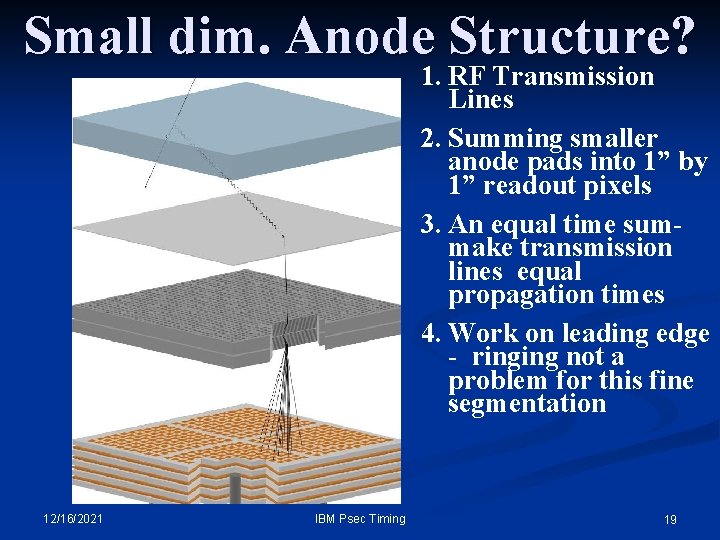
Small dim. Anode Structure? 1. RF Transmission Lines 2. Summing smaller anode pads into 1” by 1” readout pixels 3. An equal time summake transmission lines equal propagation times 4. Work on leading edge - ringing not a problem for this fine segmentation 12/16/2021 IBM Psec Timing 19
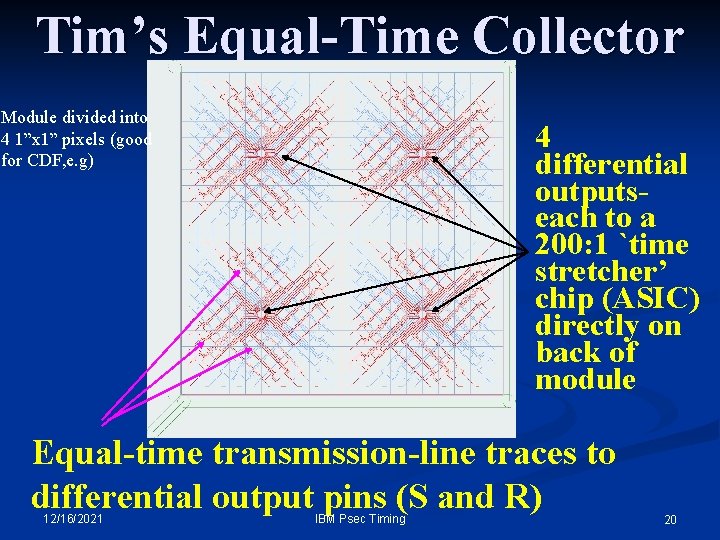
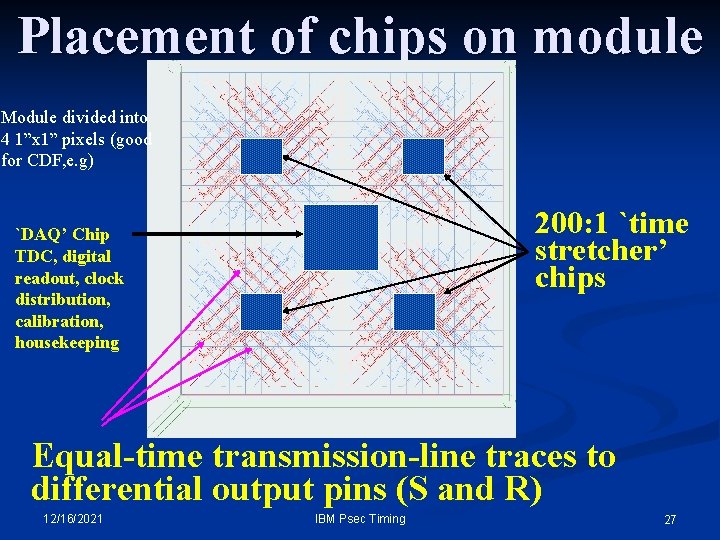
Tim’s Equal-Time Collector Module divided into 4 1”x 1” pixels (good for CDF, e. g) 4 differential outputseach to a 200: 1 `time stretcher’ chip (ASIC) directly on back of module Equal-time transmission-line traces to differential output pins (S and R) 12/16/2021 IBM Psec Timing 20
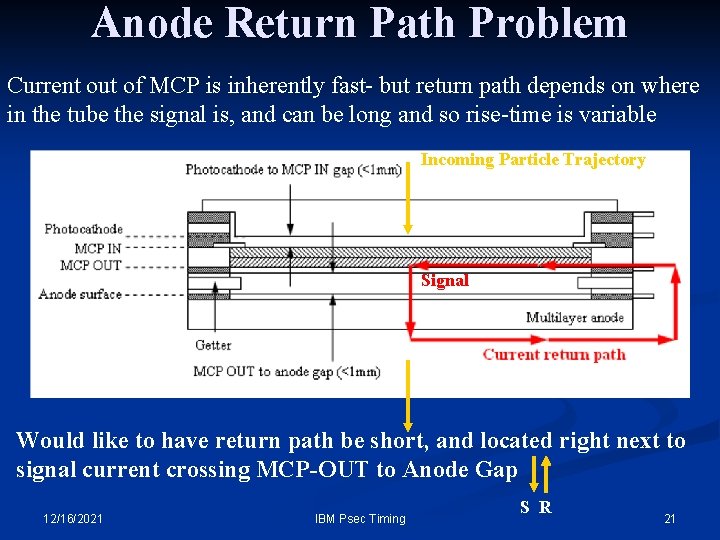
Anode Return Path Problem Current out of MCP is inherently fast- but return path depends on where in the tube the signal is, and can be long and so rise-time is variable Incoming Particle Trajectory Signal Would like to have return path be short, and located right next to signal current crossing MCP-OUT to Anode Gap 12/16/2021 IBM Psec Timing S R 21
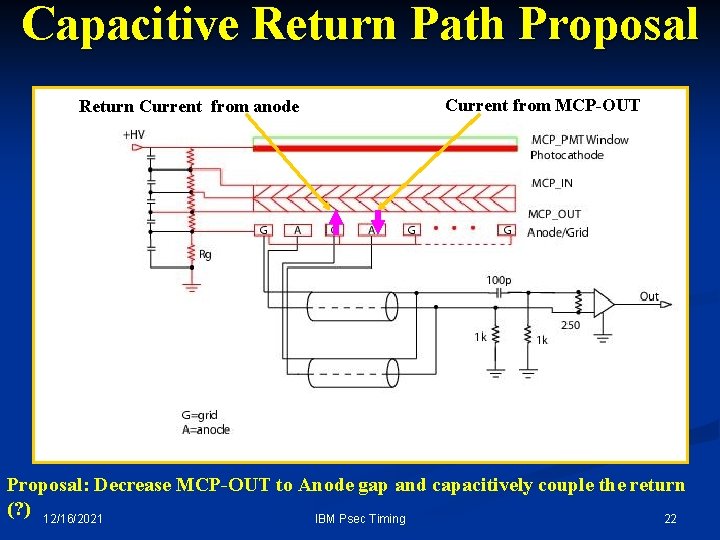
Capacitive Return Path Proposal Return Current from anode Current from MCP-OUT Proposal: Decrease MCP-OUT to Anode gap and capacitively couple the return (? ) 12/16/2021 IBM Psec Timing 22
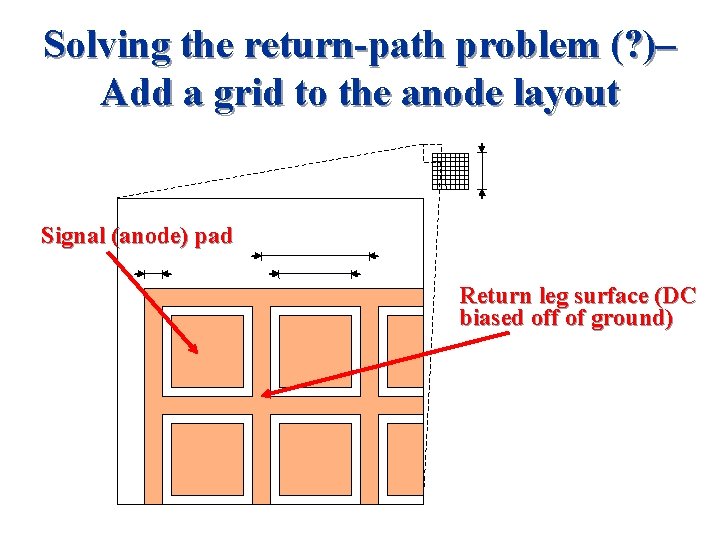
Solving the return-path problem (? )– Add a grid to the anode layout 2 in. Signal (anode) pad 0. 070 0. 250 0. 160 Return leg surface (DC biased off of ground) 12/16/2021 IBM Psec Timing 23
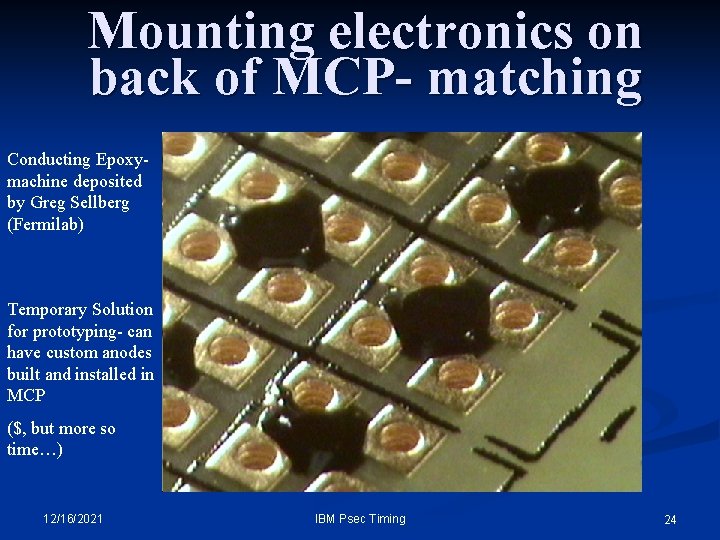
Mounting electronics on back of MCP- matching Conducting Epoxymachine deposited by Greg Sellberg (Fermilab) Temporary Solution for prototyping- can have custom anodes built and installed in MCP ($, but more so time…) 12/16/2021 dum IBM Psec Timing 24
End-to-End Simulation Result Output at anode from simulation of 10 particles going through fused quartz window- T. Credo, R. Schroll Jitter on leading edge 0. 86 psec 12/16/2021 IBM Psec Timing 25
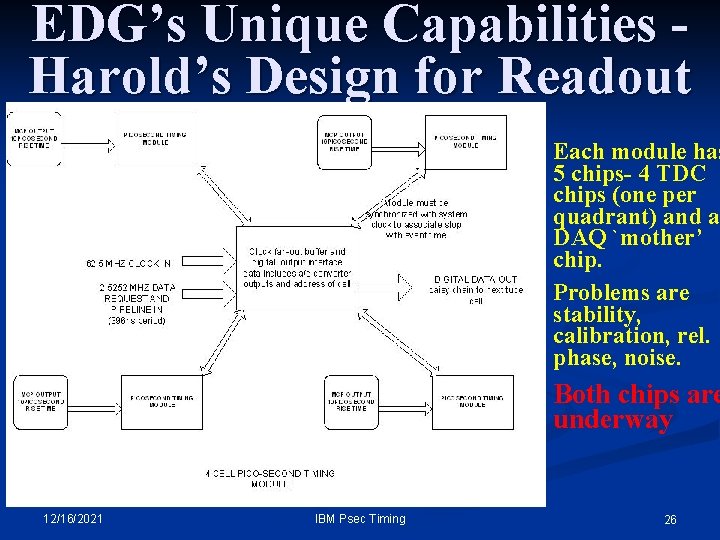
EDG’s Unique Capabilities Harold’s Design for Readout Each module has 5 chips- 4 TDC chips (one per quadrant) and a DAQ `mother’ chip. Problems are stability, calibration, rel. phase, noise. Both chips are underway dum 12/16/2021 IBM Psec Timing 26
Placement of chips on module Module divided into 4 1”x 1” pixels (good for CDF, e. g) 200: 1 `time stretcher’ chips `DAQ’ Chip TDC, digital readout, clock distribution, calibration, housekeeping Equal-time transmission-line traces to differential output pins (S and R) 12/16/2021 IBM Psec Timing 27
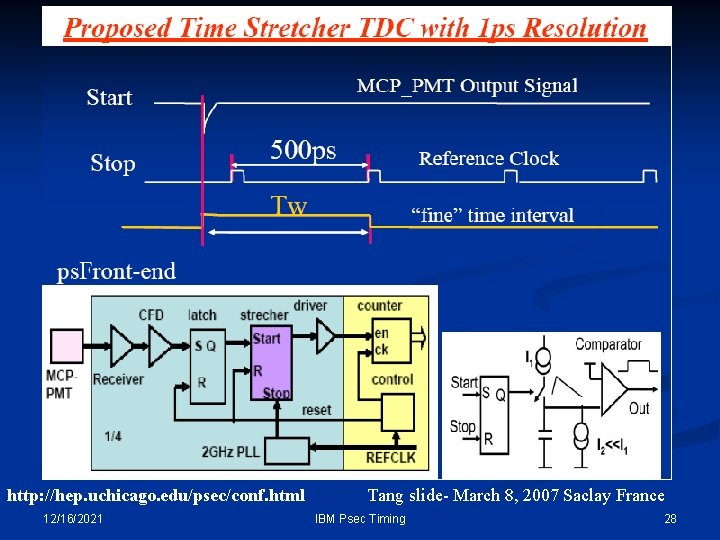
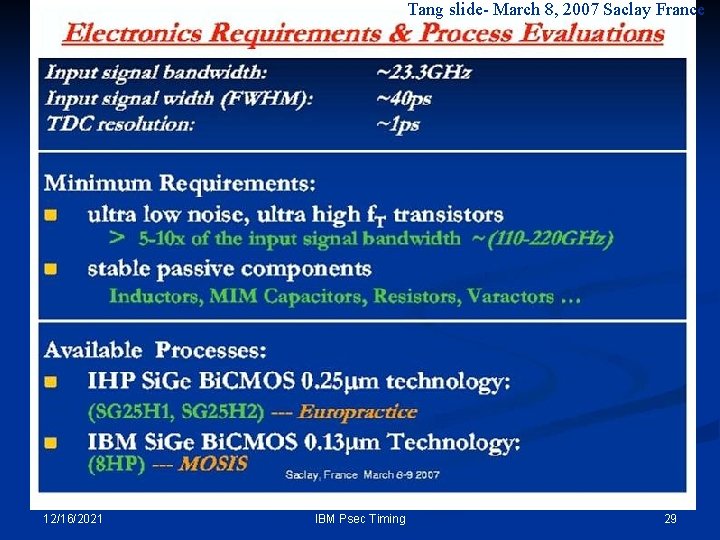
http: //hep. uchicago. edu/psec/conf. html 12/16/2021 Tang slide- March 8, 2007 Saclay France IBM Psec Timing 28
Tang slide- March 8, 2007 Saclay France 12/16/2021 IBM Psec Timing 29
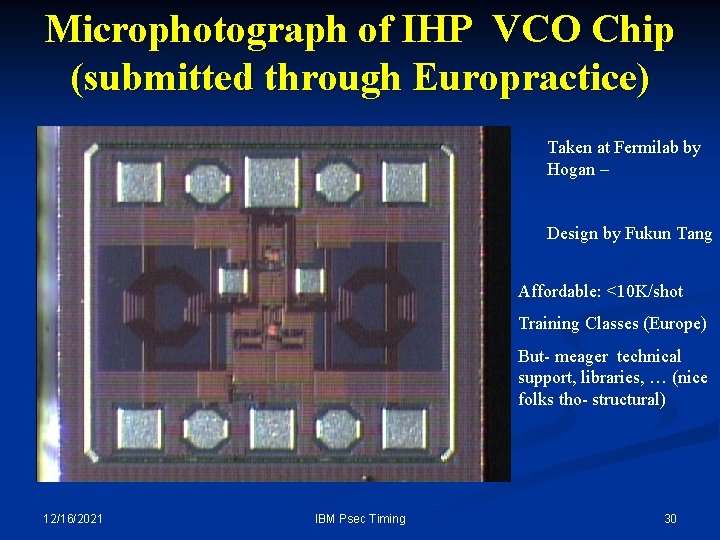
Microphotograph of IHP VCO Chip (submitted through Europractice) Taken at Fermilab by Hogan – Design by Fukun Tang Affordable: <10 K/shot Training Classes (Europe) But- meager technical support, libraries, … (nice folks tho- structural) 12/16/2021 IBM Psec Timing 30
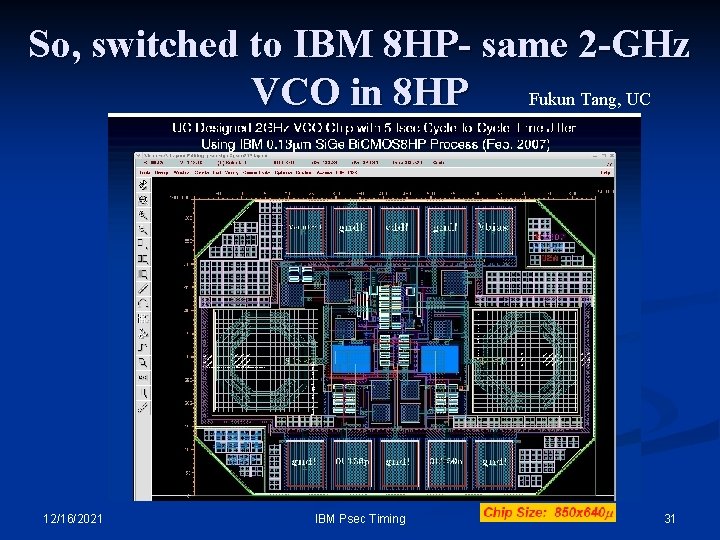
So, switched to IBM 8 HP- same 2 -GHz VCO in 8 HP Fukun Tang, UC 12/16/2021 IBM Psec Timing 31
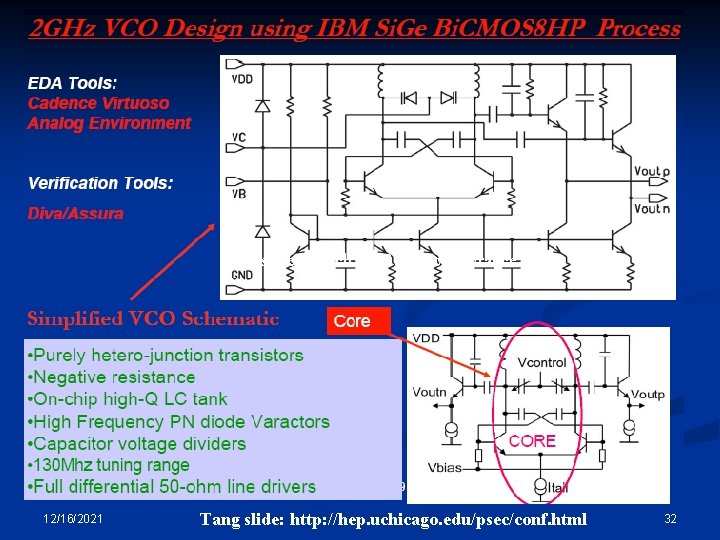
Tang slide- March 8, 2007 Saclay France 12/16/2021 Tang slide: http: //hep. uchicago. edu/psec/conf. html 32
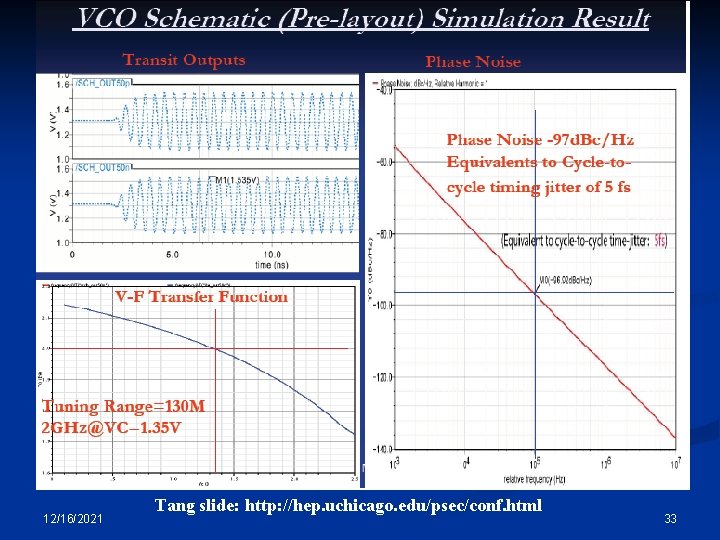
12/16/2021 Tang slide: http: //hep. uchicago. edu/psec/conf. html 33
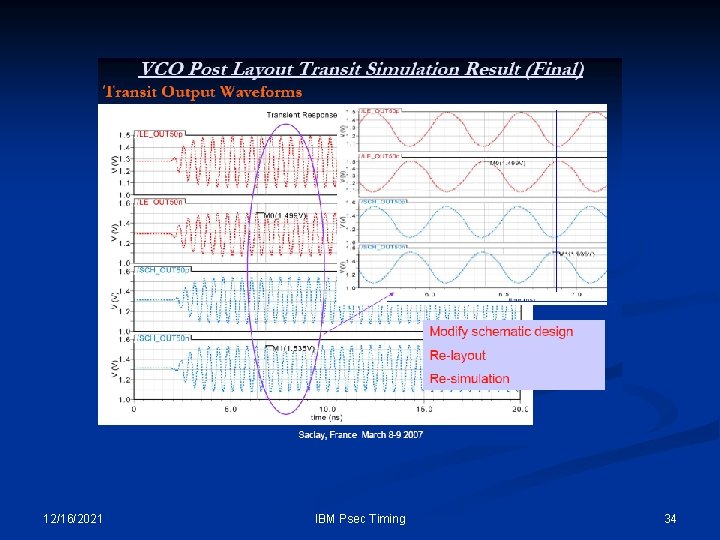
12/16/2021 IBM Psec Timing 34
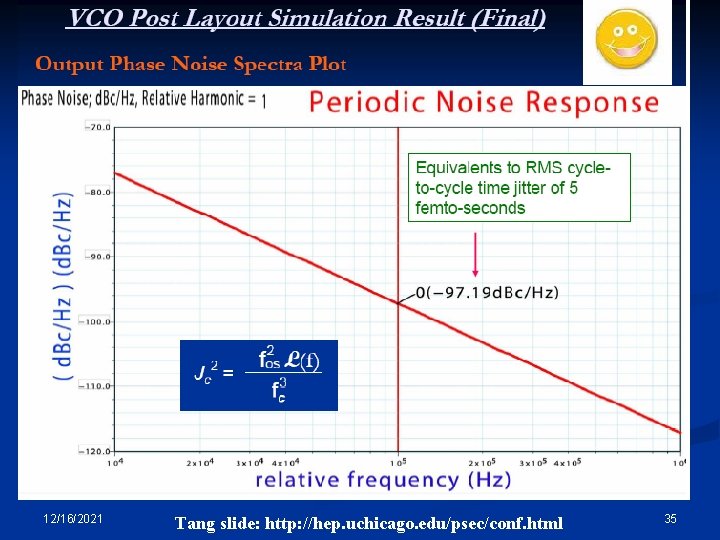
12/16/2021 Tang slide: http: //hep. uchicago. edu/psec/conf. html 35
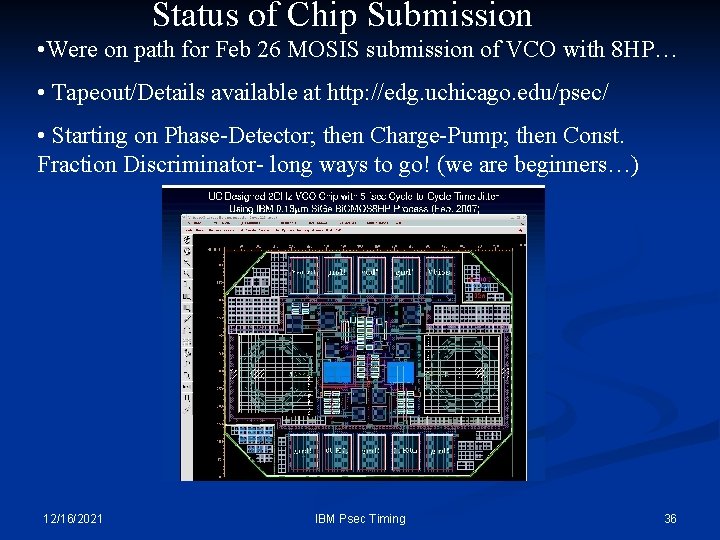
Status of Chip Submission • Were on path for Feb 26 MOSIS submission of VCO with 8 HP… • Tapeout/Details available at http: //edg. uchicago. edu/psec/ • Starting on Phase-Detector; then Charge-Pump; then Const. Fraction Discriminator- long ways to go! (we are beginners…) 12/16/2021 IBM Psec Timing 36
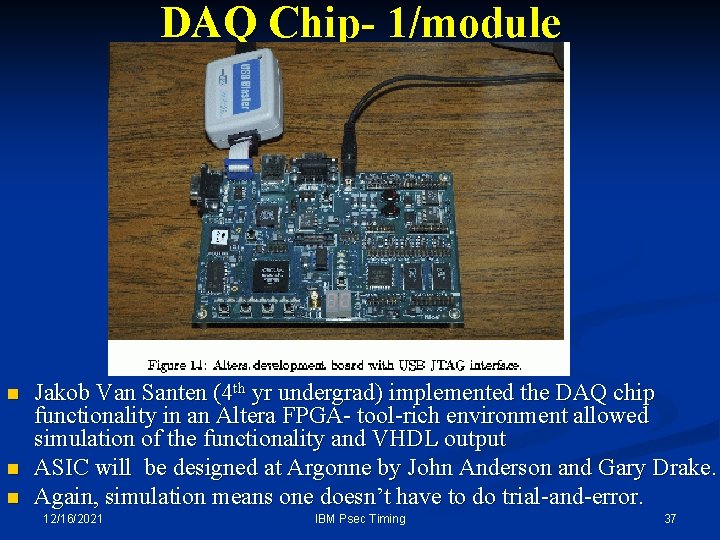
DAQ Chip- 1/module n n n Jakob Van Santen (4 th yr undergrad) implemented the DAQ chip functionality in an Altera FPGA- tool-rich environment allowed simulation of the functionality and VHDL output ASIC will be designed at Argonne by John Anderson and Gary Drake. Again, simulation means one doesn’t have to do trial-and-error. 12/16/2021 IBM Psec Timing 37
Why is simulation essential? Want optimized MCP/Photodetector designcomplex problem in electrostatics, fast circuits, surface physics, …. n Want maximum performance without trial-anderror optimization (time, cost, performance) n At these speeds (~1 psec) cannot probe electronics n Debugging is impossible any other way. n 12/16/2021 IBM Psec Timing 38
Slide from Chin-Tu Chen (UC) talk at Saclay Workshop –see url in references…. PET, TOFPET & SPECT Disclaimer- I know almost nothing about PET- need Chin-Tu or Patrick Le. Du! Chin-Tu Chen Chien-Min Kao, Christian Wietholt, Qingguo Xie, Yun Dong, Jeffrey Souris, Hsing-Tsuen Chen, Bill C. O’Brien-Penney, Patrick J. La Riviere, Xiaochuan Pan 12/16/2021 Department of Radiology & Committee on Medical Physics Pritzker School of Medicine & Division of Biological Sciences The University of Chicago IBM Psec Timing 39
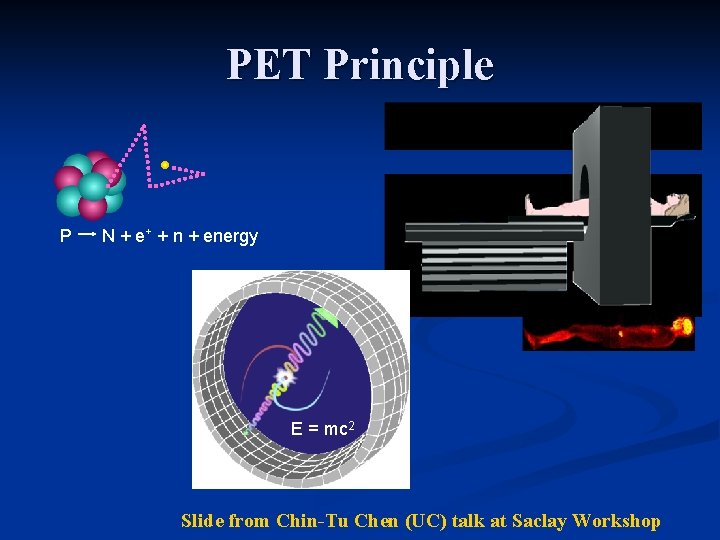
PET Principle P N + e+ + n + energy E = mc 2 Slide from Chin-Tu Chen (UC) talk at Saclay Workshop
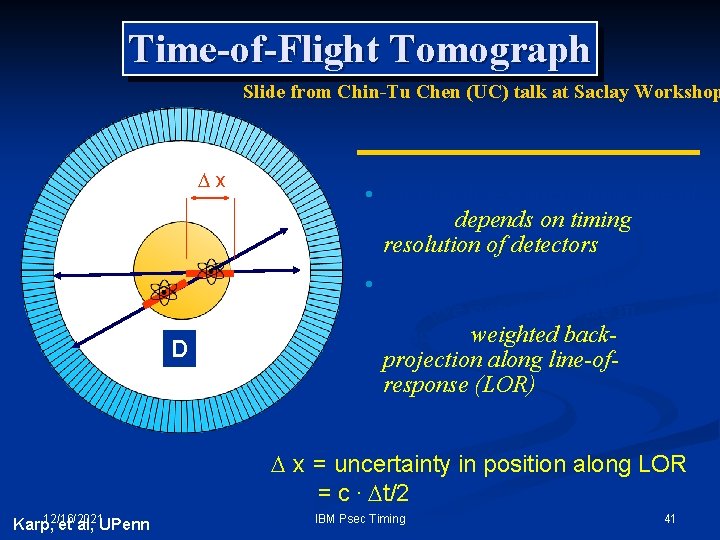
Time-of-Flight Tomograph Slide from Chin-Tu Chen (UC) talk at Saclay Workshop x D • Can localize source along line of flight - depends on timing resolution of detectors • Time of flight information can improve signal-to-noise in images - weighted backprojection along line-ofresponse (LOR) x = uncertainty in position along LOR = c. t/2 12/16/2021 Karp, et al, UPenn IBM Psec Timing 41
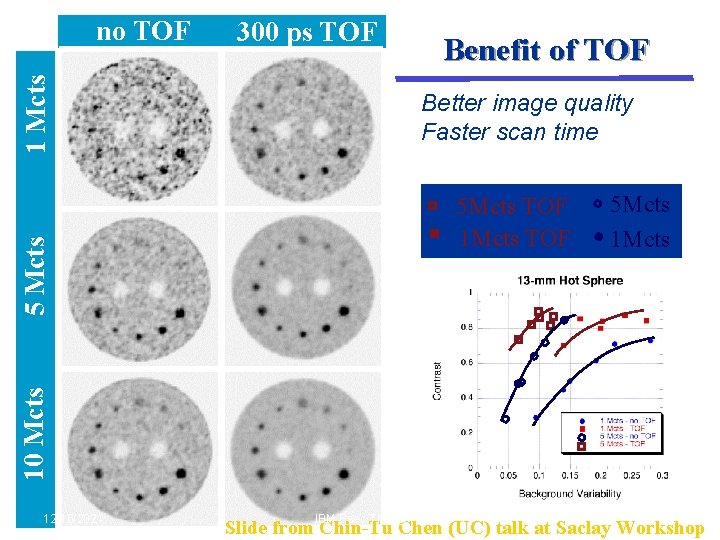
300 ps TOF 1 Mcts no TOF Benefit of TOF Better image quality Faster scan time 5 Mcts 10 Mcts 5 Mcts TOF 12/16/2021 IBM Psec Timing 42 Slide from Chin-Tu Chen (UC) talk at Saclay Workshop Karp, et al, UPenn
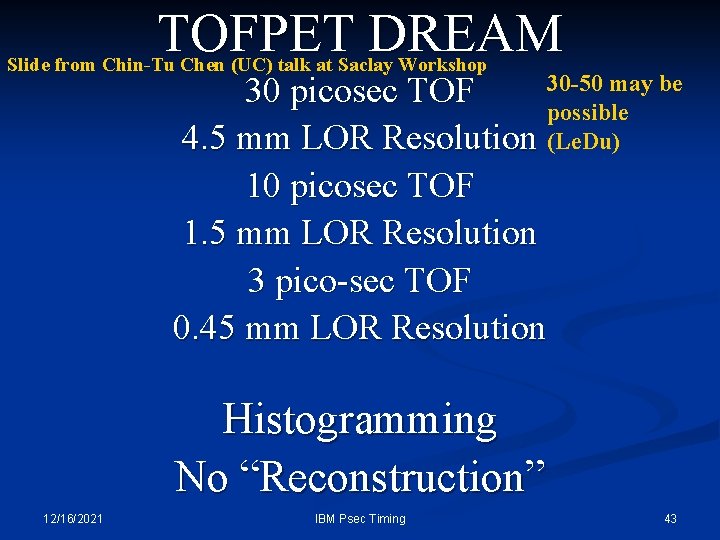
TOFPET DREAM Slide from Chin-Tu Chen (UC) talk at Saclay Workshop 30 -50 may be 30 picosec TOF possible 4. 5 mm LOR Resolution (Le. Du) 10 picosec TOF 1. 5 mm LOR Resolution 3 pico-sec TOF 0. 45 mm LOR Resolution Histogramming No “Reconstruction” 12/16/2021 IBM Psec Timing 43
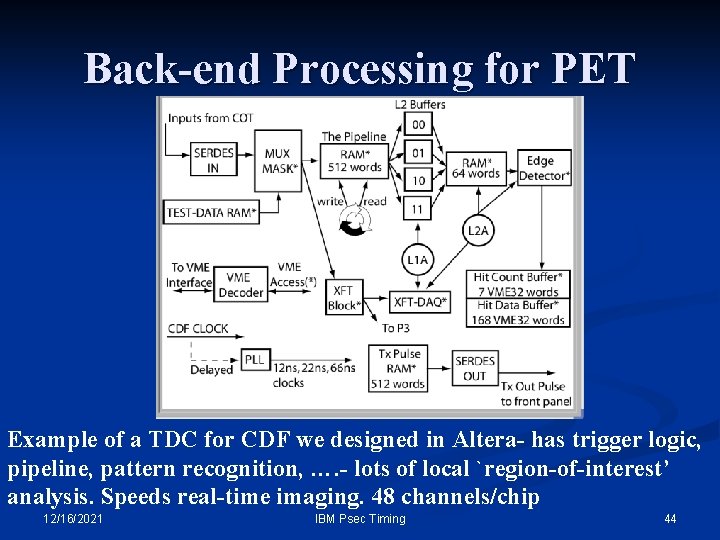
Back-end Processing for PET Example of a TDC for CDF we designed in Altera- has trigger logic, pipeline, pattern recognition, …. - lots of local `region-of-interest’ analysis. Speeds real-time imaging. 48 channels/chip 12/16/2021 IBM Psec Timing 44
SOME REFERENCES Saclay Workshop (March 8, 9 -07; talks on PET, Detectors, Electronics, Simulation… (in particular see talks of Chen, Le. Du, Genat, Jarron, …) http: //indico. cern. ch/contribution. List. Display. py? conf. Id=13750 http: //hep. uchicago. edu/psec/conf. html ANL/UC effort, links (workshops, talks, references…) http: //hep. uchicago. edu/psec/ http: //hep. uchicago. edu/~frisch/ J. Va’vra et al latest paper: on MCP timing: Nucl. Inst. Mett A 572, 459 (2007) 12/16/2021 IBM Psec Timing 45
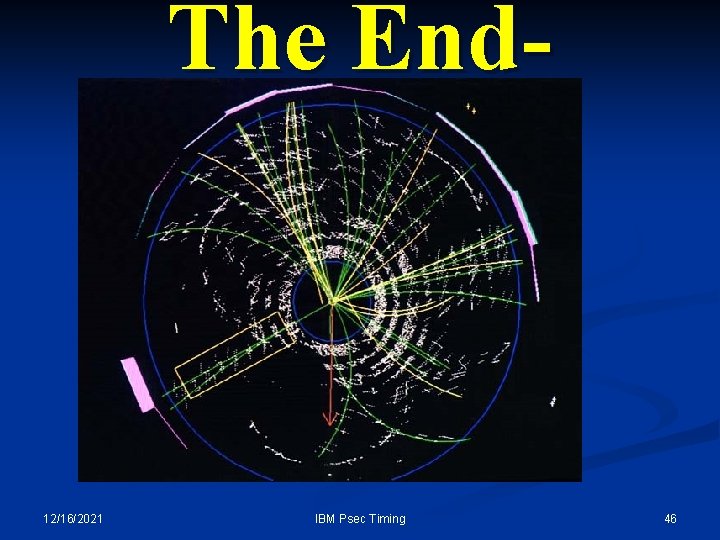
The End- 12/16/2021 IBM Psec Timing 46
Backup Slides 12/16/2021 IBM Psec Timing 47
The Future of Psec Timing. From the work of the Nagoya Group, Jerry Va’vra, and ourselves it looks that the psec goal is not impossible. It’s a new field, and we have made first forays, and understand some fundamentals (e. g. need no bounces and short distances), but it’s entirely possible, even likely, that there are still much better ideas out there. Big Questions: • What determines the ultimate limits? • Are there other techniques? (e. g. all Silicon)? 12/16/2021 IBM Psec Timing 48
Smaller Questions for Which I’d Love to Know the Answers What is the time structure of signals from crystals in PET? (amplitude vs time at psec level ) n Could one integrate the electronics into the MCP structure- 3 D silicon (Paul Horn, Pierre Jarron)? n Will the capacitative return work? n How to calibrate the darn thing (a big system)? ! n How to distribute the clock n Can we join forces with others and go faster? n Saclay slide 12/16/2021 IBM Psec Timing 49
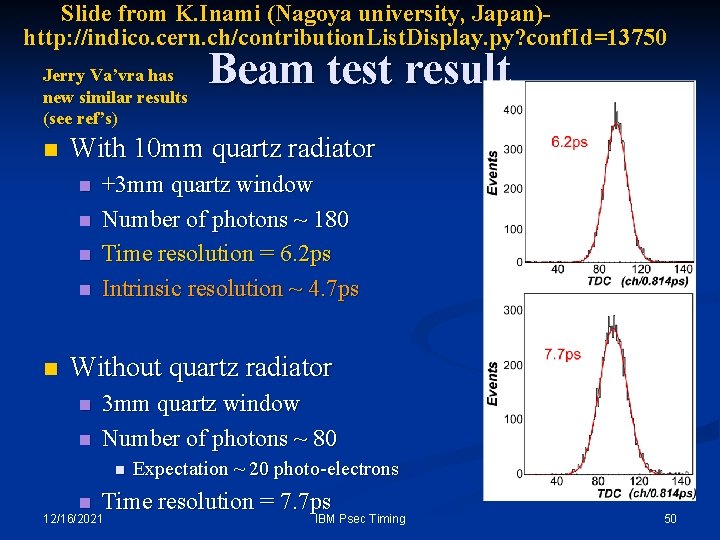
Slide from K. Inami (Nagoya university, Japan)http: //indico. cern. ch/contribution. List. Display. py? conf. Id=13750 Jerry Va’vra has new similar results (see ref’s) n With 10 mm quartz radiator n n n Beam test result +3 mm quartz window Number of photons ~ 180 Time resolution = 6. 2 ps Intrinsic resolution ~ 4. 7 ps Without quartz radiator n n 3 mm quartz window Number of photons ~ 80 n n Expectation ~ 20 photo-electrons Time resolution = 7. 7 ps 12/16/2021 IBM Psec Timing 50
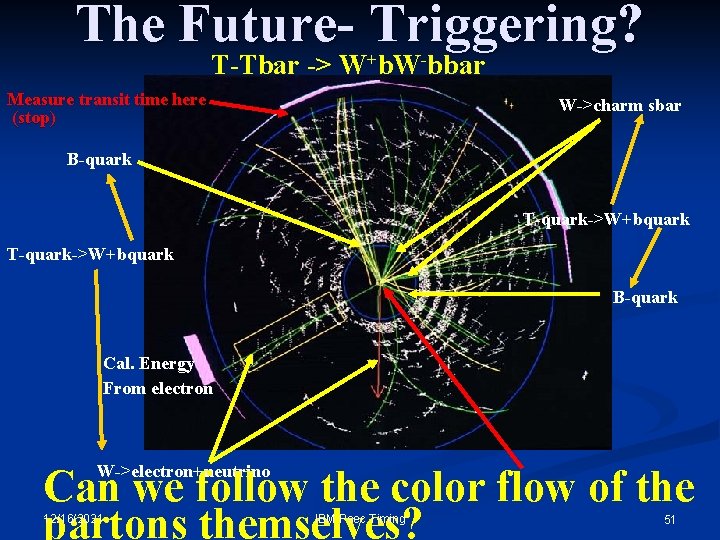
The Future- Triggering? T-Tbar -> W+b. W-bbar Measure transit time here (stop) W->charm sbar B-quark T-quark->W+bquark B-quark Cal. Energy From electron W->electron+neutrino Can we follow the color flow of the partons themselves? 12/16/2021 IBM Psec Timing 51
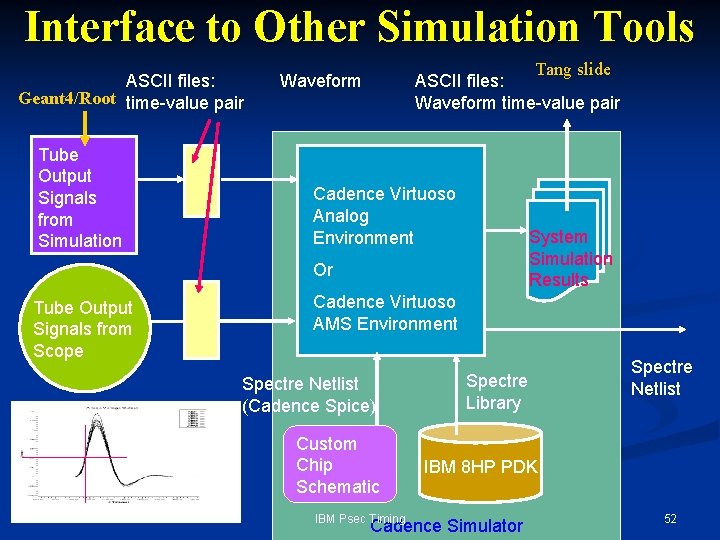
Interface to Other Simulation Tools ASCII files: Geant 4/Root time-value pair Tube Output Signals from Simulation Tang slide ASCII files: Waveform time-value pair Waveform Cadence Virtuoso Analog Environment System Simulation Results Or Tube Output Signals from Scope Cadence Virtuoso AMS Environment Spectre Netlist (Cadence Spice) Custom Chip Schematic 12/16/2021 IBM Psec Timing Spectre Library Spectre Netlist IBM 8 HP PDK Cadence Simulator 52
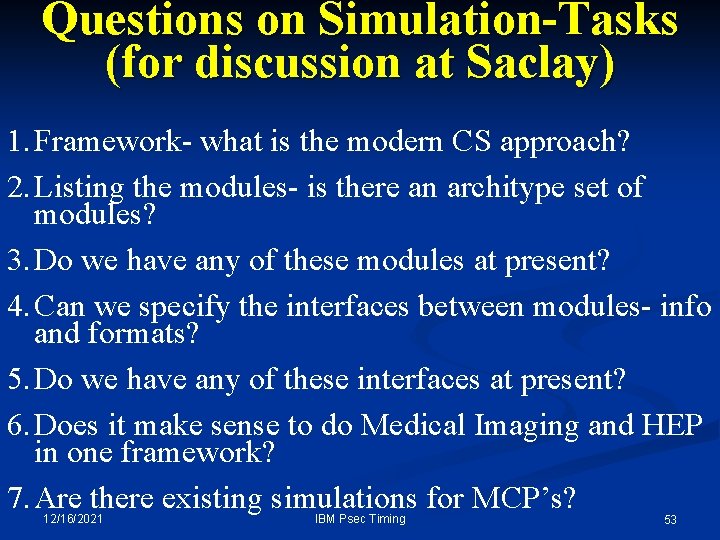
Questions on Simulation-Tasks (for discussion at Saclay) 1. Framework- what is the modern CS approach? 2. Listing the modules- is there an architype set of modules? 3. Do we have any of these modules at present? 4. Can we specify the interfaces between modules- info and formats? 5. Do we have any of these interfaces at present? 6. Does it make sense to do Medical Imaging and HEP in one framework? 7. Are there existing simulations for MCP’s? 12/16/2021 IBM Psec Timing 53
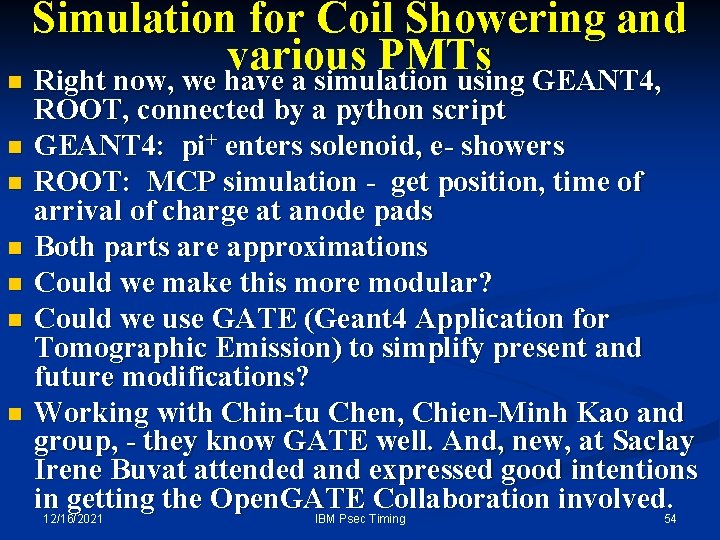
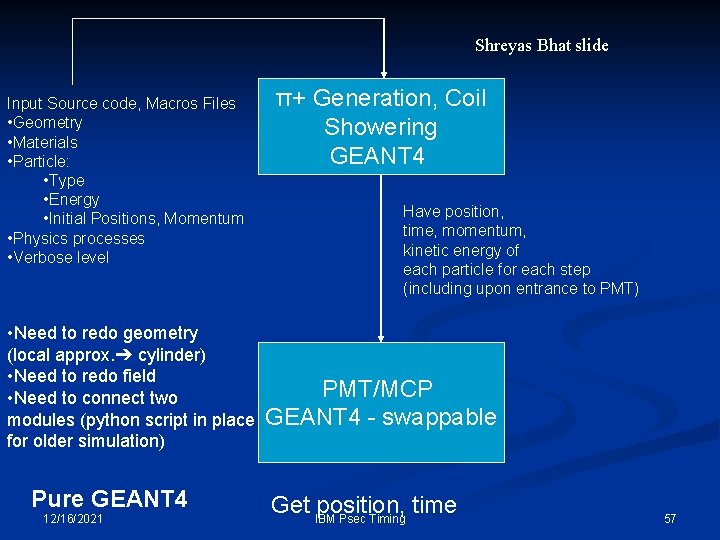
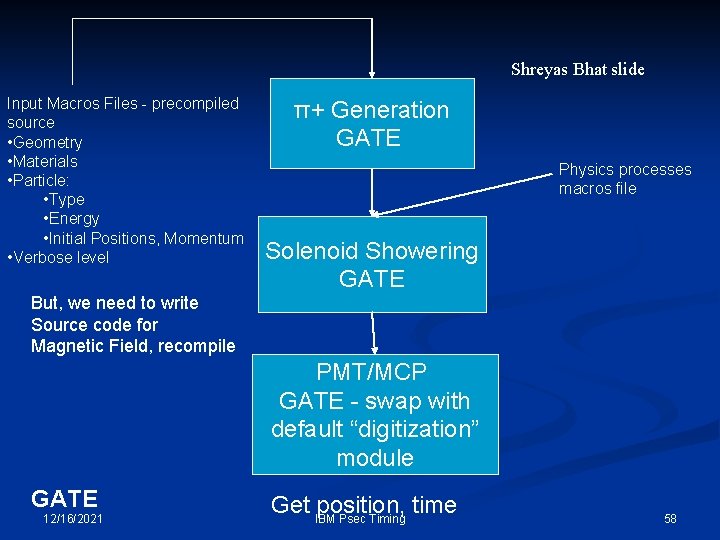
Simulation for Coil Showering and various PMTs n Right now, we have a simulation using GEANT 4, n n n ROOT, connected by a python script GEANT 4: pi+ enters solenoid, e- showers ROOT: MCP simulation - get position, time of arrival of charge at anode pads Both parts are approximations Could we make this more modular? Could we use GATE (Geant 4 Application for Tomographic Emission) to simplify present and future modifications? Working with Chin-tu Chen, Chien-Minh Kao and group, - they know GATE well. And, new, at Saclay Irene Buvat attended and expressed good intentions in getting the Open. GATE Collaboration involved. 12/16/2021 IBM Psec Timing 54
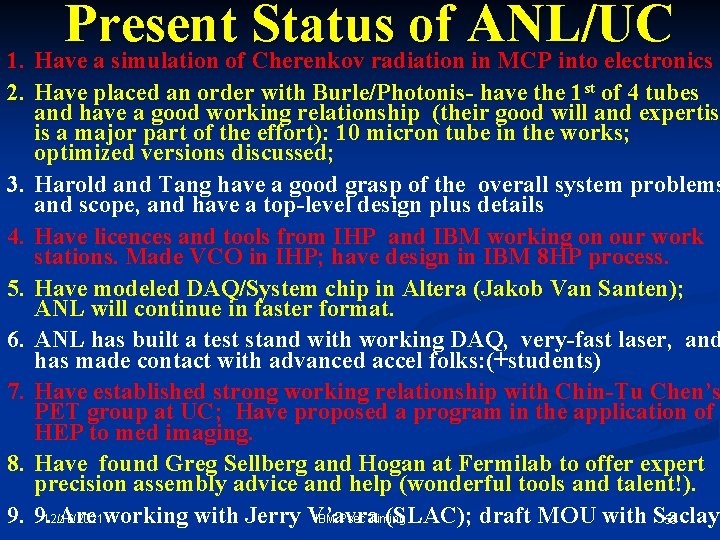
Present Status of ANL/UC 1. Have a simulation of Cherenkov radiation in MCP into electronics 2. Have placed an order with Burle/Photonis- have the 1 st of 4 tubes and have a good working relationship (their good will and expertise is a major part of the effort): 10 micron tube in the works; optimized versions discussed; 3. Harold and Tang have a good grasp of the overall system problems and scope, and have a top-level design plus details 4. Have licences and tools from IHP and IBM working on our work stations. Made VCO in IHP; have design in IBM 8 HP process. 5. Have modeled DAQ/System chip in Altera (Jakob Van Santen); ANL will continue in faster format. 6. ANL has built a test stand with working DAQ, very-fast laser, and has made contact with advanced accel folks: (+students) 7. Have established strong working relationship with Chin-Tu Chen’s PET group at UC; Have proposed a program in the application of HEP to med imaging. 8. Have found Greg Sellberg and Hogan at Fermilab to offer expert precision assembly advice and help (wonderful tools and talent!). 9. 9. 12/16/2021 Are working with Jerry V’avra (SLAC); draft MOU with Saclay IBM Psec Timing 55
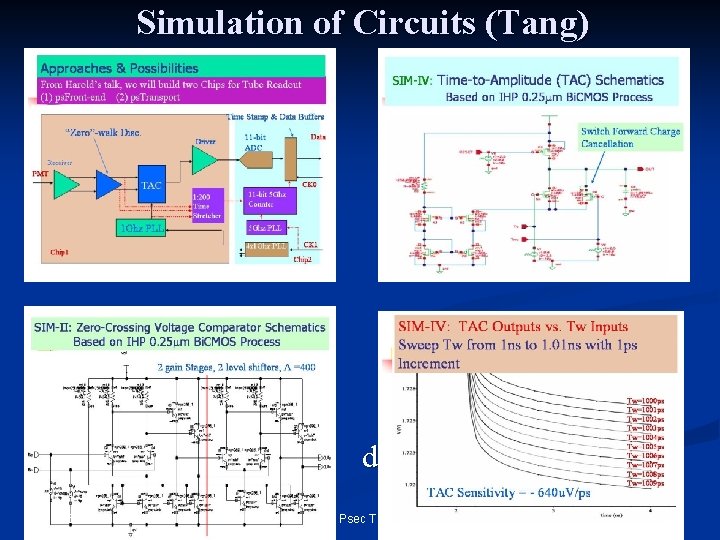
Simulation of Circuits (Tang) dum 12/16/2021 IBM Psec Timing 56
Shreyas Bhat slide Input Source code, Macros Files • Geometry • Materials • Particle: • Type • Energy • Initial Positions, Momentum • Physics processes • Verbose level • Need to redo geometry (local approx. ➔ cylinder) • Need to redo field • Need to connect two modules (python script in place for older simulation) Pure GEANT 4 12/16/2021 π+ Generation, Coil Showering GEANT 4 Have position, time, momentum, kinetic energy of each particle for each step (including upon entrance to PMT) PMT/MCP GEANT 4 - swappable Get IBM position, time Psec Timing 57
Shreyas Bhat slide Input Macros Files - precompiled source • Geometry • Materials • Particle: • Type • Energy • Initial Positions, Momentum • Verbose level π+ Generation GATE Physics processes macros file Solenoid Showering GATE But, we need to write Source code for Magnetic Field, recompile PMT/MCP GATE - swap with default “digitization” module GATE 12/16/2021 Get IBM position, time Psec Timing 58
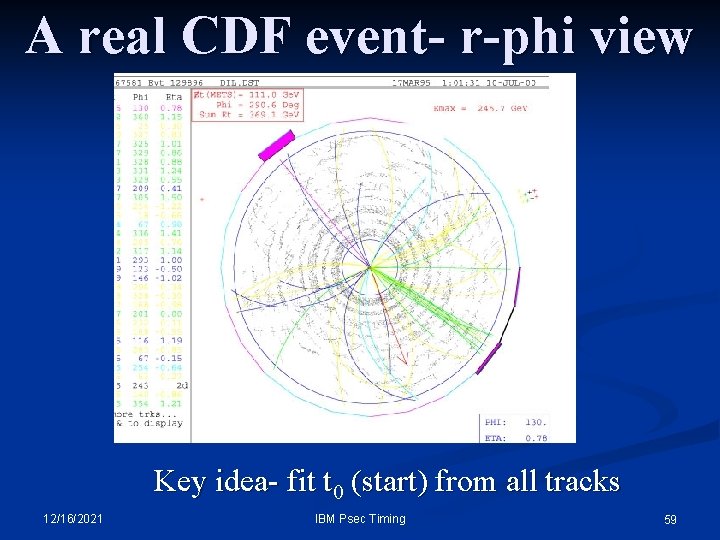
A real CDF event- r-phi view Key idea- fit t 0 (start) from all tracks 12/16/2021 IBM Psec Timing 59