
The Development of Internet CANDIC E BA IJING

The Development of Internet CANDIC E BA IJING WANG COM 9660 SE L T OP ICS/CO RP COMM SUM MER 2016

Agenda • Internet History • Internet Evolution • Internet Growth – Present • The Future of Internet
What Was the “Victorian Internet”?
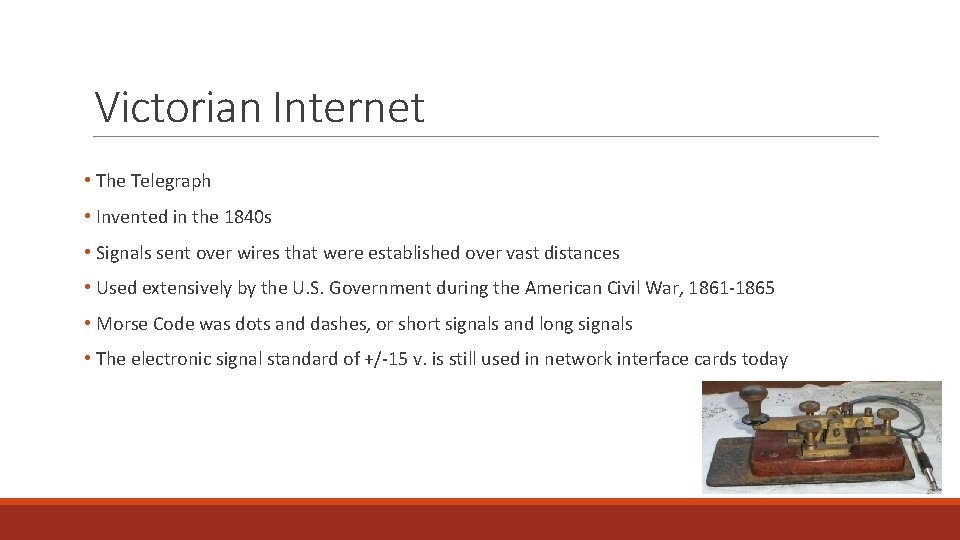
Victorian Internet • The Telegraph • Invented in the 1840 s • Signals sent over wires that were established over vast distances • Used extensively by the U. S. Government during the American Civil War, 1861 -1865 • Morse Code was dots and dashes, or short signals and long signals • The electronic signal standard of +/-15 v. is still used in network interface cards today
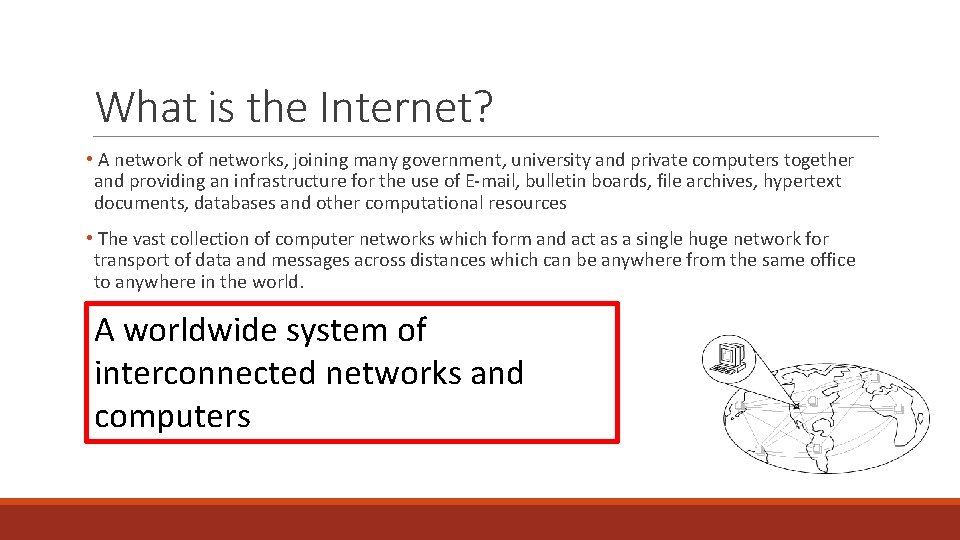
What is the Internet? • A network of networks, joining many government, university and private computers together and providing an infrastructure for the use of E-mail, bulletin boards, file archives, hypertext documents, databases and other computational resources • The vast collection of computer networks which form and act as a single huge network for transport of data and messages across distances which can be anywhere from the same office to anywhere in the world. A worldwide system of interconnected networks and computers
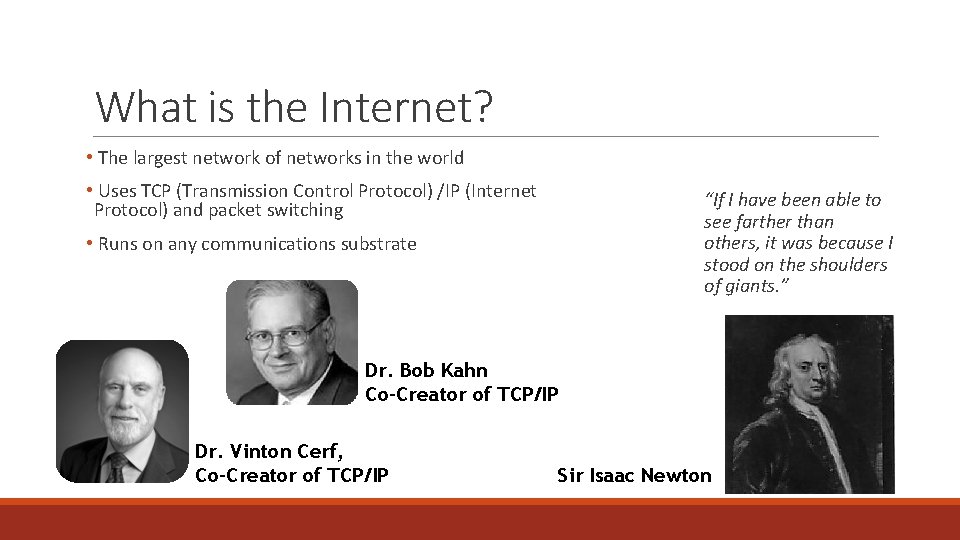
What is the Internet? • The largest network of networks in the world • Uses TCP (Transmission Control Protocol) /IP (Internet Protocol) and packet switching “If I have been able to see farther than others, it was because I stood on the shoulders of giants. ” • Runs on any communications substrate Dr. Bob Kahn Co-Creator of TCP/IP Dr. Vinton Cerf, Co-Creator of TCP/IP Sir Isaac Newton
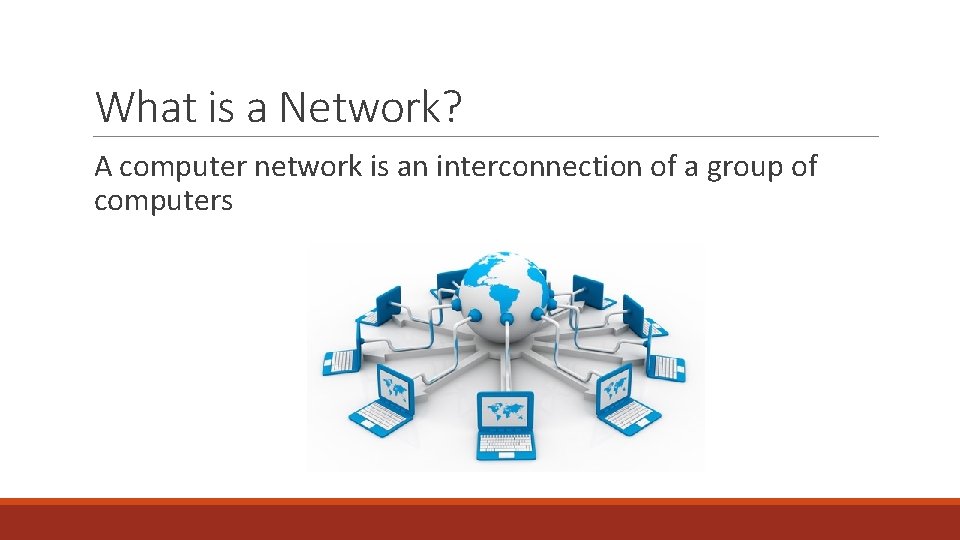
What is a Network? A computer network is an interconnection of a group of computers
History of the Internet • 1968 – DARPA (Defense Advanced Research Projects Agency) contracts with BBN (Bolt, Beranek & Newman) to create APRAnet • 1970 – First five nodes: - UCLA - Stanford - UC Santa Barbara - U of Utah, and BBN • 1974 – TCP specification by Vint Cerf • 1984 – On January 1, the Internet with its 1000 hosts using TCP/IP for its messaging
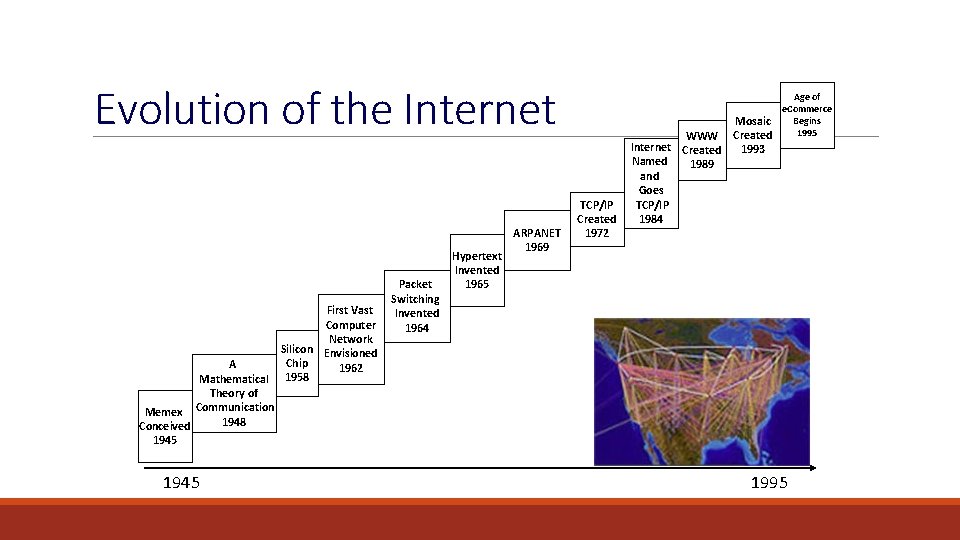
Evolution of the Internet First Vast Computer Network Silicon Envisioned Chip A 1962 Mathematical 1958 Theory of Communication Memex 1948 Conceived 1945 Packet Switching Invented 1964 Hypertext Invented 1965 ARPANET 1969 TCP/IP Created 1972 Mosaic WWW Created Internet Created 1993 Named 1989 and Goes TCP/IP 1984 Age of e. Commerce Begins 1995
The Creation of the Internet • The creation of the Internet solved the following challenges: - Basically inventing digital networking as we know it - Survivability of an infrastructure to send/receive high-speed electronic messages - Reliability of computer messaging
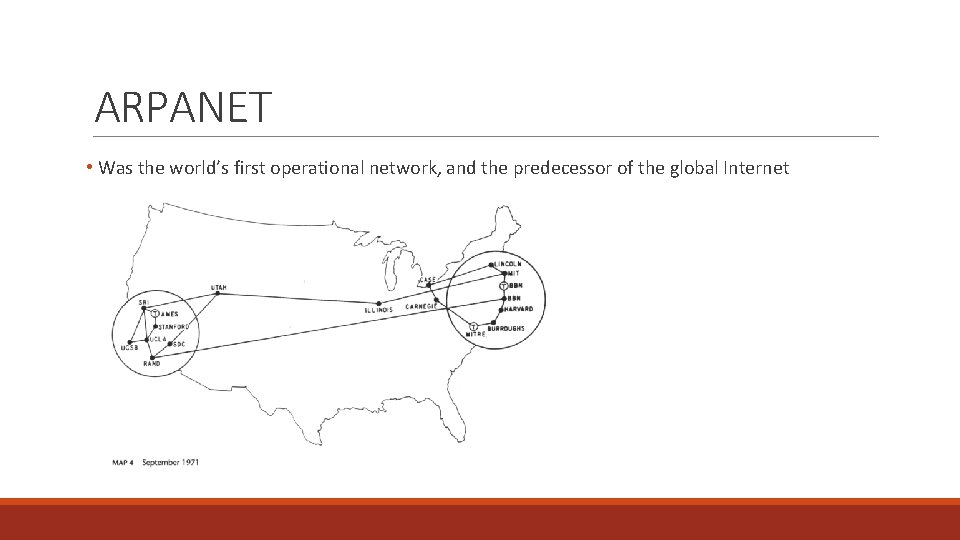
ARPANET • Was the world’s first operational network, and the predecessor of the global Internet
The World Wide Web • The original Internet provided screens full of text • Great for sharing info and accessing the Library of Congress • Text was all one font and size • BORING!
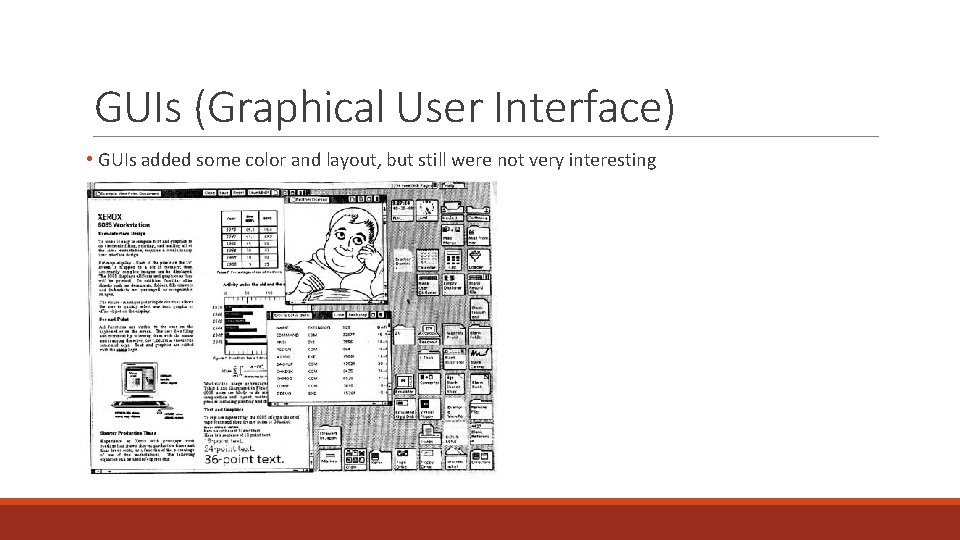
GUIs (Graphical User Interface) • GUIs added some color and layout, but still were not very interesting
The World Wide Web • Hyperlinks were invented www. nbc. com • The mouse was invented to click on hyperlinks • The URL (Uniform Resource Locater) was invented. This allowed sites to be named • Tim Berners Lee brought all of this together to form the World Wide Web in 1990
Mosaic: The First Web Browser • Very slow • Did not handle loading pictures very well • Modems were very slow • Did not give an indication of the potential of this medium
1994 – A Big Year for the WWW • Tim Berners Lee develops the World Wide Web Consortium to develop standards for the Web • Netscape is founded
The development of Internet • The Internet exploded during this period • The first commercial site was built – Amazon. com • In 1994 the World Wide Web grew by an astounding 2300% • Amazon saw that online shopping was the wave of the future
Internet Growth Trends 1977: 111 hosts on Internet 1981: 213 hosts 1983: 562 hosts 1984: 1, 000 hosts 1986: 5, 000 hosts 1987: 10, 000 hosts 1989: 100, 000 hosts 1992: 1, 000 hosts 2001: 150 – 175 million hosts 2002: over 200 million hosts By 2010, about 80% of the planet will be on the Internet
Browser Wars • Netscape was the standard until 1998 • It folded and was taken over by AOL • Microsoft Internet Explorer snagged 96% of the browser market • IE has only recently been challenged by the excellent Mozilla browser
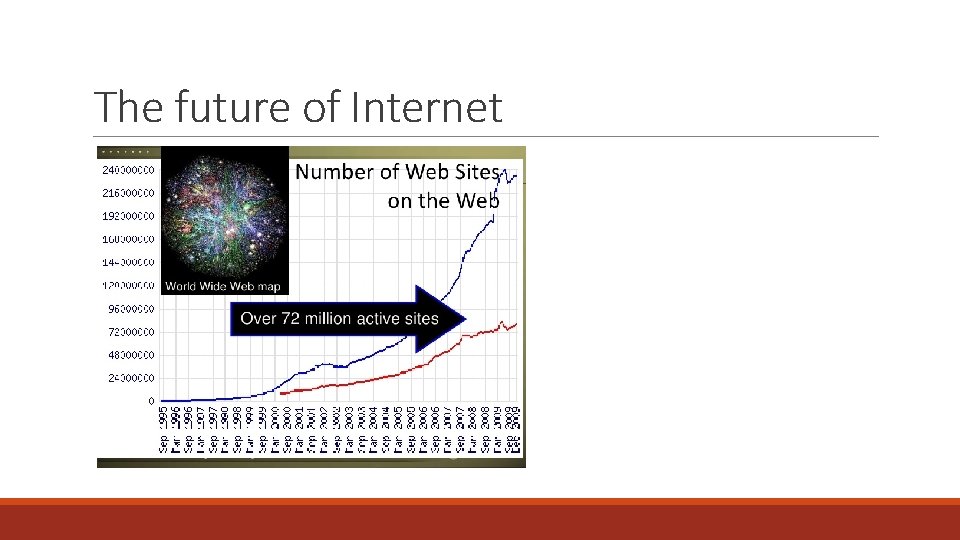
The future of Internet
The future of Internet • Internet access will be ubiquitous • The Web will become faster and smarter • Security will improve • IT products will morph into services • Internet 2 will emerge • Faster web browsers • Higher speed Cable/ADSL/cell phone and in-home network
- Slides: 21