
The development of Impact Case Studies for REF

- Slides: 21
The development of Impact Case Studies for REF 2021 at Nottingham Business School Pete Murphy
What are Impact Case Studies? The Research Excellence Framework 2014 was the first exercise to assess the impact of research outside of academia. Impact was defined as ‘an effect on, change or benefit to the economy, society, culture, public policy or services, health, the environment or quality of life, beyond academia’. As part of the 2014 Research Excellence Framework exercise, UK higher education institutions (HEIs) submitted 6, 975 impact case studies demonstrating the impact of their research on wider society. Impact case studies accounted for 30% of a REF score – this proportion and the importance of Case studies is likely to increase in 2021 to 25%.
How is the REF assessment structured? • Units of Assessment - 36 in 2014, and 34 in 2021 • C 19 (and C 17 in 2021) Business and Management is coterminous with most Business School’s Research interests • C 19/C 17 is the 2 nd biggest Uo. A • Each Uo. A is assessed according to • Published Research outputs from individual or multiple authored research papers • Impact Case Studies • The Research Environment of the Institution
A common confusion Academic Impact and Non-Academic Impact • In 2014 and in 2021 the non-academic impact will still need to be based on high quality research – this acts as a benchmark to the case study being assessed. • The case study author or at least one member of the case study team must be submitted as an individual researcher in the university’s submission. • Having met the academic benchmark the assessment of impact rests entirely on non-academic impact • The impact is assessed against 4 defined levels
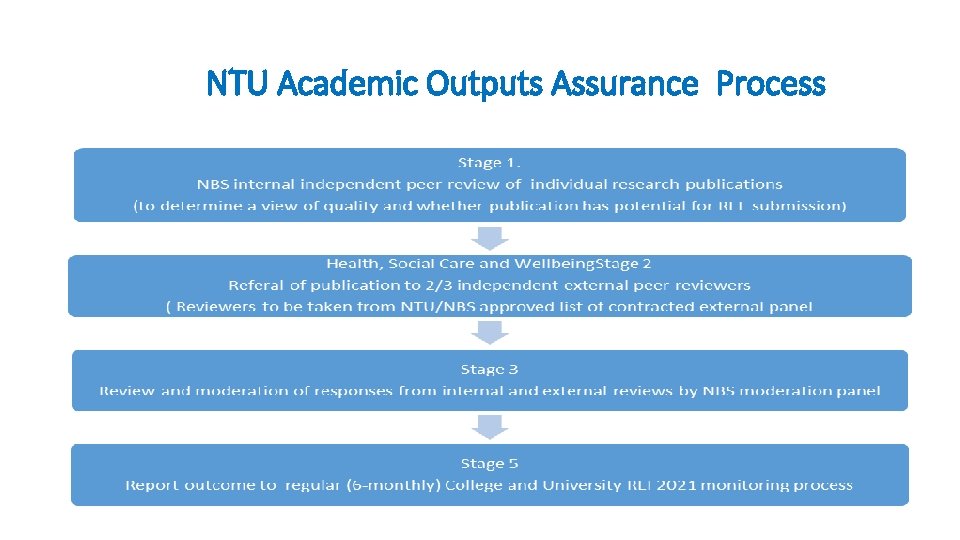
NTU Academic Outputs Assurance Process
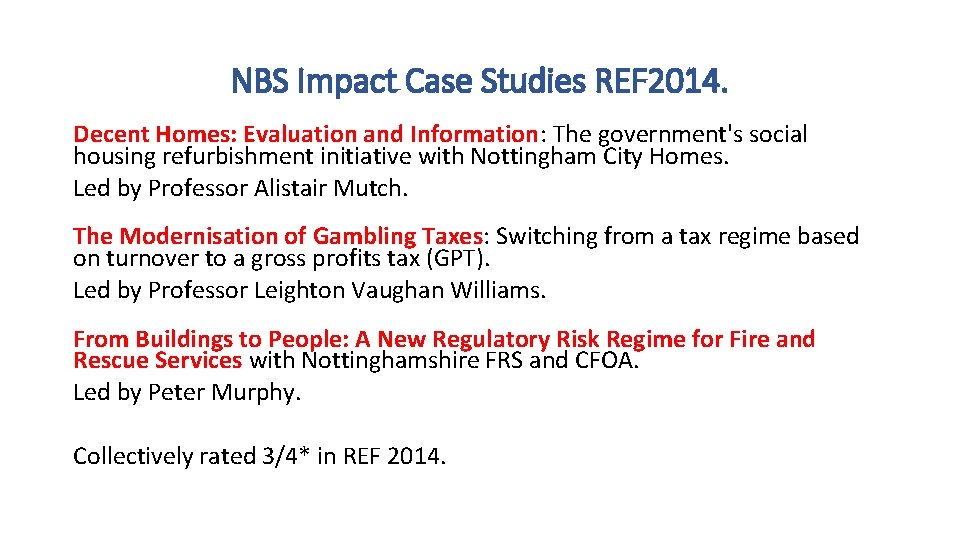
NBS Impact Case Studies REF 2014. Decent Homes: Evaluation and Information: The government's social housing refurbishment initiative with Nottingham City Homes. Led by Professor Alistair Mutch. The Modernisation of Gambling Taxes: Switching from a tax regime based on turnover to a gross profits tax (GPT). Led by Professor Leighton Vaughan Williams. From Buildings to People: A New Regulatory Risk Regime for Fire and Rescue Services with Nottinghamshire FRS and CFOA. Led by Peter Murphy. Collectively rated 3/4* in REF 2014.
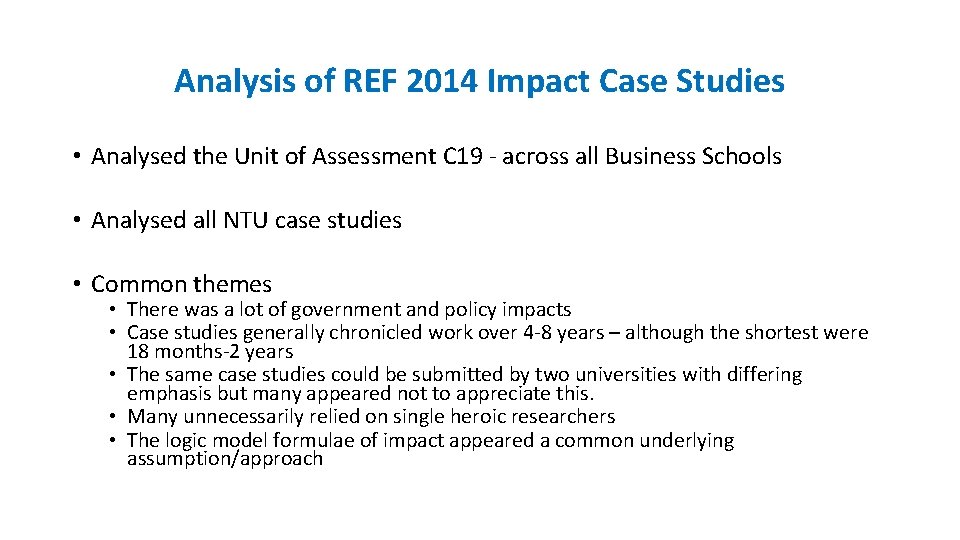
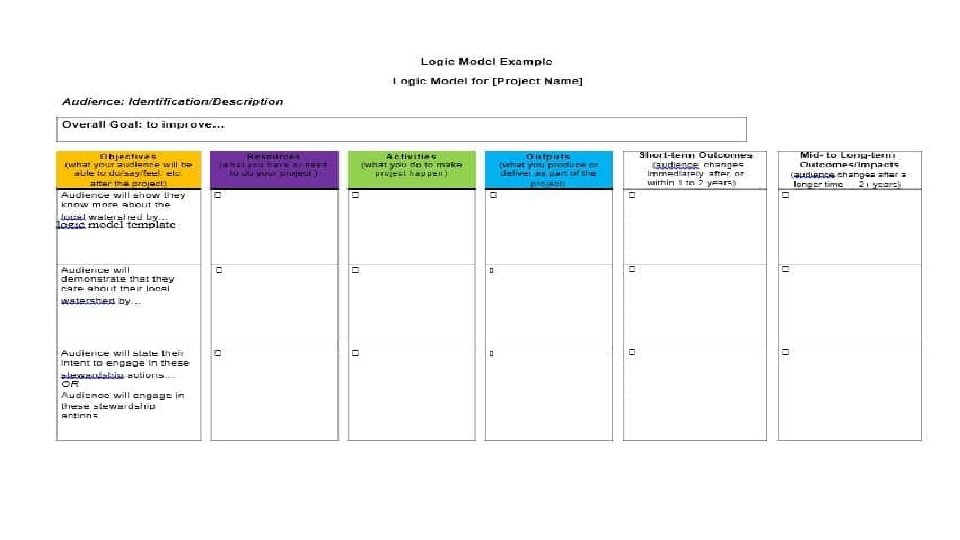
Analysis of REF 2014 Impact Case Studies • Analysed the Unit of Assessment C 19 - across all Business Schools • Analysed all NTU case studies • Common themes • There was a lot of government and policy impacts • Case studies generally chronicled work over 4 -8 years – although the shortest were 18 months-2 years • The same case studies could be submitted by two universities with differing emphasis but many appeared not to appreciate this. • Many unnecessarily relied on single heroic researchers • The logic model formulae of impact appeared a common underlying assumption/approach
NBS approach for REF 2021 to-date • An ecological or cluster approach to the identification and development of case studies for 2021 and 2015/6 • Developing potential cases out of the previous three 2014 submissions • Building time and resources into workload planning via the Individual Research Review process • NTU-wide support and external support Including inter-disciplinary cases) • Internal (NTU and NBS) leadership and support • The individual outputs internal and external review process • Developing academic and non academic strategies for each potential case study
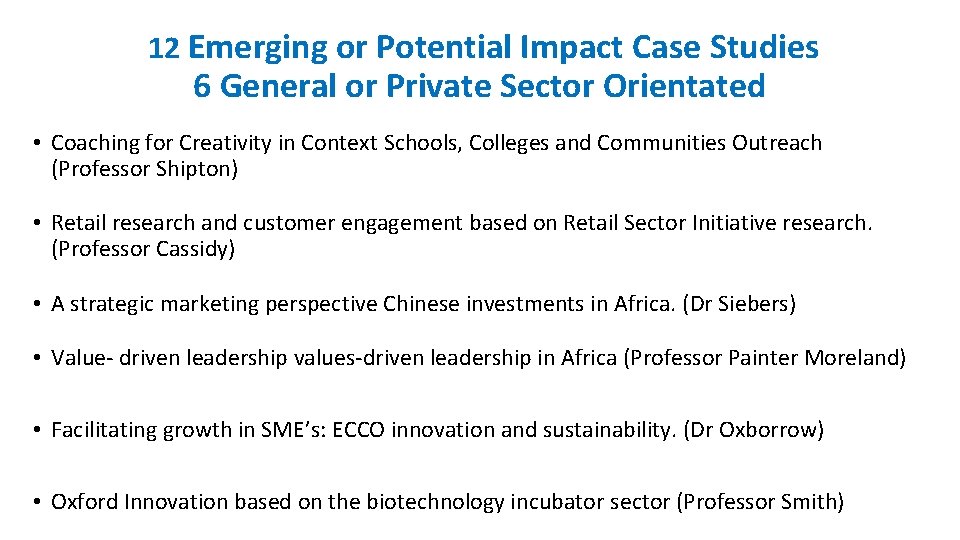
12 Emerging or Potential Impact Case Studies 6 General or Private Sector Orientated • Coaching for Creativity in Context Schools, Colleges and Communities Outreach (Professor Shipton) • Retail research and customer engagement based on Retail Sector Initiative research. (Professor Cassidy) • A strategic marketing perspective Chinese investments in Africa. (Dr Siebers) • Value- driven leadership values-driven leadership in Africa (Professor Painter Moreland) • Facilitating growth in SME’s: ECCO innovation and sustainability. (Dr Oxborrow) • Oxford Innovation based on the biotechnology incubator sector (Professor Smith)
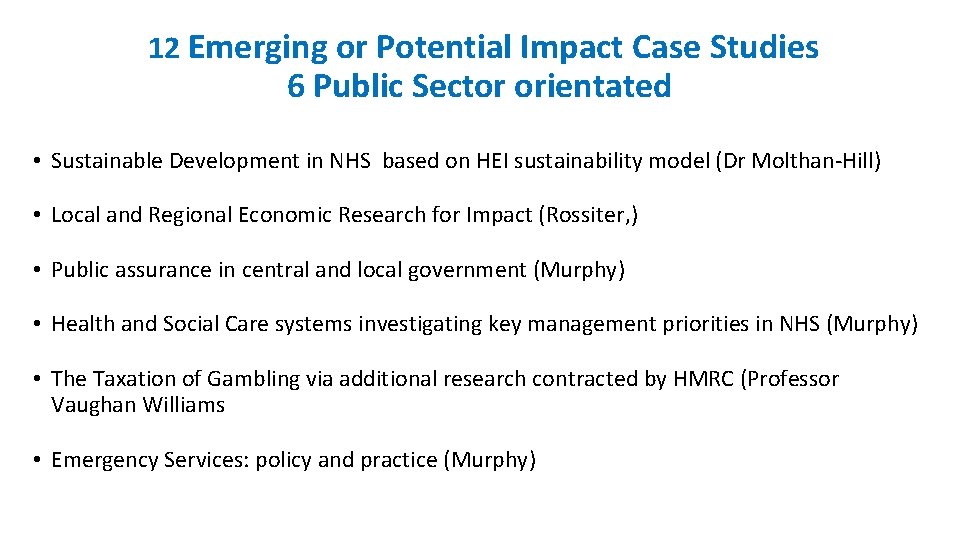
12 Emerging or Potential Impact Case Studies 6 Public Sector orientated • Sustainable Development in NHS based on HEI sustainability model (Dr Molthan-Hill) • Local and Regional Economic Research for Impact (Rossiter, ) • Public assurance in central and local government (Murphy) • Health and Social Care systems investigating key management priorities in NHS (Murphy) • The Taxation of Gambling via additional research contracted by HMRC (Professor Vaughan Williams • Emergency Services: policy and practice (Murphy)
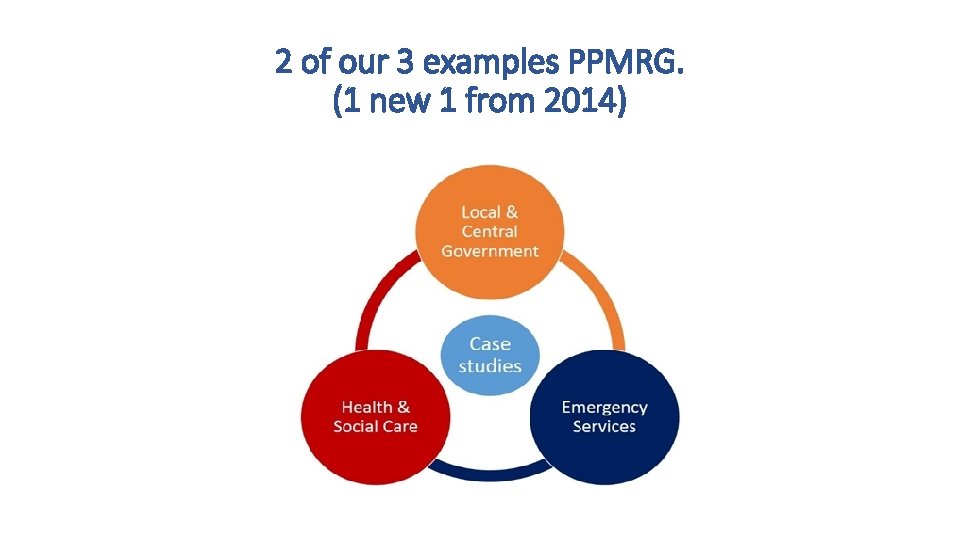
2 of our 3 examples PPMRG. (1 new 1 from 2014)
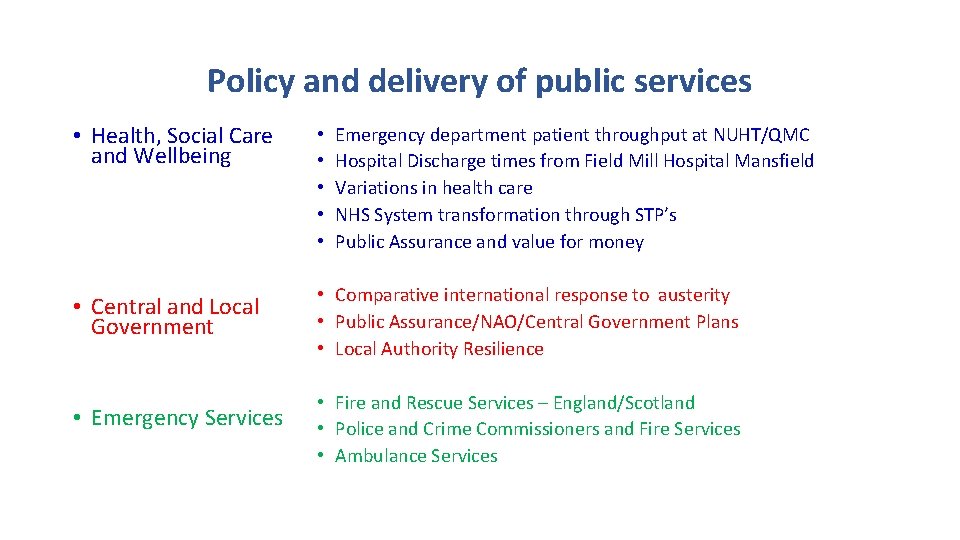
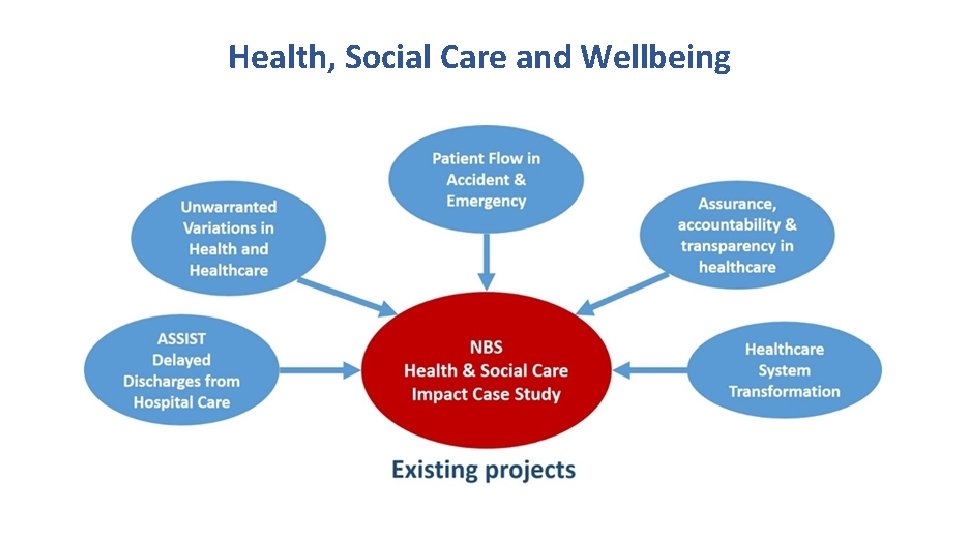
Policy and delivery of public services • Health, Social Care and Wellbeing • • • Central and Local Government • Comparative international response to austerity • Public Assurance/NAO/Central Government Plans • Local Authority Resilience • Emergency Services Emergency department patient throughput at NUHT/QMC Hospital Discharge times from Field Mill Hospital Mansfield Variations in health care NHS System transformation through STP’s Public Assurance and value for money • Fire and Rescue Services – England/Scotland • Police and Crime Commissioners and Fire Services • Ambulance Services
Health, Social Care and Wellbeing
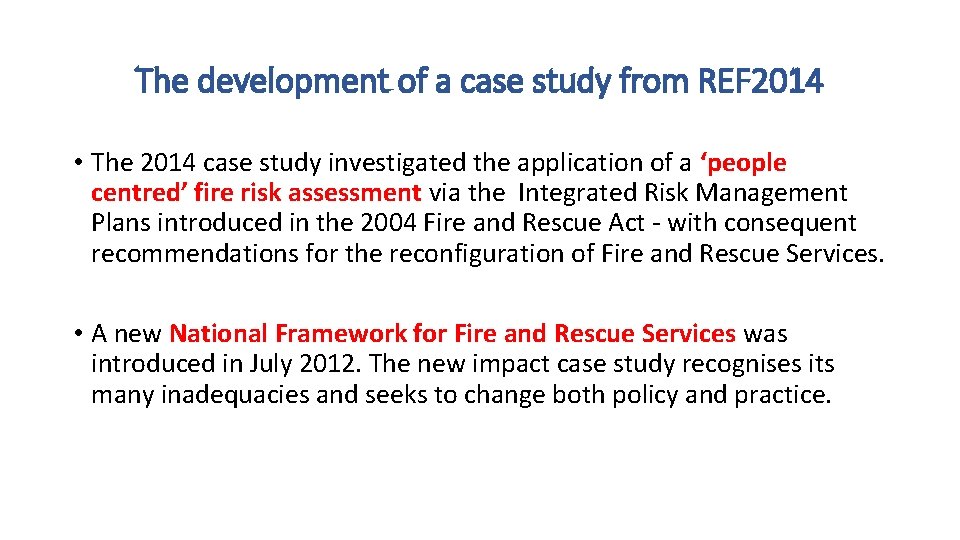
The development of a case study from REF 2014 • The 2014 case study investigated the application of a ‘people centred’ fire risk assessment via the Integrated Risk Management Plans introduced in the 2004 Fire and Rescue Act - with consequent recommendations for the reconfiguration of Fire and Rescue Services. • A new National Framework for Fire and Rescue Services was introduced in July 2012. The new impact case study recognises its many inadequacies and seeks to change both policy and practice.
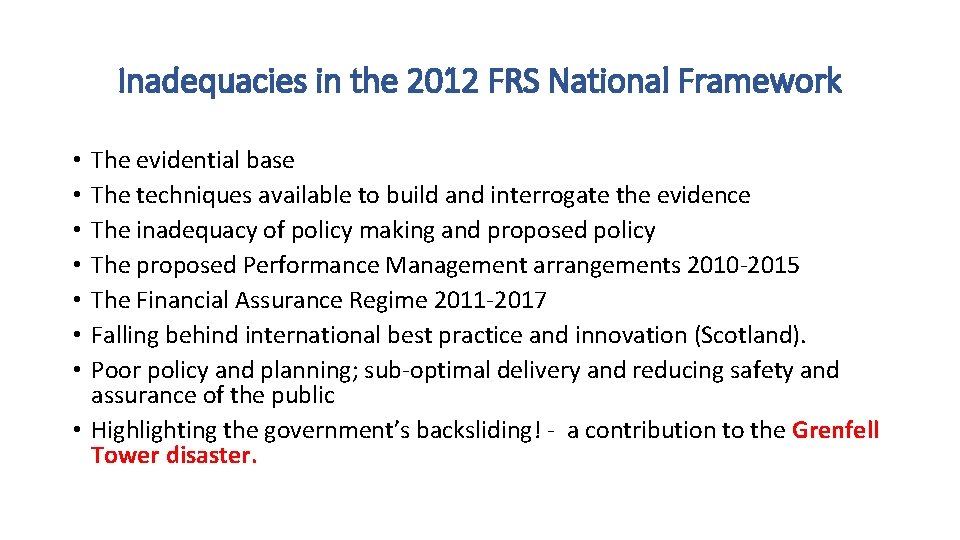
Inadequacies in the 2012 FRS National Framework The evidential base The techniques available to build and interrogate the evidence The inadequacy of policy making and proposed policy The proposed Performance Management arrangements 2010 -2015 The Financial Assurance Regime 2011 -2017 Falling behind international best practice and innovation (Scotland). Poor policy and planning; sub-optimal delivery and reducing safety and assurance of the public • Highlighting the government’s backsliding! - a contribution to the Grenfell Tower disaster. • •
Investigating the evidence, assurance and accountability • Initial initiative: The NAO commission prior to the 2015 election – the 4 locally delivered public services Local Authorities, Health, Police and Fire and Rescue. • Key Commissions: The 2 National Audit Office Fire and Rescue reports, the Public Accounts Committee Report and the 2017 Policing and Crime Act. • Latest issue: Post 2017 Act implementation - the new proposals for the (no longer) ‘independent’ fire inspectorate • Future Issue: The Scottish comparison and reconceptualization of value for money
Non-Academic Impact • Changes to government departmental responsibilities, departmental policy and guidance. • Changes to the delivery system and fire and rescue service organisations at national and local levels. • Changes to the regulatory and external monitoring systems and the public reporting system. • Impact and influence domestically and internationally. The importance of engaging in the professional and practitioner discourse as well as in academic publishing.
Examples – professional and general media • MURPHY, P. , 2017. Independent inspectorate in danger of becoming Home Office handmaiden. FIRE, • MURPHY, P. and GREENHALGH, K. , 2016. The new fire and rescue framework for Scotland. FIRE, • MURPHY, P. , 2016. A very political fix: the consultation on blue light integration is deeply flawed. FIRE, • MURPHY, P. , 2016. If PCCs are to take over fire services, they need to prove these six things. The Guardian. • MURPHY, P. , 2015. Plans to merge fire and police services have dodged proper scrutiny. Putting police in charge of firefighters could lead to neglect of emergency services – something the sham public consultation failed to mention. The Guardian. • MURPHY, P. and GREENHALGH, K. , 2014. Peer challenge needs an independent Fire Inspectorate. , pp. 17 -19. • MURPHY, P. and GREENHALGH, K. , 2014. Tenth anniversary of the 2004 Acts. , pp. 14 -16.
Examples, non–academic policy impact FERRY, L. , GEBREITER, F. and MURPHY, P. , 2017. Written evidence submitted to the Public Accounts Committee on Financial Sustainability of the NHS. MURPHY, P. , 2016. Ambulance services: submission to National Audit Office. MURPHY, P. and GREENHALGH, K. , 2016. Joint University Research Group response to the Scottish Government consultation: Fire and rescue framework for Scotland 2016. MURPHY, P. and GREENHALGH, K. , 2015. Joint University Research Group response to Home Office consultation: Enabling closer working between the emergency services. MURPHY, P. , 2015. Briefing note on 'Financial sustainability of fire and rescue services - value for money report' for the National Audit Office. MURPHY, P. , Briefing note on 'Financial sustainability of fire and rescue services - value for money report' for the National Audit Office. FERRY, L. and MURPHY, P. , 2015. Financial sustainability, accountability and transparency across local public service bodies in England under austerity. Briefing note to Centre for Public Scrutiny (Cf. PS) Advisory Board. FERRY, L. and MURPHY, P. , 2015. Financial sustainability, accountability and transparency across local public service bodies in England under austerity. Report to National Audit Office. MURPHY, P. and GREENHALGH, K. , 2015. The Joint Universities Research Programme response to Lyn Brown MP, Shadow Fire and Rescue Minister, on 'The future of the fire and rescue service in England'. GREENHALGH, K. and MURPHY, P. , 2015. The new National Framework for Fire and Rescue Services: report to Nottinghamshire Fire and Rescue Service and CFOA.
Questions?