
The development of a National Information Literacy Framework
- Slides: 14
The development of a National Information Literacy Framework (Scotland) Christine Irving The Scottish Information Literacy Project Glasgow Caledonian University North Ayrshire School Librarian’s Meeting Tuesday 25 th September 2007
Scottish Information Literacy Project Objectives 2007 • Advocacy on behalf of information literacy for education and wider community • Working with information literacy champions both UK and worldwide • Researching and promoting information literacy in the workplace • Identifying and working with partners, both in education and the wider community • Researching the role of information literacy in continuing professional development • to develop an information literacy framework, with crosssector partners linking primary, secondary and tertiary education to lifelong learning including workplace and adult literacies agendas.
Recognition of need To develop a national overarching framework of information literacy skills and competencies which all sectors of education can recognise and develop or which can be applied to the world of work, equipping learners with skills needed for the 21 st century.
Research findings • Schools - information literacy skills were generally taught in first and second year (aged 12 / 13) but not subsequently reinforced within the curriculum resulting in fragmented levels of knowledge and usage for their remaining years at school. • HE - students arriving at university have generally either poor or limited information literacy skills, for some these skills will be enhanced but many will leave as they arrived. • The workplace - indication that although employers do not explicitly ask for information literacy it is implicitly expected, seen as important at work but not included in workplace training.
Project deliverables • Draft framework developed in conjunction with partners • Evaluation exercise of draft framework • Identification of barriers and constraints • Contribution to curriculum development • Contribution to the IL agenda on a national and international basis.
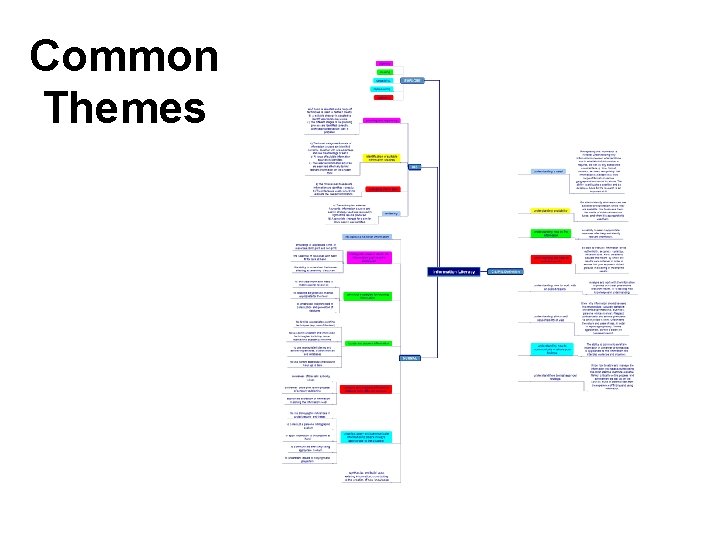
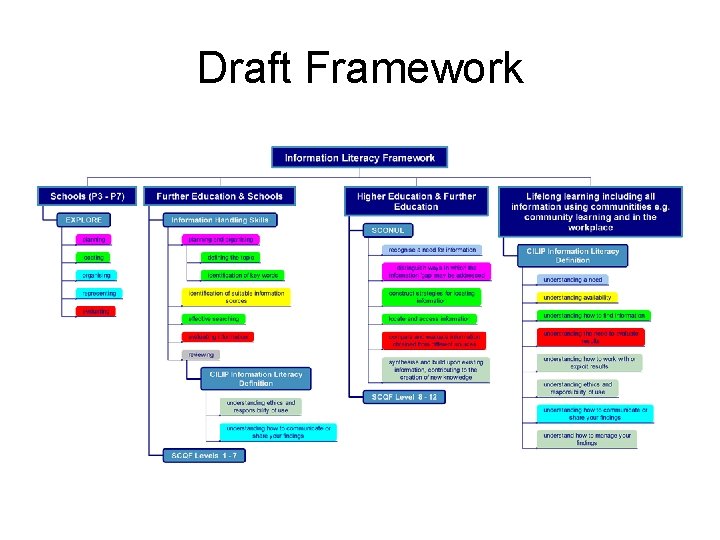
Developing the framework • Looked at other frameworks – at home and abroad • Discussions with relevant bodies and individuals • Not reinventing the wheel – incorporate what is being used – look for common themes from existing models and definitions
Common Themes
Draft Framework
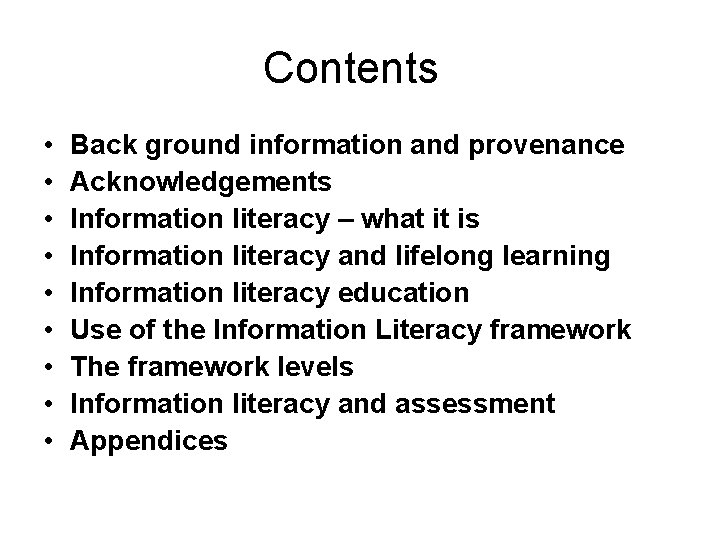
Contents • • • Back ground information and provenance Acknowledgements Information literacy – what it is Information literacy and lifelong learning Information literacy education Use of the Information Literacy framework The framework levels Information literacy and assessment Appendices
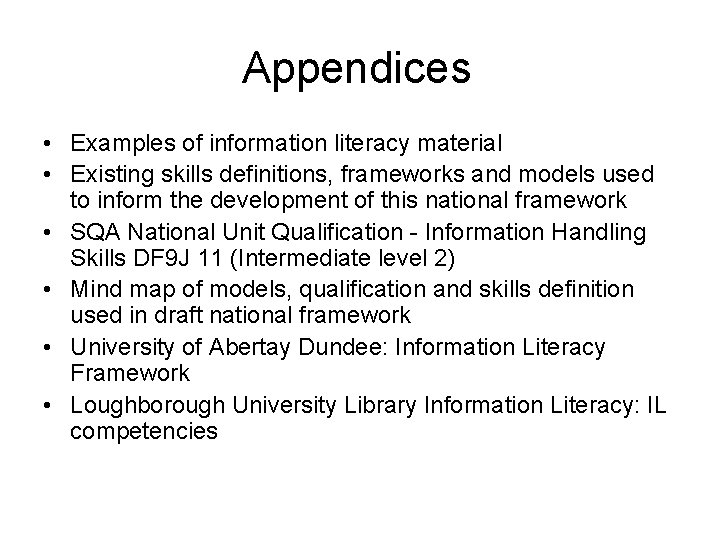
Appendices • Examples of information literacy material • Existing skills definitions, frameworks and models used to inform the development of this national framework • SQA National Unit Qualification - Information Handling Skills DF 9 J 11 (Intermediate level 2) • Mind map of models, qualification and skills definition used in draft national framework • University of Abertay Dundee: Information Literacy Framework • Loughborough University Library Information Literacy: IL competencies
Draft Framework
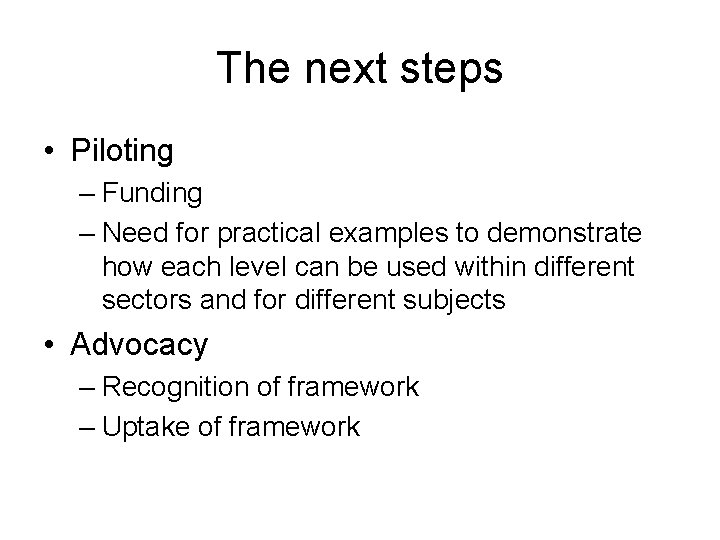
The next steps • Piloting – Funding – Need for practical examples to demonstrate how each level can be used within different sectors and for different subjects • Advocacy – Recognition of framework – Uptake of framework
For more information Christine Irving Project Officer (part-time) National Information Literacy Framework Learner Support Glasgow Caledonian University Room RS 305, (3 rd Floor) 6 Rose Street Glasgow G 3 6 RB Tel: 0141 273 1249 e-mail: christine. irving@gcal. ac. uk project website: www. caledonian. ac. uk/ils/ framework website www. caledonian. ac. uk/ils/framework. html
Questions?