
THE DEVELOPMENT AND MEASUREMENT OF ATTUNEMENT AMONG ADULTS
- Slides: 36
THE DEVELOPMENT AND MEASUREMENT OF ATTUNEMENT AMONG ADULTS IN THE YOUTH MENTORING SYSTEM INVOLVE CONFERENCE, WELLINGTON, NZ AUGUST 14, 2018 Julia Pryce, Ph. D. , LCSW In collaboration with community partners, Linda Gilkerson, Ph. D. , & Kelsey Deane, Ph. D.
Pair and share the day WWhat has thas he day been like fo r you sfor been like so o faryou ? far?
Our Time Together § Introduction of key concepts --Attunement --Mentoring FAN § § § Photo Credit: http: //ww w. clker. c om/clipart -checklist form. html Overview of findings from work with agencies on Mentoring FAN training Introduction of Mentor Attunement Scale (MAS) Q & A and wrap up
Practicing Presence
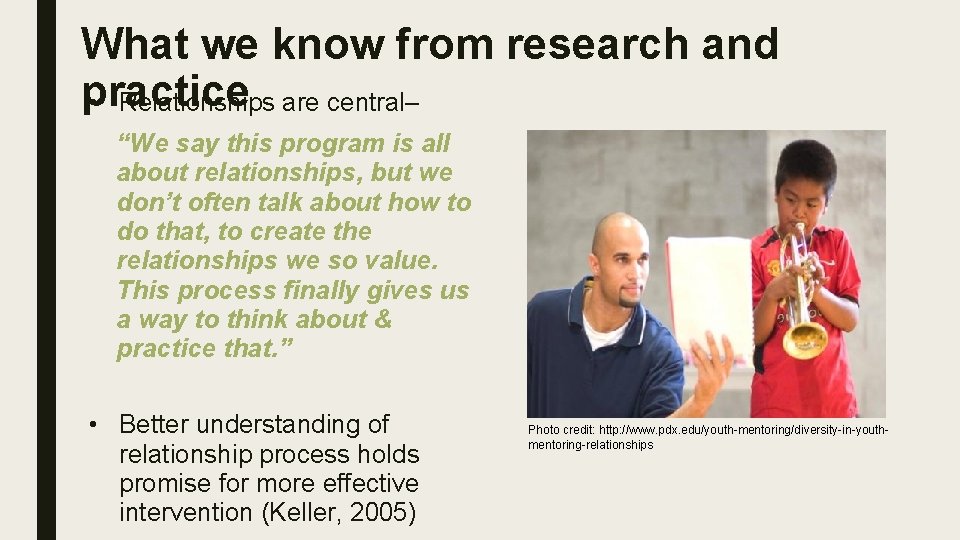
What we know from research and practice • Relationships are central– “We say this program is all about relationships, but we don’t often talk about how to do that, to create the relationships we so value. This process finally gives us a way to think about & practice that. ” • Better understanding of relationship process holds promise for more effective intervention (Keller, 2005) Photo credit: http: //www. pdx. edu/youth-mentoring/diversity-in-youthmentoring-relationships
Definition of Attunement (Pryce, 2012) ■ Capacity to respond flexibly to verbal and nonverbal cues by taking into account others’ needs and desires ■ Represents broad strategy to elicit, read, interpret and reflect on others’ cues ■ Requires adaptation of expectations based on others’ interests ■ Involves level of intentionality in approve toward building the relationship
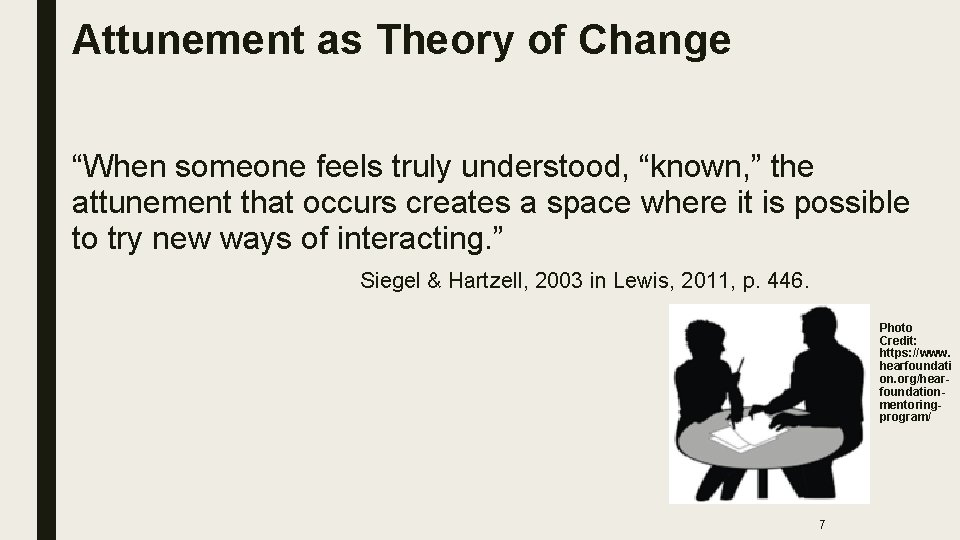
Attunement as Theory of Change “When someone feels truly understood, “known, ” the attunement that occurs creates a space where it is possible to try new ways of interacting. ” Siegel & Hartzell, 2003 in Lewis, 2011, p. 446. Photo Credit: https: //www. hearfoundati on. org/hearfoundationmentoringprogram/ 7
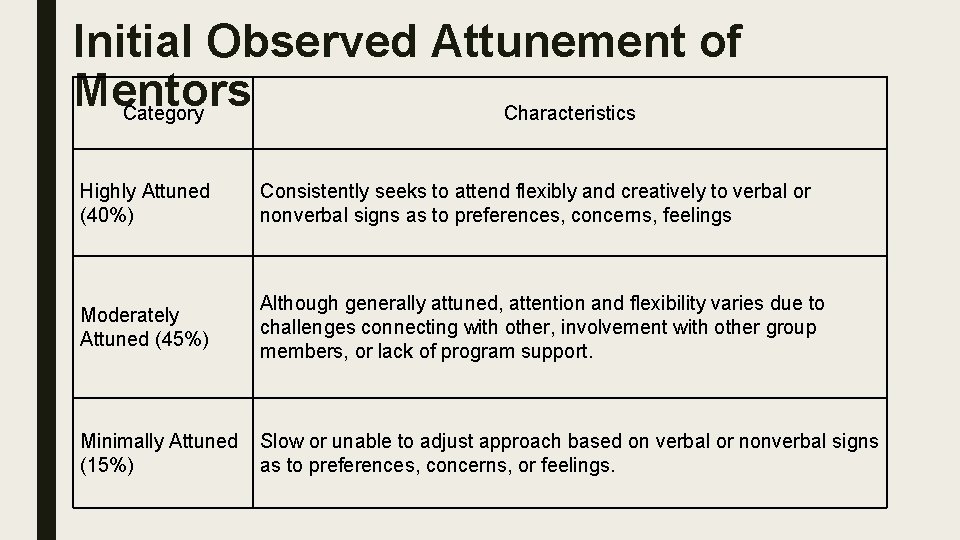
Initial Observed Attunement of Mentors Category Characteristics Highly Attuned (40%) Consistently seeks to attend flexibly and creatively to verbal or nonverbal signs as to preferences, concerns, feelings Moderately Attuned (45%) Although generally attuned, attention and flexibility varies due to challenges connecting with other, involvement with other group members, or lack of program support. Minimally Attuned (15%) Slow or unable to adjust approach based on verbal or nonverbal signs as to preferences, concerns, or feelings.
Fussy Baby Network ® ■ National model prevention program ■ FAN Approach to Family Engagement and Reflective Practice (Gilkerson & Gray, 2013; Gilkerson et al, 2013). ■ International Network ■ FAN approach applicable to communication and engagement processes across settings
Mentoring FAN: “How you do the work” PLEASE EMAIL jpryce@luc. edu IF YOU ARE INTERESTED IN THIS MODEL
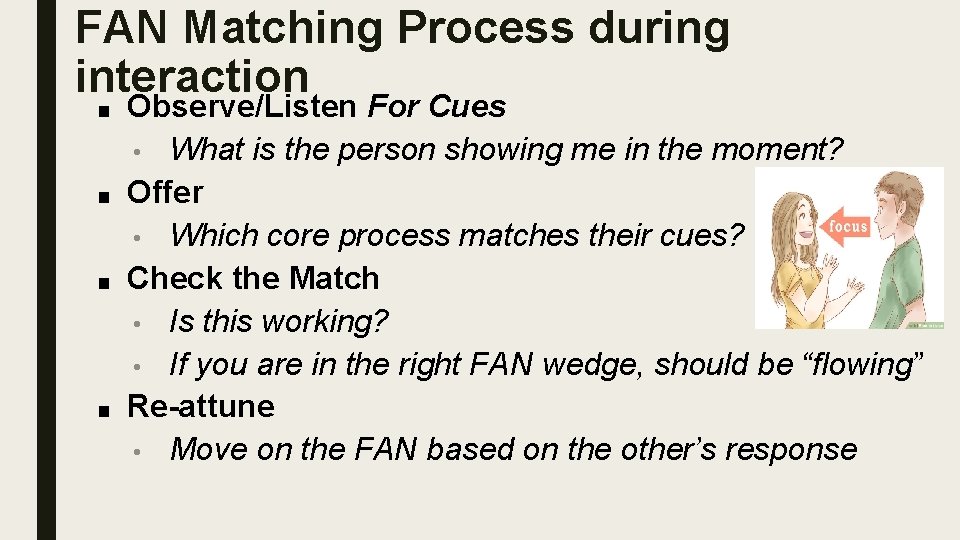
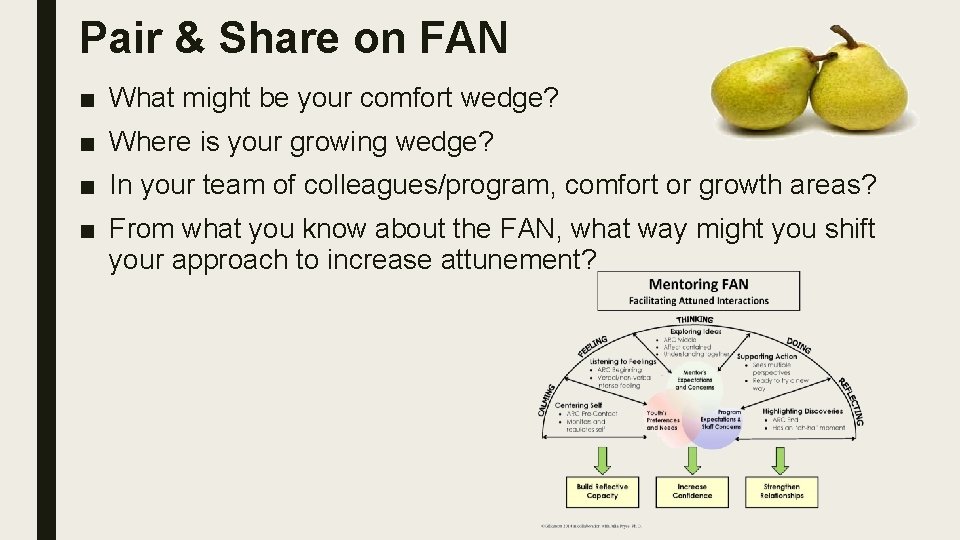
FAN Matching Process during interaction ■ ■ Observe/Listen For Cues • What is the person showing me in the moment? Offer • Which core process matches their cues? Check the Match • Is this working? • If you are in the right FAN wedge, should be “flowing” Re-attune • Move on the FAN based on the other’s response
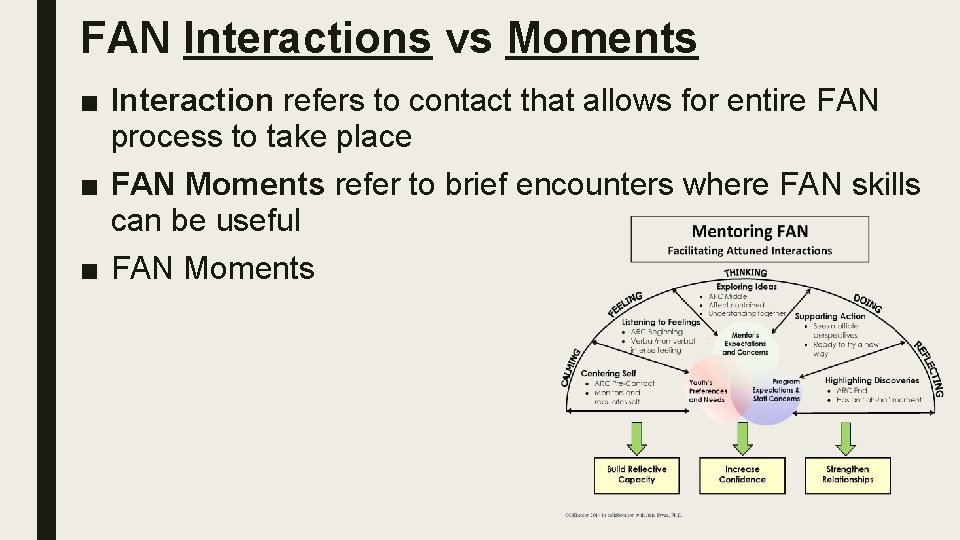
FAN Interactions vs Moments ■ Interaction refers to contact that allows for entire FAN process to take place ■ FAN Moments refer to brief encounters where FAN skills can be useful ■ FAN Moments
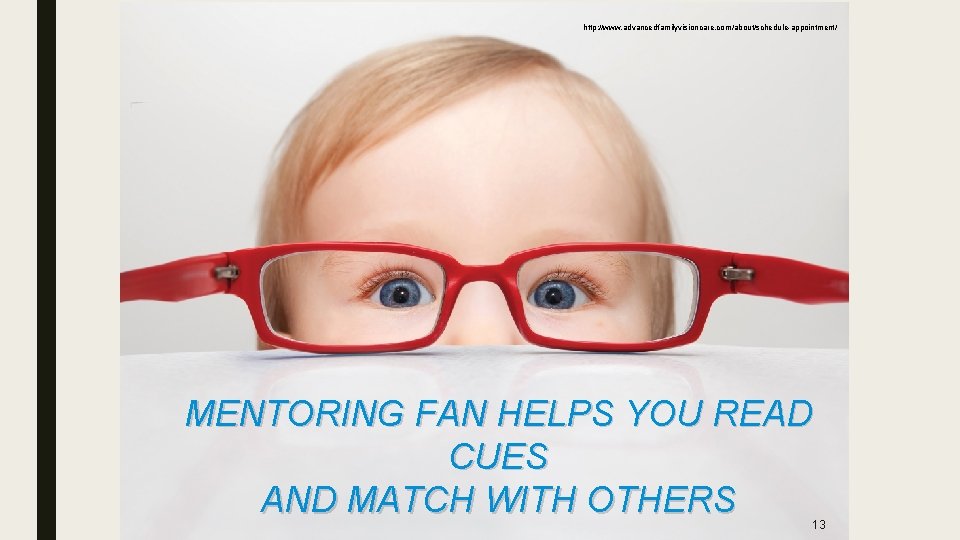
http: //www. advancedfamilyvisioncare. com/about/schedule-appointment/ Take A Peek… Cues Related to the FAN Core Processes MENTORING FAN HELPS YOU READ CUES AND MATCH WITH OTHERS 13
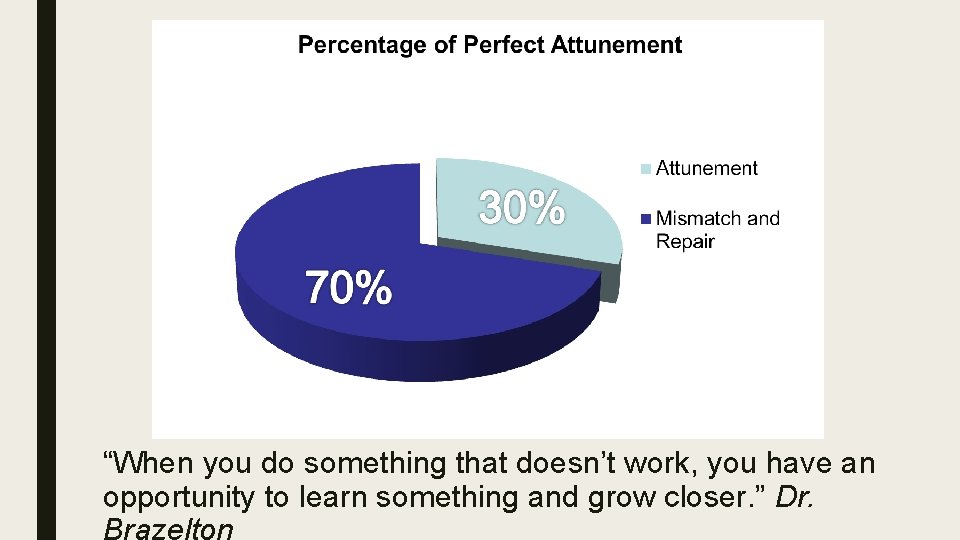
“When you do something that doesn’t work, you have an opportunity to learn something and grow closer. ” Dr. Brazelton
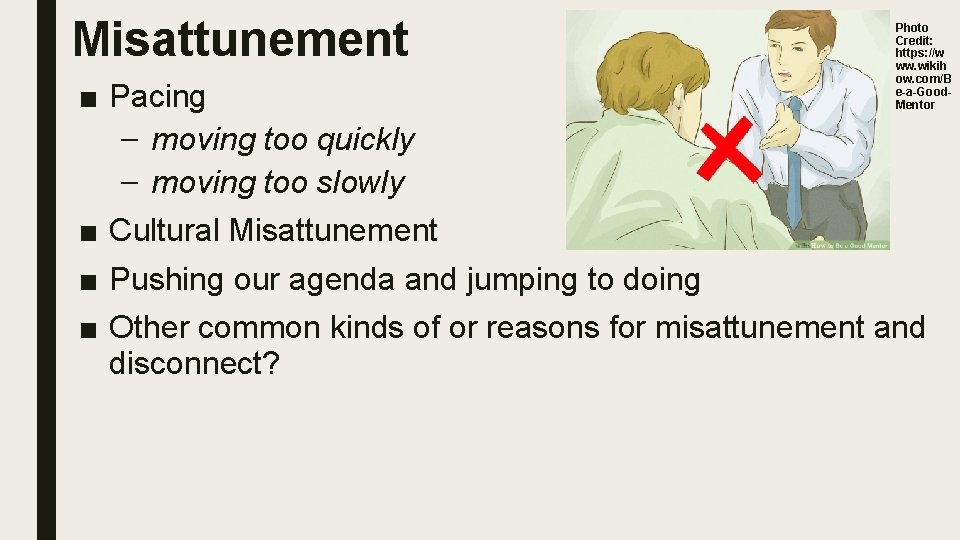
Misattunement Photo Credit: https: //w ww. wikih ow. com/B e-a-Good. Mentor ■ Pacing – moving too quickly – moving too slowly ■ Cultural Misattunement ■ Pushing our agenda and jumping to doing ■ Other common kinds of or reasons for misattunement and disconnect?
Your Mismatch Story ■ ■ ■ Think of an interaction that you had with someone that didn’t go so well, ideally in professional context Draw a picture of this interaction in your mind so you can come back to it Share with colleague: • What were you needing? • What actually happened? • How did it feel for you?
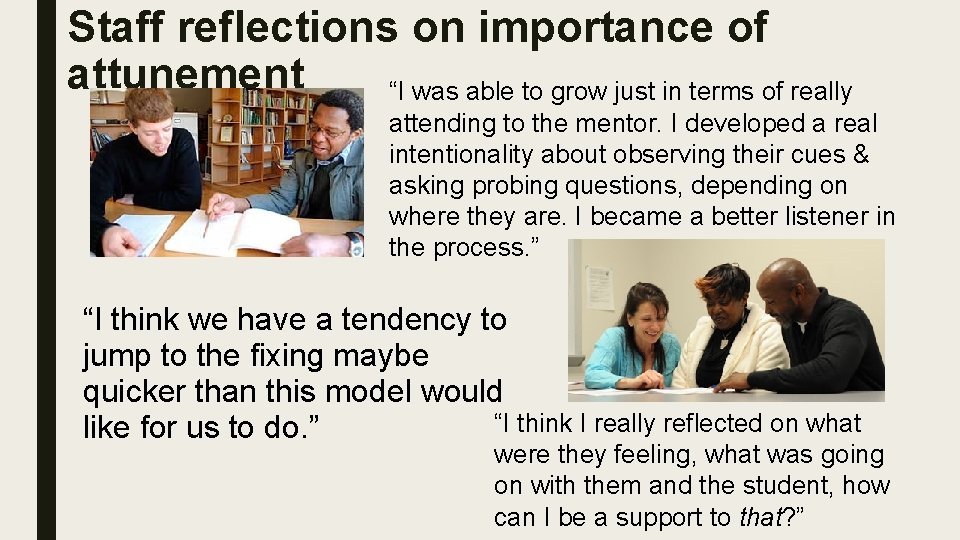
Staff reflections on importance of attunement “I was able to grow just in terms of really attending to the mentor. I developed a real intentionality about observing their cues & asking probing questions, depending on where they are. I became a better listener in the process. ” “I think we have a tendency to jump to the fixing maybe quicker than this model would “I think I really reflected on what like for us to do. ” were they feeling, what was going on with them and the student, how can I be a support to that? ”
Pair & Share on FAN ■ What might be your comfort wedge? ■ Where is your growing wedge? ■ In your team of colleagues/program, comfort or growth areas? ■ From what you know about the FAN, what way might you shift your approach to increase attunement?
Empathic Inquiry: Example “First she wanted to explain everything and defend herself and she’s obviously not in a position yet to move forward with me to try and solve the problem. She was in that processing stage where all of us get where someone thinks we’ve done something wrong and that makes us feel uncomfortable. [FAN] enabled me to hear more: “Ok she is not yet ready for us to move into this, what is it going to look like next stage. I need to just let her vent some. ” - Sara, Site Coordinator
Empathic Response? Yes or No “I think I’m ready to give • Sounds like things have been really up. ” • • • rough. Don’t give up. You will make it through this. Hang in there. It must feel hard sometimes. What do you mean when you say that? I know you are committed as a mentor.
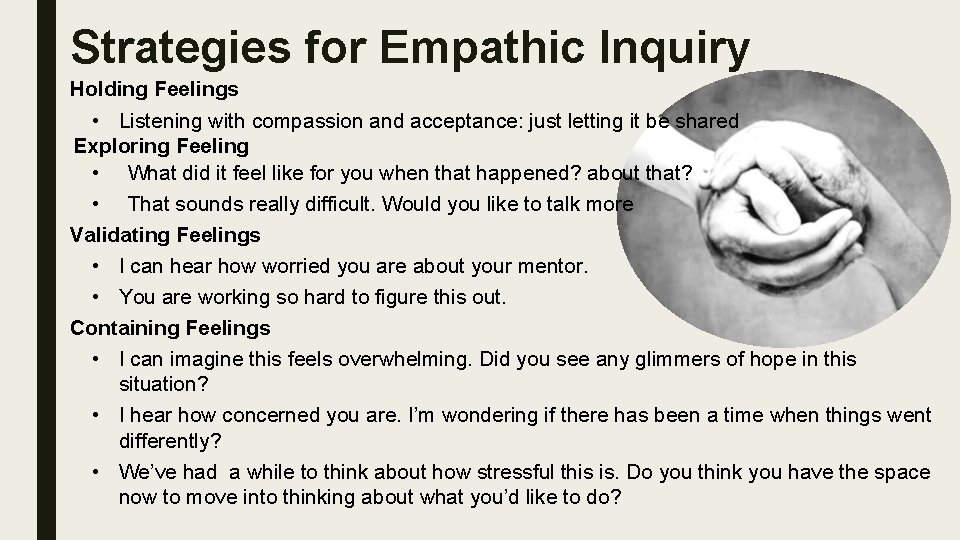
Strategies for Empathic Inquiry Holding Feelings • Listening with compassion and acceptance: just letting it be shared Exploring Feeling • What did it feel like for you when that happened? about that? • That sounds really difficult. Would you like to talk more Validating Feelings • I can hear how worried you are about your mentor. • You are working so hard to figure this out. Containing Feelings • I can imagine this feels overwhelming. Did you see any glimmers of hope in this situation? • I hear how concerned you are. I’m wondering if there has been a time when things went differently? • We’ve had a while to think about how stressful this is. Do you think you have the space now to move into thinking about what you’d like to do?
Pair and Share ■ ■ Think of times your mentor, colleague, or mentee/youth that you know was in FEELINGS Write two empathic statements that validate or explore the feelings Share with partner Group discussion
Findings on training of mentoring staff ■ Statistically significant differences in staff interpersonal reactivity: t(28) = -2. 22, p=. 04. ■ Statistically significant differences in staff ability to selfreflect, and increased level of insight regarding work t(9) = -2. 77, p =. 024; t(9) = -4. 10, p=. 003. ■ Measures of empathy and mindfulness yielded positive trends – Staff self-reported growth in ability to be empathic and self-aware, and an increased use and comfort in employing mindfulness practice techniques
Qualitative findings Central Themes from Interviews ■ Attunement: Listening and reading cues I was able to grow just in terms of really attending to the mentor. I developed a real intentionality about observing their cues, um, and asking more probing questions depending on where they’re at. I came to a place where I can really sort of watch them. I guess I became a better listener in the process. Just thinking more about where they’re at and what they’re ready for before I begin to provide feedback… provide guidance, provide suggestions, um, and observe where they’re at before I jump into those things. - Tyrone Photo Credit: https: //gr owthfreak s. com/act ivelisteningskills/
Qualitative findings (cont). ■ Attunement: Awareness of self and other But now I’m much more conscious of what other people in the situation are thinking or feeling. Um, and allowing them to not only share their ideas, but implementing their ideas as effective as mine would be…[the FAN] allows me to take a step back and be empathetic that not everybody thinks or feels the way that I think. -Kelly ■ Supervision as a collaborative relationship: shift in nature of supervision from hierarchical problem-solving to collaborative exploration …I think before [FAN training] I kind of took on more of a teacher role and I would tell them, ‘you know, maybe you should do this or that, and now, I just kind of let them be and let them try to figure it out instead of always try to solve everything. doing the FAN has allowed me to see them [the mentors] in a little bit of a different role. Before, they were my mentors and I would tell them what to do and they would just do it…and now it’s like we’re working together.
Qualitative findings (cont). ■ Improved ability to support relationships between mentors and youth: As staff developed skills in attunement, more able to understand the mentors and mentoring relationships Just working with that mentor and not um, giving up…there were very many times when I know he wanted to give up, and I kind of wanted to terminate the match because of the frustration I was feeling because of the mentor. Meeting together, problem solving to think of solutions, and just affirming his worth, his value in the relationship, really helped change the relationship. -Charlotte ■ Increased sense of staff purpose in work supporting mentors ■ Mentor feedback further reinforces the strengthening of connection between staff and mentors as associated with Mentoring FAN training
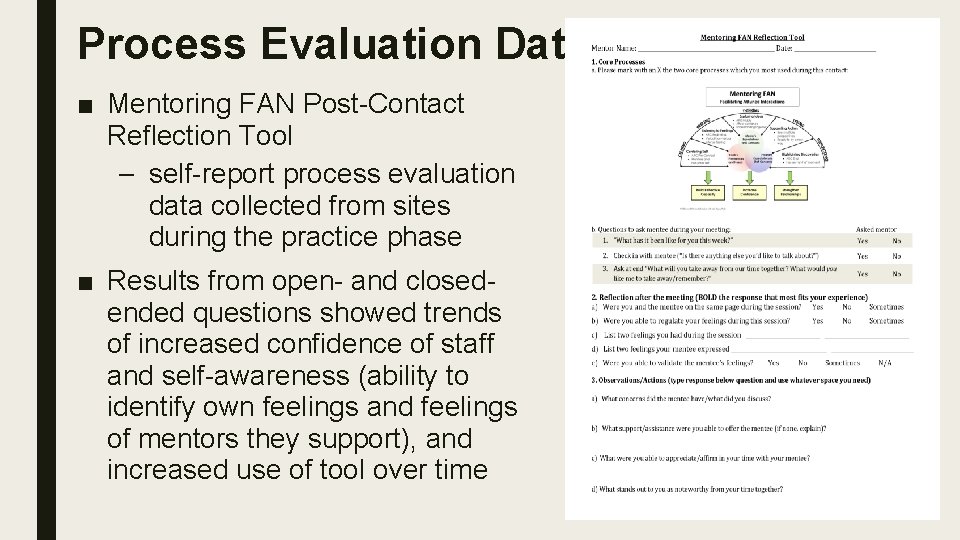
Process Evaluation Data ■ Mentoring FAN Post-Contact Reflection Tool – self-report process evaluation data collected from sites during the practice phase ■ Results from open- and closedended questions showed trends of increased confidence of staff and self-awareness (ability to identify own feelings and feelings of mentors they support), and increased use of tool over time
Findings to date from mentor feedback ■ Strengthening of relationship between staff and mentor The opportunity for more in-depth conversation with my site coordinator has also led to other more in-depth conversations about personal lives, which has allowed us to get to know each other better and develop a relationship, which I think aids in the retention of mentors to the program. ■ Increased use of self-reflection Conversations helped because it provided me as a mentor the opportunity to stop and reflect upon my interactions with my mentee, which allowed me to recognize the changes that were occurring in our relationship. ■ Opportunities for staff to reflect with the mentor and highlight strengths and successes Our extended conversations have given me the confidence and sense
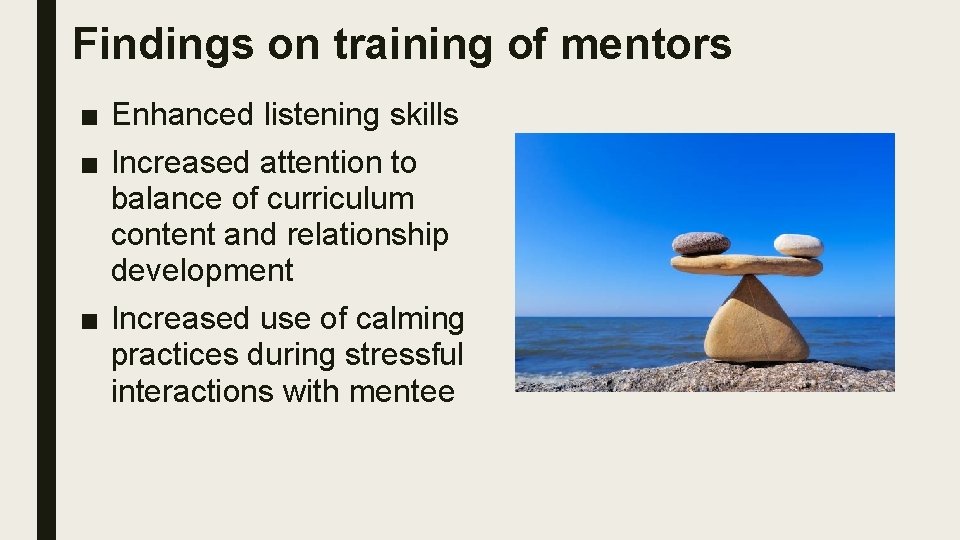
Findings on training of mentors ■ Enhanced listening skills ■ Increased attention to balance of curriculum content and relationship development ■ Increased use of calming practices during stressful interactions with mentee
Overview of partner agencies to date ■ School-Based Mentoring of Champaign/Urbana ■ Big Brothers/Big Sisters of Dallas ■ Spark Chicago ■ De. Paul University Cities Mentor Project ■ Higher Education Mentoring Initiative ■ Read Ahead New York City ■ Arrupe College Chicago
Overview of Training Structure ■ First level training: – One day training on Mentoring FAN – 5 month follow up (which included monthly calls or meetings used to practice Mentoring FAN) – Can consider virtual training as well to accommodate New Zealand context ■ Train-the-trainer option – Trainer participates in first level training – Trainer conducts Mentoring FAN trainings and is observed and receives feedback
Overview of findings from trainings ■ Feedback from one day training across two cases – Overall Mentoring FAN Training consistently well received ■ 86% of participants rated training as helpful or very helpful (4. 4/5 on average rating across evaluation) ■ “The materials provided were clear and engaging and eyeopening. The training was clearly well thought-out and organized. I appreciated the variation in activities. Great experiential learning. ” ■ “I will find the time for this! This will really make a difference!” ■ Most helpful aspects of training include: – Focus on Mentoring Relationships – FAN Matching Process and Self-Awareness – Attention to Mindful Self-Regulation – Shift of focus to collaboration – ARC of Engagement as tool
Reactions? Questions? Anticipated Challenges? One idea you would like to remember from the Mentoring FAN? What will you take with you? Photo Credit: http: //iteachblogging. com/sha re-your-idea/
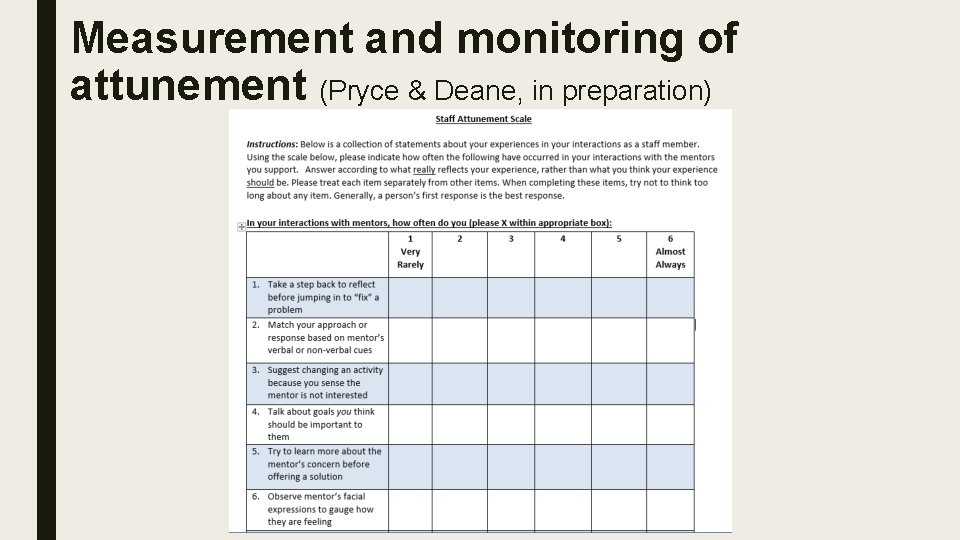
Measurement and monitoring of attunement (Pryce & Deane, in preparation)
Next steps in measuring attunement ■ Analyzing scale from current U. S. based sample (n = 405); promising findings to date ■ Piloting of scale with mentors in India-based sample and exploration of role of attunement in predicting match quality and potentially correlating with empathy ■ Interest in ongoing cross-cultural work so field can use measure to screen and support mentors and staff ■ Check in after workshop if curious!
Wrap-Up ■ Final questions and considerations