
The Developing Person Through Childhood and Adolescence by

The Developing Person Through Childhood and Adolescence by Kathleen Stassen Berger Seventh Edition Chapter 7 The First Two Years: Psychosocial Development Slides prepared by Kate Byerwalter, Ph. D. , Grand Rapids Community College
What does “psychosocial” mean? n Psychosocial development is the combination of emotional and social development. n During infancy, interactions with sensitive, responsive caregivers foster psychosocial development. Berger: The Developing Person Through Childhood and Adolescence, 7 th Edition, Chapter 7
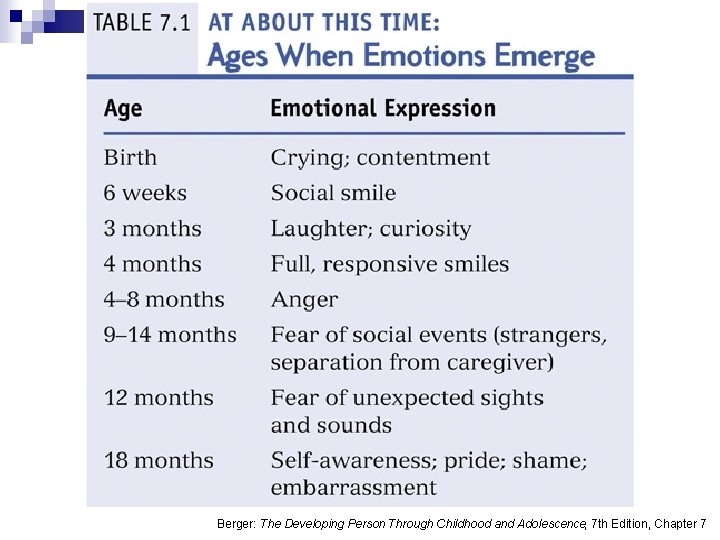
Emotional Development in Infancy n The First Year ¨ At birth: distress and contentment ¨ Social smile appears around 6 weeks ¨ Anger (as early as 4 months) ¨ Fear n Stranger wariness n Separation anxiety Berger: The Developing Person Through Childhood and Adolescence, 7 th Edition, Chapter 7
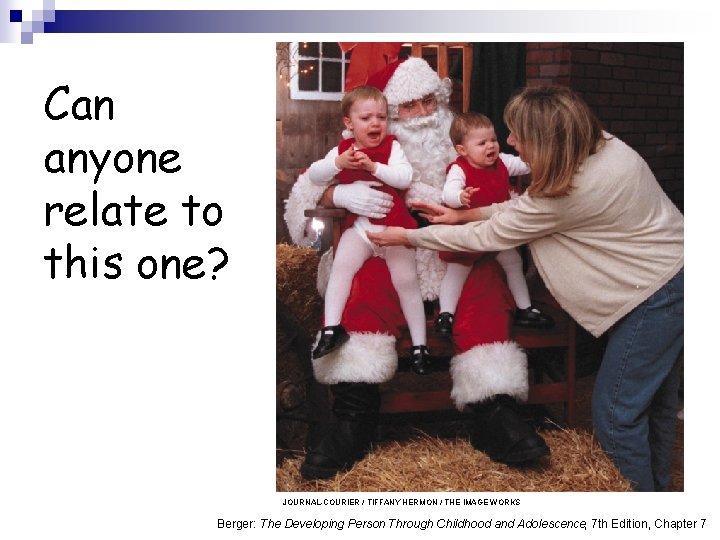
Can anyone relate to this one? JOURNAL-COURIER / TIFFANY HERMON / THE IMAGE WORKS Berger: The Developing Person Through Childhood and Adolescence, 7 th Edition, Chapter 7
Emotional Development in Infancy (cont. ) n The Second Year ¨ Fear and anger, laughing and crying become more discriminating ¨ New emotions appear: pride, shame, embarrassment, guilt These emotions require a sense of self n Dot-of-rouge experiment n Berger: The Developing Person Through Childhood and Adolescence, 7 th Edition, Chapter 7
Berger: The Developing Person Through Childhood and Adolescence, 7 th Edition, Chapter 7
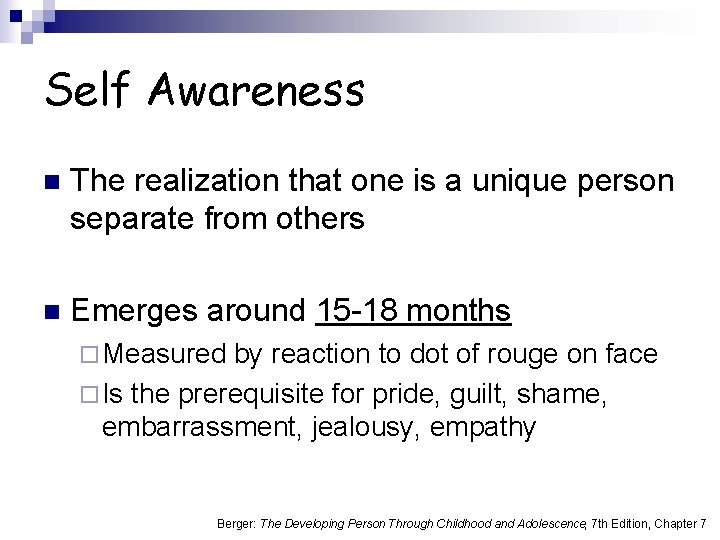
Self Awareness n The realization that one is a unique person separate from others n Emerges around 15 -18 months ¨ Measured by reaction to dot of rouge on face ¨ Is the prerequisite for pride, guilt, shame, embarrassment, jealousy, empathy Berger: The Developing Person Through Childhood and Adolescence, 7 th Edition, Chapter 7
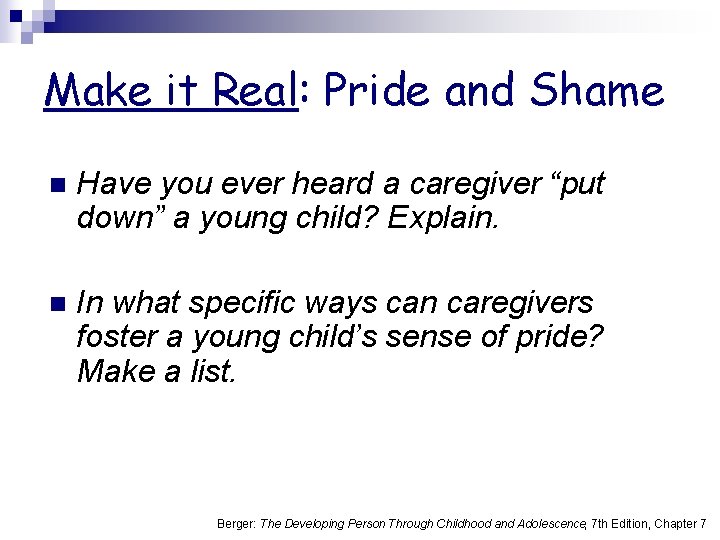
Make it Real: Pride and Shame n Have you ever heard a caregiver “put down” a young child? Explain. n In what specific ways can caregivers foster a young child’s sense of pride? Make a list. Berger: The Developing Person Through Childhood and Adolescence, 7 th Edition, Chapter 7
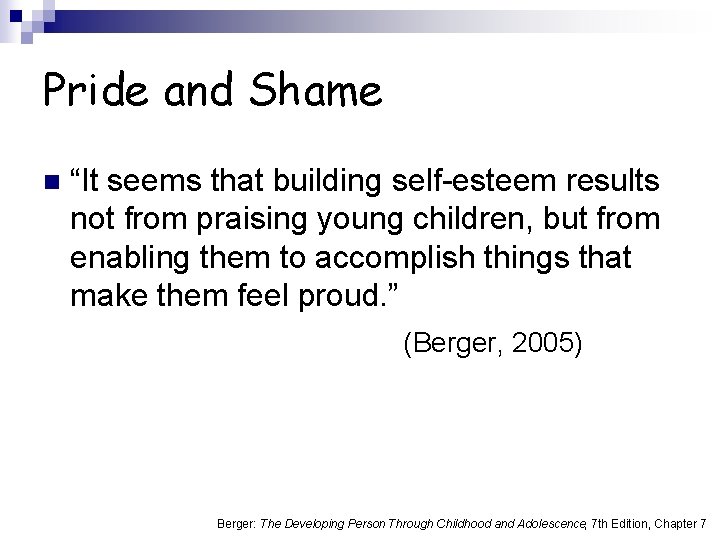
Pride and Shame n “It seems that building self-esteem results not from praising young children, but from enabling them to accomplish things that make them feel proud. ” (Berger, 2005) Berger: The Developing Person Through Childhood and Adolescence, 7 th Edition, Chapter 7
Theories about Caregiving n There are several theories of how the interaction between caregiver and infant shapes the infant’s behavior, personality, and relationships with others. Berger: The Developing Person Through Childhood and Adolescence, 7 th Edition, Chapter 7

Psychoanalytic Theory n Freud believed that conflicts during the oral and anal stages shaped the infant’s later personality. n Example: Too strict toilet training may lead to an anal retentive personality. Berger: The Developing Person Through Childhood and Adolescence, 7 th Edition, Chapter 7
Erikson’s First Two Psychosocial Stages n Trust vs. Mistrust: quality of care in the first year shapes the infant’s view of the consistency and predictability of the world n Autonomy vs. Shame and Doubt = basic need to gain self-rule or feel ashamed that it doesn’t happen Berger: The Developing Person Through Childhood and Adolescence, 7 th Edition, Chapter 7
Behaviorism n Infant’s emotions and personality are molded as parents reinforce or punish child’s spontaneous behavior. n Social referencing strengthens learning by observation. Berger: The Developing Person Through Childhood and Adolescence, 7 th Edition, Chapter 7
Cognitive Theory n Cognitive Theory states that infants form a concept of what to expect from people. n The result is a working model, a set of assumptions about relationships. n Example: An infant learns to expect that people can be trusted (or not). Berger: The Developing Person Through Childhood and Adolescence, 7 th Edition, Chapter 7
Epigenetic Theory n Epigenetic theory holds that child-rearing practices shape inborn predispositions. n Example: A “naturally” fearful infant becomes less fearful in the context of a supportive parent who encourages bravery. Berger: The Developing Person Through Childhood and Adolescence, 7 th Edition, Chapter 7
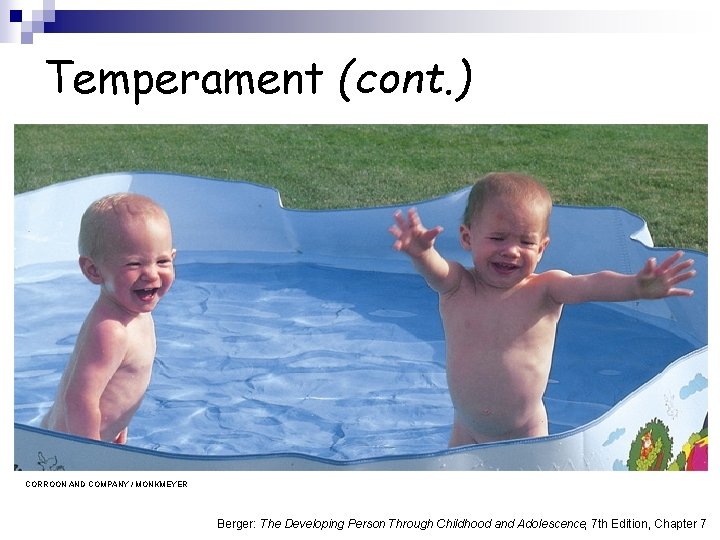
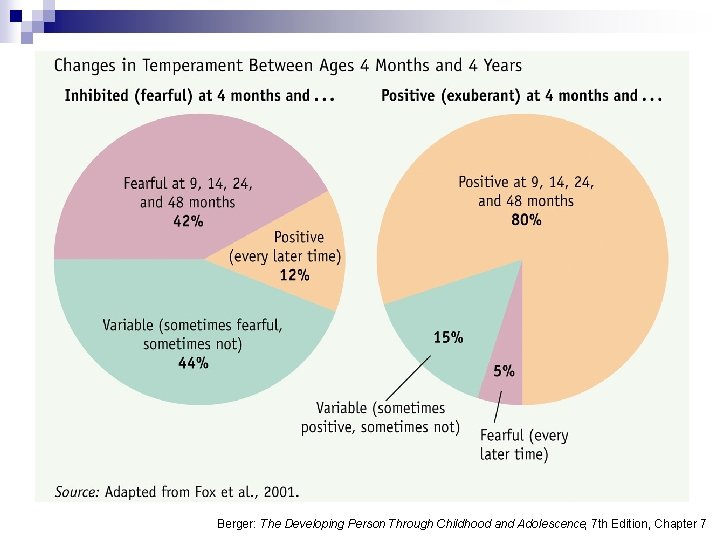
Temperament: An Example Of Epigenetic Theory n Temperamental traits originate in one’s genes, but are influenced by experience. n Examples: Infants differ in their reactions to new situations (fearful or bold); some infants cry easily, others seem “born tough”. Berger: The Developing Person Through Childhood and Adolescence, 7 th Edition, Chapter 7
Temperament (cont. ) CORROON AND COMPANY / MONKMEYER Berger: The Developing Person Through Childhood and Adolescence, 7 th Edition, Chapter 7
Measuring Temperament n The NYLS relied on parent reports and direct observations to categorize infants as: ¨ EASY (40%) ¨ SLOW TO WARM UP (15%) ¨ DIFFICULT (10%) ¨ HARD TO CLASSIFY (35%) Berger: The Developing Person Through Childhood and Adolescence, 7 th Edition, Chapter 7
Temperament and Caregiving n It is important to appreciate each child’s unique temperament. n Goodness of fit: the match between the child’s temperament and the environment ¨ This is especially important for a child with a difficult temperament Berger: The Developing Person Through Childhood and Adolescence, 7 th Edition, Chapter 7
Berger: The Developing Person Through Childhood and Adolescence, 7 th Edition, Chapter 7
Sociocultural Theory n Sociocultural theory places a strong emphasis on the role of the entire social context on infant development. n Ethnotheory states that child-rearing practices (e. g. , co-sleeping or not) are embedded within each culture or ethnic group. Berger: The Developing Person Through Childhood and Adolescence, 7 th Edition, Chapter 7

Make it Real: Ethnotheory n The text describes the reaction of Mayan parents to their 18 -month-old son’s refusal to wear pants; this is contrasted to how Western parents might react. n After reading the passage, think about your own reaction. How much are your thoughts influenced by your culture? Berger: The Developing Person Through Childhood and Adolescence, 7 th Edition, Chapter 7
Proximal and Distal Parenting n A study of West African and Greek parents found differences in infant-caregiver play. n West African mothers were more likely to use proximal parenting (keeping the infant physically near), whereas Greek parents used distal parenting (physically distant). Berger: The Developing Person Through Childhood and Adolescence, 7 th Edition, Chapter 7
Proximal and Distal Parenting (cont). n The researchers found that proximal parenting at 3 months predicted more compliant behavior at 1½ yrs; whereas distal parenting predicted greater selfrecognition (a sign of independence). Berger: The Developing Person Through Childhood and Adolescence, 7 th Edition, Chapter 7
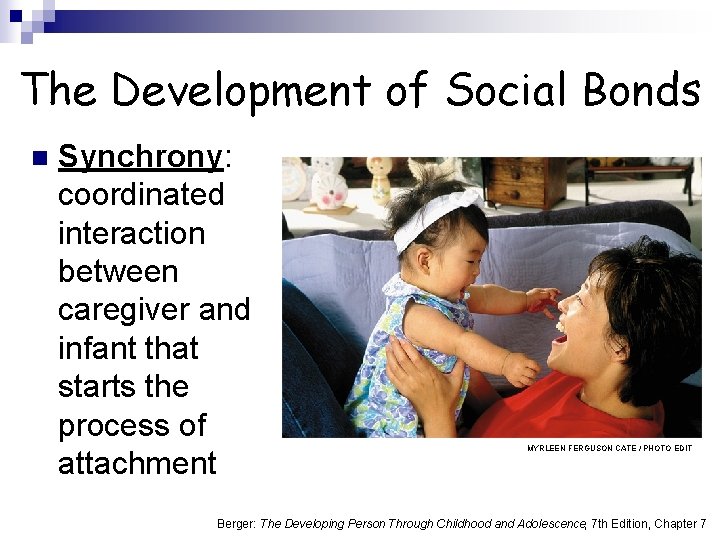
The Development of Social Bonds n Synchrony: coordinated interaction between caregiver and infant that starts the process of attachment MYRLEEN FERGUSON CATE / PHOTO EDIT Berger: The Developing Person Through Childhood and Adolescence, 7 th Edition, Chapter 7
Early Emotional Responses n Interactions between caregiver and infant are crucial for emotional development (i. e. , synchrony). n Still face technique = studying synchrony by assessing infant’s reaction when caregiver halts synchronous behavior…(infants don’t like it!). Berger: The Developing Person Through Childhood and Adolescence, 7 th Edition, Chapter 7
Attachment n Attachment is a close emotional bond between infant and caregiver(s) that develops gradually over the first year of life. Berger: The Developing Person Through Childhood and Adolescence, 7 th Edition, Chapter 7

Signs of Attachment n It is easy to know if a parent is attached to an infant (they pull out the wallet full of pictures, talk lovingly about the infant, etc. ). n But how do we know how the infant feels about the parent? Berger: The Developing Person Through Childhood and Adolescence, 7 th Edition, Chapter 7
Signs of Attachment n Infants show their desire to be with a caregiver through: n contact-maintaining behaviors (e. g. , smile, hold on to person), and n proximity-seeking behaviors (e. g. , crawl toward person). Berger: The Developing Person Through Childhood and Adolescence, 7 th Edition, Chapter 7
Measuring Attachment n Mary Ainsworth measured attachment through the “Strange Situation” ¨ Performed when infant is around 1 year old ¨ Results have correlated with child outcomes later in life Berger: The Developing Person Through Childhood and Adolescence, 7 th Edition, Chapter 7
Measuring Attachment n Strange Situation is a laboratory procedure assessing: ¨ Exploration of the toys ¨ Reaction to caregiver’s departure ¨ Reaction to caregiver’s return Berger: The Developing Person Through Childhood and Adolescence, 7 th Edition, Chapter 7
Berger: The Developing Person Through Childhood and Adolescence, 7 th Edition, Chapter 7
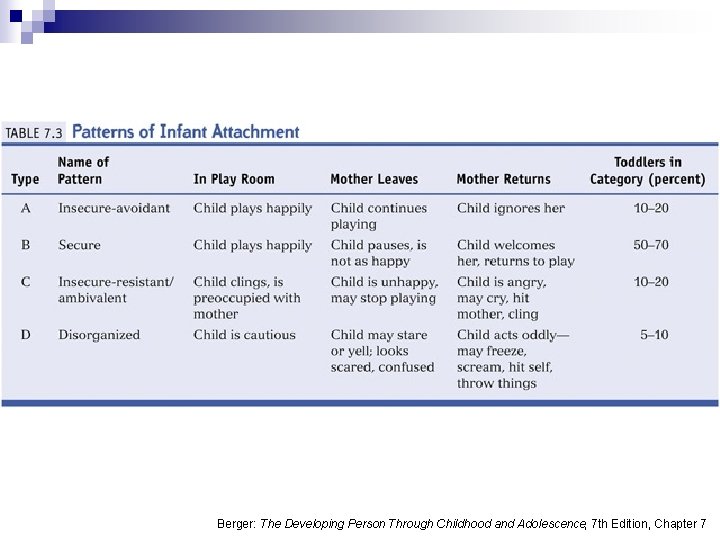
Categories of Attachment n Secure Attachment = ¨ Yes, explore toys ¨ May cry upon caregiver leaving ¨ Happy to see caregiver return n Long-term outcomes are positive (e. g. , good social skills, well-liked, happy kids) Berger: The Developing Person Through Childhood and Adolescence, 7 th Edition, Chapter 7
Categories of Attachment n Insecure-Resistant Attachment: ¨ Little to no exploration of toys ¨ Cry when caregiver leaves ¨ Remains upset (cry/anger) upon caregiver’s return n Long-term outcomes include dependence (especially for girls) or aggression (especially for boys) Berger: The Developing Person Through Childhood and Adolescence, 7 th Edition, Chapter 7
Categories of Attachment n Insecure Avoidant Attachment ¨ Yes, explores the toys ¨ Doesn’t cry when caregiver turns ¨ Avoids or ignores caregiver upon return Berger: The Developing Person Through Childhood and Adolescence, 7 th Edition, Chapter 7

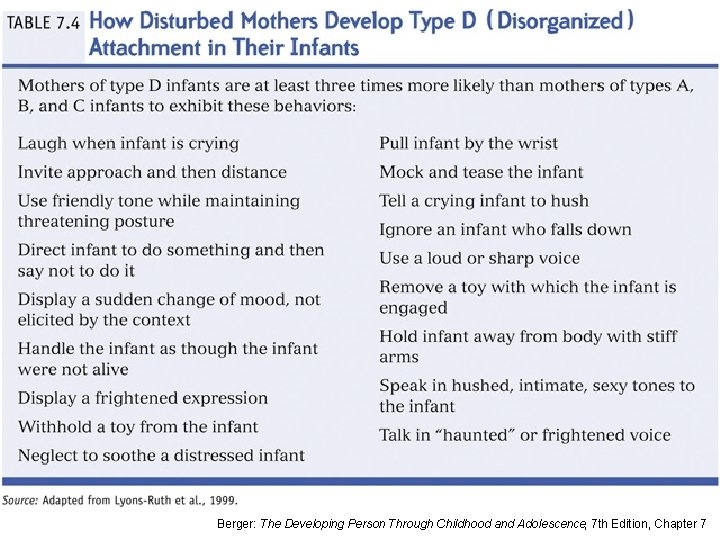
Attachment Categories n Disorganized Attachment ¨ Infant demonstrates bizarre, inconsistent behavior toward the parent ¨ Infants in this category may have been abused or neglected ¨ Outcomes for them are often negative Berger: The Developing Person Through Childhood and Adolescence, 7 th Edition, Chapter 7
Berger: The Developing Person Through Childhood and Adolescence, 7 th Edition, Chapter 7
Secure Attachment is Likely When: n The parent is: ¨ sensitive to child’s needs ¨ responsive to signals ¨ engages in infant-caregiver play ¨ not overly stressed n And when the infant is “easy” Berger: The Developing Person Through Childhood and Adolescence, 7 th Edition, Chapter 7
Attachment Over Time n An infant can change attachment status over time, especially if the social setting changes. ¨ Examples: n divorce, abuse, remarriage Overall, secure attachment in infancy is associated with positive outcomes later in life. Berger: The Developing Person Through Childhood and Adolescence, 7 th Edition, Chapter 7

Make it Real: Attachment n Think of someone you know who has difficulty in relationships (could be you). How might early attachment experiences influenced his or her ability to form connections with others? Berger: The Developing Person Through Childhood and Adolescence, 7 th Edition, Chapter 7
Social Referencing n Looking to others for cues for how to feel, especially in a new situation ¨ Example: If a caregiver shows fear of a situation, the infant likely will too! n This shows that emotions can be learned Berger: The Developing Person Through Childhood and Adolescence, 7 th Edition, Chapter 7
Referencing Mothers n A study by Kochanska (2001) found that in general, infants and toddlers obey their mother’s requests, especially if the mother was convincing in her tone and choice of words. n (Yes, toddlers do have the ability to obey!) Berger: The Developing Person Through Childhood and Adolescence, 7 th Edition, Chapter 7
Referencing Fathers n Fathers today spend considerable time with their children, and research is just beginning to document the importance of this relationship. Berger: The Developing Person Through Childhood and Adolescence, 7 th Edition, Chapter 7
Make it real: Referencing Fathers n In what ways do you think fathers interact with infants differently than mothers? Berger: The Developing Person Through Childhood and Adolescence, 7 th Edition, Chapter 7
Referencing Fathers (cont. ) n Fathers tend to: ¨ Be more encouraging of infant exploration ¨ Engage in more physical, noisy, emotional play ¨ Engage in teasing n Infants tend to: ¨ Comply with father’s commands more often Berger: The Developing Person Through Childhood and Adolescence, 7 th Edition, Chapter 7
Infant Day Care n As more infants spend time in nonparental care, the question of the effects of that care on child development continues to be debated. n The most comprehensive study to date is conducted by the NICHD Early Child Care Research Network Berger: The Developing Person Through Childhood and Adolescence, 7 th Edition, Chapter 7
Types of Infant Day Care n Family day care: children cared for in home of a paid caregiver n Center day care: several paid providers care for children n Our textbook author suggests that center care may be the best option, but even licensed centers vary in quality! Berger: The Developing Person Through Childhood and Adolescence, 7 th Edition, Chapter 7
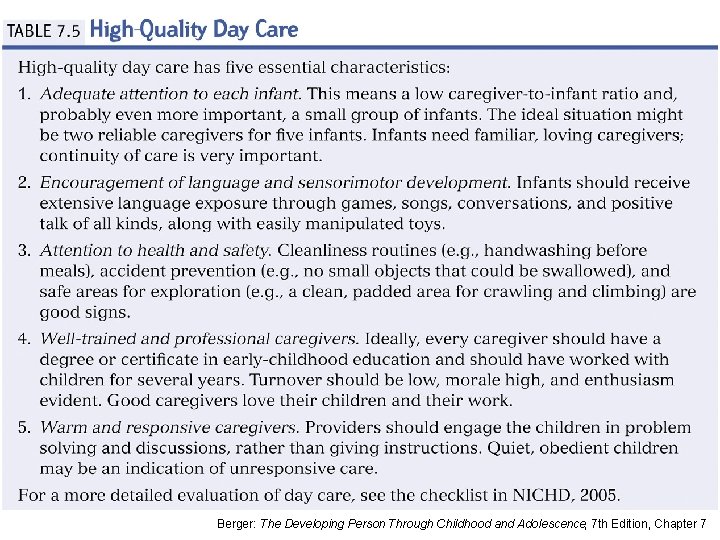
Berger: The Developing Person Through Childhood and Adolescence, 7 th Edition, Chapter 7
Some Results of the NICHD Study n Even 40 hours a week of infant child care had considerable less influence than the mother-infant relationship on child outcomes. n Secure attachment was just as likely among infants in center care as those raised at home. Berger: The Developing Person Through Childhood and Adolescence, 7 th Edition, Chapter 7
More Results n Quality of child care is important. n How time is spent when the infant is home is important as well. Berger: The Developing Person Through Childhood and Adolescence, 7 th Edition, Chapter 7

Infant Day Care…Who can afford it? n Infant day care is often more expensive than care for a toddler or preschooler. n Higher-income homes are more likely to use center care, due to the cost. n Some countries (not the U. S. ) have government funded care for all children. Berger: The Developing Person Through Childhood and Adolescence, 7 th Edition, Chapter 7
- Slides: 51