
The Developing Brain The human brain starts working

The Developing Brain The human brain starts working the moment you are born and never stops until you stand up to speak in public. George Jessel To exist is to change, to change is to mature, to mature is to go on creating oneself endlessly. Henri Bergson
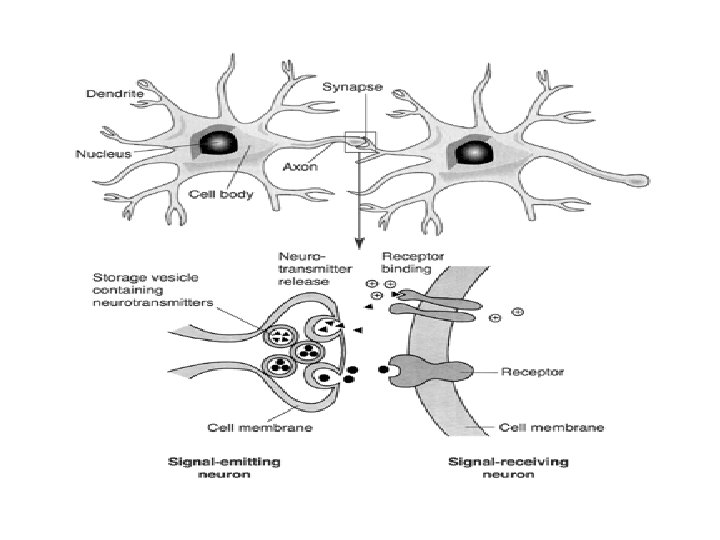
Neurons • Brain weighs about 3 pounds • 30 billion neurons • Each neuron receives about 5 thousand connections called synapses from other neurons • A neuron gets signals - usually as a burst of chemicals called neurotransmitters
Neurons • fires 5 -50 times a second • The brain is only 2% of body-weight; it uses 20 -25% of its oxygen and glucose.
Neurons • The number of possible combinations of 30 billion neurons: • 10 to the millionth power, 1 followed by a million zeros 101, 000 • The number of atoms in the universe is only 10 to the eightieth power 1080
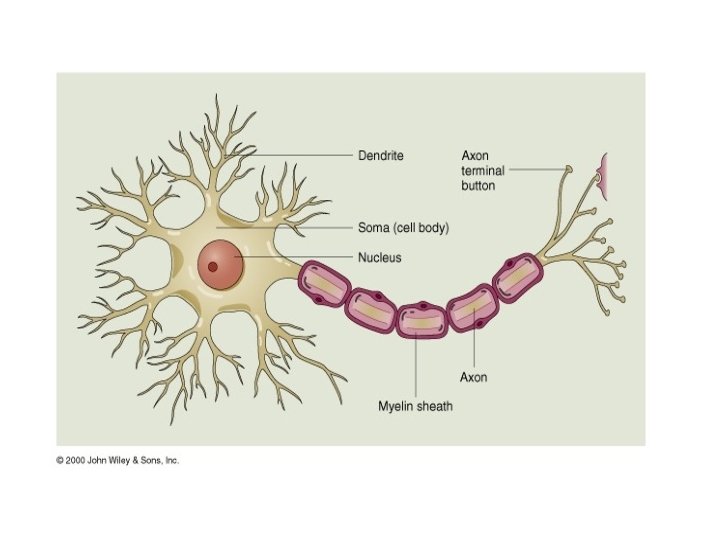
LTP – Long Term Potentiation • The more neural connections are used, “fire”, the more easily they “fire” the next time.
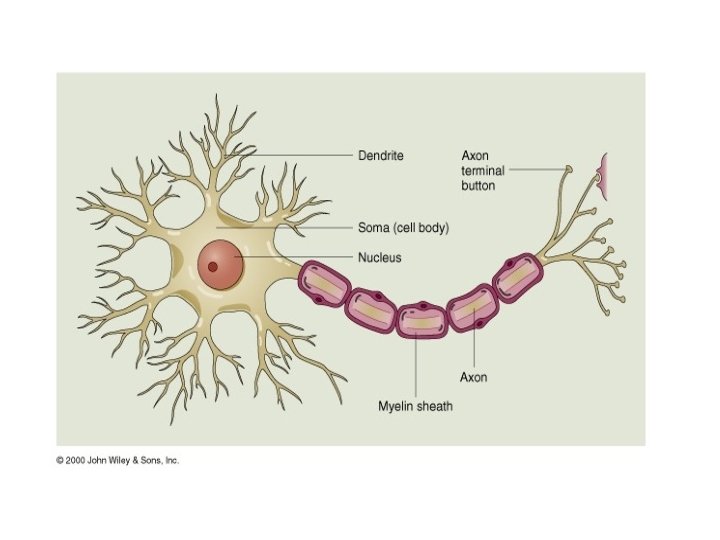
It Matters • Gray Matter = cell bodies of neurons and their dendrites • White Matter = axons and the glial cells that perform metabolic support functions
Pre-natal • first 8 weeks, every fetal brain is female • At 8 weeks, a testosterone surge turns a brain male by killing off some cells in communication centers and growing more cells in the sex and aggression centers. • Without this serge, the brain remains female, actually growing more cells in communication areas of the brain.
Newborn • Over the first three months of life • A baby girl’s skills in eye contact and mutual facial gazing will increase by over 400% • A boy during that time will not increase at all. • Not a need to be closer to her mother; it is a skill of a brain more mature at birth than a boy’s brain by one to two years.
Apoptosis • The culling of neurons, normal brain function, not an indication of decay
Newborn • The cortex is divided into two hemispheres connected by the Corpus Callosum • Weak in first years of life; hemispheres act more independently, become more coordinated as we mature…
Corpus Callosum • Right for bodily and emotional processing – Analyze multiple elements as in visual and imaginative processes – First 18 months, growth spurt as we establish attachments and begin to regulate emotions • Left for grammatical language – Linear and sequential – good for logic and language – Develops in second year enabling language development
Adolescent • Changes in environment and hormones • Frontal lobes (judgment) lags behind in development
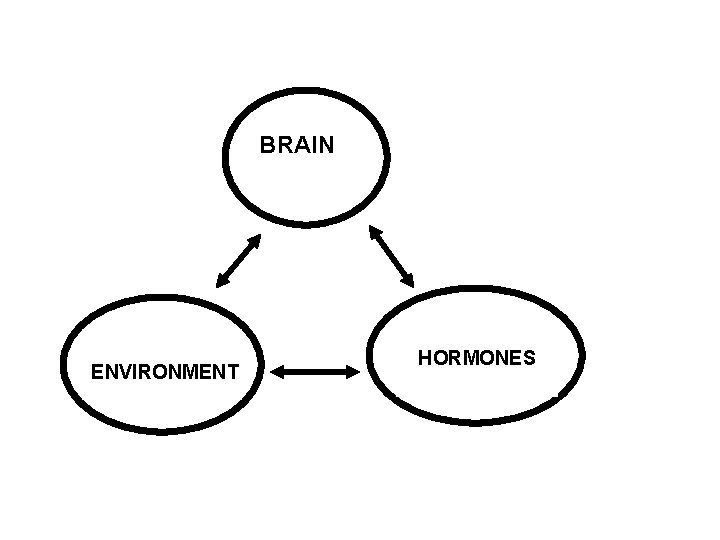
BRAIN ENVIRONMENT HORMONES
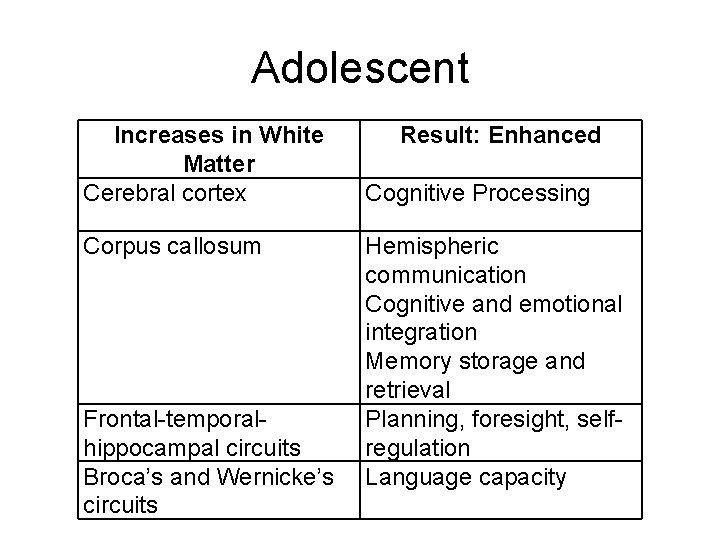
Adolescent Increases in White Matter Cerebral cortex Corpus callosum Frontal-temporalhippocampal circuits Broca’s and Wernicke’s circuits Result: Enhanced Cognitive Processing Hemispheric communication Cognitive and emotional integration Memory storage and retrieval Planning, foresight, selfregulation Language capacity
Apoptosis continues • The selection of functional and wellconnected neurons • The organization and shaping of neural networks • Enhanced processing efficiency
Adult Brain • More streamlined and efficient brain • Aided by more hormonal stability
Adult Brain • Apoptosis continues… • A normal aspect of brain maturation and is associated with increased functional abilities • While neurons may die, pathways and connections increase due to experience… • 40% of synapses eliminated from infancy to adulthood
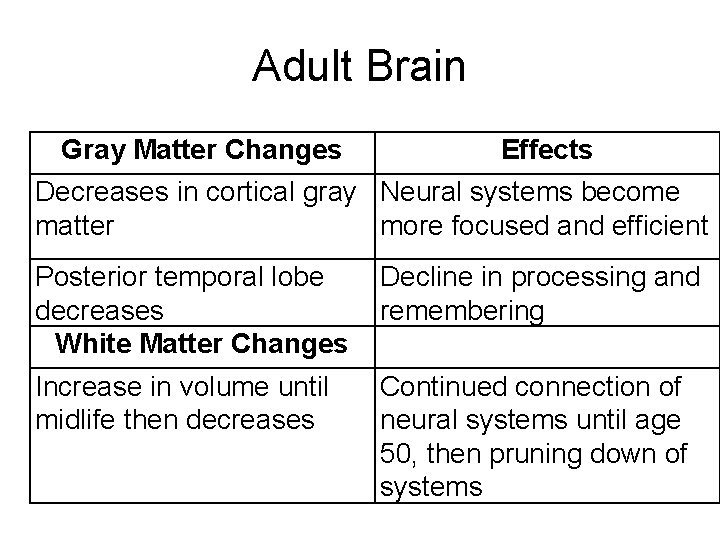
Adult Brain Gray Matter Changes Effects Decreases in cortical gray Neural systems become matter more focused and efficient Posterior temporal lobe decreases White Matter Changes Decline in processing and remembering Increase in volume until midlife then decreases Continued connection of neural systems until age 50, then pruning down of systems
Adult Brain • Varied declines in white and gray matter • Early 50’s before dendrites reach their greatest number and complexity • The brain is a constantly changing mass of activity…
Forms of Neuroplasticity • Strengthening connections between neurons through long term potentiation (LTP) • The growth of new dendrites (dendritogenesis) • New connections between neurons
Forms of Neuroplasticity • Growth of new neurons (neurogenesis) • Alterations of synaptic efficiency related to: – Neurotransmitter availability – Receptor density – Supportive glial cell availability
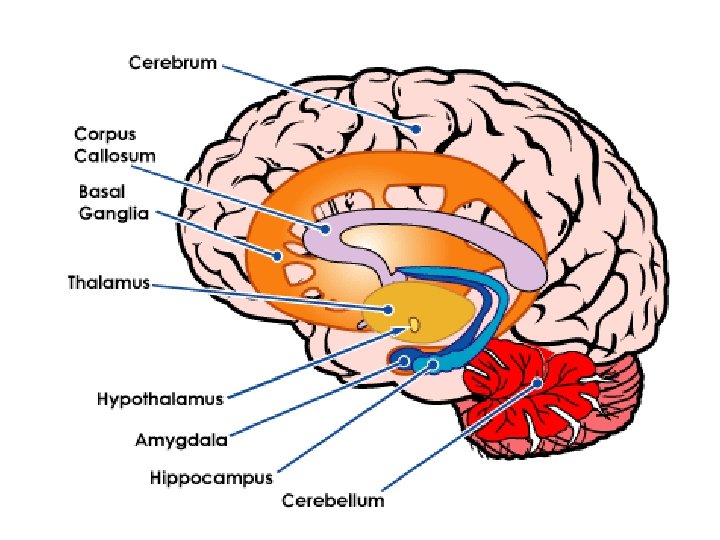
Limbic system • Hippocampus – forms new memories and detects threats (new neuron growth) • Amygdala – responds to emotionally charged stimuli • Hypothalamus – regulates primal drives, makes oxytocin, activates the pituitary gland
Limbic system • Pituitary gland – makes endorphins which buffer stress, provide soothing and reduce pain, triggers stress hormones, and stores and releases oxytocin • Thalamus – sends sensory information to parts of your brain
Oxytocin A neuromodulator that promotes nurturing, associated with closeness and love, reduces stress hormones and lowers blood pressure
As Adults Age • Experience less negative emotions • Pay less attention to negative than to positive emotional stimuli • Are less likely to remember negative that positive emotional materials
Corpus Callosum • Left Hemisphere: speech, language, mathematical and logical reasoning • Right Hemisphere: face recognition, visual -spatial comprehension, and artistic creativity
Bilateral Hemisphere Involvement • Young adults retrieve a specific word from memory, they usually use the left side of the brain • Older adults often use both sides to do the same • An impairment OR something positive more redundancy?
Bilateral Hemisphere Involvement • Measured brain activity of three groups: younger adults, low-performing older adults, and high-performing older adults – low-performing older adults used right prefrontal cortex regions similar to those used by the young adults – high-performing older adults used both hemispheres
Bilateral Hemisphere Involvement • All older adults used neural networks less efficiently, yet the high-performers counteracted this age-related neural decline by reorganizing their neural networks.
Key Neurochemicals • A hormone is a chemical released by a cell in one part of the body, that sends out messages that affect cells in other parts of the organism.
Key Neurochemicals Primary Neurotransmitters • Glutamate – excites receiving neurons • GABA – inhibits receiving neurons
Key Neurochemicals Neuromodulators: • Serotonin – regulates mood, sleep, and digestion • Dopamine – involves rewards, attention • Norepinephrine – alerts and arouses • Acetycholine – promotes wakefulness and learning • Endorphins – results in pleasurable sensations
Key Neurochemicals Other Neurochemicals: • Cortisol – released by the adrenal glands as a response to stress; stimulates the amygdale and inhibits the hippocampus • Estrogen – affects libido, mood, and memory, stimulates oxytocin
- Slides: 37