
The Detection of Driver Cognitive Distraction Using Data

- Slides: 17
The Detection of Driver Cognitive Distraction Using Data Mining Methods Presenter: Yulan Liang Department of Mechanical and Industrial Engineering The University of Iowa 1
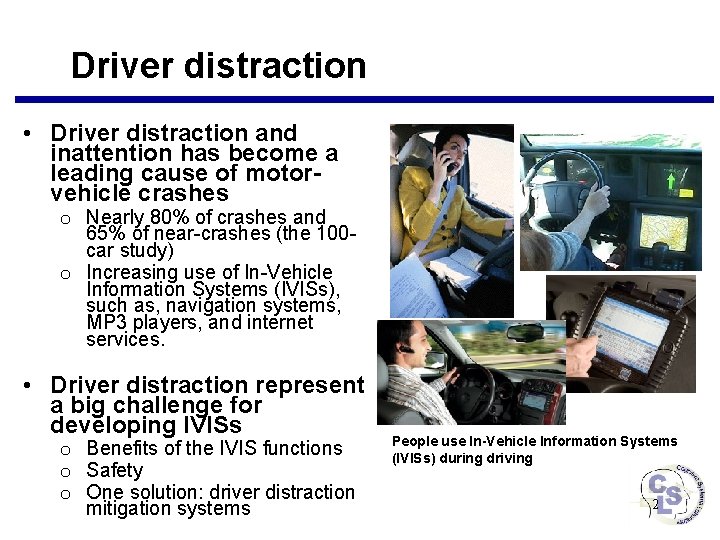
Driver distraction • Driver distraction and inattention has become a leading cause of motorvehicle crashes o Nearly 80% of crashes and 65% of near-crashes (the 100 car study) o Increasing use of In-Vehicle Information Systems (IVISs), such as, navigation systems, MP 3 players, and internet services. • Driver distraction represent a big challenge for developing IVISs o Benefits of the IVIS functions o Safety o One solution: driver distraction mitigation systems People use In-Vehicle Information Systems (IVISs) during driving 2
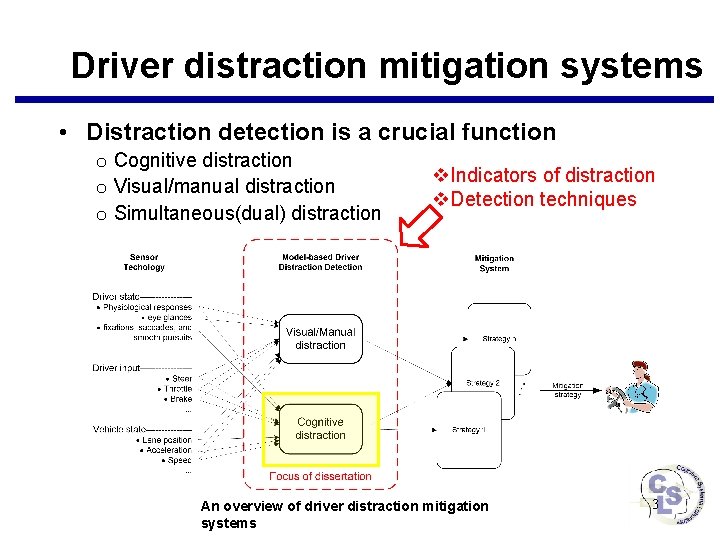
Driver distraction mitigation systems • Distraction detection is a crucial function o Cognitive distraction o Visual/manual distraction o Simultaneous(dual) distraction v. Indicators of distraction v. Detection techniques An overview of driver distraction mitigation systems 3
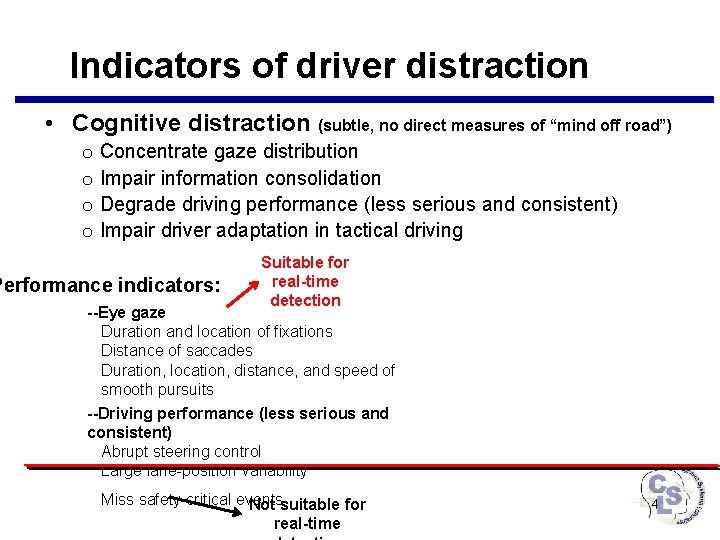
Indicators of driver distraction • Cognitive distraction (subtle, no direct measures of “mind off road”) o Concentrate gaze distribution o Impair information consolidation o Degrade driving performance (less serious and consistent) o Impair driver adaptation in tactical driving Performance indicators: Suitable for real-time detection --Eye gaze Duration and location of fixations Distance of saccades Duration, location, distance, and speed of smooth pursuits --Driving performance (less serious and consistent) Abrupt steering control Large lane-position variability Miss safety-critical events Not suitable for real-time 4
Detection algorithm for driver distraction • Driving is complex and continuous human behavior • Data mining approaches are suitable to detect driver distraction o Insufficient knowledge impedes using theories to detect distraction precisely o Data mining techniques can detect non-linear and time-dependent relationships o Linear regression, decision tree, Support Vector Machines (SVMs), and Bayesian Networks (BNs) have been used to identify various distractions Support Vector Machines (SVMs) Bayesian Networks (BNs) 5
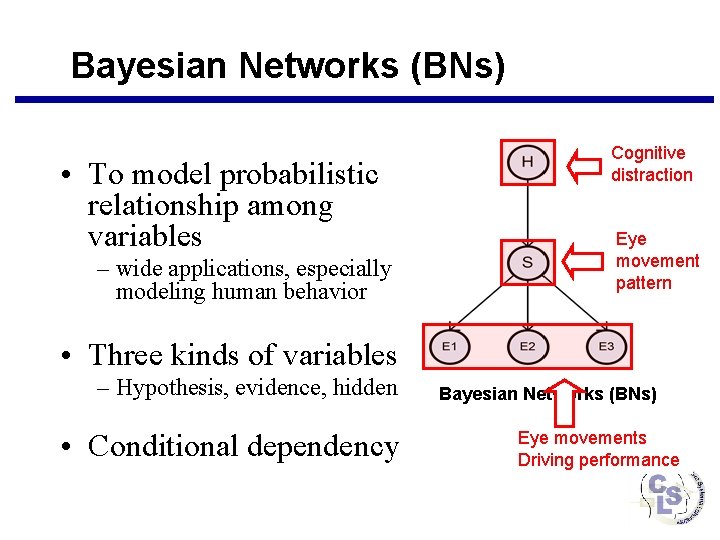
Bayesian Networks (BNs) • To model probabilistic relationship among variables – wide applications, especially modeling human behavior Cognitive distraction Eye movement pattern • Three kinds of variables – Hypothesis, evidence, hidden • Conditional dependency Bayesian Networks (BNs) Eye movements Driving performance
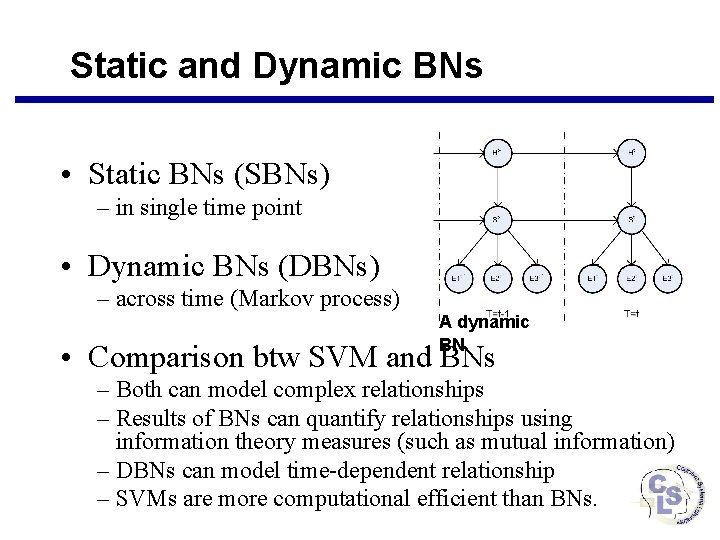
Static and Dynamic BNs • Static BNs (SBNs) – in single time point • Dynamic BNs (DBNs) – across time (Markov process) A dynamic BN • Comparison btw SVM and BNs – Both can model complex relationships – Results of BNs can quantify relationships using information theory measures (such as mutual information) – DBNs can model time-dependent relationship – SVMs are more computational efficient than BNs.
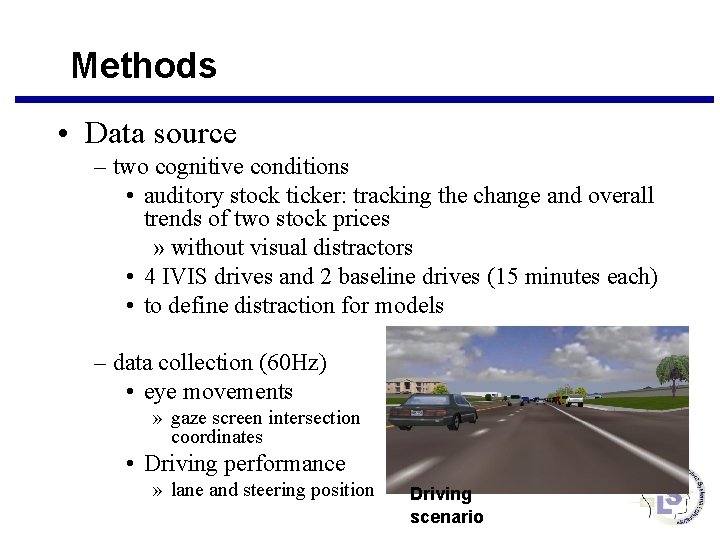
Methods • Data source – two cognitive conditions • auditory stock ticker: tracking the change and overall trends of two stock prices » without visual distractors • 4 IVIS drives and 2 baseline drives (15 minutes each) • to define distraction for models – data collection (60 Hz) • eye movements » gaze screen intersection coordinates • Driving performance » lane and steering position Driving scenario
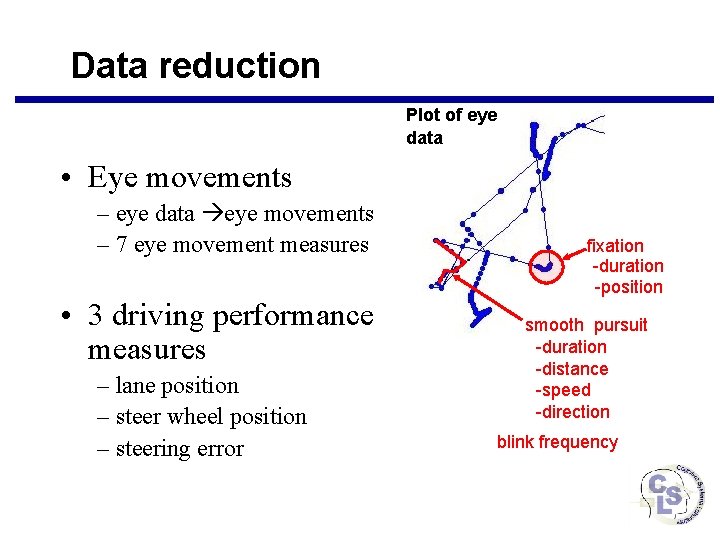
Data reduction Plot of eye data • Eye movements – eye data eye movements – 7 eye movement measures • 3 driving performance measures – lane position – steer wheel position – steering error fixation -duration -position smooth pursuit -duration -distance -speed -direction blink frequency
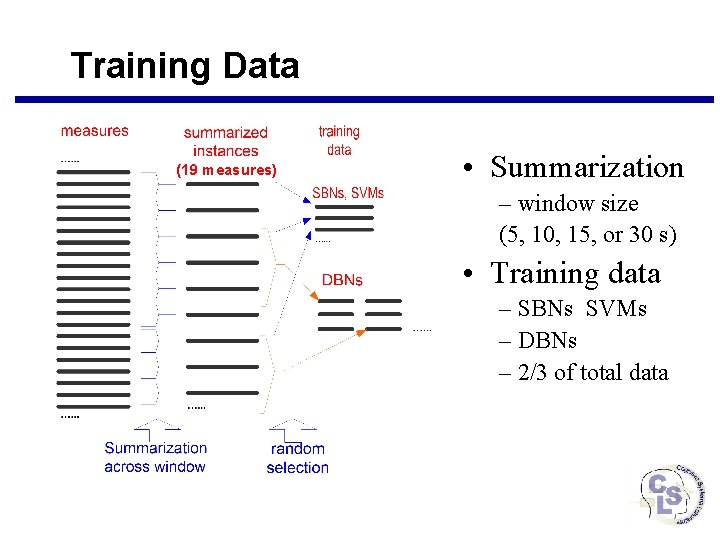
Training Data (19 measures) • Summarization – window size (5, 10, 15, or 30 s) • Training data – SBNs SVMs – DBNs – 2/3 of total data
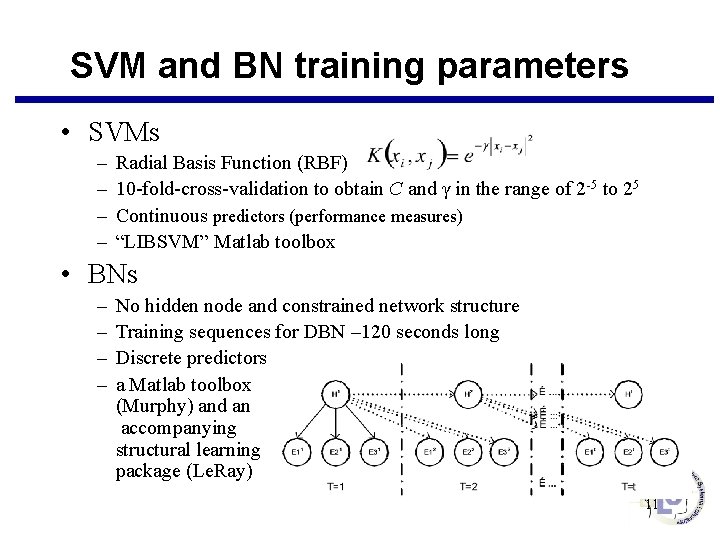
SVM and BN training parameters • SVMs – – Radial Basis Function (RBF) 10 -fold-cross-validation to obtain C and γ in the range of 2 -5 to 25 Continuous predictors (performance measures) “LIBSVM” Matlab toolbox • BNs – – No hidden node and constrained network structure Training sequences for DBN – 120 seconds long Discrete predictors a Matlab toolbox (Murphy) and an accompanying structural learning package (Le. Ray) 11
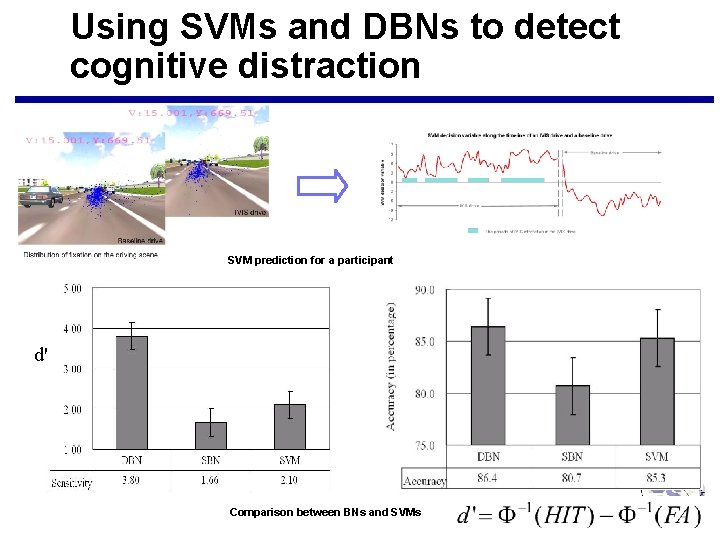
Using SVMs and DBNs to detect cognitive distraction SVM prediction for a participant d' Comparison between BNs and SVMs 12
• Changes in drivers’ eye movements and driving performance over time are important predictors of cognitive distraction. • SVMs have some advantages over SBNs – Parameter selection: 10 -fold across-validation – Computational ease: training time • Improving algorithm – Consider time-dependent relationship in behavior – Reduce computational load 13
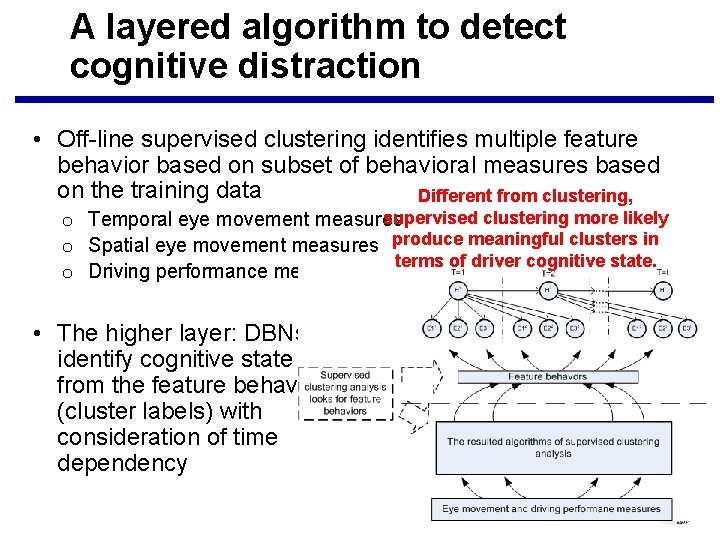
A layered algorithm to detect cognitive distraction • Off-line supervised clustering identifies multiple feature behavior based on subset of behavioral measures based on the training data Different from clustering, supervised clustering more likely o Temporal eye movement measures o Spatial eye movement measures produce meaningful clusters in terms of driver cognitive state. o Driving performance measures • The higher layer: DBNs identify cognitive state from the feature behavior (cluster labels) with consideration of time dependency 14
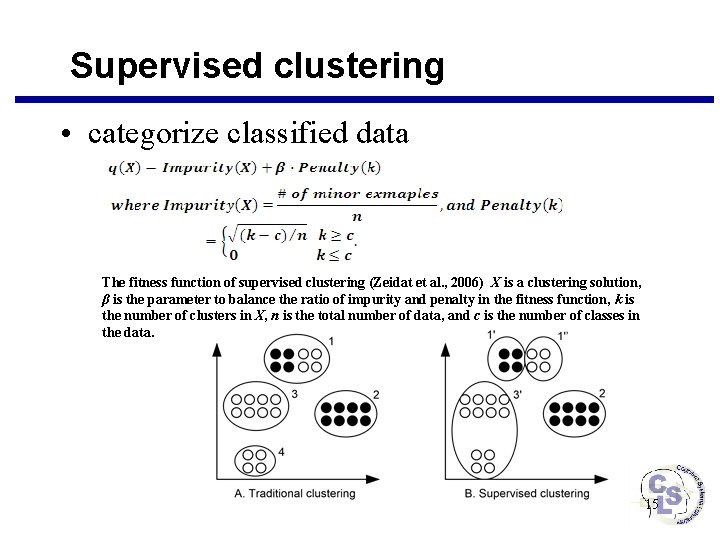
Supervised clustering • categorize classified data The fitness function of supervised clustering (Zeidat et al. , 2006) X is a clustering solution, β is the parameter to balance the ratio of impurity and penalty in the fitness function, k is the number of clusters in X, n is the total number of data, and c is the number of classes in the data. 15
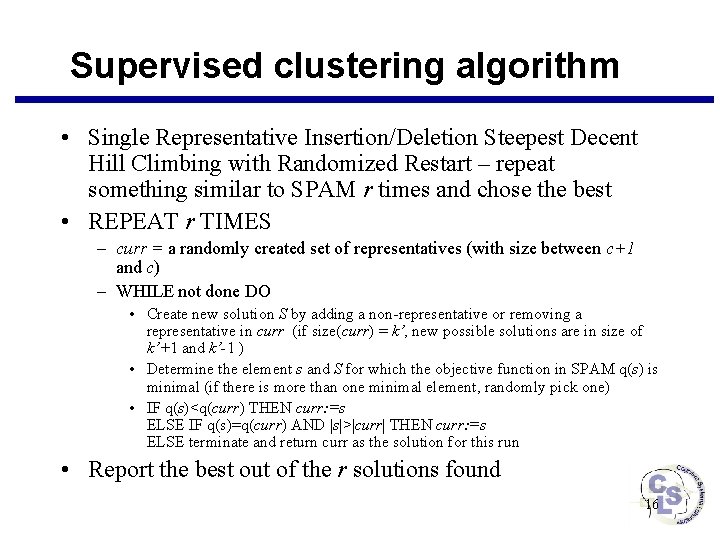
Supervised clustering algorithm • Single Representative Insertion/Deletion Steepest Decent Hill Climbing with Randomized Restart – repeat something similar to SPAM r times and chose the best • REPEAT r TIMES – curr = a randomly created set of representatives (with size between c+1 and c) – WHILE not done DO • Create new solution S by adding a non-representative or removing a representative in curr (if size(curr) = k’, new possible solutions are in size of k’+1 and k’-1 ) • Determine the element s and S for which the objective function in SPAM q(s) is minimal (if there is more than one minimal element, randomly pick one) • IF q(s)<q(curr) THEN curr: =s ELSE IF q(s)=q(curr) AND |s|>|curr| THEN curr: =s ELSE terminate and return curr as the solution for this run • Report the best out of the r solutions found 16
Thank you !! Questions ? ? 17