
The Design Process What Is Design What Is
- Slides: 24
The Design Process • What Is Design? • What Is a Design Process? • Design Process Examples © 2012 Project Lead The Way, Inc.
What Is Design? The word “design” is often used as a generic term that refers to anything that was made by a conscious human effort. Design is also a process that is used to systematically solve problems. © 2012 Project Lead The Way, Inc.
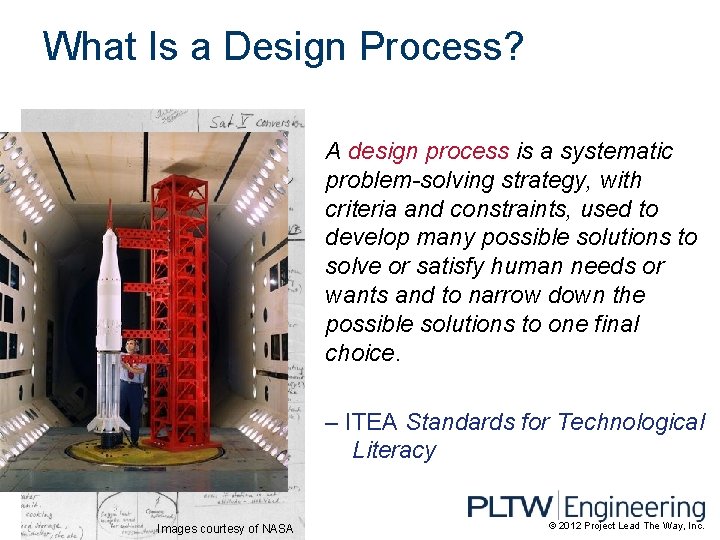
What Is a Design Process? A design process is a systematic problem-solving strategy, with criteria and constraints, used to develop many possible solutions to solve or satisfy human needs or wants and to narrow down the possible solutions to one final choice. – ITEA Standards for Technological Literacy Images courtesy of NASA © 2012 Project Lead The Way, Inc.
Design Process Various design processes are used across different technical fields. The following are examples. © 2012 Project Lead The Way, Inc.
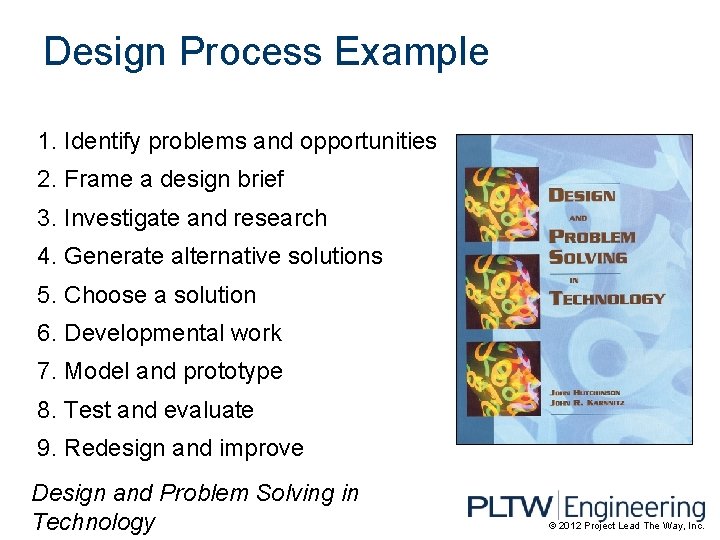
Design Process Example 1. Identify problems and opportunities 2. Frame a design brief 3. Investigate and research 4. Generate alternative solutions 5. Choose a solution 6. Developmental work 7. Model and prototype 8. Test and evaluate 9. Redesign and improve Design and Problem Solving in Technology © 2012 Project Lead The Way, Inc.
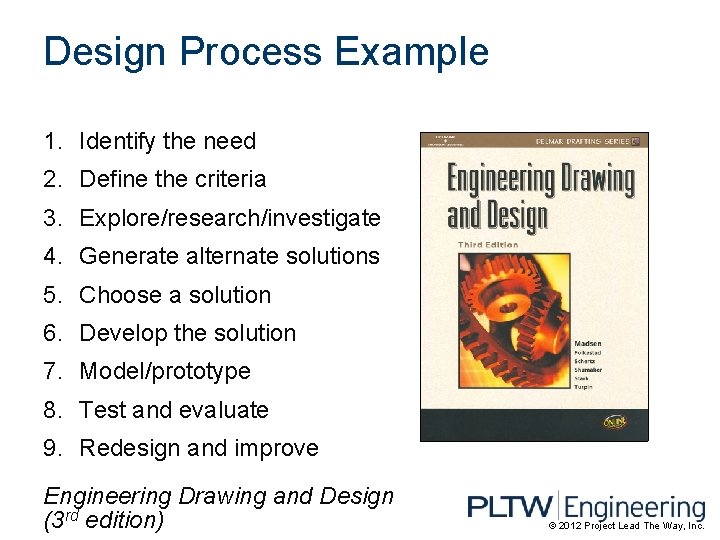
Design Process Example 1. Identify the need 2. Define the criteria 3. Explore/research/investigate 4. Generate alternate solutions 5. Choose a solution 6. Develop the solution 7. Model/prototype 8. Test and evaluate 9. Redesign and improve Engineering Drawing and Design (3 rd edition) © 2012 Project Lead The Way, Inc.
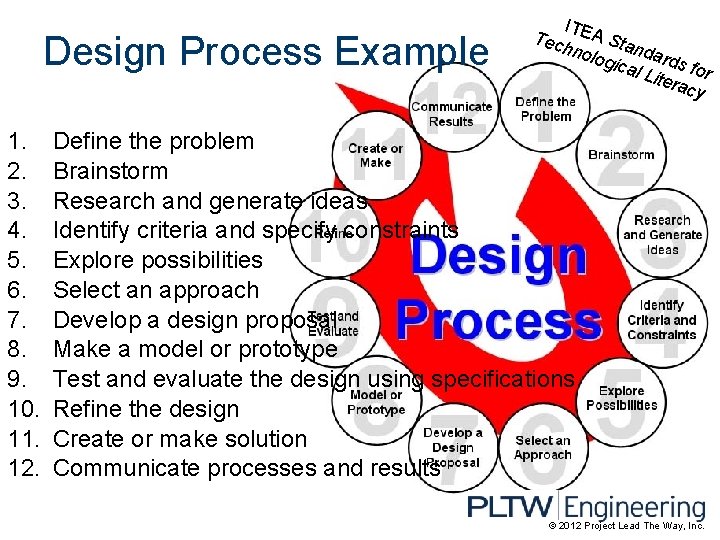
Design Process Example 1. 2. 3. 4. 5. 6. 7. 8. 9. 10. 11. 12. ITEA hno Standa logic r al L ds for itera cy Tec Define the problem Brainstorm Research and generate ideas Identify criteria and specify constraints Explore possibilities Select an approach Develop a design proposal Make a model or prototype Test and evaluate the design using specifications Refine the design Create or make solution Communicate processes and results © 2012 Project Lead The Way, Inc.
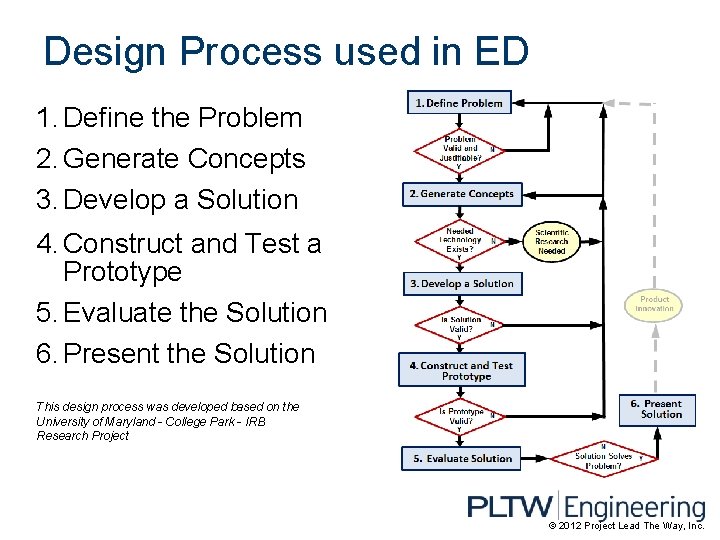
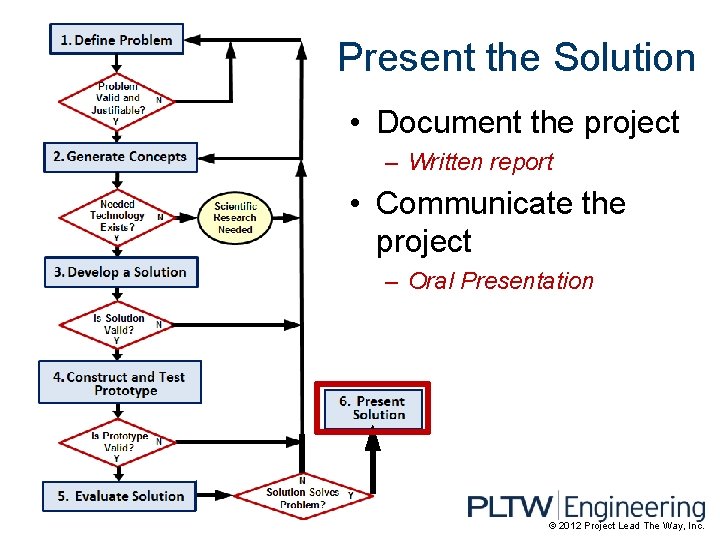
Design Process used in ED 1. Define the Problem 2. Generate Concepts 3. Develop a Solution 4. Construct and Test a Prototype 5. Evaluate the Solution 6. Present the Solution This design process was developed based on the University of Maryland - College Park - IRB Research Project © 2012 Project Lead The Way, Inc.
Design Process • Design process used in ED is an example of one design process • Many design processes exist and are effective • Consistently applying a single clearly defined design process provides a basis for understanding © 2012 Project Lead The Way, Inc.
Define the Problem • Identify a problem • Validate the problem – Who says it is a problem? – Needs and wants – Prior solutions • Justify the problem – Is the problem worth solving? • Create design requirements (specifications) – Criteria and constraints © 2012 Project Lead The Way, Inc.
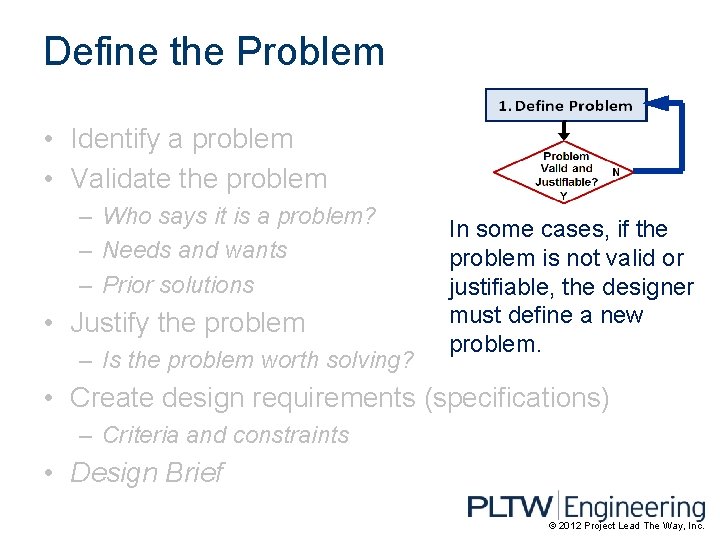
Define the Problem • Identify a problem • Validate the problem – Who says it is a problem? – Needs and wants – Prior solutions • Justify the problem – Is the problem worth solving? In some cases, if the problem is not valid or justifiable, the designer must define a new problem. • Create design requirements (specifications) – Criteria and constraints • Design Brief © 2012 Project Lead The Way, Inc.
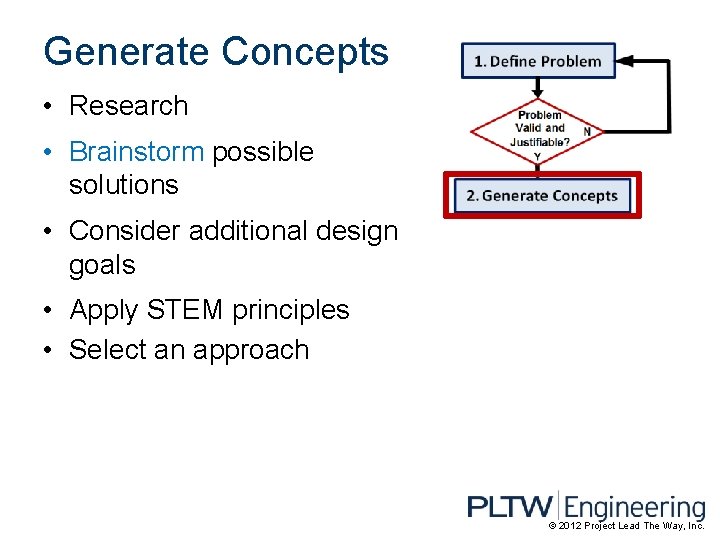
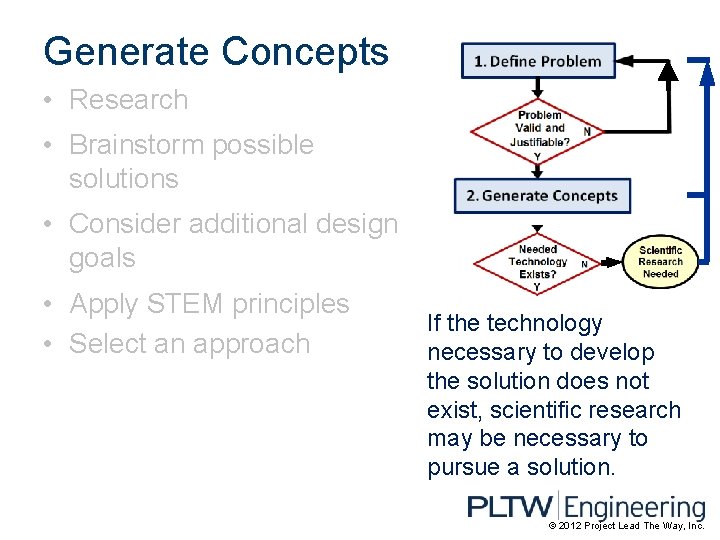
Generate Concepts • Research • Brainstorm possible solutions • Consider additional design goals • Apply STEM principles • Select an approach © 2012 Project Lead The Way, Inc.
Generate Concepts • Research • Brainstorm possible solutions • Consider additional design goals • Apply STEM principles • Select an approach If the technology necessary to develop the solution does not exist, scientific research may be necessary to pursue a solution. © 2012 Project Lead The Way, Inc.
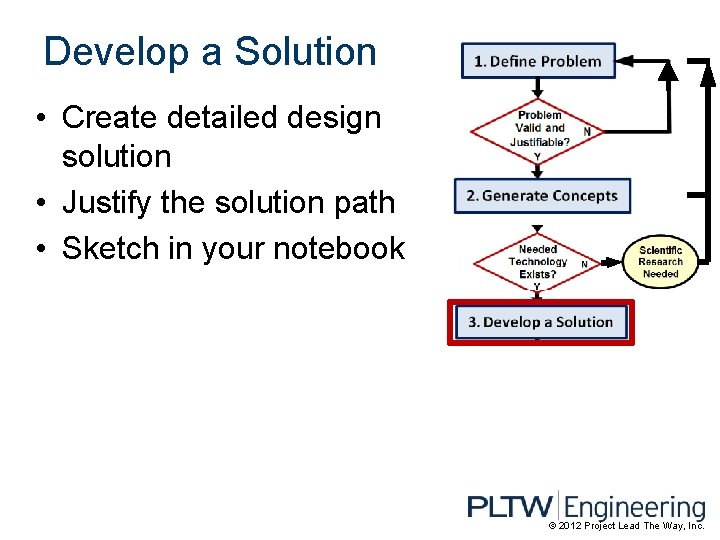
Develop a Solution • Create detailed design solution • Justify the solution path • Sketch in your notebook © 2012 Project Lead The Way, Inc.
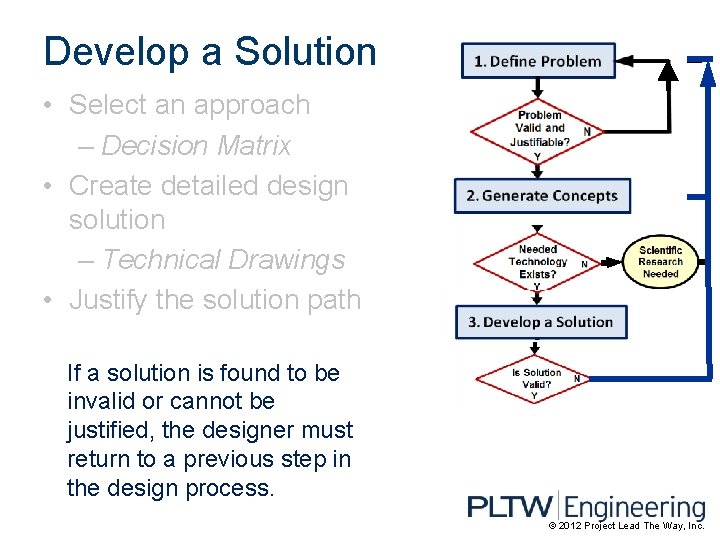
Develop a Solution • Select an approach – Decision Matrix • Create detailed design solution – Technical Drawings • Justify the solution path If a solution is found to be invalid or cannot be justified, the designer must return to a previous step in the design process. © 2012 Project Lead The Way, Inc.
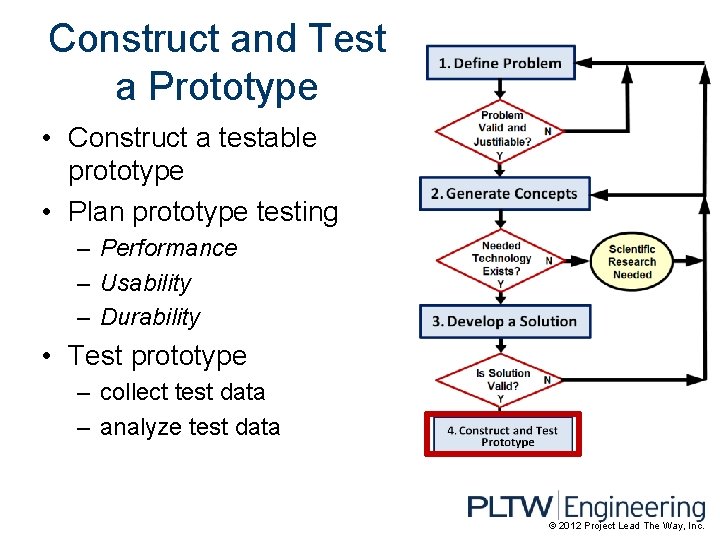
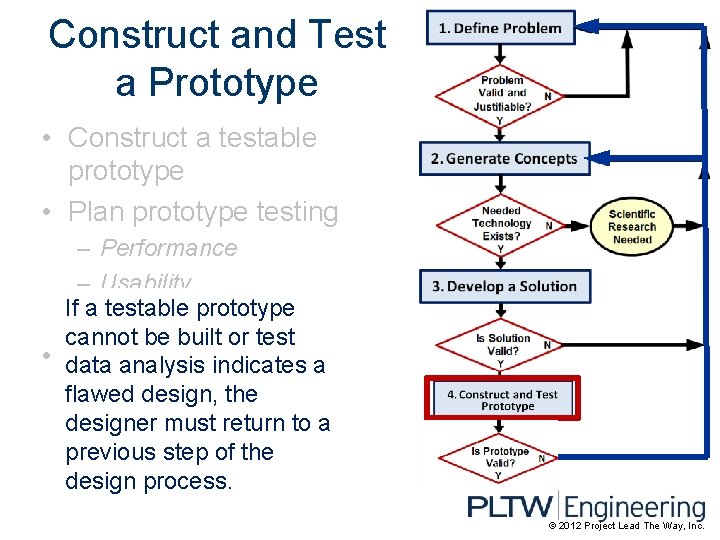
Construct and Test a Prototype • Construct a testable prototype • Plan prototype testing – Performance – Usability – Durability • Test prototype – collect test data – analyze test data © 2012 Project Lead The Way, Inc.
Construct and Test a Prototype • Construct a testable prototype • Plan prototype testing – Performance – Usability If–a Durability testable prototype cannot be built or test • data Testanalysis prototype indicates a – collect test data flawed design, the designer must – analyze testreturn data to a previous step of the design process. © 2012 Project Lead The Way, Inc.
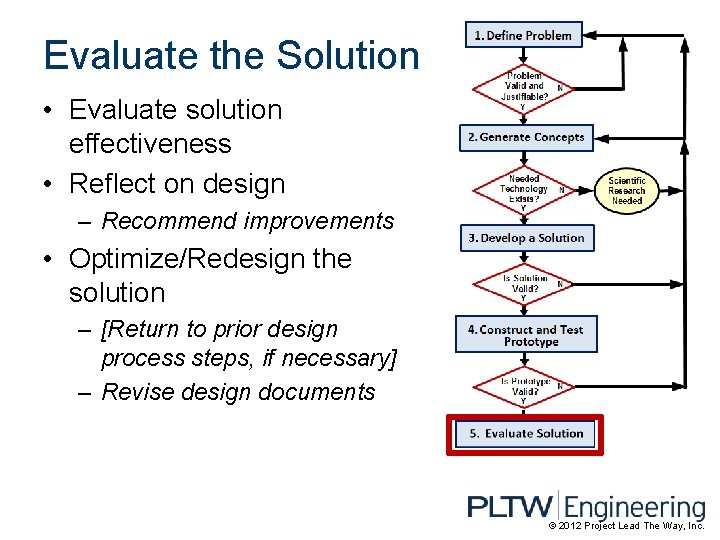
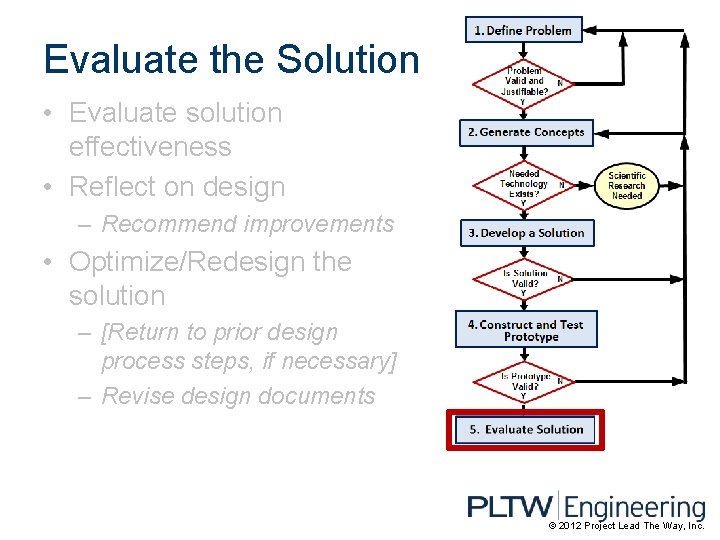
Evaluate the Solution • Evaluate solution effectiveness • Reflect on design – Recommend improvements • Optimize/Redesign the solution – [Return to prior design process steps, if necessary] – Revise design documents © 2012 Project Lead The Way, Inc.
Evaluate the Solution • Evaluate solution effectiveness • Reflect on design – Recommend improvements • Optimize/Redesign the solution – [Return to prior design process steps, if necessary] – Revise design documents © 2012 Project Lead The Way, Inc.
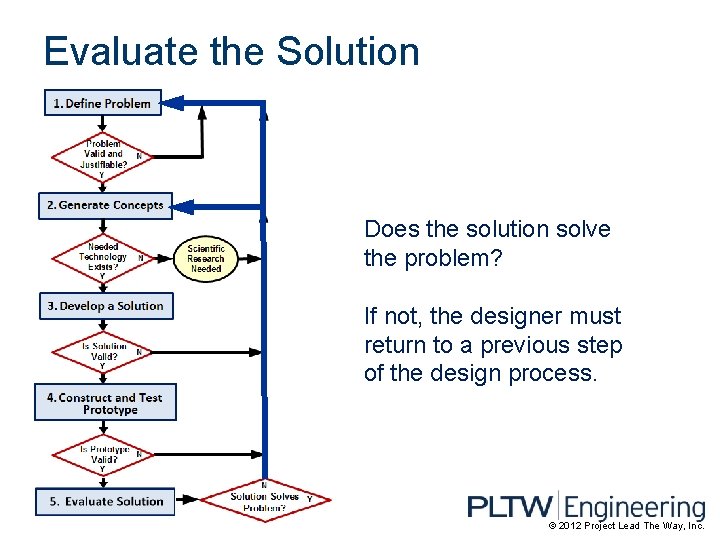
Evaluate the Solution Does the solution solve the problem? If not, the designer must return to a previous step of the design process. © 2012 Project Lead The Way, Inc.
Present the Solution • Document the project – Written report • Communicate the project – Oral Presentation © 2012 Project Lead The Way, Inc.
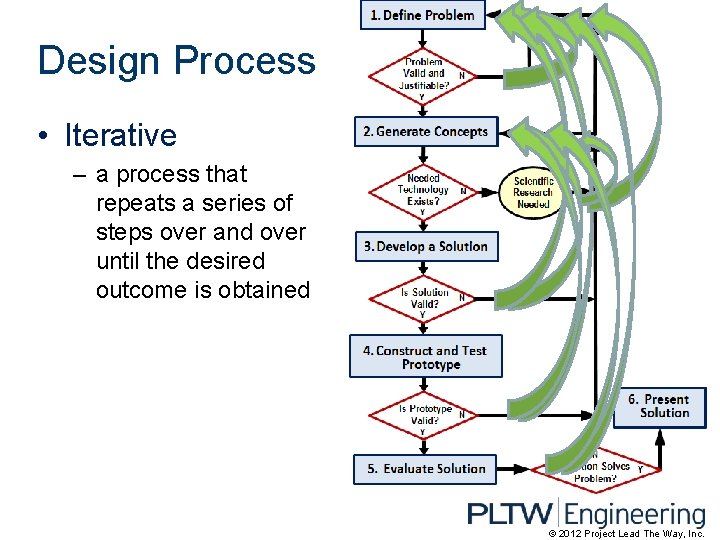
Design Process • Iterative – a process that repeats a series of steps over and over until the desired outcome is obtained © 2012 Project Lead The Way, Inc.
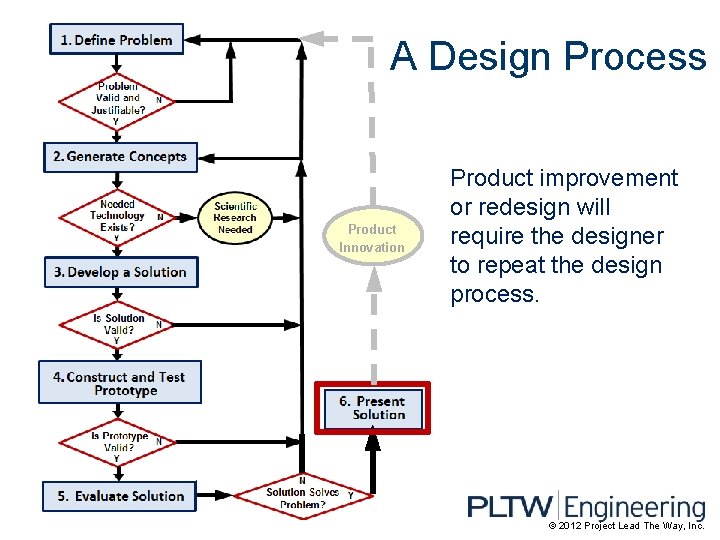
A Design Process Product Innovation Product improvement or redesign will require the designer to repeat the design process. © 2012 Project Lead The Way, Inc.
Image Resources National Aeronautics and Space Administration (NASA). (n. d. ). NASA image exchange. Retrieved from http: //nix. nasa. gov/. © 2012 Project Lead The Way, Inc.