
THE DESIGN HISTORY READER IN LONDONS MAZE THE
- Slides: 7
THE DESIGN HISTORY READER ‘IN LONDON’S MAZE’: THE PLEASURES OF FASHIONABLE CONSUMPTION, FROM THE HIDDEN CONSUMER Christopher Breward (1999)
THE PLAYGROUND OF THE CITY LIFE: CLOTHING AND THE CONVIVIALITY OF BACHELORDOM ❑ In the piece it talks about a man (‘a master’) with an assistant who helps the man dress. He has full control of his masters attire. Upper Class- It is suggested that he is the 'finished product of civilisation' because he is‘ He is booted, hatted and gloved’. ‘Cigarette case is made from enameled gold with an S inlaid in diamonds. ’ ‘ Hand picks his flower for his button hole’. ❑ The piece highlights his countless selection of canes, cravates and pins in which only the uper class could afford. ❑ Lynn Hapgood reiterates this by suggesting that' the upper class in particular is portrayed as all surface since its concerns are with life as art, in a deliberate evasion of reality. ' ❑ There is a debate of masculinity as the men take care of their appearance. ‘ the problems city life gave to understanding male desire C. 1880 + 1914’ ❑ Popular novels, tourist guides, journalistic accounts and adverts – both real and imaginary gave an ideal dandy (A man who places particular importance upon his physical appearance) ❑ Senton (Master from the piece) was seen as a perfect example of masculinity and greediness pf acquiring money or material things
❑Richard Dellamora writes about how male politicians have been blind the significance of homosexual scandal in 1890’s. He sees other historians as trying to protect the masculinity at the time. ❑ Dellamora repositions the dandy (male) to be at the centre of interactions. He ignores the day to day commercial significance of his type. ❑ ‘The dandy (male) consumes to excess while producing little or nothing’ ❑ The perception of Oscar Wilde is discussed and the influence that his 1895 Scandal had on masculinity in the twentieth century attitudes towards manliness. ❑ Regenia Gagnier states that Oscar Wilde made a choice for the nonworking class men to appear as a gentlemen, the manner of which had been perfected by the dandy (male). ❑ Wilde also mocked ideas of gentlemanliness with disastrous results. ❑ Sentons (male from piece) description describes a reflection of what
❑ If a male dressed well like a dandy they represent and adhere to a smart society in an expanded area if consumer choices. ❑ London and Londoners (published 1898) explains the above point where the author provides a tongue- in – cheek guidance to modern society. It pointed out the familiar knowledge that defined the powerful status of a fashionable bachelor. ❑ The figure of a 'leisured bachelor' began to symbolise a modern and fashionable position by the 1890's. ❑ 1860’s began a celebration of the romantic, irresponsible lifestyle associated with the single man. This reached its highest point in 1900. ❑ Bachelor Characteristics drew influences from political persuasion to physical appearance to interior decoration. ❑ This was the climax of a man who lived a luxurious sociable lifestyle and spent his day ‘ researching articles’ for popular press in the comfort of a west end restaurant/café.
❑ Popular journals described the bachelor dandy in an emotional strain of the ideal. There were descriptions of their behaviour in the streets and bars and also their appearance. ❑ For every clean-cut Englishman there was a more derogatory model supporting the ‘wicked’ attractions of the ‘east end’. ❑ There was a tendency to consider them to be the same as certain forms of physical appearance and betrayal of the ideal gentleman appearance had prejudice(pre conceived opinion) implications. ❑ Inversions of fashionable masulinity such as a 'Bohemian artist'(an artist who secedes from conventiality)who had a laboured manipulation of appearances became a potential rival to the bachelor.
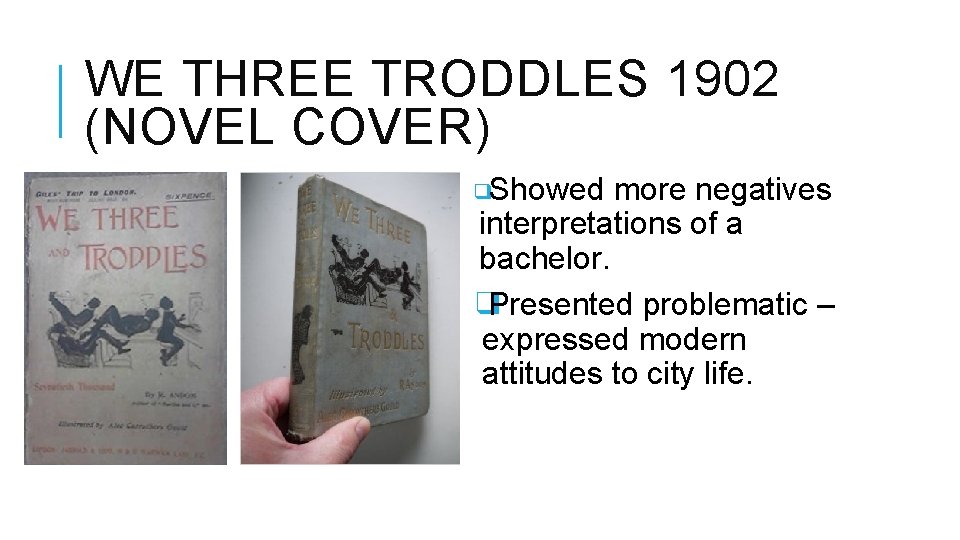
WE THREE TRODDLES 1902 (NOVEL COVER) ❑Showed more negatives interpretations of a bachelor. ❑ Presented problematic – expressed modern attitudes to city life.
❑ There were contradictory tensions between commercial cultures and artistic originality in the bohemians. ❑ Threats to the mannered perfection pf the bachelor and his limits of his make-up and environment. There were possibilities in a wider urban culture of the commercial boundaries set up to describe a bachelors position as ‘west end sophistication’. ❑ ‘In the west Pleasure is Business and in the east its an activity done for enjoyment’ ❑ Bachelor Figure has a close association to a fashions consumer culture. The Dapper persona of a bachelor drew accusations of being not genuine. This was from observations tied to the feminised and weary concerns of the west-end. ❑ East end offered masculine pleasure, free from business and an arena in which the bachelor identifies matched dangerous connotations and mediation.