
The Design Core Market Assessment Specification DETAIL DESIGN
- Slides: 30
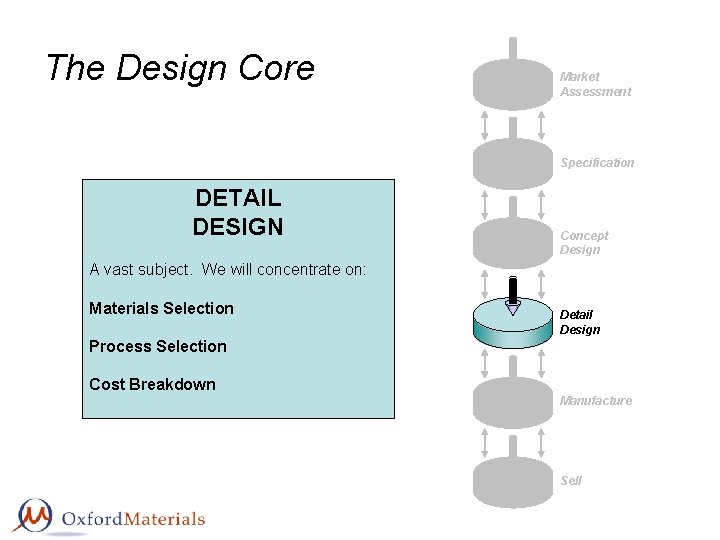
The Design Core Market Assessment Specification DETAIL DESIGN Concept Design A vast subject. We will concentrate on: Materials Selection Detail Design Process Selection Cost Breakdown Manufacture Sell
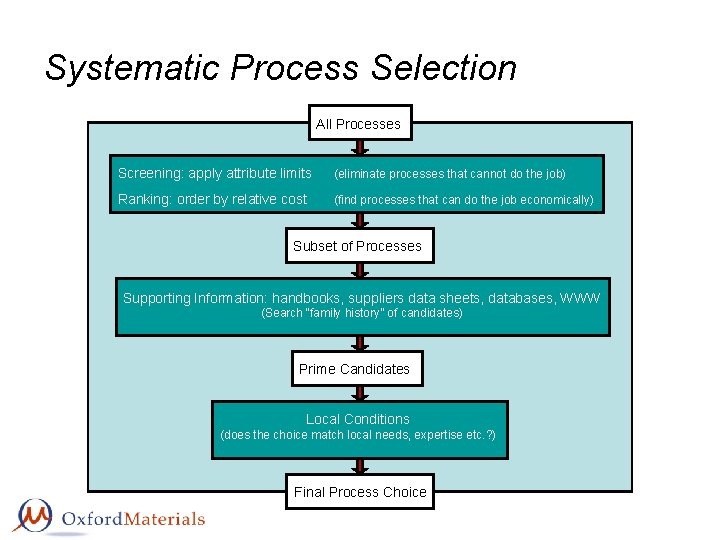
Systematic Process Selection All Processes Screening: apply attribute limits (eliminate processes that cannot do the job) Ranking: order by relative cost (find processes that can do the job economically) Subset of Processes Supporting Information: handbooks, suppliers data sheets, databases, WWW (Search “family history” of candidates) Prime Candidates Local Conditions (does the choice match local needs, expertise etc. ? ) Final Process Choice
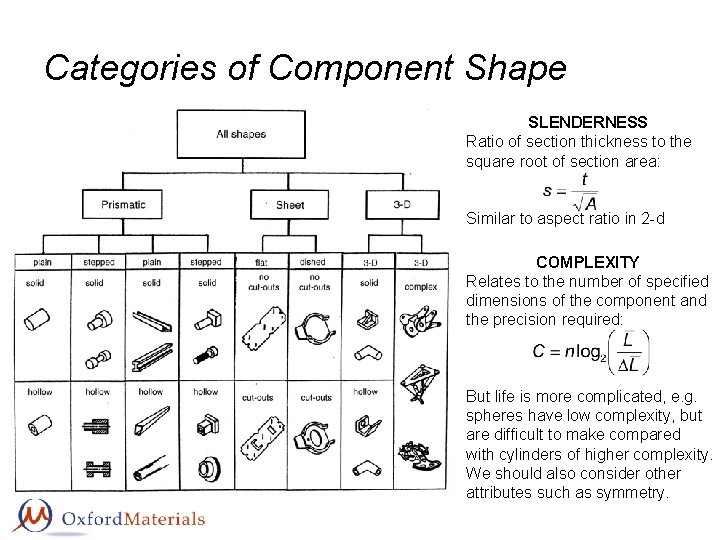
Categories of Component Shape SLENDERNESS Ratio of section thickness to the square root of section area: Similar to aspect ratio in 2 -d COMPLEXITY Relates to the number of specified dimensions of the component and the precision required: But life is more complicated, e. g. spheres have low complexity, but are difficult to make compared with cylinders of higher complexity. We should also consider other attributes such as symmetry.
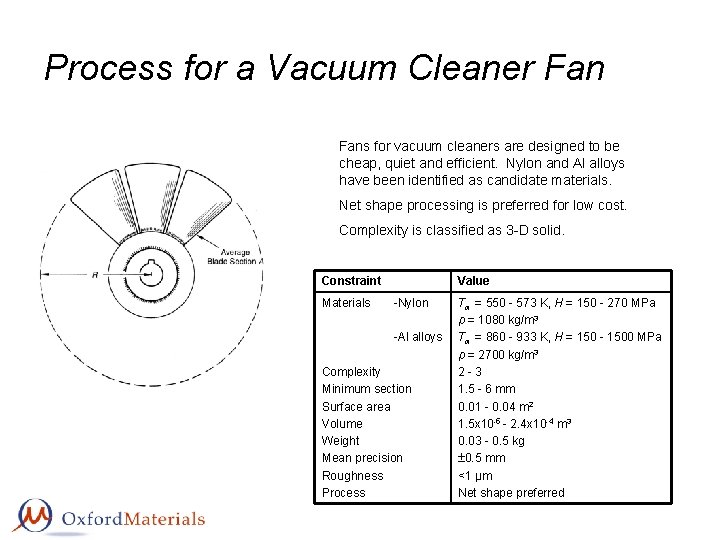
Process for a Vacuum Cleaner Fans for vacuum cleaners are designed to be cheap, quiet and efficient. Nylon and Al alloys have been identified as candidate materials. Net shape processing is preferred for low cost. Complexity is classified as 3 -D solid. Constraint Materials Value -Nylon -Al alloys Complexity Minimum section Surface area Volume Weight Mean precision Roughness Process Tm = 550 - 573 K, H = 150 - 270 MPa ρ = 1080 kg/m 3 Tm = 860 - 933 K, H = 150 - 1500 MPa ρ = 2700 kg/m 3 2 -3 1. 5 - 6 mm 0. 01 - 0. 04 m 2 1. 5 x 10 -5 - 2. 4 x 10 -4 m 3 0. 03 - 0. 5 kg 0. 5 mm <1 µm Net shape preferred
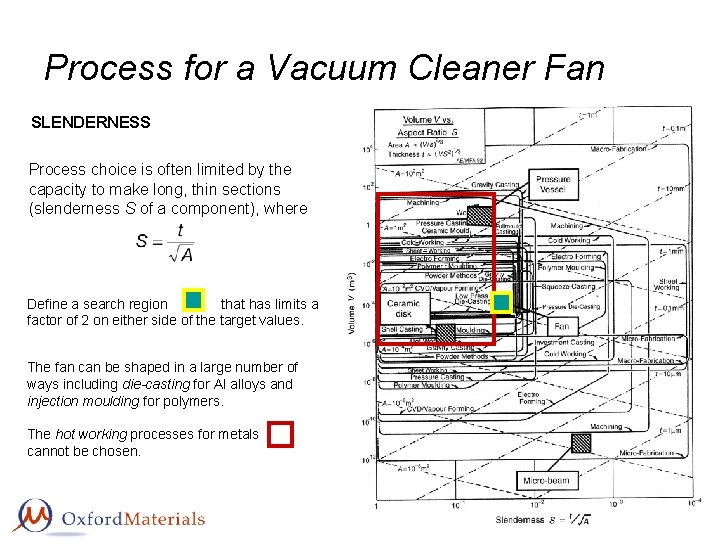
Process for a Vacuum Cleaner Fan SLENDERNESS Process choice is often limited by the capacity to make long, thin sections (slenderness S of a component), where Define a search region that has limits a factor of 2 on either side of the target values. The fan can be shaped in a large number of ways including die-casting for Al alloys and injection moulding for polymers. The hot working processes for metals cannot be chosen.
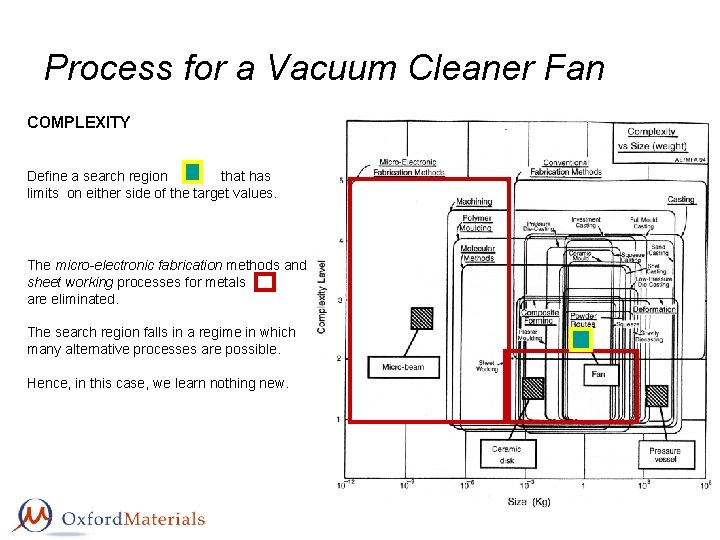
Process for a Vacuum Cleaner Fan COMPLEXITY Define a search region that has limits on either side of the target values. The micro-electronic fabrication methods and sheet working processes for metals are eliminated. The search region falls in a regime in which many alternative processes are possible. Hence, in this case, we learn nothing new.
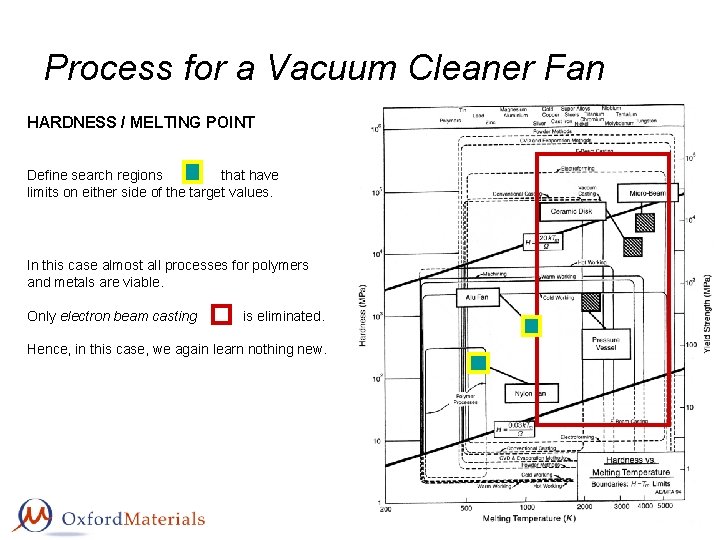
Process for a Vacuum Cleaner Fan HARDNESS / MELTING POINT Define search regions that have limits on either side of the target values. In this case almost all processes for polymers and metals are viable. Only electron beam casting is eliminated. Hence, in this case, we again learn nothing new.
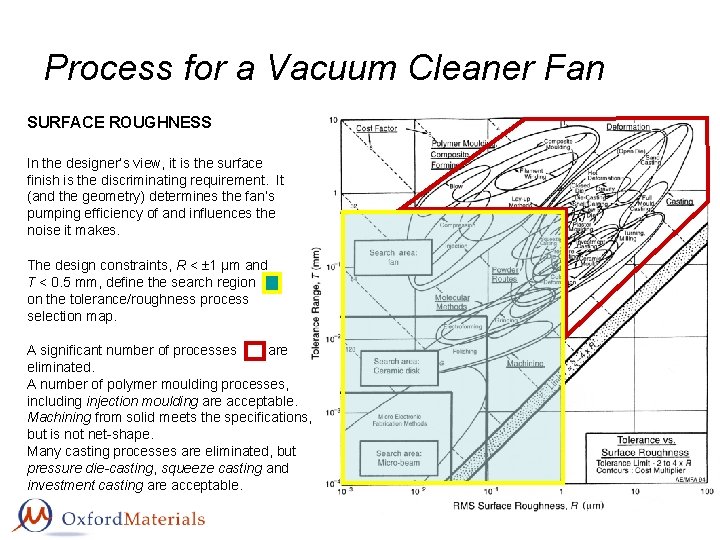
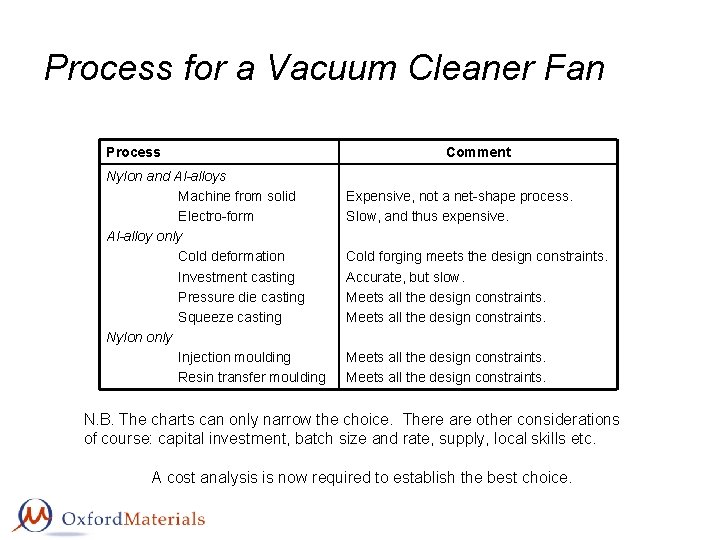
Process for a Vacuum Cleaner Fan SURFACE ROUGHNESS In the designer’s view, it is the surface finish is the discriminating requirement. It (and the geometry) determines the fan’s pumping efficiency of and influences the noise it makes. The design constraints, R < 1 µm and T < 0. 5 mm, define the search region on the tolerance/roughness process selection map. A significant number of processes are eliminated. A number of polymer moulding processes, including injection moulding are acceptable. Machining from solid meets the specifications, but is not net-shape. Many casting processes are eliminated, but pressure die-casting, squeeze casting and investment casting are acceptable.
Process for a Vacuum Cleaner Fan Process Nylon and Al-alloys Machine from solid Electro-form Al-alloy only Cold deformation Investment casting Pressure die casting Squeeze casting Nylon only Injection moulding Resin transfer moulding Comment Expensive, not a net-shape process. Slow, and thus expensive. Cold forging meets the design constraints. Accurate, but slow. Meets all the design constraints. N. B. The charts can only narrow the choice. There are other considerations of course: capital investment, batch size and rate, supply, local skills etc. A cost analysis is now required to establish the best choice.
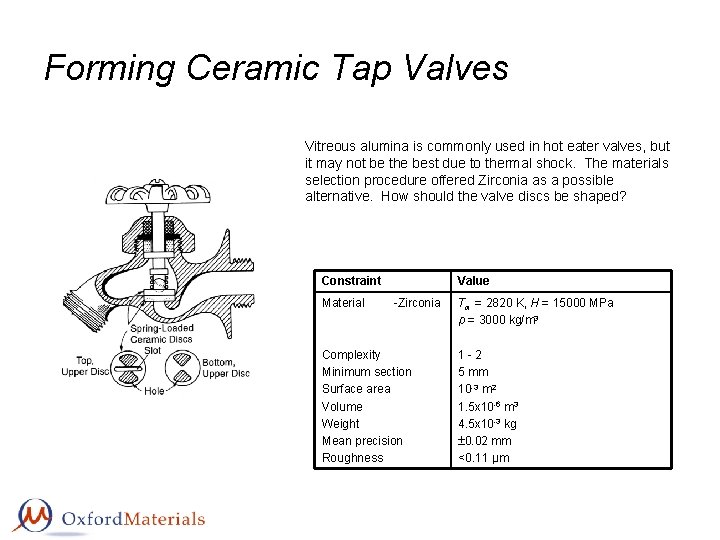
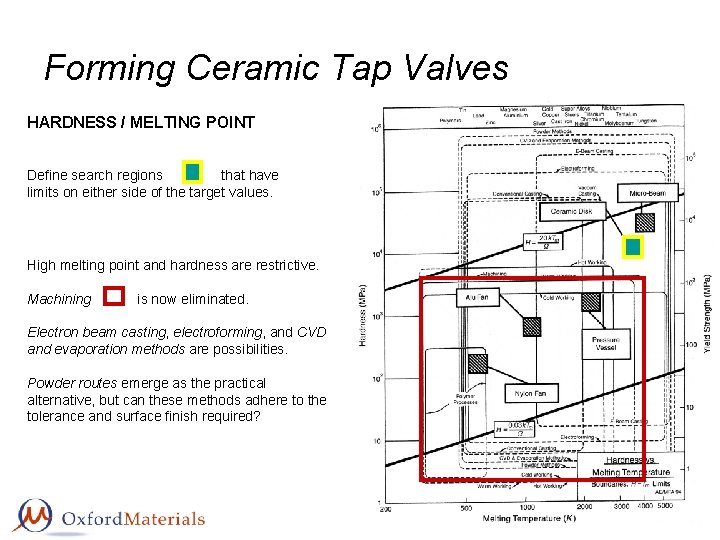
Forming Ceramic Tap Valves Vitreous alumina is commonly used in hot eater valves, but it may not be the best due to thermal shock. The materials selection procedure offered Zirconia as a possible alternative. How should the valve discs be shaped? Constraint Material Value -Zirconia Complexity Minimum section Surface area Volume Weight Mean precision Roughness Tm = 2820 K, H = 15000 MPa ρ = 3000 kg/m 3 1 -2 5 mm 10 -3 m 2 1. 5 x 10 -6 m 3 4. 5 x 10 -3 kg 0. 02 mm <0. 11 µm
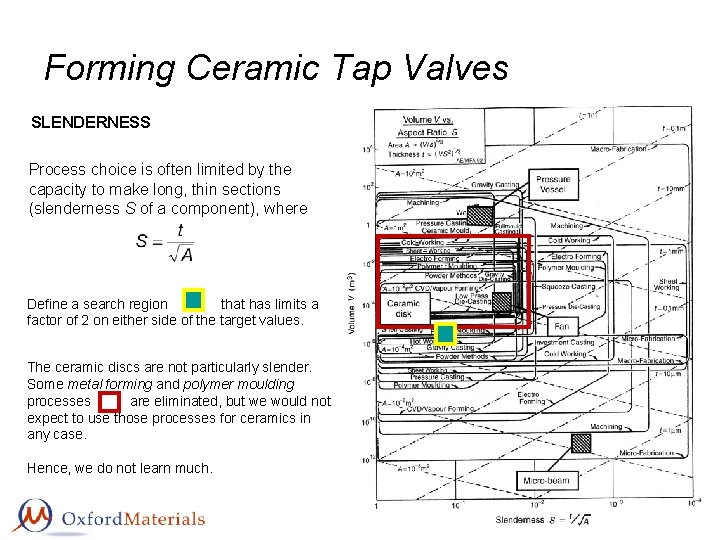
Forming Ceramic Tap Valves SLENDERNESS Process choice is often limited by the capacity to make long, thin sections (slenderness S of a component), where Define a search region that has limits a factor of 2 on either side of the target values. The ceramic discs are not particularly slender. Some metal forming and polymer moulding processes are eliminated, but we would not expect to use those processes for ceramics in any case. Hence, we do not learn much.
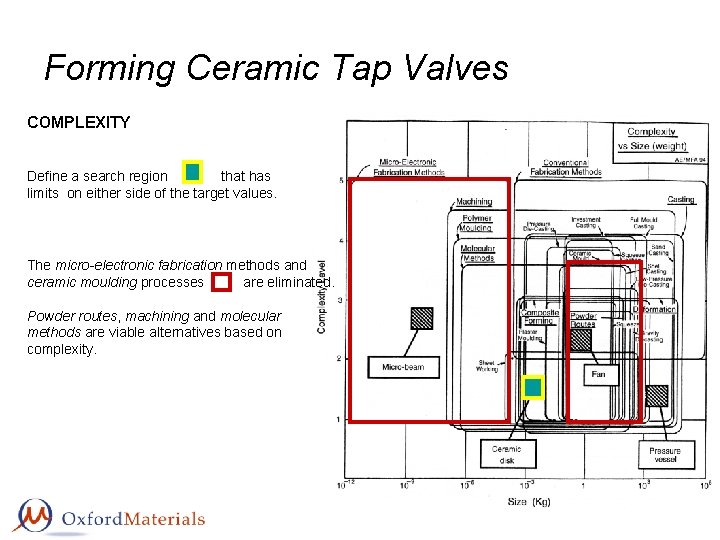
Forming Ceramic Tap Valves COMPLEXITY Define a search region that has limits on either side of the target values. The micro-electronic fabrication methods and ceramic moulding processes are eliminated. Powder routes, machining and molecular methods are viable alternatives based on complexity.
Forming Ceramic Tap Valves HARDNESS / MELTING POINT Define search regions that have limits on either side of the target values. High melting point and hardness are restrictive. Machining is now eliminated. Electron beam casting, electroforming, and CVD and evaporation methods are possibilities. Powder routes emerge as the practical alternative, but can these methods adhere to the tolerance and surface finish required?
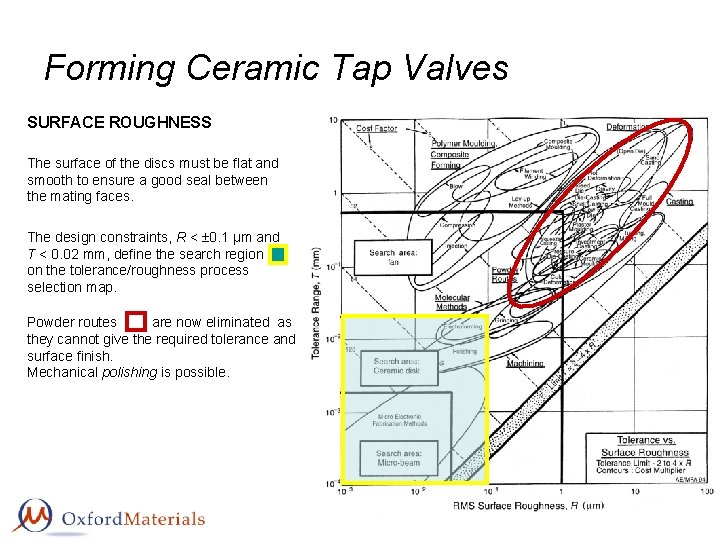
Forming Ceramic Tap Valves SURFACE ROUGHNESS The surface of the discs must be flat and smooth to ensure a good seal between the mating faces. The design constraints, R < 0. 1 µm and T < 0. 02 mm, define the search region on the tolerance/roughness process selection map. Powder routes are now eliminated as they cannot give the required tolerance and surface finish. Mechanical polishing is possible.
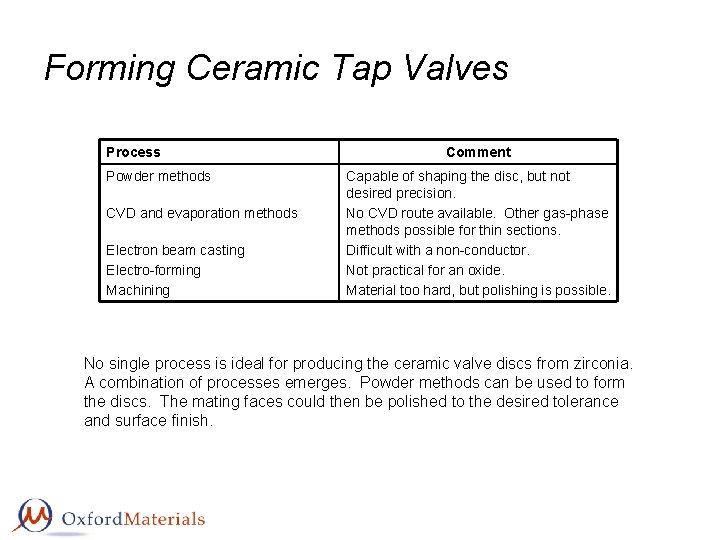
Forming Ceramic Tap Valves Process Powder methods CVD and evaporation methods Electron beam casting Electro-forming Machining Comment Capable of shaping the disc, but not desired precision. No CVD route available. Other gas-phase methods possible for thin sections. Difficult with a non-conductor. Not practical for an oxide. Material too hard, but polishing is possible. No single process is ideal for producing the ceramic valve discs from zirconia. A combination of processes emerges. Powder methods can be used to form the discs. The mating faces could then be polished to the desired tolerance and surface finish.
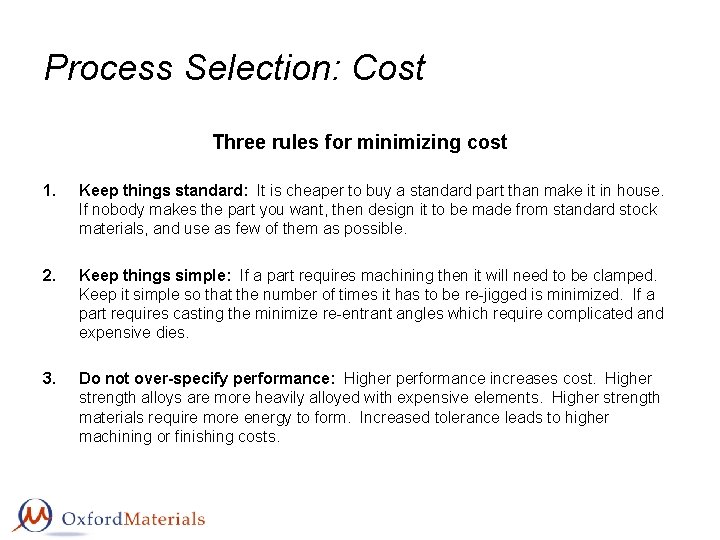
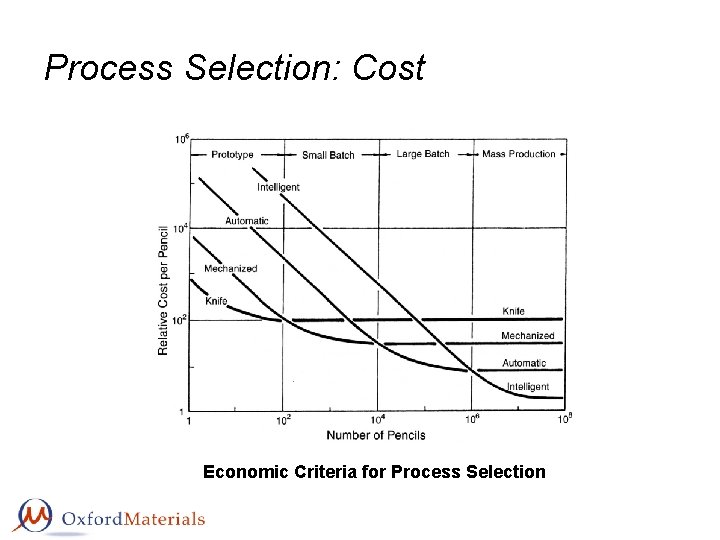
Process Selection: Cost Three rules for minimizing cost 1. Keep things standard: It is cheaper to buy a standard part than make it in house. If nobody makes the part you want, then design it to be made from standard stock materials, and use as few of them as possible. 2. Keep things simple: If a part requires machining then it will need to be clamped. Keep it simple so that the number of times it has to be re-jigged is minimized. If a part requires casting the minimize re-entrant angles which require complicated and expensive dies. 3. Do not over-specify performance: Higher performance increases cost. Higher strength alloys are more heavily alloyed with expensive elements. Higher strength materials require more energy to form. Increased tolerance leads to higher machining or finishing costs.
Materials Costs
Process Selection: Cost Economic Criteria for Process Selection
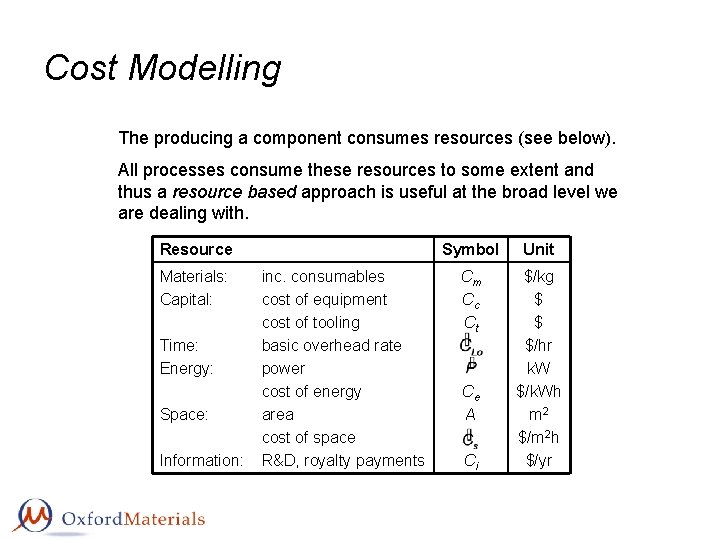
Cost Modelling The producing a component consumes resources (see below). All processes consume these resources to some extent and thus a resource based approach is useful at the broad level we are dealing with. Resource Materials: Capital: Time: Energy: Space: Information: inc. consumables cost of equipment cost of tooling basic overhead rate power cost of energy area cost of space R&D, royalty payments Symbol Unit Cm Cc Ct $/kg $ $ $/hr k. W $/k. Wh m 2 $/m 2 h $/yr Ce A Ci
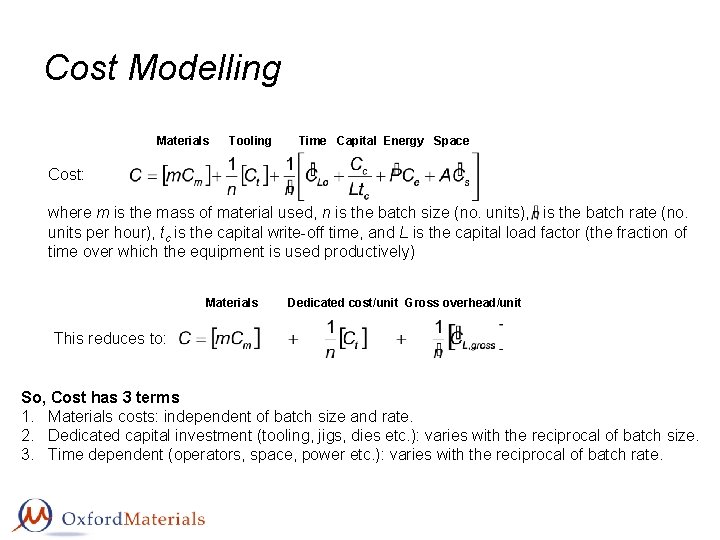
Cost Modelling Materials Tooling Time Capital Energy Space Cost: where m is the mass of material used, n is the batch size (no. units), is the batch rate (no. units per hour), tc is the capital write-off time, and L is the capital load factor (the fraction of time over which the equipment is used productively) Materials Dedicated cost/unit Gross overhead/unit This reduces to: So, Cost has 3 terms 1. Materials costs: independent of batch size and rate. 2. Dedicated capital investment (tooling, jigs, dies etc. ): varies with the reciprocal of batch size. 3. Time dependent (operators, space, power etc. ): varies with the reciprocal of batch rate.
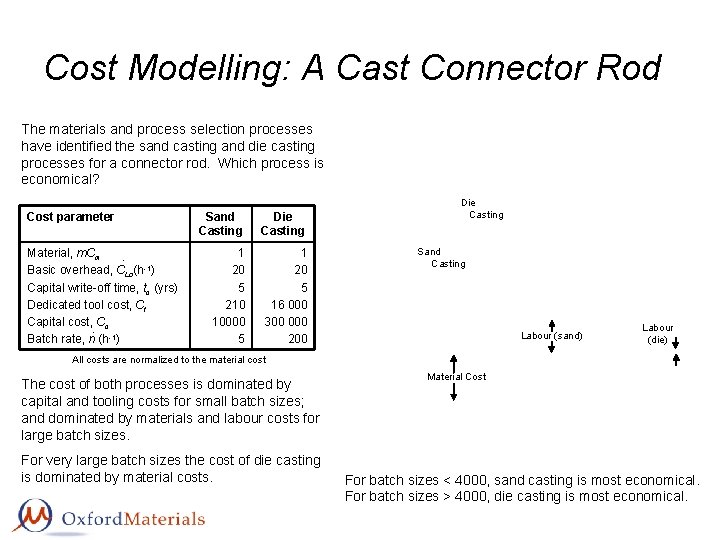
Cost Modelling: A Cast Connector Rod The materials and process selection processes have identified the sand casting and die casting processes for a connector rod. Which process is economical? Cost parameter Material, m. Cm. Basic overhead, CLo(h-1) Capital write-off time, tc (yrs) Dedicated tool cost, Ct Capital cost, Cc. Batch rate, n (h-1) Sand Casting Die Casting 1 20 5 210 10000 5 1 20 5 16 000 300 000 200 Die Casting Sand Casting Labour (sand) Labour (die) All costs are normalized to the material cost The cost of both processes is dominated by capital and tooling costs for small batch sizes; and dominated by materials and labour costs for large batch sizes. For very large batch sizes the cost of die casting is dominated by material costs. Material Cost For batch sizes < 4000, sand casting is most economical. For batch sizes > 4000, die casting is most economical.
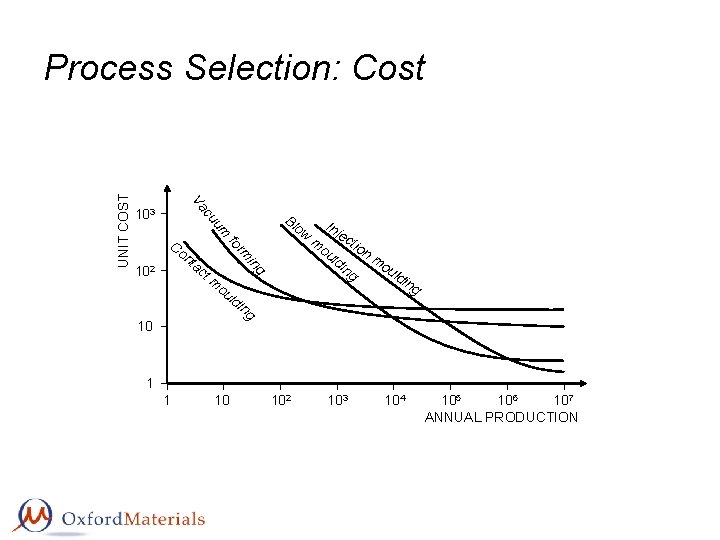
um cu Va 103 ta ct m g in 102 rm Co n Bl ow fo UNIT COST Process Selection: Cost ou ld 10 m Inj ec ou tion mo ld in uld g in g 1 1 10 102 103 104 105 106 107 ANNUAL PRODUCTION
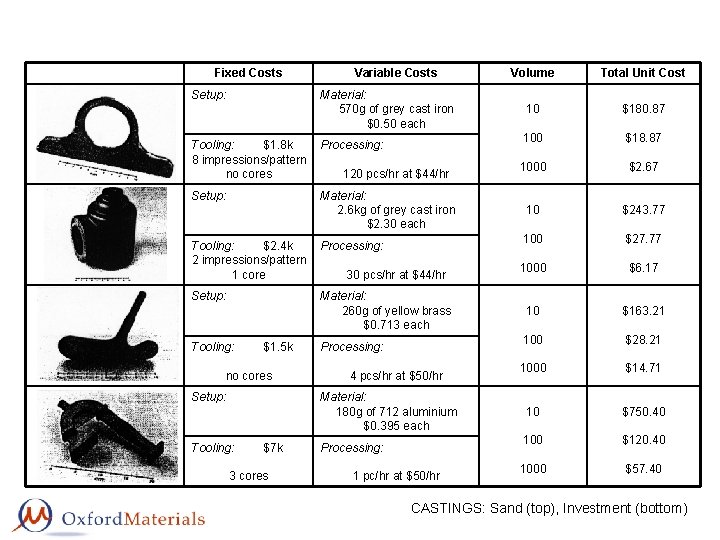
Fixed Costs Setup: Variable Costs Material: 570 g of grey cast iron $0. 50 each Tooling: $1. 8 k 8 impressions/pattern no cores Processing: Setup: Material: 2. 6 kg of grey cast iron $2. 30 each 120 pcs/hr at $44/hr Tooling: $2. 4 k 2 impressions/pattern 1 core Processing: Setup: Material: 260 g of yellow brass $0. 713 each Tooling: $1. 5 k no cores Setup: 30 pcs/hr at $44/hr Processing: 4 pcs/hr at $50/hr Material: 180 g of 712 aluminium $0. 395 each Tooling: $7 k 3 cores Processing: 1 pc/hr at $50/hr Volume Total Unit Cost 10 $180. 87 100 $18. 87 1000 $2. 67 10 $243. 77 100 $27. 77 1000 $6. 17 10 $163. 21 100 $28. 21 1000 $14. 71 10 $750. 40 100 $120. 40 1000 $57. 40 CASTINGS: Sand (top), Investment (bottom)
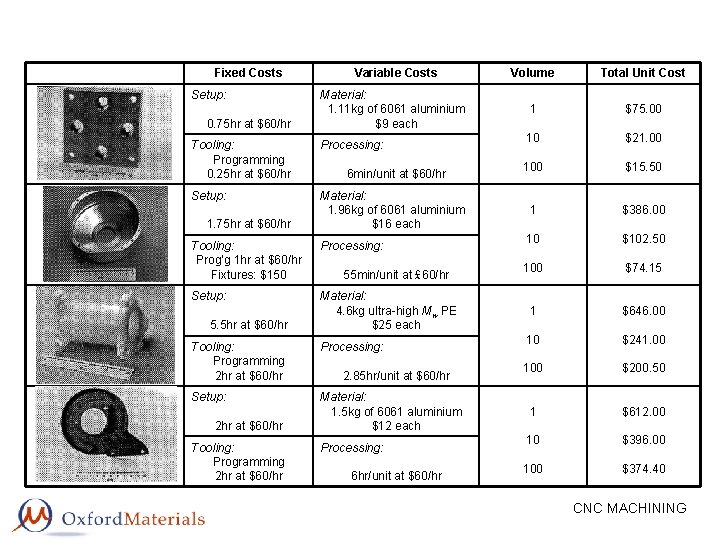
Fixed Costs Setup: 0. 75 hr at $60/hr Variable Costs Volume Total Unit Cost Material: 1. 11 kg of 6061 aluminium $9 each 1 $75. 00 10 $21. 00 100 $15. 50 1 $386. 00 10 $102. 50 100 $74. 15 1 $646. 00 10 $241. 00 100 $200. 50 1 $612. 00 10 $396. 00 100 $374. 40 Tooling: Programming 0. 25 hr at $60/hr Processing: Setup: Material: 1. 96 kg of 6061 aluminium $16 each 1. 75 hr at $60/hr 6 min/unit at $60/hr Tooling: Prog’g 1 hr at $60/hr Fixtures: $150 Processing: Setup: Material: 4. 6 kg ultra-high Mw PE $25 each 5. 5 hr at $60/hr 55 min/unit at £ 60/hr Tooling: Programming 2 hr at $60/hr Processing: Setup: Material: 1. 5 kg of 6061 aluminium $12 each 2 hr at $60/hr Tooling: Programming 2 hr at $60/hr 2. 85 hr/unit at $60/hr Processing: 6 hr/unit at $60/hr CNC MACHINING
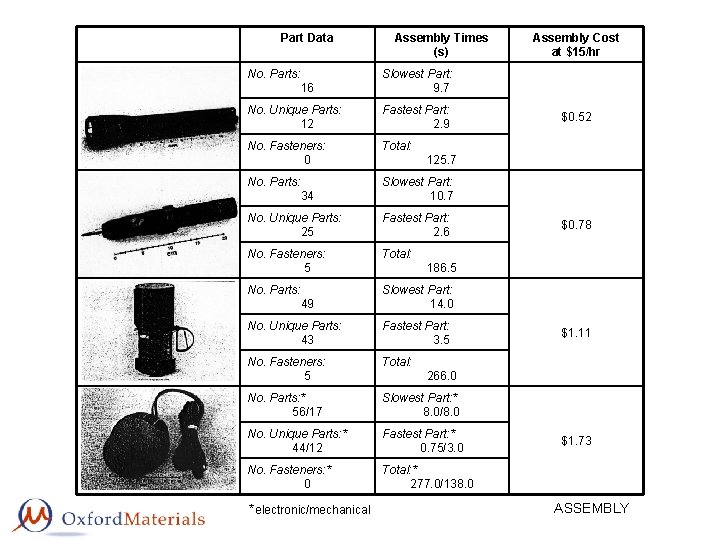
Part Data No. Parts: 16 Assembly Times (s) Slowest Part: 9. 7 No. Unique Parts: 12 Fastest Part: 2. 9 No. Fasteners: 0 Total: No. Parts: Slowest Part: 10. 7 34 Fastest Part: 2. 6 No. Fasteners: 5 Total: No. Parts: Slowest Part: 14. 0 $0. 78 186. 5 No. Unique Parts: 43 Fastest Part: 3. 5 No. Fasteners: 5 Total: No. Parts: * 56/17 Slowest Part: * 8. 0/8. 0 No. Unique Parts: * 44/12 Fastest Part: * 0. 75/3. 0 No. Fasteners: * 0 Total: * 277. 0/138. 0 *electronic/mechanical $0. 52 125. 7 No. Unique Parts: 25 49 Assembly Cost at $15/hr $1. 11 266. 0 $1. 73 ASSEMBLY
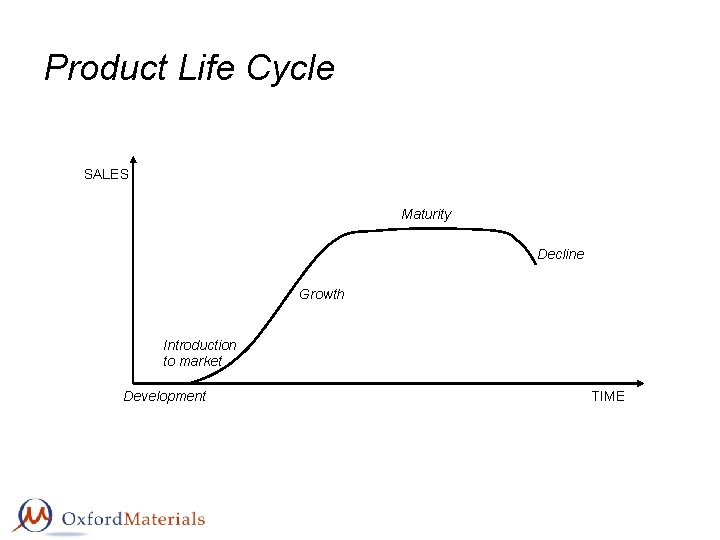
Product Life Cycle SALES Maturity Decline Growth Introduction to market Development TIME
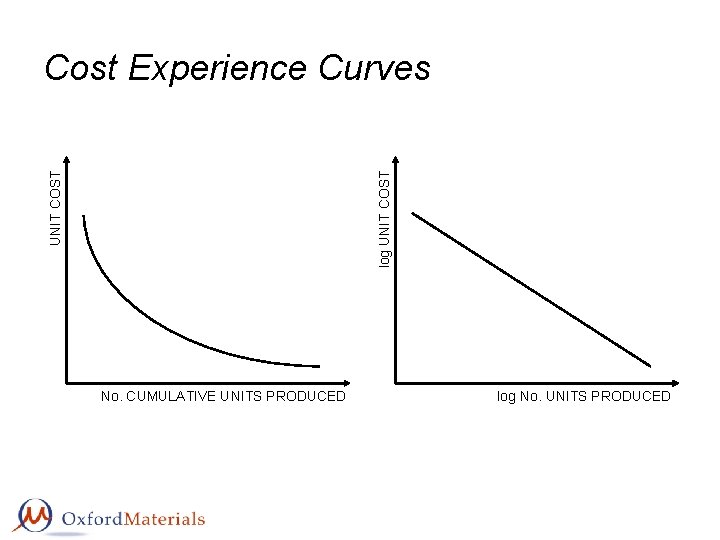
log UNIT COST Cost Experience Curves No. CUMULATIVE UNITS PRODUCED log No. UNITS PRODUCED
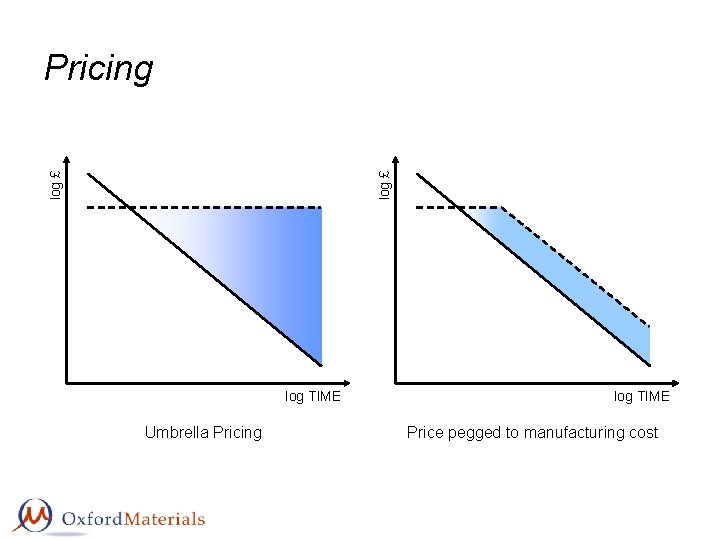
log £ Pricing log TIME Umbrella Pricing log TIME Price pegged to manufacturing cost
The Design Core Market Assessment Specification MANUFACTURE Concept Design Detail Design Manufacture Sell
The Design Core Market Assessment Specification SELL Concept Design Detail Design Manufacture Sell