
The derivation of benchmarks CEH Lancaster 1 st
The derivation of benchmarks CEH Lancaster 1 st – 3 rd April 2014

OBJECTIVES What is a benchmark? Why are benchmarks needed? How are benchmarks derived? How are benchmarks used?
INTRODUCTION The need for benchmarks. . . a retrospective screening model example www. radioecology-exchange. org
A Tier-1 screening model of risk to fish living in a radioactively contaminated stream during the 1960 s Fundamental to this approach is the necessity for the dose estimate to be conservative This assures the modeler that the PREDICTED DOSES are LARGER than the REAL DOSES www. radioecology-exchange. org
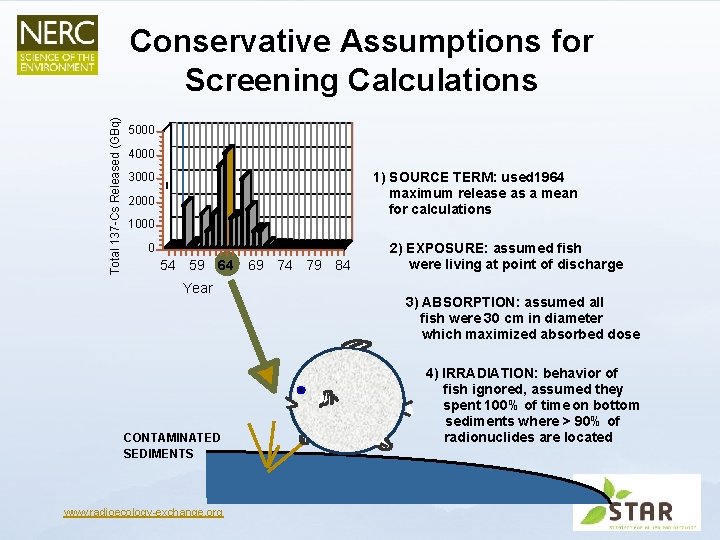
Total 137 -Cs Released (GBq) Conservative Assumptions for Screening Calculations 5000 4000 1) SOURCE TERM: used 1964 maximum release as a mean for calculations 3000 2000 1000 0 54 59 64 Year CONTAMINATED SEDIMENTS www. radioecology-exchange. org 69 74 79 84 2) EXPOSURE: assumed fish were living at point of discharge 3) ABSORPTION: assumed all fish were 30 cm in diameter which maximized absorbed dose 4) IRRADIATION: behavior of fish ignored, assumed they spent 100% of time on bottom sediments where > 90% of radionuclides are located
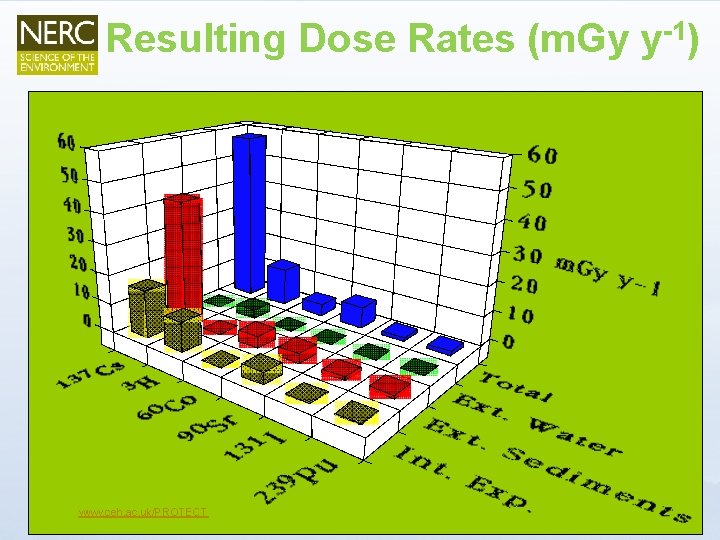
Resulting Dose Rates (m. Gy y-1) www. ceh. ac. uk/PROTECT
www. radioecology-exchange. org
www. radioecology-exchange. org
www. radioecology-exchange. org

We need a point of reference; a known value to which we can compare… …a BENCHMARK value
Definition of benchmarks Benchmarks are numerical values used to guide risk assessors at various decision points in a tiered approach Benchmarks values are concentrations, doses, or dose rates that are assumed to be safe based on exposure – response information. They represent « safe levels » for the ecosystem The derivation of benchmarks needs to be through transparent, scientific reasoning Benchmarks correspond to screening values when they are used in screening tiers www. radioecology-exchange. org
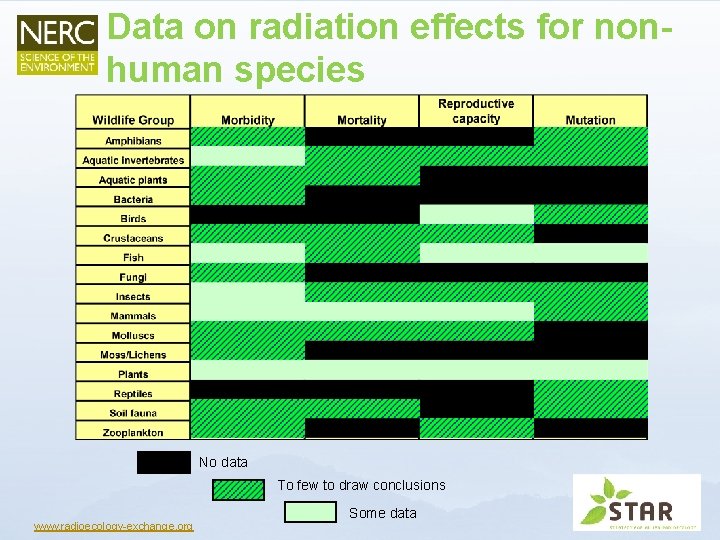
Data on radiation effects for nonhuman species No data To few to draw conclusions www. radioecology-exchange. org Some data

Approaches to derive protection criteria www. radioecology-exchange. org
www. radioecology-exchange. org
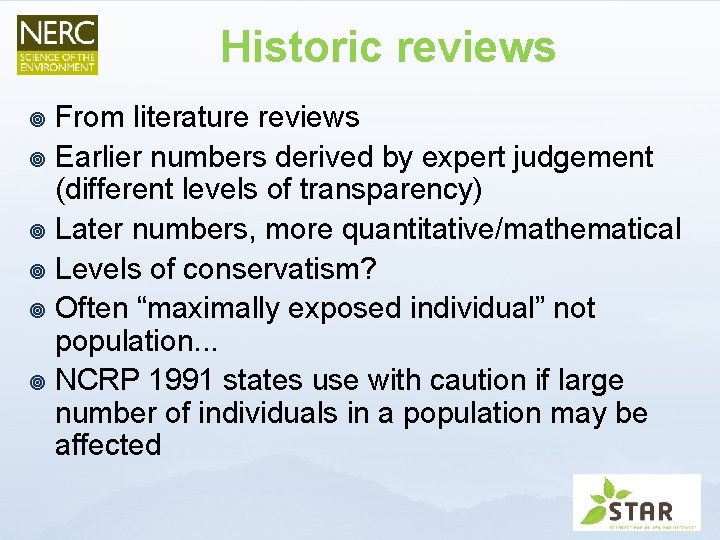
Historic reviews From literature reviews ¥ Earlier numbers derived by expert judgement (different levels of transparency) ¥ Later numbers, more quantitative/mathematical ¥ Levels of conservatism? ¥ Often “maximally exposed individual” not population. . . ¥ NCRP 1991 states use with caution if large number of individuals in a population may be affected ¥
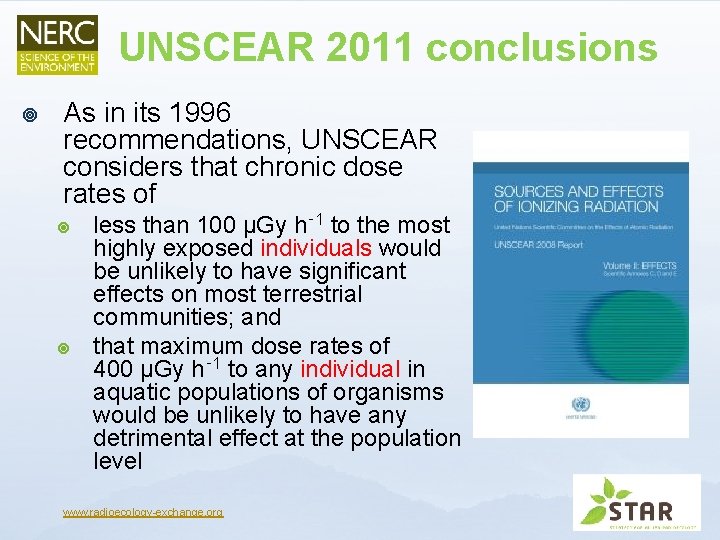
UNSCEAR 2011 conclusions ¥ As in its 1996 recommendations, UNSCEAR considers that chronic dose rates of ¥ ¥ less than 100 μGy h‑ 1 to the most highly exposed individuals would be unlikely to have significant effects on most terrestrial communities; and that maximum dose rates of 400 μGy h‑ 1 to any individual in aquatic populations of organisms would be unlikely to have any detrimental effect at the population level www. radioecology-exchange. org
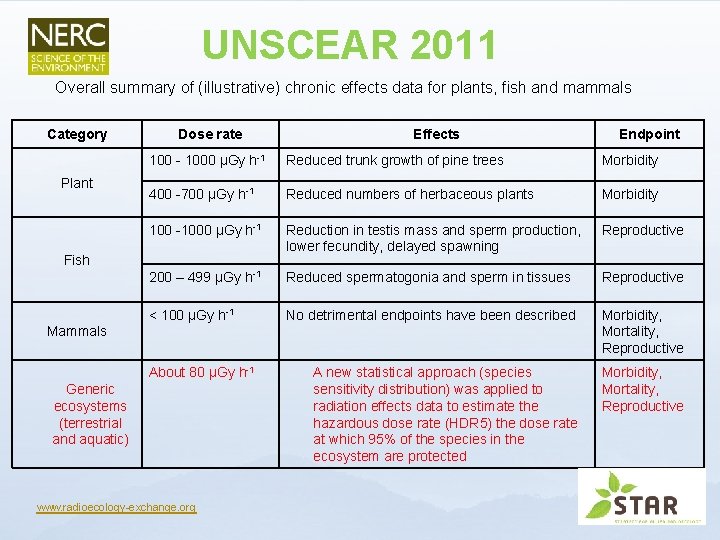
UNSCEAR 2011 Overall summary of (illustrative) chronic effects data for plants, fish and mammals Category Plant Dose rate Effects Endpoint 100 - 1000 μGy h-1 Reduced trunk growth of pine trees Morbidity 400 -700 μGy h-1 Reduced numbers of herbaceous plants Morbidity 100 -1000 μGy h-1 Reduction in testis mass and sperm production, lower fecundity, delayed spawning Reproductive 200 – 499 μGy h-1 Reduced spermatogonia and sperm in tissues Reproductive < 100 μGy h-1 No detrimental endpoints have been described Morbidity, Mortality, Reproductive A new statistical approach (species sensitivity distribution) was applied to radiation effects data to estimate the hazardous dose rate (HDR 5) the dose rate at which 95% of the species in the ecosystem are protected Morbidity, Mortality, Reproductive Fish Mammals About 80 μGy h-1 Generic ecosystems (terrestrial and aquatic) www. radioecology-exchange. org
A Quantitative approach ¥ Used to derive the ERICA and PROTECT values ¥ Consistent with EC approach for other chemicals
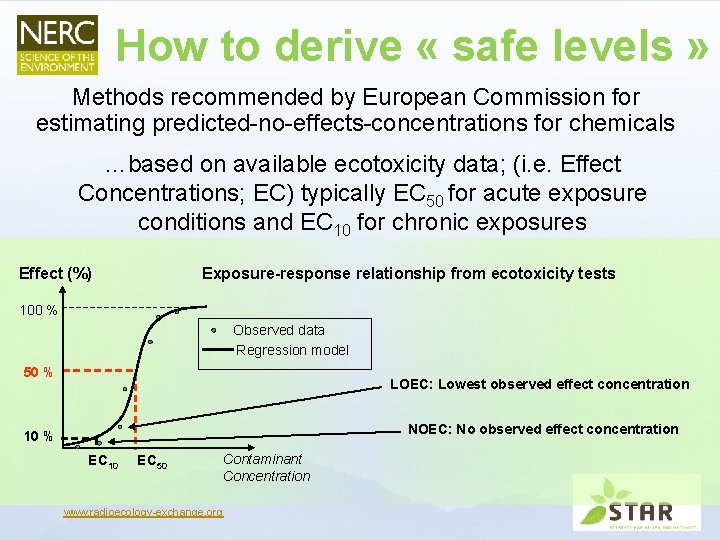
How to derive « safe levels » Methods recommended by European Commission for estimating predicted-no-effects-concentrations for chemicals …based on available ecotoxicity data; (i. e. Effect Concentrations; EC) typically EC 50 for acute exposure conditions and EC 10 for chronic exposures Exposure-response relationship from ecotoxicity tests Effect (%) 100 % Observed data Regression model 50 % LOEC: Lowest observed effect concentration NOEC: No observed effect concentration 10 % EC 10 EC 50 Contaminant Concentration www. radioecology-exchange. org
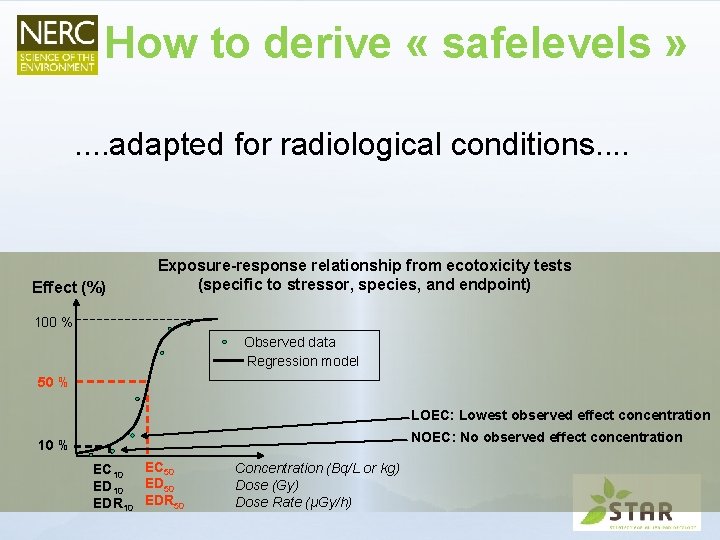
How to derive « safelevels » . . adapted for radiological conditions. . Effect (%) Exposure-response relationship from ecotoxicity tests (specific to stressor, species, and endpoint) 100 % Observed data Regression model 50 % LOEC: Lowest observed effect concentration NOEC: No observed effect concentration 10 % EC 50 EC 10 ED 50 ED 10 EDR 50 Concentration (Bq/L or kg) Dose (Gy) Dose Rate (µGy/h)
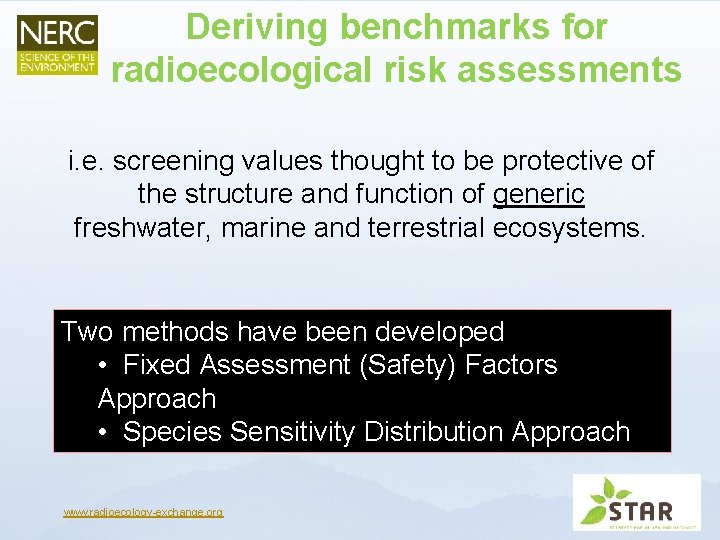
Deriving benchmarks for radioecological risk assessments i. e. screening values thought to be protective of the structure and function of generic freshwater, marine and terrestrial ecosystems. Two methods have been developed • Fixed Assessment (Safety) Factors Approach • Species Sensitivity Distribution Approach www. radioecology-exchange. org
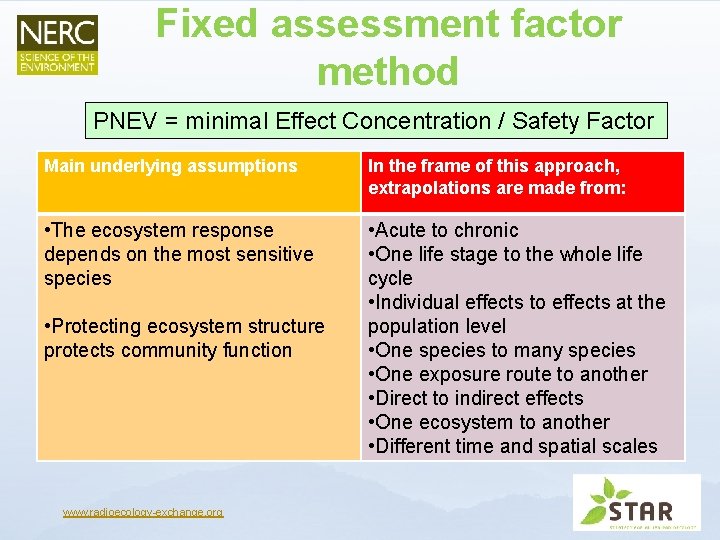
Fixed assessment factor method PNEV = minimal Effect Concentration / Safety Factor Main underlying assumptions In the frame of this approach, extrapolations are made from: • The ecosystem response depends on the most sensitive species • Acute to chronic • One life stage to the whole life cycle • Individual effects to effects at the population level • One species to many species • One exposure route to another • Direct to indirect effects • One ecosystem to another • Different time and spatial scales • Protecting ecosystem structure protects community function www. radioecology-exchange. org
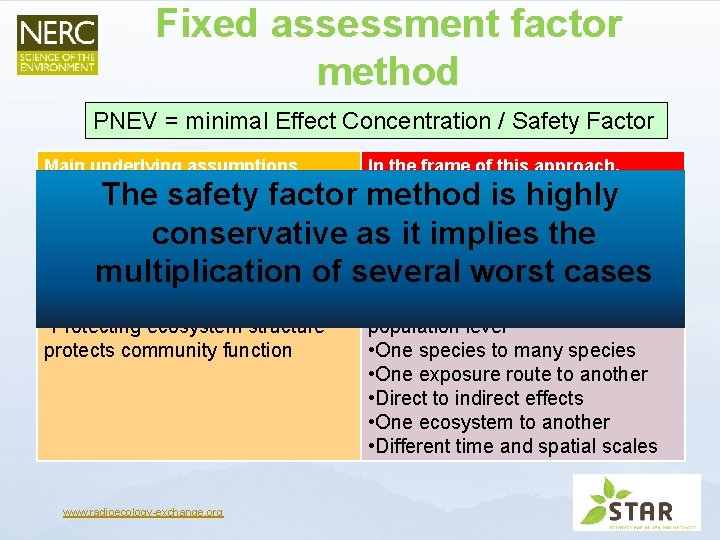
Fixed assessment factor method PNEV = minimal Effect Concentration / Safety Factor Main underlying assumptions In the frame of this approach, extrapolations are made from: The safety factor method is highly • The ecosystem response • Acute to chronic conservative as it implies the depends on the most sensitive • One life stage to the whole life multiplication of several worst cases species cycle • Protecting ecosystem structure protects community function www. radioecology-exchange. org • Individual effects to effects at the population level • One species to many species • One exposure route to another • Direct to indirect effects • One ecosystem to another • Different time and spatial scales
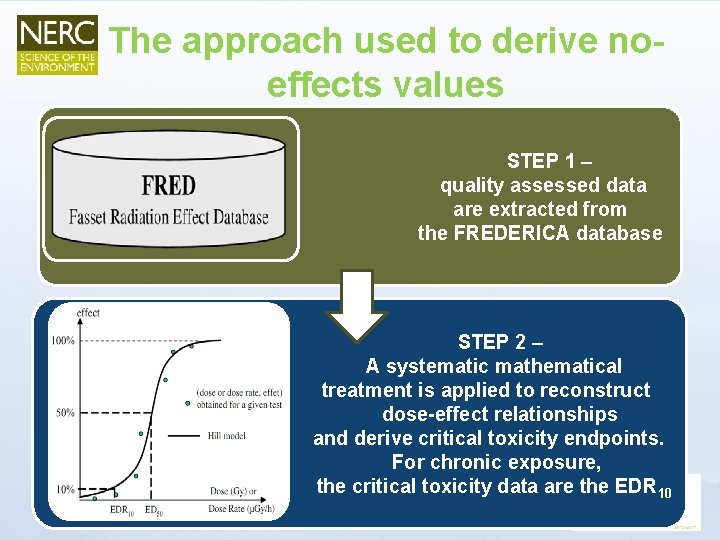
The approach used to derive noeffects values STEP 1 – quality assessed data are extracted from the FREDERICA database STEP 2 – A systematic mathematical treatment is applied to reconstruct dose-effect relationships and derive critical toxicity endpoints. For chronic exposure, the critical toxicity data are the EDR 10 www. ceh. ac. uk/PROTECT
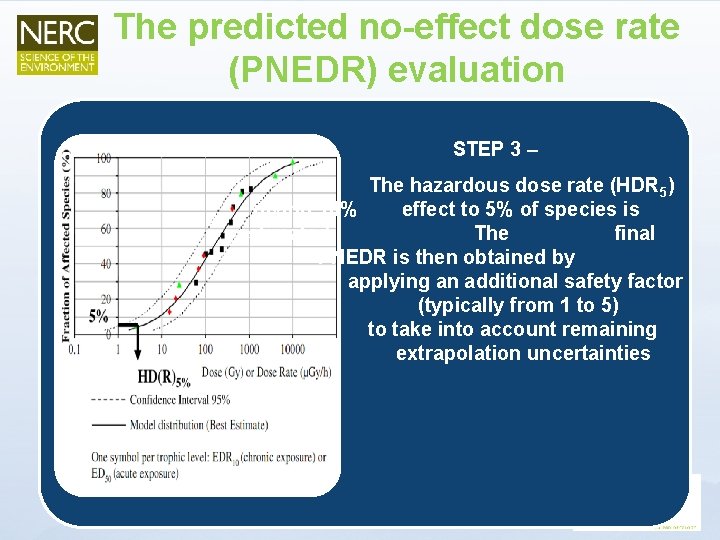
The predicted no-effect dose rate (PNEDR) evaluation STEP 3 – The hazardous dose rate (HDR 5) giving 10% effect to 5% of species is estimated The final PNEDR is then obtained by applying an additional safety factor (typically from 1 to 5) to take into account remaining extrapolation uncertainties www. ceh. ac. uk/PROTECT
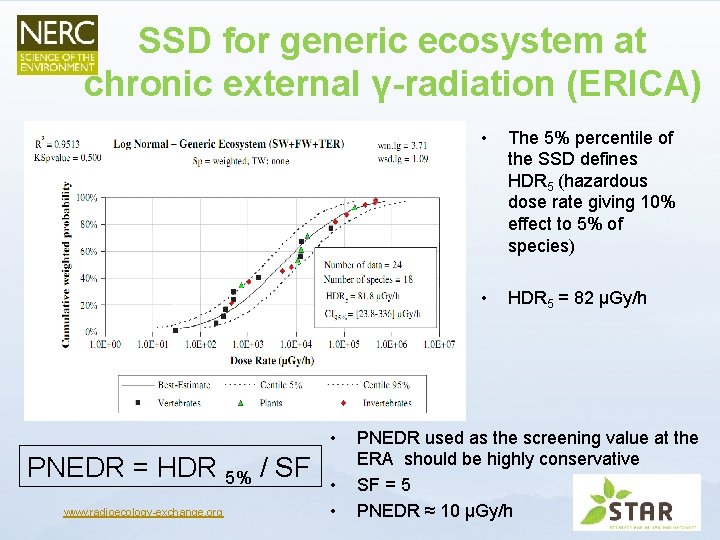
SSD for generic ecosystem at chronic external γ-radiation (ERICA) • PNEDR = HDR 5% / SF www. radioecology-exchange. org • • • The 5% percentile of the SSD defines HDR 5 (hazardous dose rate giving 10% effect to 5% of species) • HDR 5 = 82 μGy/h PNEDR used as the screening value at the ERA should be highly conservative SF = 5 PNEDR ≈ 10 μGy/h
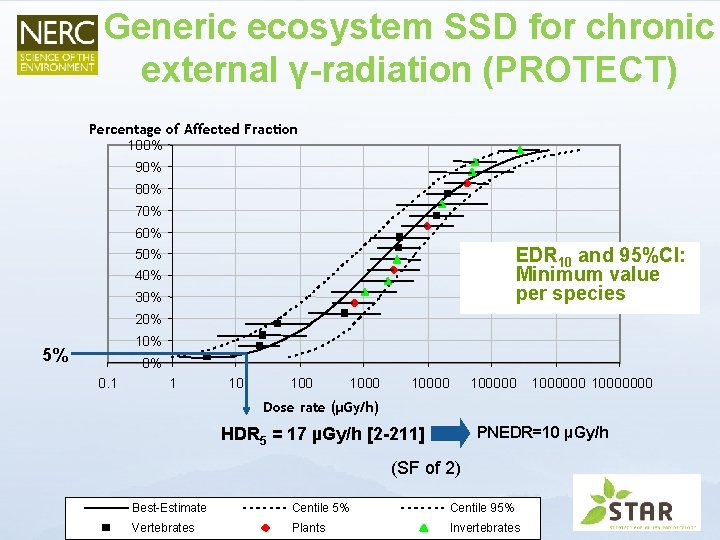
Generic ecosystem SSD for chronic external γ-radiation (PROTECT) Percentage of Affected Fraction 100% 90% 80% 70% 60% 50% EDR 10 and 95%CI: Minimum value per species 40% 30% 20% 10% 5% 0% 0. 1 1 10 100000 10000000 Dose rate (µGy/h) PNEDR=10 µGy/h HDR 5 = 17 µGy/h [2 -211] (SF of 2) Best-Estimate www. ceh. ac. uk/PROTECT Vertebrates Centile 5% Centile 95% Plants Invertebrates
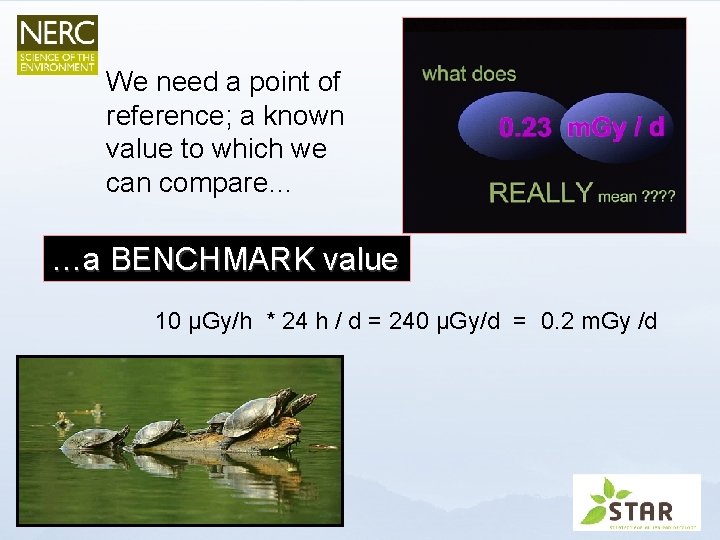
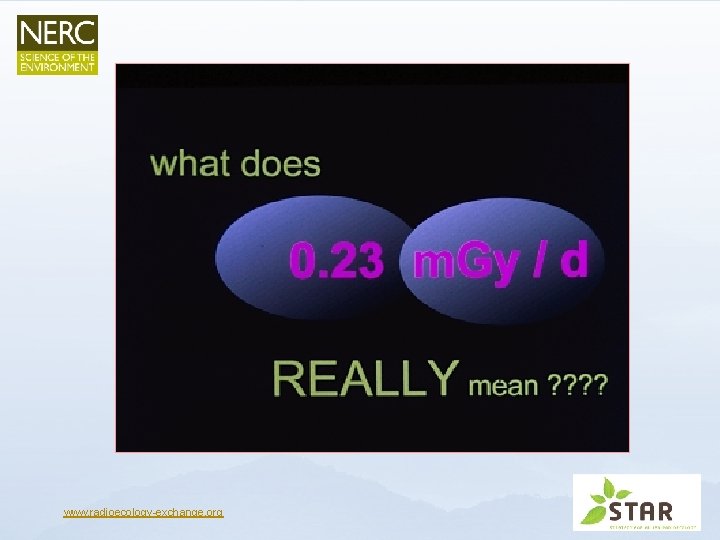
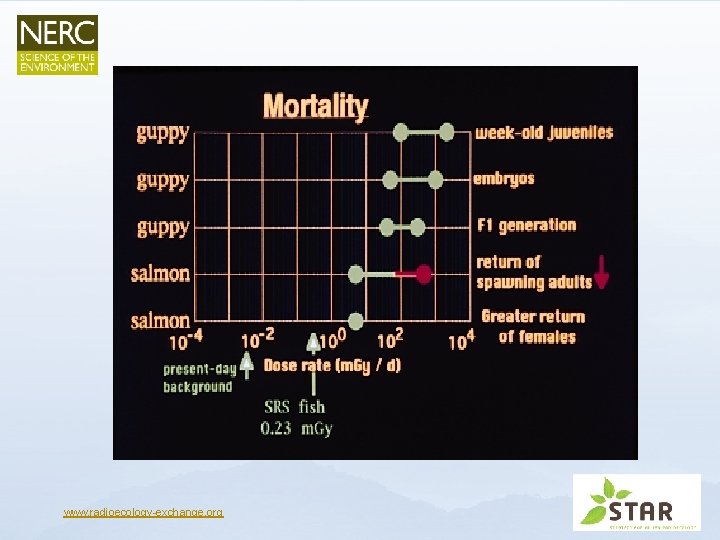
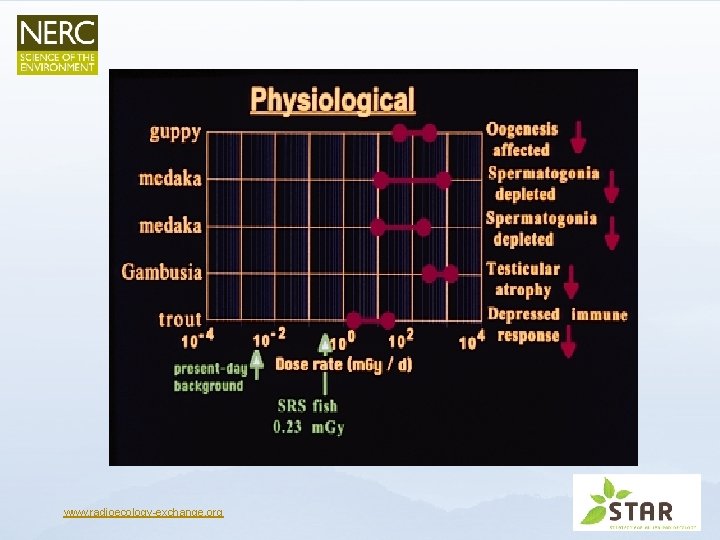
We need a point of reference; a known value to which we can compare… …a BENCHMARK value 10 μGy/h * 24 h / d = 240 μGy/d = 0. 2 m. Gy /d www. ceh. ac. uk/PROTECT
Reminders… ¥ The PNEDR: is a basic generic ecosystem screening value ¥ Can be applied to a number of situations requiring environmental and human risk assessment ¥ ¥ Be aware of: PNEDR was derived for use only in Tiers 1 and 2 of the ERICA Integrated Approach ¥ Use for incremental dose rates and not total dose rates which include background ¥
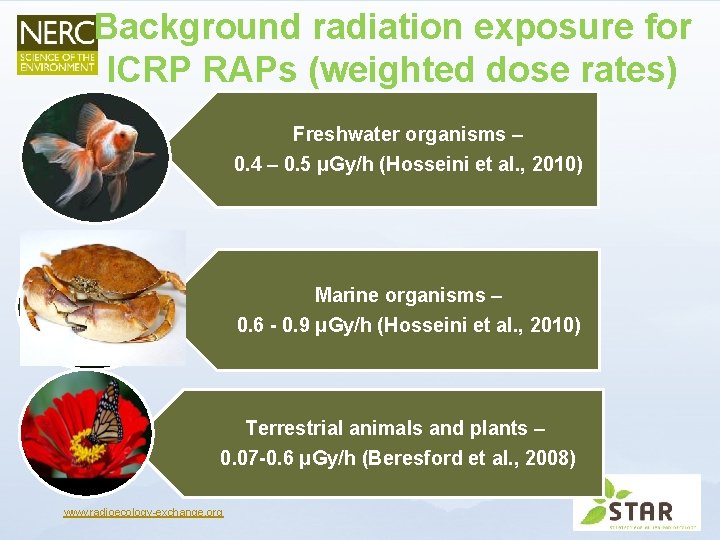
Background radiation exposure for ICRP RAPs (weighted dose rates) Freshwater organisms – 0. 4 – 0. 5 μGy/h (Hosseini et al. , 2010) Marine organisms – 0. 6 - 0. 9 μGy/h (Hosseini et al. , 2010) Terrestrial animals and plants – 0. 07 -0. 6 μGy/h (Beresford et al. , 2008) www. radioecology-exchange. org
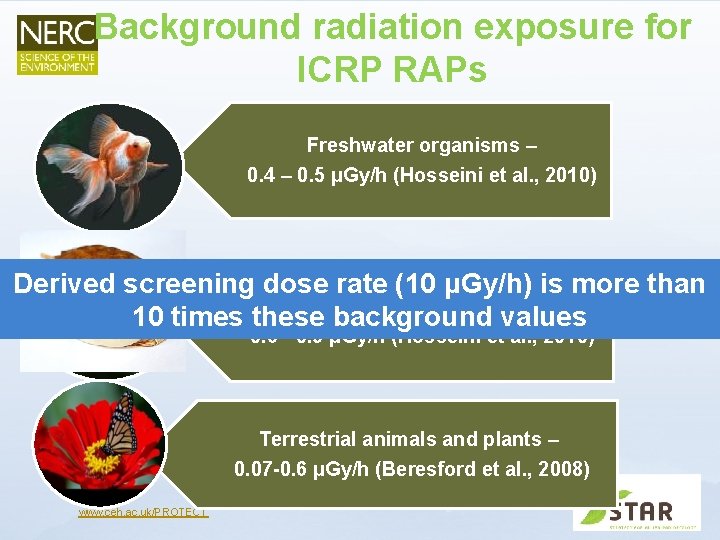
Background radiation exposure for ICRP RAPs Freshwater organisms – 0. 4 – 0. 5 μGy/h (Hosseini et al. , 2010) Derived screening dose rate (10 μGy/h) is more than Marine organisms – 10 times these background values 0. 6 - 0. 9 μGy/h (Hosseini et al. , 2010) Terrestrial animals and plants – 0. 07 -0. 6 μGy/h (Beresford et al. , 2008) www. ceh. ac. uk/PROTECT
Furthermore. . . ¥ The hazardous dose rate definition means that 95% of species would be protected at a 90% effect However, there may be keystone species among that are unprotected at the 10% level and the effect on the 5% may be > 10% ¥ Some keystone species will be more radiosensitive than others
Generic screening dose rate ERICA (default) and R&D 128 assume a single (generic) screening dose rate (i. e. application of predicted no effect dose rate) applicable across all species and ecosystems ¥ Advantage = simple ¥ PROTECT objective to consider scientifically robust determination of (generic) screening dose rate(s) ¥ What are limiting organisms for the 63 radionuclides considered in ERICA? ¥
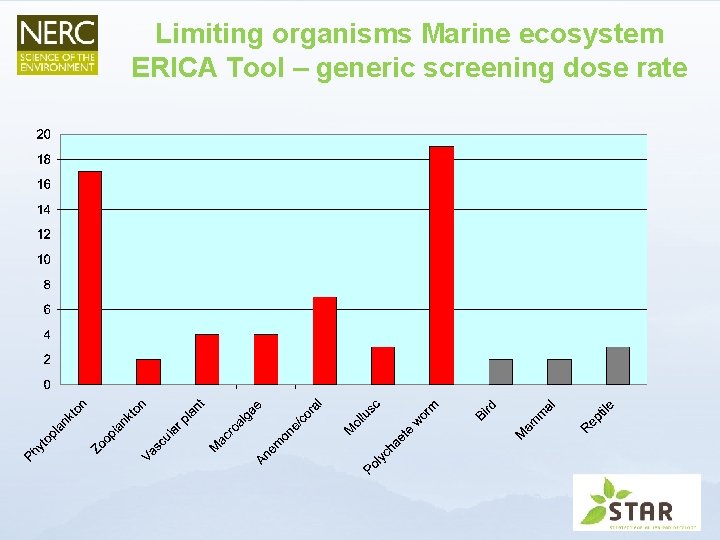
Limiting organisms Marine ecosystem ERICA Tool – generic screening dose rate
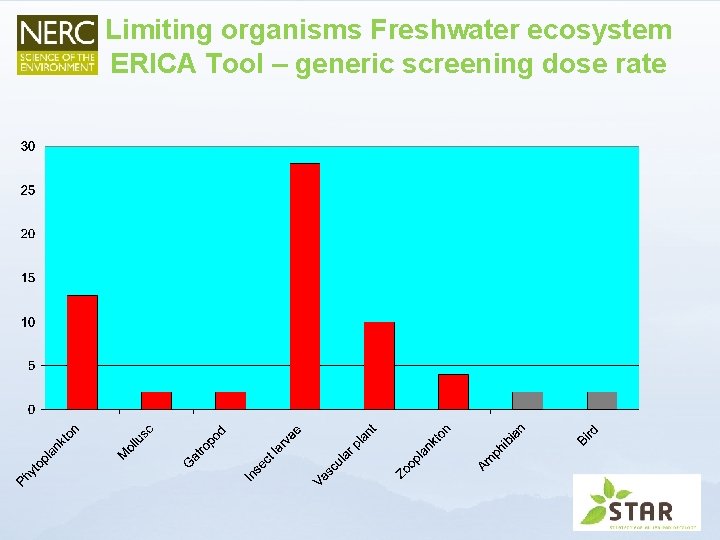
Limiting organisms Freshwater ecosystem ERICA Tool – generic screening dose rate
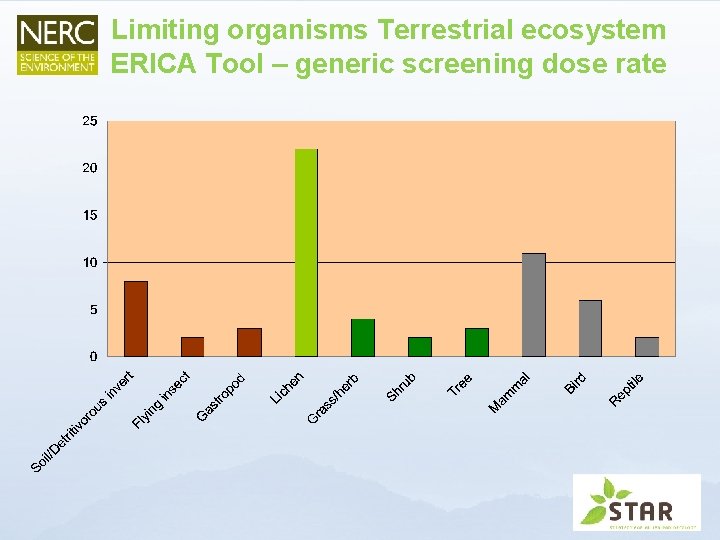
Limiting organisms Terrestrial ecosystem ERICA Tool – generic screening dose rate
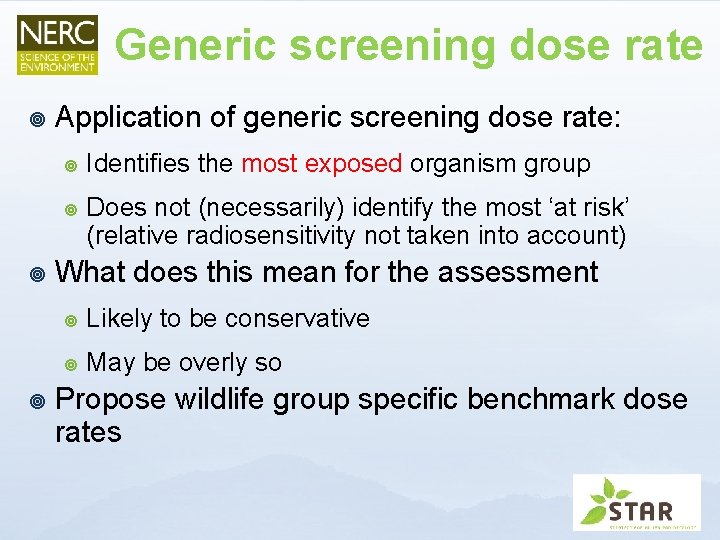
Generic screening dose rate ¥ Application of generic screening dose rate: ¥ ¥ Identifies the most exposed organism group Does not (necessarily) identify the most ‘at risk’ (relative radiosensitivity not taken into account) What does this mean for the assessment ¥ Likely to be conservative ¥ May be overly so Propose wildlife group specific benchmark dose rates
ICRP Approach
Effects ¥ As part of ICRP 108, effects considered ¥ No dose ‘limits’ but still need something to compare to ¥ …background ¥ …derived consideration reference levels www. radioecology-exchange. org
DCRLs ¥ Derived Consideration Reference Levels ¥ “A band of dose rate within which there is likely to be some chance of deleterious effects of ionising radiation occurring to individuals of that type of RAP (derived from a knowledge of expected biological effects for that type of organism) that, when considered together with other relevant information, can be used as a point of reference to optimise the level of effort expended on environmental protection, dependent upon the overall management objectives and the relevant exposure situation. ”
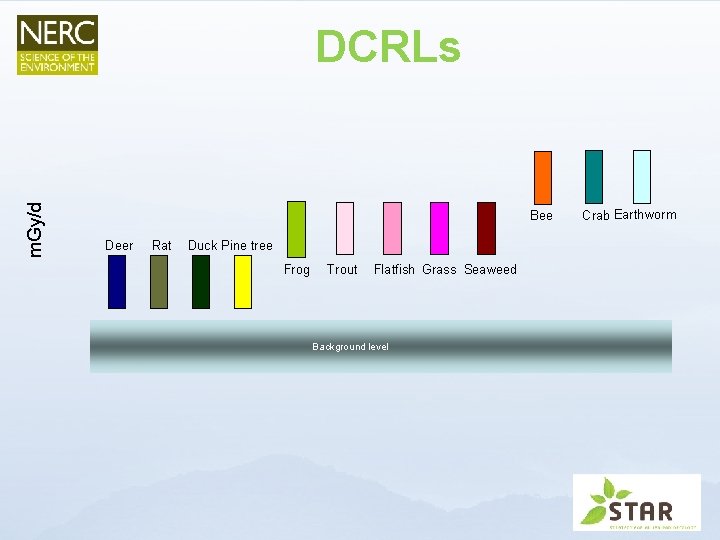
m. Gy/d DCRLs Bee Deer Rat Duck Pine tree Frog Trout Flatfish Grass Seaweed Background level Crab Earthworm
Application ¥ Provision of advice on how to use the RAP framework ¥ Likely to use ‘representative organism’ concept
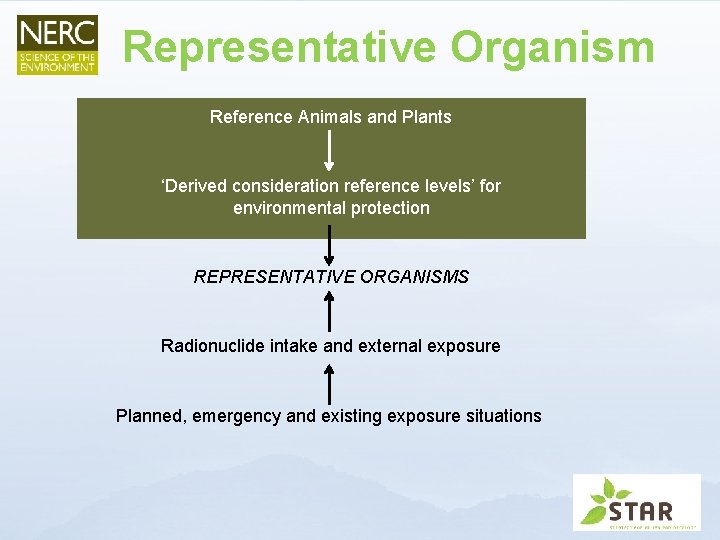
Representative Organism Reference Animals and Plants ‘Derived consideration reference levels’ for environmental protection REPRESENTATIVE ORGANISMS Radionuclide intake and external exposure Planned, emergency and existing exposure situations
Integration ¥ Integrating the ICRP systems of protection for humans and non-human species Consider ethics and values ¥ Consider how principles of justification, optimisation etc apply to both humans and nonhuman species ¥ Consider the principles used in chemical risk assessment/protection ¥
What is a benchmark? Benchmarks are numerical values used to guide risk assessors at various decision points in a tiered approach In radiation protection, usually applied as the incremental dose ABOVE background www. radioecology-exchange. org
How are benchmarks derived? ¥ Quantitative approach eg chemicals ¥ Safety factor, SSD ¥ ICRP – will use DCRL values ¥ Are they benchmarks? Currently summarise where biological effects are likely to occur ¥ C 5 is working on how the DCRLs can be incorporated into the wider ICRP system of radiological protection ¥
Summary ¥ Range of methods for deriving benchmarks ¥ Range of benchmarks proposed ¥ Be careful with the wording around the benchmark ¥ What does it reflect? ¥ Look for clear, well documented benchmark values ¥ Watch this space for further developments! www. radioecology-exchange. org
Combining chemical and radioactive risk assessments www. radioecology-exchange. org
Dealing with mixtures ¥ Adding apples and pears together… Garnier-Laplace et al 2009 ¥ Outlined a possible method for combined risk assessment in freshwater ecosystems ¥ Uses an assumption of zero interactions between substances when in mixture ¥ Uses the outputs of SSDs ¥ Hazardous concentration … ¥ Hazardous dose rate … ¥ …affecting 50% of species ¥ www. radioecology-exchange. org
Dealing with mixtures ¥ Adding apples and pears together… Potentially affected fraction (PAF) (50%) ¥ Back calculate concentration in media for each chemical and radionuclide ¥ ¥ ¥ Can then use these data to rank (essentially RQ) each contaminant in terms of potentially impact But… www. radioecology-exchange. org
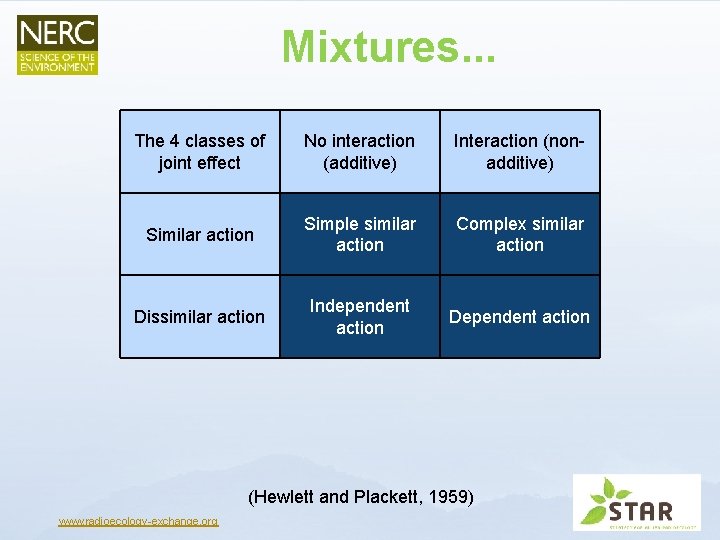
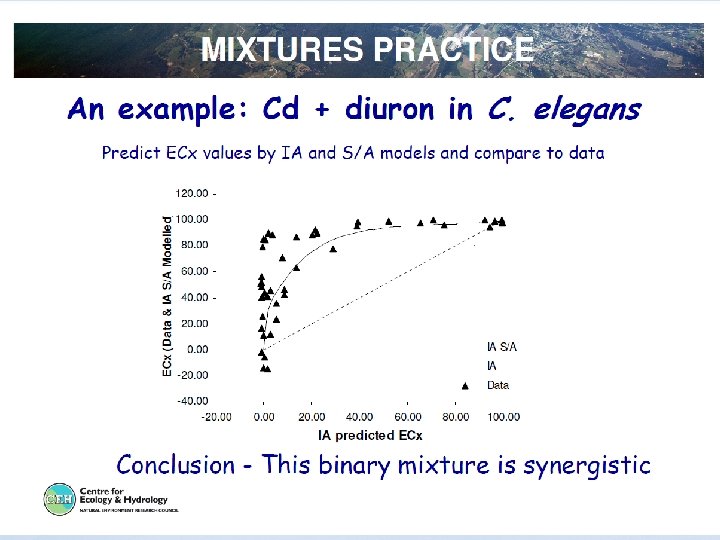
Mixtures. . . The 4 classes of joint effect No interaction (additive) Interaction (nonadditive) Similar action Simple similar action Complex similar action Dissimilar action Independent action Dependent action (Hewlett and Plackett, 1959) www. radioecology-exchange. org
www. ceh. ac. uk/PROTECT
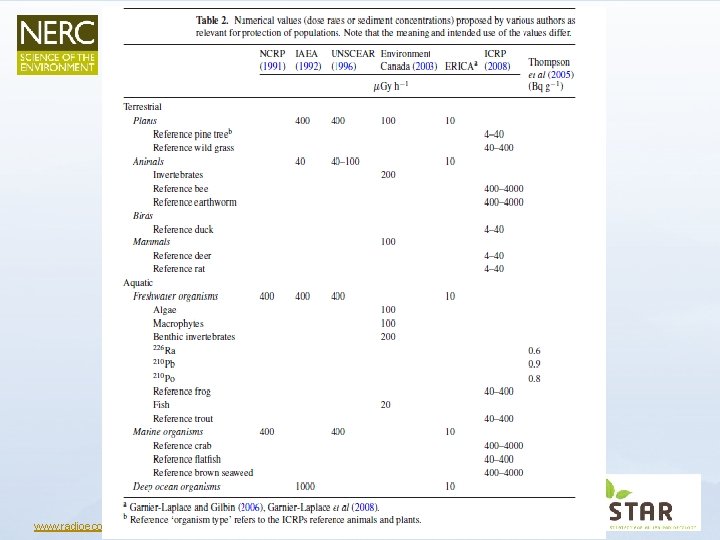
Caveats. . . ¥ Adapted text in the older documents from NCRP (1991), IAEA (1992) and UNSCEAR (1996) is given below: ¥ ¥ ¥ NCRP Aquatic organisms: it appears that a chronic dose rate of no greater than 0. 4 m. Gy h− 1 to the maximally exposed individual in a population of aquatic organisms would ensure protection for the population. If modelling and/or dosimetric measurements indicate a level of 0. 1 m. Gy h− 1, then a more detailed evaluation of the potential ecological consequences to the endemic population should be conducted IAEA Terrestrial organisms: irradiation at chronic dose rates of 10 m. Gy d− 1 and 1 m. Gy d− 1 or less does not appear likely to cause observable changes in terrestrial plant and animal populations respectively. Aquatic organisms: it appears that limitation of the dose rate to the maximally exposed individuals in the population to <10 m. Gy d− 1 would provide adequate protection for the populations UNSCEAR Terrestrial plants: chronic dose rates less than 400 μGy h− 1 (10 m. Gy d− 1) would have effects, although slight, in sensitive plants but would be unlikely to have significant deleterious effects in the wider range of plants present in natural plant communities. Terrestrial animals: for the most sensitive animal species, mammals, there is little indication that dose rates of 400 μGy h− 1 to the most exposed individual would seriously affect mortality in the population. For dose rates up to an order of magnitude less (40– 100 μGy h− 1), the same statement could be made with respect to reproductive effects. Aquatic organisms: for aquatic organisms, the general conclusion was that maximum dose rates of 400 μGy h− 1 to a small proportion of the individuals and, therefore, a lower average dose rate to the remaining organisms would not have any detrimental effects at the population level www. radioecology-exchange. org
- Slides: 53