
The denial of moral truth objections Michael Lacewing
The denial of moral truth: objections Michael Lacewing enquiries@alevelphilosophy. co. uk

Metaethics • Metaphysics: what kind of thing is morality? – Is it objective (mind-independent), is it relative to societies/cultures, or is it subjective (mind-dependent)? • Epistemology: how can we discover moral truths?

Metaethics • Moral thought and language: what kind of thinking is moral thinking? – E. g. does it represent the world or not? What are moral judgments? – What does moral disagreement amount to, and what is moral argument actually doing?

Two positions • Cognitivism: moral judgments express beliefs and can be true or false • Non-cognitivism: there are no moral beliefs; moral attitudes do not represent the world; moral judgments are reflections of our attitudes, and do not describe the world

Emotivism • Moral statements are neither true nor false: – If I say to someone, “You acted wrongly in stealing that money”…I am simply evincing my moral disapproval of it. It is as if I had said, “You stole that money, ” in a peculiar tone of horror’. (Ayer, Language, Truth and Logic, p. 146)
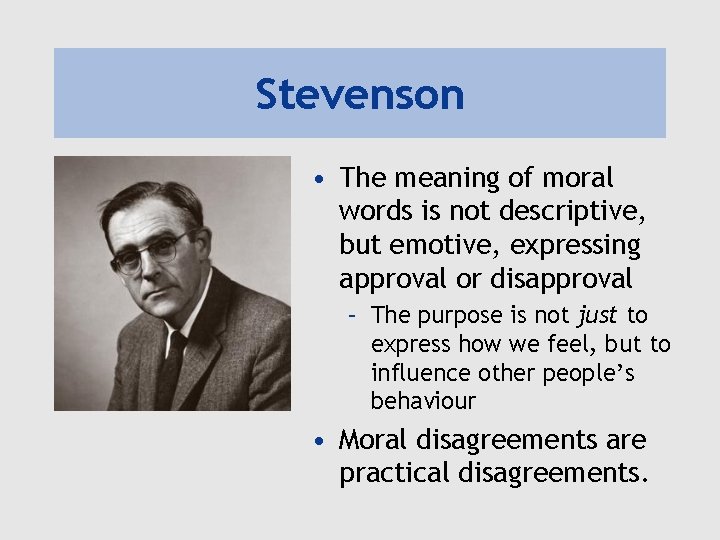
Stevenson • The meaning of moral words is not descriptive, but emotive, expressing approval or disapproval – The purpose is not just to express how we feel, but to influence other people’s behaviour • Moral disagreements are practical disagreements.
The limits of value • Non-cognitivism doesn’t identify any limits to morality, because it equates morality with approval or disapproval – If what we value isn’t restricted by what s objectively valuable, it seems we could approve or disapprove of anything. – But morality isn’t about just anything, but about sympathy, courage, happiness, etc. – it is about what is good for people.
The limits of value • Morality is non-cognitive, but psychologically, we can’t value just anything – There is no logical restriction on approval but there is a psychological one – Human nature underlies what we value – but it is our feelings that create value
The nature of approval • What is the distinction between moral approval and non-moral, e. g. aesthetic, approval? – What makes approval ‘moral’? • The non-cognitivist analyses morality in terms of (moral) approval – but what explains the ‘moral’ nature of approval?
Condemning immorality • If there is no objective moral truth, then does ‘anything go’? What is the authority of morality? – If my morality is different from yours, but both are subjective, on what authority can I condemn your morality? • Tolerance can be a virtue, but when we tolerate what is immoral, this is a vice
Condemning immorality • If morality is subjective, then is it anything more than a matter of taste? • Reply: this is a misunderstanding – Living as though there are no moral values is itself a kind of choice, an immoral one – Non-cognitivism does not entail that we should stop having moral feelings!
Tolerance • The denial of moral truth does not lead to tolerance – Tolerance is a value: ‘You ought to tolerate other people’s values, because there are no moral values’ is selfcontradictory – Tolerance has limits – preventing murder is more important than being tolerant
Moral progress • If there is no moral reality, then our moral beliefs or feelings cannot become better or worse. – They may have changed, but change is not progress if there is no truth. • Reply: people’s views can change for the better in non-moral ways, e. g. become more informed or rational (consistent or coherent)
Moral progress • Reply 2: people’s views can become better in moral ways: – If we disapprove of past moral codes and approve of our own moral code, then we will say that we have made moral progress. • Moral progress is relative to a particular point of view – but this is just the usual problem of moral disagreement
- Slides: 14