
The Demographic Transition Model Links to Rostows Ladder
- Slides: 13
The Demographic Transition Model Links to Rostow’s Ladder of Economic Development (Modernization Model)
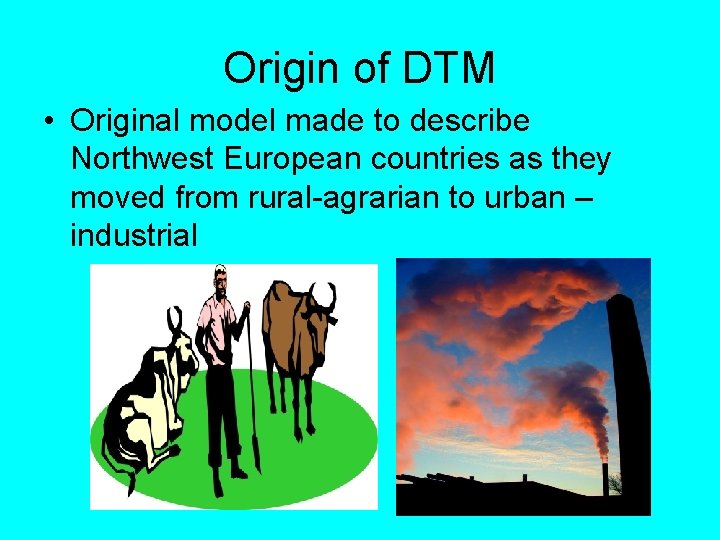
Origin of DTM • Original model made to describe Northwest European countries as they moved from rural-agrarian to urban – industrial
Origin cont… • Western Europe entered 2 nd Stage of DTM with industrialization 1750 • Its effects – declining death rates with high birth rates • Rapidly increasing population during 2 nd Stage results from dramatic increases in life expectancy. • Reflects falling death rates due to advances in medical and sanitation practices, rising per capita incomes, urbanization that provides environment where medicine and food distribution improvements are concentrated.
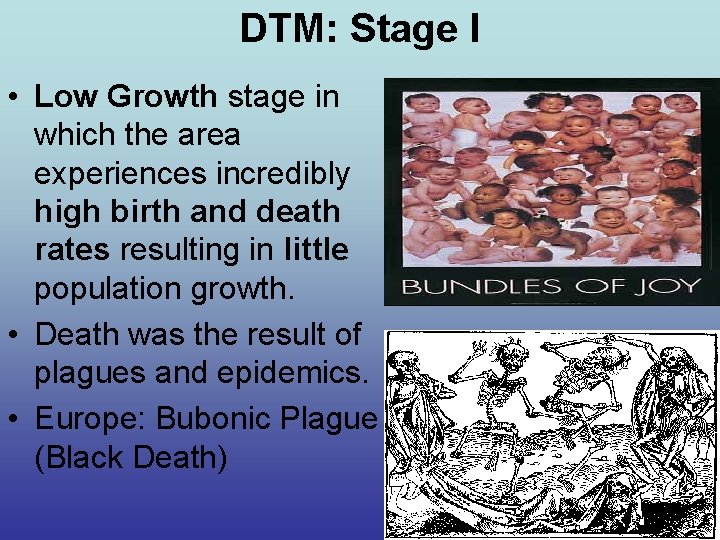
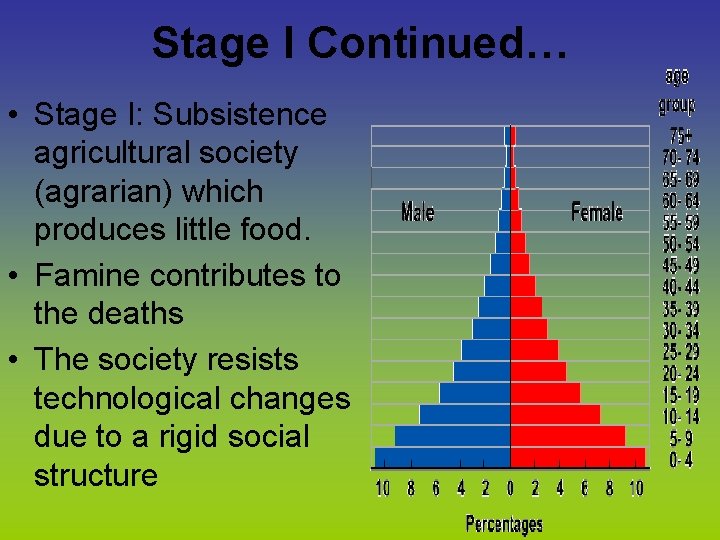
DTM: Stage I • Low Growth stage in which the area experiences incredibly high birth and death rates resulting in little population growth. • Death was the result of plagues and epidemics. • Europe: Bubonic Plague (Black Death)
Stage I Continued… • Stage I: Subsistence agricultural society (agrarian) which produces little food. • Famine contributes to the deaths • The society resists technological changes due to a rigid social structure
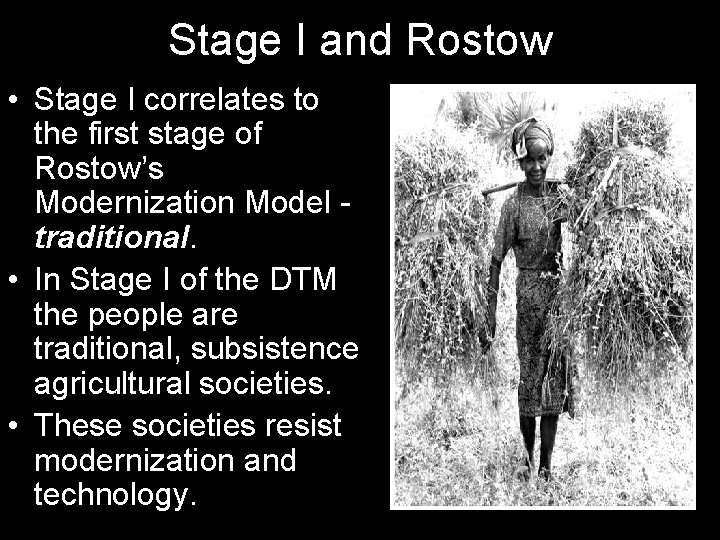
Stage I and Rostow • Stage I correlates to the first stage of Rostow’s Modernization Model traditional. • In Stage I of the DTM the people are traditional, subsistence agricultural societies. • These societies resist modernization and technology.
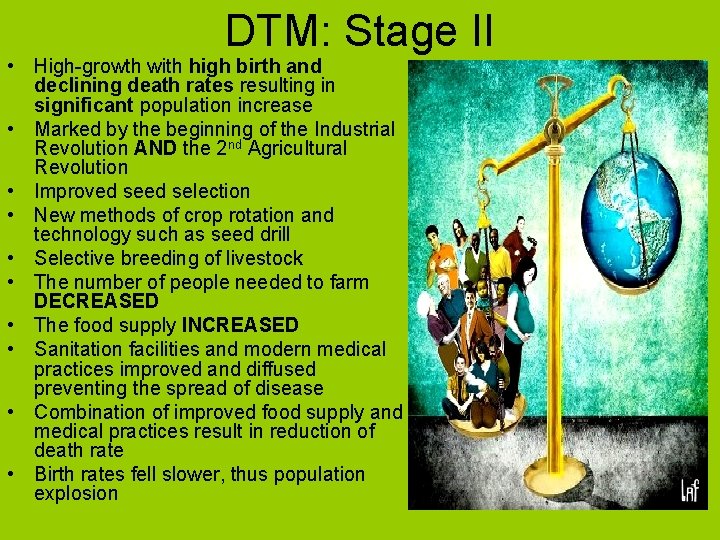
DTM: Stage II • High-growth with high birth and declining death rates resulting in significant population increase • Marked by the beginning of the Industrial Revolution AND the 2 nd Agricultural Revolution • Improved selection • New methods of crop rotation and technology such as seed drill • Selective breeding of livestock • The number of people needed to farm DECREASED • The food supply INCREASED • Sanitation facilities and modern medical practices improved and diffused preventing the spread of disease • Combination of improved food supply and medical practices result in reduction of death rate • Birth rates fell slower, thus population explosion
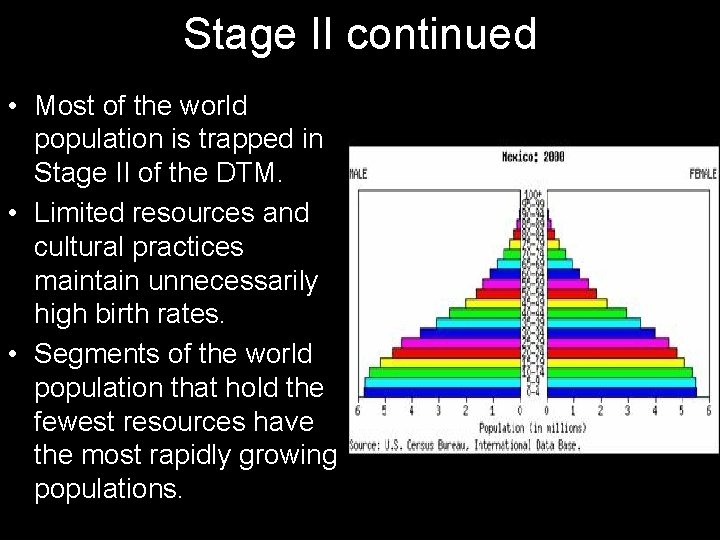
Stage II continued • Most of the world population is trapped in Stage II of the DTM. • Limited resources and cultural practices maintain unnecessarily high birth rates. • Segments of the world population that hold the fewest resources have the most rapidly growing populations.
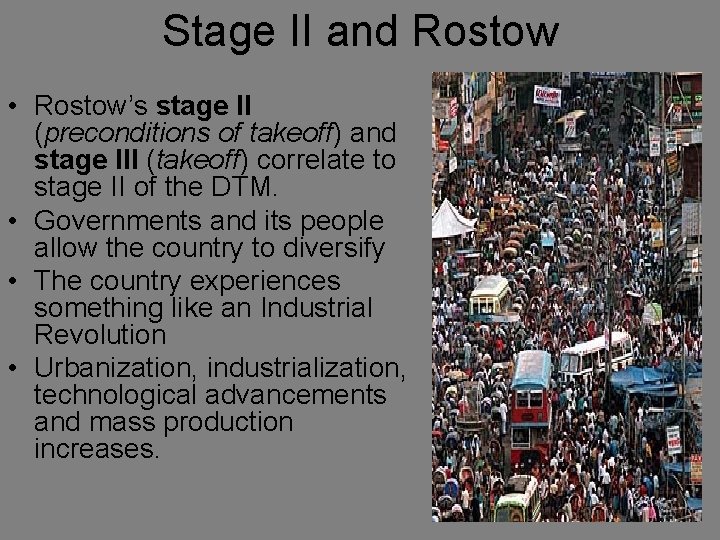
Stage II and Rostow • Rostow’s stage II (preconditions of takeoff) and stage III (takeoff) correlate to stage II of the DTM. • Governments and its people allow the country to diversify • The country experiences something like an Industrial Revolution • Urbanization, industrialization, technological advancements and mass production increases.
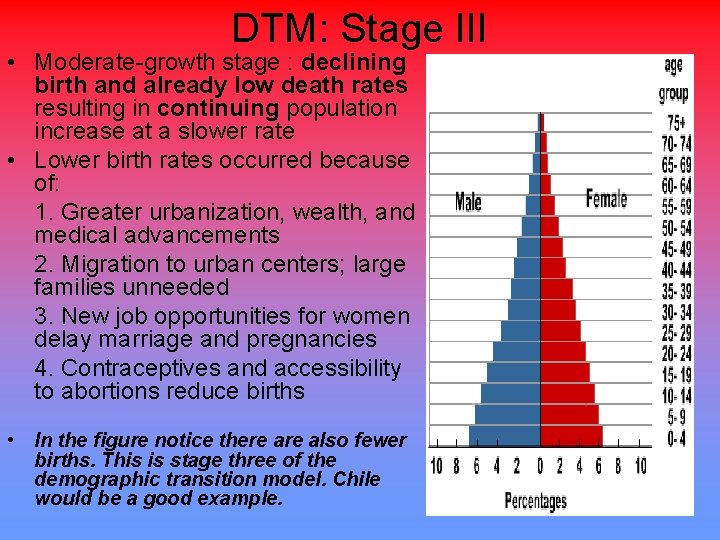
DTM: Stage III • Moderate-growth stage : declining birth and already low death rates resulting in continuing population increase at a slower rate • Lower birth rates occurred because of: 1. Greater urbanization, wealth, and medical advancements 2. Migration to urban centers; large families unneeded 3. New job opportunities for women delay marriage and pregnancies 4. Contraceptives and accessibility to abortions reduce births • In the figure notice there also fewer births. This is stage three of the demographic transition model. Chile would be a good example.
Stage III and Rostow • Stage III of the DTM corresponds with Rostow’s 4 th stage, Drive to Maturity • Technologies diffuse • Industrialization and international trade expand • Modernization occurs • Population grows slowly
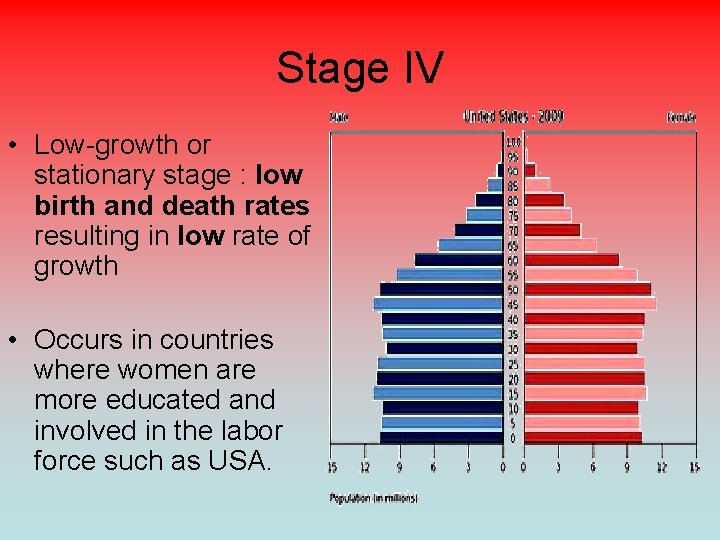
Stage IV • Low-growth or stationary stage : low birth and death rates resulting in low rate of growth • Occurs in countries where women are more educated and involved in the labor force such as USA.
Stage IV and Rostow • Stage IV of the DTM corresponds to Rostow’s final stage of High Mass Consumption • Countries in this stage will have high incomes and widespread production of many goods and services • Majority of workers enter the service sector of the economy