
The dehesa agroforestry system in the Iberian Peninsula
The dehesa agroforestry system in the Iberian Peninsula Juan M. Domingo Santos & Reyes Alejano University of Huelva, Spain juan. domingo@uhu. es
Notes for instructors and users Juan M. Domingo-Santos & Reyes Alejano (University of Huelva, Spain) provided this presentation to HNV-Link Project. The HNV-Link project team adapted it for inclusion in the educational package on High Nature Value farming. Notes are based partly on the information in the listed sources. Other resources of the education package are available www. hnvlink. eu. It is an Open Source material under CC BY-NC-SA. You may use freely any elements of it or as a whole, also modifying as fit, as long as you cite the project and its funding and use is for non-commercial purposes. Observe copyrights for images: unless otherwise specified, images are copyright by the authors. THIS PROJECT HAS RECEIVED FUNDING FROM THE EUROPEAN UNION HORIZON 2020 RESEARCH AND INNOVATION PROGRAMME UNDER GRANT AGREEMENT NO. 696391 2 2
Content • • What is Dehesa? Products obtained from the dehesa Services provided by the dehesa Reasons for dehesas’ existence and maintenance Current threats Conservation values Management recommendations
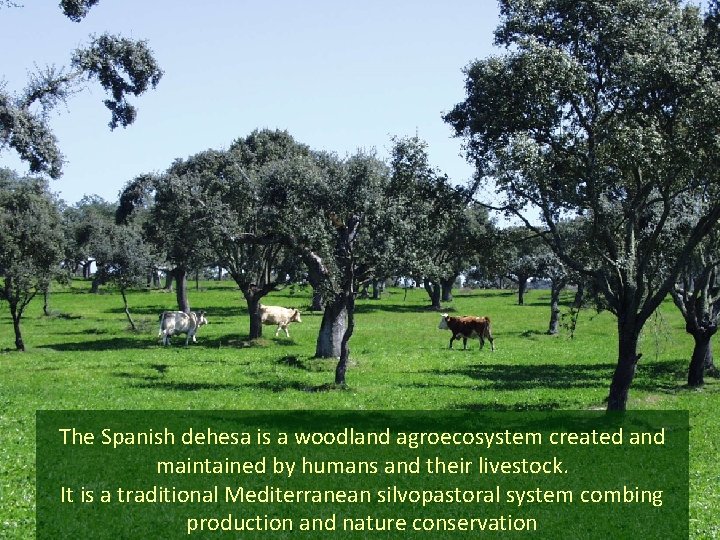
The Spanish dehesa is a woodland agroecosystem created and maintained by humans and their livestock. It is a traditional Mediterranean silvopastoral system combing production and nature conservation
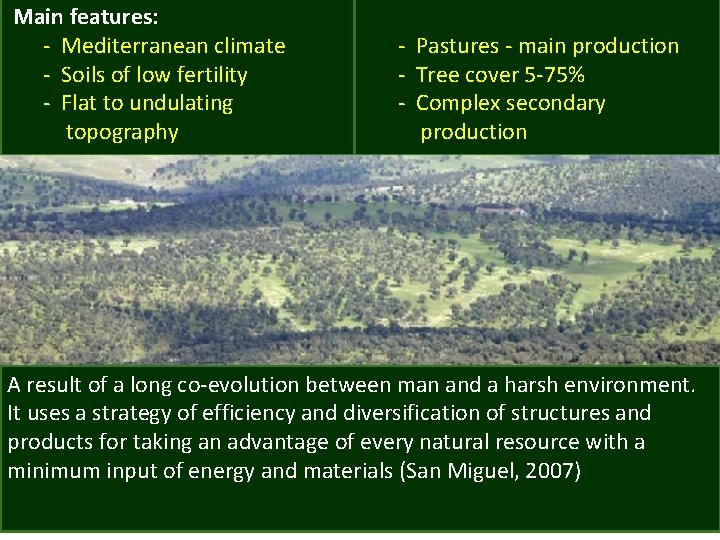
Main features: - Mediterranean climate - Soils of low fertility - Flat to undulating topography - Pastures - main production - Tree cover 5 -75% - Complex secondary production A result of a long co-evolution between man and a harsh environment. It uses a strategy of efficiency and diversification of structures and products for taking an advantage of every natural resource with a minimum input of energy and materials (San Miguel, 2007)
? Dehesa ?
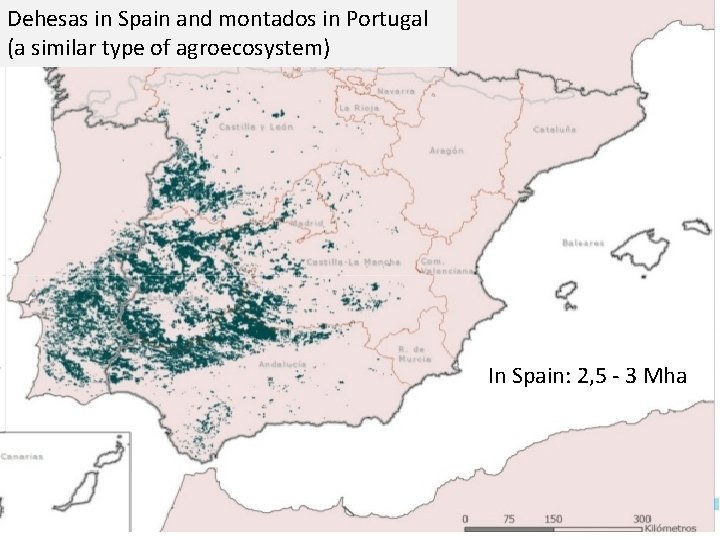
Dehesas in Spain and montados in Portugal (a similar type of agroecosystem) In Spain: 2, 5 - 3 Mha
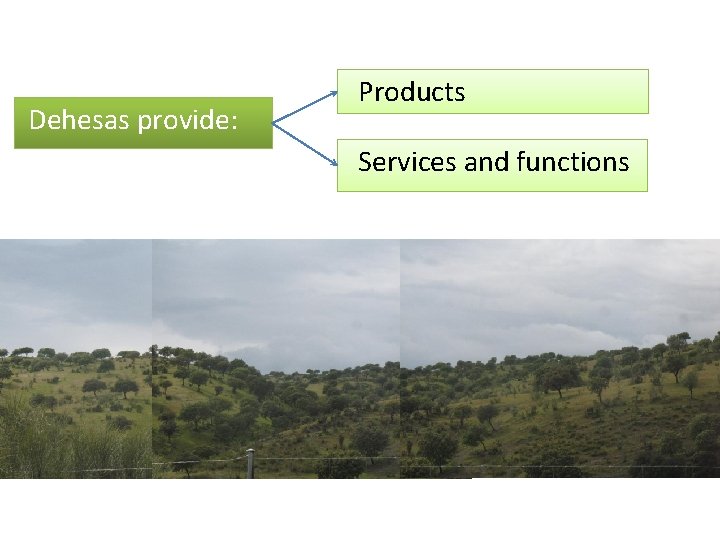
Dehesas provide: Products Services and functions
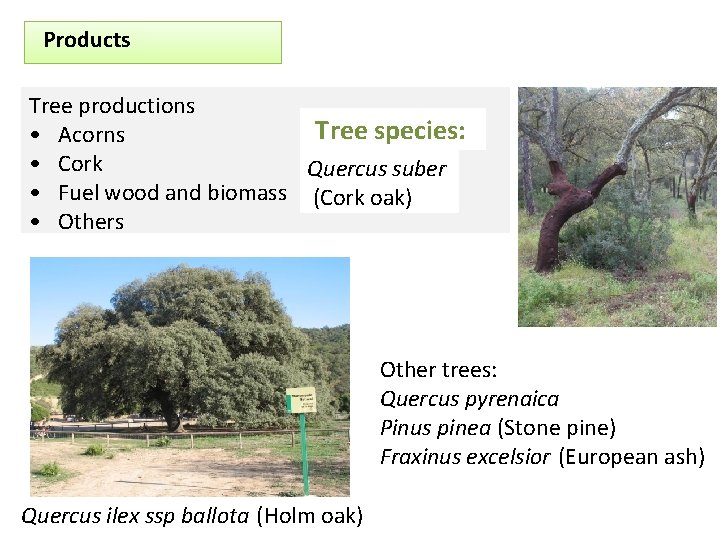
Products Tree productions Tree species: • Acorns • Cork Quercus suber • Fuel wood and biomass (Cork oak) • Others Other trees: Quercus pyrenaica Pinus pinea (Stone pine) Fraxinus excelsior (European ash) Quercus ilex ssp ballota (Holm oak)
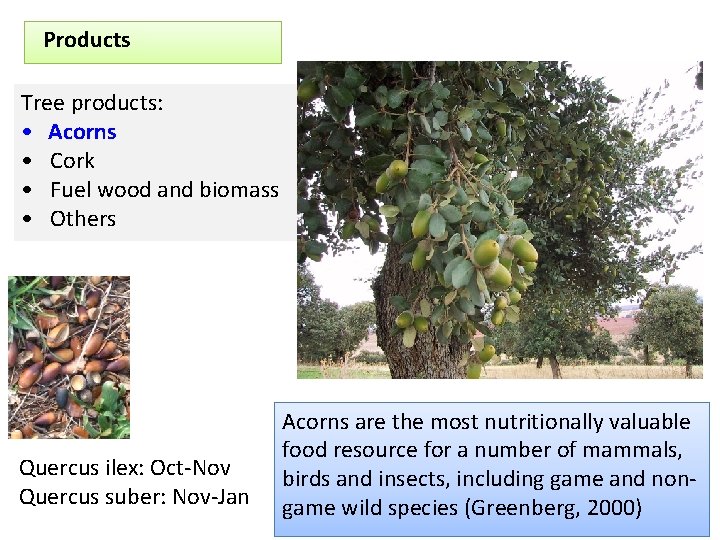
Products Tree products: • Acorns • Cork • Fuel wood and biomass • Others Quercus ilex: Oct-Nov Quercus suber: Nov-Jan Acorns are the most nutritionally valuable food resource for a number of mammals, birds and insects, including game and nongame wild species (Greenberg, 2000)
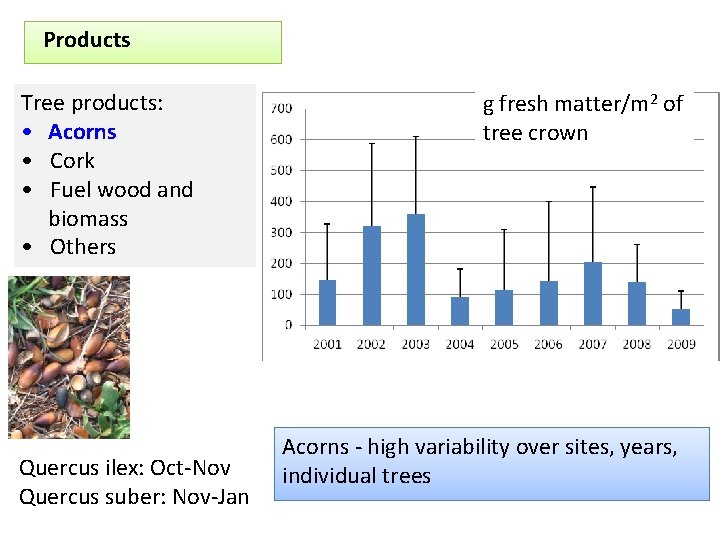
Products Tree products: • Acorns • Cork • Fuel wood and biomass • Others Quercus ilex: Oct-Nov Quercus suber: Nov-Jan g fresh matter/m 2 of tree crown Acorns - high variability over sites, years, individual trees
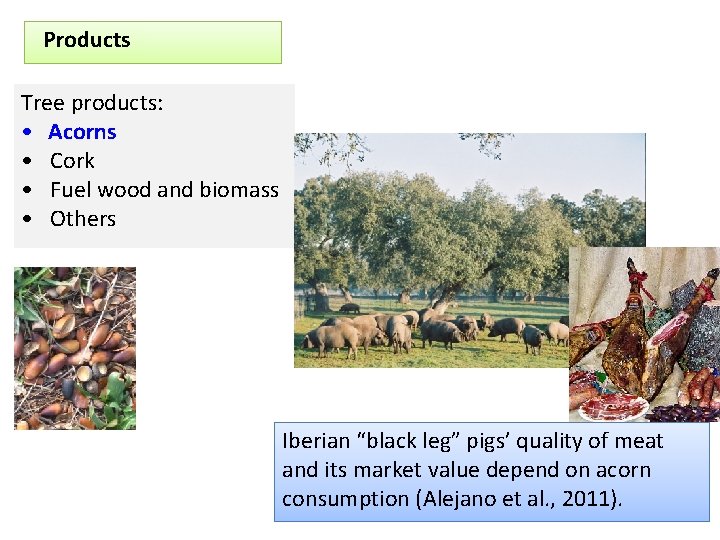
Products Tree products: • Acorns • Cork • Fuel wood and biomass • Others Iberian “black leg” pigs’ quality of meat and its market value depend on acorn consumption (Alejano et al. , 2011).
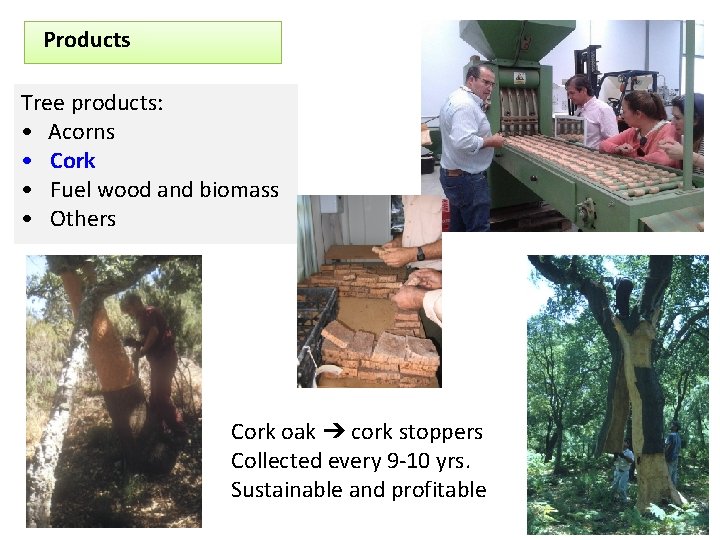
Products Tree products: • Acorns • Cork • Fuel wood and biomass • Others Cork oak ➔ cork stoppers Collected every 9 -10 yrs. Sustainable and profitable
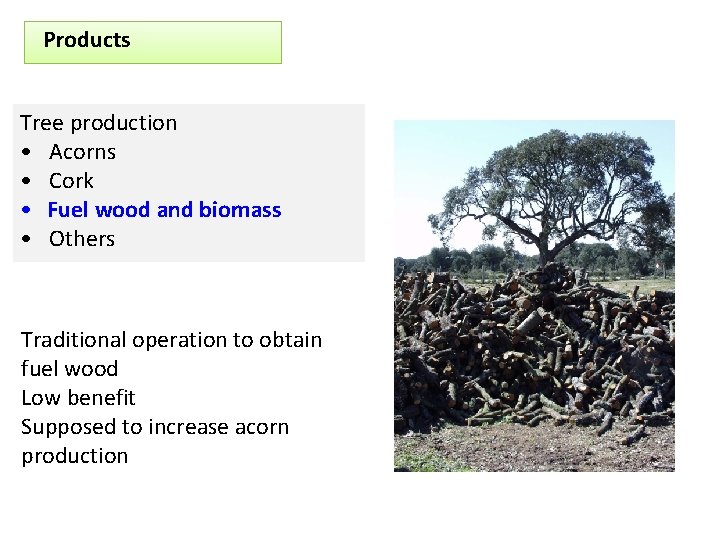
Products Tree production • Acorns • Cork • Fuel wood and biomass • Others Traditional operation to obtain fuel wood Low benefit Supposed to increase acorn production
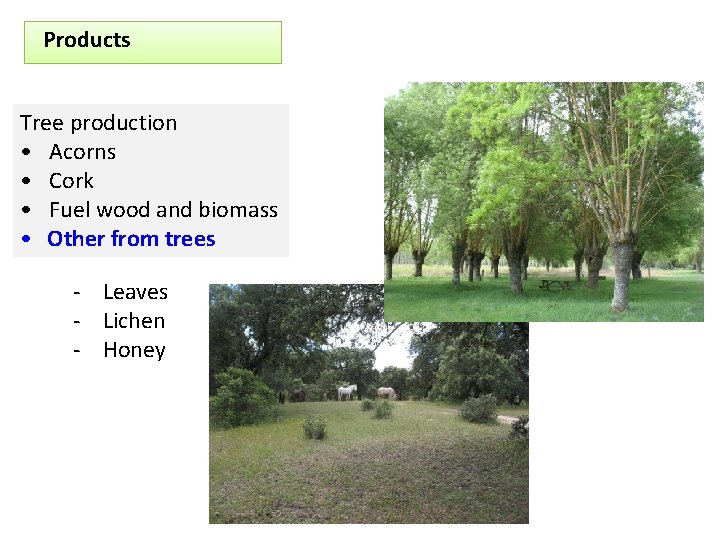
Products Tree production • Acorns • Cork • Fuel wood and biomass • Other from trees - Leaves - Lichen - Honey
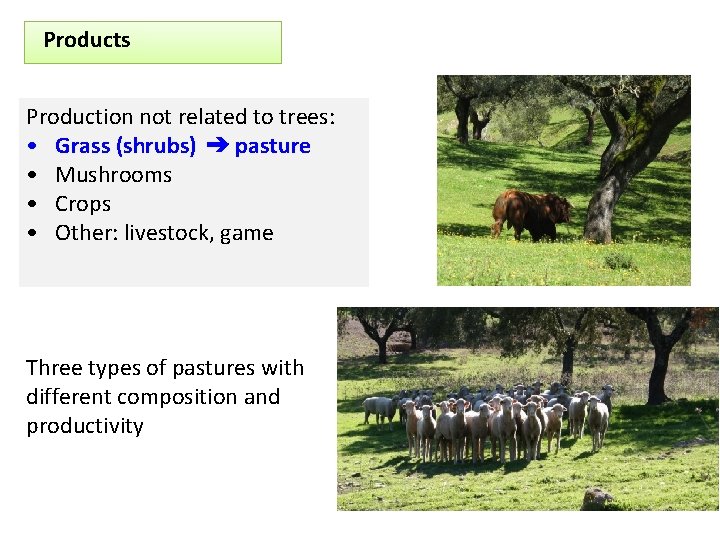
Products Production not related to trees: • Grass (shrubs) ➔ pasture • Mushrooms • Crops • Other: livestock, game Three types of pastures with different composition and productivity
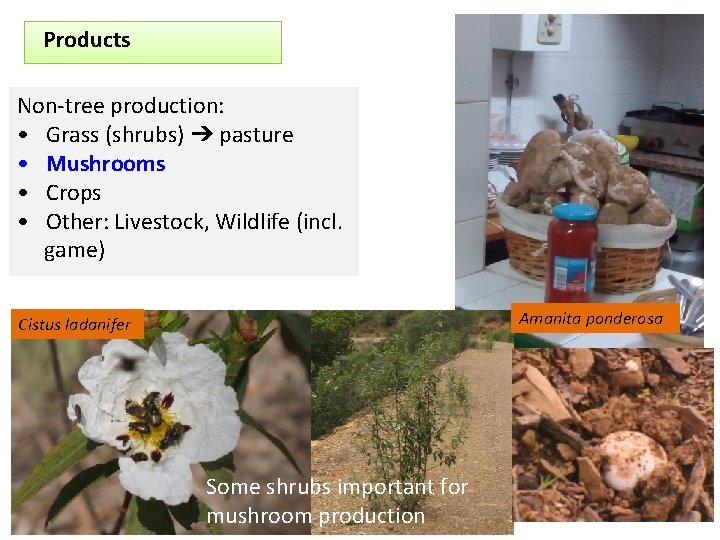
Products Non-tree production: • Grass (shrubs) ➔ pasture • Mushrooms • Crops • Other: Livestock, Wildlife (incl. game) Amanita ponderosa Cistus ladanifer Some shrubs important for mushroom production
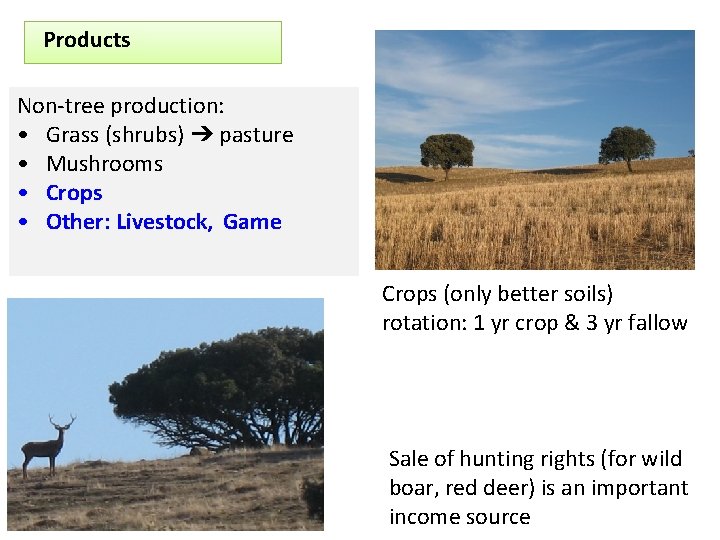
Products Non-tree production: • Grass (shrubs) ➔ pasture • Mushrooms • Crops • Other: Livestock, Game Crops (only better soils) rotation: 1 yr crop & 3 yr fallow Sale of hunting rights (for wild boar, red deer) is an important income source
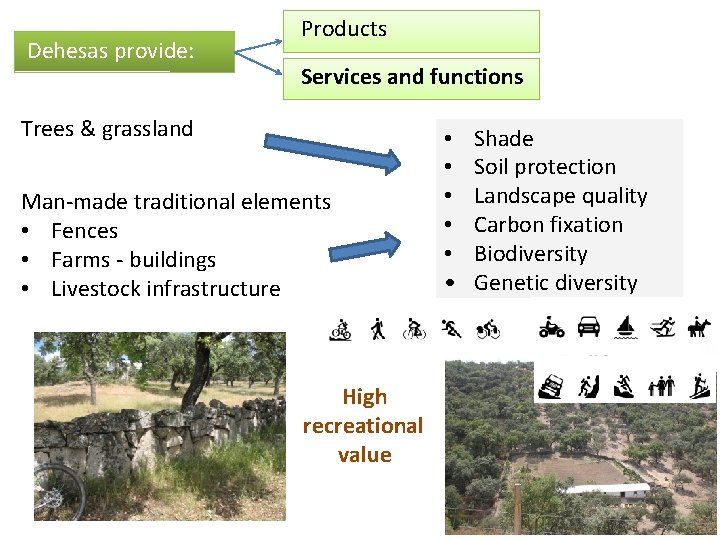
Dehesas provide: Products Services and functions Trees & grassland Man-made traditional elements • Fences • Farms - buildings • Livestock infrastructure High recreational value • • • Shade Soil protection Landscape quality Carbon fixation Biodiversity Genetic diversity
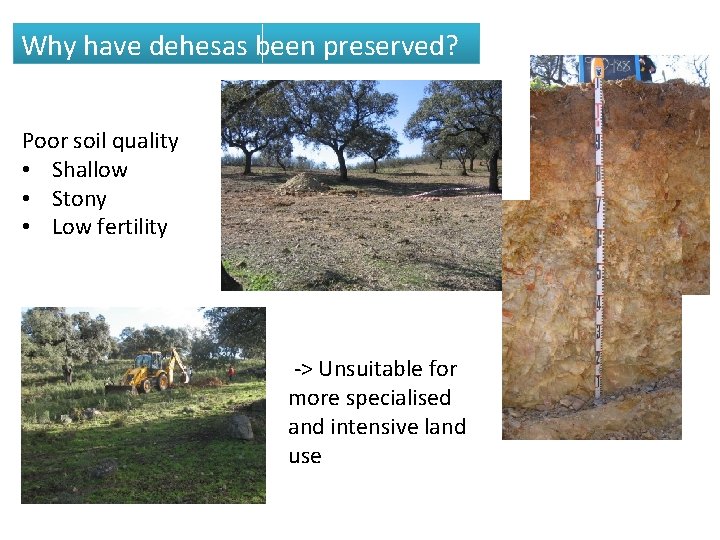
Why have dehesas been preserved? Poor soil quality • Shallow • Stony • Low fertility -> Unsuitable for more specialised and intensive land use
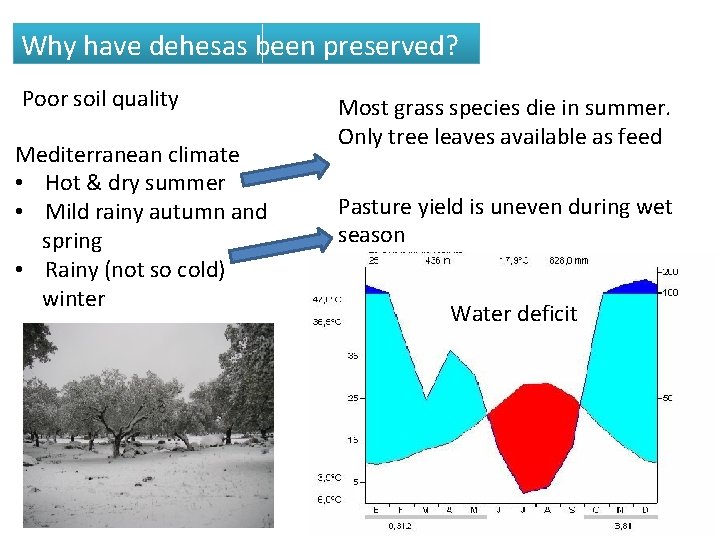
Why have dehesas been preserved? Poor soil quality Mediterranean climate • Hot & dry summer • Mild rainy autumn and spring • Rainy (not so cold) winter Most grass species die in summer. Only tree leaves available as feed Pasture yield is uneven during wet season Water deficit
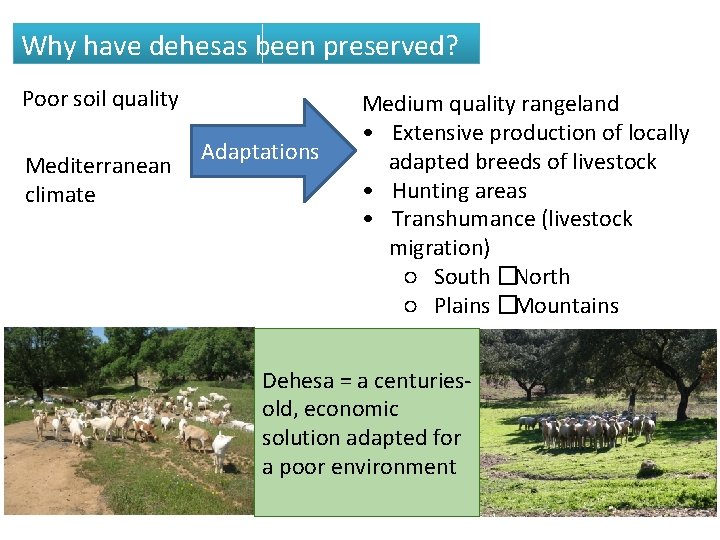
Why have dehesas been preserved? Poor soil quality Mediterranean climate Adaptations Medium quality rangeland • Extensive production of locally adapted breeds of livestock • Hunting areas • Transhumance (livestock migration) ○ South �North ○ Plains �Mountains Dehesa = a centuriesold, economic solution adapted for a poor environment
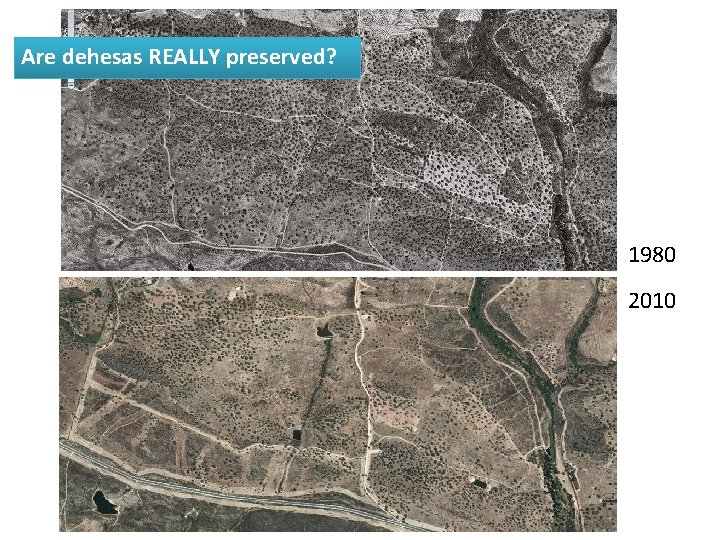
Are dehesas REALLY preserved? 1980 2010
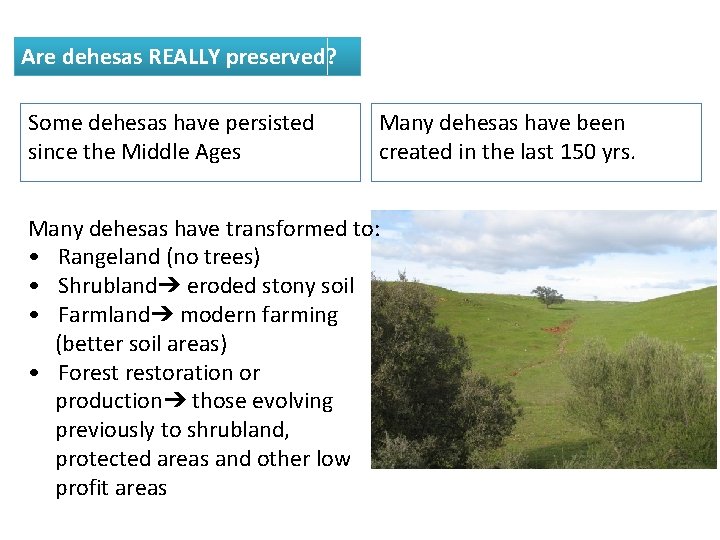
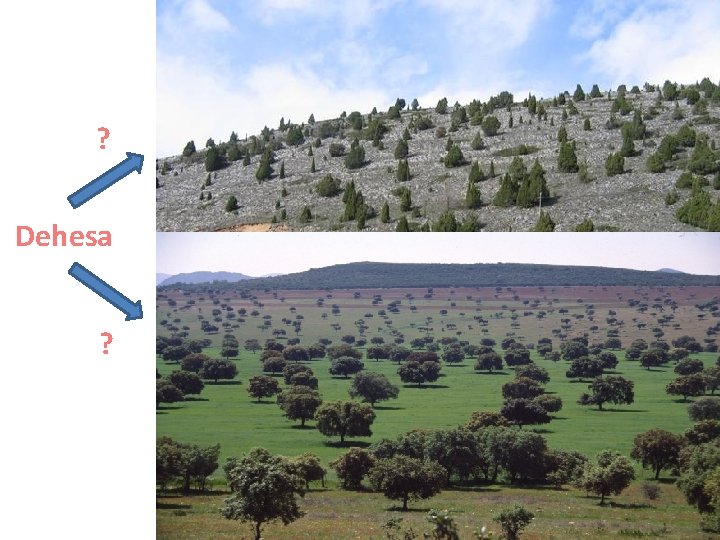
Are dehesas REALLY preserved? Some dehesas have persisted since the Middle Ages Many dehesas have been created in the last 150 yrs. Many dehesas have transformed to: • Rangeland (no trees) • Shrubland➔ eroded stony soil • Farmland➔ modern farming (better soil areas) • Forestoration or production➔ those evolving previously to shrubland, protected areas and other low profit areas
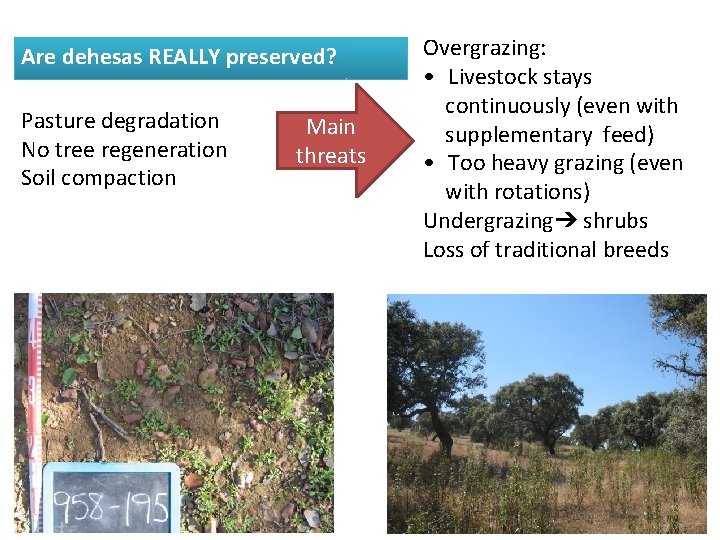
Are dehesas REALLY preserved? Pasture degradation No tree regeneration Soil compaction Main threats Overgrazing: • Livestock stays continuously (even with supplementary feed) • Too heavy grazing (even with rotations) Undergrazing➔ shrubs Loss of traditional breeds
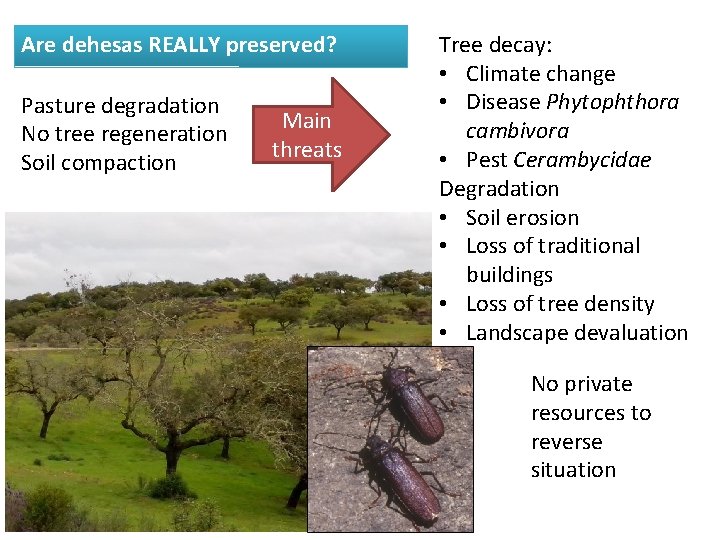
Are dehesas REALLY preserved? Pasture degradation No tree regeneration Soil compaction Main threats Tree decay: • Climate change • Disease Phytophthora cambivora • Pest Cerambycidae Degradation • Soil erosion • Loss of traditional buildings • Loss of tree density • Landscape devaluation No private resources to reverse situation
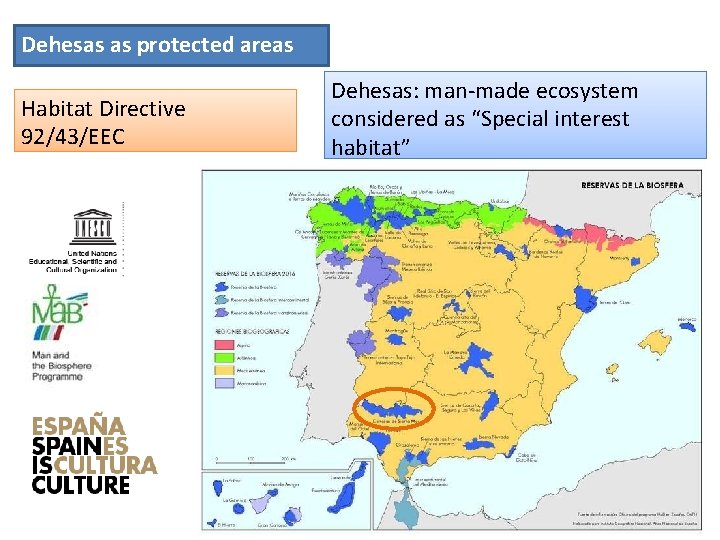
Dehesas as protected areas Habitat Directive 92/43/EEC Dehesas: man-made ecosystem considered as “Special interest habitat” Habitat # 6310
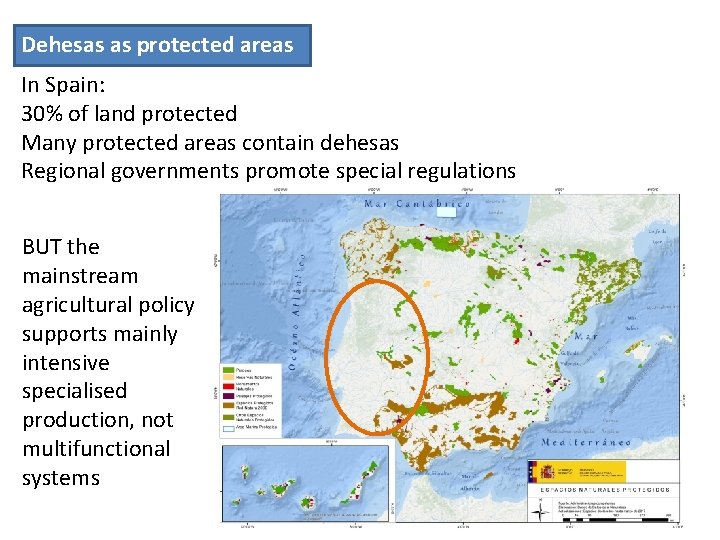
Dehesas as protected areas In Spain: 30% of land protected Many protected areas contain dehesas Regional governments promote special regulations BUT the mainstream agricultural policy supports mainly intensive specialised production, not multifunctional systems
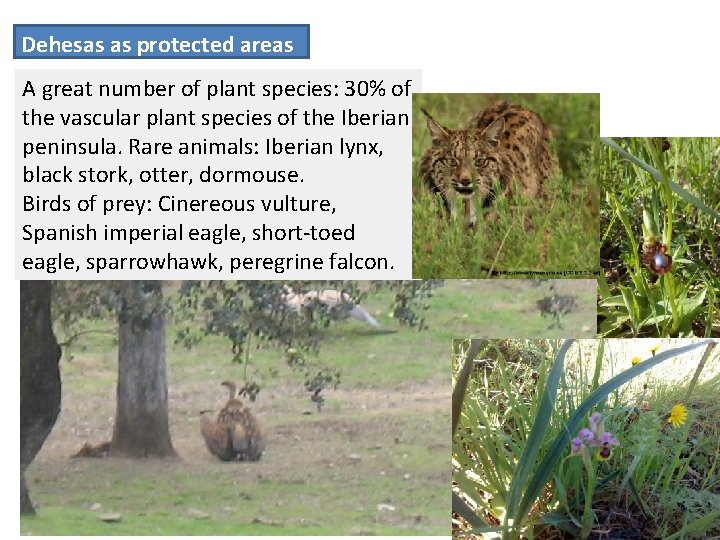
Dehesas as protected areas A great number of plant species: 30% of the vascular plant species of the Iberian peninsula. Rare animals: Iberian lynx, black stork, otter, dormouse. Birds of prey: Cinereous vulture, Spanish imperial eagle, short-toed eagle, sparrowhawk, peregrine falcon.
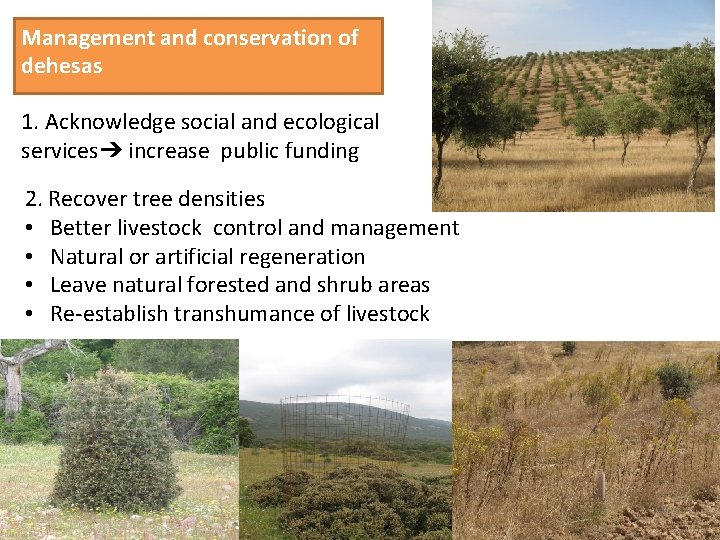
Management and conservation of dehesas 1. Acknowledge social and ecological services➔ increase public funding 2. Recover tree densities • Better livestock control and management • Natural or artificial regeneration • Leave natural forested and shrub areas • Re-establish transhumance of livestock
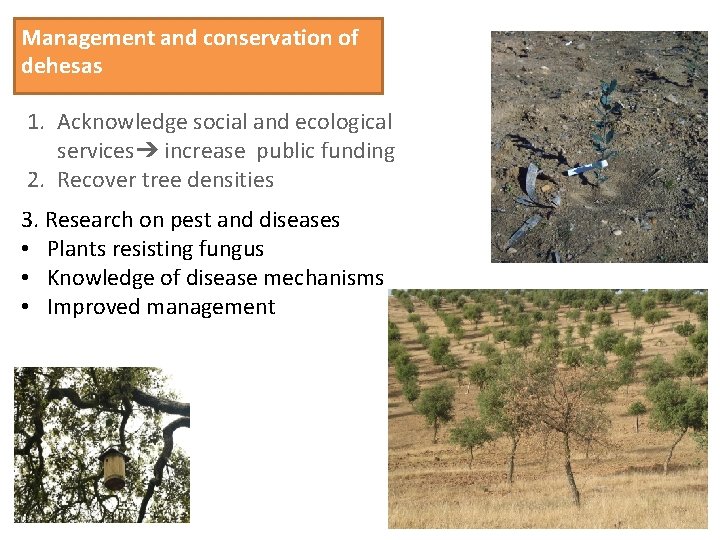
Management and conservation of dehesas 1. Acknowledge social and ecological services➔ increase public funding 2. Recover tree densities 3. Research on pest and diseases • Plants resisting fungus • Knowledge of disease mechanisms • Improved management
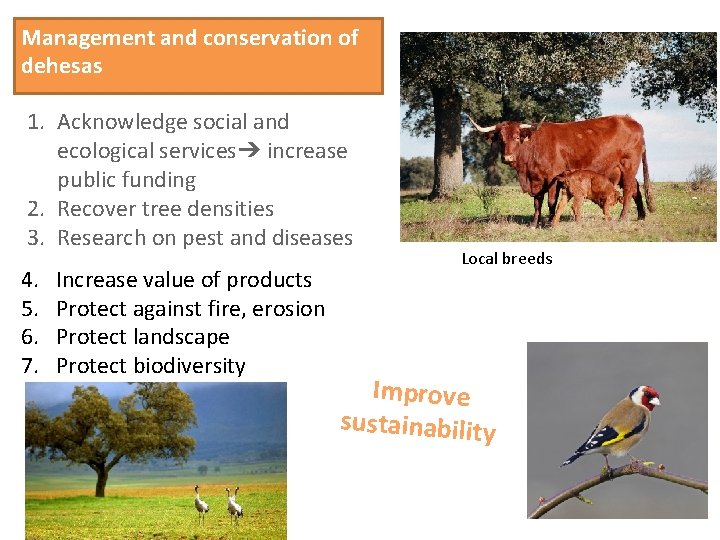
Management and conservation of dehesas 1. Acknowledge social and ecological services➔ increase public funding 2. Recover tree densities 3. Research on pest and diseases 4. 5. 6. 7. Increase value of products Protect against fire, erosion Protect landscape Protect biodiversity Local breeds Improve sustainability
Sources: Alejano, R. , Vázquez-Piqué, F. J. , Domingo-Santos J. M. , Fernández Martínez, M. , Andivia-Muñoz, E. , Martín Pérez, D. , Pérez-Carral, C. , González Pérez, M. A. 2013. Dehesas: Open woodland forests of Quercus in Southwestern Spain. In Chuteira, C. A. y Grao, A. B. (Eds. ), Oak: Ecology, types and management. Nova Science Publishers; Hauppauge, New York. pp. 87 -117. Fra. Paleo, Urbano. (2010). "The dehesa/montado landscape". pp. 149– 151 in Sustainable Use of Biological Diversity in Socio-ecological Production Landscapes, eds. Bélair, C. , Ichikawa, K. , Wong, B. Y. L. and Mulongoy, K. J. Montreal: Secretariat of the Convention on Biological Diversity. Technical Series no. 52. Available https: //www. cbd. int/doc/publications/cbd-ts-52 en. pdf Eichhorn, M. P. , Paris, P. Herzog, F. , Incoll, L. D. , Liagre F. , Mantzanas, K. , Mayus, M. , Moreno, G. , Papanastasis, V. P. , Pilbeam, D. J. , Pisanelli, A. , Dupraz, C. 2006. Silvoarable Systems in Europe – Past, Present and Future Prospects. Agroforestry Systems 67, 29– 50. Agforward. 2016. System report: Dehesa Iberian, Spain. Available et https: //www. agforward. eu
- Slides: 33