
The Definition of Money Lecture 1 Copyright 1996
- Slides: 25
The Definition of Money Lecture 1 Copyright, 1996 © Dale Carnegie & Associates, Inc.
Introduction This lecture examines the definition of money. What is meant by money? Why is it important that we define it correctly? What are the problems associated with measuring money
Financial Innovation & Deregulation • Global markets have seen financial innovation and deregulation. • This has led to the breakdown in the traditional relationships between the measures of money and economic activity. • This has raised the issue as to what is meant by money.
Definition - a procedure • One of two procedures. • Attach labels to real world objects Nominalist. • Attach labels to concepts and then search for the corresponding real world entity Empiricist.
Characteristics of Money • • Medium of Exchange - (concrete) Unit of Account - (abstract) Store of Value. “Nothing is more ultimate than money. Instead of going out of existence, unwanted money gets passed around until it ceases to be unwanted” Yeager
Artificial historical framework • Commodity money - problem of jointness • Localised issue - reputation • Government issue - legal tender
Forms of money • No generalised market for titles - (Paul Davidson) • Legal restrictions - (Neil Wallace) • Means of Final Payment - (Charles Goodhart)
Liquidity • Separation of money from other assets is its superiority in liquidity • potential to liquidate - use in transactions • term to maturity - low capital risk
Pesek and Saving -1 • Money is contrasted with debt. Debt pays interest while money does not. Debt is Inside money • Non-interest bearing deposits are an asset to the holder but a liability to no one, while interest bearing deposits are a debt like a bond
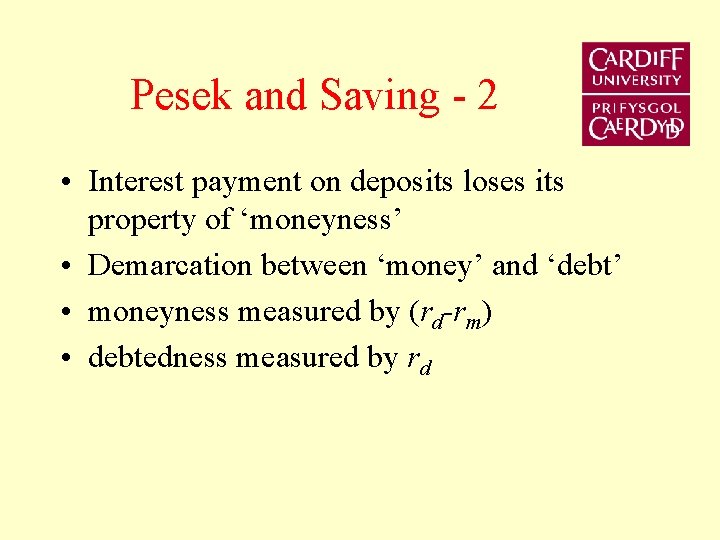
Pesek and Saving - 2 • Interest payment on deposits loses its property of ‘moneyness’ • Demarcation between ‘money’ and ‘debt’ • moneyness measured by (rd-rm) • debtedness measured by rd
Critique • Friedman & Schwartz - transactions services have become a ‘free good’, available without cost to the holder • ‘moneyness’ is a joint product with ‘debtedness’ • Newlyn suggests - criterion of ‘neutrality’
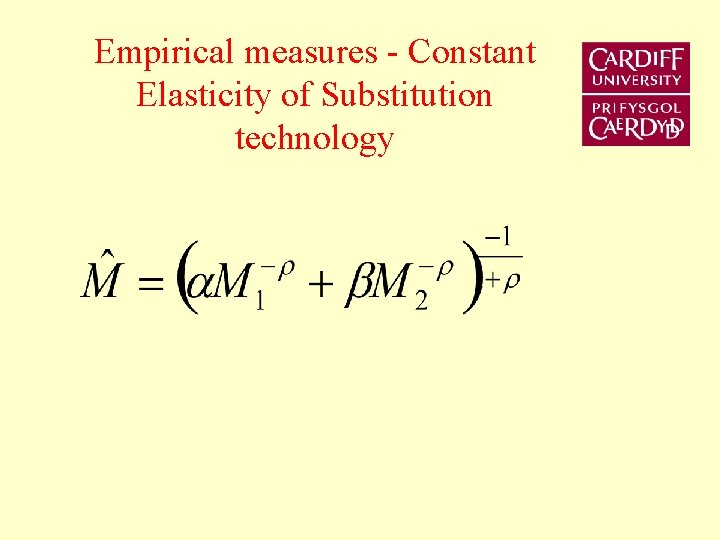
Empirical measures - Constant Elasticity of Substitution technology
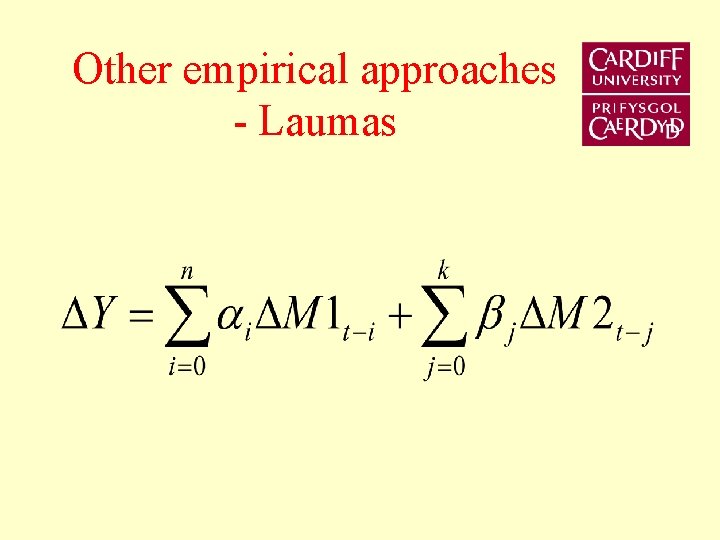
Other empirical approaches - Laumas
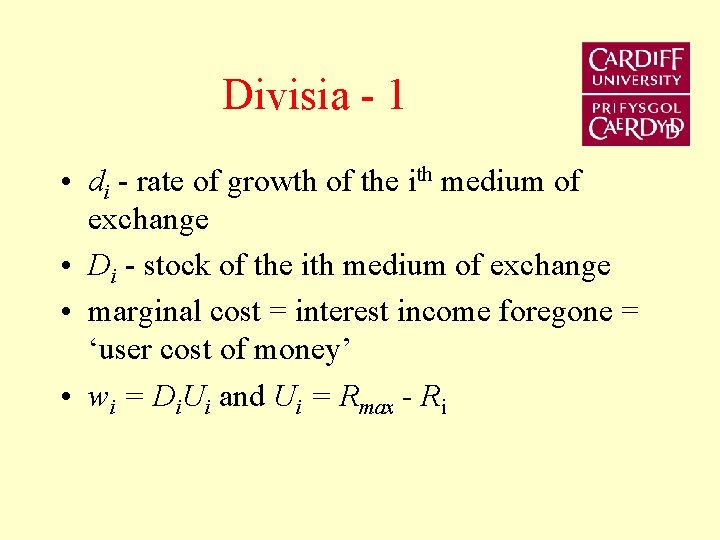
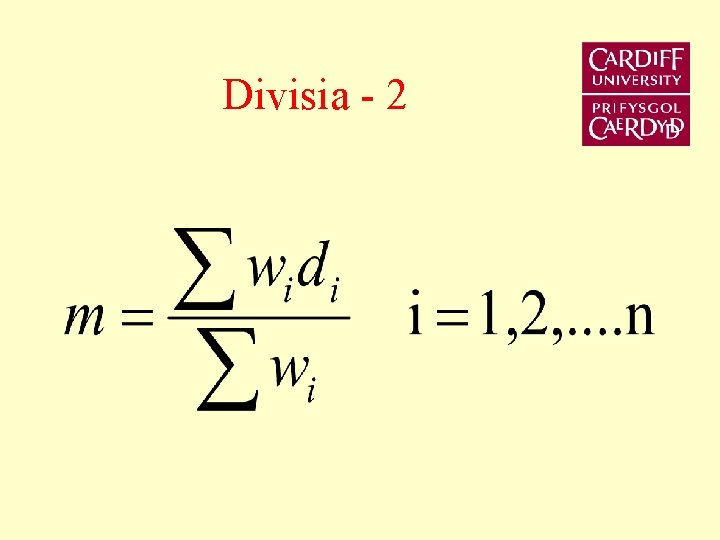
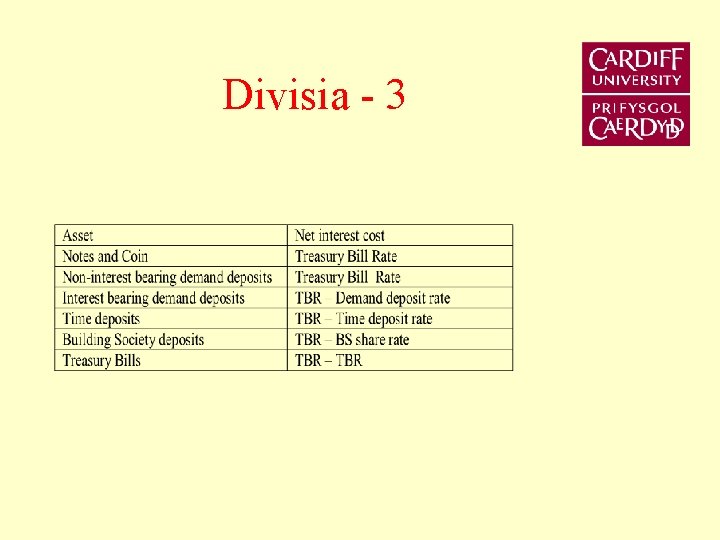
Divisia - 1 • di - rate of growth of the ith medium of exchange • Di - stock of the ith medium of exchange • marginal cost = interest income foregone = ‘user cost of money’ • wi = Di. Ui and Ui = Rmax - Ri
Divisia - 2
Divisia - 3
Conclusion • The definition of money has become important for 2 reasons • 1 Trends in financial innovation have blurred the distinction between money and non-money • 2 measuring money is important for policy
How can the emergence of money be explained? • Money must emerge as an optimal exchange system from a world of barter. • What are the specific properties of money that make its use general? • Money is a social phenomenon - exists only in societies where exchange takes place.
Classical View • Money exists on efficiency grounds. • The problem of double coincidence of wants • The search for a trading partner involves costs. The longer the search time the lower the transaction cost. • But the longer the search time, the higher the waiting cost
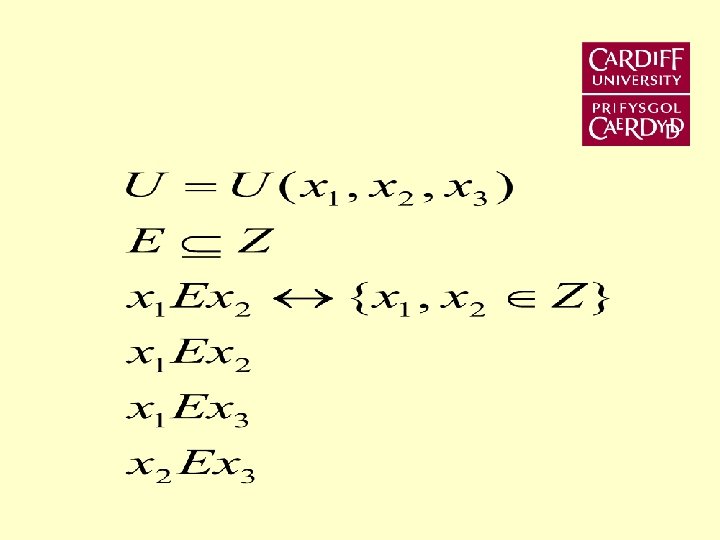
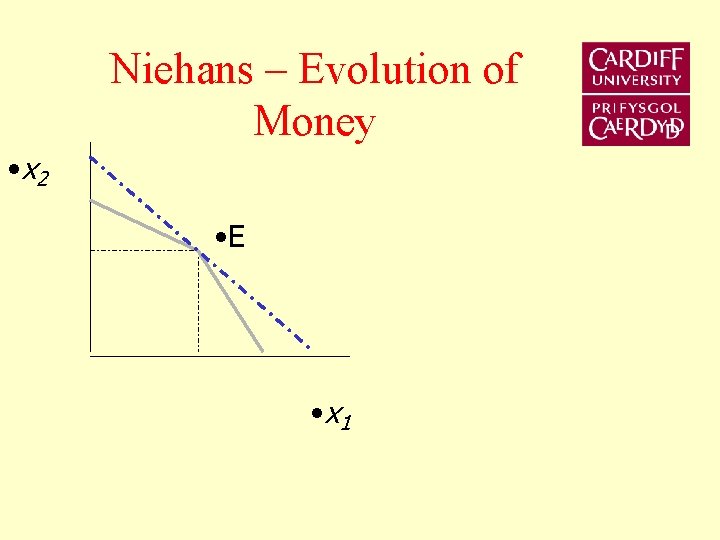
A Dynamic Model by Niehans - Assumptions • All exchanges involve transactions costs • lower transactions costs involved with using good xn • The greater the frequency of exchange, the lower the transactions cost.
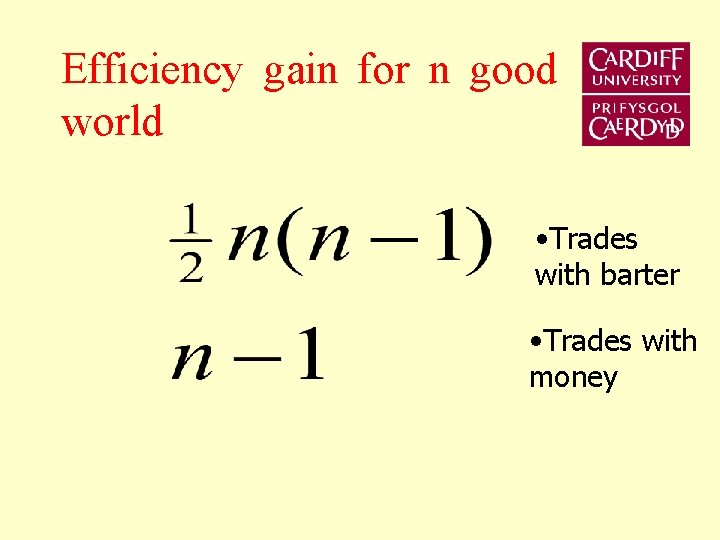
Efficiency gain for n good world • Trades with barter • Trades with money
Clower – Cash in Advance Model • • Goods buy money Money buys goods But goods do not buy goods How can the Classical transactions costs approach give us Clower’s result?
Evolution of Money • By assumption 1 – all transactions incur costs • By assumption 2 – a) x 3 Ex 2 and b) x 1 Ex 3 incur lower costs than c) x 1 Ex 2 • Therefore a) and b) will be more frequent than c) • By assumption 3 the costs of a) and b) will fall relative to c) • In the limit c) dissappears
Niehans – Evolution of Money • x 2 • E • x 1