
The Declaration of Independence Quick Facts n It
- Slides: 11
The Declaration of Independence
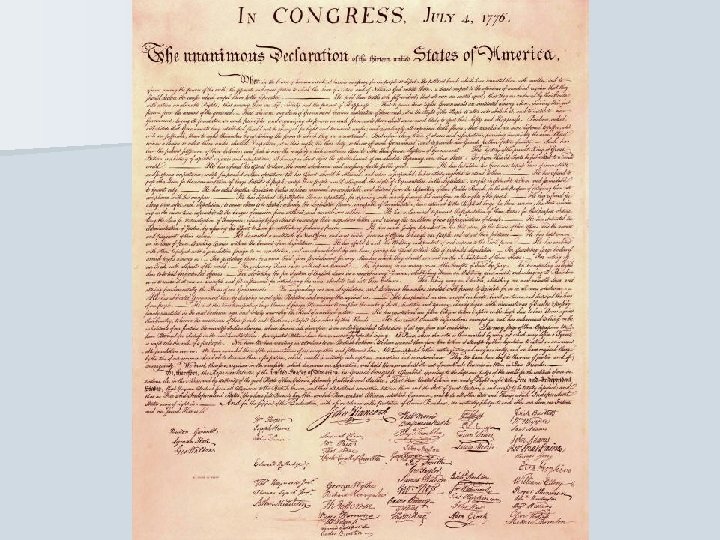
Quick Facts n It was written by Thomas Jefferson, although he initially refused to write it because he felt he wasn’t a good writer. n The Second Continental Congress never called it the “Declaration of Independence. ” n The official copy of the Declaration of Independence wasn’t completely signed until August 2, 1776.
What is it? n The Declaration of Independence is often called “one of the greatest documents in history, ” but very few people today actually know what it says. n In short, it declares the United States of America to be an independent nation. However, most people don’t realize that the young USA had a problem to take care of first before it could be “free. ” n Do you know what that problem was? – Hint: It started in 1775.
The Declaration’s “Table of Contents” n The Declaration can be divided into three main areas: – Part One: the Introduction: Jefferson explains the purpose of government and where people get their rights to govern themselves – “the Laws of Nature and of Nature’s God. ”
n Part One – – He sets up the argument by explaining that people have certain rights, granted by God. Among these rights are the rights to “Life, Liberty, and the Pursuit of Happiness. ” – He goes on to explain that, if a government does not work, that “it is the Right of the People to alter or abolish it. ”
n Part Two: the main argument against the King – In the “body” of the Declaration, Jefferson goes to great lengths to explain WHY the states should be free from the King. – As evidence that the “King of Great Britain” (he never mentions King George III by name) is not fit to be king, Jefferson rolls off a long list of things the King had done against the colonies.
– Jefferson lists 29 separate complaints about the King, even going so far as stating that the King was “unfit to be Ruler of a free people. ” (Keep in mind that the Declaration was going to be sent to the King!)
n PART Three – the Conclusion and statement of Independence – The short final section is probably the most important section of the document. – Jefferson declares that the colonies are “FREE AND INDEPENDENT STATES. ”
n In addition, the colonies have no allegiance to Great Britain and all political connection is “dissolved. ” n Essentially, Jefferson states that the United States of America are an independent nation. (notice that I said “are” instead of “is. ”) Most people claim that this is the “birth” of the USA.
Some Questions n What do you think would have happened to the men who wrote and/or signed a document that insulted the King and criticized his leadership, if they had been caught? Some say they were risking their lives. Is this a fair assumption? n Would the United States have been free, even if the declaration had never been written? n If Great Britain had won the Revolutionary War, what would be thought of Jefferson’s “Declaration of Independence? ” Would it have been “one of the greatest documents in history? ”