
THE DECIMATION OF THE EVERGLADES BACKGROUND The park
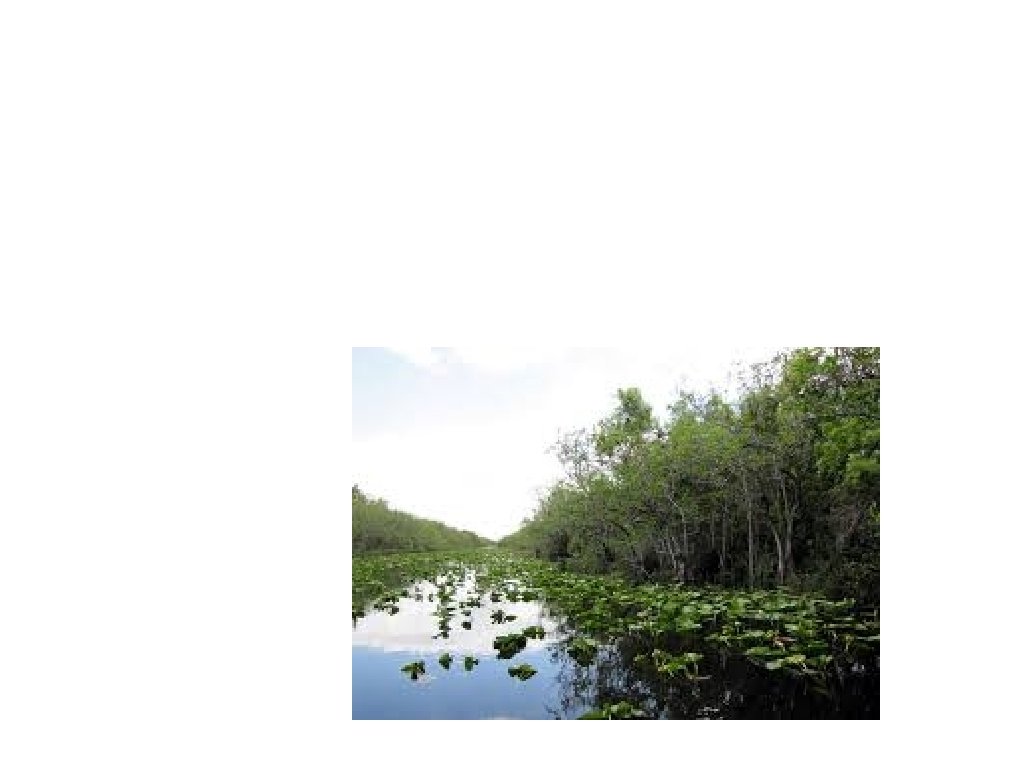
THE DECIMATION OF THE EVERGLADES.
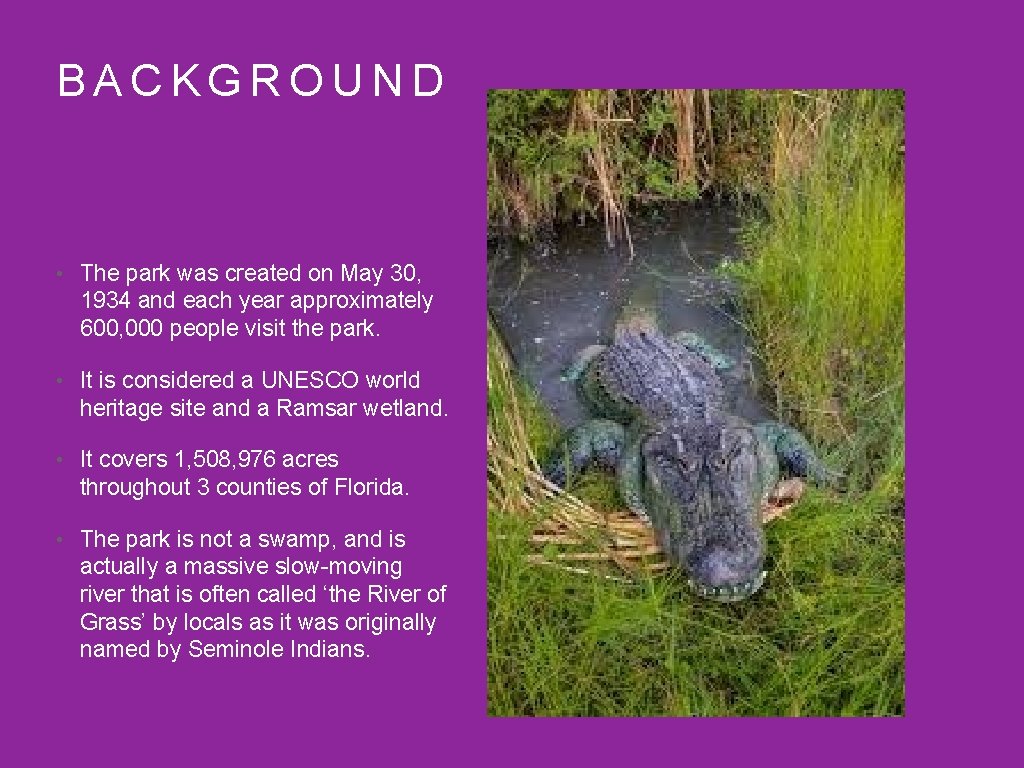
BACKGROUND • The park was created on May 30, 1934 and each year approximately 600, 000 people visit the park. • It is considered a UNESCO world heritage site and a Ramsar wetland. • It covers 1, 508, 976 acres throughout 3 counties of Florida. • The park is not a swamp, and is actually a massive slow-moving river that is often called ‘the River of Grass’ by locals as it was originally named by Seminole Indians.
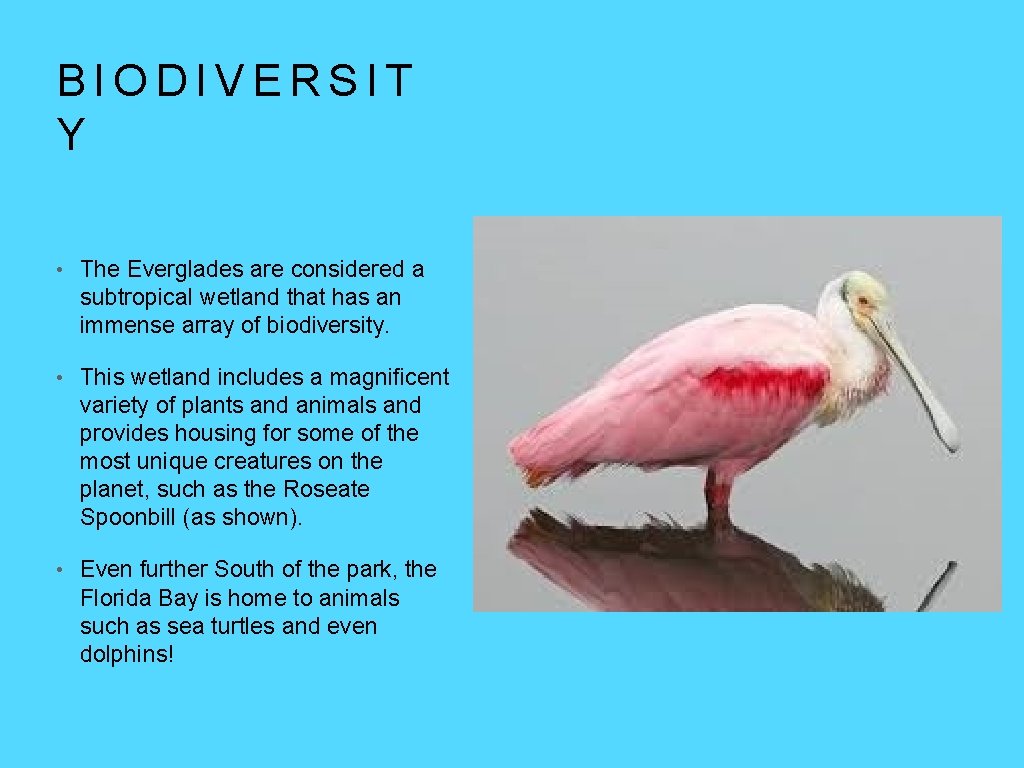
BIODIVERSIT Y • The Everglades are considered a subtropical wetland that has an immense array of biodiversity. • This wetland includes a magnificent variety of plants and animals and provides housing for some of the most unique creatures on the planet, such as the Roseate Spoonbill (as shown). • Even further South of the park, the Florida Bay is home to animals such as sea turtles and even dolphins!
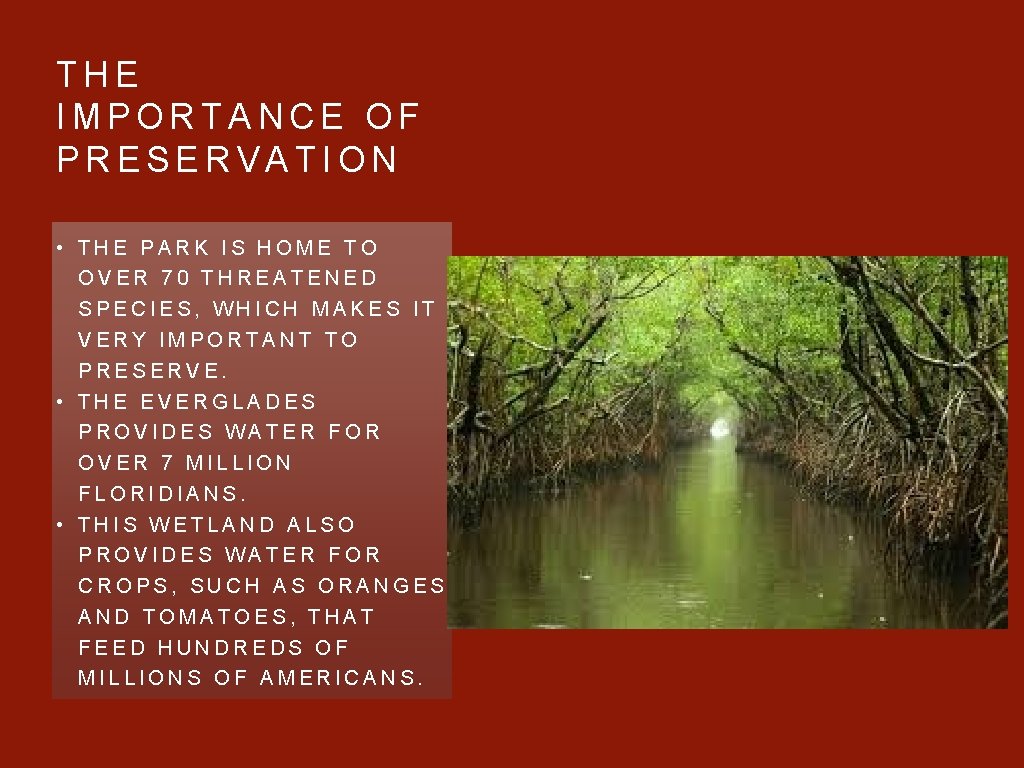
THE IMPORTANCE OF PRESERVATION • THE PARK IS HOME TO OVER 70 THREATENED SPECIES, WHICH MAKES IT VERY IMPORTANT TO PRESERVE. • THE EVERGLADES PROVIDES WATER FOR OVER 7 MILLION FLORIDIANS. • THIS WETLAND ALSO PROVIDES WATER FOR CROPS, SUCH AS ORANGES AND TOMATOES, THAT FEED HUNDREDS OF MILLIONS OF AMERICANS.

PROBLEMS WITH THE BURMESE PYTHON • Burmese pythons were introduced to the Everglades when people who owned them as pets decided to stop taking care of them because of their size and dumped them into the Everglades. • Once they established a controlled population in the park, these snakes thrived and reproduced rapidly. • This python is considered an apex predator and threatens the luscious biodiversity of the park.
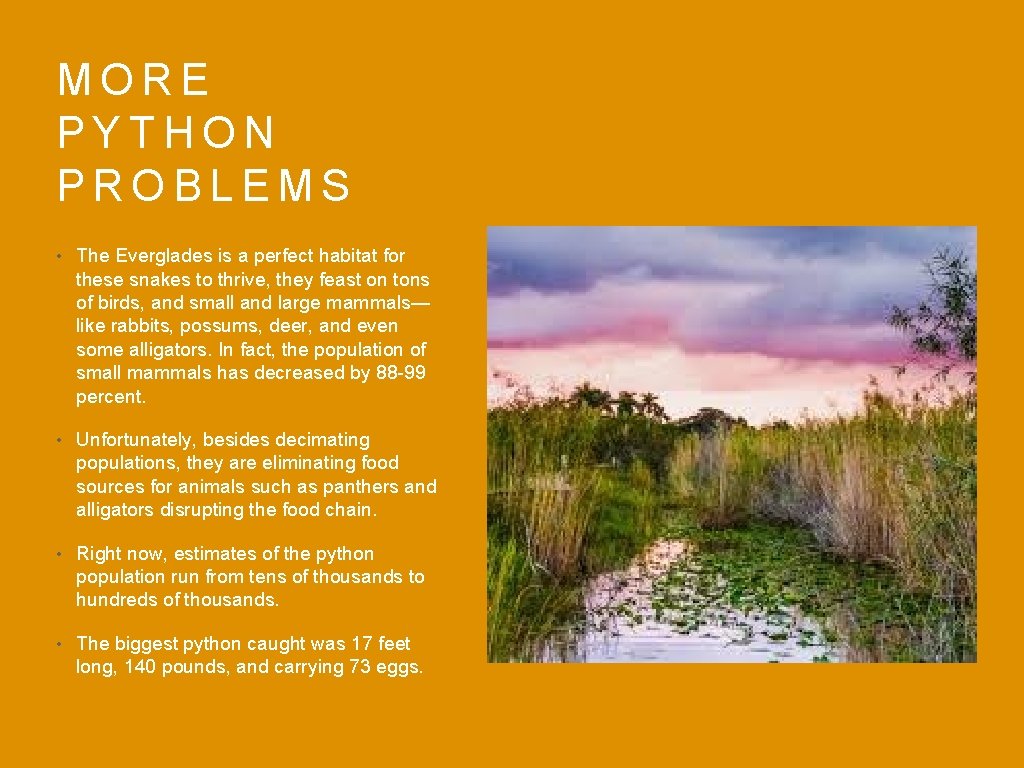
MORE PYTHON PROBLEMS • The Everglades is a perfect habitat for these snakes to thrive, they feast on tons of birds, and small and large mammals— like rabbits, possums, deer, and even some alligators. In fact, the population of small mammals has decreased by 88 -99 percent. • Unfortunately, besides decimating populations, they are eliminating food sources for animals such as panthers and alligators disrupting the food chain. • Right now, estimates of the python population run from tens of thousands to hundreds of thousands. • The biggest python caught was 17 feet long, 140 pounds, and carrying 73 eggs.

ANIMALS THE BURMESE PYTHON EATS
WHAT’S BEING DONE? • To eliminate the amount of pythons in the Everglades, the Floridian government hosted events such as the Python Challenge that occurred in 2013 and 2016 in which hunters competed against each other over a few weeks to catch the most snakes. A total of 3500 hunters came to these events and although not many snakes were killed, the community became finally aware of the problems the park faces with pythons. • After the Python Challenge events, the state decided to hire 25 skilled python hunters. As soon as the news was heard that the state wanted hunters, applications for the job flooded in and a total of 1, 000 applicants applied within 96 hours. • In order to receive the job, hunters had to prove that they had success in catching pythons. As a result of the search for applicants, 25 elite hunters were hired and all are described as having, ‘A special gift for seeing snakes. ’
Hunting Snakes • These hunters hired by the state are given access to special roads that have no other traffic on them and run deep into all parts of the park. These roads span hundreds of miles all over the park. On the sides of these roads, snakes like to come up to bask in the sun where hunters can capture and kill them. • The hunters who work tirelessly to control the population of pythons in the park say that, ‘’this is the best job [they’ve] had!” They earn $8. 46 per hour for up to ten hours and an extra $50 per snake and $25 for every extra foot over four feet long. • These hunters use a few different methods to catch snakes while working with other conservation groups such as The Conservancy of Southwest Florida (a nonprofit scientific organization), including thermal drones that search for snakes, pheromone traps, sentinel snakes that lead hunters to other snakes, and snakehunting dogs. All of these have drawbacks though, and therefore these hunters rely mostly on hands and eyes to do the job.

LINK TO VIDEO ON PYTHONS IN THE EVERGLADES AND HUNTERS FIGHTING AGAINST THEM https: //www. youtube. com/watch? v=bet 24 Qoo SLM
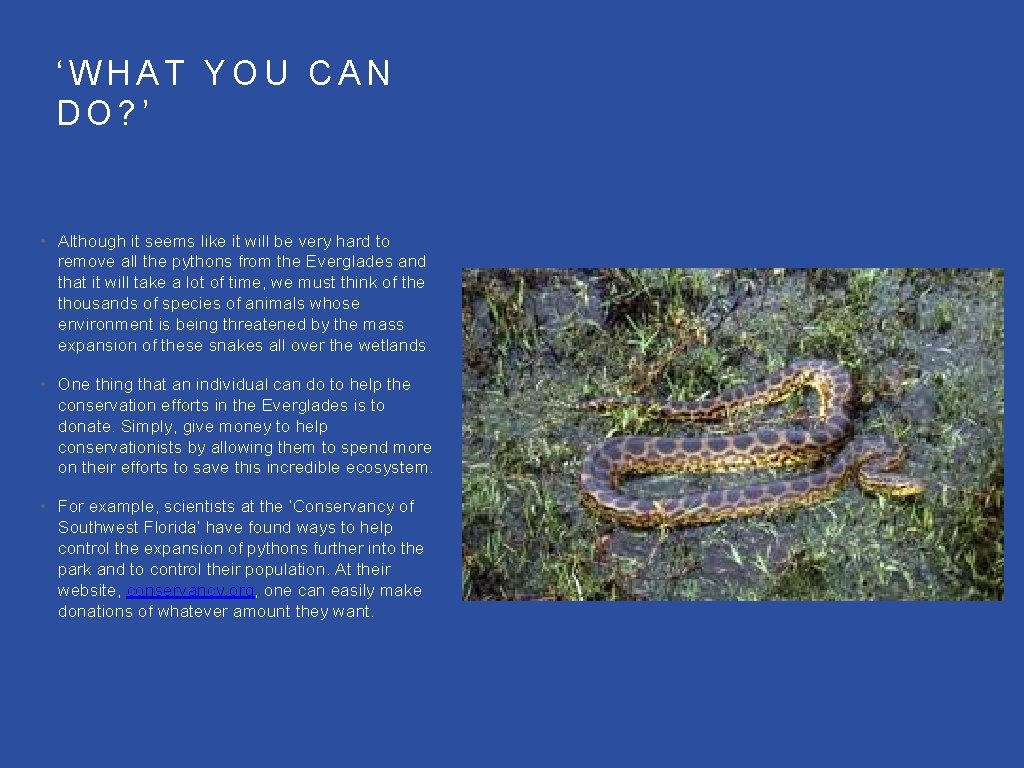
‘WHAT YOU CAN DO? ’ • Although it seems like it will be very hard to remove all the pythons from the Everglades and that it will take a lot of time, we must think of the thousands of species of animals whose environment is being threatened by the mass expansion of these snakes all over the wetlands. • One thing that an individual can do to help the conservation efforts in the Everglades is to donate. Simply, give money to help conservationists by allowing them to spend more on their efforts to save this incredible ecosystem. • For example, scientists at the ‘Conservancy of Southwest Florida’ have found ways to help control the expansion of pythons further into the park and to control their population. At their website, conservancy. org, one can easily make donations of whatever amount they want.
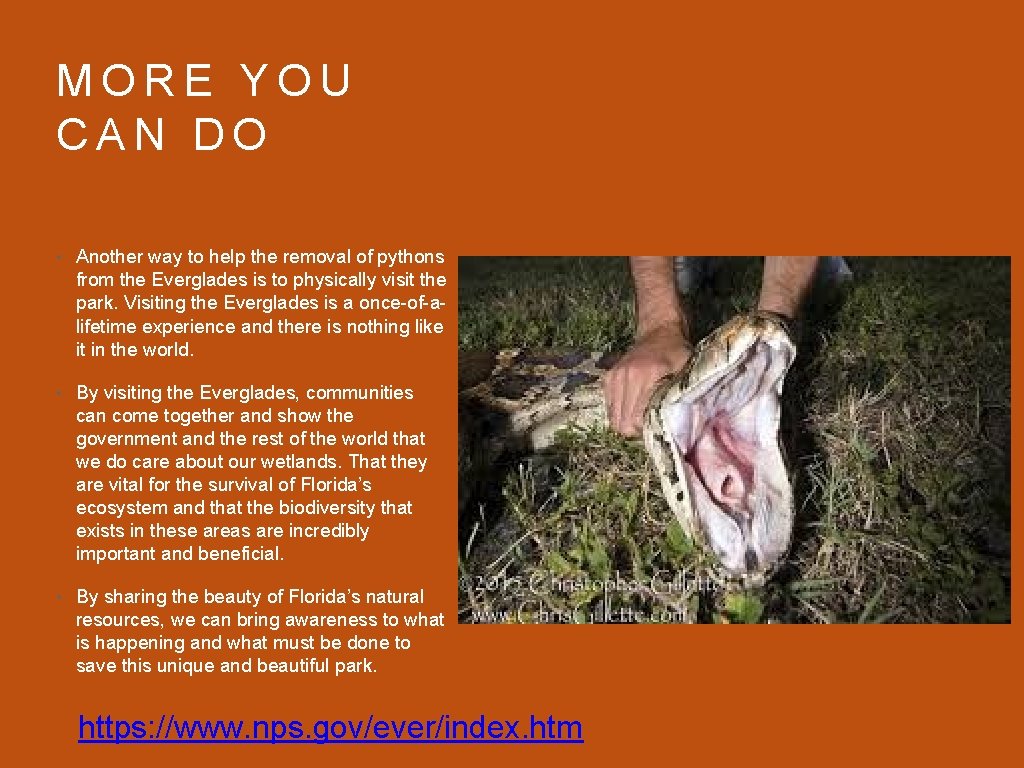
MORE YOU CAN DO • Another way to help the removal of pythons from the Everglades is to physically visit the park. Visiting the Everglades is a once-of-alifetime experience and there is nothing like it in the world. • By visiting the Everglades, communities can come together and show the government and the rest of the world that we do care about our wetlands. That they are vital for the survival of Florida’s ecosystem and that the biodiversity that exists in these areas are incredibly important and beneficial. • By sharing the beauty of Florida’s natural resources, we can bring awareness to what is happening and what must be done to save this unique and beautiful park. https: //www. nps. gov/ever/index. htm
REFERENCES: • Frazier, I. (2019, July). The Snakes That Ate Florida. Smithsonian. • Staff, N. G. (2017, June 26). Everglades National Park. Retrieved from https: //www. nationalgeographic. com/travel/national-parks/everglades-national-park/ • Solly, M. (2019, April 10). Record-Breaking 17 -Foot-Long Burmese Python Found in Florida. Retrieved from https: //www. smithsonianmag. com/smart-news/record-breaking-17 -foot-long-burmese-python-found-florida-180971929/ • Wetlands of International Importance (Ramsar Sites). (n. d. ). Retrieved from https: //www. ramsar. org/about/wetlands-of- international-importance-ramsar-sites • CBS News. (2017, May 17). The paid hunters dealing with Florida's python problem. Retrieved from https: //www. cbsnews. com/news/python-problem-hunters-everglades/ • Park, E. S. (2011, January 24). Why Should I Care About the Everglades? Retrieved from http: //evergladessafaripark. com/blog/everglades-national-park/why-should-i-care-about-theeverglades/#. XTNng. C 2 ZNm. N • Deutsche Welle. (n. d. ). The Burmese python and the fight for the Florida Everglades: DW: 11. 07. 2018. Retrieved from https: //www. dw. com/en/the-burmese-python-and-the-fight-for-the-florida-everglades/a-44599606 -0 • BURMESE PYTHON RESEARCH. (n. d. ). Retrieved from https: //www. conservancy. org/donate/burmese-python- removal • National Park Service. (n. d. ). What's in a Name? Retrieved from https: //www. nps. gov/ever/learn/kidsyouth/whats-in-a- name. htm
- Slides: 13