
THE DEATH OF THE AUTHOR ROLAND BARTHES Yasin
THE DEATH OF THE AUTHOR ROLAND BARTHES Yasin KÜÇÜKYILMAZ
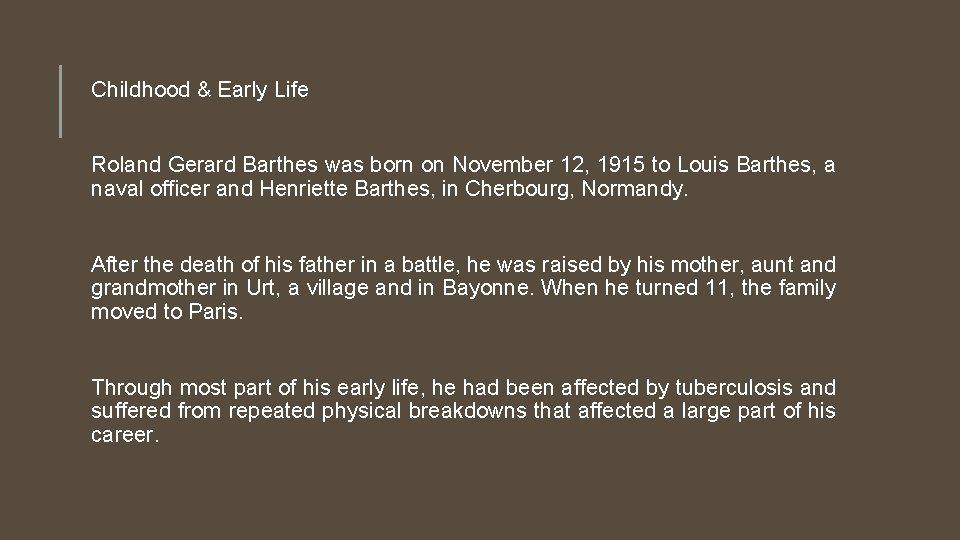
Childhood & Early Life Roland Gerard Barthes was born on November 12, 1915 to Louis Barthes, a naval officer and Henriette Barthes, in Cherbourg, Normandy. After the death of his father in a battle, he was raised by his mother, aunt and grandmother in Urt, a village and in Bayonne. When he turned 11, the family moved to Paris. Through most part of his early life, he had been affected by tuberculosis and suffered from repeated physical breakdowns that affected a large part of his career.
His illnesses kept him away from education and also became the main reason for him to be out of military service during World War II. From 1935 to 1939, he spent his time at the Sorbonne, where he earned a certificate in classical letters and philology. He published a number of papers, struggling with his health at the same time.
Career In the 1960 s, he spent most of time studying semiology and structuralism, as well as chairing a number of faculty positions in Europe. His views led to an aggressive tete-a-tete with Raymond Picard, a professor of literature, who despised Barthes’ views. He came back with a confutation in his book, ‘Criticism and Truth’, which was published in 1966. In the latter half of the 1960 s, he travelled around the world and also wrote one of his best-known works at this time—an essay titled, ‘The Death of the Author’, in 1967. In 1975, he wrote an autobiography titled ‘Roland Barthes’ and two years later, he chaired the ‘Semiologie Litteraire’ at the College de France. In 1980, he published his last works, ‘Camera Lucida’, which was mainly an examination into the nature and crux of photography.
Personal Life & Legacy He shared an extremely close bond with his mother, whom he lived with for 60 years of his life. After her demise, he was shattered and grieved his mother’s death till the time of his death. He was extremely interested in photography and believed that photographs presented a real representation of the world, an explanation of which was given in his works, ‘Camera Lucida’. He was hit by a laundry van in Paris on February 25, 1980 and died a month later, succumbing to the injuries he sustained during the accident. His legacy is an extensive one. Most of Barthes’ works gave rise to structuralism, semiotics and post-structuralism schools of thoughts. Apart from these broad genres, his influence can be felt in every field concerned with the exemplification of material and prototypes of communiqué including photography, literature, music and computers.
Roland Barthes is a legendary figure and semiotician, whose ideas encouraged the advancement of a number of fields including structuralism, anthropology, post-structuralism, semiotics and social theory. He was highly influenced by Ferdinand de Saussure’s semiology throughout his life and thus, began to develop his own complex theoretical concepts that became central to a number of schools of thought in France and Europe. He was also a leading critic of his time and a prominent theoretical personality across Europe and America. Interestingly, he left an indelible impression wherever he went and making himself known in popular culture as well.
Some of his well-known works included, ‘Writing Degree Zero’, ‘Mythologies’, ‘Criticism and Truth’, ‘The Pleasure of the Text’ and ‘Image Music Text’. Most of his works carried with them a multiplicity, applying semiotic theory and literary critique. He was often potholed against more traditional French scholars, but never minding their thoughts, he managed to make important advances in a number of areas. During his time, he was considered a living legend a leading critic of his generation. His works secured a number of translations since his untimely death in an accident at the age of sixty-four.
THE DEATH OF THE AUTHOR
“The Death of the Author” by Roland Barthes is a landmark for 20 -th century literature, literary theory, post-structuralism, and postmodernism. The essay opposes the established trends “in ordinary culture […] tyrannically centered on the author, his person, his life, ” and abolish the classical literary criticism that analyses a literary work within the biographical and personal context of the author of the work. The philosophical implications of “The Death of the Author” transcend literature and are closely related to the postmodern trends of collapse of meaning and inability of originality.
The text is a tissue of citations (quotations), resulting from the thousand sources of culture. The writer can only imitate what is anterior, never original. The unity of a text is not in its origin (author), it is in its destination (listener or reader) It is the listener or the reader who understands each written words. “The birth of the reader must be at the cost of the death of the Author. ”
“The Death of the Author” rejects the idea of authorial intent, and instead develops a reader-response critical theory: The reader is the space on which all the quotations that make up a writing are inscribed without any of them being lost; a text’s unity lies not in its origin but in its destination.
The use of the word “quotations” expresses the idea that a text cannot really be “created” or “original”—it is always made up of an arrangement of preexisting “quotations” or ideas. Therefore, the “author” is not really an author, but rather a “scriptor” who simply puts together preexisting texts.
In literary writing, the death of the Author is the “death” of the omniscient narrator and the author who calls attention to his presence in the text. For example, the author should not address the readers with phrases such as “dear reader”; the author should not give information about the characters that cannot be known in a “real-life” situation—such as characters’ thoughts and feelings. The death of the Author is the inability to create, produce, or discover any text or idea. The author is a “scriptor” who simply collects preexisting quotations. He is not able to create or decide the meaning of his work. The task of meaning falls “in the destination”—the reader.
In culture, the death of the Author is the denial of a single “discoverer” or contributor. It is the equivalent of the “scriptor” outside literature. Therefore, “discoveries” seem to exist as possibilities predating their inventor, and the discoverer simply “confirms” ideas that have already been there. The theory is known as “multiple discovery”—more than one person reaches the same discovery/idea/conclusion independently. Carl Jung’s idea of the collective unconscious is similar to multiple discovery—a series of archetypes collected throughout the course of evolution that guide different individuals to experience, feel, think, and observe in similar patterns.
Another aspect of the multiple discovery theory is the development and elaboration of ideas. For multiple discovery, a “discoverer” is simply one of the many contributors. Common culture has it that Alexander Graham Bell is the inventor of the telephone, but the discovery was likely reached independently by others too, as well as elaborated on. The stages before the official “completion” of the telephone, for example the wires necessary for a telephone to operate, are just as important. In a similar way, Apple is considered the creator of the i. Phone. But is it not simply an elaboration of the invention of the telephone, a discovery inevitably dependent on the invention of camera, micro chips, etc. ?
Once the author is removed, the claim to decipher a text becomes quite futile. To give a text an Author is to impose a limit on that text. The Death of The Author is the multiplicity of meaning—therefore the ultimate collapse of meaning. It is the freedom from the shackles of meaning and Author’s intention. The death of the Author is also the inability to create, invent, or be original. It is the spinning out of control into the abyss of multiple meanings and inevitable meaninglessness.

Thanks for your attention.
REFERENCES Erich Auerbach, Mimesis: The Representation of Reality in Western Literature, trans. Willard R. Trask. Princeton, 1953, repr. 1974 "Chapter 1" Roland Barthes' "The Death of the Author" William Wimsatt and Monroe C. Beardsley, "The Intentional Fallacy. " Sewanee Review, vol. 54 (1946): 468 -488. Revised and republished in The Verbal Icon: Studies in the Meaning of Poetry, University of Kentucky Press, 1954: 3 -18. Paglia, Camille (1990). Sexual Personae: Art and Decadence from Nefertiti to Emily Dickinson, NY: Vintage, p. 34 Burke, Seán (2010). The Death and Return of the Author: Criticism and Subjectivity in Barthes, Foucault, and Derrida (3 ed. ). Edinburgh University Press. ISBN 978 -0748637119. Barthes, Roland, trans. Richard Miller. S/Z. New York: Hill and Wang, 1974. Barthes, Roland. Susan Sontag, ed. A Barthes Reader. New York: Hill and Wang, 1982. http: //www. independent. co. uk/arts-entertainment/books/death-of-the-author-roland-barthes-a-biographyby-louis-jean-calvet-trs-sarah-wykes-polity-press-1567120. html
- Slides: 19