
THE DBQ How to write the Document Based
THE DBQ How to write the Document Based Question Essay
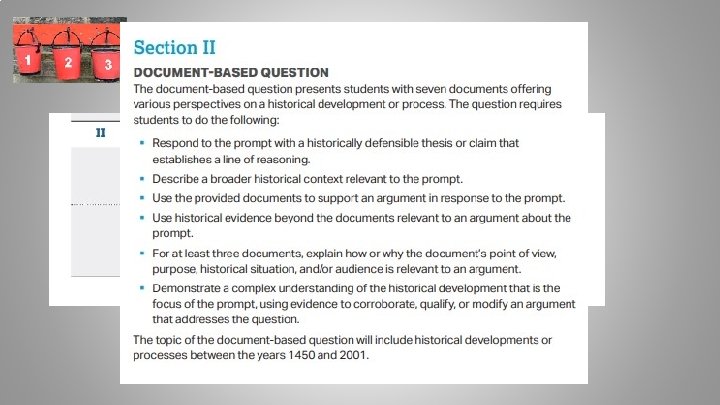
AP WORLD HISTORY EXAM Covers 1450 -2001 time period
What is the DBQ? • Essay based on a set of 7 various documents. • Documents will include written or visual primary sources (quotes, letters, speeches, decrees, laws, political cartoons, drawings, maps, photos, etc. ) • An essay question that asks you to take a position on an issue that has several possible answers. Evaluate the extent to which. . . • No “right” or “correct” response • You must craft a thesis based on your own knowledge and your interpretation of the evidence present.
HISTORICAL THINKING SKILLS In the DBQ Essay, students will be expected to illustrate that they have mastered the AP historical thinking skills below In your response you should do the following. • Respond to the prompt with a historically defensible thesis or claim that establishes a line of reasoning. • Describe a broader historical context relevant to the prompt. • Support an argument in response to the prompt using at least six documents. • Use at least one additional piece of specific historical evidence (beyond that found in the documents) relevant to an argument about the prompt. • For at least three documents, explain how or why the document’s point of view, purpose, historical situation, and/or audience is relevant to an argument. • Use evidence to corroborate, qualify, or modify an argument that addresses the prompt.
Prompt Dissection Prompt: Evaluate the extent to which beliefs about and responses to the Bubonic Plague changed from 14 th and 15 th centuries C. E. 1. What are the tasks of the question? 2. Specifically, what are the TWO ways the prompt asks you to analyze the Bubonic Plague?
Outside Evidence Brainstorming Prompt: Evaluate the extent to which beliefs about and responses to the Bubonic Plague changed from 14 centuries C. E. • th and 15 th What do you already know about the Bubonic Plague: list terms/events/leaders etc that you could later use to support your arguments. Rats Fleas Mongols Silk road Ships Medieval Europe Plague Doctors Ring around the Rosie Anger at the Catholic Church Hundred Years War 1/3 of population dead Known as Black Death
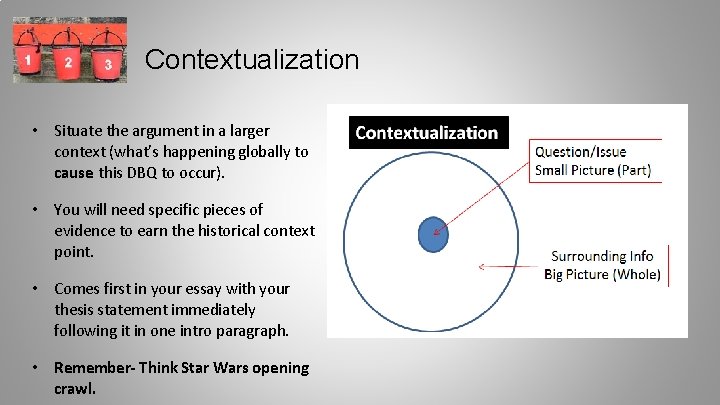
Contextualization • Situate the argument in a larger context (what’s happening globally to cause this DBQ to occur). • You will need specific pieces of evidence to earn the historical context point. • Comes first in your essay with your thesis statement immediately following it in one intro paragraph. • Remember- Think Star Wars opening crawl.
Contextualization Example Prompt: Evaluate the extent to which beliefs about and responses to the Bubonic Plague changed from 14 th and 15 th centuries C. E. Example: “In the 14 th and 15 th centuries, the Bubonic Plague was brought to Europe. This was facilitated by the spread of infected fleas on rats through the Indian Ocean and Silk Roads trade routes. The safe passage of merchants along the silk roads was brought by the Mongol security, although the Mongols also spread the plague by their use of catapulted plagued bodies in biological warfare. These causes set the scene for the Bubonic Plague to kill one third of the European population during the Post Classical Era.
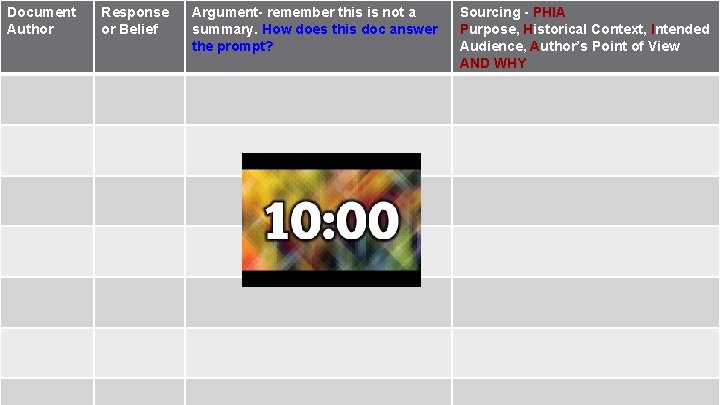
Document Author Response or Belief Argument- remember this is not a summary. How does this doc answer the prompt? Sourcing - PHIA Purpose, Historical Context, Intended Audience, Author’s Point of View AND WHY
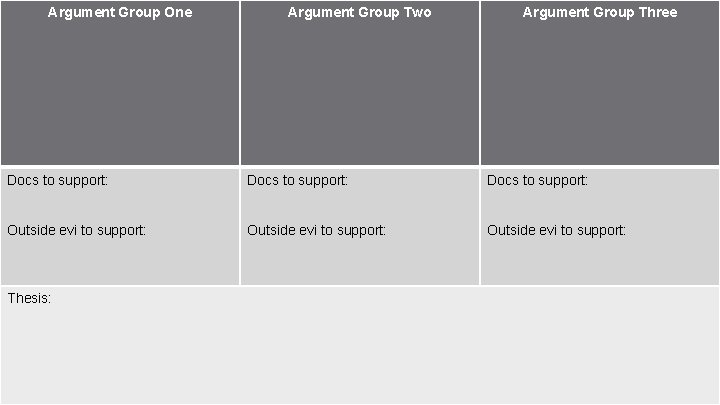
Argument Group One Argument Group Two Argument Group Three Argument Groups Docs to support: Outside evi to support: Thesis:
THESIS • Student essays will require the development of a THESIS or argument supported by specific, relevant historical evidence. • The thesis encompasses the main point(s), or “argument” that the student intends to prove throughout the essay. • It is a specific and direct answer to the essay prompt. It is not enough to say something changed (like-- government changed) you must EXPLAIN the change in your thesis (government shifted from this to that) • The thesis guides the entire essay. The student should continually be looking back and asking, “Am I proving and tying everything back to my thesis? ”
THESIS • • Your thesis statement should follow our formula. X (counter argument). However A and B (main arguments). Therefore Y (A and B are more significant than X). • It must be clear, properly structured, and be the last sentences in the intro paragraph following your historical context sentences. • Your thesis must use the terms from the prompt. Date. Point of Analysis. Location. • Your thesis must have 3 points of analysis (these analysis points will make up your three body paragraphs and will be how your documents group together to answer the prompt)
THESIS Example Prompt: Evaluate the extent to which responses to the Bubonic Plague changed from 14 th and 15 th centuries C. E. Although, many people continued to turn to religion to help explain the Bubonic Plague during the 14 th and 15 th centuries, others instead began to flee from the ill and also began to further spread the plague. Therefore, the changes in response to the Bubonic Plague were more significant to Western Europe than its continuity during the 14 th and 15 th centuries.
Body Paragraphs 1. Always start with an assertion. This will be one of your analysis/arguments points of your thesis. 2. What is my argument? Does my argument/ grouping address the question? 3. How do my documents support it? PHIA Analysis: what PHIA most affects our interpretation of the document and WHY does it change our interpretation and how does it help strengthen our argument & address the prompt? 4. Outside Evidence : What event/policy/leader could strengthen this argument? Be SPECIFIC- not king of France, but King Louis XIV. Not disease, but Smallpox or Bubonic Plague. 5. Corroborate, Contradict, or Qualify. How am I demonstrating a connection between the documents?
Body Paragraph – Assertion Sentence 1. Continued to turn to religion 2. Flee from ill 3. Spread the plague Example: “The natural response of many people, during the 14 th and 15 th centuries, to help explain the Bubonic plague was to turn to their religion and belief in God. ” Prompt: Evaluate the extent to which responses to the Bubonic Plague changed from 14 th and 15 th centuries C. E. What is my argument? Does my argument/grouping address the question?
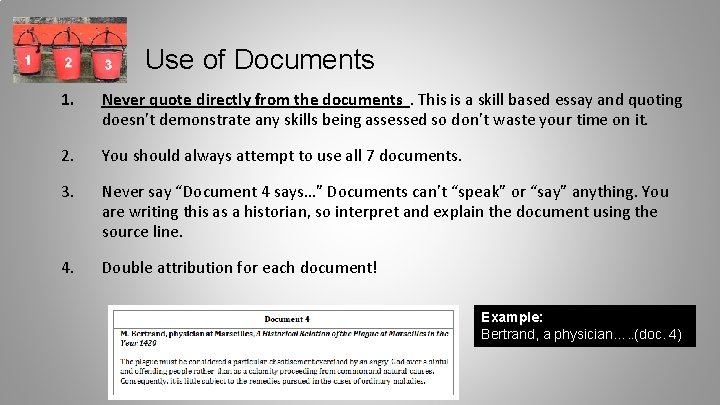
Use of Documents 1. Never quote directly from the documents. This is a skill based essay and quoting doesn’t demonstrate any skills being assessed so don’t waste your time on it. 2. You should always attempt to use all 7 documents. 3. Never say “Document 4 says…” Documents can’t “speak” or “say” anything. You are writing this as a historian, so interpret and explain the document using the source line. 4. Double attribution for each document! Example: Bertrand, a physician…. . (doc. 4)
Use of Documents 1. In order to come up with your thesis, you must read analyze the documents to put them into categories (groups) which answer the prompt and address your argument. 2. Your categories (groups) must always ANSWER THE PROMPT. 3. Documents may be used in more than one group and you don’t need an even number of documents in each group. 4. When writing your body paragraphs, make sure to connect the documents together to show the relationship. You may use documents that contradict each other as well as support each other. For example: “In addition…. ”, “Also”, “This can be supported by…. , ” “However, _____ contradicts the idea”
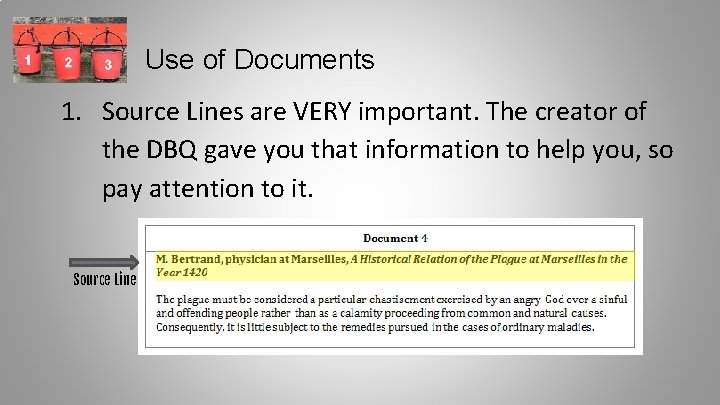
Use of Documents 1. Source Lines are VERY important. The creator of the DBQ gave you that information to help you, so pay attention to it. Source Line
Use of Documents - Sourcing • Must source 3 documents correctly to earn the point. It’s a hard point to earn. • Must explain how the purpose, the historical context of the document, intended audience, or author's’ point of view SHAPE how we interpret what the document means. • Sourcing Acronym PHIA P – Purpose H - Historical Context I – Intended Audience A – Author’s Point of view WHY does (PHIA) change/shape how we interpret what the document means in regards to our argument?
Sourcing – PHIA– Historical Context • Must source explain the SIGNIFICANCE of the historical context. • Must explain how the context (developments not described in the document) shapes or informs the content of the document • Uses context to situate one document • Must explain why this influences/shapes how we interpret the document in regards to our argument. Example: “Ibn Battuta, one of the foremost travelers in the Middle Ages, explains the reaction to the plague in Damascus by stating that it was recommended for people to fast and pray at the Grand Mosque to show God their submissiveness and get his help to heal them. (Doc. 1). At this time Damascus was a major trade city in the Middle East, further supported by the Caliphates promotion of merchants and exemption from jizya tax. Thus, many People of the Book came here to trade and had some common rituals as Abrahamic faiths. ”
Sourcing – PHIA – Intended Audience • Must source explain the SIGNIFICANCE of the audience. • Must explain how the audience shapes or informs the content of the document • Must explain why this influences/shapes how we interpret the document in regards to our argument. Example: “In his ‘Letter to Posterity, ’ Petrarch laments the destruction of the disease and explains that God’s punishment was deserved (Doc. 6). Petrarch is writing to people in the future and admonishing them to not fall victim to the same sinfulness and thereby avoiding God’s wrath. He also writes to defend against their sins being worse than those before them. ”
Sourcing – PHIA – Purpose • Must source explain the SIGNIFICANCE of the author’s purpose. • Must explain how the author’s purpose shapes or informs the content of the document • Must explain why this influences/shapes how we interpret the document in regards to our argument. Example: “Weyer, a German physician recounts how it became common practice to spread the disease by smearing the city gates with diseased ointment (doc. 7). Weyer is concerned by the callous nature of those wanting to inherit property by creating more fear and speeding up the spread of the disease. ”
Sourcing – PHIA – Author’s Point of View • Must source explain the SIGNIFICANCE of the author’s point of view. • Must explain how the author’s point of view shapes or informs the document • Must explain why this influences/shapes how we interpret the document in regards to our argument. Example: “Bertrand, a Marseilles physician, explained that God must be punishing the sinful with the plague. (Doc. 4) Obviously, as a physician, Bertrand was familiar with treating deadly disease, but due to his inability to explain and help his dying patients Bertrand instead attempts to throw off the cast of suspicion on his own failure to save his patients, and puts the blame on the weakness and sinfulness of his patients. ”
Argument Development (Argumentation) • Focus’ on three ideas: corroboration, contradiction & qualification • Although the bulk of your argument development will be in the final sentence or two of your paragraph, in order to earn this point you have to demonstrate the relationship between the documents and your argument THROUGHOUT the entire essay. • This is not just a skill you complete once and never come back to again. • Therefore make sure you connect the documents together in your body paragraph using connection words such as: “In addition…. ”, “Also”, “This can be supported by…. , ” “However, _____ contradicts the idea” “but”
Argument Development (Argumentation) Corroboration Craft a ‘corroboration’ statement in the paragraph: ”Both of these documents corroborate or give support to the idea. . . ” or “This document corroborates or supports the fact that [outside historical evidence included by student]. . . “ Synonyms: Validates, supports, upholds, verifies, etc. Example: “The writings from Bertrand Battuta both give support to the idea that people turned to what they did know—their religion to help explain the unexplainable. ”
Argument Development (Argumentation) Contradiction Craft a ‘concession’ statement in the paragraph: "although these documents contradict each other with regards to. . . ” or "although this document contradicts the fact that [outside historical evidence included by student]. . . ”
Argument Development (Argumentation) Qualify • A qualification is a limitation on the scope or precision of your argument, often expressing degrees of confidence or probability. • Why would you want to qualify your argument? Usually as a way of anticipating potential objections against counterarguments. • Only attempt this type of argument development if you are secure in your analysis of the documents. Useful words To all intents and purposes To some extent Up to a point It is no exaggeration to say that In a way Almost In effect More or less Practically But
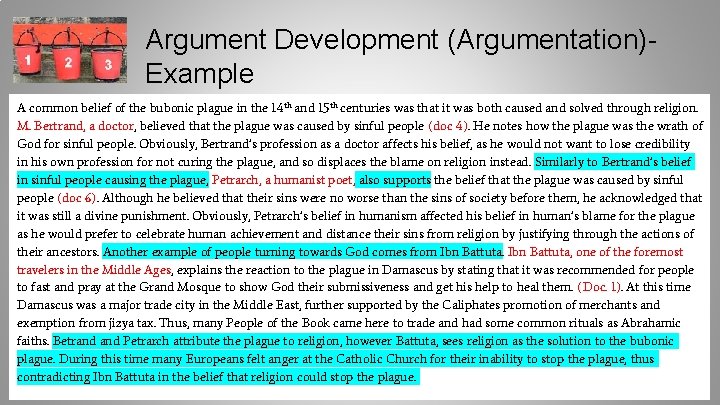
Argument Development (Argumentation)Example A common belief of the bubonic plague in the 14 th and 15 th centuries was that it was both caused and solved through religion. M. Bertrand, a doctor, believed that the plague was caused by sinful people (doc 4). He notes how the plague was the wrath of God for sinful people. Obviously, Bertrand’s profession as a doctor affects his belief, as he would not want to lose credibility in his own profession for not curing the plague, and so displaces the blame on religion instead. Similarly to Bertrand’s belief in sinful people causing the plague, Petrarch, a humanist poet, also supports the belief that the plague was caused by sinful people (doc 6). Although he believed that their sins were no worse than the sins of society before them, he acknowledged that it was still a divine punishment. Obviously, Petrarch’s belief in humanism affected his belief in human’s blame for the plague as he would prefer to celebrate human achievement and distance their sins from religion by justifying through the actions of their ancestors. Another example of people turning towards God comes from Ibn Battuta, one of the foremost travelers in the Middle Ages, explains the reaction to the plague in Damascus by stating that it was recommended for people to fast and pray at the Grand Mosque to show God their submissiveness and get his help to heal them. (Doc. 1). At this time Damascus was a major trade city in the Middle East, further supported by the Caliphates promotion of merchants and exemption from jizya tax. Thus, many People of the Book came here to trade and had some common rituals as Abrahamic faiths. Betrand Petrarch attribute the plague to religion, however Battuta, sees religion as the solution to the bubonic plague. During this time many Europeans felt anger at the Catholic Church for their inability to stop the plague, thus contradicting Ibn Battuta in the belief that religion could stop the plague.
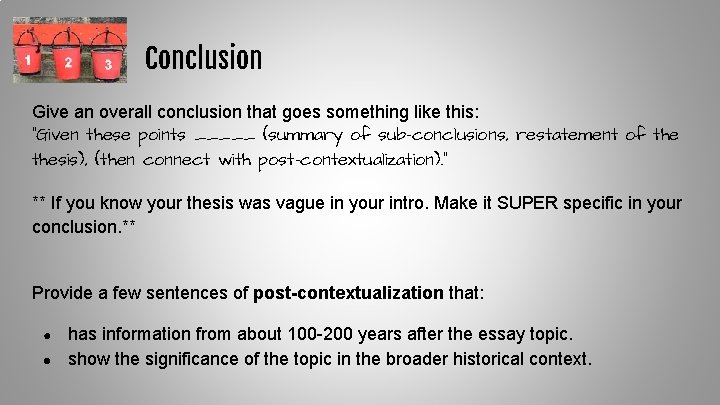
Conclusion Give an overall conclusion that goes something like this: “Given these points _____ (summary of sub-conclusions, restatement of thesis), (then connect with post-contextualization). ” ** If you know your thesis was vague in your intro. Make it SUPER specific in your conclusion. ** Provide a few sentences of post-contextualization that: ● ● has information from about 100 -200 years after the essay topic. show the significance of the topic in the broader historical context.
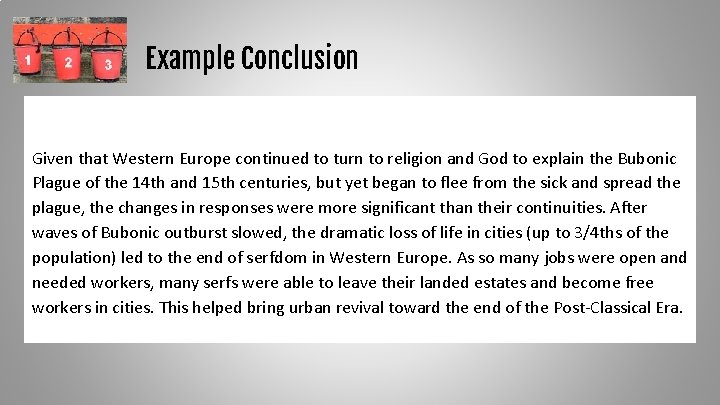
Example Conclusion Given that Western Europe continued to turn to religion and God to explain the Bubonic Plague of the 14 th and 15 th centuries, but yet began to flee from the sick and spread the plague, the changes in responses were more significant than their continuities. After waves of Bubonic outburst slowed, the dramatic loss of life in cities (up to 3/4 ths of the population) led to the end of serfdom in Western Europe. As so many jobs were open and needed workers, many serfs were able to leave their landed estates and become free workers in cities. This helped bring urban revival toward the end of the Post-Classical Era.
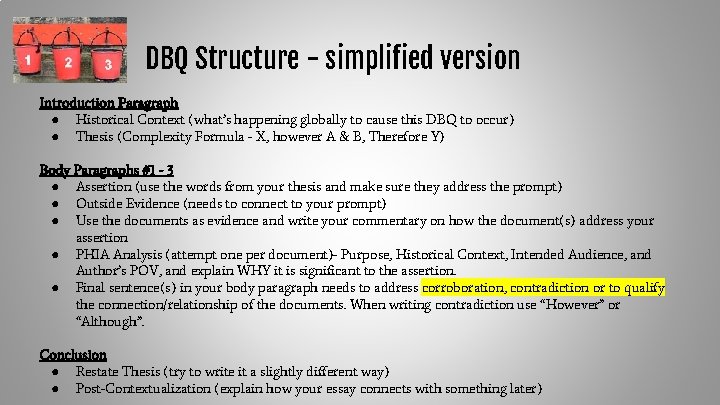
DBQ Structure - simplified version Introduction Paragraph ● Historical Context (what’s happening globally to cause this DBQ to occur) ● Thesis (Complexity Formula - X, however A & B, Therefore Y) Body Paragraphs #1 - 3 ● Assertion (use the words from your thesis and make sure they address the prompt) ● Outside Evidence (needs to connect to your prompt) ● Use the documents as evidence and write your commentary on how the document(s) address your assertion ● PHIA Analysis (attempt one per document)- Purpose, Historical Context, Intended Audience, and Author’s POV, and explain WHY it is significant to the assertion. ● Final sentence(s) in your body paragraph needs to address corroboration, contradiction or to qualify the connection/relationship of the documents. When writing contradiction use “However” or “Although”. Conclusion ● Restate Thesis (try to write it a slightly different way) ● Post-Contextualization (explain how your essay connects with something later)
DBQ Structure - detailed version See Google Classroom for a copy of the detailed version.
- Slides: 33