
The Dawn of Theatre Part 1 Primitive Societies
- Slides: 20
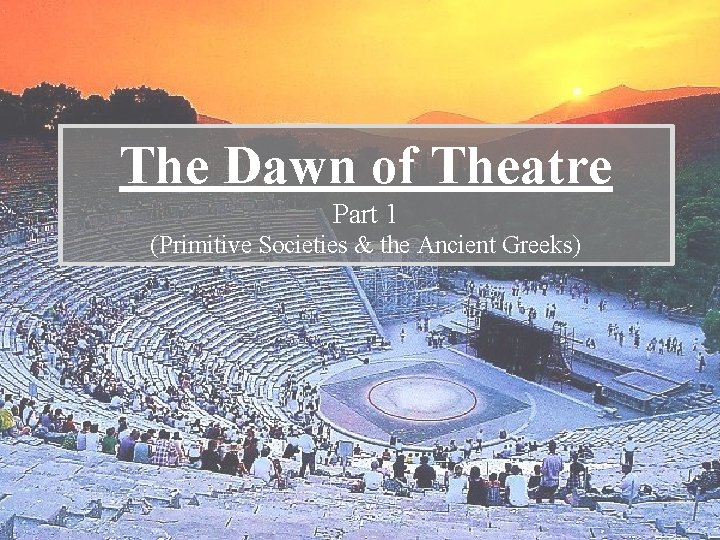
The Dawn of Theatre Part 1 (Primitive Societies & the Ancient Greeks)
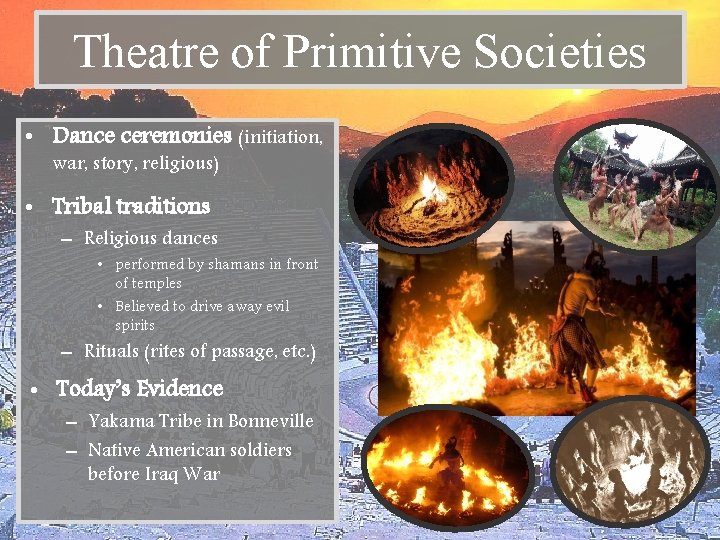
Theatre of Primitive Societies • Dance ceremonies (initiation, war, story, religious) • Tribal traditions – Religious dances • performed by shamans in front of temples • Believed to drive away evil spirits – Rituals (rites of passage, etc. ) • Today’s Evidence – Yakama Tribe in Bonneville – Native American soldiers before Iraq War
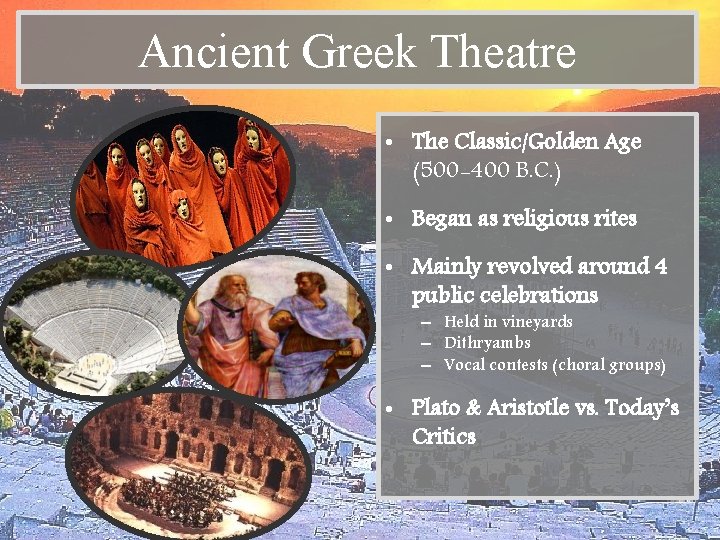
Ancient Greek Theatre • The Classic/Golden Age (500 -400 B. C. ) • Began as religious rites • Mainly revolved around 4 public celebrations – Held in vineyards – Dithryambs – Vocal contests (choral groups) • Plato & Aristotle vs. Today’s Critics
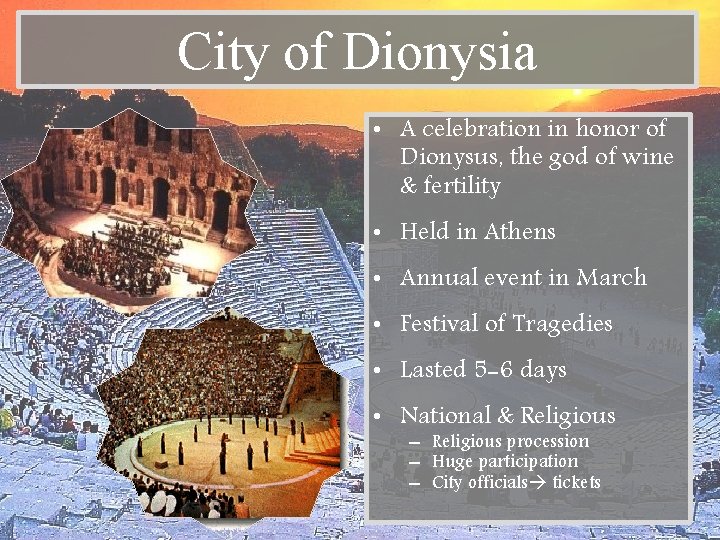
City of Dionysia • A celebration in honor of Dionysus, the god of wine & fertility • Held in Athens • Annual event in March • Festival of Tragedies • Lasted 5 -6 days • National & Religious – Religious procession – Huge participation – City officials tickets
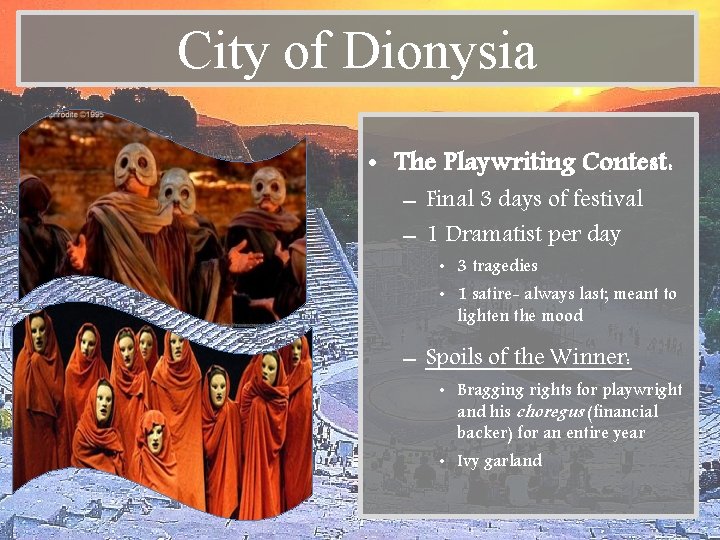
City of Dionysia • The Playwriting Contest: – Final 3 days of festival – 1 Dramatist per day • 3 tragedies • 1 satire- always last; meant to lighten the mood – Spoils of the Winner: • Bragging rights for playwright and his choregus (financial backer) for an entire year • Ivy garland
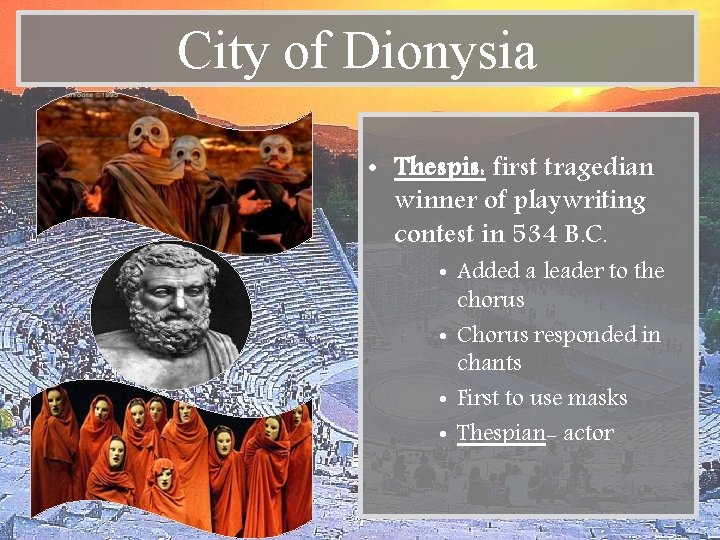
City of Dionysia • Thespis: first tragedian winner of playwriting contest in 534 B. C. • Added a leader to the chorus • Chorus responded in chants • First to use masks • Thespian- actor
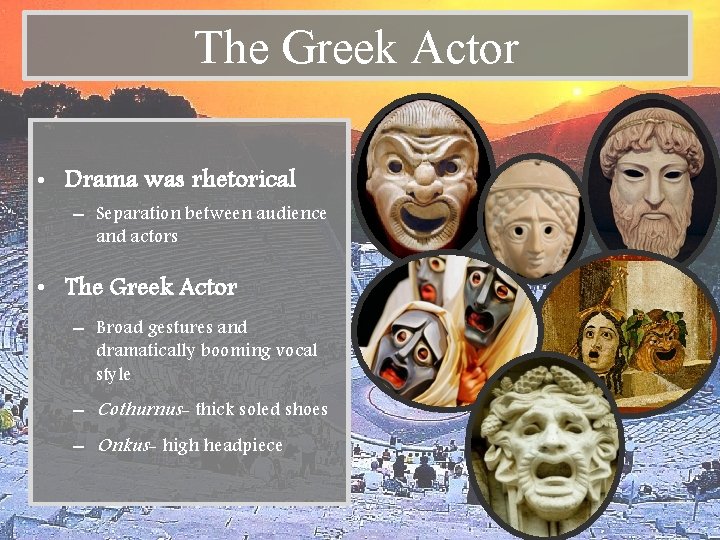
The Greek Actor • Drama was rhetorical – Separation between audience and actors • The Greek Actor – Broad gestures and dramatically booming vocal style – Cothurnus- thick soled shoes – Onkus- high headpiece
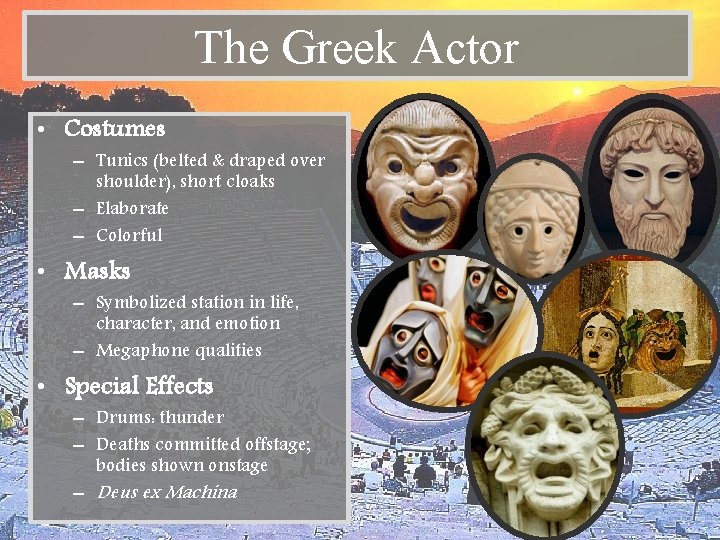
The Greek Actor • Costumes – Tunics (belted & draped over shoulder), short cloaks – Elaborate – Colorful • Masks – Symbolized station in life, character, and emotion – Megaphone qualities • Special Effects – Drums: thunder – Deaths committed offstage; bodies shown onstage – Deus ex Machina
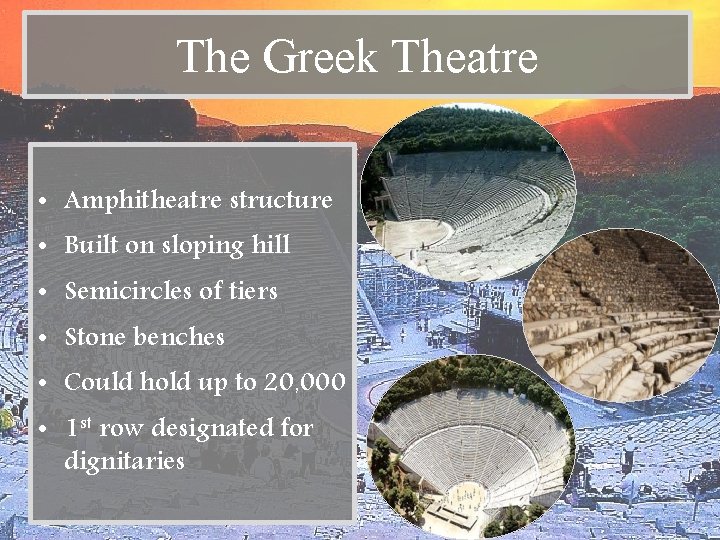
The Greek Theatre • Amphitheatre structure • Built on sloping hill • Semicircles of tiers • Stone benches • Could hold up to 20, 000 • 1 st row designated for dignitaries
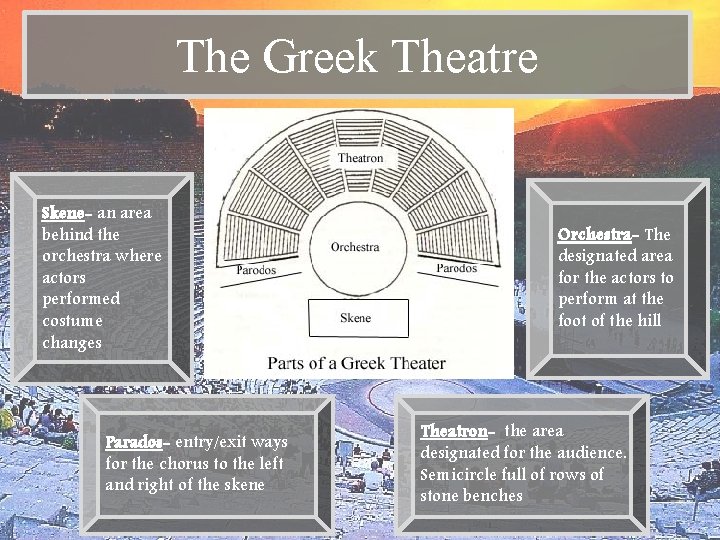
The Greek Theatre Skene- an area behind the orchestra where actors performed costume changes Parados- entry/exit ways for the chorus to the left and right of the skene Orchestra- The designated area for the actors to perform at the foot of the hill Theatron- the area designated for the audience. Semicircle full of rows of stone benches
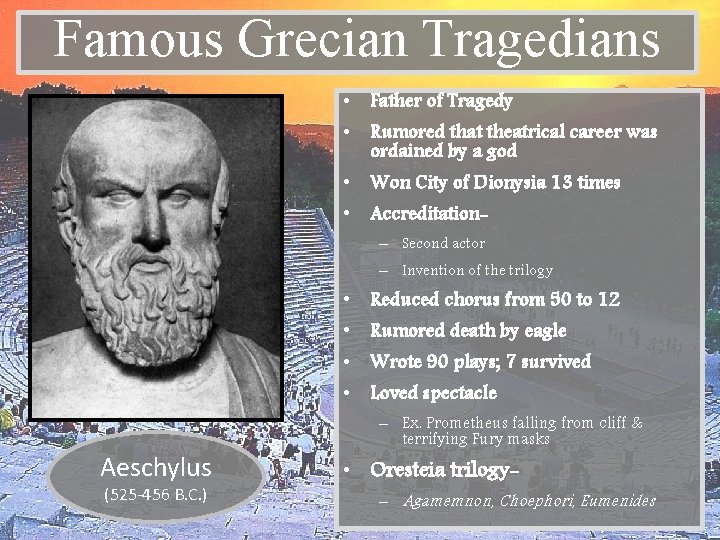
Famous Grecian Tragedians • Father of Tragedy • Rumored that theatrical career was ordained by a god • Won City of Dionysia 13 times • Accreditation– Second actor – Invention of the trilogy • Reduced chorus from 50 to 12 • Rumored death by eagle • Wrote 90 plays; 7 survived • Loved spectacle Aeschylus (525 -456 B. C. ) – Ex. Prometheus falling from cliff & terrifying Fury masks • Oresteia trilogy– Agamemnon, Choephori, Eumenides
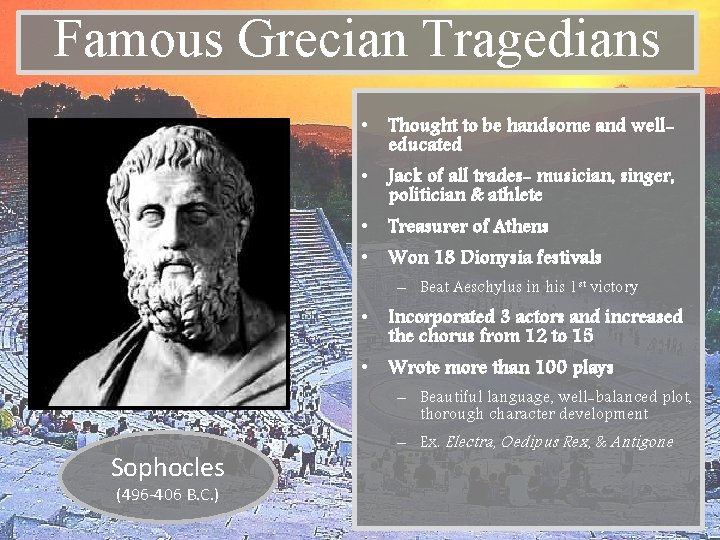
Famous Grecian Tragedians • Thought to be handsome and welleducated • Jack of all trades- musician, singer, politician & athlete • Treasurer of Athens • Won 18 Dionysia festivals – Beat Aeschylus in his 1 st victory • Incorporated 3 actors and increased the chorus from 12 to 15 • Wrote more than 100 plays – Beautiful language, well-balanced plot, thorough character development Sophocles (496 -406 B. C. ) – Ex. Electra, Oedipus Rex, & Antigone
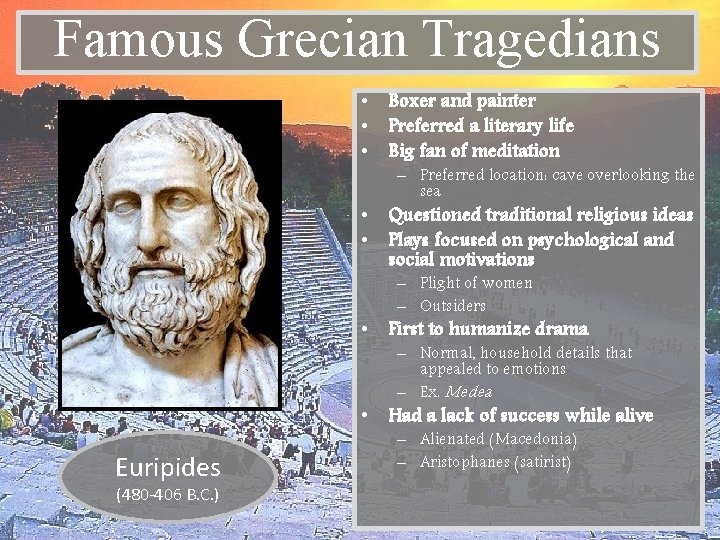
Famous Grecian Tragedians • Boxer and painter • Preferred a literary life • Big fan of meditation – Preferred location: cave overlooking the sea • Questioned traditional religious ideas • Plays focused on psychological and social motivations – Plight of women – Outsiders • First to humanize drama – Normal, household details that appealed to emotions – Ex. Medea • Had a lack of success while alive Euripides (480 -406 B. C. ) – Alienated (Macedonia) – Aristophanes (satirist)
Welcome to Greekbook – Create a Greekbook profile for the tragedian assigned to your group on a poster. – You must use your notes to infer what type of person he was in real life. – Include the following on his Greekbook page: >His Likes >His Dislikes >Home City >Occupation >Groups he might be in >Pages he might like >Some of his favorite modern day movies, T. V. shows, and/or quotes
Playwright Comic Book Create a comic strip about a ONE of the Greek playwrights discussed on pages 406 -408. Must Haves: • 10 comic boxes • Touch on key events that happened to this playwright • Playwright’s personality traits • Most popular plays (what is he known for today? ) • Important people in his life (Ex. Friends, competitors, Choregus, etc. )
Playwright Rap Create a rap about ONE of the Greek playwrights discussed on pages 406 -408. Must Haves: • 10 lines • Touch on key events that happened to this playwright • Playwright’s personality traits • Most popular plays (what is he known for today? ) • Important people in his life (Ex. Friends, competitors, Choregus, etc. )
Greek Theatre Layout Exhibit Create an exhibit for a Hernando Drama History Museum based on the components of a Ancient Greek Theatre. Must Haves: • Emphasize key parts of a Greek theatre. • • Interactive Element Drawn Diagram of a Greek theatre Include details (Ex. Capacity, shape, location, etc. ) Important people that come and events that take place there. (Ex. Playwrights, Choregus, Festival of Tragedies etc. )
Greek Theatre Tour Guide Improv Lead a tour of the designated areas of the classroom that represent the parts of a Greek theatre covered on pages 402 -404. Must Haves: • Tour Brochure (1 piece of paper folded 3 x) • Front picture • Location (Name of theatre, where is it located, etc. ) • Events held there (Festival of Tragedies, etc. ) & Famous people who have been there (Playwrights, Choregus, etc. ) • Each group member must present a specific part of theatre
Greek. TV Playwright Press Conference Write and perform a script for a press conference for one of the Greek playwrights discussed on pgs. 406 -408. Must Haves: • 10 questions • Touch on key life events, key people in his life, major plays he is known for, personality traits • Must assign 2 people to play the reporters, 1 person to play the playwright’s assistant. • Perform scripted press conference
Greek Theatre Recap Demonstrate the vocal level and gestures of a Greek actor. What was the name of Greek festival held in March dedicated to the god Dionysus? What was another name for it? Name one practice in primitive societies that drama possibly resulted from. Who was the more introverted tragedian on the Grecian theatre scene? What was Thespis’s role in theatrical history?