
THE DAWN OF THE SPACE AGE Jonathan Mc
- Slides: 57
THE DAWN OF THE SPACE AGE Jonathan Mc. Dowell Harvard-Smithsonian Center for Astrophysics jcm@cfa. harvard. edu http: //www. planet 4589. org
2005 - Titan
2004 - Spaceship One
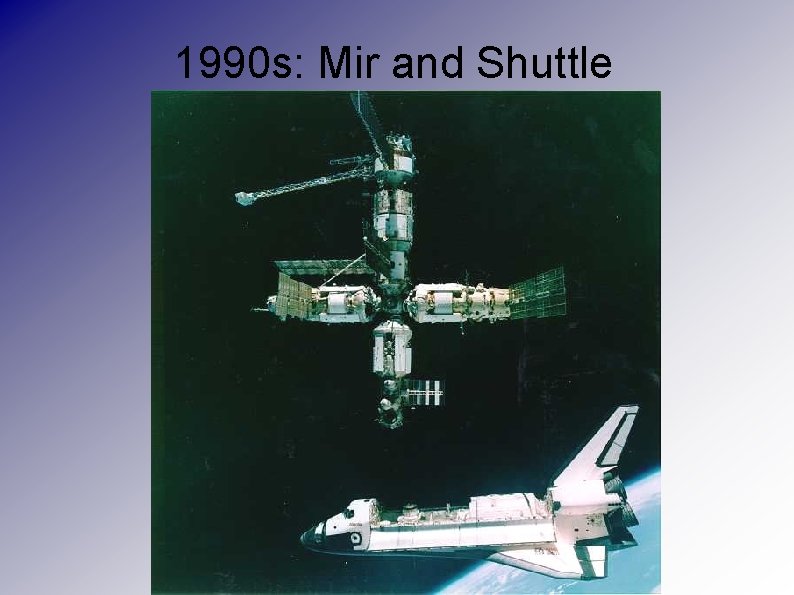
1990 s: Mir and Shuttle
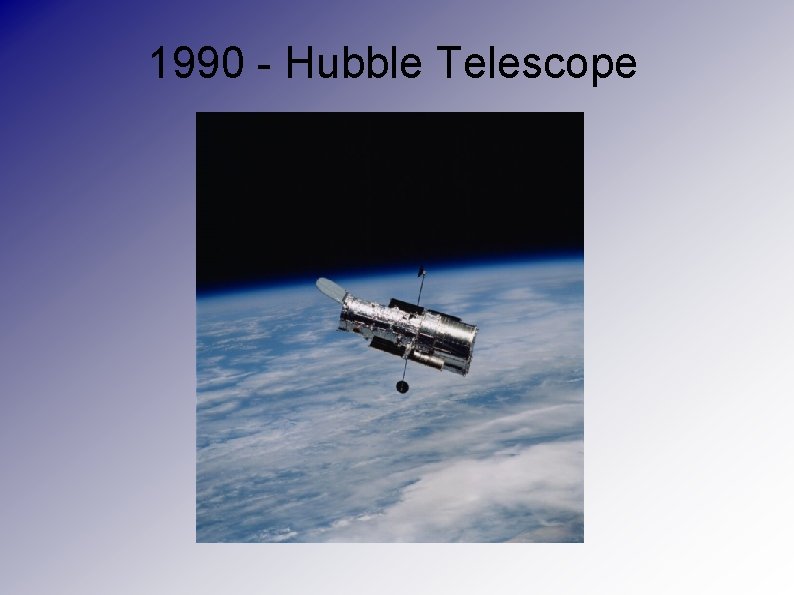
1990 - Hubble Telescope
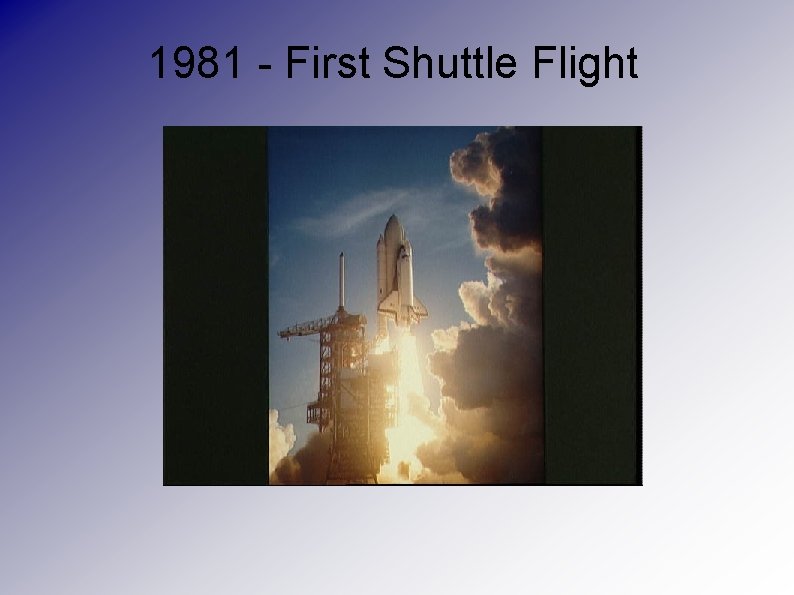
1981 - First Shuttle Flight
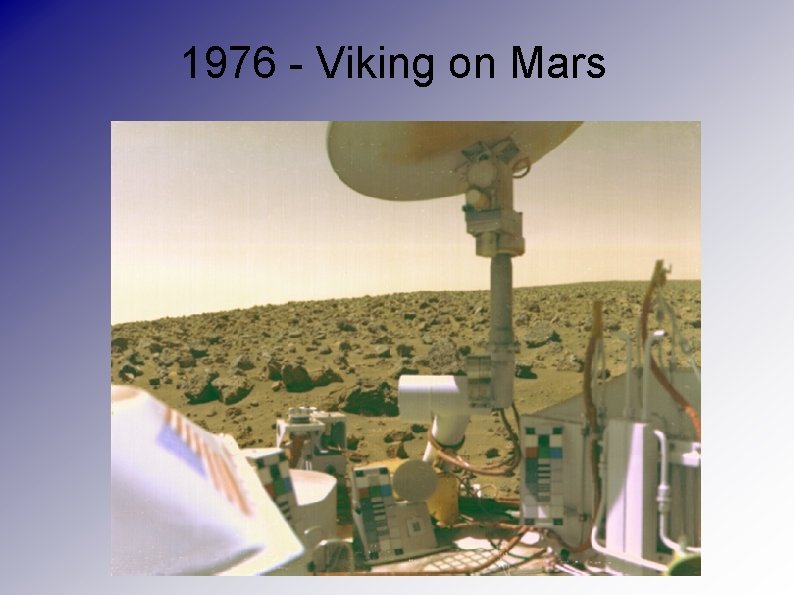
1976 - Viking on Mars
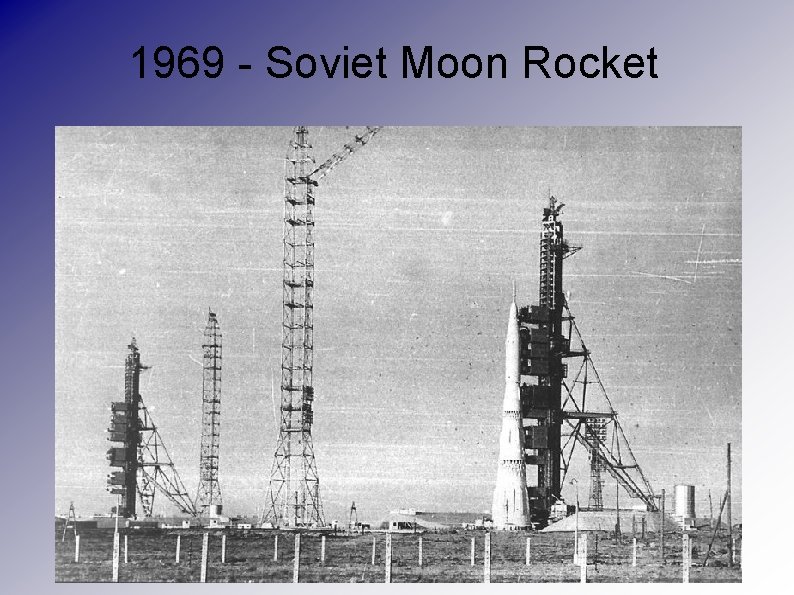
1969 - Soviet Moon Rocket
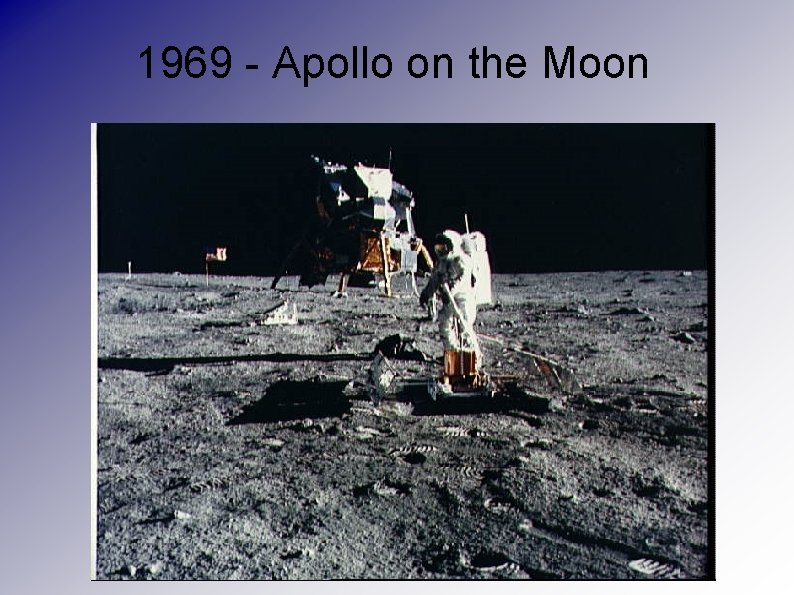
1969 - Apollo on the Moon
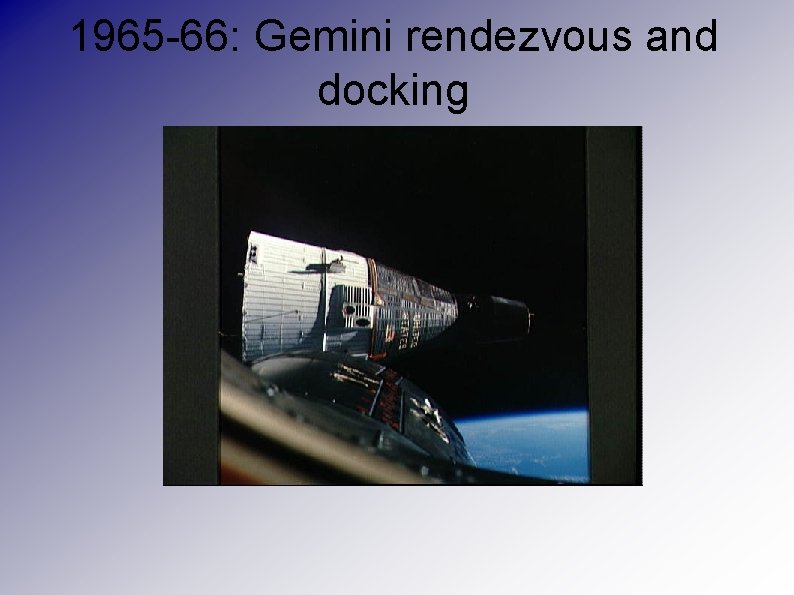
1965 -66: Gemini rendezvous and docking
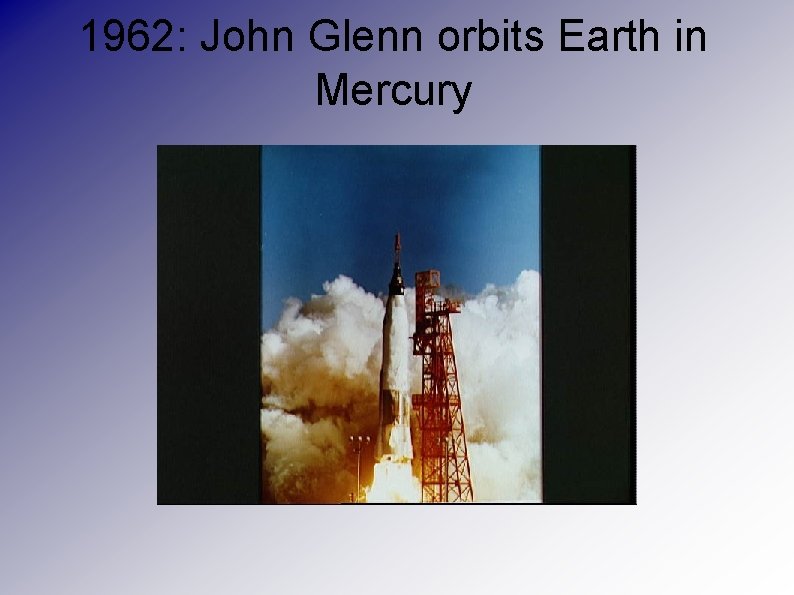
1962: John Glenn orbits Earth in Mercury
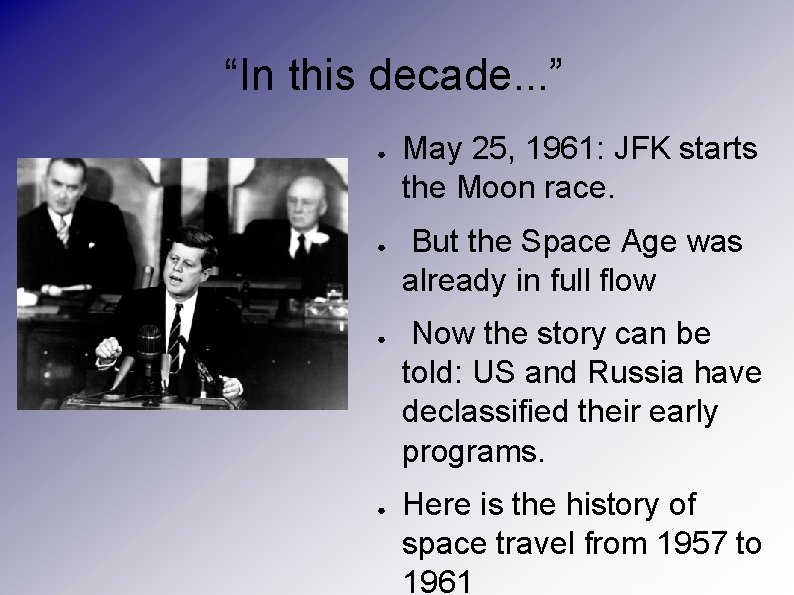
“In this decade. . . ” ● ● May 25, 1961: JFK starts the Moon race. But the Space Age was already in full flow Now the story can be told: US and Russia have declassified their early programs. Here is the history of space travel from 1957 to 1961
Plan of talk ● Statistics of the early space age ● The Soviet space program 1957 -1961 ● The US space program 1957 -1961 ● Later developments 1961 -1963 (if time)
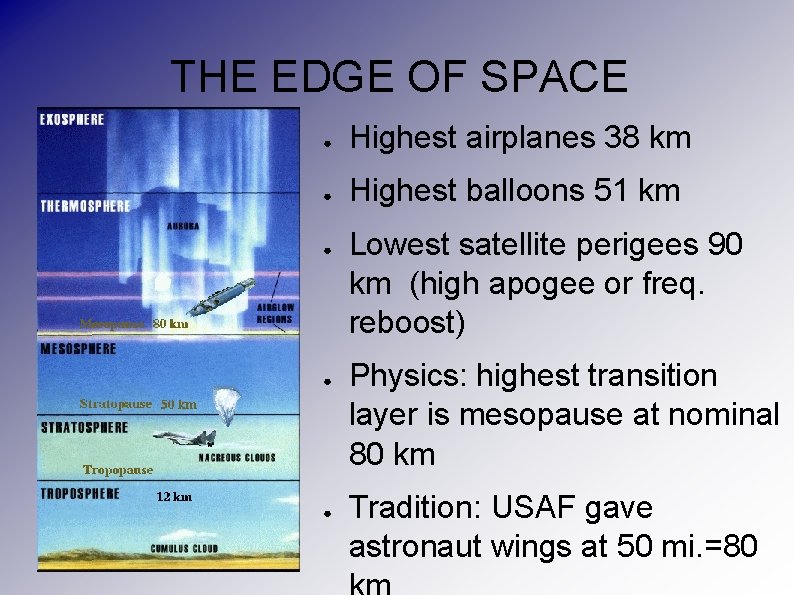
THE EDGE OF SPACE ● Highest airplanes 38 km ● Highest balloons 51 km ● ● ● Lowest satellite perigees 90 km (high apogee or freq. reboost) Physics: highest transition layer is mesopause at nominal 80 km Tradition: USAF gave astronaut wings at 50 mi. =80
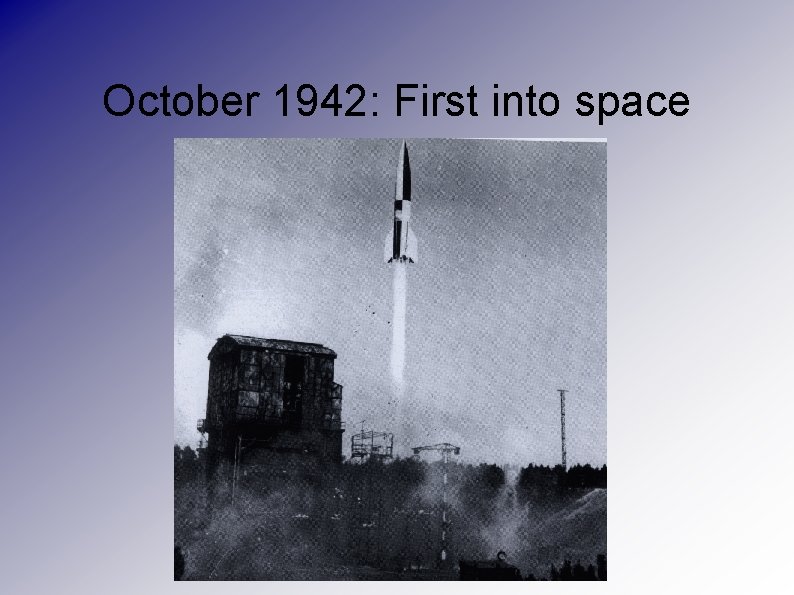
October 1942: First into space
Early space launches (suborbital) ● Germany (Peenemunde): 1942 Oct 3 (or 1943 Mar 18? ), V-2 ● USA (White Sands): 1946 May 10, V-2 ● USSR (Kapustin Yar): 1947 Oct 18, V-2 ● France (Hammaguir): 1954 Feb 21 , Veronique ● UK (Woomera): 1957 Jul 23, Skylark ● Japan (Akita): 1960 Jul 11, Kappa-8 ● Canada (Churchill): 1960 Oct 12, Black Brant 2 ● China (Jiuquan): 1960 Nov, R-2 (V-2 derivative) ● Italy (Sardinia): 1961 Jan 12 with US Nike Cajun ● India (TERLS): 1963 Nov 21 with US Nike Apache ● India (SHAR): 1971 Oct 9 with RH-300 (? )
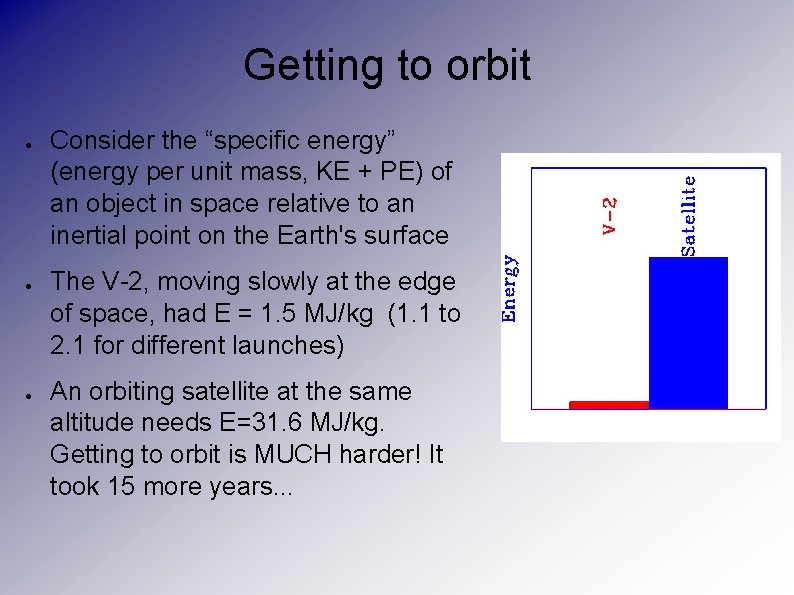
Getting to orbit ● ● ● Consider the “specific energy” (energy per unit mass, KE + PE) of an object in space relative to an inertial point on the Earth's surface The V-2, moving slowly at the edge of space, had E = 1. 5 MJ/kg (1. 1 to 2. 1 for different launches) An orbiting satellite at the same altitude needs E=31. 6 MJ/kg. Getting to orbit is MUCH harder! It took 15 more years. . .
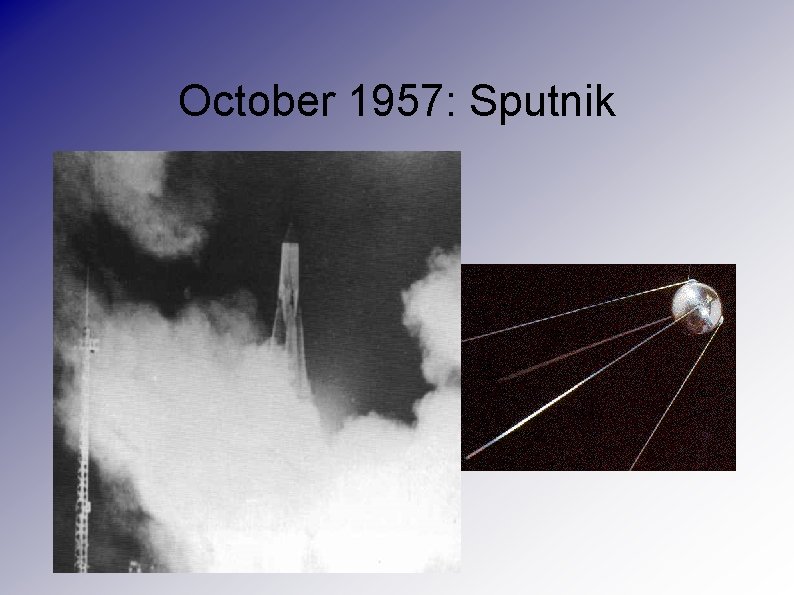
October 1957: Sputnik
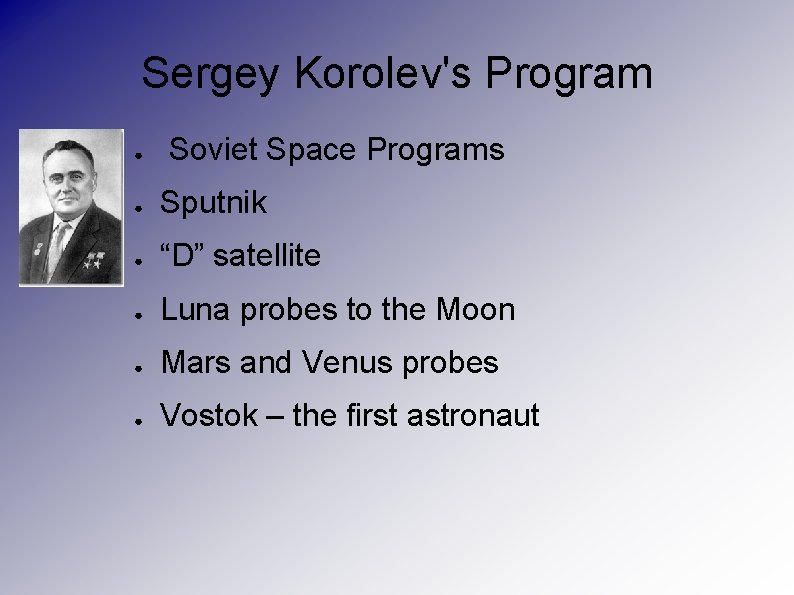
Sergey Korolev's Program ● Soviet Space Programs ● Sputnik ● “D” satellite ● Luna probes to the Moon ● Mars and Venus probes ● Vostok – the first astronaut
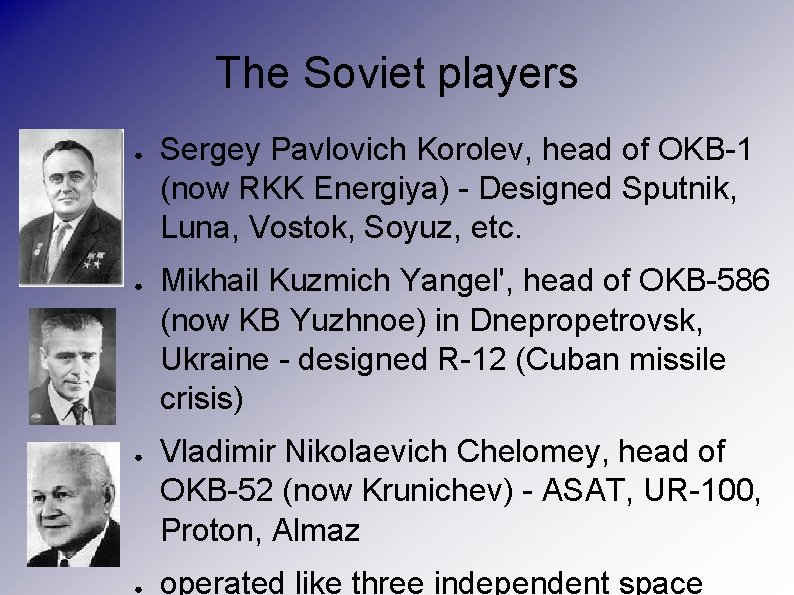
The Soviet players ● ● Sergey Pavlovich Korolev, head of OKB-1 (now RKK Energiya) - Designed Sputnik, Luna, Vostok, Soyuz, etc. Mikhail Kuzmich Yangel', head of OKB-586 (now KB Yuzhnoe) in Dnepropetrovsk, Ukraine - designed R-12 (Cuban missile crisis) Vladimir Nikolaevich Chelomey, head of OKB-52 (now Krunichev) - ASAT, UR-100, Proton, Almaz operated like three independent space
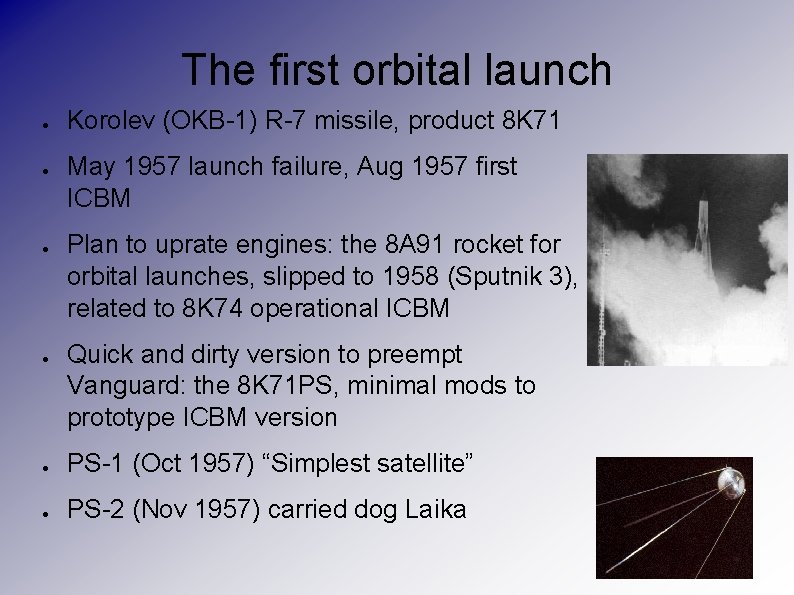
The first orbital launch ● ● Korolev (OKB-1) R-7 missile, product 8 K 71 May 1957 launch failure, Aug 1957 first ICBM Plan to uprate engines: the 8 A 91 rocket for orbital launches, slipped to 1958 (Sputnik 3), related to 8 K 74 operational ICBM Quick and dirty version to preempt Vanguard: the 8 K 71 PS, minimal mods to prototype ICBM version ● PS-1 (Oct 1957) “Simplest satellite” ● PS-2 (Nov 1957) carried dog Laika
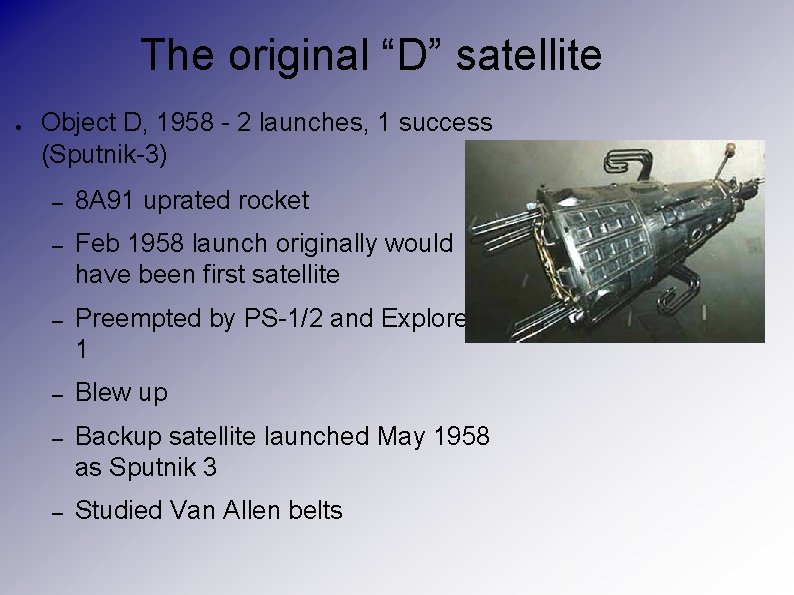
The original “D” satellite ● Object D, 1958 - 2 launches, 1 success (Sputnik-3) – 8 A 91 uprated rocket – Feb 1958 launch originally would have been first satellite – Preempted by PS-1/2 and Explorer 1 – Blew up – Backup satellite launched May 1958 as Sputnik 3 – Studied Van Allen belts
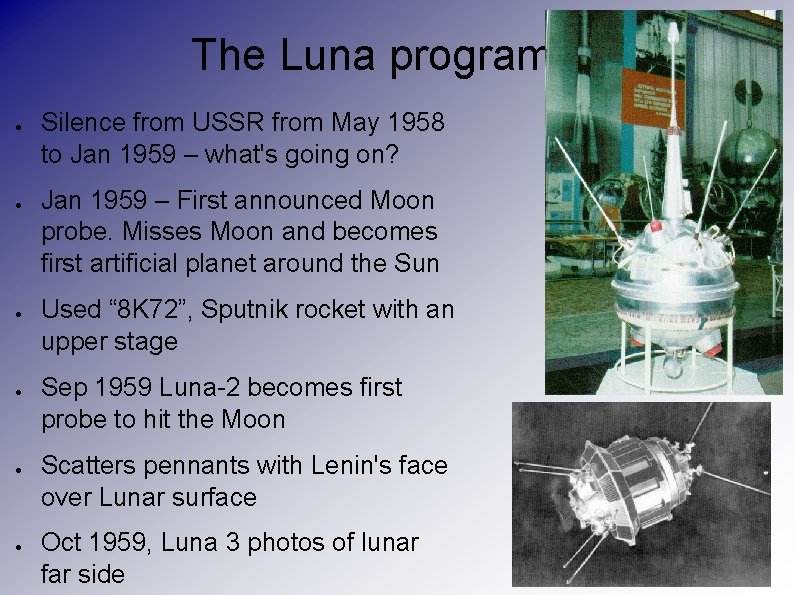
The Luna program ● ● ● Silence from USSR from May 1958 to Jan 1959 – what's going on? Jan 1959 – First announced Moon probe. Misses Moon and becomes first artificial planet around the Sun Used “ 8 K 72”, Sputnik rocket with an upper stage Sep 1959 Luna-2 becomes first probe to hit the Moon Scatters pennants with Lenin's face over Lunar surface Oct 1959, Luna 3 photos of lunar far side
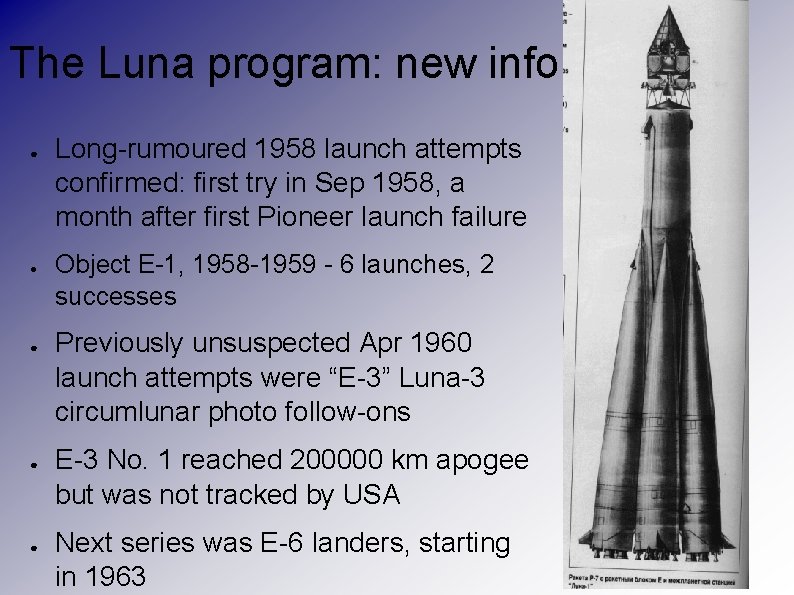
The Luna program: new info ● ● ● Long-rumoured 1958 launch attempts confirmed: first try in Sep 1958, a month after first Pioneer launch failure Object E-1, 1958 -1959 - 6 launches, 2 successes Previously unsuspected Apr 1960 launch attempts were “E-3” Luna-3 circumlunar photo follow-ons E-3 No. 1 reached 200000 km apogee but was not tracked by USA Next series was E-6 landers, starting in 1963
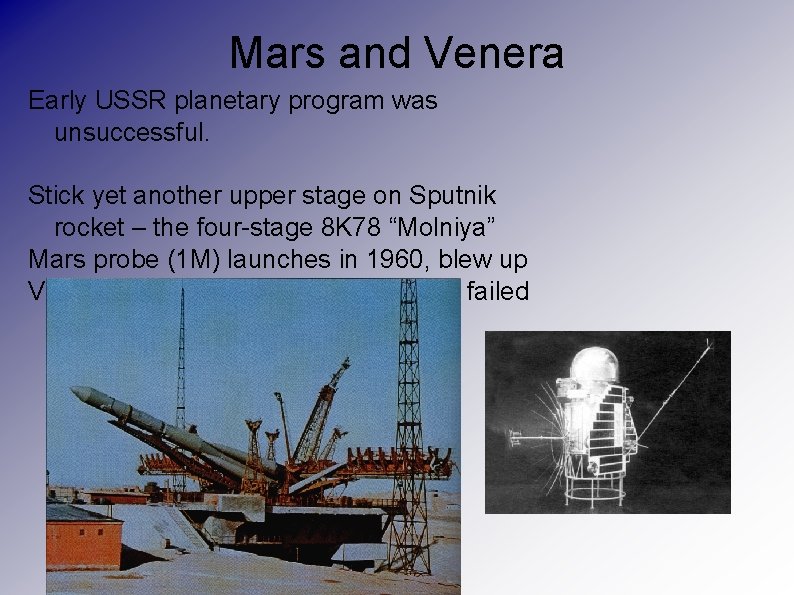
Mars and Venera Early USSR planetary program was unsuccessful. Stick yet another upper stage on Sputnik rocket – the four-stage 8 K 78 “Molniya” Mars probe (1 M) launches in 1960, blew up Venus probe (1 VA) launches in 1961, failed
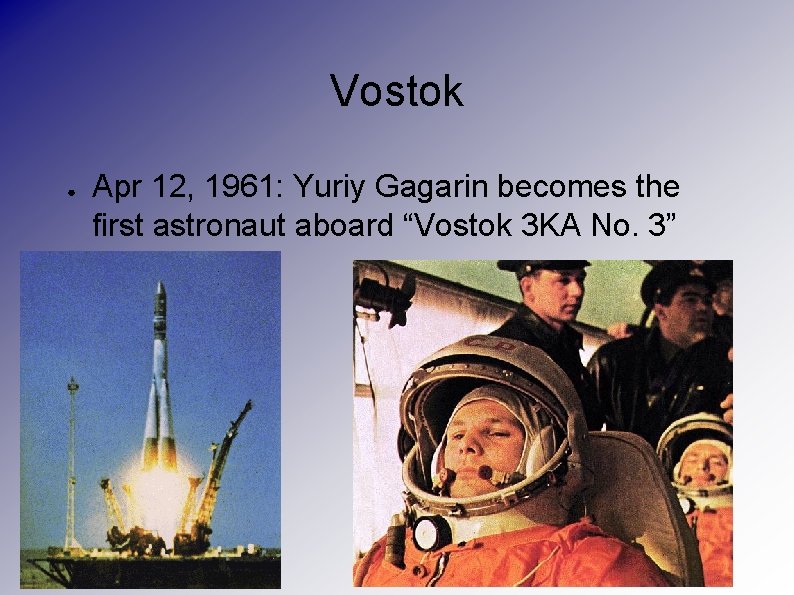
Vostok ● Apr 12, 1961: Yuriy Gagarin becomes the first astronaut aboard “Vostok 3 KA No. 3”
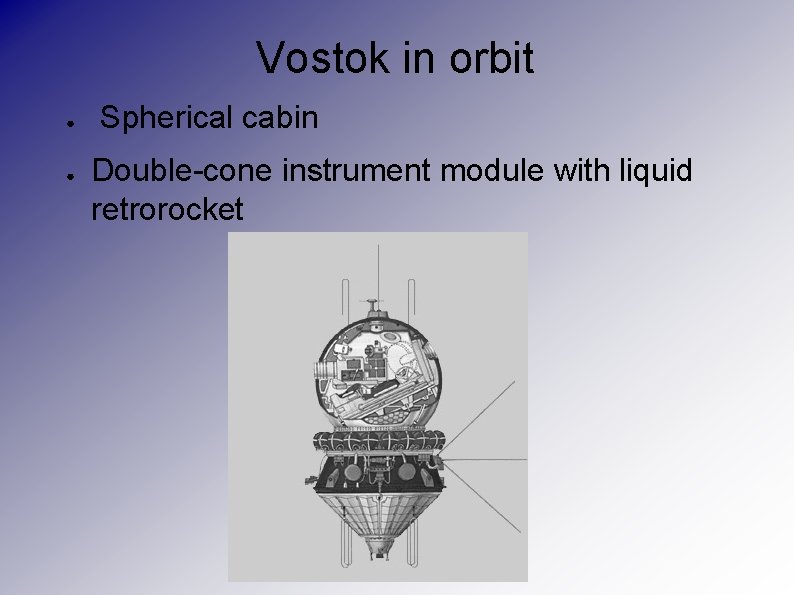
Vostok in orbit ● ● Spherical cabin Double-cone instrument module with liquid retrorocket
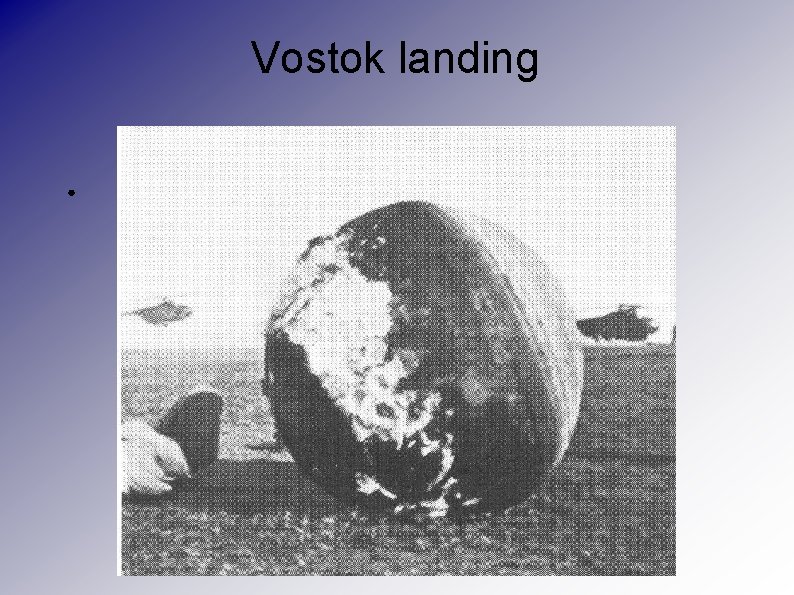
Vostok landing ●
The Vostok program (1) ● ● ● Vostok used the 8 K 72 K rocket, which was a Sputnik with the Blok E upper stage like that used for the “E” lunar missions The first launches, without astronauts, were announced as “Korabl'-Sputnik” (Spaceship. Satellite) The 1 K prototype was followed by the 3 KA human-rated version and later the 3 KV/3 KD multiseater (Voskhod)
The Vostok program (2) ● May 1960 test launch - retro fired in wrong direction ● July 1960 1 K No. 1 crashed near launch site ● Aug 1960 1 K No. 2 - dogs Belka and Strelka first living things recovered from orbit ● Dec 1960 1 K No. 3 - destroyed in reentry ● Dec 1960 1 K No. 4 - launch failure crashed in Siberia ● Mar 1961 3 KA No. 1 - dog recovered safely after 1 orbit ● Mar 1961 3 KA No. 2 - dog recovered safely after 1 orbit ● Apr 1961 3 KA No. 3 - Yuri Gagarin's flight ● Aug 1961 - Jun 1963: Titov, Nikolaev, Popovich, Bykovsky, Tereshkova all fly successfully
Other Soviet programs ● ● All these programs (PS, D, E/Luna, Mars, Venera, Vostok) were run by Korolev and used his R-7 (8 K 71) rocket and its derivatives Vostok was modified as a spy satellite in 1962; derivatives still fly for science missions The Yangel program, with “DS” (Dnepropetrovskiy Sputnik) satellites and the R-12 booster got going in late 1961, with first success in 1962 under the Kosmos-1 cover name The first Chelomei product, an antisatellite development test, flew in 1963.
America in orbit 1957 -1961 ● ● Early program run by military and CIA: – US Army (ABMA/Huntsville): Explorer, Pioneer (with JPL) – US Navy (NRL/Washington): Vanguard – US Navy (NOTS/China Lake): “NOTSNIK” – US Air Force (WDD/Los Angeles): Able, Samos, Midas – CIA (Langley): CORONA (Discoverer) NASA formed 1958 for civilian space programs
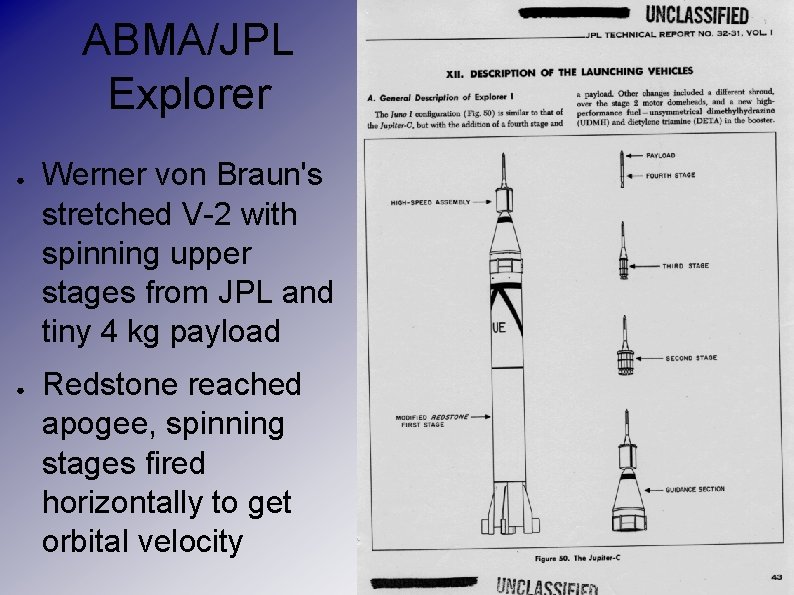
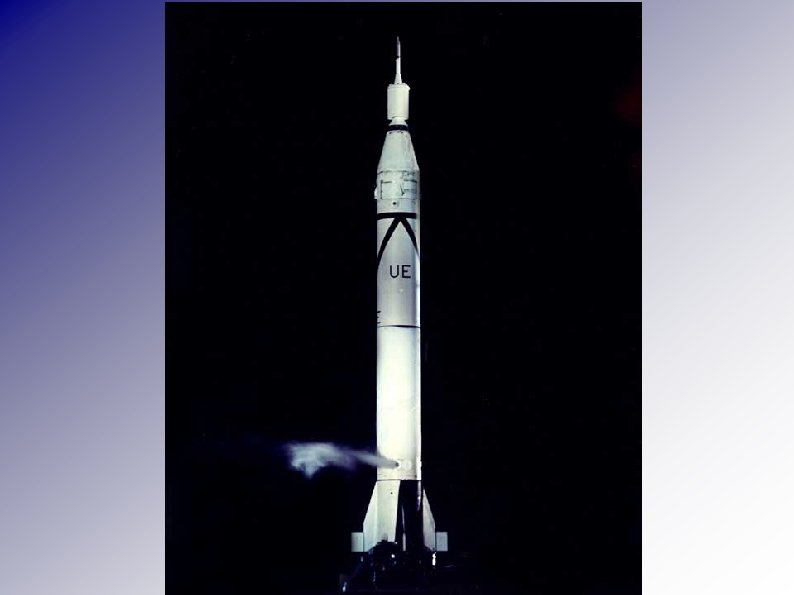
ABMA/JPL Explorer ● ● Werner von Braun's stretched V-2 with spinning upper stages from JPL and tiny 4 kg payload Redstone reached apogee, spinning stages fired horizontally to get orbital velocity
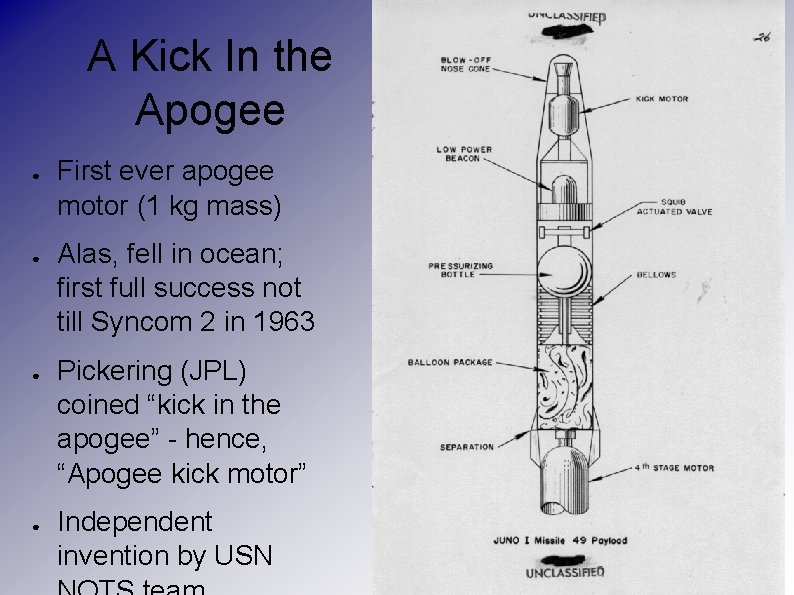
A Kick In the Apogee ● ● First ever apogee motor (1 kg mass) Alas, fell in ocean; first full success not till Syncom 2 in 1963 Pickering (JPL) coined “kick in the apogee” - hence, “Apogee kick motor” Independent invention by USN
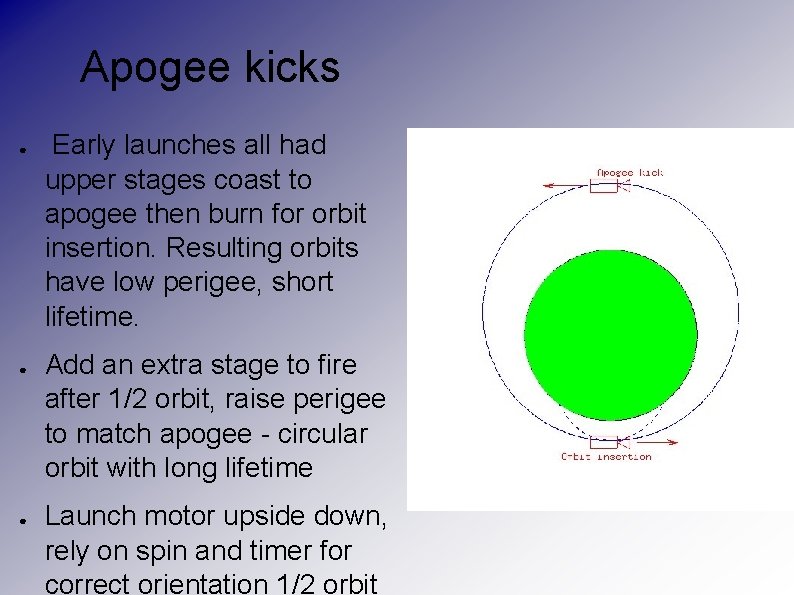
Apogee kicks ● ● ● Early launches all had upper stages coast to apogee then burn for orbit insertion. Resulting orbits have low perigee, short lifetime. Add an extra stage to fire after 1/2 orbit, raise perigee to match apogee - circular orbit with long lifetime Launch motor upside down, rely on spin and timer for correct orientation 1/2 orbit
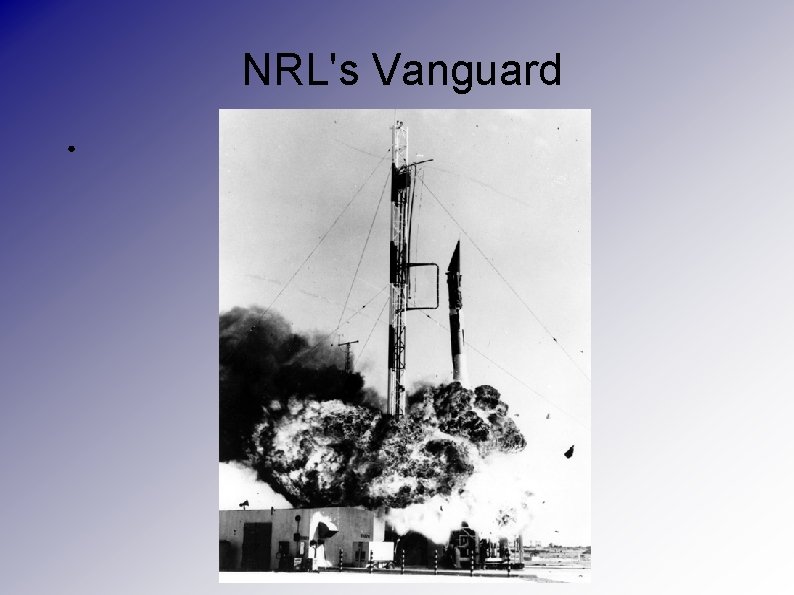
NRL's Vanguard ●
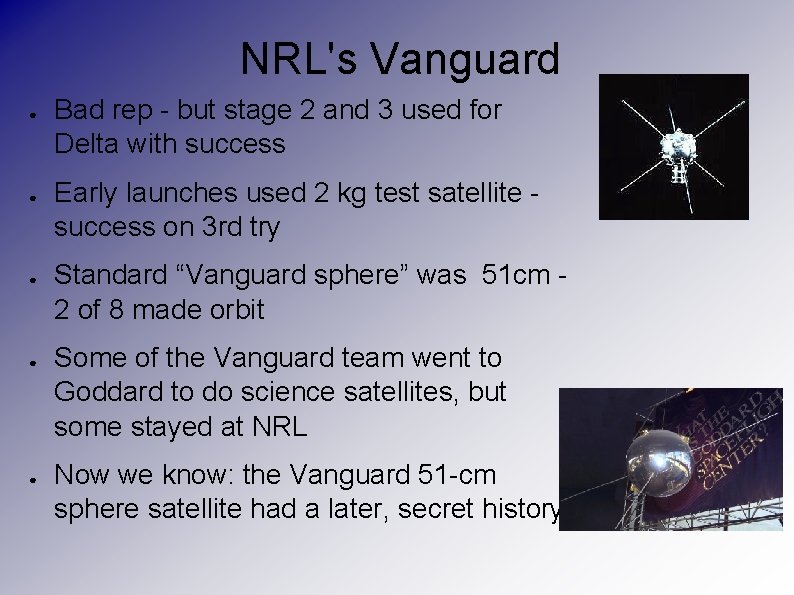
NRL's Vanguard ● ● ● Bad rep - but stage 2 and 3 used for Delta with success Early launches used 2 kg test satellite success on 3 rd try Standard “Vanguard sphere” was 51 cm 2 of 8 made orbit Some of the Vanguard team went to Goddard to do science satellites, but some stayed at NRL Now we know: the Vanguard 51 -cm sphere satellite had a later, secret history
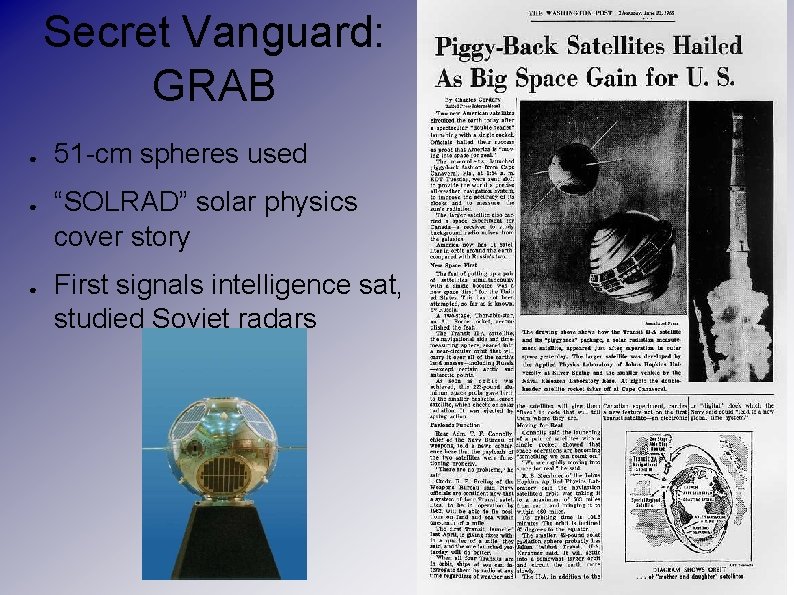
Secret Vanguard: GRAB ● ● ● 51 -cm spheres used “SOLRAD” solar physics cover story First signals intelligence sat, studied Soviet radars
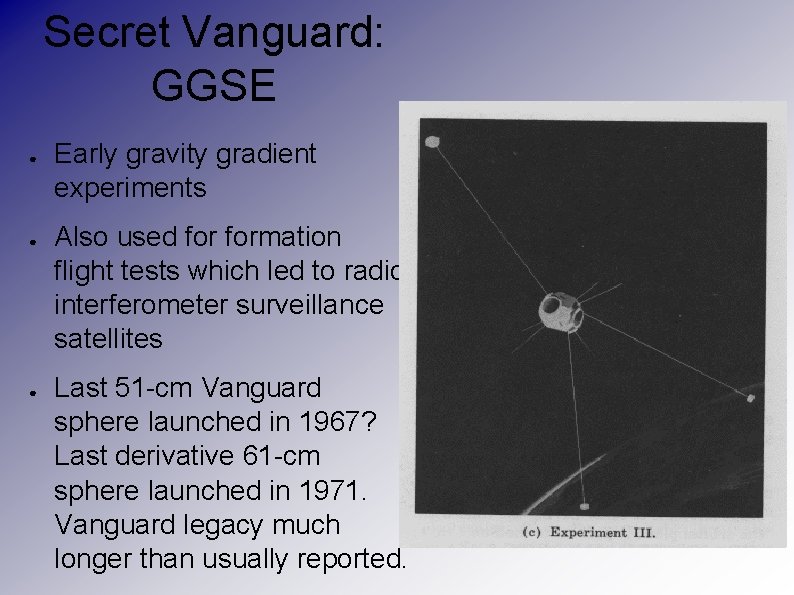
Secret Vanguard: GGSE ● ● ● Early gravity gradient experiments Also used formation flight tests which led to radio interferometer surveillance satellites Last 51 -cm Vanguard sphere launched in 1967? Last derivative 61 -cm sphere launched in 1971. Vanguard legacy much longer than usually reported.
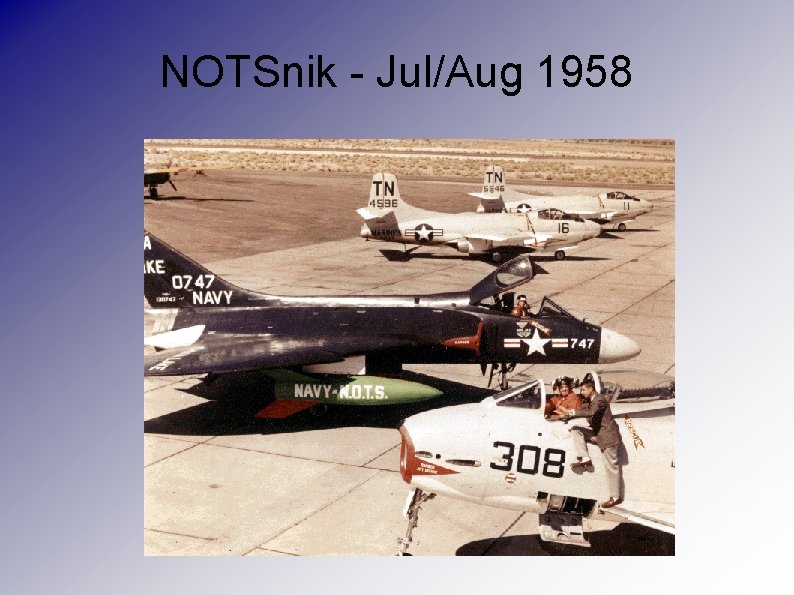
NOTSnik - Jul/Aug 1958
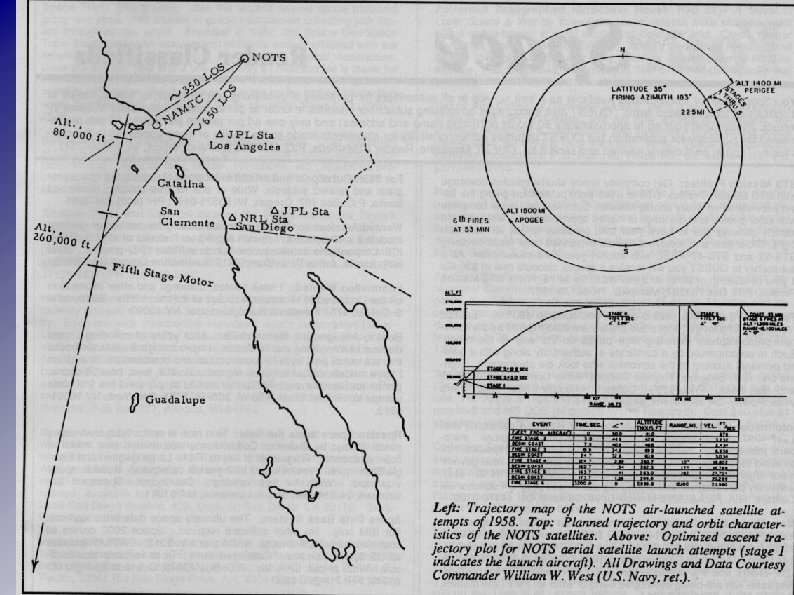
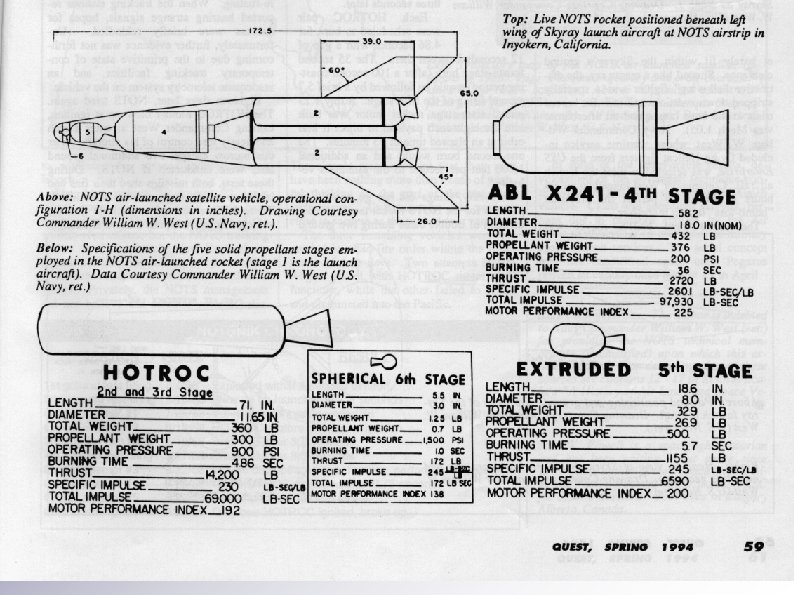
NOTS project ● ● ● First air-launched satellite attempt, off California coast Six tries, no confirmed successes 2 types of payload: radiation diagnostics for Argus artificial radiation belts, and infrared scanner instrument. 1 kg satellite! ● Five stage vehicle very unreliable ● Details did not emerge until 1990 s
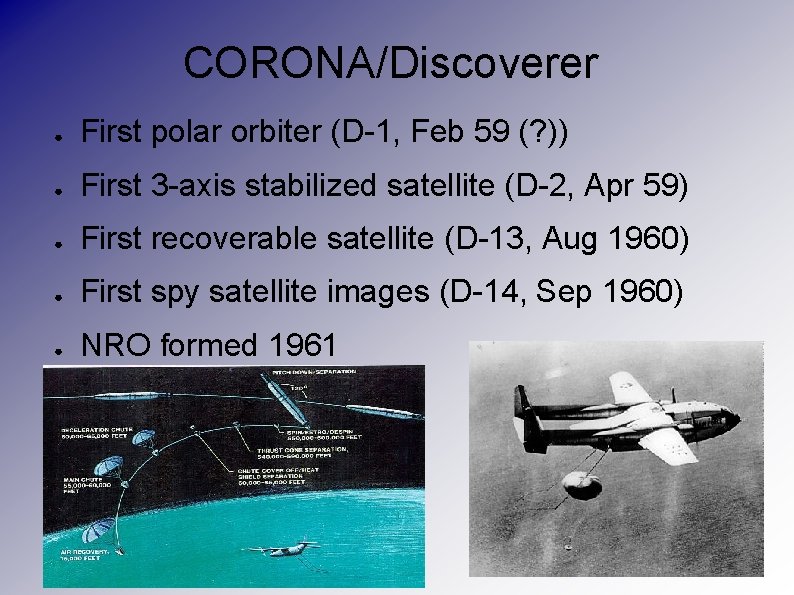
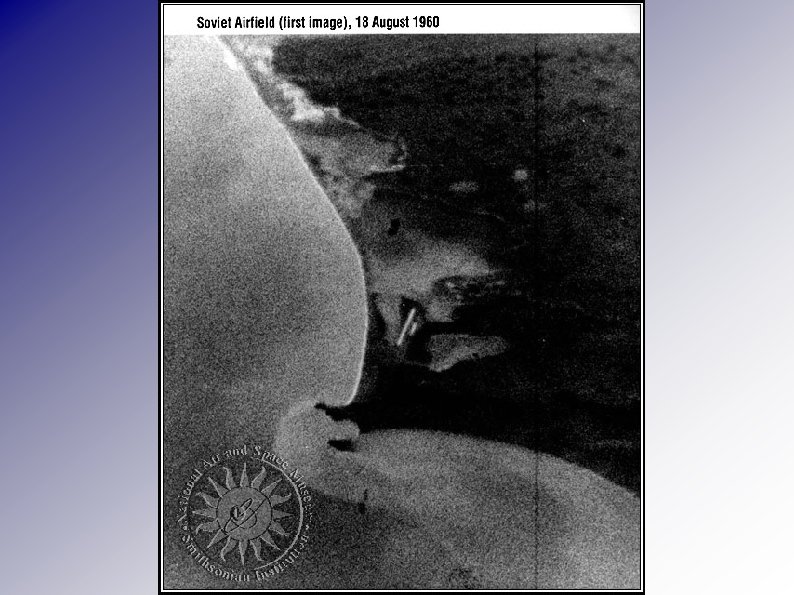
CORONA/Discoverer ● First polar orbiter (D-1, Feb 59 (? )) ● First 3 -axis stabilized satellite (D-2, Apr 59) ● First recoverable satellite (D-13, Aug 1960) ● First spy satellite images (D-14, Sep 1960) ● NRO formed 1961
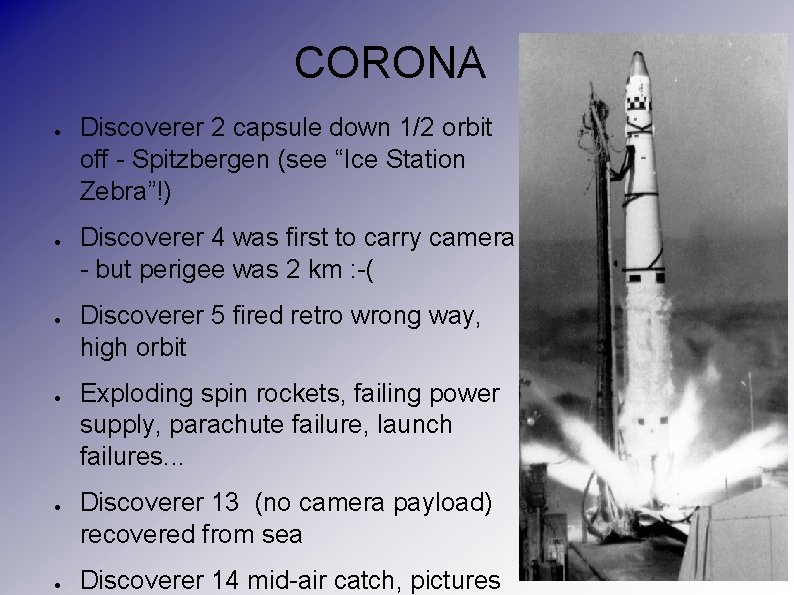
CORONA ● ● ● Discoverer 2 capsule down 1/2 orbit off - Spitzbergen (see “Ice Station Zebra”!) Discoverer 4 was first to carry camera - but perigee was 2 km : -( Discoverer 5 fired retro wrong way, high orbit Exploding spin rockets, failing power supply, parachute failure, launch failures. . . Discoverer 13 (no camera payload) recovered from sea Discoverer 14 mid-air catch, pictures
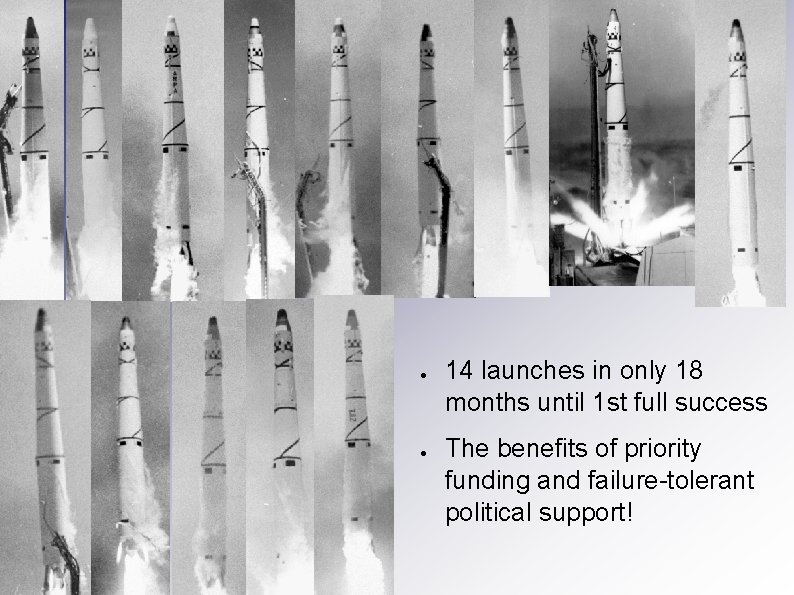
● ● 14 launches in only 18 months until 1 st full success The benefits of priority funding and failure-tolerant political support!
NASA is formed ● NACA Langley lab (Virginia) - Balloon satellites, Scout, Mercury, and aeronautical research ● NACA Ames lab (San Francisco) - aeronautical research ● NACA Lewis lab (Cleveland) - engines ● ● NRL Vanguard group -moves to new “Beltsville Space Center”, later called Goddard Army ABMA group (Huntsville) - becomes NASA-Marshall in 1960 Army contract with JPL goes to NASA Small group at Canaveral later becomes KSC; Houston develops in mid-1960 s
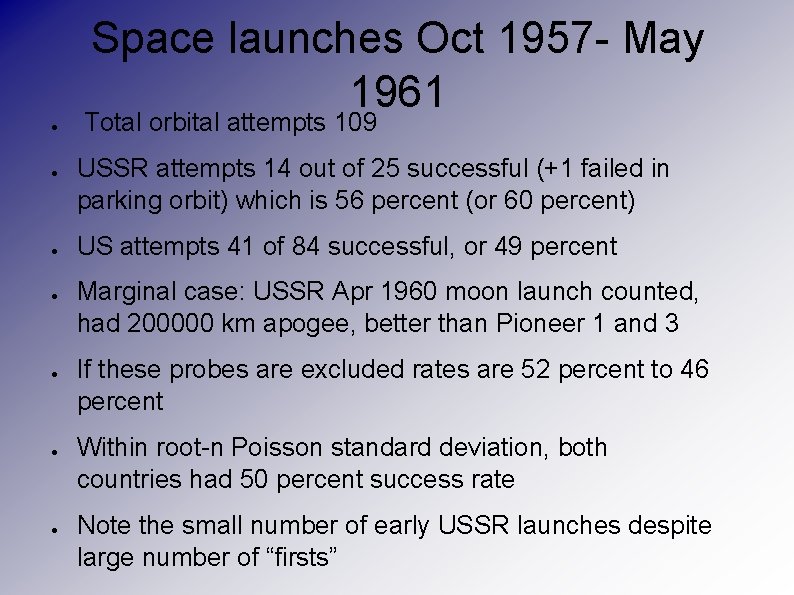
Space launches Oct 1957 - May 1961 ● ● ● ● Total orbital attempts 109 USSR attempts 14 out of 25 successful (+1 failed in parking orbit) which is 56 percent (or 60 percent) US attempts 41 of 84 successful, or 49 percent Marginal case: USSR Apr 1960 moon launch counted, had 200000 km apogee, better than Pioneer 1 and 3 If these probes are excluded rates are 52 percent to 46 percent Within root-n Poisson standard deviation, both countries had 50 percent success rate Note the small number of early USSR launches despite large number of “firsts”
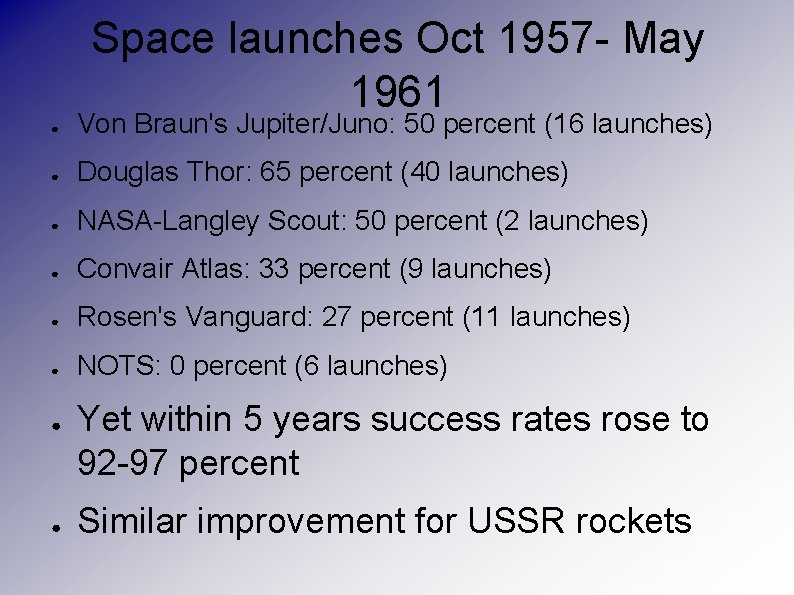
Space launches Oct 1957 - May 1961 ● Von Braun's Jupiter/Juno: 50 percent (16 launches) ● Douglas Thor: 65 percent (40 launches) ● NASA-Langley Scout: 50 percent (2 launches) ● Convair Atlas: 33 percent (9 launches) ● Rosen's Vanguard: 27 percent (11 launches) ● NOTS: 0 percent (6 launches) ● ● Yet within 5 years success rates rose to 92 -97 percent Similar improvement for USSR rockets
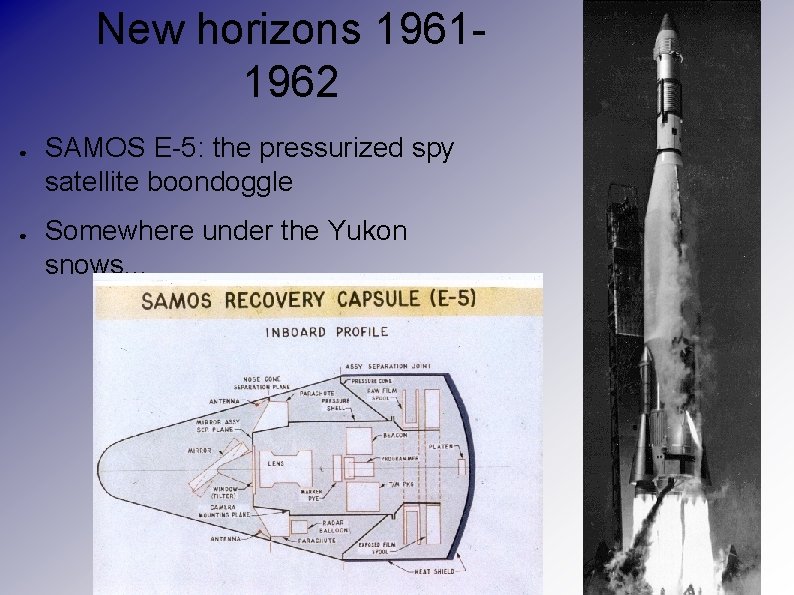
New horizons 19611962 ● ● SAMOS E-5: the pressurized spy satellite boondoggle Somewhere under the Yukon snows. . .
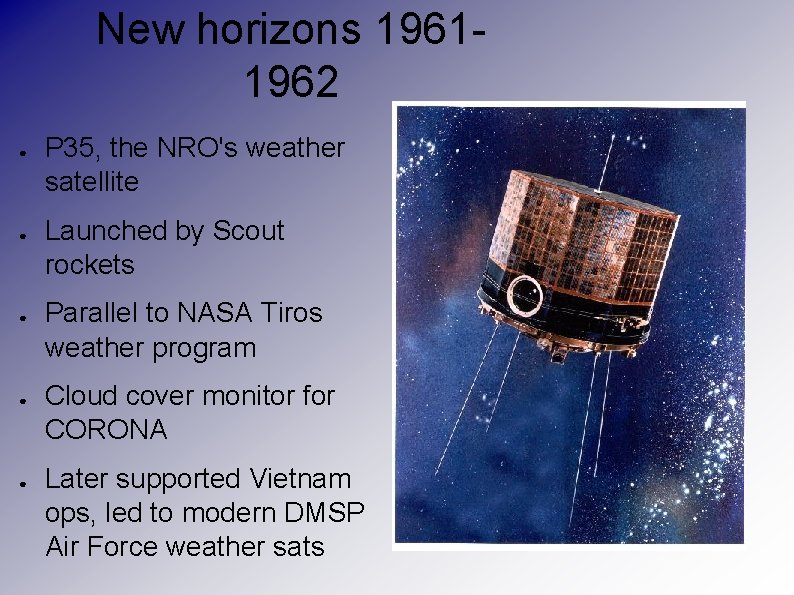
New horizons 19611962 ● ● ● P 35, the NRO's weather satellite Launched by Scout rockets Parallel to NASA Tiros weather program Cloud cover monitor for CORONA Later supported Vietnam ops, led to modern DMSP Air Force weather sats
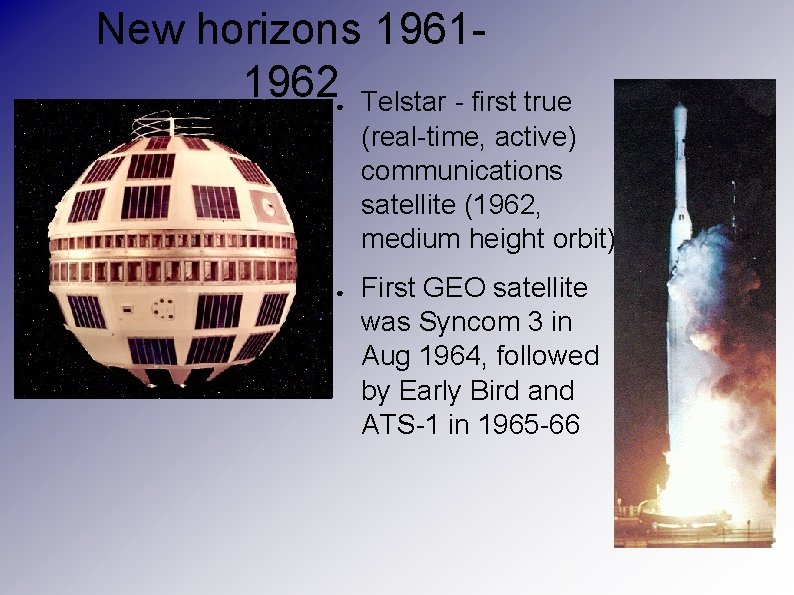
New horizons 19611962 Telstar - first true ● (real-time, active) communications satellite (1962, medium height orbit) ● First GEO satellite was Syncom 3 in Aug 1964, followed by Early Bird and ATS-1 in 1965 -66
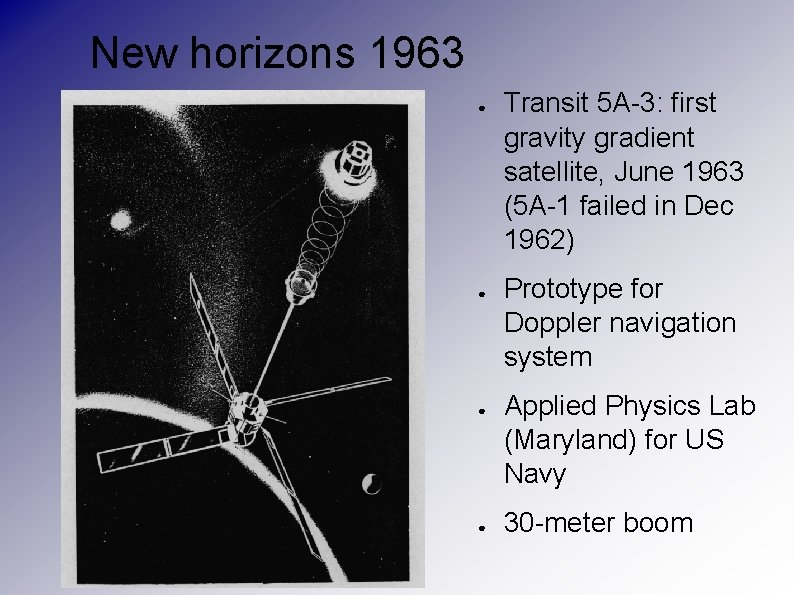
New horizons 1963 ● ● Transit 5 A-3: first gravity gradient satellite, June 1963 (5 A-1 failed in Dec 1962) Prototype for Doppler navigation system Applied Physics Lab (Maryland) for US Navy 30 -meter boom
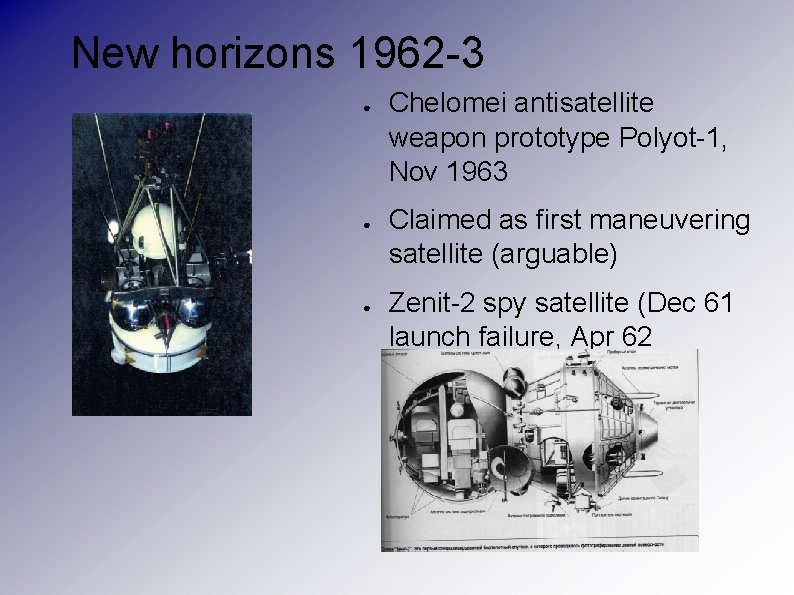
New horizons 1962 -3 ● ● ● Chelomei antisatellite weapon prototype Polyot-1, Nov 1963 Claimed as first maneuvering satellite (arguable) Zenit-2 spy satellite (Dec 61 launch failure, Apr 62 success)
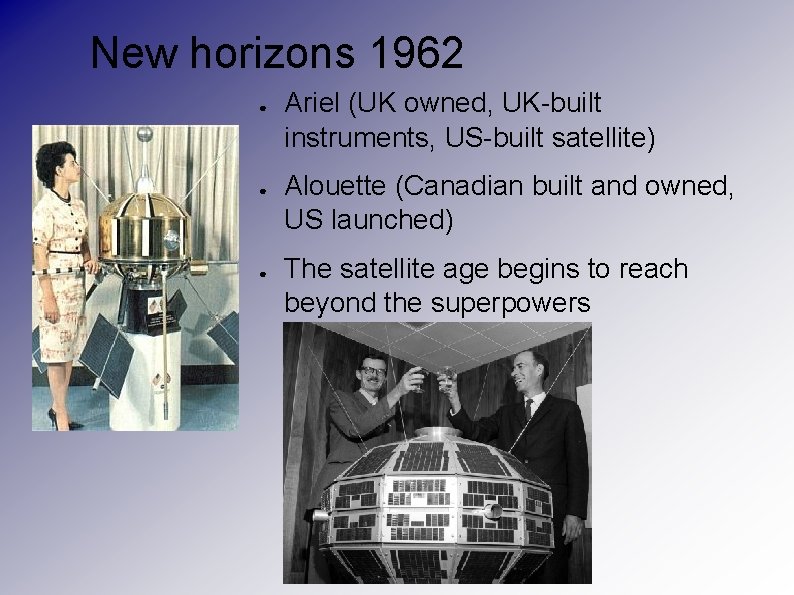
New horizons 1962 ● ● ● Ariel (UK owned, UK-built instruments, US-built satellite) Alouette (Canadian built and owned, US launched) The satellite age begins to reach beyond the superpowers