
The Dawn of Heavy Metal Led Zeppelin Black
The Dawn of Heavy Metal Led Zeppelin Black Sabbath & 70’s Metal
Description Heavy Metal has been described a meeting place between blues-based rock, psychedelic acid rock, and classical music.
Prominent characteristics • Complicated structures with several discrete sections • Orchestral texture, multiple vocals, gritty, “screaming” vocals • Acoustic parts contrast very loud electric segments • Emphasis on: – – – Long guitar solos Electronic effects Modal scales Extreme volume “Power chords” & “riffs” • Extreme stage costume and stage antics, very macho • References to occult topics, black magic, mythology, etc
Steppenwolf Born to be Wild • Released in 1968 • Written by Mars Bonfire • This song has become a staple in the description of “biker” culture • The term “heavy metal” appears for the first time in song here – “heavy metal thunder”
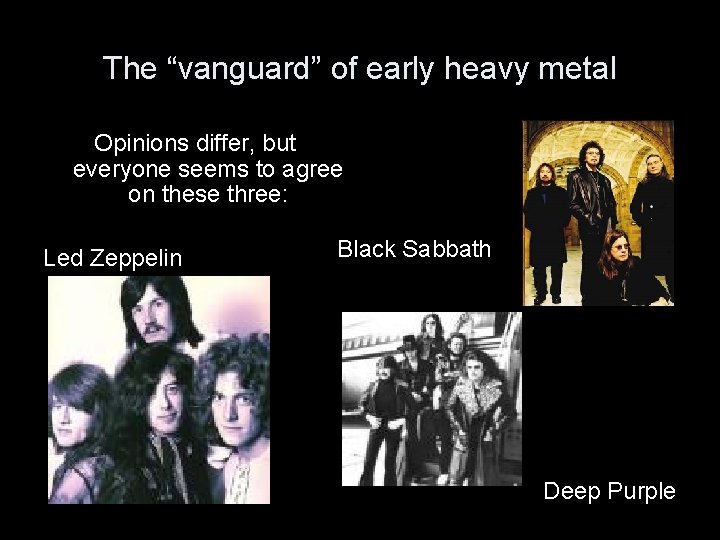
The “vanguard” of early heavy metal Opinions differ, but everyone seems to agree on these three: Led Zeppelin Black Sabbath Deep Purple
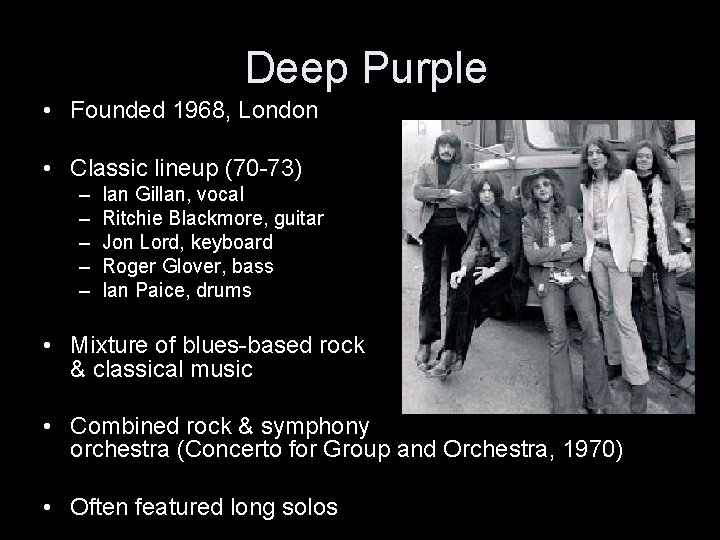
Deep Purple • Founded 1968, London • Classic lineup (70 -73) – – – Ian Gillan, vocal Ritchie Blackmore, guitar Jon Lord, keyboard Roger Glover, bass Ian Paice, drums • Mixture of blues-based rock & classical music • Combined rock & symphony orchestra (Concerto for Group and Orchestra, 1970) • Often featured long solos
Deep Purple Smoke on the Water • Originally from Machine Head, 1972 • This song mentions popular hangouts & bands of the time (Frank Zappa & the Mothers, for example) • This ‘riff’ is one of the most recognizable of the genre
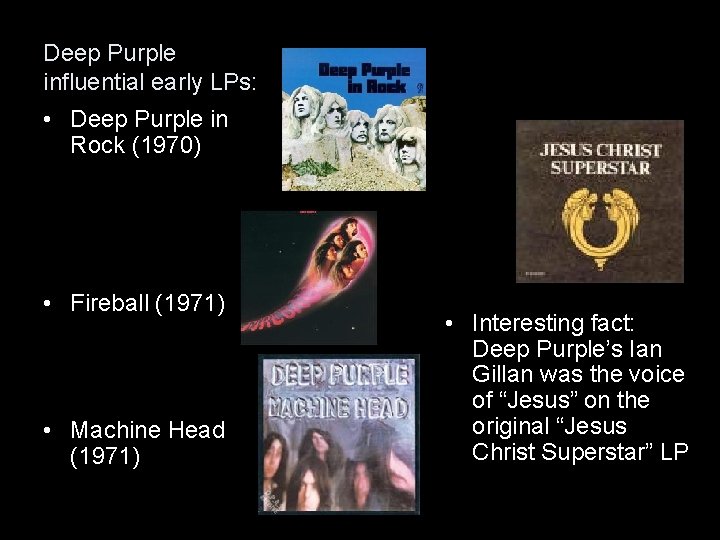
Deep Purple influential early LPs: • Deep Purple in Rock (1970) • Fireball (1971) • Machine Head (1971) • Interesting fact: Deep Purple’s Ian Gillan was the voice of “Jesus” on the original “Jesus Christ Superstar” LP
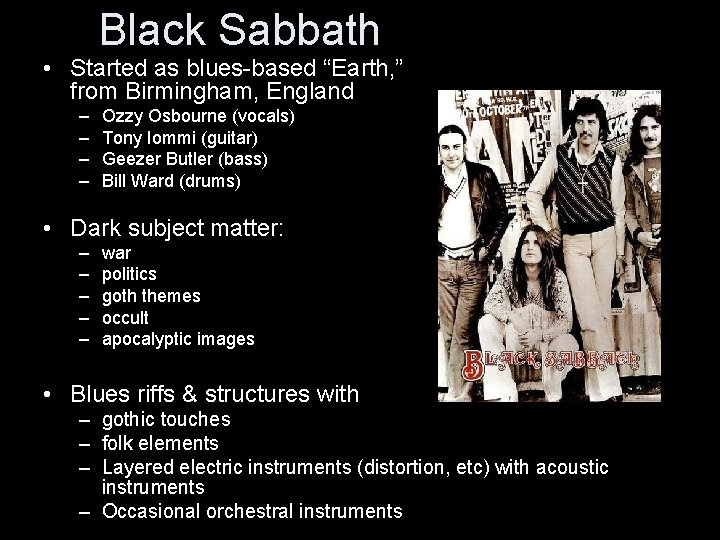
Black Sabbath • Started as blues-based “Earth, ” from Birmingham, England – – Ozzy Osbourne (vocals) Tony Iommi (guitar) Geezer Butler (bass) Bill Ward (drums) • Dark subject matter: – – – war politics goth themes occult apocalyptic images • Blues riffs & structures with – gothic touches – folk elements – Layered electric instruments (distortion, etc) with acoustic instruments – Occasional orchestral instruments
Black Sabbath • From Black Sabbath, 1970 • Sabbath began slowing down the tempo & turning up the volume in an attempt to get bar patrons to listen to them • Listen to the “light vs. dark” or quiet vs. loud dynamic contrast
Black Sabbath Children of the Grave • From 1971’s Master of Reality • The band often tuned down (lower) to accommodate Ozzy’s vocals • This song is about atomic war, not the occult! • Renamed around 1970 – “Black Sabbath” was a Boris Karloff movie
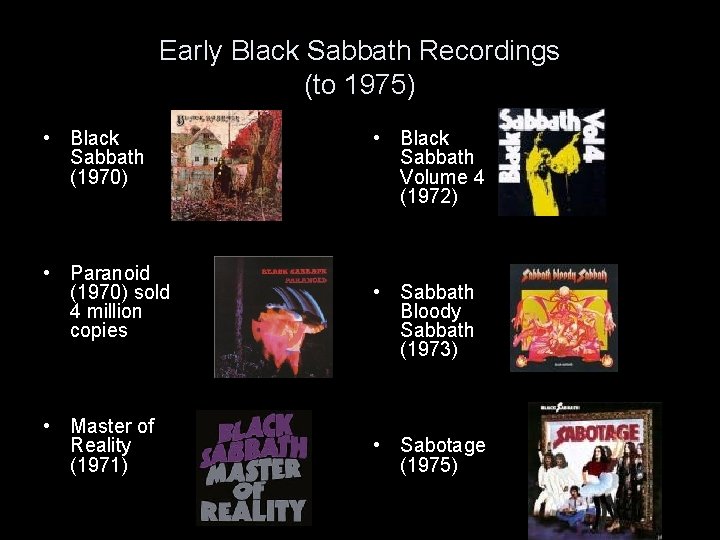
Early Black Sabbath Recordings (to 1975) • Black Sabbath (1970) • Paranoid (1970) sold 4 million copies • Master of Reality (1971) • Black Sabbath Volume 4 (1972) • Sabbath Bloody Sabbath (1973) • Sabotage (1975)
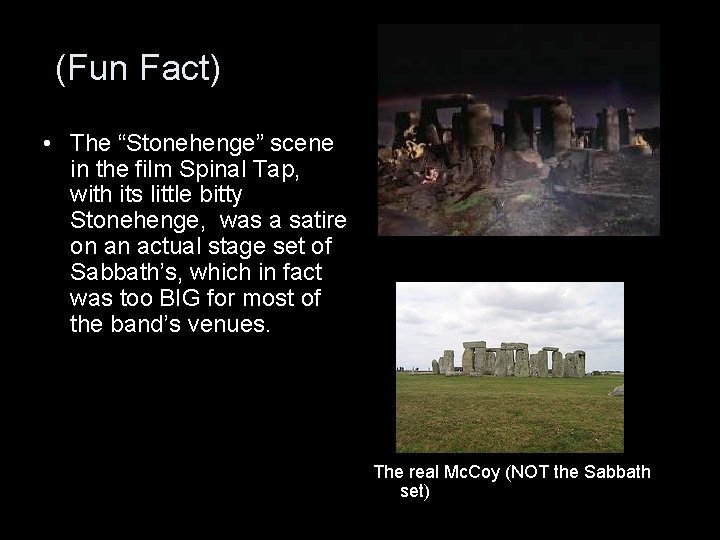
(Fun Fact) • The “Stonehenge” scene in the film Spinal Tap, with its little bitty Stonehenge, was a satire on an actual stage set of Sabbath’s, which in fact was too BIG for most of the band’s venues. The real Mc. Coy (NOT the Sabbath set)
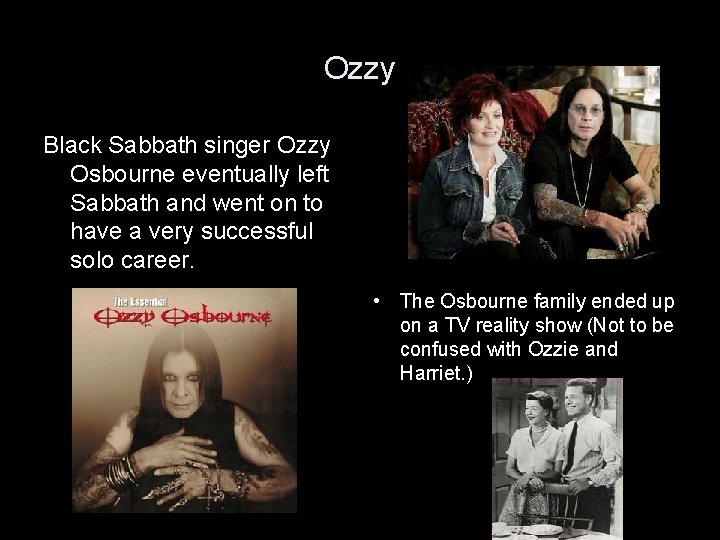
Ozzy Black Sabbath singer Ozzy Osbourne eventually left Sabbath and went on to have a very successful solo career. • The Osbourne family ended up on a TV reality show (Not to be confused with Ozzie and Harriet. )
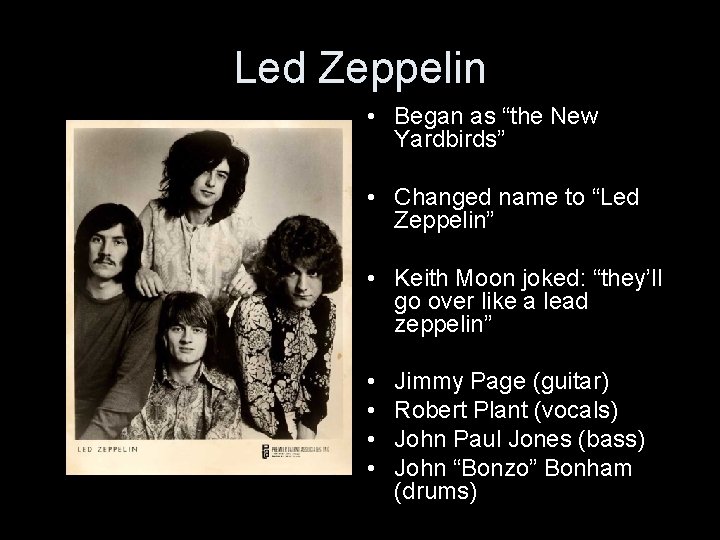
Led Zeppelin • Began as “the New Yardbirds” • Changed name to “Led Zeppelin” • Keith Moon joked: “they’ll go over like a lead zeppelin” • • Jimmy Page (guitar) Robert Plant (vocals) John Paul Jones (bass) John “Bonzo” Bonham (drums)
Led Zeppelin Since I’ve Been Lovin’ You • From Led Zeppelin III, 1970 • Page, like Beck, Clapton, & Richards, had spent years studying the American blues sound – this is the result • Plant’s vocals have been compared to Janis Joplin’s! • Both he & Joplin most likely listened to the same singers & songs
Led Zeppelin Immigrant Song • From Led Zeppelin III, 1970 • Page was more than just a guitarist & songwriter, he produced almost all the Zep catalog himself • Page was already an accomplished studio musicians by the time he formed the band
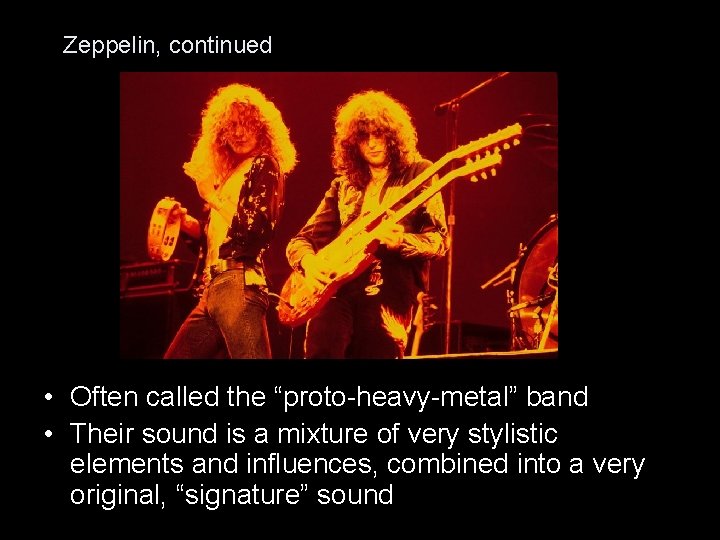
Zeppelin, continued • Often called the “proto-heavy-metal” band • Their sound is a mixture of very stylistic elements and influences, combined into a very original, “signature” sound
Led Zeppelin Dancing Days • From Houses of the Holy, 1973 • Led Zeppelin established their own record label in 1974: Swan Song, a subsidiary of Atlantic • The LZ catalog features songs in many diverse styles, including reggae, funk, rock, & Celtic-style traditional
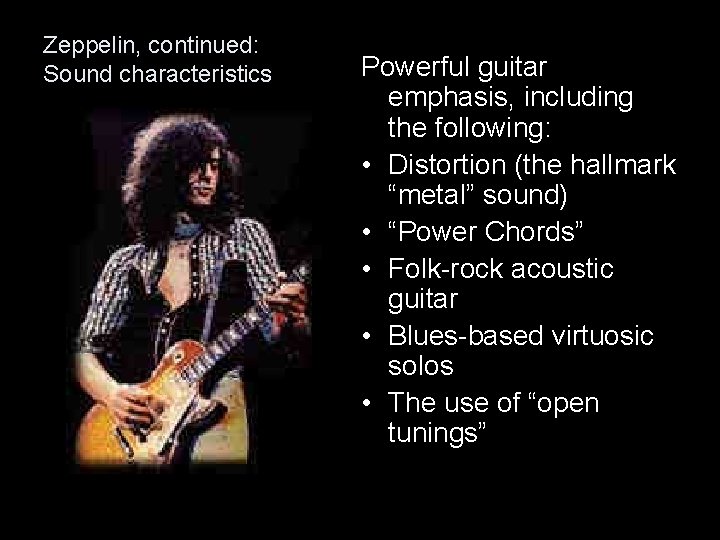
Zeppelin, continued: Sound characteristics Powerful guitar emphasis, including the following: • Distortion (the hallmark “metal” sound) • “Power Chords” • Folk-rock acoustic guitar • Blues-based virtuosic solos • The use of “open tunings”
Zeppelin Sound Characteristics, continued • Bottom-heavy, intense rhythm section • Plant’s highly individualistic, raspy voice • Page's heavily distorted guitar sound • Complex lyrics, "mythological" or spiritual themes as well as standard rock themes • Sound "extremes, " such as the following: – Plant's incredibly high voice – switching to & from “folk” acoustic to heavy metal in one piece – extreme manipulation of rhythm; the use of complex rhythms as in Black Dog • Use of a huge range of musical styles
Some examples of Zeppelin’s Diverse Musical Styles… • The “proto metal” sound (Good Times Bad Times, Whole Lotta Love, Black Dog) • The “British blues revival” sound (Since I’ve Been Loving You, Rock and Roll) • The “folk-rock” influenced sound (Goin’ to California, Battle of Evermore) • The progressive or “art rock” sound (The Rain Song, Kashmir)
Led Zeppelin The Battle of Evermore • From Led Zeppelin IV, 1971 • This song features Sandy Denny, vocalist for the English folk/art band Fairport Convention • Led Zeppelin often received negative reviews from the media
Led Zeppelin Going to California • From Led Zeppelin IV, 1971 • This song is rumored to be about Joni Mitchell (she sang a song called “California”) • This song features instruments not often associated with “heavy metal”
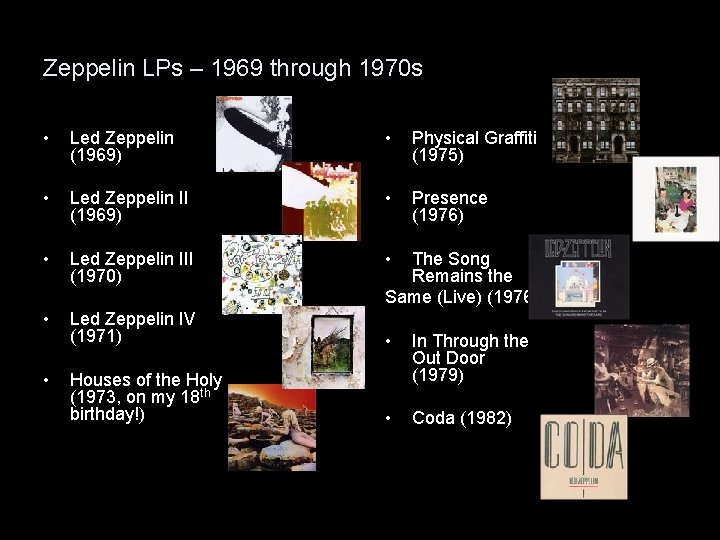
Zeppelin LPs – 1969 through 1970 s • Led Zeppelin (1969) • Physical Graffiti (1975) • Led Zeppelin II (1969) • Presence (1976) • Led Zeppelin III (1970) • • Led Zeppelin IV (1971) • Houses of the Holy (1973, on my 18 th birthday!) In Through the Out Door (1979) • Coda (1982) • The Song Remains the Same (Live) (1976)
Led Zeppelin: Misty Mountain Hop (1971) • Frequently referred to as one of the first “heavy metal” bands • Zep has many different influences, from English folk ballads to American blues. • Led Zeppelin represents Jimmy Page’s extrapolation of the – Psychedelic blues of Jimi Hendrix and Cream – Moody, quasi-Celtic imagery of folk-rock and Lord of the Rings. • Driven by Page’s brilliance as an arranger, Robert Plant’s tomcat-howl and on-stage persona, and the under-recognized, utterly innovative drumming of John Bonham, • Zeppelin set the blueprint for heavy metal.
- Slides: 26