The Data Reference Model and Intellectual Property 2

- Slides: 14
The Data Reference Model and Intellectual Property 2 November 2006 Federal Data Architecture Subcommittee Co-chairs: Bryan Aucoin Suzanne Acar DNI CIO Chief Architect 703. 874. 8501 bryanja@dni. gov Department of the Interior Senior Information Arhictect suzanne_acar@ios. doi. gov
Agenda Basic Data Sharing Concepts What’s a Document according to the FEA DRM? FEA DRM Guidance on Privacy and Security The Way Ahead
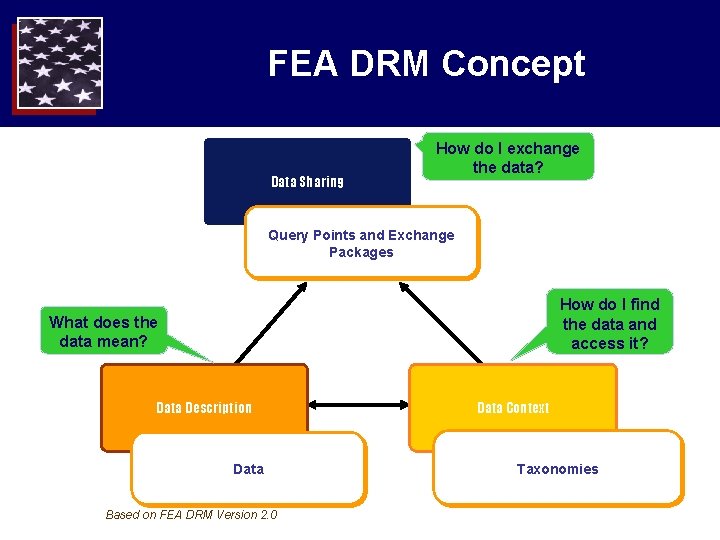
FEA DRM Concept Data Sharing How do I exchange the data? Query Points and Exchange Packages How do I find the data and access it? What does the data mean? Data Description Data Based on FEA DRM Version 2. 0 Data Context Taxonomies
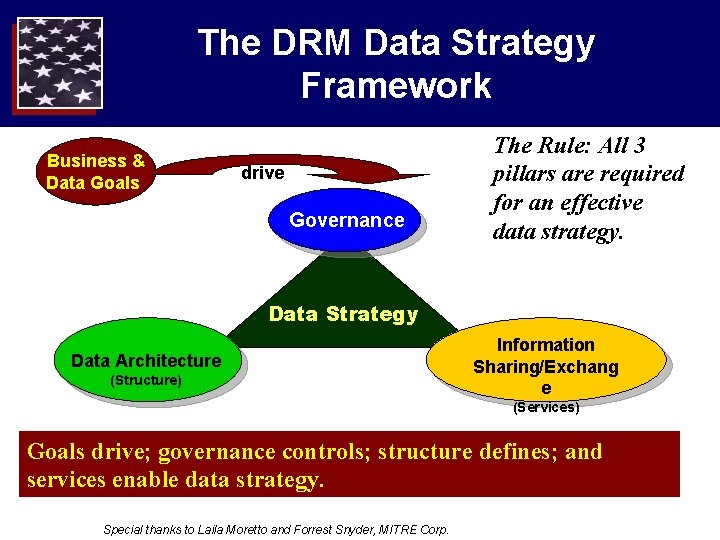
The DRM Data Strategy Framework Business & Data Goals drive Governance The Rule: All 3 pillars are required for an effective data strategy. Data Strategy Data Architecture (Structure) Information Sharing/Exchang e (Services) Goals drive; governance controls; structure defines; and services enable data strategy. Special thanks to Laila Moretto and Forrest Snyder, MITRE Corp.
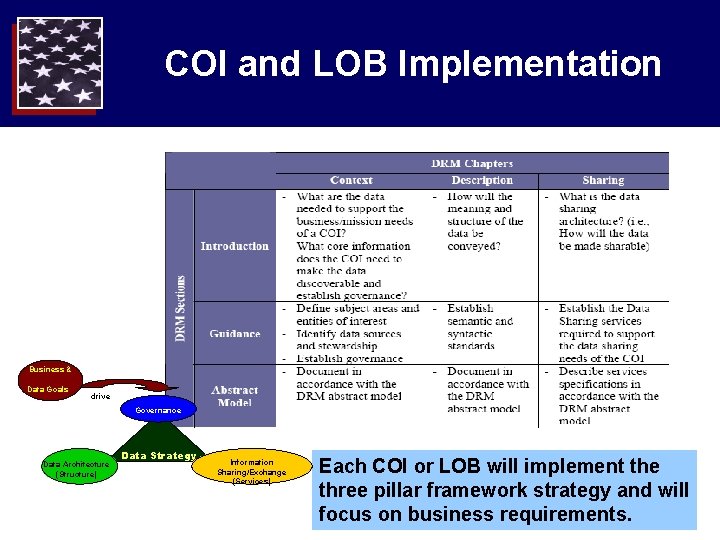
COI and LOB Implementation Business & Data Goals drive Governance Data Architecture (Structure) Data Strategy Information Sharing/Exchange (Services) Each COI or LOB will implement the three pillar framework strategy and will focus on business requirements.
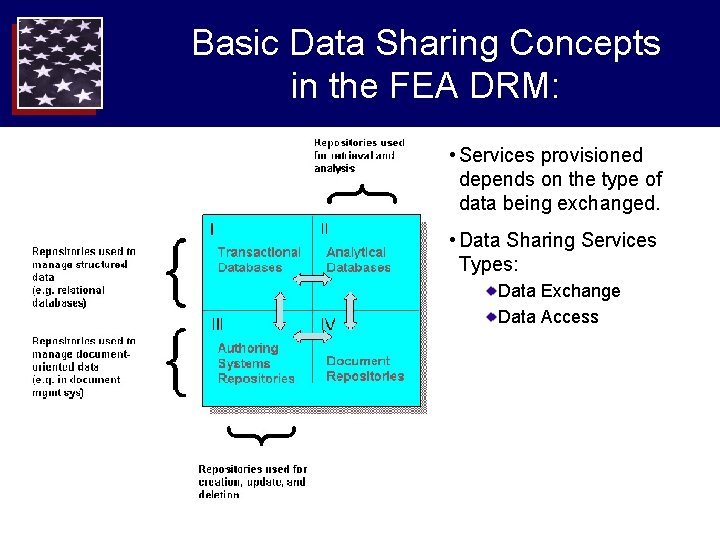
Basic Data Sharing Concepts in the FEA DRM: • Services provisioned depends on the type of data being exchanged. • Data Sharing Services Types: Data Exchange Data Access
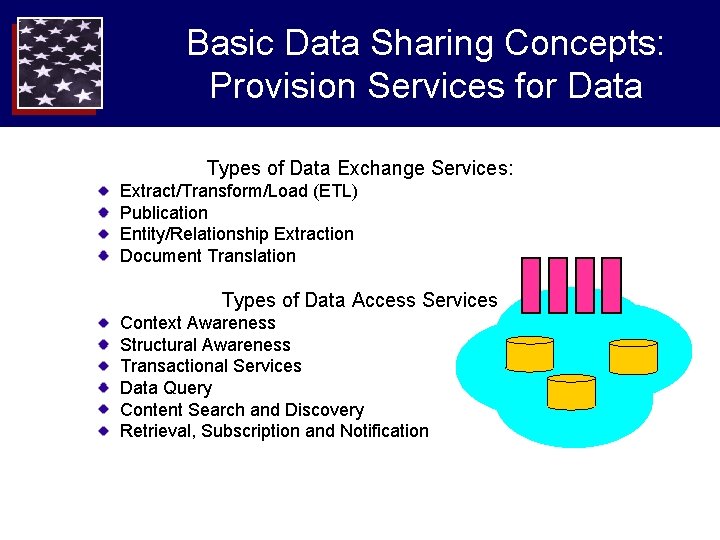
Basic Data Sharing Concepts: Provision Services for Data Types of Data Exchange Services: Extract/Transform/Load (ETL) Publication Entity/Relationship Extraction Document Translation Types of Data Access Services Context Awareness Structural Awareness Transactional Services Data Query Content Search and Discovery Retrieval, Subscription and Notification
The DRM Definition of a Document A file containing Unstructured and/or Semi-Structured Data Resources. A discrete and unique electronic aggregation of data produced with the intent of conveying information. All data within a document may be in the same format (e. g. , text), or a document may be a composite that consists of sets of data in a variety of formats (e. g. , MS Word files containing embedded graphics). The term “discrete” implies that a document requires no linkage to other data to convey its meaning. The term “unique” implies that each instance or version of a document can be distinguished from all others (i. e. , it can be assigned a unique identifying number).
The DRM Definition of a Documents may be unstructured The document follows no rigid, machine interpretable structural convention or it may contain self describing metadata that is machine interpretable. • For example: An ASCII text document Documents may be semi-structured The documents conforms to a machine interpretable structural convention or contains embedded self-describing metadata that is machine interpretable. • A Microsoft Word document with headings and subheadings is considered semi-structured, as is a XHTML document.
Relevant DRM Document Related Data Services Publication (Structured data or documents to aggregate documents): Publication is the process of assembling a document from its component pieces, putting into a desired format and disseminating it to target databases. The payload of this type of service is a document. Document Translation (Document to document) Document translation is the process of transforming a document from its original format to a format required to support a target application. The transformations may be structural (e. g. , transforming MS Word to PDF format), language-oriented (e. g. , changing English to French), or special purpose (e. g. , the development of abstracts from longer documents. ) The payload of this type of service is a document.
DRM Guidance on Quality, Security, Privacy, and Confidentiality Within A Community of Interest (COI): Establish Data Stewardship Define the Policies. Use the following “policy buckets”: • Data is available for open, unrestricted access • Data is accessible only to a group • Data access is a function of the person (his or her identity), data about that person (e. g. , current position), and data about the environment (e. g. , physical location) • Data is self protecting through digital rights management or similar technologies Implement the policies within the Data Sharing Services
So…What’s the Way Ahead for Copyrighting and Marking US Government Works? A FEA Profile that builds on the DRM Constructs: Notional Components: Stewards in a COI identify material that needs copyright protection. Focus on Publication and Translation Services • Tag the documents at publication (e. g. source referencing) • If non-repudiation is needed, sign the documents – (Also what to think about records and records management here. ) • If the documents are very sensitive, wrap them in a Digital Rights Management capable package. Need to agree on voluntary consensus standards for document tagging for copyright. The Data Architecture Subcommittee can help.
Summary • FEA DRM provides an overarching construct. • While copyright and intellectual property is not specifically addressed, the model can be extended. • Federal level guidance could be addressed in a profile. • The Federal Data Architecture Subcommittee (DAS) is ready to help.
Questions