
The Darknet and the Future of Content Distribution
The Darknet and the Future of Content Distribution by Shruthi B Krishnan
Agenda u u u u Introduction What is darknet? Features of darknet Evolution of darknet Introducing content into darknet Methods of policing Conclusions
Introduction u u u Copying or distributing content in digital format is easier Legal vs. illegal distribution of content Terms used • • • Objects Users Hosts
What is darknet? § § Darknet is a collection of networks and technologies used to share digital content Assumptions • Any widely distributed object is available to some users in a form that permits copying • Users copy available and interesting objects • Users have high-bandwidth channels § Infrastructure requirements § § § Input facilities Transmission facilities Output facilities Search mechanisms/ database Caching mechanism Target infrastructure requirements to fight darknet
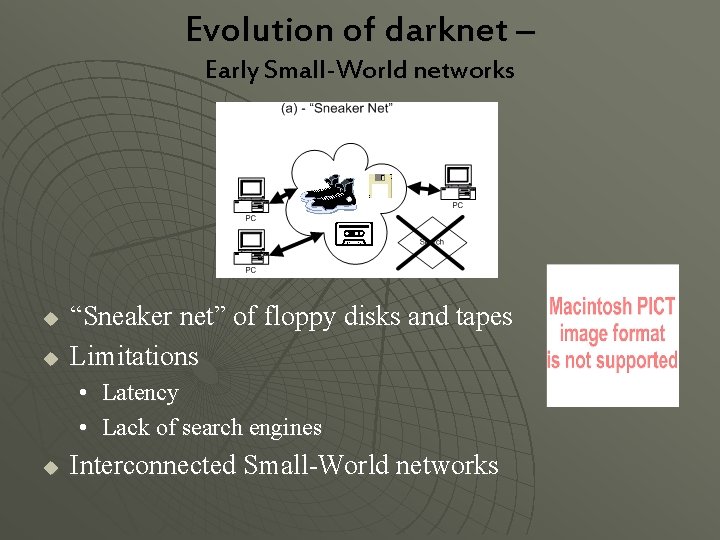
Evolution of darknet – Early Small-World networks u u “Sneaker net” of floppy disks and tapes Limitations • Latency • Lack of search engines u Interconnected Small-World networks
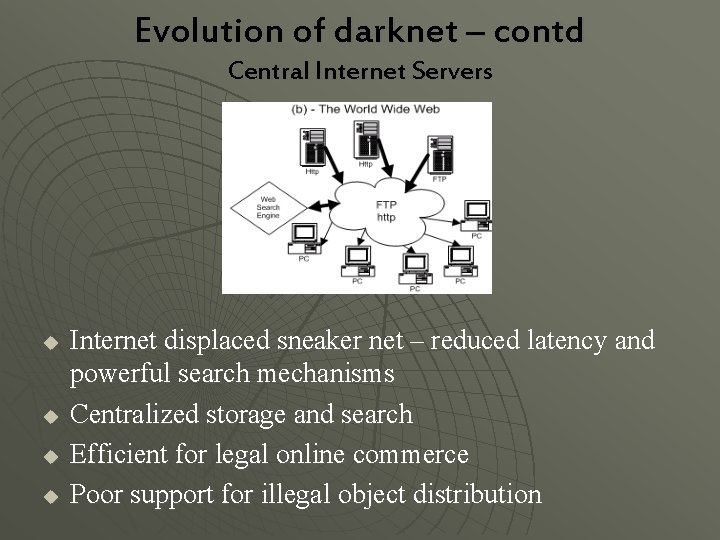
Evolution of darknet – contd Central Internet Servers u u Internet displaced sneaker net – reduced latency and powerful search mechanisms Centralized storage and search Efficient for legal online commerce Poor support for illegal object distribution
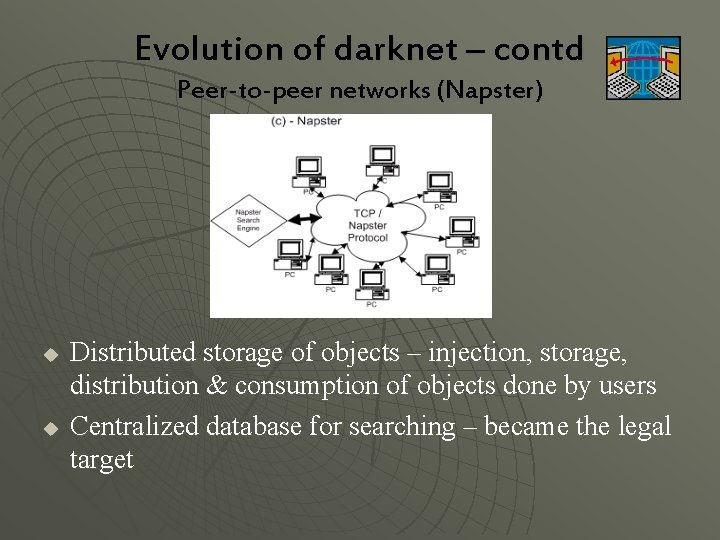
Evolution of darknet – contd Peer-to-peer networks (Napster) u u Distributed storage of objects – injection, storage, distribution & consumption of objects done by users Centralized database for searching – became the legal target
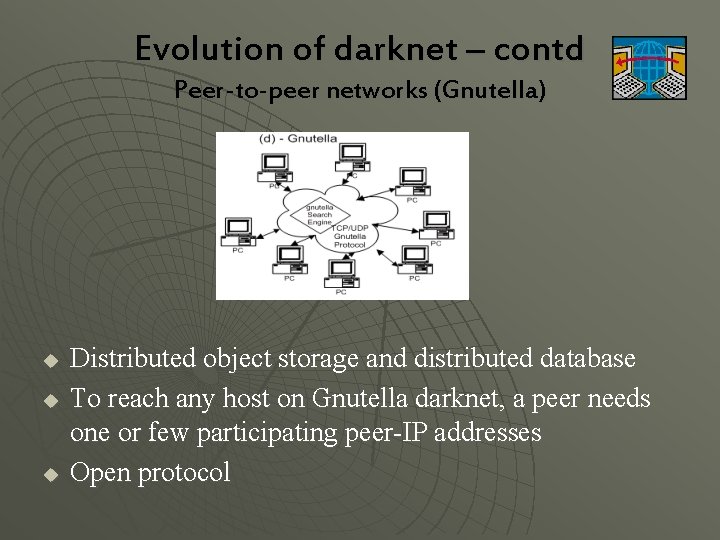
Evolution of darknet – contd Peer-to-peer networks (Gnutella) u u u Distributed object storage and distributed database To reach any host on Gnutella darknet, a peer needs one or few participating peer-IP addresses Open protocol
Fully distributed darknets How robust are they? u Free riding u • Downloading objects without sharing them • Some users sacrifice their resources, free-riders don’t u Lack of anonymity • Server end-points can be determined
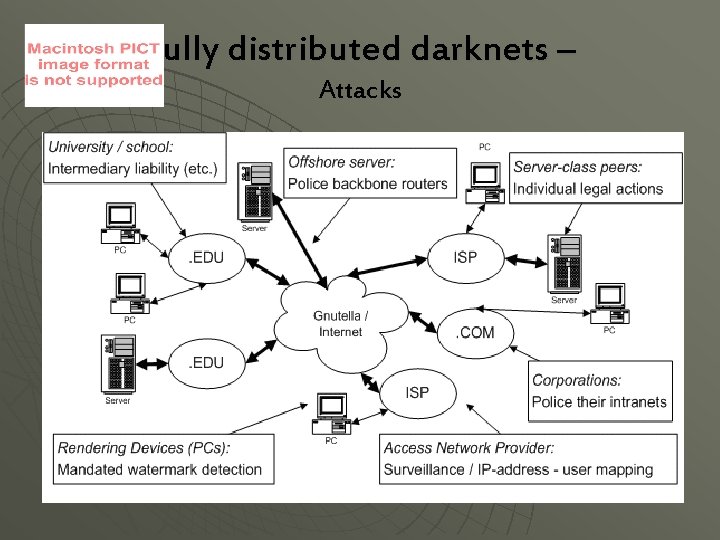
Fully distributed darknets – Attacks
Introducing content into darknet – Conditional Access systems u u u Subscribers are given access to objects based on a service contract Customers have no access to channels they are not entitled to Can freely use channels subscribed for
Introducing content into darknet (contd) – DRM systems u Client obtains • Encrypted content • License specifying how to use u BOBE-strong vs. BOBE-weak systems u Renewability
Introducing content into darknet (contd) – using software u u Mainly used to secure computer programs Bind software to a host – program won’t work on an unlicensed machine Machine id should not be virtualizable Code to perform bind-checks should be resistant to tampering
Policing hosts – Watermarking u u Embeds an indelible, invisible mark on content Concerns about the robustness of the embedding layer u Key management u Watermark detectors in software or hardware
Policing hosts (contd) – Fingerprinting u Supplier marks the object with an individualized mark identifying the purchaser u If shared on darknet, purchaser is identified u No key-distribution needed u Expensive u Collusion attacks
Conclusion u Technological implications • Even strong DRM systems can fail • Watermark detectors have not made an impact u Competition to legal commerce u Evidence that darknet will continue to exist

Questions….
- Slides: 17