
The Darkness of the Universe Acceleration and Deceleration
![Equation of State Reconstruction from EOS: (a) = c exp{ 3 dln a [1+w(z)]](https://slidetodoc.com/presentation_image_h2/095e3f7b0e22be5f9ade4ab72e55ad2a/image-12.jpg "Equation of State Reconstruction from EOS: (a) = c exp{ 3 dln a [1+w(z)]")
![Dark Energy Models Scalar fields can roll: 1) fast -- “kination” [Tracking models] 2)](https://slidetodoc.com/presentation_image_h2/095e3f7b0e22be5f9ade4ab72e55ad2a/image-19.jpg "Dark Energy Models Scalar fields can roll: 1) fast -- “kination” [Tracking models] 2)")
![Linear Potential Linear potential [Linde 1986] V( )=V 0+ leads to collapsing universe, can](https://slidetodoc.com/presentation_image_h2/095e3f7b0e22be5f9ade4ab72e55ad2a/image-22.jpg "Linear Potential Linear potential [Linde 1986] V( )=V 0+ leads to collapsing universe, can")
- Slides: 32
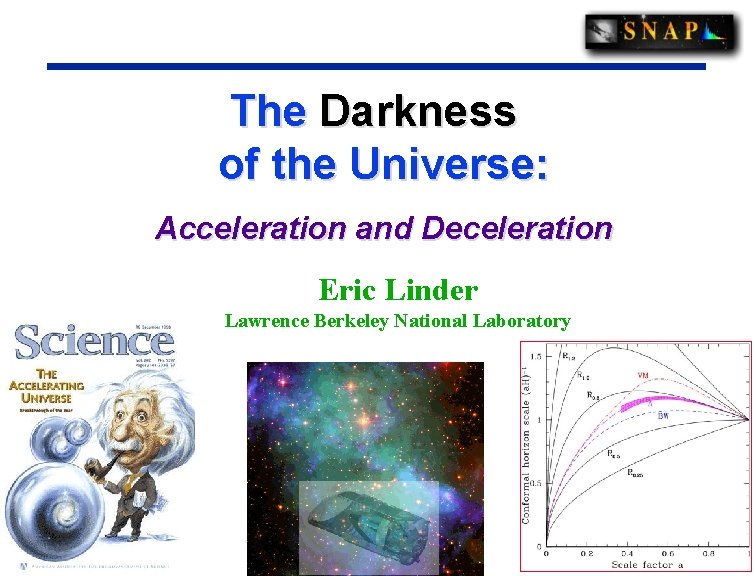
The Darkness of the Universe: Acceleration and Deceleration Eric Linder Lawrence Berkeley National Laboratory 11
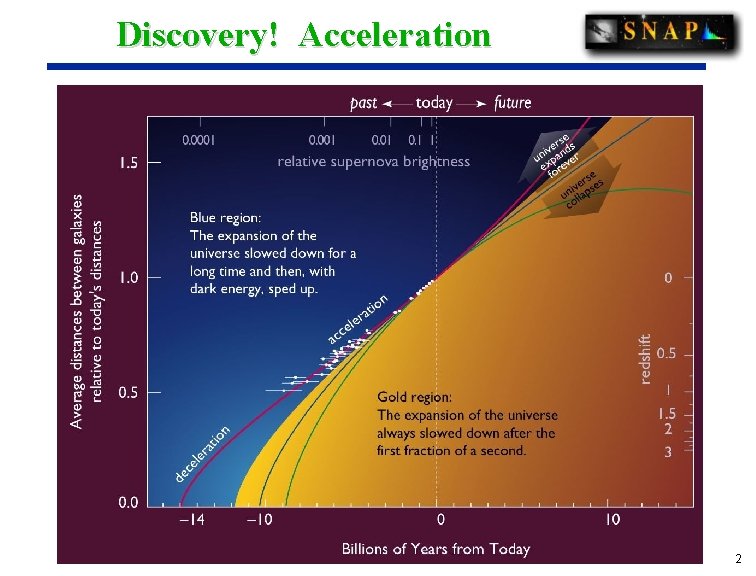
Discovery! Acceleration 22
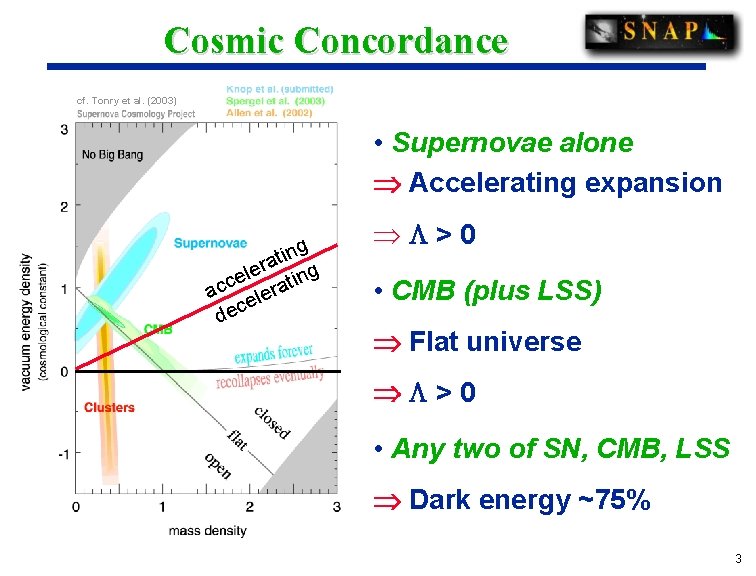
Cosmic Concordance cf. Tonry et al. (2003) • Supernovae alone Accelerating expansion gg n n i i t t rara g e e l l e e ting acaccc learatin eer c l e e d dec Þ >0 • CMB (plus LSS) Flat universe >0 • Any two of SN, CMB, LSS Dark energy ~75% 33
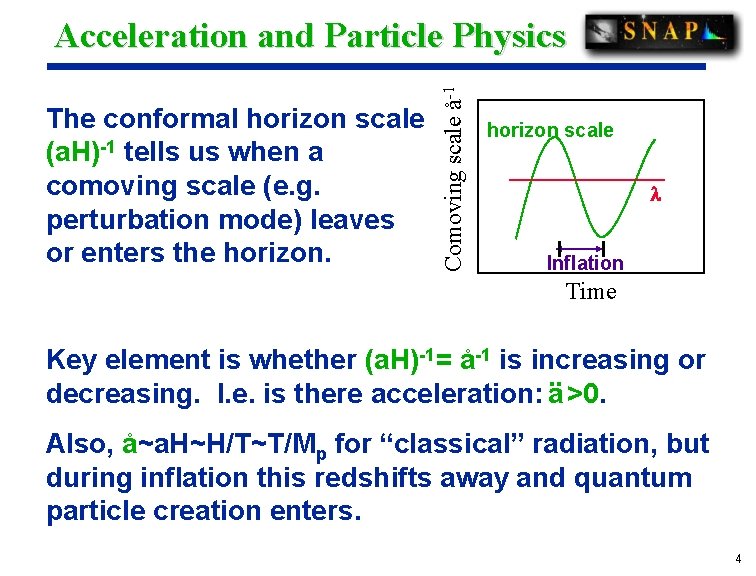
The conformal horizon scale (a. H)-1 tells us when a comoving scale (e. g. perturbation mode) leaves or enters the horizon. Comoving scale å-1 Acceleration and Particle Physics horizon scale Inflation Time Key element is whether (a. H)-1= å-1 is increasing or. . decreasing. I. e. is there acceleration: a >0. Also, å~a. H~H/T~T/Mp for “classical” radiation, but during inflation this redshifts away and quantum particle creation enters. 44
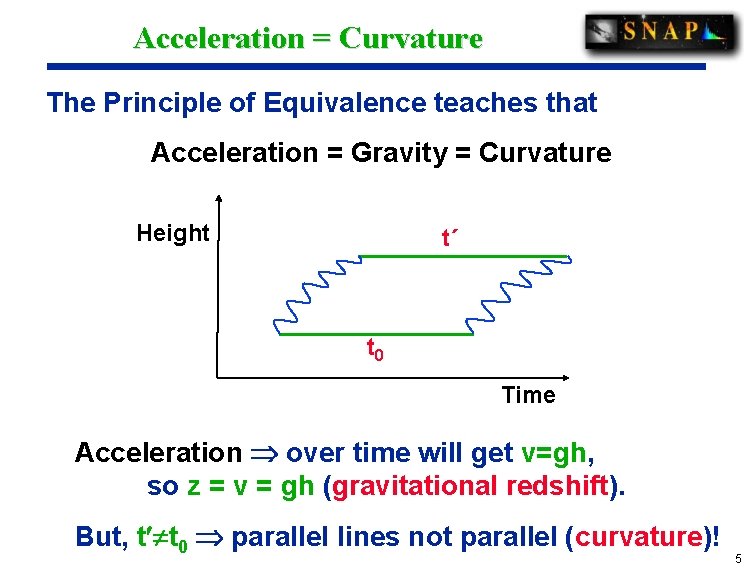
Acceleration = Curvature The Principle of Equivalence teaches that Acceleration = Gravity = Curvature Height t´ t 0 Time Acceleration over time will get v=gh, so z = v = gh (gravitational redshift). But, t t 0 parallel lines not parallel (curvature)! 55
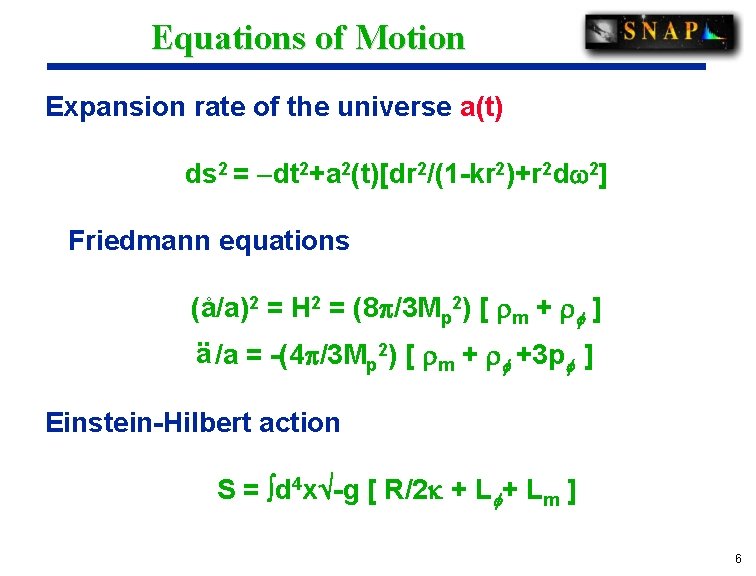
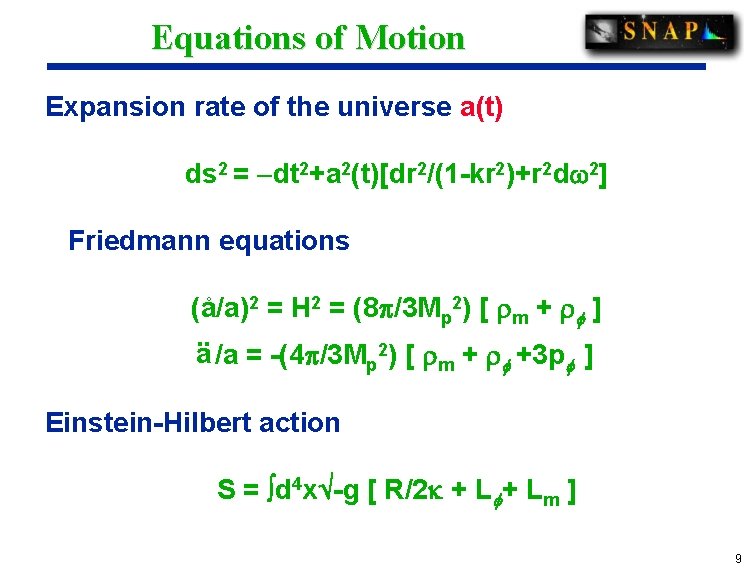
Equations of Motion Expansion rate of the universe a(t) ds 2 = dt 2+a 2(t)[dr 2/(1 -kr 2)+r 2 d 2] Friedmann equations (å/a)2 = H 2 = (8 /3 Mp 2) [ m + ]. . a /a = -(4 /3 Mp 2) [ m + +3 p ] Einstein-Hilbert action S = d 4 x -g [ R/2 + Lm ] 66
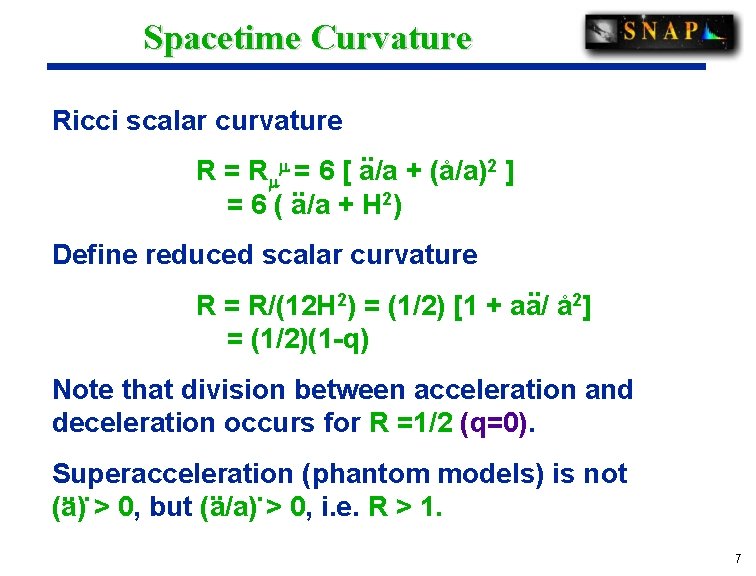
Spacetime Curvature Ricci scalar curvature . . R = R 6 [ a/a + (å/a)2 ]. . = 6 ( a/a + H 2) = Define reduced scalar curvature. . 2 R= = (1/2) [1 + aa/ å ] = (1/2)(1 -q) R/(12 H 2) Note that division between acceleration and deceleration occurs for R =1/2 (q=0). Superacceleration (phantom models) is not. . . (a) > 0, but (a/a) > 0, i. e. R > 1. 77
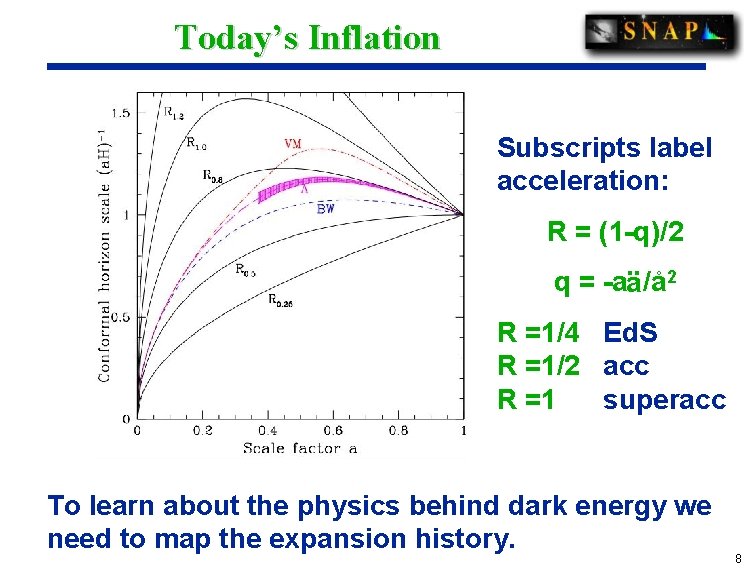
Today’s Inflation Subscripts label acceleration: R = (1 -q)/2. . 2 q = -aa /å R =1/4 Ed. S R =1/2 acc R =1 superacc To learn about the physics behind dark energy we need to map the expansion history. 88
Equations of Motion Expansion rate of the universe a(t) ds 2 = dt 2+a 2(t)[dr 2/(1 -kr 2)+r 2 d 2] Friedmann equations (å/a)2 = H 2 = (8 /3 Mp 2) [ m + ]. . a /a = -(4 /3 Mp 2) [ m + +3 p ] Einstein-Hilbert action S = d 4 x -g [ R/2 + Lm ] 99
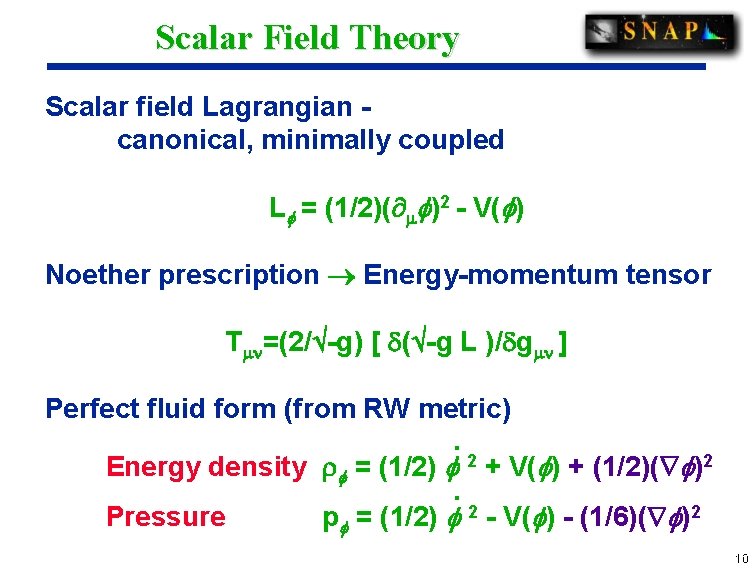
Scalar Field Theory Scalar field Lagrangian canonical, minimally coupled L = (1/2)( )2 - V( ) Noether prescription Energy-momentum tensor T =(2/ -g) [ ( -g L )/ g ] Perfect fluid form (from RW metric). Energy density = (1/2) 2 + V( ) + (1/2)( )2. Pressure p = (1/2) 2 - V( ) - (1/6)( )2 10 10
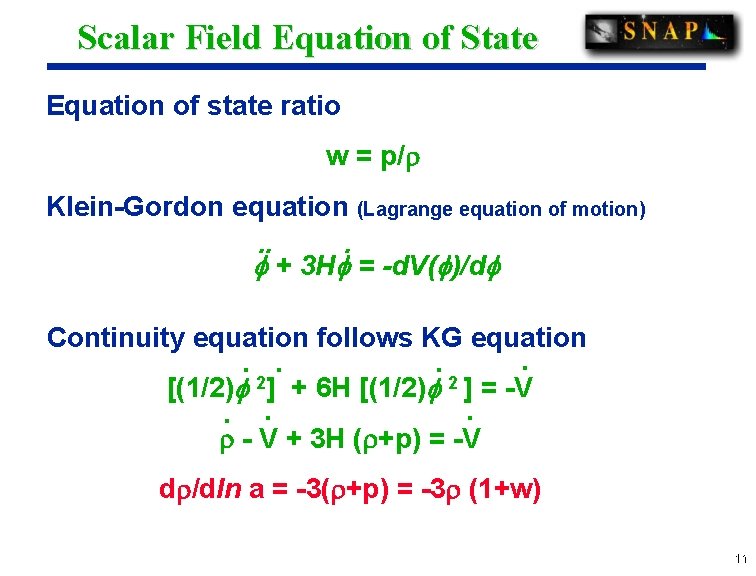
Scalar Field Equation of State Equation of state ratio w = p/ Klein-Gordon equation (Lagrange equation of motion) ¨ + 3 H ˙ = -d. V( )/d Continuity equation follows KG equation. . [(1/2) 2] + 6 H [(1/2) 2 ] = -V. . . - V + 3 H ( +p) = -V d /dln a = -3( +p) = -3 (1+w) 11 11
Equation of State Reconstruction from EOS: (a) = c exp{ 3 dln a [1+w(z)] } (a) = dln a H-1 sqrt{ (a) [1+w(z)] } V(a) = (1/2) (a) [1 -w(z)]. K(a) = (1/2) 2 = (1/2) (a) [1+w(z)] 12 12
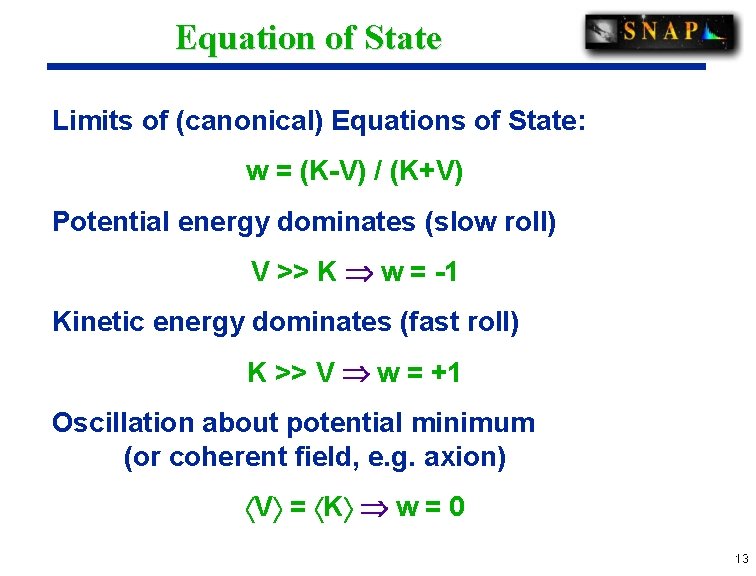
Equation of State Limits of (canonical) Equations of State: w = (K-V) / (K+V) Potential energy dominates (slow roll) V >> K w = -1 Kinetic energy dominates (fast roll) K >> V w = +1 Oscillation about potential minimum (or coherent field, e. g. axion) V = K w = 0 13 13
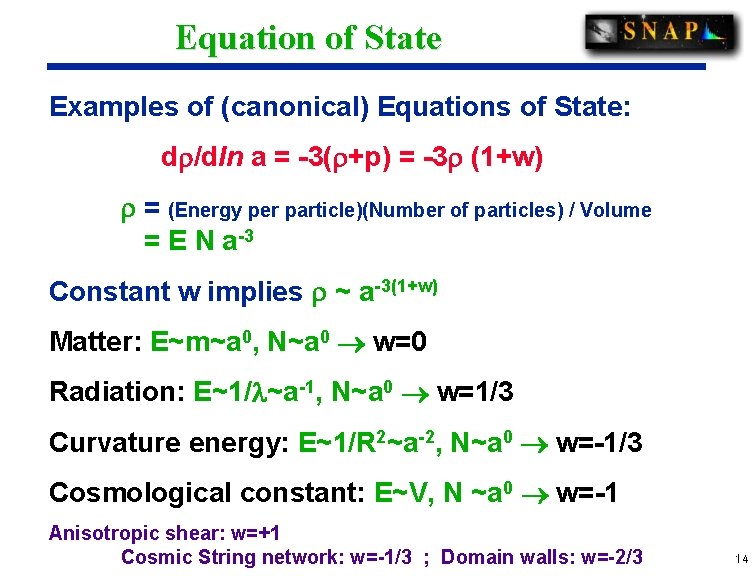
Equation of State Examples of (canonical) Equations of State: d /dln a = -3( +p) = -3 (1+w) = (Energy per particle)(Number of particles) / Volume = E N a-3 Constant w implies ~ a-3(1+w) Matter: E~m~a 0, N~a 0 w=0 Radiation: E~1/ ~a-1, N~a 0 w=1/3 Curvature energy: E~1/R 2~a-2, N~a 0 w=-1/3 Cosmological constant: E~V, N ~a 0 w=-1 Anisotropic shear: w=+1 Cosmic String network: w=-1/3 ; Domain walls: w=-2/3 14 14
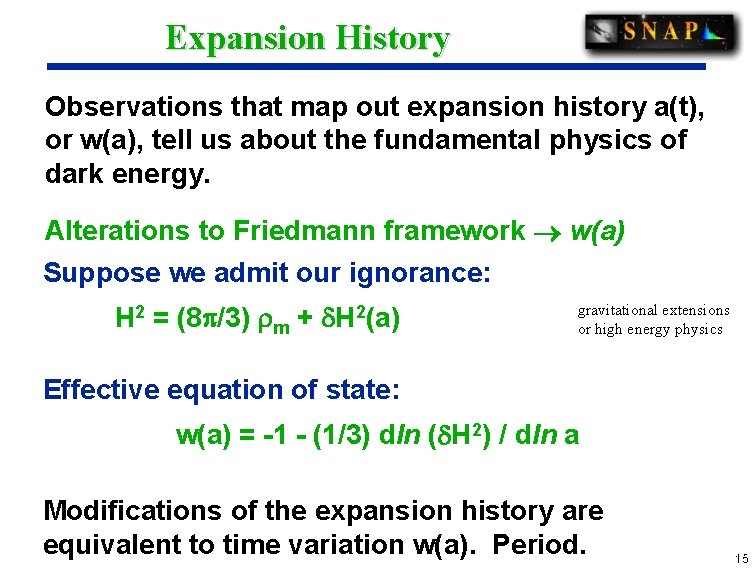
Expansion History Observations that map out expansion history a(t), or w(a), tell us about the fundamental physics of dark energy. Alterations to Friedmann framework w(a) Suppose we admit our ignorance: H 2 = (8 /3) m + H 2(a) gravitational extensions or high energy physics Effective equation of state: w(a) = -1 - (1/3) dln ( H 2) / dln a Modifications of the expansion history are equivalent to time variation w(a). Period. 15 15
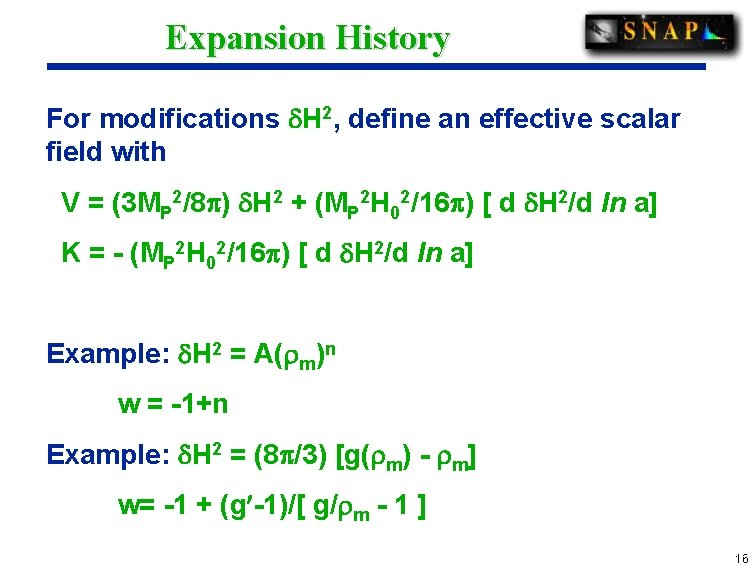
Expansion History For modifications H 2, define an effective scalar field with V = (3 MP 2/8 ) H 2 + (MP 2 H 02/16 ) [ d H 2/d ln a] K = - (MP 2 H 02/16 ) [ d H 2/d ln a] Example: H 2 = A( m)n w = -1+n Example: H 2 = (8 /3) [g( m) - m] w= -1 + (g -1)/[ g/ m - 1 ] 16 16
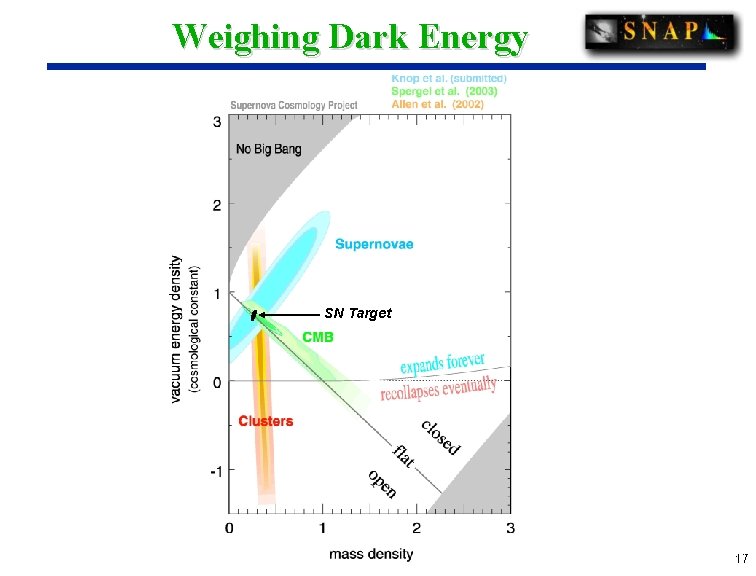
Weighing Dark Energy SN Target 17 17
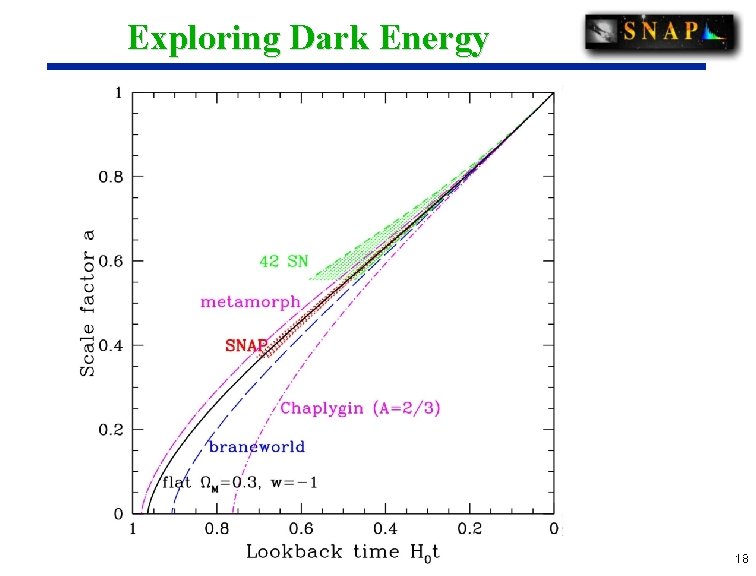
Exploring Dark Energy 18 18
Dark Energy Models Scalar fields can roll: 1) fast -- “kination” [Tracking models] 2) slow -- acceleration [Quintessence] 3) steadily -- acceleration deceleration [Linear potential] 4) oscillate -- potential minimum, pseudoscalar, PNGB [V~ n] 19 19
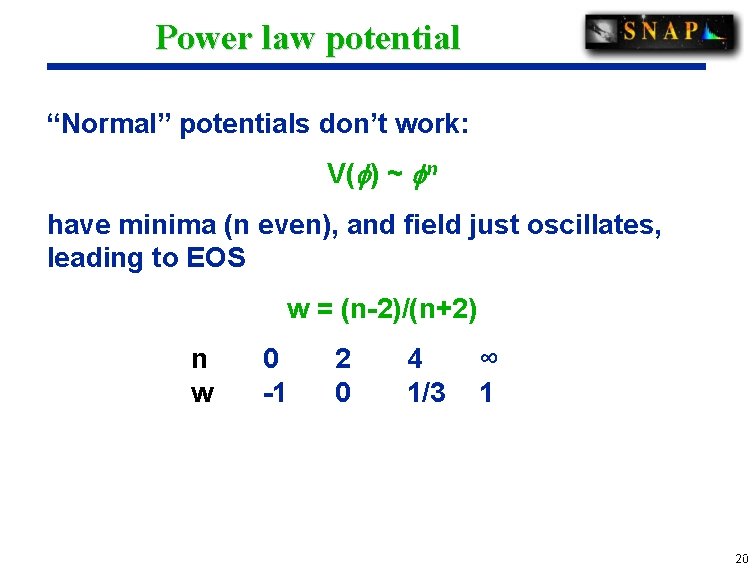
Power law potential “Normal” potentials don’t work: V( ) ~ n have minima (n even), and field just oscillates, leading to EOS w = (n-2)/(n+2) n w 0 -1 2 0 4 1/3 ∞ 1 20 20
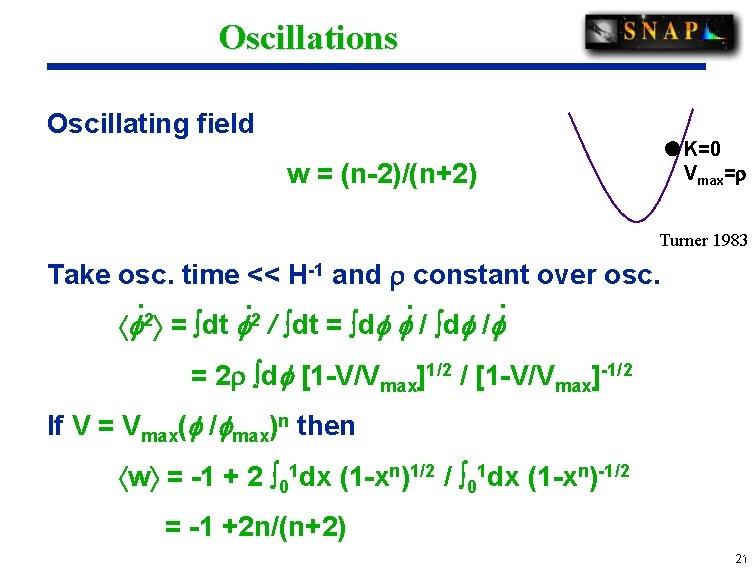
Oscillations Oscillating field K=0 w = (n-2)/(n+2) Vmax= Turner 1983 Take osc. time << H-1 and constant over osc. . . 2 = dt 2 / dt = d / d / = 2 d [1 -V/Vmax]1/2 / [1 -V/Vmax]-1/2 If V = Vmax( / max)n then w = -1 + 2 01 dx (1 -xn)1/2 / 01 dx (1 -xn)-1/2 = -1 +2 n/(n+2) 21 21
Linear Potential Linear potential [Linde 1986] V( )=V 0+ leads to collapsing universe, can constrain tc a t curves of 22 22
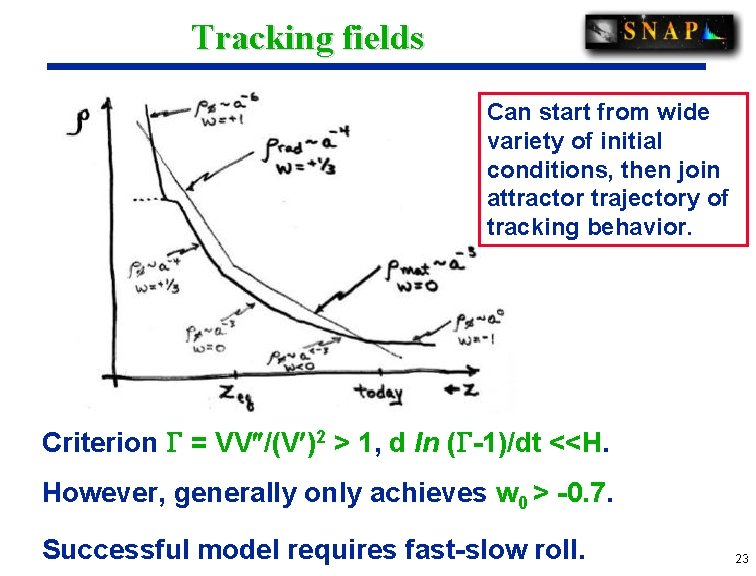
Tracking fields Can start from wide variety of initial conditions, then join attractor trajectory of tracking behavior. Criterion = VV /(V )2 > 1, d ln ( -1)/dt <<H. However, generally only achieves w 0 > -0. 7. Successful model requires fast-slow roll. 23 23
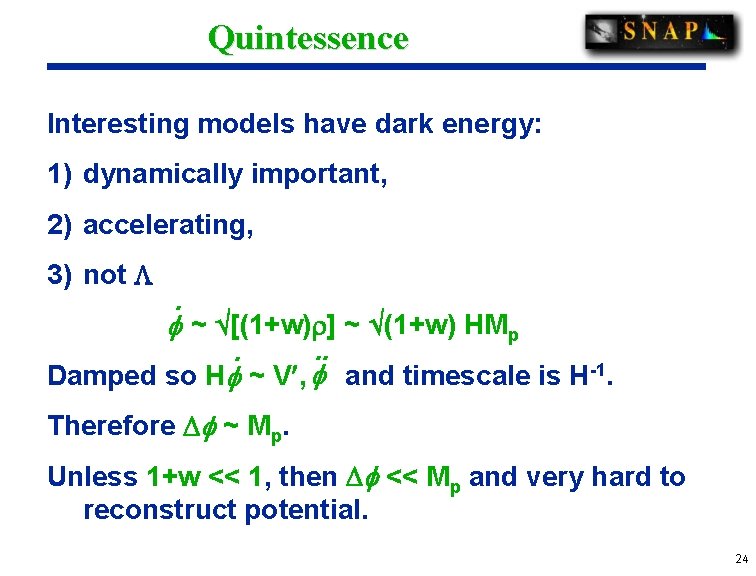
Quintessence Interesting models have dark energy: 1) dynamically important, 2) accelerating, 3) not . ~ [(1+w) ] ~ (1+w) HMp. . . Damped so H ~ V , and timescale is H-1. Therefore ~ Mp. Unless 1+w << 1, then << Mp and very hard to reconstruct potential. 24 24
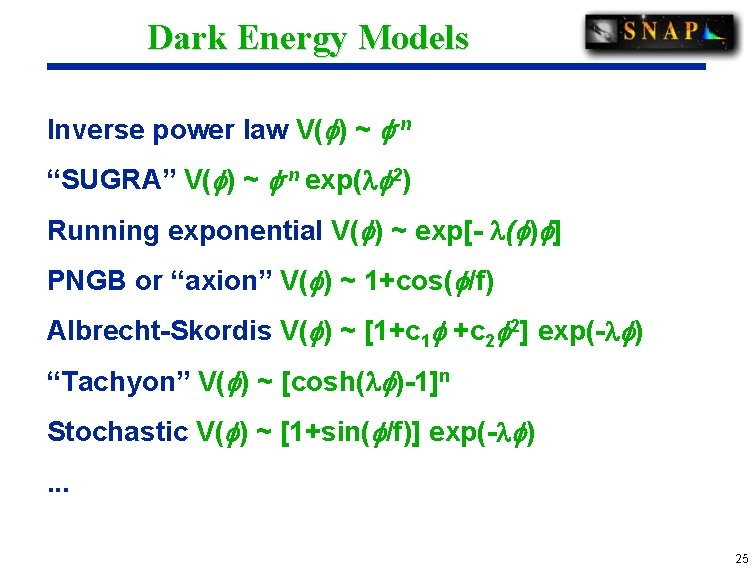
Dark Energy Models Inverse power law V( ) ~ -n “SUGRA” V( ) ~ -n exp( 2) Running exponential V( ) ~ exp[- ( ) ] PNGB or “axion” V( ) ~ 1+cos( /f) Albrecht-Skordis V( ) ~ [1+c 1 +c 2 2] exp(- ) “Tachyon” V( ) ~ [cosh( )-1]n Stochastic V( ) ~ [1+sin( /f)] exp(- ). . . 25 25
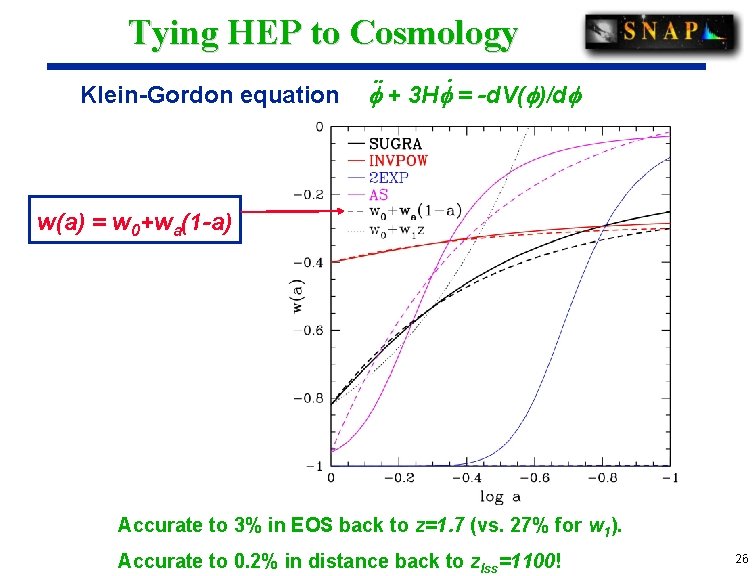
Tying HEP to Cosmology Klein-Gordon equation ¨ + 3 H ˙ = -d. V( )/d w(a) = w 0+wa(1 -a) Accurate to 3% in EOS back to z=1. 7 (vs. 27% for w 1). Accurate to 0. 2% in distance back to zlss=1100! 26 26
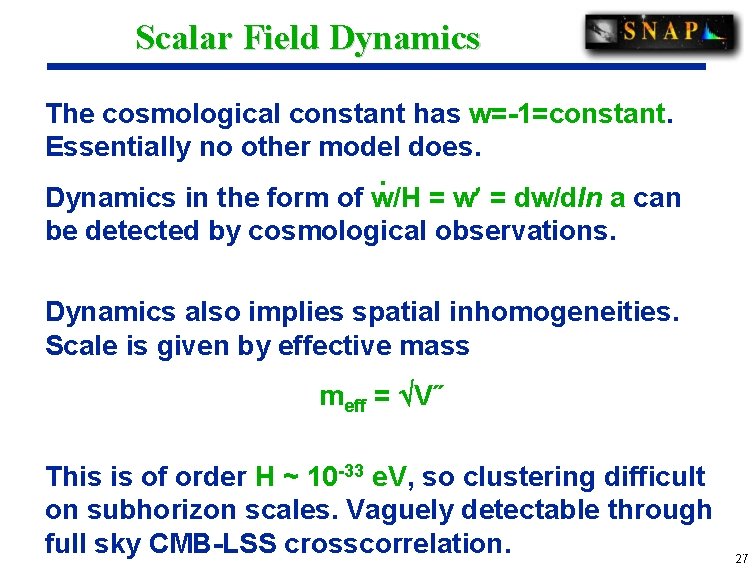
Scalar Field Dynamics The cosmological constant has w=-1=constant. Essentially no other model does. . Dynamics in the form of w/H = w = dw/dln a can be detected by cosmological observations. Dynamics also implies spatial inhomogeneities. Scale is given by effective mass meff = V˝ This is of order H ~ 10 -33 e. V, so clustering difficult on subhorizon scales. Vaguely detectable through full sky CMB-LSS crosscorrelation. 27 27
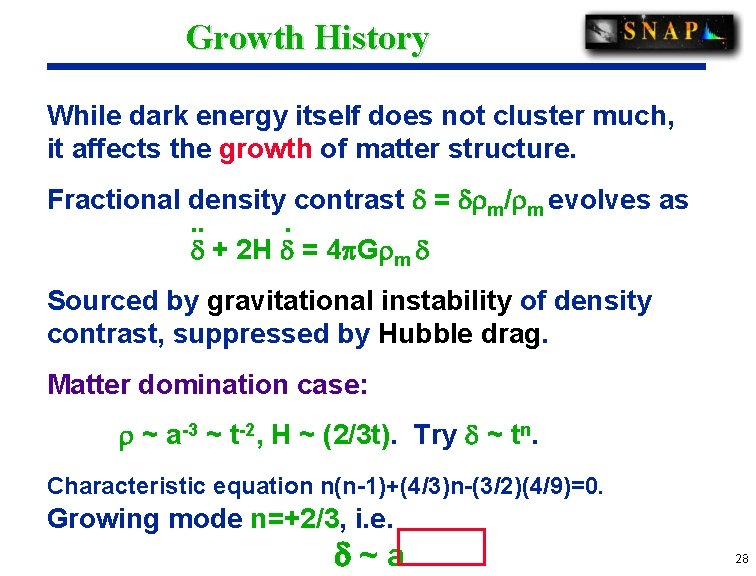
Growth History While dark energy itself does not cluster much, it affects the growth of matter structure. Fractional density contrast = m/ m evolves as. . . + 2 H = 4 G m Sourced by gravitational instability of density contrast, suppressed by Hubble drag. Matter domination case: ~ a-3 ~ t-2, H ~ (2/3 t). Try ~ tn. Characteristic equation n(n-1)+(4/3)n-(3/2)(4/9)=0. Growing mode n=+2/3, i. e. ~a 28 28
Growth History Growth rate of density fluctuations g(a) = ( m/ m)/a 29 29
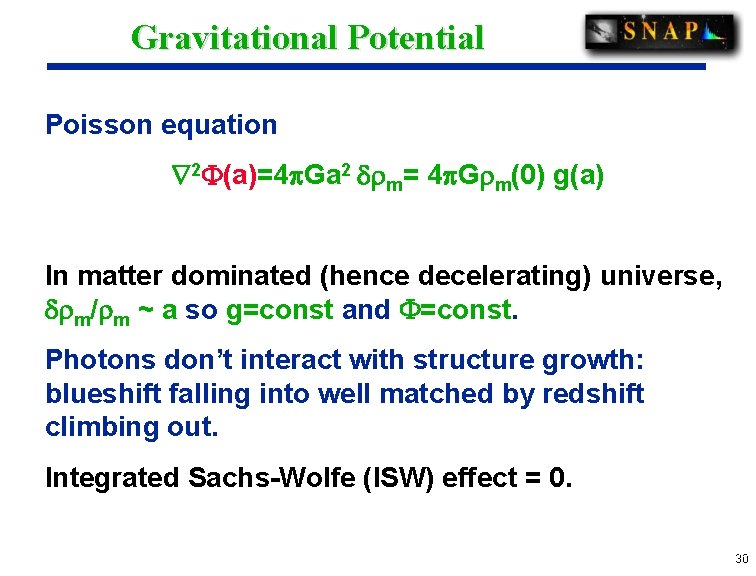
Gravitational Potential Poisson equation 2 (a)=4 Ga 2 m= 4 G m(0) g(a) In matter dominated (hence decelerating) universe, m/ m ~ a so g=const and =const. Photons don’t interact with structure growth: blueshift falling into well matched by redshift climbing out. Integrated Sachs-Wolfe (ISW) effect = 0. 30 30
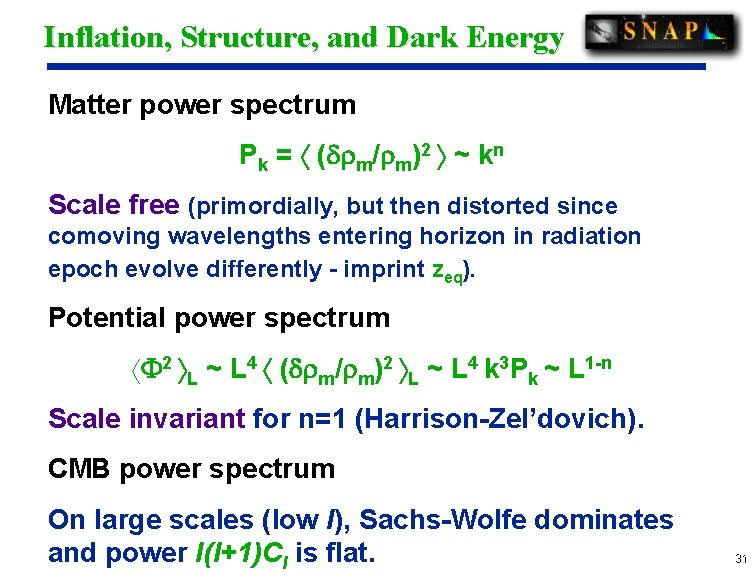
Inflation, Structure, and Dark Energy Matter power spectrum Pk = ( m/ m)2 ~ kn Scale free (primordially, but then distorted since comoving wavelengths entering horizon in radiation epoch evolve differently - imprint zeq). Potential power spectrum á 2 L ~ L 4 ( m/ m)2 L ~ L 4 k 3 Pk ~ L 1 -n Scale invariant for n=1 (Harrison-Zel’dovich). CMB power spectrum On large scales (low l), Sachs-Wolfe dominates and power l(l+1)Cl is flat. 31 31
Deceleration and Acceleration CMB power spectrum measures n-1 and inflation. Nonzero ISW measures breakdown of matter domination: at early times (radiation) and late times (dark energy). Large scales (low l) not precisely measurable due to cosmic variance. So look for better way to probe decay of gravitational potentials. Next: The Darkness of the Universe 3: Mapping Expansion and Growth 32 32