
The Danish Trans Fat Ban Paolo M Drostby
The Danish Trans Fat Ban Paolo M. Drostby Head of Food Policy Division
The rules – Order on TFA • • Trans fatty acids maximum level: 2 % of fat content Focus on oils and fats – limit at the source Only industrially processed trans fatty acids Applied from 1 January 2004 TACD - Generation 2
Scientific Background – DNC Reports Well-established link between trans fatty acids and cardiovascular disease • Increase of 5 g TFA/Day = 25 % increased risk of cardiovascular disease • Intake of 20 g TFA/Day = 2, 5 times higher risk of cardiovascular disease • Risk related to TFA 4 -5 times higher than risk related to saturated fats • US estimate (1997): 30 -40% of deaths related to cardiovascular disease due to TFA (>30. 000 deaths a year); average TFAintake 5 g/Day TACD - Generation 3
Recommendations from scientific bodies • WHO 2004: ” … Towards the elimination of TFA”. • Institute of Medicine 2002: ”Keep intake as low as possible while consuming a nutritionally adequate diet” • AFSSA 2005: ”Intake >2 E% increases risk of CVD. ” Maximum of 1 %. TACD - Generation 4

Why maximum level ? Maximum level • Protecion of citizens • Simple and efficient way of reducing intake • Enforceable, controllable and technologically feasible TACD - Generation Labelling • Empowering of citizens • Reduces intake ? • Labelling not understandable for citizens • Unpacked food products • Massive public information required 5
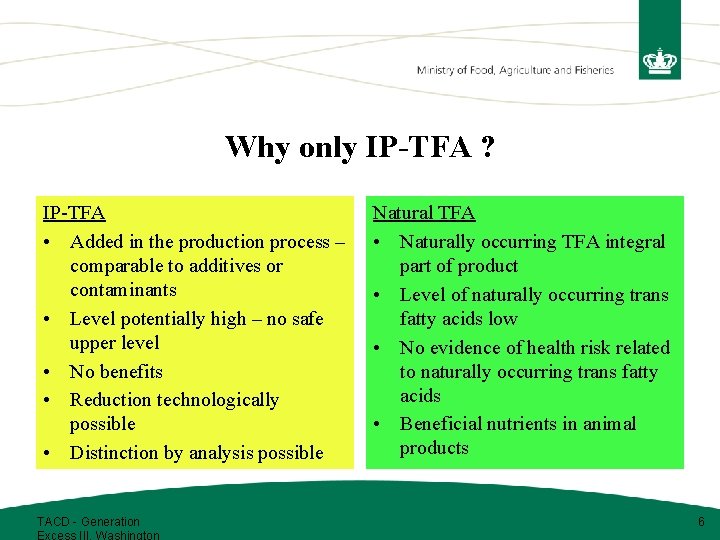
Why only IP-TFA ? IP-TFA • Added in the production process – comparable to additives or contaminants • Level potentially high – no safe upper level • No benefits • Reduction technologically possible • Distinction by analysis possible TACD - Generation Natural TFA • Naturally occurring TFA integral part of product • Level of naturally occurring trans fatty acids low • No evidence of health risk related to naturally occurring trans fatty acids • Beneficial nutrients in animal products 6
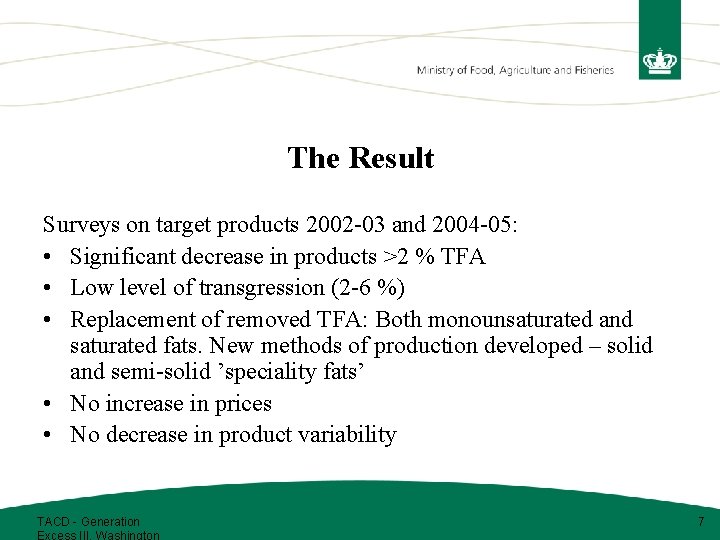
The Result Surveys on target products 2002 -03 and 2004 -05: • Significant decrease in products >2 % TFA • Low level of transgression (2 -6 %) • Replacement of removed TFA: Both monounsaturated and saturated fats. New methods of production developed – solid and semi-solid ’speciality fats’ • No increase in prices • No decrease in product variability TACD - Generation 7
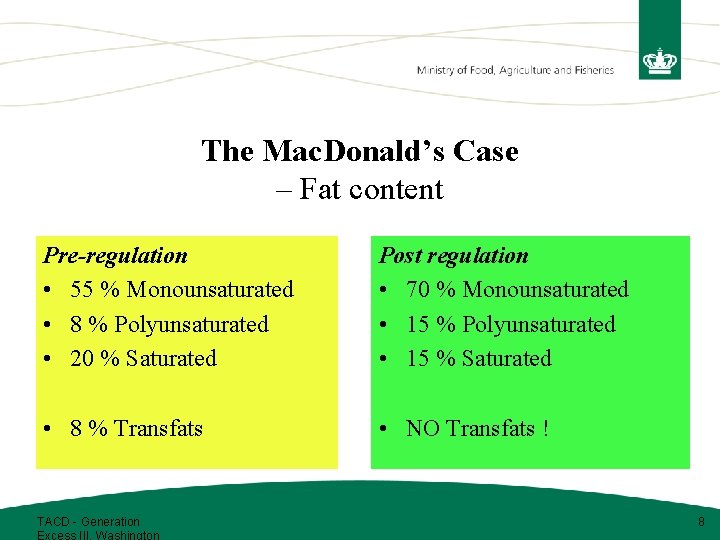
The Mac. Donald’s Case – Fat content Pre-regulation • 55 % Monounsaturated • 8 % Polyunsaturated • 20 % Saturated Post regulation • 70 % Monounsaturated • 15 % Polyunsaturated • 15 % Saturated • 8 % Transfats • NO Transfats ! TACD - Generation 8
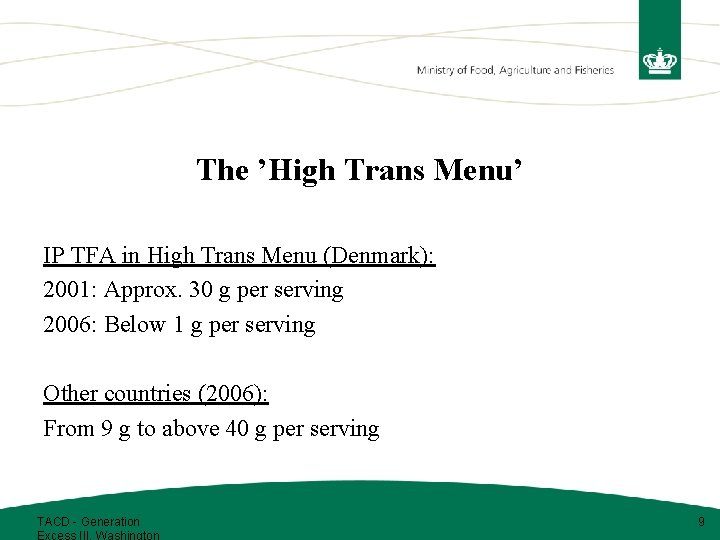
The ’High Trans Menu’ IP TFA in High Trans Menu (Denmark): 2001: Approx. 30 g per serving 2006: Below 1 g per serving Other countries (2006): From 9 g to above 40 g per serving TACD - Generation 9
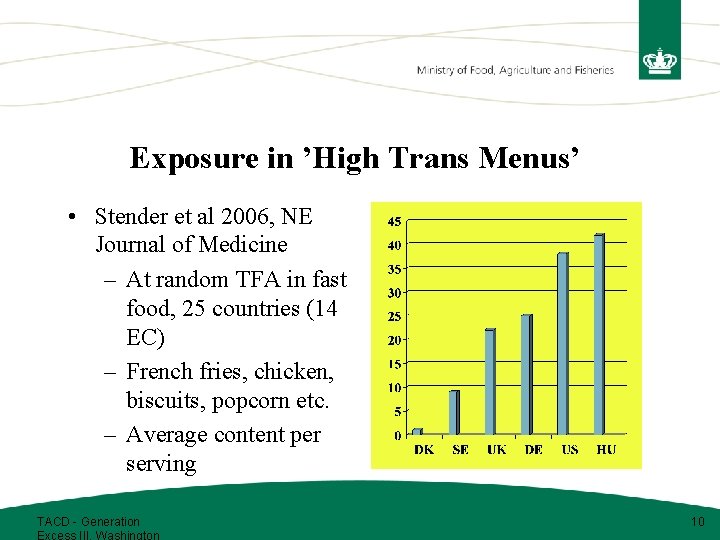
Exposure in ’High Trans Menus’ • Stender et al 2006, NE Journal of Medicine – At random TFA in fast food, 25 countries (14 EC) – French fries, chicken, biscuits, popcorn etc. – Average content per serving TACD - Generation 10
Health impact ? • Difficult to ’isolate’ TFA-impact in health studies • Studies conducted by Danish Obesity Research Center – Epidemiologic survey – Intervention study • Further information: www. Dan. ORC. dk TACD - Generation 11
- Slides: 11