
The cycle of relapse recovery of substance misusing
The cycle of relapse & recovery of substance misusing offenders on a community rehabilitation management programme Childhood, trauma, relationships & psychological health (SSA Symposium 2016) Beverly Love: B. Love@surrey. ac. uk Room: 23 AC 04 Supervisors: Professor Arlene Vetere, Dr Paul Davis & Professor Jane Ogden
Introduction • Background & aims of the research • Qualitative approach (IPA) – semi structured interviews • Findings • Implications for theory, policy & practice • Value & merit of using IPA within the addictions field
Background, questions & aims The UK Government Drug Interventions Programme (DIP) aims to reduce Class A drug misuse & the associated offending behaviour. This group have entrenched and long lasting addictions with many ‘failed’ attempts at recovery. Key Question How do Class A drug misusing ex/offenders experience and make sense of their journey of relapse and recovery in relation to significant life events and relationships. (e. g. childhoods, trauma, family and psychological health). Aims • Use psychological theories to help to illuminate & understand DIP clients cycle of relapse, recovery & drug use. • Help further develop policy & practise. Qualitative approach: • Part 1 - focus groups ; Part 2 - interviews.
Gaps in policy & research • Gaps in Home Office DIP policy: - Practical elements of support – housing, employment - Relationships - Mental health • Substance misusers - increased risk of mental health & offending behaviour (Strathdee et al 2002). Offenders increased risk of mental health, (SEU 2002).
Psychological theories informing the research • Modern attachment theory Flores (2012) views addiction as a mechanism to help those manage who’ve had difficult childhoods due to poor attachments to parents/primary care givers. This might be due to abuse, trauma, bereavement/loss or neglect. • Self psychology theory Kohut (1977) a healthy/coherent ‘self’ (e. g. self esteem, empathy) are constructed in childhood, which can be disrupted/damaged due to poor attachments to parents/primary care giver. • Affect regulation theory Flores (2012), Kohut (1977) Khantzian (1982) view addiction as a means to regulate negative affect & therefore attempts to repair the damaged ‘self’.
Rationale for qualitative: • Paucity of published research (Neal et al 2005, Neal 2013, Hucklesbury & Wincup 2010, Best et al 2008, Turnbull & Skinns 2010) • “Distinctive voices” to be heard (Smith et al 2012) • Uncover novel areas of importance (Rhodes 2000) • Practicalities of engaging hard to reach group (Turnball & Skinns 2010)

What is Interpretative Phenomenological Analysis (IPA)? • Thematic qualitative approach (Smith et al 2012) • No absolute truth - explore people’s narratives in depth – their meaning and what they believe to be true • Does not seek cause and effect • Reflexivity - researcher co-creator of meaning, my unique political position, bias & preconceptions • Quality assurance (Neal et al 2013)
Part 2: Semi structured interviews Participants • N=17 - Age range 32 -63, (male & female). - Mix of current & past DIP clients. - Crack, heroin or both N=16; cocaine use N=1 - Many used other substances too.
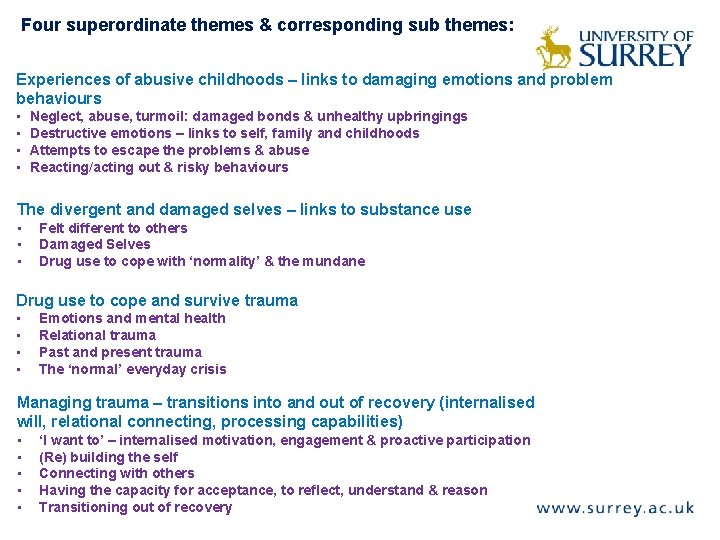
Four superordinate themes & corresponding sub themes: Experiences of abusive childhoods – links to damaging emotions and problem behaviours • • Neglect, abuse, turmoil: damaged bonds & unhealthy upbringings Destructive emotions – links to self, family and childhoods Attempts to escape the problems & abuse Reacting/acting out & risky behaviours The divergent and damaged selves – links to substance use • • • Felt different to others Damaged Selves Drug use to cope with ‘normality’ & the mundane Drug use to cope and survive trauma • • Emotions and mental health Relational trauma Past and present trauma The ‘normal’ everyday crisis Managing trauma – transitions into and out of recovery (internalised will, relational connecting, processing capabilities) • • • ‘I want to’ – internalised motivation, engagement & proactive participation (Re) building the self Connecting with others Having the capacity for acceptance, to reflect, understand & reason Transitioning out of recovery
Findings: 1. Abusive childhood experiences – links to damaging emotions & problem behaviours • Neglect, abuse, turmoil: damaged bonds & unhealthy upbringings: - violence, sexual, mental, neglect, turmoil, conflict - Chaotic teens – substance use, criminality, ‘wrong crowd’, homeless, disrupted schooling (truant/expelled), emotional & behavioural problems, teenage parents. • Destructive emotions – links to self, family & childhoods: Negative emotions in childhood/teens– fear, anger, hatred, rejection – linked to parents (one spoke about mental health) • Attempts to escape the problems - Substance use to belong/fit, cope with trauma, ran away • Acted out /risky behaviours - Joined criminal gangs/’wrong crowd’ to fit/belong somewhere (because they didn’t at home or school), normalised it
Findings: 2. The divergent and damaged selves • Felt different to others - Childhood/teens ‘feel they are different’, ‘don’t fit/ belong’ or ‘not wanted’. - Negative emotions linked to themselves • Damaged selves - Begin to see a damaged sense of self developing - Lost self, rebellious self, negative self, disorganised self & addict identity • Drug use to cope with ‘normality’ & the mundane - Didn’t know what normal was, didn’t feel normal - Trigger in recovery (maintaining home, bills, employment)
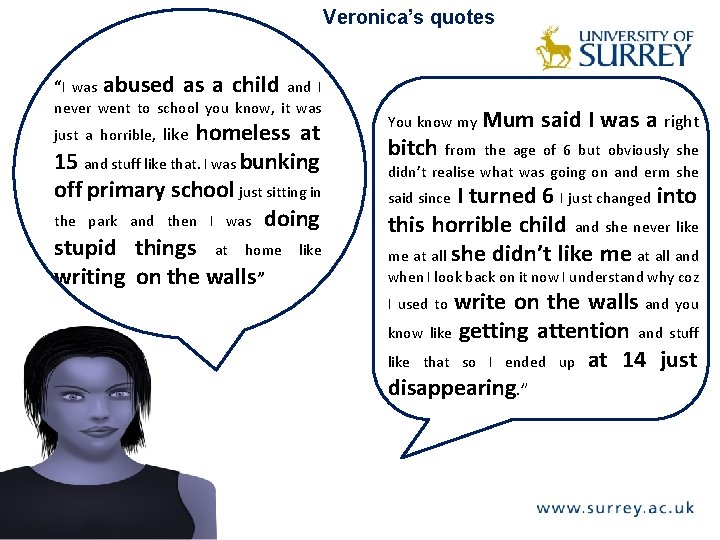
Veronica’s quotes “I was abused as a child and I never went to school you know, it was homeless at 15 and stuff like that. I was bunking off primary school just sitting in the park and then I was doing stupid things at home like writing on the walls” just a horrible, like You know my Mum bitch said I was a right from the age of 6 but obviously she didn’t realise what was going on and erm she I turned 6 I just changed into this horrible child and she never like me at all she didn’t like me at all and said since when I look back on it now I understand why coz write on the walls and you know like getting attention and stuff like that so I ended up at 14 just disappearing. ” I used to
Findings: 3. Drug use, lapse/relapse – to cope and survive trauma: • - Emotions & mental health emotions attached to difficult/abusive relationships from childhood Attached to trauma (childhood & adulthood) Fear, anger, loss, loneliness/emptiness, to feel better/happy Depression, anxiety, stress • Past & present trauma – childhood, violent abusive adult relationships, bereavement/loss • Relational trauma - Abusive childhood, being a parent, socially, struggles with relationships • The ‘normal’ everyday crisis - Mostly relapse trigger – managing home, legit job - Don’t know how to – never had it
Findings: 4. Managing trauma – transitions into and out of recovery (internalised will, relational connecting, processing capabilities) • ‘I want to’ - Internal motivation, engagement & proactive participation - In recovery process & building a non drug using ‘normal’ life • Relational connecting: - Support networks (professional, peers, selected family) - Quality of support – caring, trusting, empathy - (Re) building the self - Fulfilment, self worth, self esteem building through helping others, peer mentoring, work. • - Capacity for acceptance, reflection, rational thinking Understanding & evaluating risk Reflection, insight, realisation Weigh up costs of drug using vs benefits in recovery Accept loss & letting go of old drug using life • Transitioning out of recovery - an absence or lack of the above are signs of lapse/relapse/not fully engaged in recovery
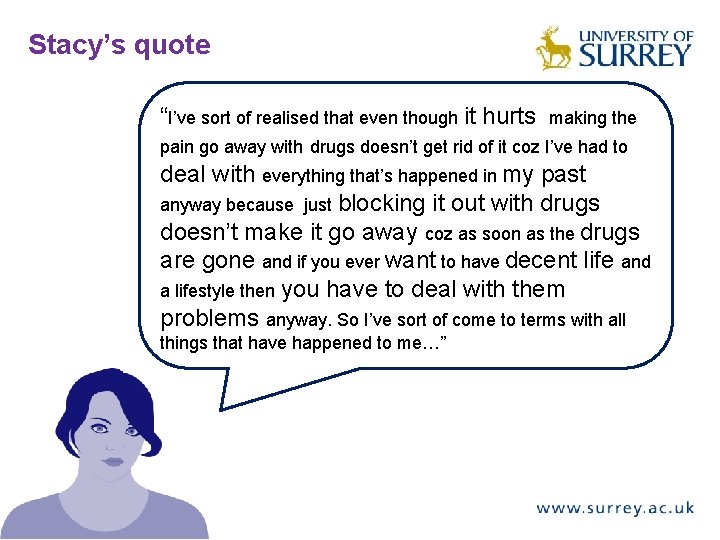
Stacy’s quote “I’ve sort of realised that even though it hurts making the pain go away with drugs doesn’t get rid of it coz I’ve had to deal with everything that’s happened in my past anyway because just blocking it out with drugs doesn’t make it go away coz as soon as the drugs are gone and if you ever want to have decent life and a lifestyle then you have to deal with them problems anyway. So I’ve sort of come to terms with all things that have happened to me…”
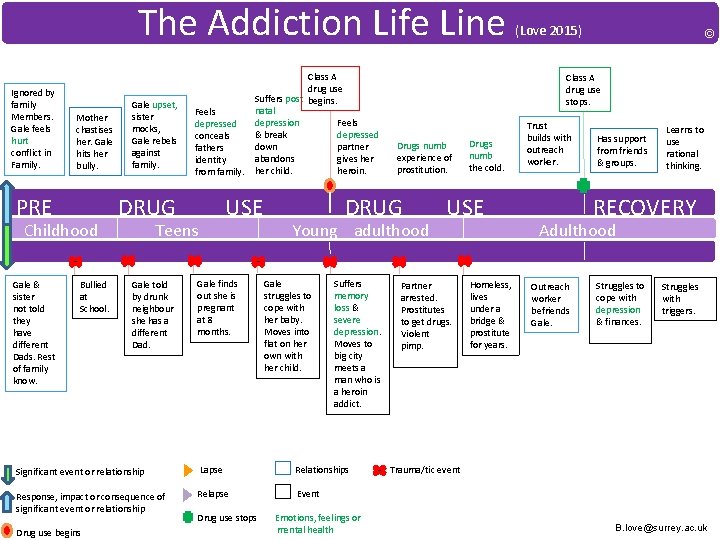
The Addiction Life Line Ignored by family Members. Gale feels hurt conflict in Family. Mother chastises her. Gale hits her bully. PRE Childhood Gale & sister not told they have different Dads. Rest of family know. Bullied at School. Gale upset, sister mocks, Gale rebels against family. Feels depressed conceals fathers identity from family. DRUG USE Teens Gale told by drunk neighbour she has a different Dad. Class A drug use Suffers post begins. natal depression Feels & break depressed down partner abandons gives her child. heroin. Gale finds out she is pregnant at 8 months. Significant event or relationship Lapse Relationships Response, impact or consequence of significant event or relationship Relapse Event Drug use begins Drug use stops Drugs numb experience of prostitution. Young adulthood Suffers memory loss & severe depression. Moves to big city meets a man who is a heroin addict. Emotions, feelings or mental health © Class A drug use stops. DRUG Gale struggles to cope with her baby. Moves into flat on her own with her child. (Love 2015) Drugs numb the cold. USE Partner arrested. Prostitutes to get drugs. Violent pimp. Homeless, lives under a bridge & prostitute for years. Trust builds with outreach worker. Has support from friends & groups. Learns to use rational thinking. RECOVERY Adulthood Outreach worker befriends Gale. Struggles to cope with depression & finances. Struggles with triggers. Trauma/tic event B. love@surrey. ac. uk
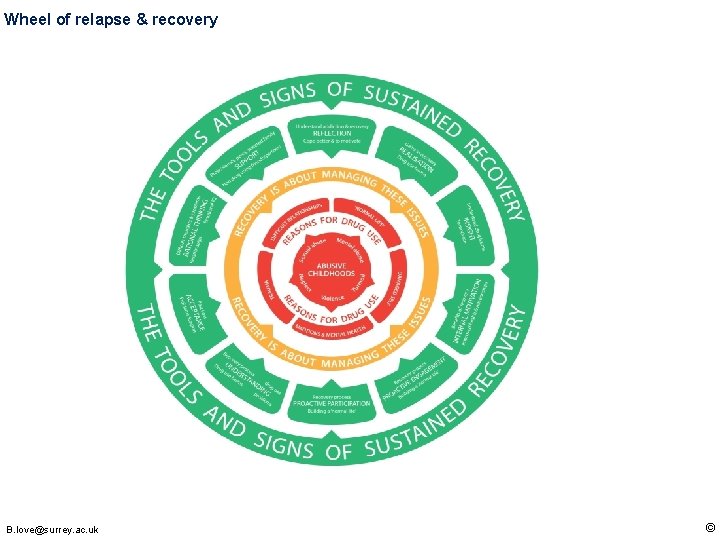
Wheel of relapse & recovery B. love@surrey. ac. uk ©
Links to theory: • Abusive childhoods & damaged bonds with parents – attachment theories. • Using substances to cope with their emotions & mental health – affect regulation theories. • Developmental trauma literature – early childhood abuse, neglect, bereavement/loss. • Damaged selves – self psychology theories, identity transition.
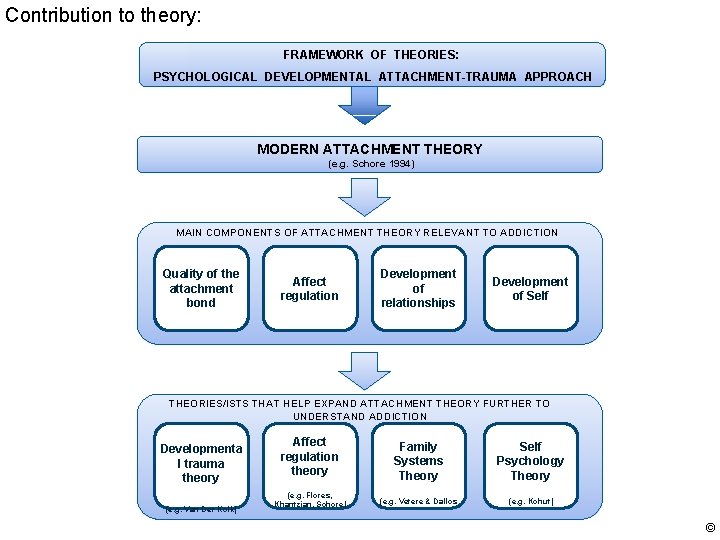
Contribution to theory: FRAMEWORK OF THEORIES: PSYCHOLOGICAL DEVELOPMENTAL ATTACHMENT-TRAUMA APPROACH MODERN ATTACHMENT THEORY (e. g. Schore 1994) MAIN COMPONENTS OF ATTACHMENT THEORY RELEVANT TO ADDICTION Quality of the attachment bond Affect regulation Development of relationships Development of Self THEORIES/ISTS THAT HELP EXPAND ATTACHMENT THEORY FURTHER TO THEORIES/ISTS THAT HELP TO EXPAND ATTACHMENT THEORY FURTHER TO UNDERSTAND ADDICTION Developmenta l trauma theory (e. g. Van Der Kolk) Affect regulation theory (e. g. Flores, Khantzian, Schore) Family Systems Theory Self Psychology Theory (e. g. Vetere & Dallos (e. g. Kohut) ©
Further implications for policy & practice • Recognition of the complexity of their lives before drug use & during drug use • Explicitly address past trauma – developmental childhood trauma • Longer term psychological therapies – managing emotions as well as mental health. • Help with relationships, parenting, family
Value & merit of using IPA within the addictions field • Allowed individual’s voices to be heard e. g: - variations of the functions drug use serves “crack saved me from domestic violence” • Uncovered novel areas researcher would not have considered e. g: - damaging emotions in childhood

Thank you to the following organisations for their support B. Love@surrey. ac. uk www. Linked. In. com
References Best, D. , Day, E. , Homayoun, S. , Lenton, H. , Moverley, R. & Openshaw, M. (2008) Treatment retention in the Drugs Intervention Programme: Do primary drug users fare better than primary offenders? Drugs: education, prevention and policy Vol. 5 (2), 201 -9 Flores, P. J. (2012) Addiction as an Attachment Disorder, Aronson, Plymouth. Hucklesbury, A. , & Wincup, E. , (2010) Drug Interventions in Criminal Justice, Mc. Graw-Hill Education, London. Khantzian, E. J. (1982) Psychopathology, psychodynamics & alcoholism. In E. M. Pattinson & S. E. Kaufman (Eds) Encyclopaedic handbook of alcoholism (581 -597). New York: Gardner Press. Cited by Flores, P. J. (2012) Addiction as An Attachment Disorder, Plymouth: Jason Aronson. Kohut, H. (1977) The preface in J. D. Blaine & A. D. Julius (Eds) Psychodynamics of drug dependence. NIDA Publication No. ADM 77 -470. Washington, DC: superintendent of Documents US Government Printing Office. Cited by Flores, P. J. (2012) Addiction as An Attachment Disorder, Plymouth: Jason Aronson. Neal, J. , Hunt, G. , Lankenau, S. , Mayock, P. , Miller, P. , Sheridan, J. , Small, W. , & Treloar, C. (2013) Addiction Journal is committed to publishing qualitative research, Addiction, Vol 108, 3 pp 447 -449 Neal, J. , Allen, D, Coombes, L. (2005) Qualitative research methods within the addictions, Addiction. Rhodes, T. (2000) The Multiple Roles of Qualitative Research in Understanding and Responding to Illicit Drug Use. Chapter 1, in Understanding and Responding to Drug Use, The Role of Qualitative Research, Greenwood, G. & Robertson, K. Eds (2000) EMCDDA, Scientific Monograph Series 4 Smith, J. A. , Flowers, P. , Larkin, M. (2012) Interpretative Phenomenological Analysis, Theory, Method & Research, London: Sage. Social Exclusion Unit (2002) Reducing Re-offending By Ex-prisoners, July ODPM. Strathdee, G. , Manning, V. , Best, D. , Keaney, F. , Bhui, K. , Witton, J. , Wall, S. Mc. Gillivary, L. , Marsden, J. , Johnson, F. , Piek, C. & Wilson-Jones, C. (2002). Dual Diagnosis In A Primary Care Group (PCG), NTA, November, 2004 briefing. Turnbull, P. , & Skinns, L. , (2010) Drug Interventions Programme: Neither success nor failure? (Ch 4) in Hucklesbury, A. , & Wincup, E. , (2010) Drug Interventions in Criminal Justice, Mc. Graw-Hill Education, London.
- Slides: 23