
The current situation of national OSH Strategies in
- Slides: 12
The current situation of national OSH Strategies in the EU William Cockburn Head of the Prevention and Research Unit 4 th ACSH Workshop on National OSH Strategies Luxembourg, 15 -16/Oct/18 Safety and health at work is everyone’s concern. It’s good for you. It’s good for business.
Status – National OSH Strategies (I) § Currently 26 Member States have a national OSH strategy. § The most recent national OSH strategies are the Bulgarian, Greek, Rumanian and Slovenian ones. § The information on national OSH strategies feeds into the EU OSH information system. § The information collection also supports the ACSH Working Party Strategies in their activities. http: //osha. europa. eu 2
Status – National OSH Strategies (II) § The current published version of the national strategies report includes the national OSH strategies of 25 Member States: Austria, Belgium, Bulgaria, Cyprus, Czech Republic, Denmark, Estonia, Finland, France, Germany, Greece, Hungary, Italy, Ireland, Latvia, Lithuania, Malta, Netherlands, Poland, Portugal, Slovakia, Slovenia, Spain, Sweden and the United Kingdom. § The Romanian national OSH strategy will be incorporated into the report with the help of the Focal Point as no English translation is available. http: //osha. europa. eu 3
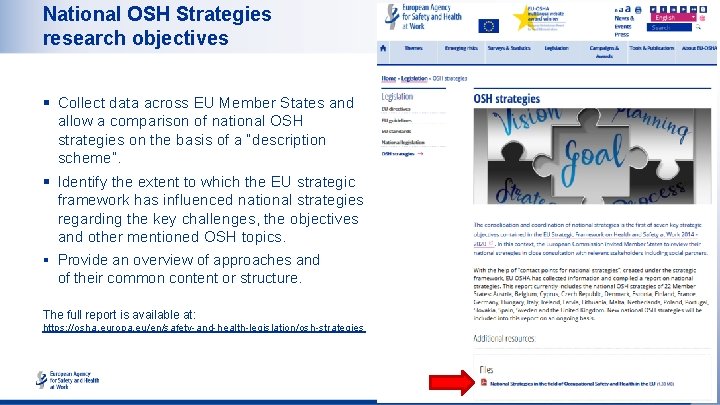
National OSH Strategies research objectives § Collect data across EU Member States and allow a comparison of national OSH strategies on the basis of a “description scheme”. § Identify the extent to which the EU strategic framework has influenced national strategies regarding the key challenges, the objectives and other mentioned OSH topics. § Provide an overview of approaches and of their common content or structure. The full report is available at: https: //osha. europa. eu/en/safety and health legislation/osh strategies http: //osha. europa. eu 4
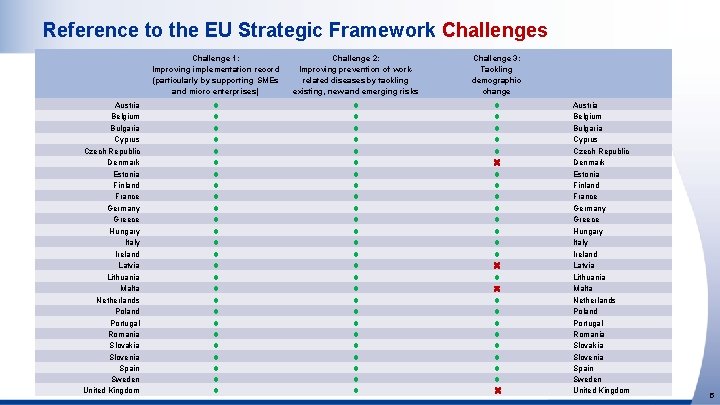
Reference to the EU Strategic Framework Challenges Austria Belgium Bulgaria Cyprus Czech Republic Denmark Estonia Finland France Germany Greece Hungary Italy Ireland Latvia Lithuania Malta Netherlands Poland Portugal Romania Slovakia Slovenia Spain Sweden United Kingdom Challenge 1: Improving implementation record (particularly by supporting SMEs and micro enterprises) Challenge 2: Improving prevention of workrelated diseases by tackling existing, new and emerging risks Challenge 3: Tackling demographic change Austria Belgium Bulgaria Cyprus Czech Republic Denmark Estonia Finland France Germany Greece Hungary Italy Ireland Latvia Lithuania Malta Netherlands Poland Portugal Romania Slovakia Slovenia Spain Sweden http: //osha. europa. eu United Kingdom 5
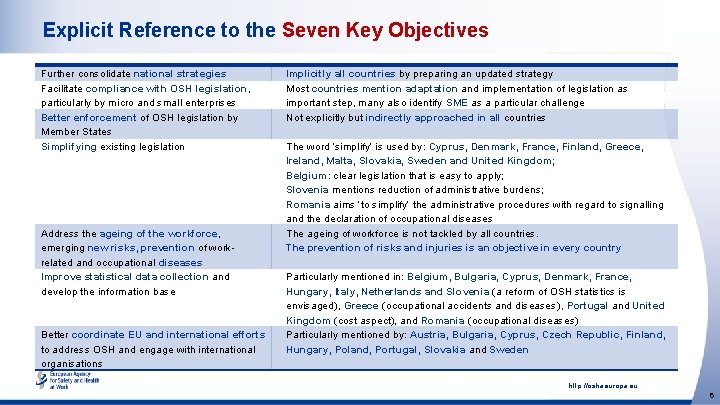
Explicit Reference to the Seven Key Objectives Further consolidate national strategies Facilitate compliance with OSH legislation, particularly by micro and small enterprises Better enforcement of OSH legislation by Member States Simplifying existing legislation Address the ageing of the workforce, emerging new risks, prevention of work related and occupational diseases Improve statistical data collection and develop the information base Better coordinate EU and international efforts to address OSH and engage with international organisations Implicitly all countries by preparing an updated strategy Most countries mention adaptation and implementation of legislation as important step, many also identify SME as a particular challenge Not explicitly but indirectly approached in all countries The word ‘simplify’ is used by: Cyprus, Denmark, France, Finland, Greece, Ireland, Malta, Slovakia, Sweden and United Kingdom; Belgium: clear legislation that is easy to apply; Slovenia mentions reduction of administrative burdens; Romania aims ‘to simplify’ the administrative procedures with regard to signalling and the declaration of occupational diseases The ageing of workforce is not tackled by all countries. The prevention of risks and injuries is an objective in every country Particularly mentioned in: Belgium, Bulgaria, Cyprus, Denmark, France, Hungary, Italy, Netherlands and Slovenia (a reform of OSH statistics is envisaged), Greece (occupational accidents and diseases), Portugal and United Kingdom (cost aspect), and Romania (occupational diseases) Particularly mentioned by: Austria, Bulgaria, Cyprus, Czech Republic, Finland, Hungary, Poland, Portugal, Slovakia and Sweden http: //osha. europa. eu 6
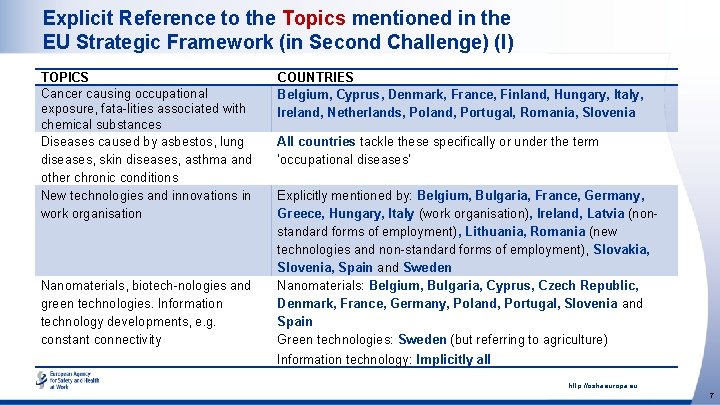
Explicit Reference to the Topics mentioned in the EU Strategic Framework (in Second Challenge) (I) TOPICS Cancer causing occupational exposure, fata lities associated with chemical substances Diseases caused by asbestos, lung diseases, skin diseases, asthma and other chronic conditions New technologies and innovations in work organisation Nanomaterials, biotech nologies and green technologies. Information technology developments, e. g. constant connectivity COUNTRIES Belgium, Cyprus, Denmark, France, Finland, Hungary, Italy, Ireland, Netherlands, Poland, Portugal, Romania, Slovenia All countries tackle these specifically or under the term ‘occupational diseases’ Explicitly mentioned by: Belgium, Bulgaria, France, Germany, Greece, Hungary, Italy (work organisation), Ireland, Latvia (non standard forms of employment), Lithuania, Romania (new technologies and non standard forms of employment), Slovakia, Slovenia, Spain and Sweden Nanomaterials: Belgium, Bulgaria, Cyprus, Czech Republic, Denmark, France, Germany, Poland, Portugal, Slovenia and Spain Green technologies: Sweden (but referring to agriculture) Information technology: Implicitly all http: //osha. europa. eu 7
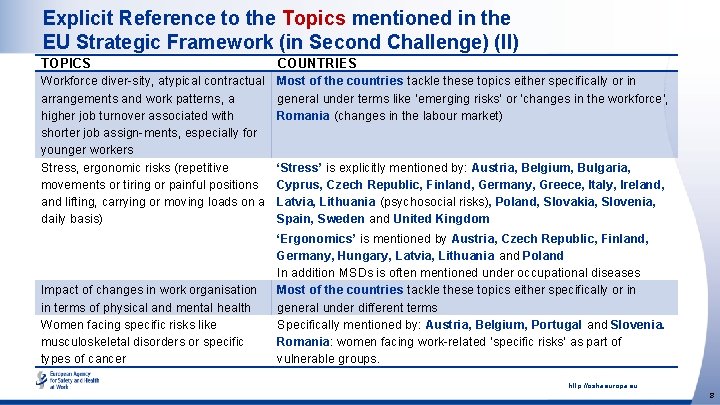
Explicit Reference to the Topics mentioned in the EU Strategic Framework (in Second Challenge) (II) TOPICS COUNTRIES Workforce diver sity, atypical contractual arrangements and work patterns, a higher job turnover associated with shorter job assign ments, especially for younger workers Stress, ergonomic risks (repetitive movements or tiring or painful positions and lifting, carrying or moving loads on a daily basis) Most of the countries tackle these topics either specifically or in general under terms like ‘emerging risks’ or ‘changes in the workforce’, Romania (changes in the labour market) Impact of changes in work organisation in terms of physical and mental health Women facing specific risks like musculoskeletal disorders or specific types of cancer ‘Stress’ is explicitly mentioned by: Austria, Belgium, Bulgaria, Cyprus, Czech Republic, Finland, Germany, Greece, Italy, Ireland, Latvia, Lithuania (psychosocial risks), Poland, Slovakia, Slovenia, Spain, Sweden and United Kingdom ‘Ergonomics’ is mentioned by Austria, Czech Republic, Finland, Germany, Hungary, Latvia, Lithuania and Poland In addition MSDs is often mentioned under occupational diseases Most of the countries tackle these topics either specifically or in general under different terms Specifically mentioned by: Austria, Belgium, Portugal and Slovenia. Romania: women facing work related ‘specific risks’ as part of vulnerable groups. http: //osha. europa. eu 8
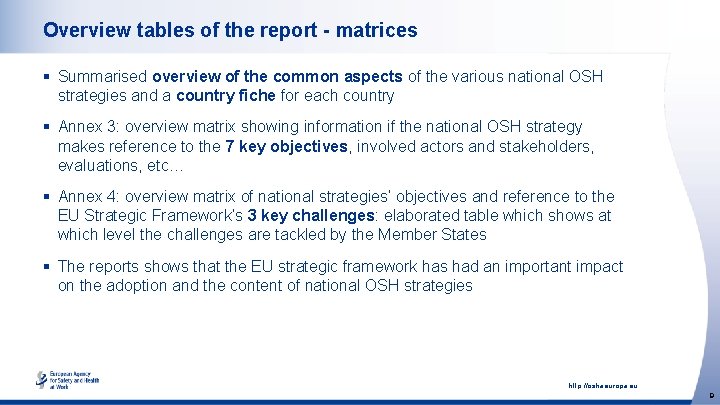
Overview tables of the report - matrices § Summarised overview of the common aspects of the various national OSH strategies and a country fiche for each country § Annex 3: overview matrix showing information if the national OSH strategy makes reference to the 7 key objectives, involved actors and stakeholders, evaluations, etc… § Annex 4: overview matrix of national strategies’ objectives and reference to the EU Strategic Framework’s 3 key challenges: elaborated table which shows at which level the challenges are tackled by the Member States § The reports shows that the EU strategic framework has had an important impact on the adoption and the content of national OSH strategies http: //osha. europa. eu 9
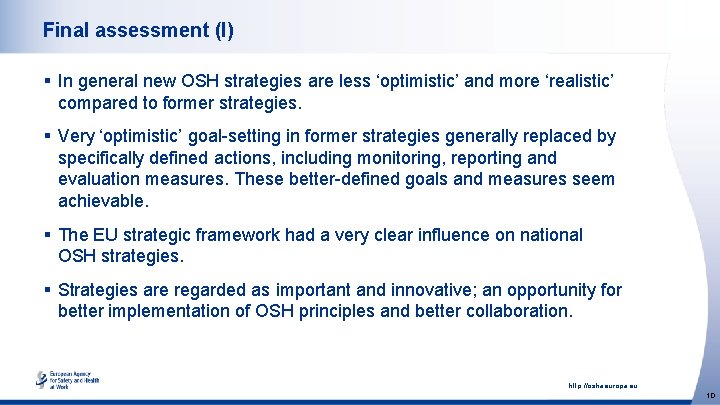
Final assessment (I) § In general new OSH strategies are less ‘optimistic’ and more ‘realistic’ compared to former strategies. § Very ‘optimistic’ goal setting in former strategies generally replaced by specifically defined actions, including monitoring, reporting and evaluation measures. These better defined goals and measures seem achievable. § The EU strategic framework had a very clear influence on national OSH strategies. § Strategies are regarded as important and innovative; an opportunity for better implementation of OSH principles and better collaboration. http: //osha. europa. eu 10
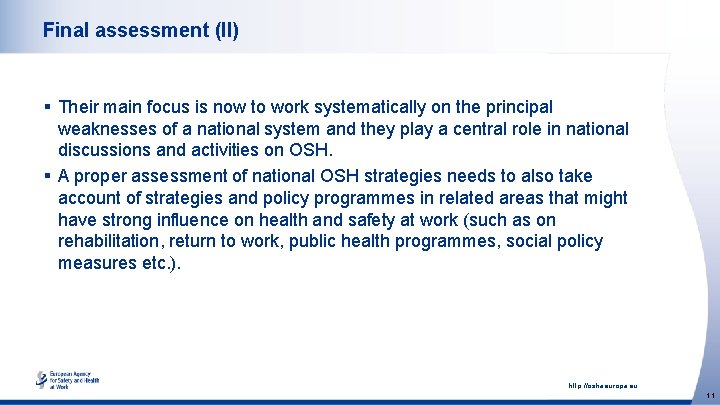
Final assessment (II) § Their main focus is now to work systematically on the principal weaknesses of a national system and they play a central role in national discussions and activities on OSH. § A proper assessment of national OSH strategies needs to also take account of strategies and policy programmes in related areas that might have strong influence on health and safety at work (such as on rehabilitation, return to work, public health programmes, social policy measures etc. ). http: //osha. europa. eu 11
Thank you for your attention! http: //osha. europa. eu 12