
The Culture and Soft Power of Korea Embassy
The Culture and Soft Power of Korea Embassy of the Republic of Korea
Contents 1 Korea at a Glance 2 Korean Culture 3 Korea’s Soft Power 4 Korean Culture in Croatia
Korea at a Glance
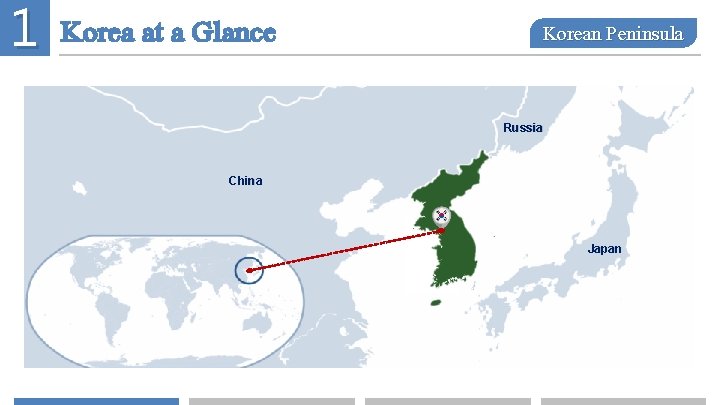
1 Korea at a Glance Korean Peninsula Russia China Japan
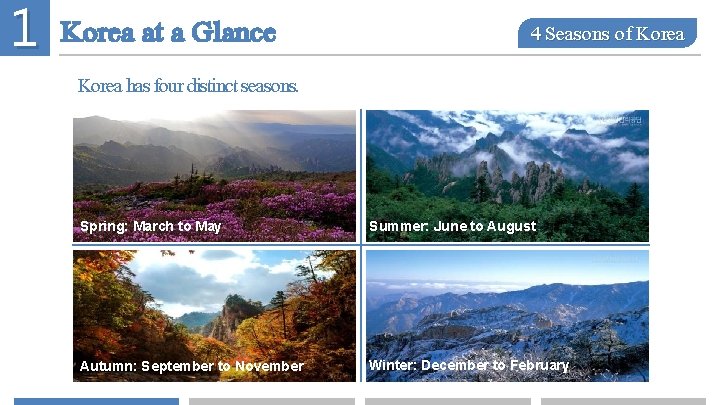
1 Korea at a Glance 4 Seasons of Korea has four distinct seasons. Spring: March to May Summer: June to August Autumn: September to November Winter: December to February
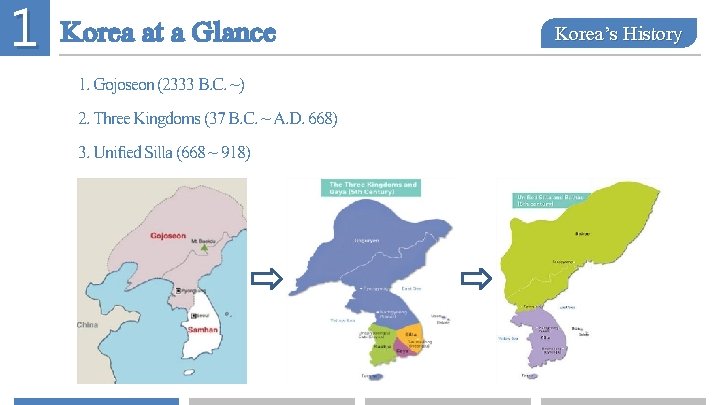
1 Korea at a Glance 1. Gojoseon (2333 B. C. ~) 2. Three Kingdoms (37 B. C. ~ A. D. 668) 3. Unified Silla (668 ~ 918) Korea’s History
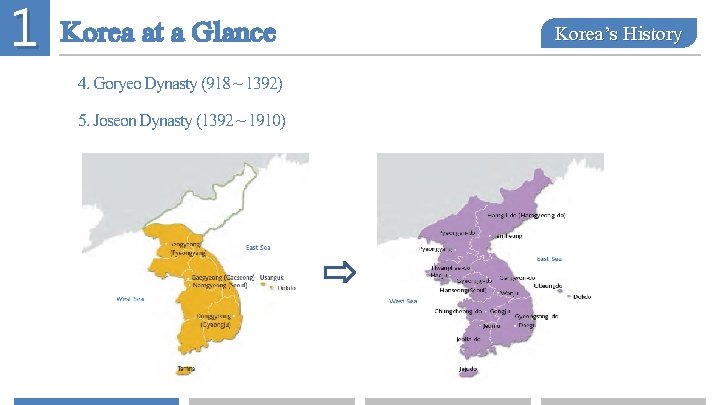
1 Korea at a Glance 4. Goryeo Dynasty (918 ~ 1392) 5. Joseon Dynasty (1392 ~ 1910) Korea’s History
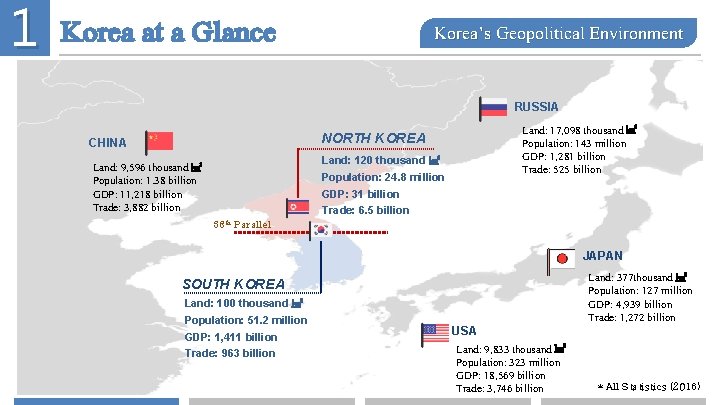
1 Korea at a Glance Korea’s Geopolitical Environment RUSSIA Land: 17, 098 thousand ㎢ Population: 143 million GDP: 1, 281 billion Trade: 525 billion NORTH KOREA CHINA Land: 120 thousand ㎢ Land: 9, 596 thousand ㎢ Population: 1. 38 billion GDP: 11, 218 billion Trade: 3, 882 billion Population: 24. 8 million GDP: 31 billion Trade: 6. 5 billion 38 th Parallel JAPAN Land: 377 thousand ㎢ Population: 127 million GDP: 4, 939 billion Trade: 1, 272 billion SOUTH KOREA Land: 100 thousand ㎢ Population: 51. 2 million GDP: 1, 411 billion Trade: 963 billion USA Land: 9, 833 thousand ㎢ Population: 323 million GDP: 18, 569 billion Trade: 3, 746 billion * All Statistics (2016)
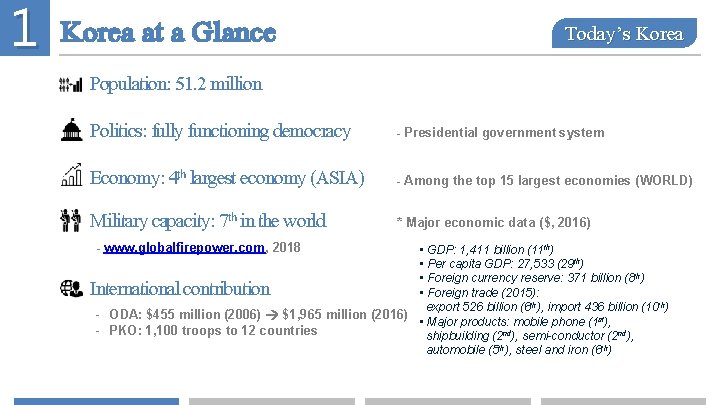
1 Korea at a Glance Today’s Korea Population: 51. 2 million Politics: fully functioning democracy - Presidential government system Economy: 4 th largest economy (ASIA) - Among the top 15 largest economies (WORLD) Military capacity: 7 th in the world * Major economic data ($, 2016) - www. globalfirepower. com, 2018 • GDP: 1, 411 billion (11 th) • Per capita GDP: 27, 533 (29 th) • Foreign currency reserve: 371 billion (8 th) • Foreign trade (2015): export 526 billion (6 th), import 436 billion (10 th) - ODA: $455 million (2006) $1, 965 million (2016) • Major products: mobile phone (1 st), - PKO: 1, 100 troops to 12 countries shipbuilding (2 nd), semi-conductor (2 nd), automobile (5 th), steel and iron (6 th) International contribution
Korean Culture

2 Korean Culture Main Characteristics Strong Collective Identity Adaptation but Difference A. Similarities B. Differences - Spoken Language and Written Script Korean Alphabet Chinese Alphabet Hiragana / Gatakana
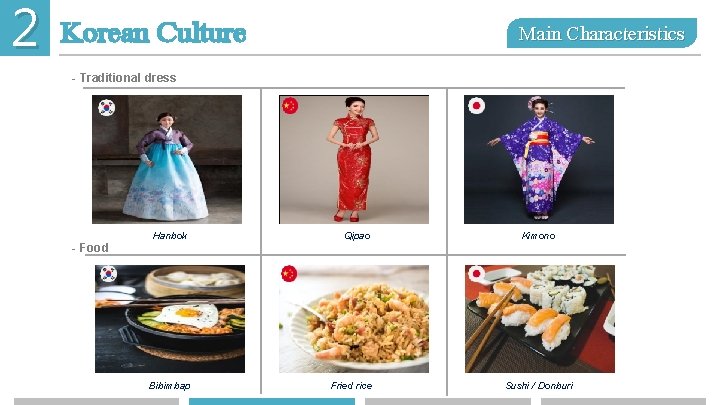
2 Korean Culture Main Characteristics - Traditional dress Hanbok Qipao Kimono - Food Bibimbap Fried rice Sushi / Donburi

2 Korean Culture Originality Main Characteristics B. Samullori A. Korean shamans C. Mask dance
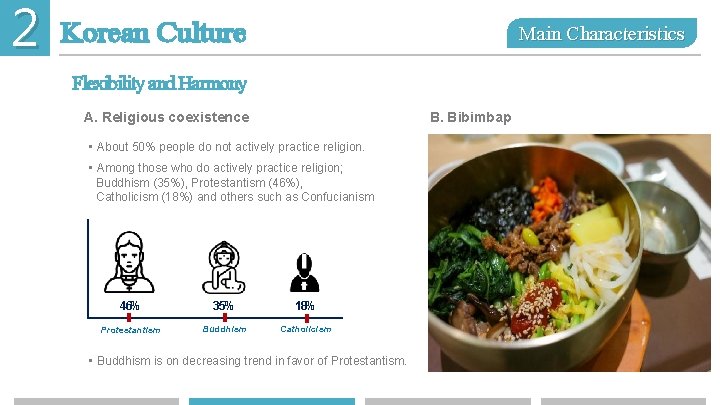
2 Korean Culture Main Characteristics Flexibility and Harmony A. Religious coexistence B. Bibimbap • About 50% people do not actively practice religion. • Among those who do actively practice religion; Buddhism (35%), Protestantism (46%), Catholicism (18%) and others such as Confucianism 46% 35% 18% Protestantism Buddhism Catholicism • Buddhism is on decreasing trend in favor of Protestantism.
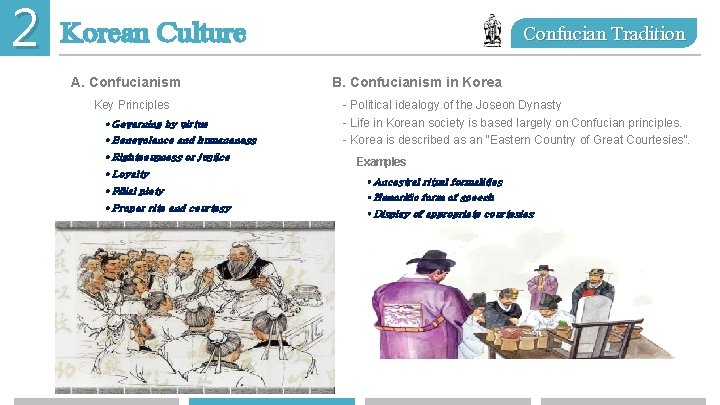
2 Korean Culture A. Confucianism Key Principles • Governing by virtue • Benevolence and humaneness • Righteousness or justice • Loyalty • Filial piety • Proper rite and courtesy Confucian Tradition B. Confucianism in Korea - Political idealogy of the Joseon Dynasty - Life in Korean society is based largely on Confucian principles. - Korea is described as an “Eastern Country of Great Courtesies”. Examples • Ancestral ritual formalities • Honorific form of speech • Display of appropriate courtesies
2 Korean Culture A. Hansik (Korean Food) B. Hanbok (Korean Costume) C. Hanok (Korean House) D. Hangul (Korean Language) E. Hanji (Korean Paper) F. Gukak (Korean Music ) Main Features of Korean Life and Culture
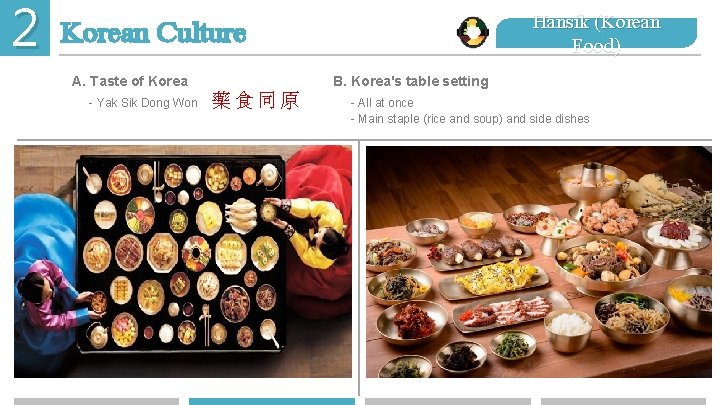
2 Hansik (Korean Food) Korean Culture A. Taste of Korea - Yak Sik Dong Won B. Korea's table setting 藥食同原 - All at once - Main staple (rice and soup) and side dishes
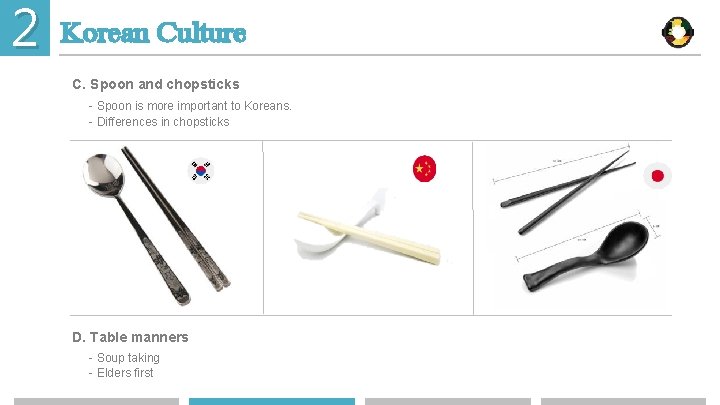
2 Korean Culture C. Spoon and chopsticks - Spoon is more important to Koreans. - Differences in chopsticks D. Table manners - Soup taking - Elders first

2 Korean Culture E. Fermentation - The key of Korean food culture; over 80% of Korean foods are produced through the fermentation process. - The fermentation process alters the composition of the food and brings new nutritional benefits. F. Kimchi and Kimjang culture - Kimchi is Korea's signature food product and a prime example of a fermented food. - Tow-phase fermentation process
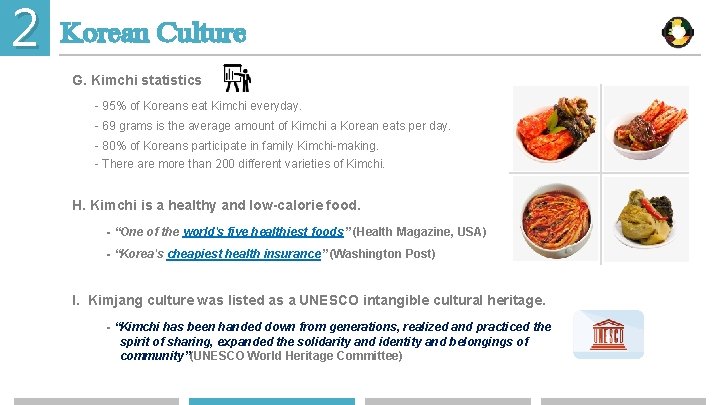
2 Korean Culture G. Kimchi statistics - 95% of Koreans eat Kimchi everyday. - 69 grams is the average amount of Kimchi a Korean eats per day. - 80% of Koreans participate in family Kimchi-making. - There are more than 200 different varieties of Kimchi. H. Kimchi is a healthy and low-calorie food. - “One of the world's five healthiest foods” (Health Magazine, USA) - “Korea's cheapiest health insurance” (Washington Post) I. Kimjang culture was listed as a UNESCO intangible cultural heritage. - “Kimchi has been handed down from generations, realized and practiced the spirit of sharing, expanded the solidarity and identity and belongings of community”(UNESCO World Heritage Committee)
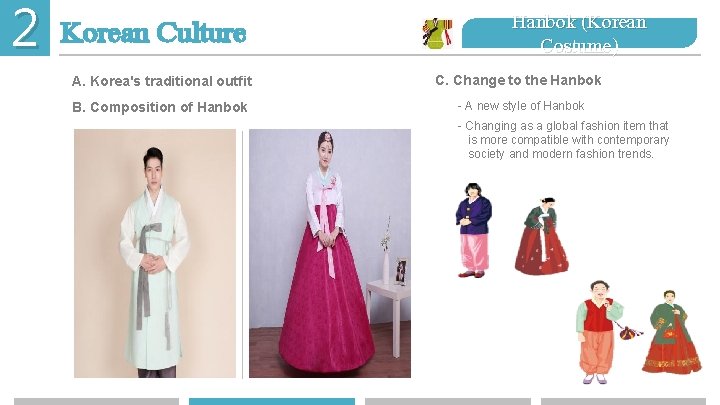
2 Korean Culture Hanbok (Korean Costume) A. Korea's traditional outfit C. Change to the Hanbok B. Composition of Hanbok - A new style of Hanbok - Changing as a global fashion item that is more compatible with contemporary society and modern fashion trends.
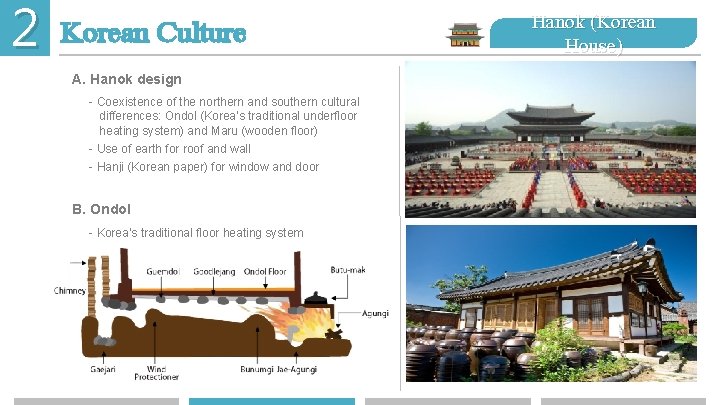
2 Korean Culture A. Hanok design - Coexistence of the northern and southern cultural differences: Ondol (Korea’s traditional underfloor heating system) and Maru (wooden floor) - Use of earth for roof and wall - Hanji (Korean paper) for window and door B. Ondol - Korea’s traditional floor heating system Hanok (Korean House)
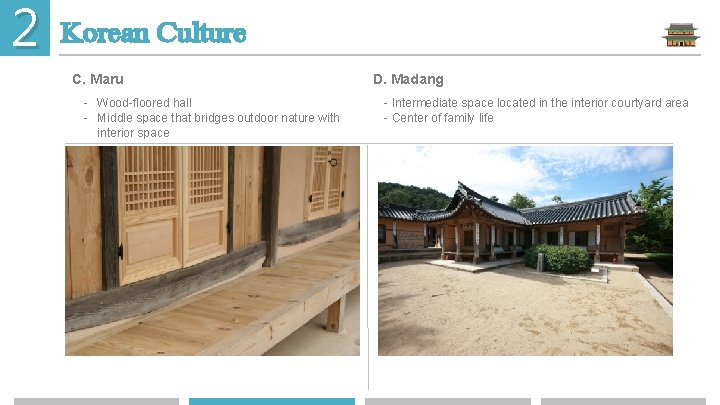
2 Korean Culture C. Maru - Wood-floored hall - Middle space that bridges outdoor nature with interior space D. Madang - Intermediate space located in the interior courtyard area - Center of family life

2 Korean Culture A. Origin of Hangul - Created in 1446 by King Sejong B. Characteristics of Hangul - Scientific language based on phonetic lettering system - 24 letters (14 consonants, 10 vowels) Hangul (Korean Language)
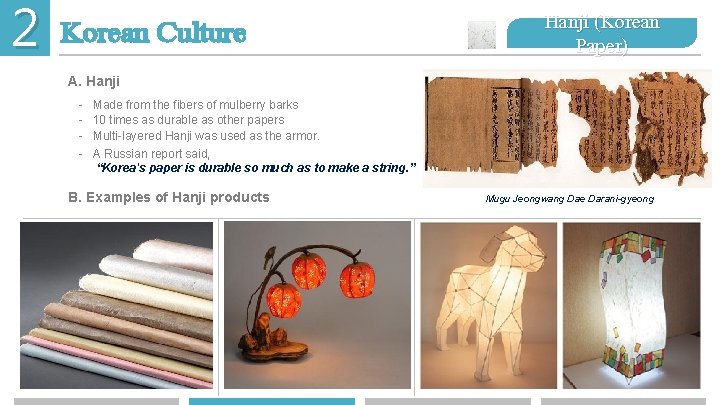
2 Korean Culture Hanji (Korean Paper) A. Hanji - Made from the fibers of mulberry barks 10 times as durable as other papers Multi-layered Hanji was used as the armor. A Russian report said, “Korea's paper is durable so much as to make a string. ” B. Examples of Hanji products Mugu Jeongwang Dae Darani-gyeong
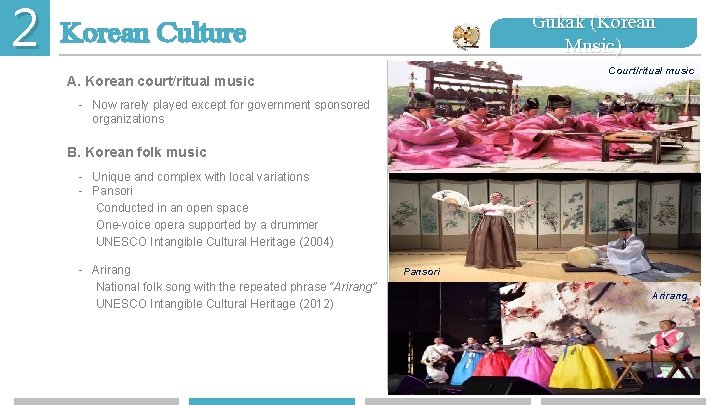
2 Gukak (Korean Music) Korean Culture Court/ritual music A. Korean court/ritual music - Now rarely played except for government sponsored organizations B. Korean folk music - Unique and complex with local variations - Pansori Conducted in an open space One-voice opera supported by a drummer UNESCO Intangible Cultural Heritage (2004) - Arirang National folk song with the repeated phrase “Arirang” UNESCO Intangible Cultural Heritage (2012) Pansori Arirang
Korea’s Soft Power
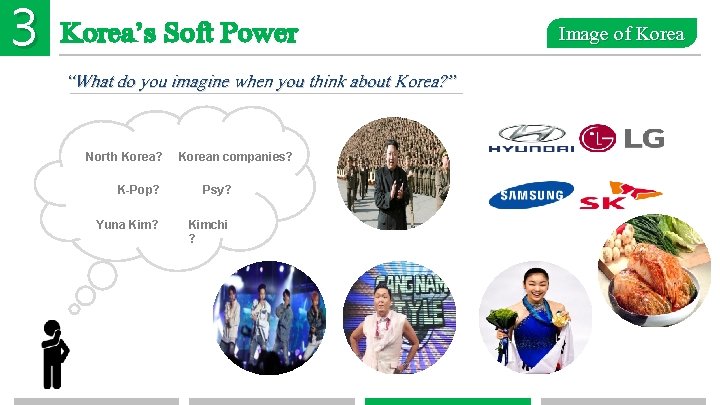
3 Korea’s Soft Power “What do you imagine when you think about Korea? ” North Korea? Korean companies? K-Pop? Psy? Yuna Kim? Kimchi ? Image of Korea
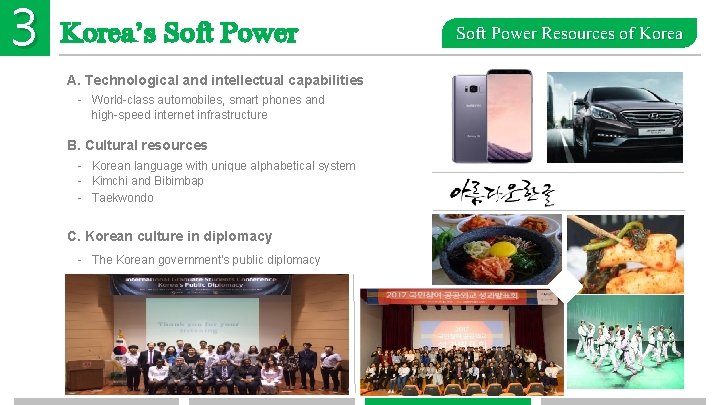
3 Korea’s Soft Power A. Technological and intellectual capabilities - World-class automobiles, smart phones and high-speed internet infrastructure B. Cultural resources - Korean language with unique alphabetical system - Kimchi and Bibimbap - Taekwondo C. Korean culture in diplomacy - The Korean government's public diplomacy Soft Power Resources of Korea
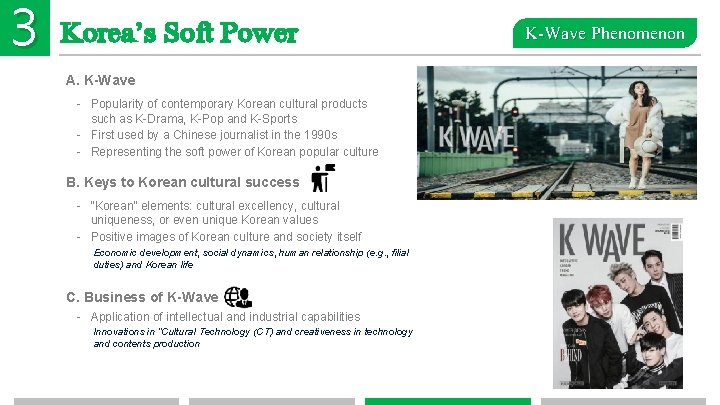
3 Korea’s Soft Power A. K-Wave - Popularity of contemporary Korean cultural products such as K-Drama, K-Pop and K-Sports - First used by a Chinese journalist in the 1990 s - Representing the soft power of Korean popular culture B. Keys to Korean cultural success - “Korean” elements: cultural excellency, cultural uniqueness, or even unique Korean values - Positive images of Korean culture and society itself Economic development, social dynamics, human relationship (e. g. , filial duties) and Korean life C. Business of K-Wave - Application of intellectual and industrial capabilities Innovations in “Cultural Technology (CT) and creativeness in technology and contents production K-Wave Phenomenon
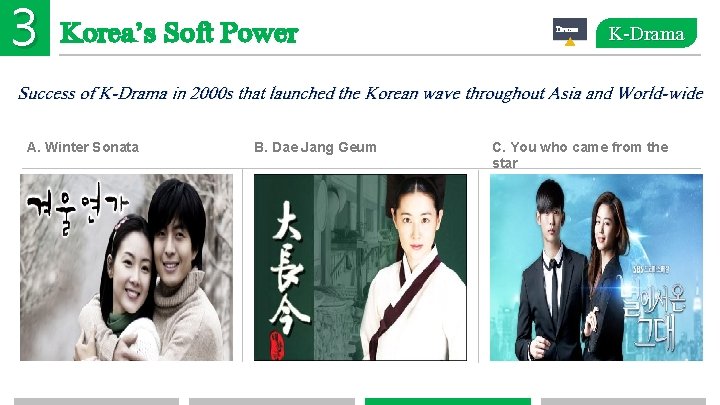
3 Korea’s Soft Power Drama K-Drama Success of K-Drama in 2000 s that launched the Korean wave throughout Asia and World-wide A. Winter Sonata B. Dae Jang Geum C. You who came from the star
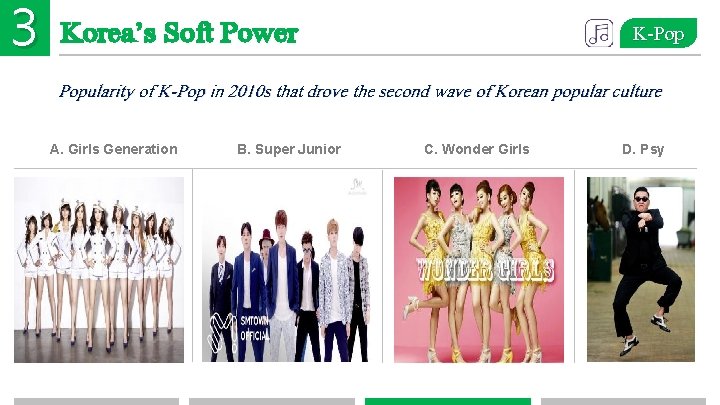
3 Korea’s Soft Power K-Pop Popularity of K-Pop in 2010 s that drove the second wave of Korean popular culture A. Girls Generation B. Super Junior C. Wonder Girls D. Psy
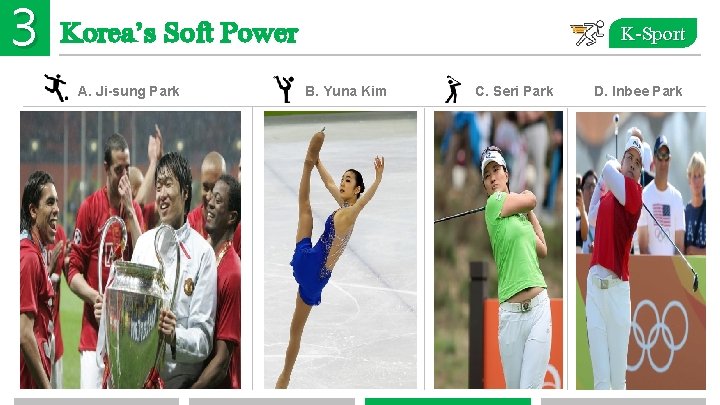
3 Korea’s Soft Power A. Ji-sung Park K-Sport B. Yuna Kim C. Seri Park D. Inbee Park
Korean Culture in Croatia
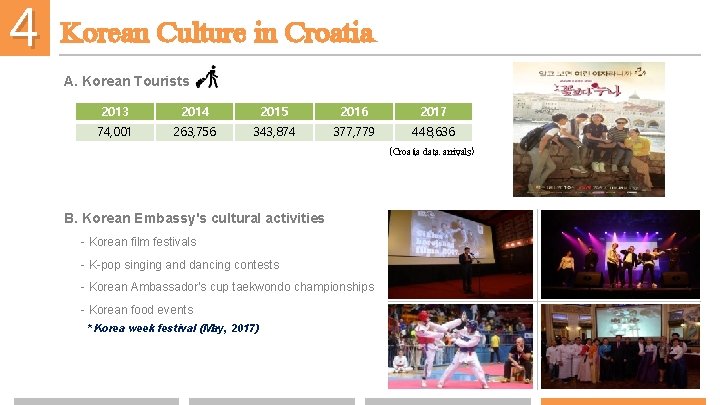
4 Korean Culture in Croatia A. Korean Tourists 2013 2014 2015 2016 2017 74, 001 263, 756 343, 874 377, 779 448, 636 (Croatia data, arrivals) B. Korean Embassy's cultural activities - Korean film festivals - K-pop singing and dancing contests - Korean Ambassador's cup taekwondo championships - Korean food events * Korea week festival (May, 2017)
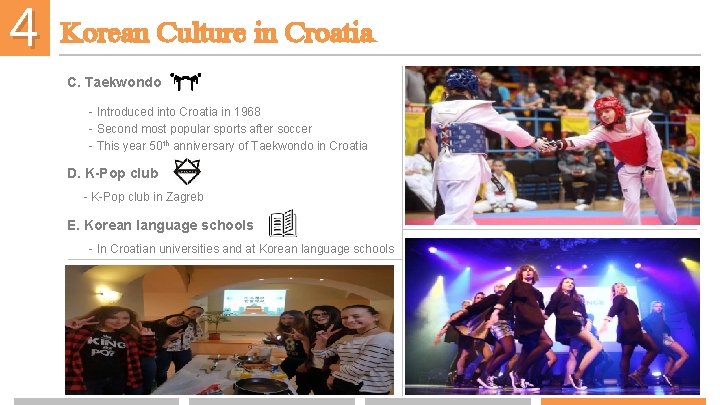
4 Korean Culture in Croatia C. Taekwondo - Introduced into Croatia in 1968 - Second most popular sports after soccer - This year 50 th anniversary of Taekwondo in Croatia D. K-Pop club - K-Pop club in Zagreb E. Korean language schools - In Croatian universities and at Korean language schools

- Slides: 38