
The Cueing System The 4 systems that clue
- Slides: 22
The Cueing System The 4 systems that “clue” us into making meaning!
Phonological (sound) system � Important for beginning readers & writers � Learn to pronounce sounds as they learn to talk � Learn to associate sounds with letters as they learn to read and write � Students use phonics to decode words, but phonics is not a complete reading program b/c not all words can be decoded easily and reading is more than just decoding.
Phonological cueing system � 44 sounds in the English language, 26 letters � Phoneme=smallest unit of sound � Grapheme=written version of a phoneme using one or more letters � Phonological awareness: being able to hear the sounds (word play, rimes, onsets) � Phonemic awareness: being able to orally manipulate phonemes in words (orally segmenting) � Phonics: instruction about phonemegrapheme correspondence and spelling rules
Syntactic System �The grammar that regulates how words are combined into sentences. �Grammar literally means the rules for governing how words are combined in sentences, not parts of speech. �Word order is important to making meaning.
Syntactic System �“The horses galloped through the gate and out into the field” �Student may not be able to read “through” but could substitute with “out of” or “past” because it makes sense in the structure of the sentence.
Syntactic System �Morphemes=smallest unit of meaning �“dog, ” “cat, ” “play” are all free morphemes �“-s” and “-ed” are bound morphemes • Plural marker or past-tense marker • Change the meaning of the words they are added onto.
Semantic System �Focuses on meaning �Vocabulary is key component • • Teaching more than one meaning for words Teaching synonyms and antonyms for words Connotations, or associations, of words Homonyms �Sound alike but are spelled differently • Using context clues
Pragmatic System �The social aspects of language use. �Language varies across social classes, ethnic groups and geographic regions
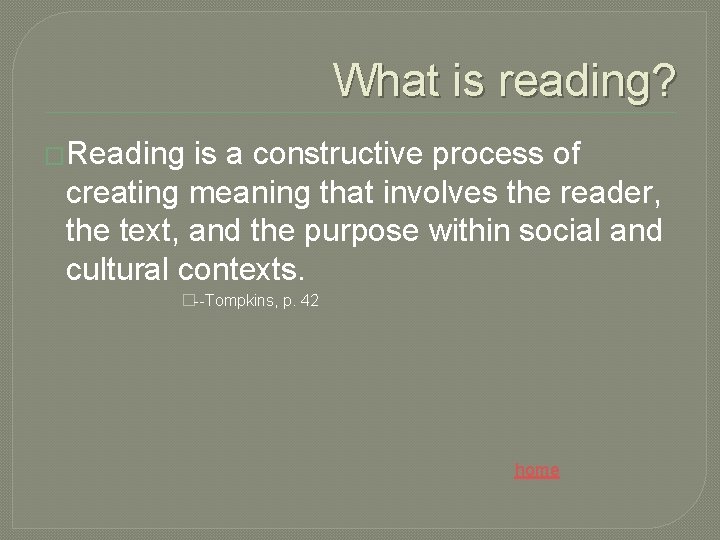
What is reading? �Reading is a constructive process of creating meaning that involves the reader, the text, and the purpose within social and cultural contexts. �--Tompkins, p. 42 home
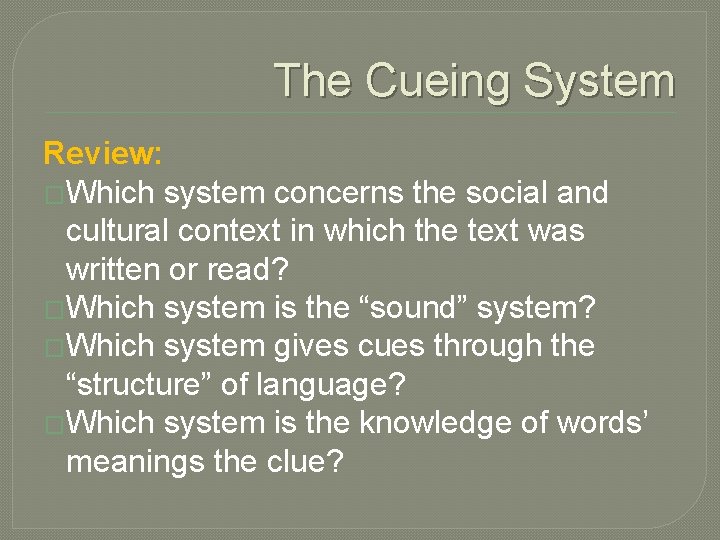
The Cueing System Review: �Which system concerns the social and cultural context in which the text was written or read? �Which system is the “sound” system? �Which system gives cues through the “structure” of language? �Which system is the knowledge of words’ meanings the clue?
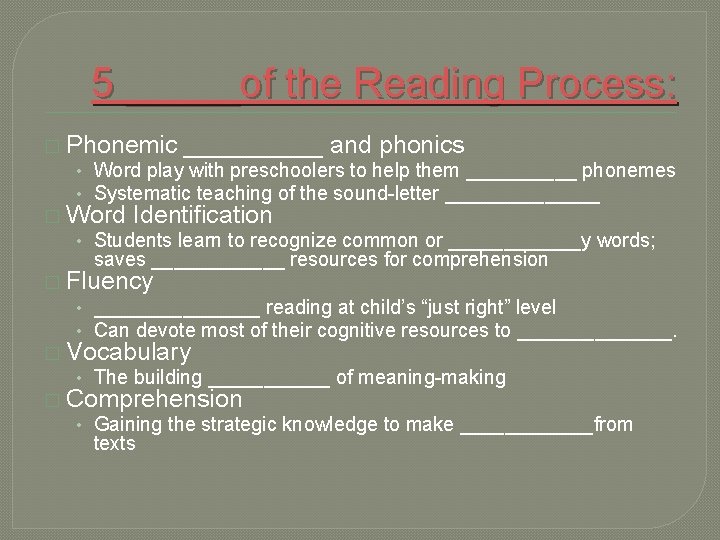
5 _____of the Reading Process: � Phonemic _____ and phonics • Word play with preschoolers to help them _____ phonemes • Systematic teaching of the sound-letter _______ � Word Identification • Students learn to recognize common or ______y words; saves ______ resources for comprehension � Fluency • ________ reading at child’s “just right” level • Can devote most of their cognitive resources to _______. � Vocabulary • The building ______ of meaning-making � Comprehension • Gaining the strategic knowledge to make ______from texts
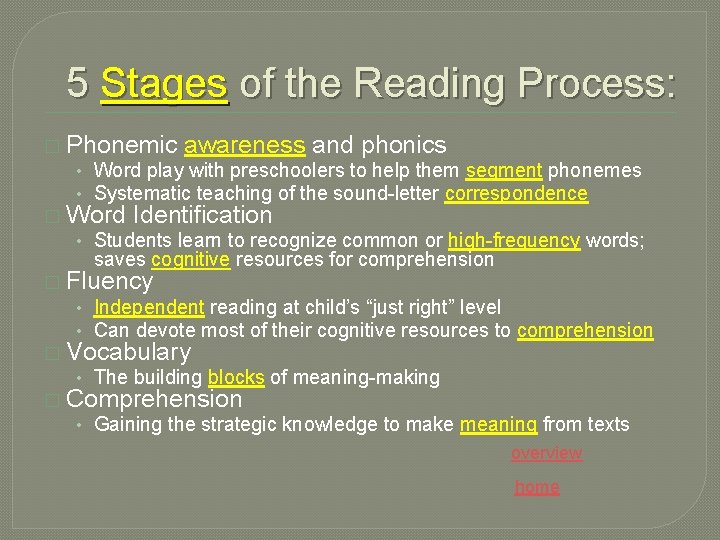
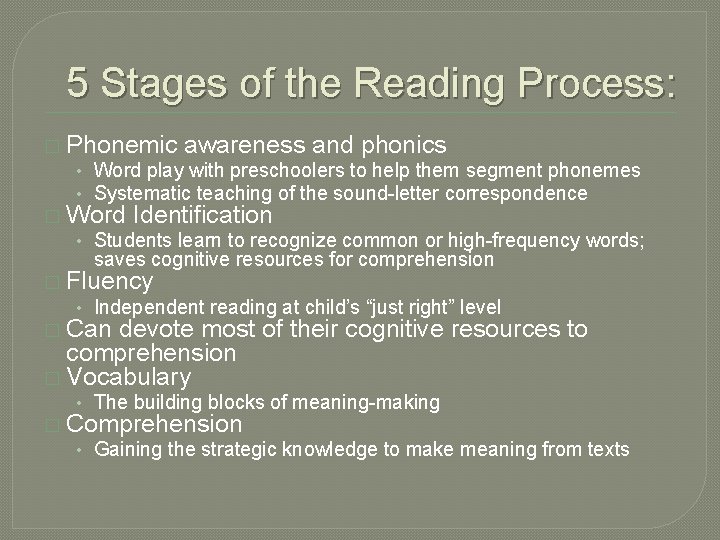
5 Stages of the Reading Process: � Phonemic awareness and phonics • Word play with preschoolers to help them segment phonemes • Systematic teaching of the sound-letter correspondence � Word Identification • Students learn to recognize common or high-frequency words; saves cognitive resources for comprehension � Fluency • Independent reading at child’s “just right” level • Can devote most of their cognitive resources to comprehension � Vocabulary • The building blocks of meaning-making � Comprehension • Gaining the strategic knowledge to make meaning from texts overview home
5 Stages of the Reading Process: � Phonemic awareness and phonics • Word play with preschoolers to help them segment phonemes • Systematic teaching of the sound-letter correspondence � Word Identification • Students learn to recognize common or high-frequency words; saves cognitive resources for comprehension � Fluency • Independent reading at child’s “just right” level � Can devote most of their cognitive resources comprehension � Vocabulary • The building blocks of meaning-making to � Comprehension • Gaining the strategic knowledge to make meaning from texts
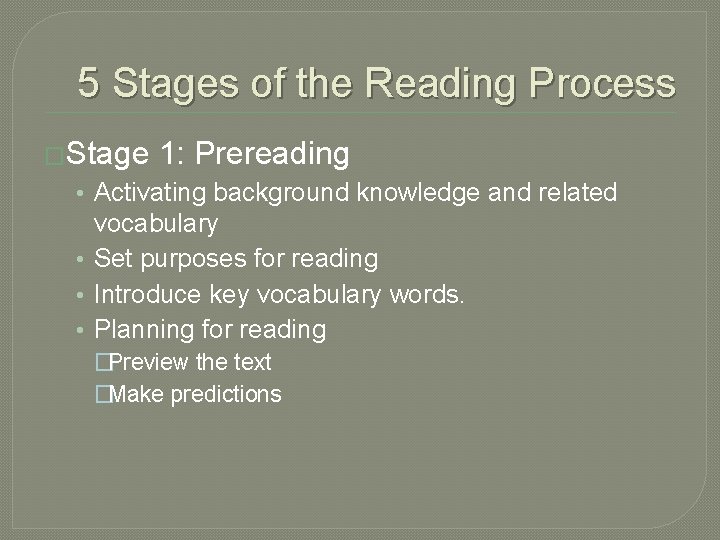
5 Stages of the Reading Process �Stage 1: Prereading • Activating background knowledge and related vocabulary • Set purposes for reading • Introduce key vocabulary words. • Planning for reading �Preview the text �Make predictions
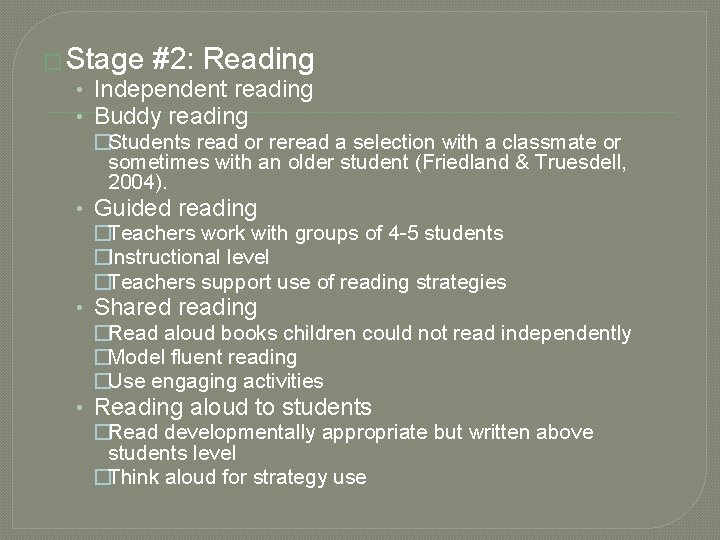
� Stage #2: Reading • Independent reading • Buddy reading �Students read or reread a selection with a classmate or sometimes with an older student (Friedland & Truesdell, 2004). • Guided reading �Teachers work with groups of 4 -5 students �Instructional level �Teachers support use of reading strategies • Shared reading �Read aloud books children could not read independently �Model fluent reading �Use engaging activities • Reading aloud to students �Read developmentally appropriate but written above students level �Think aloud for strategy use
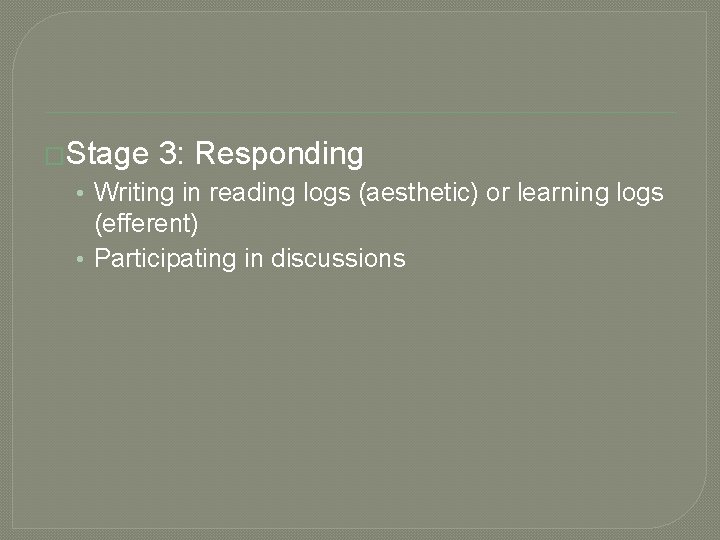
�Stage 3: Responding • Writing in reading logs (aesthetic) or learning logs (efferent) • Participating in discussions
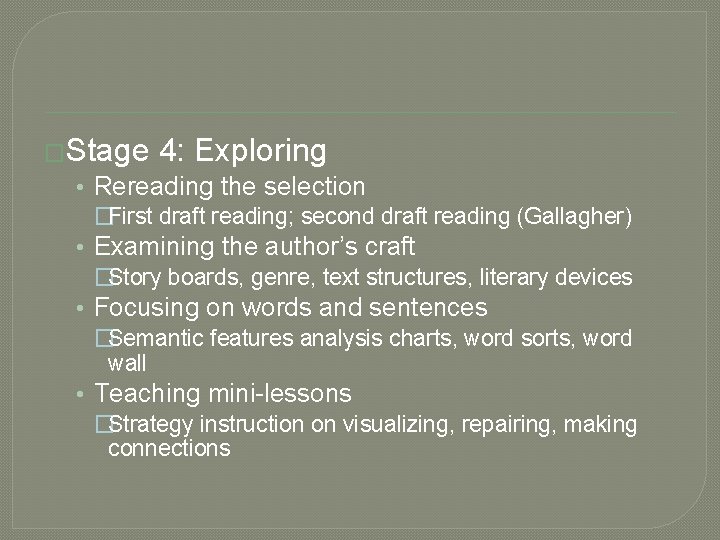
�Stage 4: Exploring • Rereading the selection �First draft reading; second draft reading (Gallagher) • Examining the author’s craft �Story boards, genre, text structures, literary devices • Focusing on words and sentences �Semantic features analysis charts, word sorts, word wall • Teaching mini-lessons �Strategy instruction on visualizing, repairing, making connections
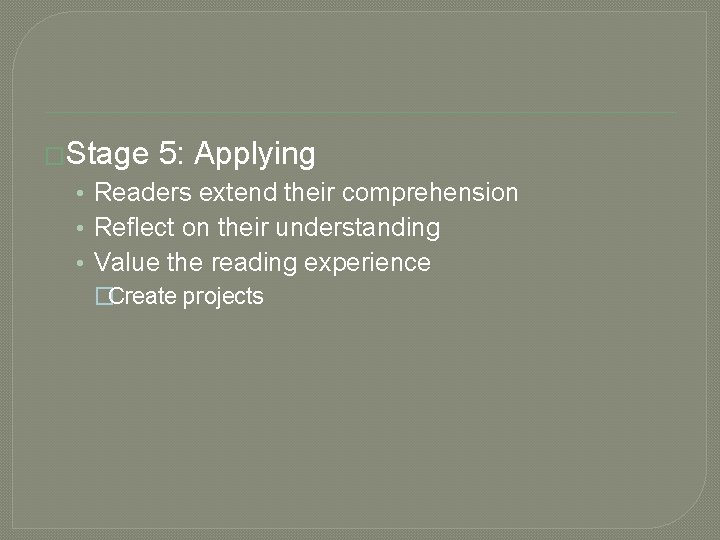
�Stage 5: Applying • Readers extend their comprehension • Reflect on their understanding • Value the reading experience �Create projects
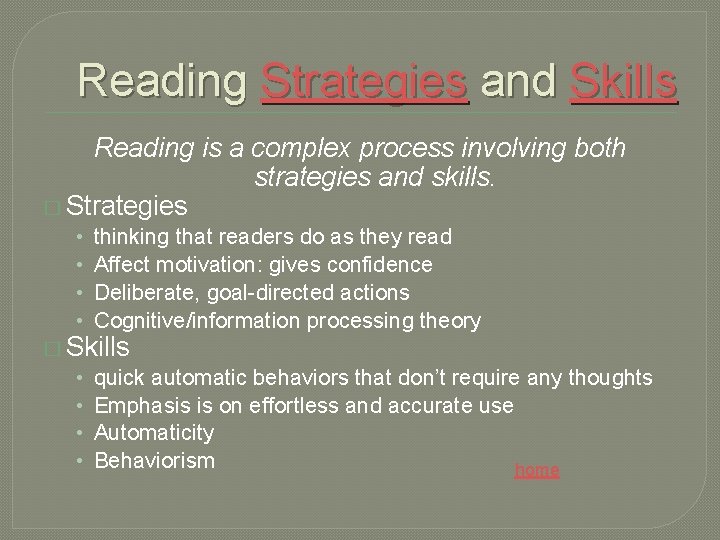
Reading Strategies and Skills Reading is a complex process involving both strategies and skills. � Strategies • • thinking that readers do as they read Affect motivation: gives confidence Deliberate, goal-directed actions Cognitive/information processing theory � Skills • quick automatic behaviors that don’t require any thoughts • Emphasis is on effortless and accurate use • Automaticity • Behaviorism home
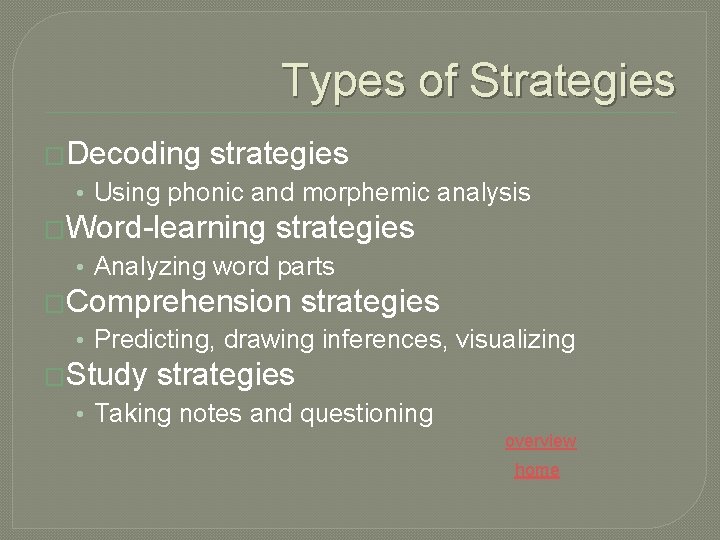
Types of Strategies �Decoding strategies • Using phonic and morphemic analysis �Word-learning strategies • Analyzing word parts �Comprehension strategies • Predicting, drawing inferences, visualizing �Study strategies • Taking notes and questioning overview home
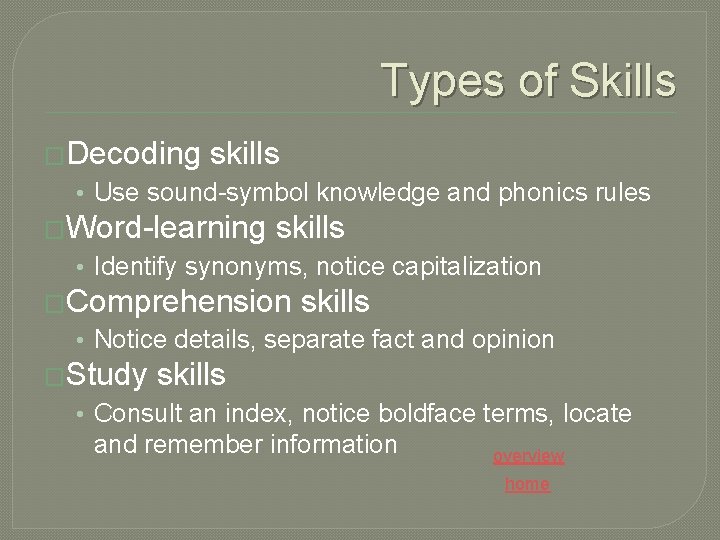
Types of Skills �Decoding skills • Use sound-symbol knowledge and phonics rules �Word-learning skills • Identify synonyms, notice capitalization �Comprehension skills • Notice details, separate fact and opinion �Study skills • Consult an index, notice boldface terms, locate and remember information overview home
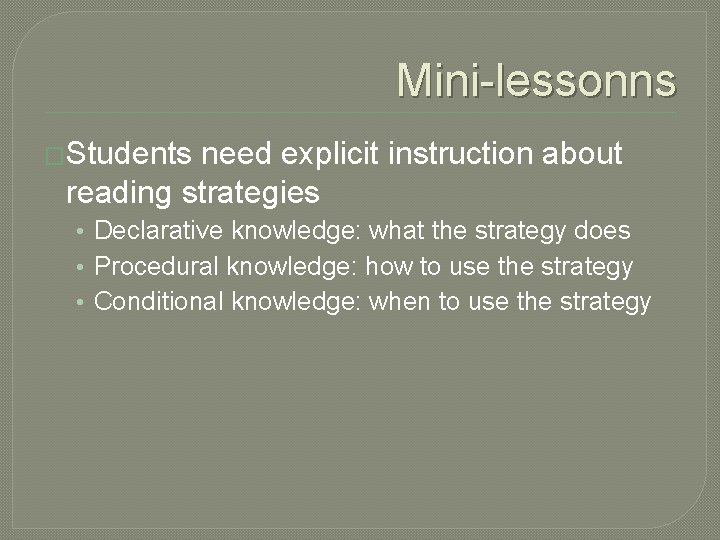
Mini-lessonns �Students need explicit instruction about reading strategies • Declarative knowledge: what the strategy does • Procedural knowledge: how to use the strategy • Conditional knowledge: when to use the strategy