
The CSIRO ASKAP Science Data Archive Progress and
- Slides: 23
The CSIRO ASKAP Science Data Archive Progress and Plans Jessica Chapman, CSIRO ASTRONOMY AND SPACE SCIENCE
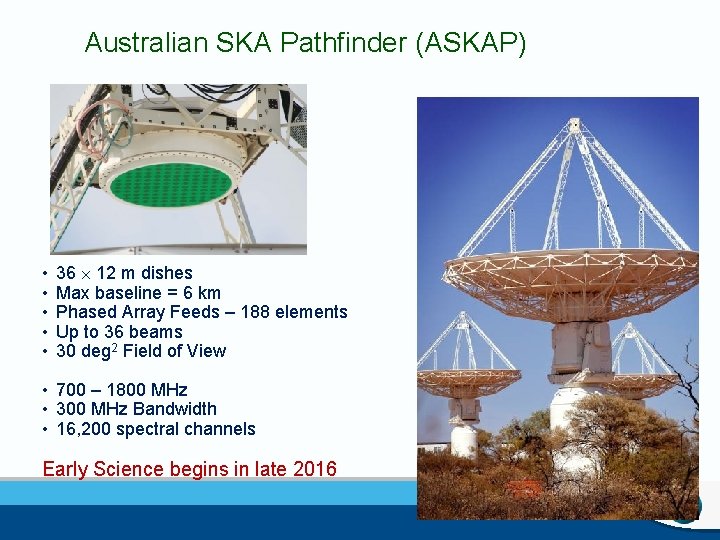
Australian SKA Pathfinder (ASKAP) • • • 36 12 m dishes Max baseline = 6 km Phased Array Feeds – 188 elements Up to 36 beams 30 deg 2 Field of View • 700 – 1800 MHz • 300 MHz Bandwidth • 16, 200 spectral channels Early Science begins in late 2016
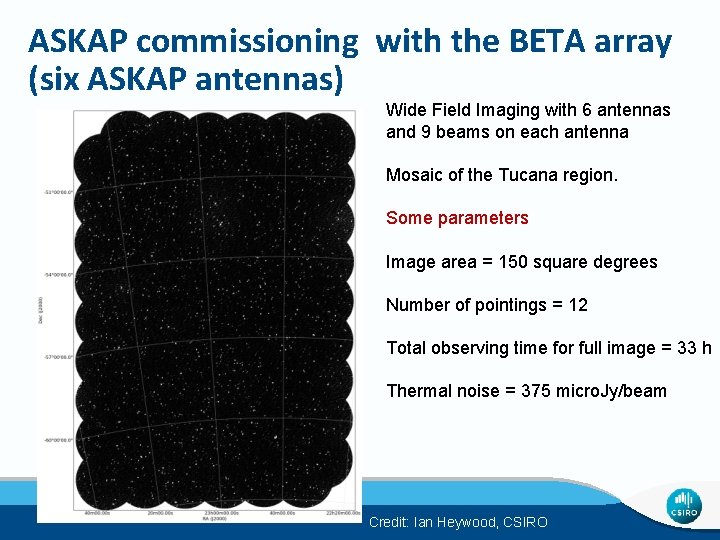
ASKAP commissioning with the BETA array (six ASKAP antennas) Wide Field Imaging with 6 antennas and 9 beams on each antenna Mosaic of the Tucana region. Some parameters Image area = 150 square degrees Number of pointings = 12 Total observing time for full image = 33 h Thermal noise = 375 micro. Jy/beam Credit: Ian Heywood, CSIRO
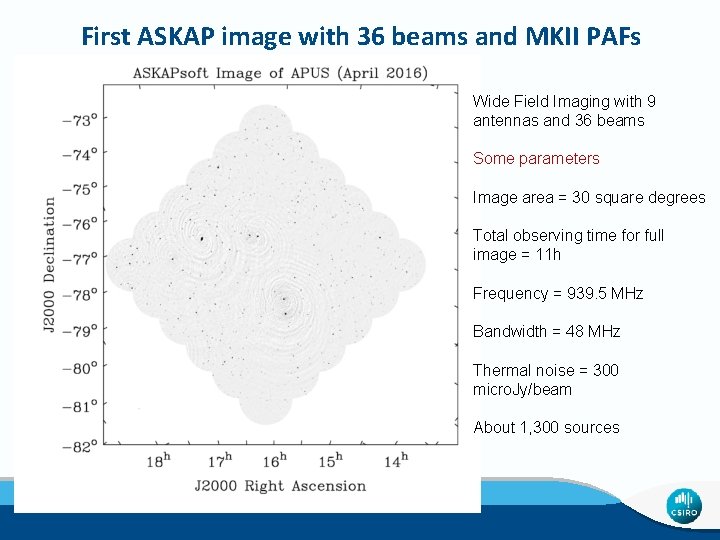
First ASKAP image with 36 beams and MKII PAFs Wide Field Imaging with 9 antennas and 36 beams Some parameters Image area = 30 square degrees Total observing time for full image = 11 h Frequency = 939. 5 MHz Bandwidth = 48 MHz Thermal noise = 300 micro. Jy/beam About 1, 300 sources
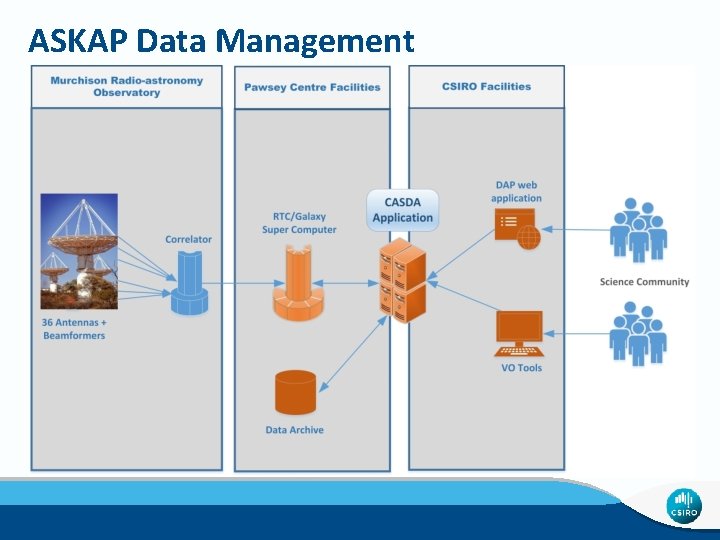
ASKAP Data Management
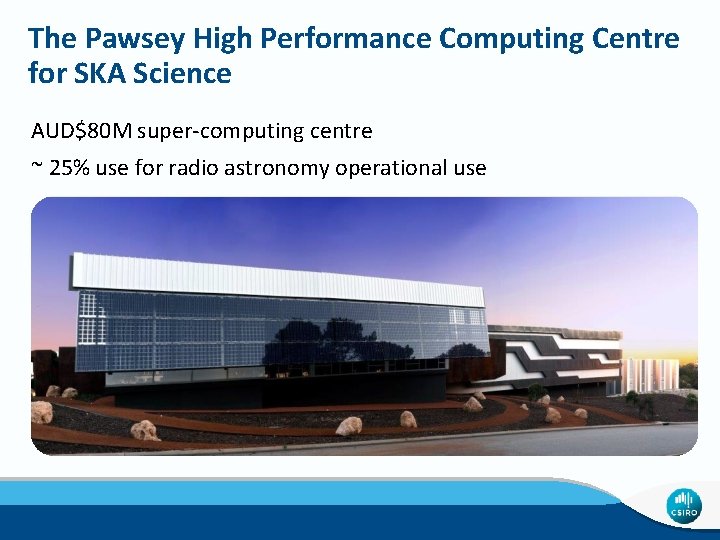
The Pawsey High Performance Computing Centre for SKA Science AUD$80 M super-computing centre ~ 25% use for radio astronomy operational use
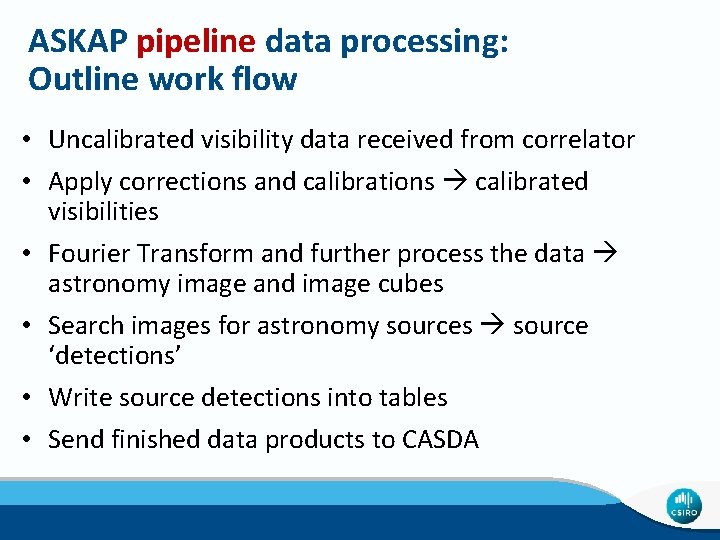
ASKAP pipeline data processing: Outline work flow • Uncalibrated visibility data received from correlator • Apply corrections and calibrations calibrated visibilities • Fourier Transform and further process the data astronomy image and image cubes • Search images for astronomy sources source ‘detections’ • Write source detections into tables • Send finished data products to CASDA
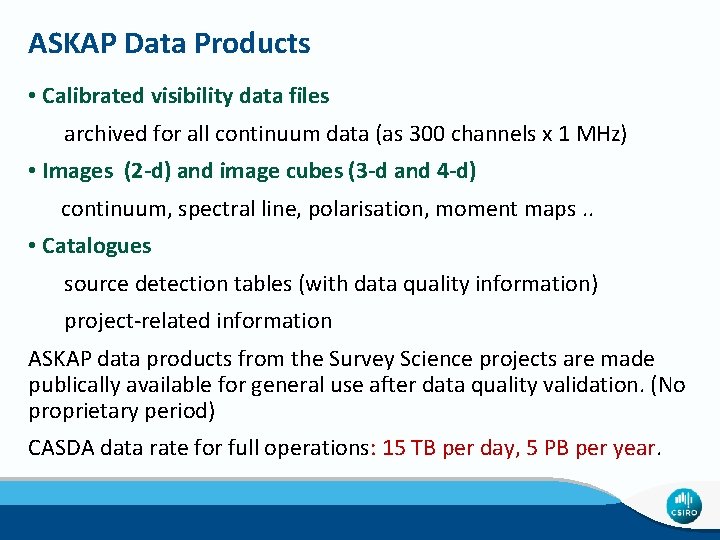
ASKAP Data Products • Calibrated visibility data files archived for all continuum data (as 300 channels x 1 MHz) • Images (2 -d) and image cubes (3 -d and 4 -d) continuum, spectral line, polarisation, moment maps. . • Catalogues source detection tables (with data quality information) project-related information ASKAP data products from the Survey Science projects are made publically available for general use after data quality validation. (No proprietary period) CASDA data rate for full operations: 15 TB per day, 5 PB per year.
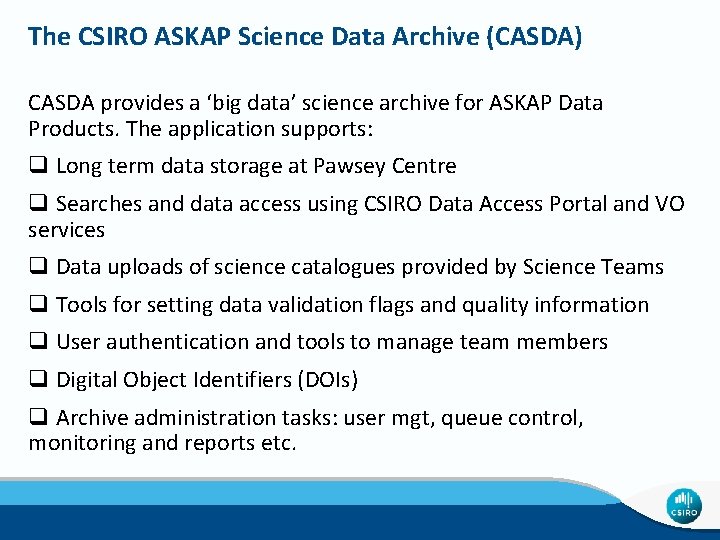
The CSIRO ASKAP Science Data Archive (CASDA) CASDA provides a ‘big data’ science archive for ASKAP Data Products. The application supports: q Long term data storage at Pawsey Centre q Searches and data access using CSIRO Data Access Portal and VO services q Data uploads of science catalogues provided by Science Teams q Tools for setting data validation flags and quality information q User authentication and tools to manage team members q Digital Object Identifiers (DOIs) q Archive administration tasks: user mgt, queue control, monitoring and reports etc.
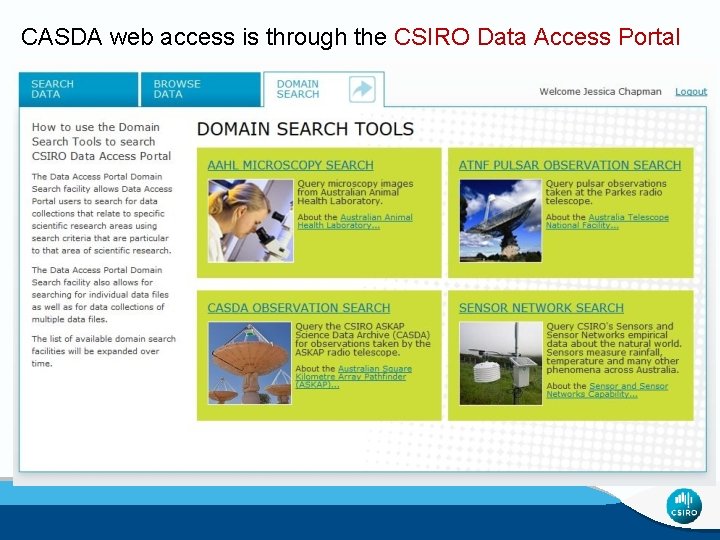
CASDA web access is through the CSIRO Data Access Portal
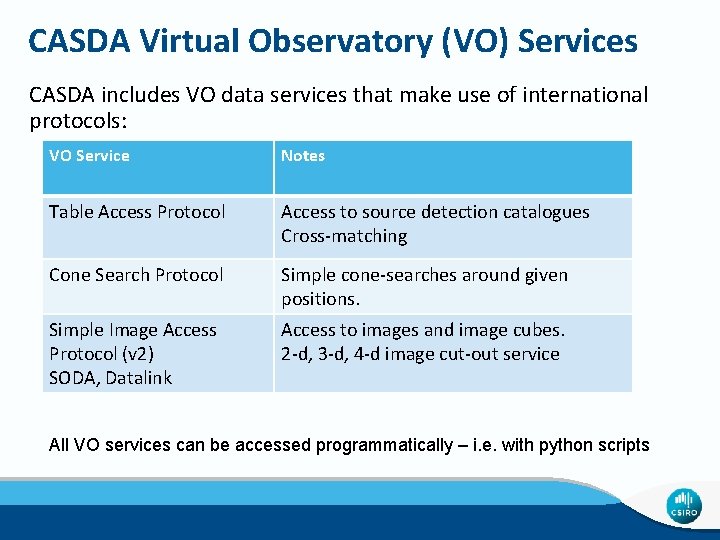
CASDA Virtual Observatory (VO) Services CASDA includes VO data services that make use of international protocols: VO Service Notes Table Access Protocol Access to source detection catalogues Cross-matching Cone Search Protocol Simple cone-searches around given positions. Simple Image Access Protocol (v 2) SODA, Datalink Access to images and image cubes. 2 -d, 3 -d, 4 -d image cut-out service All VO services can be accessed programmatically – i. e. with python scripts
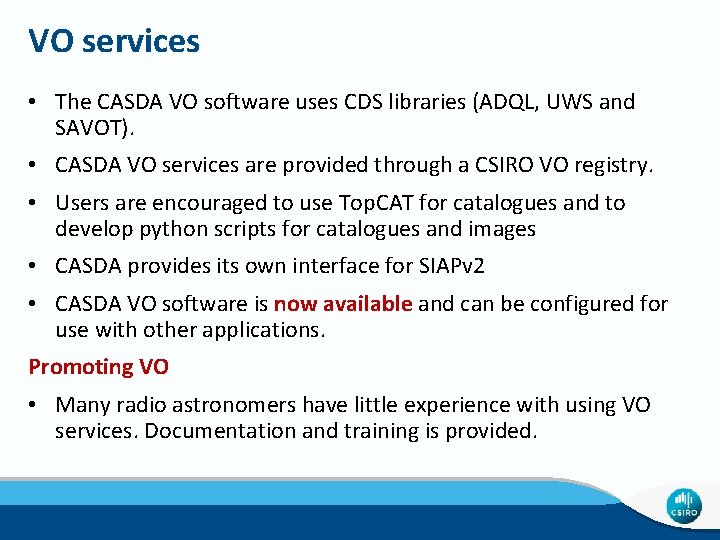
VO services • The CASDA VO software uses CDS libraries (ADQL, UWS and SAVOT). • CASDA VO services are provided through a CSIRO VO registry. • Users are encouraged to use Top. CAT for catalogues and to develop python scripts for catalogues and images • CASDA provides its own interface for SIAPv 2 • CASDA VO software is now available and can be configured for use with other applications. Promoting VO • Many radio astronomers have little experience with using VO services. Documentation and training is provided.
CASDA in Production First release (Version 1. 0 Nov 2015) : Key goal: Be ready for use with start of ASKAP Early Science and also: • Open access to science data products from BETA observations • Established three-tier service agreement • User support through helpdesk system • Provide user documentation, example python scripts and training sessions • VO TAP and cone searches and some early SIAPv 2 development
CASDA production v 1. 1 (Feb 2016) • Scripted access to large data files via VO protocols, including authenticated access • SIAP v 2: 3 -d image cube cut-outs including spatial, spectral and polarisation filtering • Provided example python scripts for producing bulk image cutouts based on a catalogue • Team member access to unvalidated (restricted) data products via VO protocols • Support for fast transfers within Pawsey Supercomputing Centre for users with Pawsey accounts • Team self-administration of project roles (e. g. allocation of validation rights for a project)
CASDA v 1. 2 (April 2016): Application Upgrades • Many small changes to improve usability, based on user feedback • Data Access Portal search form extended to handle multiple cone searches at a time • The search tools have improved handing for data products that are produced from more than one scheduling block. • Added information on (~40 different) image types and set up a CASDA ‘vocabulary’ for this. • SODA extended to include 4 D image cubes and additional features for obtaining cut outs from 2 D and 3 D images and cubes.
CASDA v 1. 2: Software Release April 2016 • Open release of CASDA VO tools application (with Do. I) through the CSIRO Data Access Portal. • Other major CASDA application software through github.
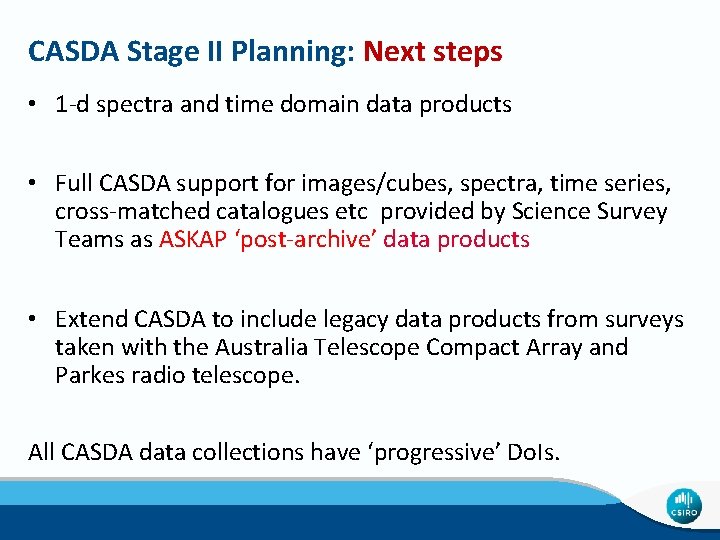
CASDA Stage II Planning: Next steps • 1 -d spectra and time domain data products • Full CASDA support for images/cubes, spectra, time series, cross-matched catalogues etc provided by Science Survey Teams as ASKAP ‘post-archive’ data products • Extend CASDA to include legacy data products from surveys taken with the Australia Telescope Compact Array and Parkes radio telescope. All CASDA data collections have ‘progressive’ Do. Is.
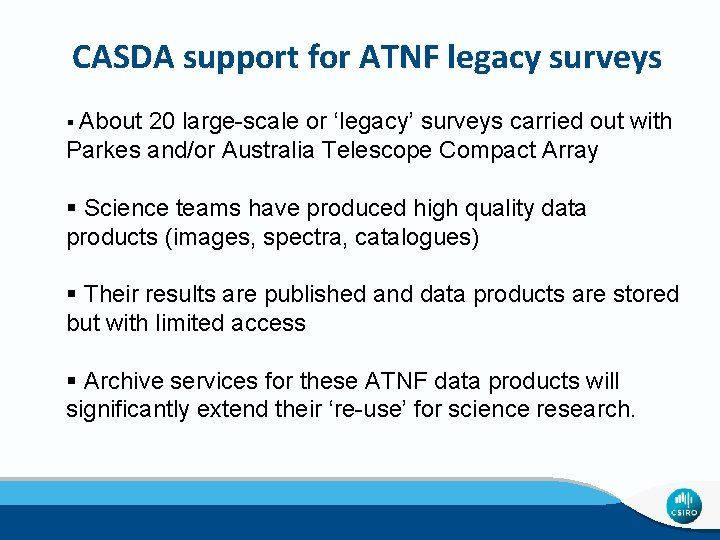
CASDA support for ATNF legacy surveys § About 20 large-scale or ‘legacy’ surveys carried out with Parkes and/or Australia Telescope Compact Array § Science teams have produced high quality data products (images, spectra, catalogues) § Their results are published and data products are stored but with limited access § Archive services for these ATNF data products will significantly extend their ‘re-use’ for science research.
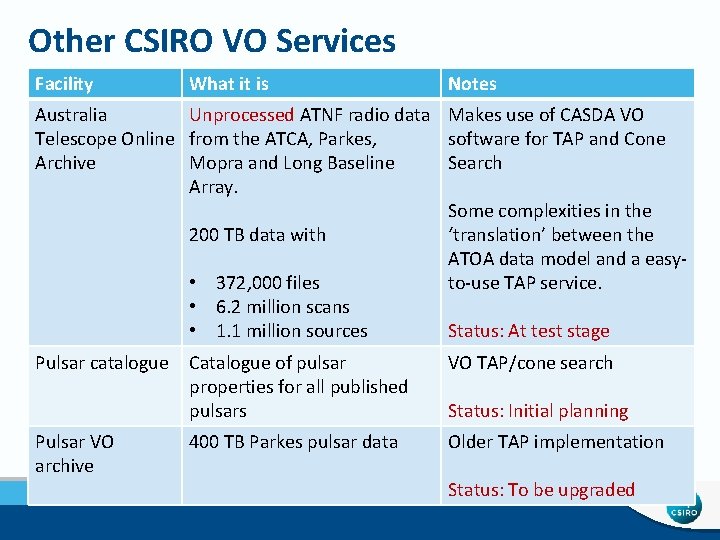
Other CSIRO VO Services Facility What it is Notes Australia Unprocessed ATNF radio data Makes use of CASDA VO Telescope Online from the ATCA, Parkes, software for TAP and Cone Archive Mopra and Long Baseline Search Array. Some complexities in the 200 TB data with ‘translation’ between the ATOA data model and a easy • 372, 000 files to-use TAP service. • 6. 2 million scans • 1. 1 million sources Status: At test stage Pulsar catalogue Pulsar VO archive Catalogue of pulsar properties for all published pulsars VO TAP/cone search 400 TB Parkes pulsar data Older TAP implementation Status: Initial planning Status: To be upgraded
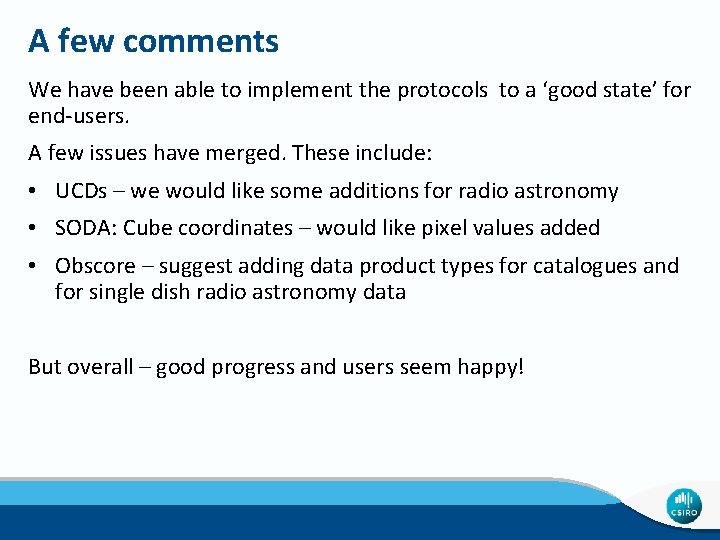
A few comments We have been able to implement the protocols to a ‘good state’ for end-users. A few issues have merged. These include: • UCDs – we would like some additions for radio astronomy • SODA: Cube coordinates – would like pixel values added • Obscore – suggest adding data product types for catalogues and for single dish radio astronomy data But overall – good progress and users seem happy!
To get started with using CASDA see the CASDA Users Guide www. atnf. csiro. au/observers/data/casdaguide. html
CASS Senior Data Scientist in Astrophysics Position available! If interested – please contact Jessica Chapman or Simon Johnston Jessica. Chapman@csiro. au Simon. Johnston@csiro. au
CSIRO Astronomy and Space Science Jessica Chapman Data Management Leader t +61 2 9372 4196 e Jessica. Chapman@csiro. au w atnf. csiro. au CSIRO ASTRONOMY AND SPACE SCIENCE