
The Critical Role of Dynamic Surface Tension of
- Slides: 1
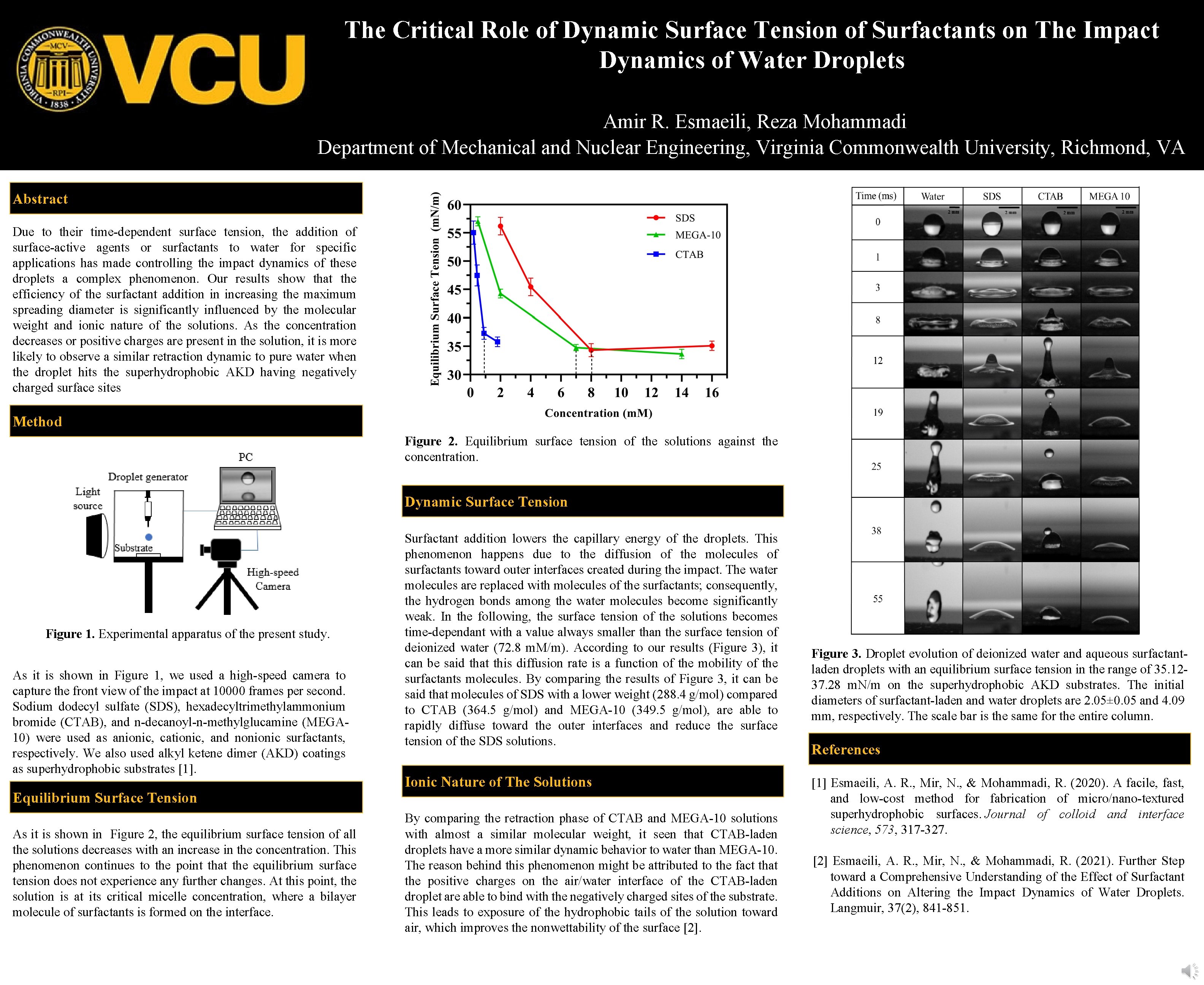
The Critical Role of Dynamic Surface Tension of Surfactants on The Impact Dynamics of Water Droplets Amir R. Esmaeili, Reza Mohammadi Department of Mechanical and Nuclear Engineering, Virginia Commonwealth University, Richmond, VA Abstract Due to their time-dependent surface tension, the addition of surface-active agents or surfactants to water for specific applications has made controlling the impact dynamics of these droplets a complex phenomenon. Our results show that the efficiency of the surfactant addition in increasing the maximum spreading diameter is significantly influenced by the molecular weight and ionic nature of the solutions. As the concentration decreases or positive charges are present in the solution, it is more likely to observe a similar retraction dynamic to pure water when the droplet hits the superhydrophobic AKD having negatively charged surface sites Method Figure 2. Equilibrium surface tension of the solutions against the concentration. Dynamic Surface Tension Figure 1. Experimental apparatus of the present study. As it is shown in Figure 1, we used a high-speed camera to capture the front view of the impact at 10000 frames per second. Sodium dodecyl sulfate (SDS), hexadecyltrimethylammonium bromide (CTAB), and n-decanoyl-n-methylglucamine (MEGA 10) were used as anionic, cationic, and nonionic surfactants, respectively. We also used alkyl ketene dimer (AKD) coatings as superhydrophobic substrates [1]. Equilibrium Surface Tension As it is shown in Figure 2, the equilibrium surface tension of all the solutions decreases with an increase in the concentration. This phenomenon continues to the point that the equilibrium surface tension does not experience any further changes. At this point, the solution is at its critical micelle concentration, where a bilayer molecule of surfactants is formed on the interface. Surfactant addition lowers the capillary energy of the droplets. This phenomenon happens due to the diffusion of the molecules of surfactants toward outer interfaces created during the impact. The water molecules are replaced with molecules of the surfactants; consequently, the hydrogen bonds among the water molecules become significantly weak. In the following, the surface tension of the solutions becomes time-dependant with a value always smaller than the surface tension of deionized water (72. 8 m. M/m). According to our results (Figure 3), it can be said that this diffusion rate is a function of the mobility of the surfactants molecules. By comparing the results of Figure 3, it can be said that molecules of SDS with a lower weight (288. 4 g/mol) compared to CTAB (364. 5 g/mol) and MEGA-10 (349. 5 g/mol), are able to rapidly diffuse toward the outer interfaces and reduce the surface tension of the SDS solutions. Ionic Nature of The Solutions By comparing the retraction phase of CTAB and MEGA-10 solutions with almost a similar molecular weight, it seen that CTAB-laden droplets have a more similar dynamic behavior to water than MEGA-10. The reason behind this phenomenon might be attributed to the fact that the positive charges on the air/water interface of the CTAB-laden droplet are able to bind with the negatively charged sites of the substrate. This leads to exposure of the hydrophobic tails of the solution toward air, which improves the nonwettability of the surface [2]. Figure 3. Droplet evolution of deionized water and aqueous surfactantladen droplets with an equilibrium surface tension in the range of 35. 1237. 28 m. N/m on the superhydrophobic AKD substrates. The initial diameters of surfactant-laden and water droplets are 2. 05± 0. 05 and 4. 09 mm, respectively. The scale bar is the same for the entire column. References [1] Esmaeili, A. R. , Mir, N. , & Mohammadi, R. (2020). A facile, fast, and low-cost method for fabrication of micro/nano-textured superhydrophobic surfaces. Journal of colloid and interface science, 573, 317 -327. [2] Esmaeili, A. R. , Mir, N. , & Mohammadi, R. (2021). Further Step toward a Comprehensive Understanding of the Effect of Surfactant Additions on Altering the Impact Dynamics of Water Droplets. Langmuir, 37(2), 841 -851.