
The Crime Scene Chapter 3 KendallHunt Publishing Company
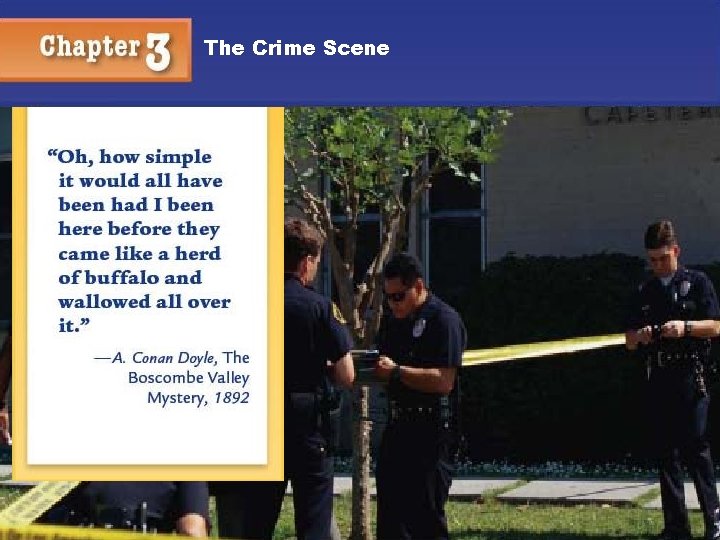
The Crime Scene Chapter 3 Kendall/Hunt Publishing Company 1 1
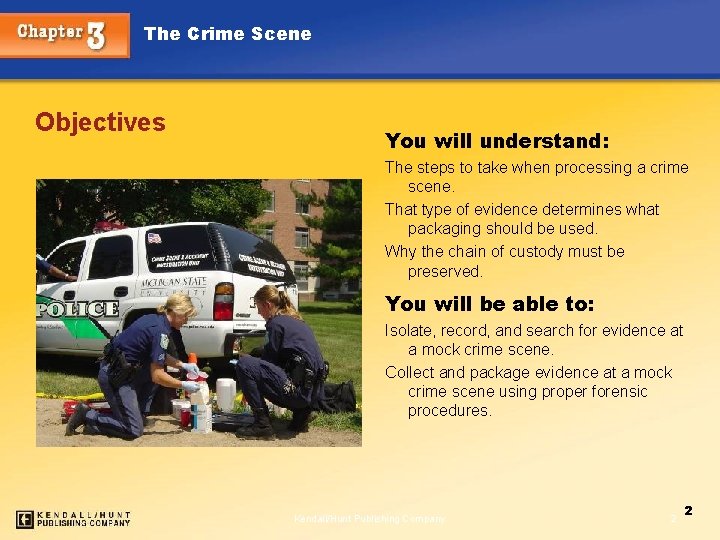
The Crime Scene Objectives You will understand: The steps to take when processing a crime scene. That type of evidence determines what packaging should be used. Why the chain of custody must be preserved. You will be able to: Isolate, record, and search for evidence at a mock crime scene. Collect and package evidence at a mock crime scene using proper forensic procedures. Chapter 3 Kendall/Hunt Publishing Company 2 2
The Crime Scene Corpus Delicti “Body of the Crime” Authorities must prove: That a crime occurred That the person charged with the crime was responsible for the crime Top reasons for committing a crime Money Revenge Emotion—love, hate, anger Source of evidence Body Suspect(s) Primary and/or secondary crime scene Vocabulary Term Modus Operandi (MO) – the characteristic method of operation of a criminal. Chapter 3 Kendall/Hunt Publishing Company 3 3
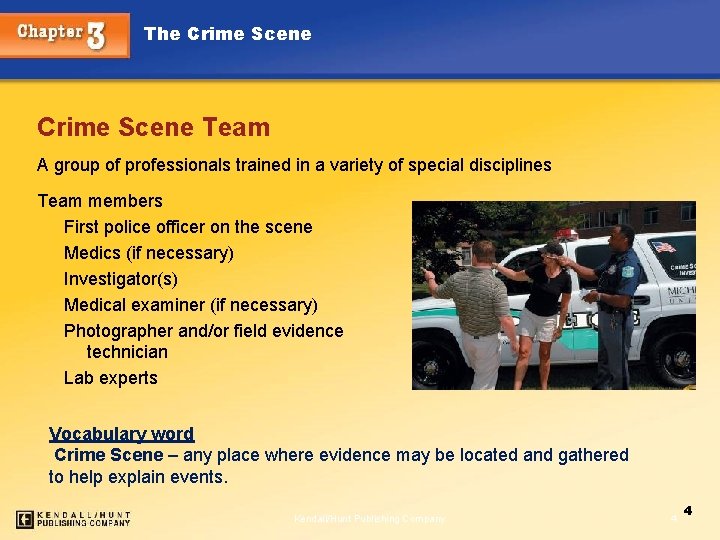
The Crime Scene Team A group of professionals trained in a variety of special disciplines Team members First police officer on the scene Medics (if necessary) Investigator(s) Medical examiner (if necessary) Photographer and/or field evidence technician Lab experts Vocabulary word Crime Scene – any place where evidence may be located and gathered to help explain events. Chapter 3 Kendall/Hunt Publishing Company 4 4
The Crime Scene Investigation Based on the scientific method, the Locard Exchange Principle, logic, and forensic techniques Involves: Recognition—scene survey, documentation, collection Identification—classification of evidence Individualization—comparison testing, evaluation, and interpretation Reconstruction—sequencing events, reporting, and presenting Chapter 3 Kendall/Hunt Publishing Company 5 5
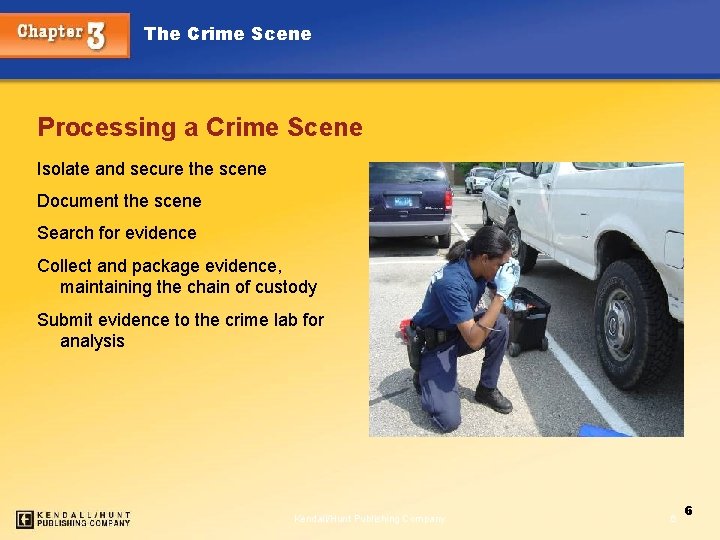
The Crime Scene Processing a Crime Scene Isolate and secure the scene Document the scene Search for evidence Collect and package evidence, maintaining the chain of custody Submit evidence to the crime lab for analysis Chapter 3 Kendall/Hunt Publishing Company 6 6
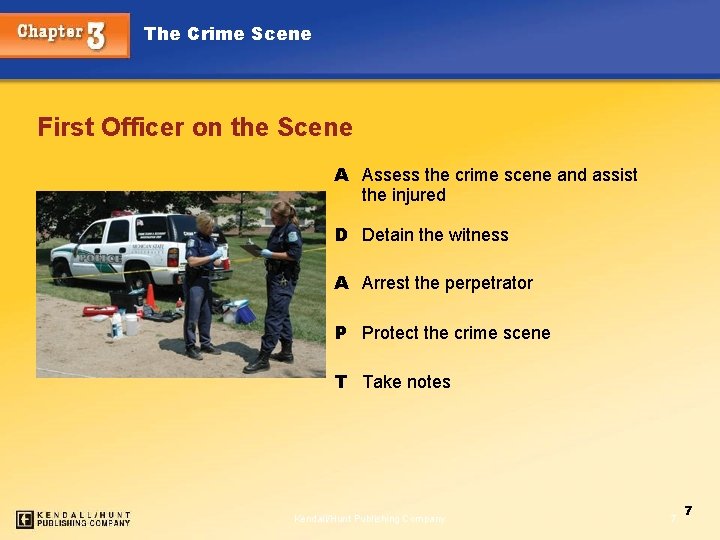
The Crime Scene First Officer on the Scene A Assess the crime scene and assist the injured D Detain the witness A Arrest the perpetrator P Protect the crime scene T Take notes Chapter 3 Kendall/Hunt Publishing Company 7 7
The Crime Scene Survey Walk-through—performed by the crime scene investigator, the first officer, and sometimes the lead detective Purpose: Mentally prepare a reconstruction theory Note any transient or conditional evidence that could change over time Note environmental and weather conditions Note points of entry or exit, as well as paths of travel within the crime scene Record initial observations of who, what, where, when, and how Identify special needs within the crime scene for personnel, precautions, or equipment and notify superior officers or other agencies Chapter 3 Kendall/Hunt Publishing Company 8 8
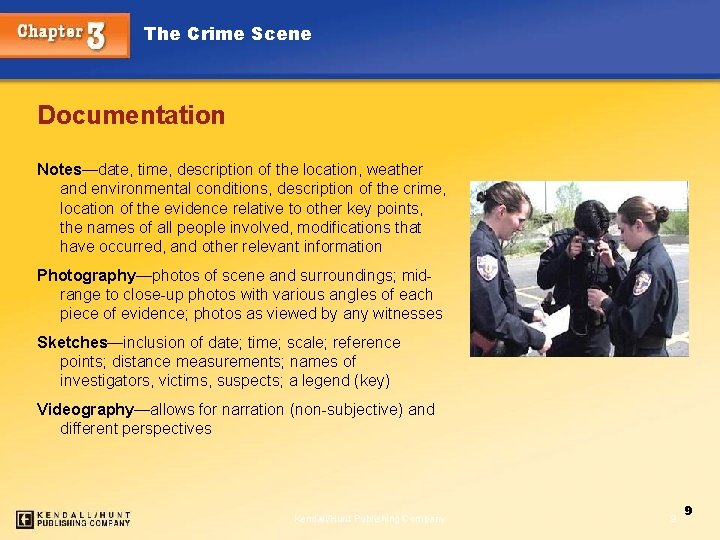
The Crime Scene Documentation Notes—date, time, description of the location, weather and environmental conditions, description of the crime, location of the evidence relative to other key points, the names of all people involved, modifications that have occurred, and other relevant information Photography—photos of scene and surroundings; midrange to close-up photos with various angles of each piece of evidence; photos as viewed by any witnesses Sketches—inclusion of date; time; scale; reference points; distance measurements; names of investigators, victims, suspects; a legend (key) Videography—allows for narration (non-subjective) and different perspectives Chapter 3 Kendall/Hunt Publishing Company 9 9
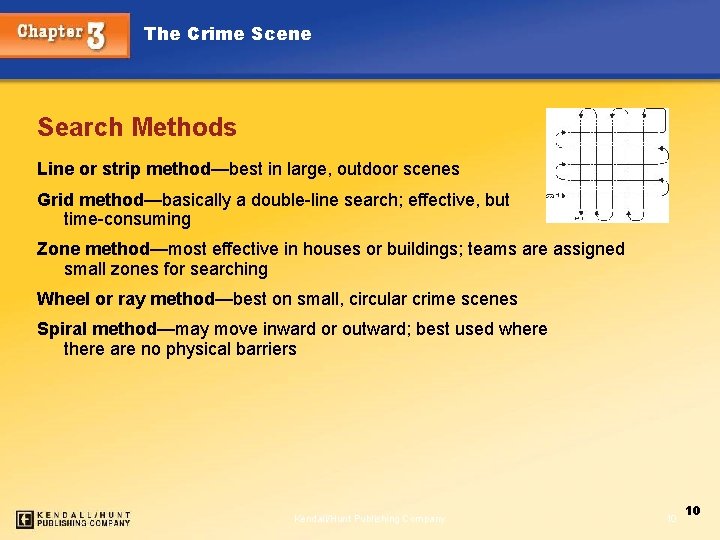
The Crime Scene Search Methods Line or strip method—best in large, outdoor scenes Grid method—basically a double-line search; effective, but time-consuming Zone method—most effective in houses or buildings; teams are assigned small zones for searching Wheel or ray method—best on small, circular crime scenes Spiral method—may move inward or outward; best used where there are no physical barriers Chapter 3 Kendall/Hunt Publishing Company 10 10
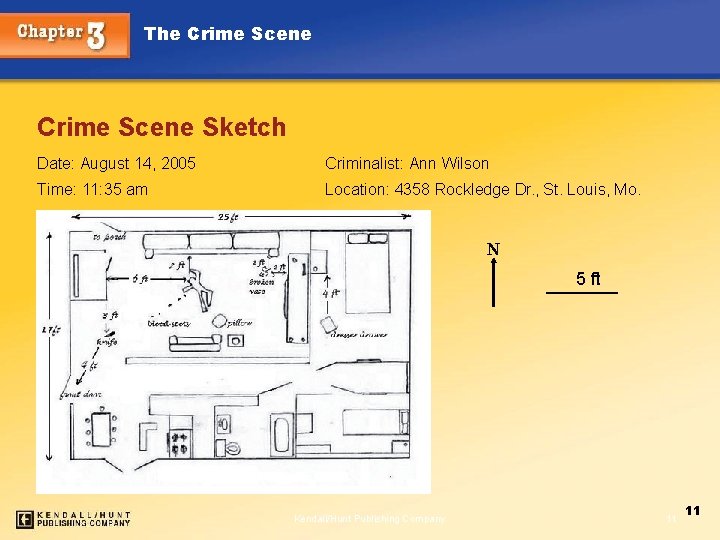
The Crime Scene Sketch Date: August 14, 2005 Criminalist: Ann Wilson Time: 11: 35 am Location: 4358 Rockledge Dr. , St. Louis, Mo. N 5 ft Chapter 3 Kendall/Hunt Publishing Company 11 11
The Crime Scene Collecting and Packaging Evidence One individual should be designated as the evidence collector to ensure that the evidence is collected, packaged, marked, sealed, and preserved in a consistent manner, maintaining the chain of custody. Each item must be placed in a separate container, sealed, and labeled. The most fragile evidence is collected and packaged first. Different types of evidence require specific or special collection and packaging techniques. The body is the property of the coroner or medical examiner; collection of evidence on the body is done by that department. Chapter 3 Kendall/Hunt Publishing Company 12 12
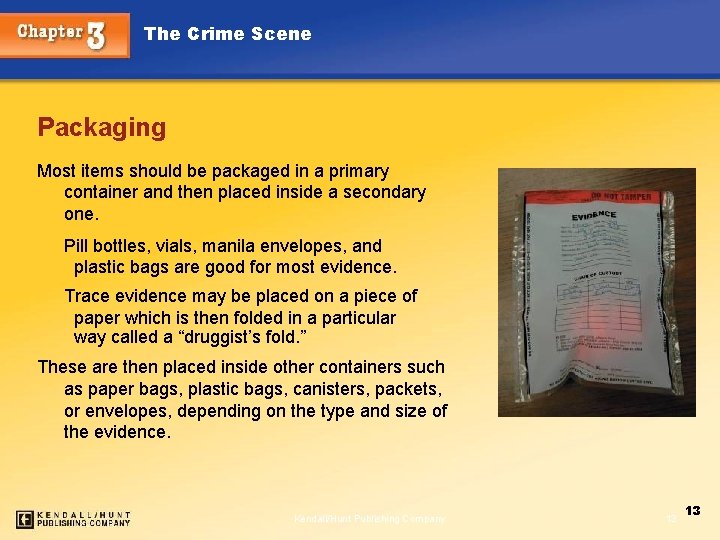
The Crime Scene Packaging Most items should be packaged in a primary container and then placed inside a secondary one. Pill bottles, vials, manila envelopes, and plastic bags are good for most evidence. Trace evidence may be placed on a piece of paper which is then folded in a particular way called a “druggist’s fold. ” These are then placed inside other containers such as paper bags, plastic bags, canisters, packets, or envelopes, depending on the type and size of the evidence. Chapter 3 Kendall/Hunt Publishing Company 13 13
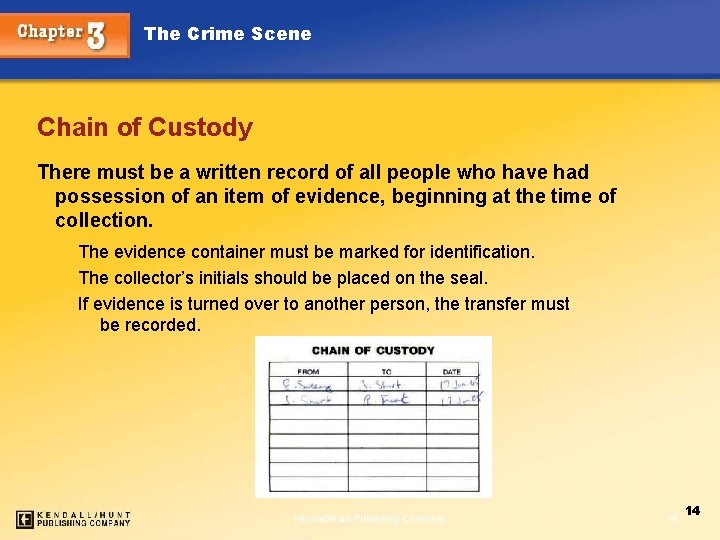
The Crime Scene Chain of Custody There must be a written record of all people who have had possession of an item of evidence, beginning at the time of collection. The evidence container must be marked for identification. The collector’s initials should be placed on the seal. If evidence is turned over to another person, the transfer must be recorded. Chapter 3 Kendall/Hunt Publishing Company 14 14
The Crime Scene Reconstruction Stages Data collection Hypothesis formation Examination, testing, and analysis Determination of the significance of the evidence Theory formulation Chapter 3 Kendall/Hunt Publishing Company 15 15
The Crime Scene Investigators “The wise forensic investigator will always remember that he must bring all of his life experiences and logic to find the truth. This means common sense, informed intuition, and the courage to see things as they are. Then he must speak honestly about what it adds up to. ” —Dr. Henry Lee Chief Emeritus for Scientific Services and the former Commissioner of Public Safety for the State of Connecticut Chapter 3 Kendall/Hunt Publishing Company 16 16
The Crime Scene The Medical Examiner and the Coroner A medical examiner is a medical doctor, usually a pathologist, and is appointed by the governing body of the area. There are 400 forensic pathologists throughout the U. S. A coroner is an elected official who usually has no special medical training. In four states, the coroner is a medical doctor. Chapter 3 Kendall/Hunt Publishing Company 17 17
The Crime Scene Medical Examiner’s Responsibilities Identify the deceased Establish the time and date of death Determine a medical cause of death (the injury or disease that resulted in the person dying) Determine the mechanism of death (the physiological reason that the person died) Classify the manner of death Natural Accidental Suicide Homicide Undetermined Notify the next of kin Chapter 3 Kendall/Hunt Publishing Company 18 18
The Crime Scene The Corpse “The way I see it, being dead is not terribly far off from being on a cruise ship. Most of your time is spent lying on your back. The brain has shut down. The flesh begins to soften. Nothing much new happens, and nothing is expected of you. ” —Mary Roach, Stiff, W. W. Norton & Company, 2003 Chapter 3 Kendall/Hunt Publishing Company 19 19
The Crime Scene People in the News Dr. Michael M. Baden is a renowned pathologist and was the Chief Medical Examiner in New York City and for Suffolk County. Dr. Baden was on the panel that investigated the assassinations of president John F. Kennedy and Dr. Martin Luther King, Jr. He has been involved as an expert in forensic pathology in many cases of international interest, including: The remains of Tsar Nicholas of Russia and his family The Claus von Bülow murder trial Expert witness for the defense in the O. J. Simpson trial Reautopsy of Medgar Evers, civil rights leader Reexamination of the Lindbergh kidnapping and murder Autopsies of the victims of TWA Flight 800 Dr. Baden is the host of HBO’s Autopsy series and is featured on many of the crime talk shows. http: //www. youtube. com/watch? v=Qx. BOe. Mv 2 cms Chapter 3 Kendall/Hunt Publishing Company 20 20
The Crime Scene More Information For additional information on crime scene investigation, check out tru. TV’s Crime Library: www. crimelibrary. com/criminal_mind/forensics/crimescene/5. html On Michael Baden and the autopsy: www. crimelibrary. com/criminal_mind/forensics/autopsy/1. html Chapter 3 Kendall/Hunt Publishing Company 21 21
- Slides: 21